


She Called My Mother Trash in Front of the Elite—Then the Doors Opened and the Whole Room Learned Who She Really Was
The chandelier above us looked less like decoration and more like a threat.
It hung over the ballroom of the Hamptons estate like a glittering beast made of glass and vanity, every crystal catching the light and throwing it across the marble floor in sharp, expensive fragments. I stood beneath it in a black tuxedo that had been tailored within an inch of its life, surrounded by two hundred people who wore wealth so effortlessly it seemed stitched into their skin. Men held whiskey older than some of the interns at my company. Women smiled with lacquered grace, their wrists lit by diamonds that could have paid off entire neighborhoods.
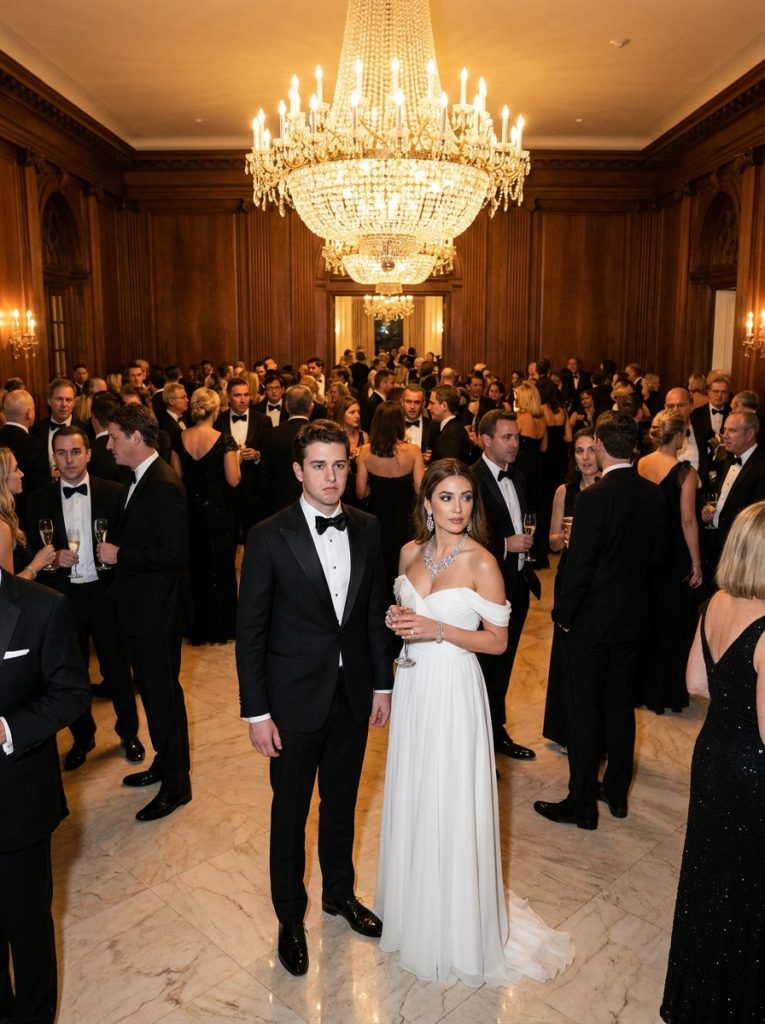
This was the world Chloe had always wanted.
Not money by itself. Not comfort. Not security. Worship. Access. A seat at tables where people didn’t just spend money—they decided where the money in the world was allowed to go.
I had never belonged in places like this. I was a software engineer from a cramped childhood home, a kid raised on discount cereal, secondhand textbooks, and a mother who could make a bag of groceries last a week through sheer willpower. My life had changed because I built something real. A machine-learning architecture so efficient it turned heads in Silicon Valley before I was old enough to stop feeling like an impostor in a blazer. I sold my startup, took the buyout, signed more documents than I thought existed in the English language, and suddenly everyone who had once overlooked me saw a different kind of man.
Not Julian Davis the quiet coder.
Julian Davis the acquisition.
“Darling, you’re drifting again.”
Chloe slid to my side like perfume taking shape. She looked flawless, impossibly so. Her white gown clung to her body with the precise confidence of something custom-made to be photographed. Her blonde hair fell in polished waves over one shoulder. Even her smile had a curated quality to it, practiced until it landed at the exact intersection of warmth and superiority.
“I’m here,” I said, forcing a smile.
“For now,” she teased, though her eyes had already moved past me to scan the room. She never stopped scanning. “Tonight matters, Julian. The right people are here. Richard Vance came. Three members of the acquisition board came. Arthur Sterling is in the north alcove, and you know he never appears unless he smells a future advantage. This is the night everyone stops seeing you as the lucky founder and starts seeing us as permanent.”
Us.
She said it like a merger already approved.
I looked around the room again. It was all gleaming surfaces and hidden calculations. A string quartet played softly in one corner. Waiters moved in precise lines with trays of champagne flutes. Laughter rose and faded in expensive bursts. Chloe squeezed my arm, but even that gesture felt strategic, like a signal to the room that I had been fully integrated into her version of the future.
Then her fingers tightened.
Not affection. Alarm.
I followed her stare toward the front entrance, where the massive oak doors had just opened.
My heart rose into my throat, then softened all at once.
My mother had arrived.
Eleanor Davis sat in her old steel wheelchair just inside the foyer, one hand resting lightly in her lap. She looked tiny against the gilded architecture of the estate, but to me she was the only thing in the room that felt solid. She wore the same navy dress she saved for special occasions and the gray hand-knit cardigan she’d had for years. Her silver hair was pulled back into a simple bun. No jewels. No designer label. No effort to mimic the room.
Just my mother, exactly as she was.
For one beautiful second, none of the rest of it mattered.
“Mom,” I said, already moving toward her.
Chloe’s hand shot out and locked around my wrist.
“Julian,” she whispered, and there was poison in it. “What is she doing here?”
I turned to her, thinking maybe I had misheard.
“It’s our engagement party,” I said. “I invited her.”
“You told me she wasn’t coming.”
“I told you she wasn’t sure if she could make the drive.”
Chloe leaned closer, smile frozen in place for anyone watching from a distance. “Look at her.”
The words came out sharp and low.
I stared at Chloe, waiting for her to hear herself and stop.
She didn’t.
“She looks like she wandered in from the street,” Chloe hissed. “This is black tie. The CEO of your parent company is twenty feet away. Half the people in this room judge weakness for sport, and you want them looking at her?”
Her.
Not your mother. Not Eleanor. Her.
Something cold shifted in my chest.
“She is my mother,” I said.
Chloe’s jaw hardened. “And tonight is not the night to parade that.”
That.
I pulled my arm free so abruptly her nails scraped my skin.
When I got to my mother, I dropped to one knee beside her chair, and the scent of lavender soap and peppermint reached me instantly. That smell took me back through every year at once—to fevers, broken school science projects, math homework at scratched kitchen tables, cheap Christmases that somehow still felt full.
“Look at you,” she said softly, cupping my cheek. “Handsome enough to make a mother forget every sleepless night that boy gave her.”
I laughed, and it came out shaky. “You made it.”
“Of course I made it. My son gets engaged once. I wasn’t missing that unless death itself rolled up first.”
“Are you in pain?”
“My back hates me, my knees hate me, and I suspect that drive took three years off my life,” she said dryly. “But I’m here.”
I took her hand and kissed it. “I’m glad you’re here.”
She glanced past me toward the ballroom, her expression quiet and unreadable. “You built quite a world.”
“No,” I said before I could stop myself. “Not me. This part… this is mostly Chloe.”
My mother gave the room another measured look, and one corner of her mouth lifted faintly. “Very shiny.”
I was about to wheel her farther inside when the air around us changed.
Chloe was coming toward us, and the look on her face was no longer carefully managed. It was elegant rage trying to wear a silk glove. Two private security guards followed a few steps behind her, uncertain already, as if they could sense disaster before they understood it.
“Eleanor,” Chloe said.
Not hello. Not welcome. Just the name, stripped down to accusation.
“Hello, Chloe,” my mother answered, calm as still water. “You’ve decorated beautifully.”
Chloe ignored the comment. “This is a private event. A formal one. You should have called before showing up.”
I stood. “That’s enough.”
Chloe lifted a hand toward my mother’s chair, toward the cardigan, toward the visible wear of her life. “This isn’t appropriate.”
“Back off,” I said, louder.
But Chloe was already beyond caution. I could see it now. The champagne. The pressure of the room. The months, maybe years, of resentment she had been swallowing whenever my background came too close to the surface. Tonight, in front of the people she wanted to impress most, she had finally decided shame was better than association.
She turned to the guards.
“There’s been a mistake,” she said crisply. “Escort this woman out through the service exit and call her a cab.”
The guards hesitated.
The nearest cluster of guests noticed. Heads turned. Conversations thinned. The room leaned toward us with the delicious hunger of rich people who had just sensed blood in the water.
I stepped forward. “No one is touching her.”
“Julian,” Chloe snapped, “stop making this worse.”
“Worse?” My voice rose. “You’re trying to throw my mother out of my engagement party.”
“She doesn’t belong here.”
The sentence landed so hard the air around us seemed to recoil.
A few guests pretended not to listen. Most stopped pretending.
My mother said nothing. She only sat there, hands folded, watching.
I looked at Chloe and saw, with terrifying clarity, that nothing about this moment was impulsive. The contempt in her had been there all along. It had just never had an audience large enough to justify revealing itself.
“Say one more thing about her,” I said, each word clipped and cold, “and this engagement ends tonight.”
For the briefest instant, fear flashed across Chloe’s face.
Then pride crushed it.
She took one step closer to my mother.
“You want the truth?” Chloe said, voice rising. “Fine. Look around. We finally made it into rooms that matter, Julian. We finally got away from the cheap, humiliating parts of your life, and she rolls in here in that sweater, smelling like a thrift store, making us look like charity.”
The gasp around us was instant.
That was the moment the room stopped being a party and became a stage for judgment.
I barely had time to move.
Chloe lunged.
Her hand flashed through the air and cracked across my mother’s face.
The sound was obscene. Sharp. Clean. Final.
My mother’s head snapped sideways. Her bun loosened and silver hair slipped free. A red welt bloomed across her cheek where Chloe’s ring had struck skin.
The quartet stopped mid-note.
Every voice in the room died.
For one second, maybe two, the entire estate held its breath.
Then Chloe, flushed with rage and humiliation and the certainty that power belonged to whoever acted without shame, pointed at my mother and screamed, “Get this smelly trash out of my sight!”
I don’t remember crossing the distance between us.
I remember my hands on Chloe’s shoulders. I remember shoving her back hard enough that she crashed into a waiter carrying champagne. Glass shattered over the marble. She fell in a spray of alcohol and crystal, her white dress soaking gold as guests stumbled out of the way.
“Don’t you ever touch her!” I roared.
I dropped beside my mother, my pulse pounding so hard it blurred my vision. “Mom—Mom, look at me. Are you hurt?”
She turned back slowly. A thin line of blood touched her lower lip. She lifted her fingers, wiped it away, adjusted her glasses, and looked at me with such eerie steadiness that my panic faltered.
“I’m fine, Julian.”
That alone would have been strange enough.
But she didn’t look shaken. She didn’t look insulted. She didn’t even look angry in the way I expected.
She looked patient.
Chloe staggered upright in the wreckage of glass, half-sobbing, half-snarling.
“You assaulted me!” she screamed at me. “Call the police! Somebody call the police! This cripple and her psycho son attacked me!”
My mother turned her head slightly toward her.
“They’re already here, dear,” she said.
Nobody understood what she meant.
Then the front driveway exploded with sound.
Heavy engines. Boots. A shouted command from outside. The oak doors burst open so violently they slammed against the walls, and red and blue lights poured into the foyer, ripping the gold warmth out of the mansion and replacing it with something hard and merciless.
“FEDERAL MARSHALS! NOBODY MOVE!”
The room shattered.
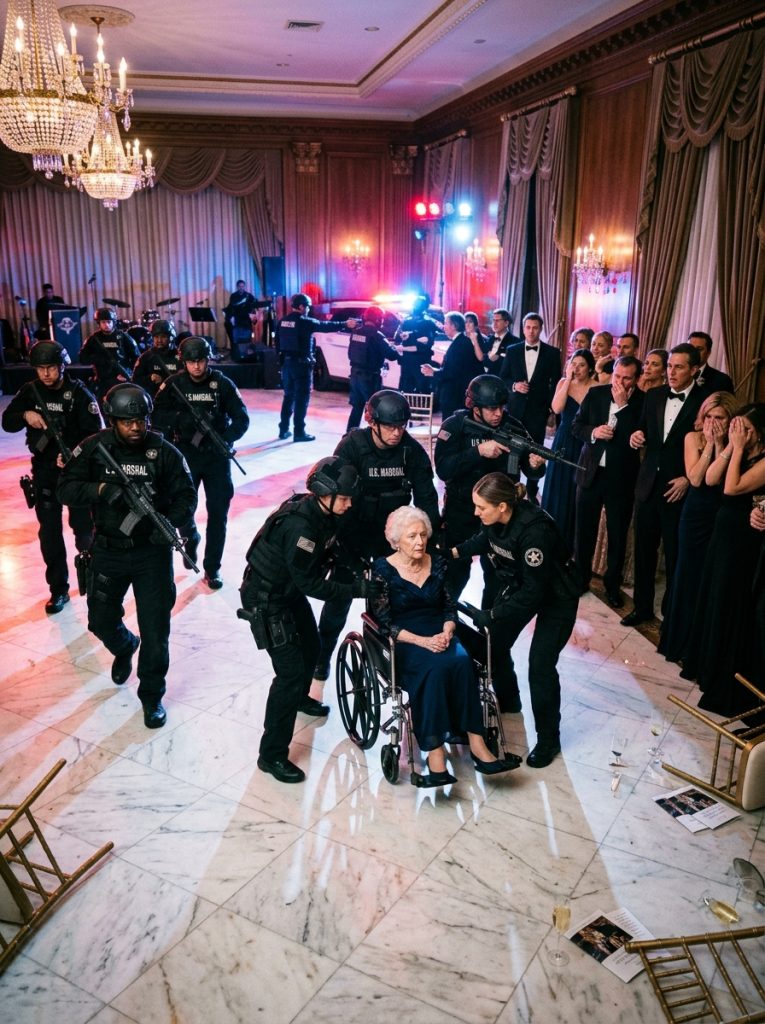
Men and women in black tactical gear stormed the estate in synchronized formation, rifles up, flashlights cutting through the ballroom. The socialites screamed. Billionaires flattened themselves against walls. A hedge fund manager actually dropped to the floor and put his hands over his head. Someone cried. Someone else started praying. Crystal trembled on tables. Waiters abandoned trays and fled into corners.
I wrapped an arm around my mother’s shoulders instinctively, trying to shield her.
But she sat perfectly upright.
Not frightened. Not confused. Watching.
Watching as if she had expected every step of this.
One of the venture capitalists near the bar found enough courage to bark, “Do you know who I am?”
A Marshal slammed him back with one brutal shove. “Move again and I’ll put you on the floor.”
He moved no more.
Chloe, still drunk on ego and too stupid to recognize a tide larger than herself, wiped at her smeared makeup and pointed at me.
“Officers! Over here!” she shrieked. “Arrest him! Arrest both of them! He assaulted me, and she’s trespassing! I want them removed now!”
Two Marshals cut toward us.
I rose halfway, hands up, ready to protect my mother if I had to. “Listen, whatever this is, my mother has nothing to do with it—”
They ignored me.
Instead of restraining us, they formed a ring.
Around her.
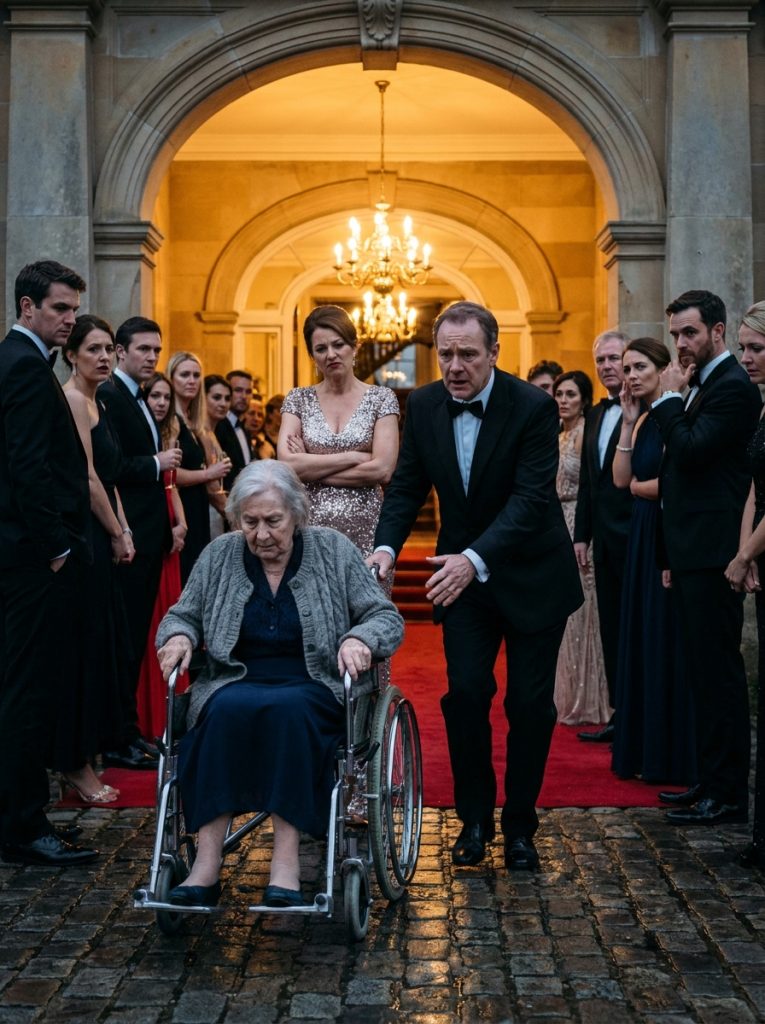
Four heavily armed federal officers positioned themselves around my mother’s wheelchair, facing outward, shielding her from the entire room.
The world narrowed to a single impossible question.
Why were federal Marshals protecting Eleanor Davis?
Chloe finally stopped talking.
The guests stared.
The only sounds left were police radios crackling and the ragged breaths of rich people who had just discovered how useless wealth looked in the face of real force.
Outside, a new convoy rolled into the driveway. Headlights washed across the windows. Doors opened in clean succession. Then footsteps entered the foyer—measured, hard, expensive in a different way than anything else in that room.
An older man in a black suit stepped into the ballroom.
Silver hair. Grave face. A presence that didn’t need to announce itself because half the country already knew it from history books, court decisions, televised oaths.
A whisper tore through the guests.
“That’s Harrison.”
“Chief Justice Harrison.”
My mind simply stopped.
Not a police chief. Not a senator. The Chief Justice of the United States Supreme Court was walking across my engagement gala while federal Marshals secured the perimeter around my mother’s wheelchair.
Chloe, God help her, still tried to use charm.
She stumbled into his path, one hand pressed theatrically to her chest. “Your Honor, thank God. I am the hostess, and I have been assaulted by—”
He walked past her as if she were a chair.
One of his security men pushed her aside with ruthless efficiency, and she fell back onto a velvet settee with a cry of shock.
The Chief Justice kept coming until he stood directly before my mother.
He took in the cardigan. The wheelchair. The bruise rising on her cheek.
Then his face changed.
A darkness moved through his expression so cold it seemed to lower the temperature in the ballroom.
He removed a white handkerchief from his inner pocket and held it out to her with both gravity and care.
Then he bowed.
Deeply.
To my mother.
“Ma’am,” he said, his voice carrying across the room like iron dragged over stone. “The perimeter is secure. The trust assets have been locked down. The board is standing by for your instruction.”
Every guest in that room felt the world tilt.
I know I did.
My mother accepted the handkerchief. Her fingers were steady.
Then the Chief Justice lifted his eyes to the mark on her face.
“Who did this to you?”
No one moved.
No one breathed.
The question didn’t feel like a request for information. It felt like the first line in a death sentence already drafted.
My mind fought for something rational and failed. My mother had worked diner shifts until her wrists swelled. She had counted coupons under bad kitchen light. She had wrapped my feet in grocery bags once because my boots had split and payday was still four days away. There was no space in any universe for the Chief Justice of the United States to be bowing to her in a ballroom full of billionaires.
“Sir,” I heard myself say, voice rough, “there has to be some mistake. This is my mother. She’s a retired waitress.”
He didn’t even look at me.
He was waiting on her.
And then my mother changed.
Not physically, not in some ridiculous theatrical way. She didn’t rise from the chair or suddenly become someone else. But the softness I knew so well pulled back, and something older stepped through. Her spine straightened. Her eyes sharpened. The room stopped seeing a frail old woman and started seeing the shape of power beneath deliberate disguise.
“You may rise, Marcus,” she said.
Marcus.
She called the Chief Justice Marcus.
He straightened immediately.
That was the first reveal, and it hit the room like a silent explosion: my mother was not in the presence of power—she was its center.
“Contain the board,” she said, dabbing the blood from her lip. “This was local, not systemic.”
“Yes, Madam Chairman.”
Madam Chairman.
Arthur Sterling, one of the richest men in the room, made a sound that was almost a whimper.
Across from us, Chloe stared as though language had abandoned her. Her lips parted, but no words came. Her entire worldview ran on visible symbols—cars, labels, addresses, invitations. The idea that real power could wear a cheap cardigan was more than she could process.
Finally she laughed, brittle and cracked.
“Julian,” she said, looking at me like I could still repair reality for her. “Tell them to stop. This is insane. This is some kind of stunt, right? You’re pranking me.”
No one answered.
My mother turned her wheelchair to face her.
“Marcus,” she said.
“Yes, Madam Chairman.”
“You asked who did this to me.” She lifted one finger and pointed directly at Chloe. “She did.”
The room went dead.
Two Marshals moved instantly, flanking Chloe before she could run.
“No, wait—Julian!” she cried. “Julian, say something!”
I couldn’t. I was still trying to understand whether I had ever known my own life at all.
Chief Justice Harrison took out a tablet and began reading in a voice stripped of all mercy.
“Chloe Elizabeth Kensington. Born Syracuse, New York. Father employed in mid-level regional management. Mother a substitute teacher. Current liquid assets: thirty-four thousand, two hundred and ten dollars. Student debt exceeding one hundred and eighty thousand. Additional revolving credit debt of sixty-five thousand, largely incurred at luxury boutiques and short-term prestige leases.”
A murmur rolled through the guests.
Chloe’s face collapsed. “How do you have that?”
He continued. “Documented pattern of targeted social infiltration into ultra-high-net-worth circles. Strategic romantic involvement with Julian Davis following his acquisition event. Multiple false representations of family wealth. Unverified claims of independent curatorial income.”
The socialites recoiled from her.
It was almost funny in a sick way. A room full of predators suddenly disgusted by one of their own because she had failed to be rich enough while pretending to belong.
I looked at Chloe and remembered every expensive taste, every casual remark about “old energy,” every time she had gently tried to steer me away from my old neighborhood, my old friends, my mother’s apartment. It all rearranged itself in my mind until the pattern became undeniable.
She had not loved me.
She had identified me.
My mother reached for my hand, and when she spoke again, her voice softened only for me.
“You want to know why I never told you?” she asked.
I swallowed hard. “Yes.”
She looked at me with love so deep it hurt.
“Because wealth without character is a disease,” she said. “Your father built an empire so large it could have swallowed you whole. When he died, every family at the top wanted access to you. They would have turned you into one of them before you were old enough to know what you were losing.”
I stared at her.
The room stared at her.
So she told us.
Not everything at once, but enough.
How my father had not merely owned companies—he had built systems beneath markets, structures other empires relied upon without fully understanding. How, after his death, she had transferred control into a blind shadow trust and disappeared from the world that knew her name. How she had raised me in Brooklyn under another identity, worked real jobs, let me feel the shape of a dollar, the humiliation of being overlooked, the discipline of earning.
“I needed you to become a man before you became an heir,” she said. “I needed you to know the value of people before I showed you the machinery that treats them like disposable parts.”
I could barely stand under the weight of it.
All those years.
All those shifts.
All that struggle.
Not because she had to.
Because she chose it for me.
My throat tightened. “You let yourself suffer.”
She squeezed my fingers. “I would do worse than suffer to keep you human.”
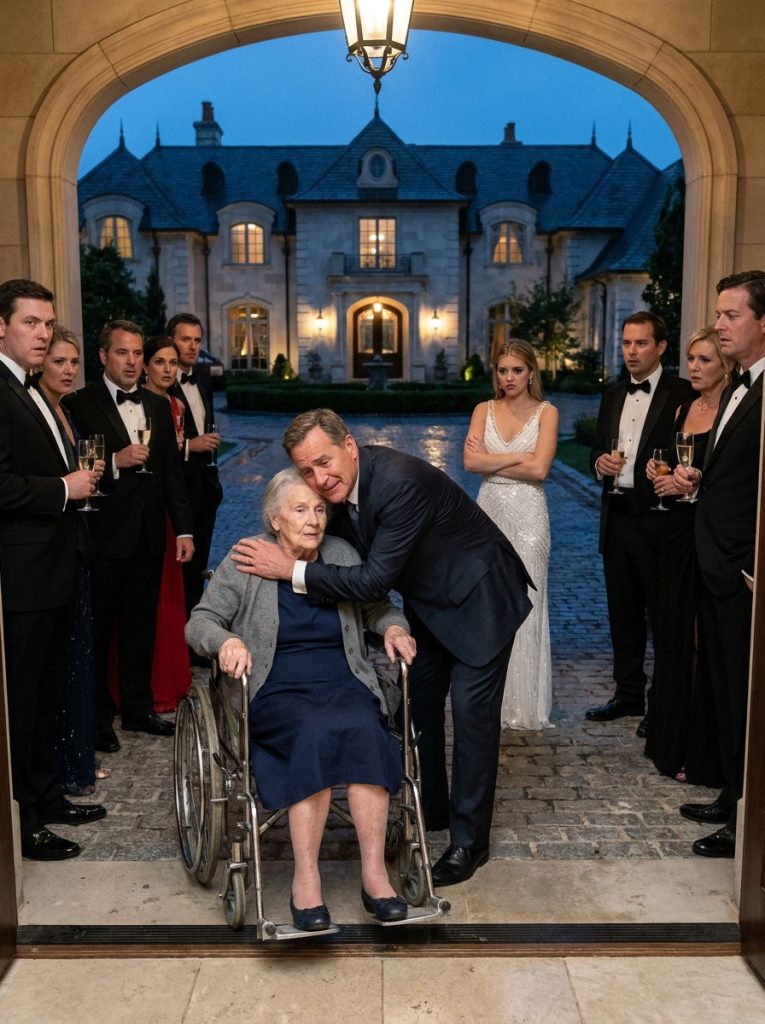
Then she turned back to Chloe, and all warmth vanished.
“And then,” my mother said, voice cooling to steel, “you brought her home.”
Chloe dropped to her knees in the glass.
If she had known. That was her first instinct. Not remorse. Not shame. Strategy.
“I didn’t know!” she sobbed. “Eleanor, I swear, if I had known who you were—”
“That is precisely the point,” my mother said.
The second reveal came colder and crueler than the first: Chloe’s sin was not that she failed to recognize power, but that she only knew how to respect it when it could benefit her.
“You saw a disabled old woman in a cheap sweater,” my mother said, leaning forward slightly in her chair. “And you saw someone safe to humiliate. Someone useful to degrade. Someone whose dignity you could spend to buy yourself status.”
Chloe reached for me, bloody hands shaking. “Julian, please. Please. We’re engaged. I love you.”
I looked at her.
At the ruined makeup. The torn silk. The desperation.
And I felt nothing that resembled love.
“You don’t know what love is,” I said quietly. “You know valuation.”
The words seemed to hit her harder than the arrest.
“The engagement is over.”
She made a sound then that I will probably hear for the rest of my life. It came from someplace beneath language.
But my mother was not finished.
She called Arthur Sterling forward next. The billionaire nearly tripped over himself obeying. A man who could ruin founders with a phone call now shook like a schoolboy in the principal’s office.
“You own the lease on the Kensington family home through a real estate subsidiary,” my mother said.
Sterling swallowed. “Yes, Madam Chairman.”
“Evict her parents.”
Chloe screamed.
Not for herself. Not first.
For them.
And that told me more than anything else could have. Somewhere under all the ambition and fraud, she had always known exactly how much damage she had already done.
My mother exposed that too. The reverse mortgages. The drained retirement accounts. The fabricated investment fund Chloe had used to bleed her parents so she could dress like someone born above consequence.
The room recoiled again, not from morality but from contamination. They could forgive cruelty. They could even admire it. But dependence disguised as pedigree? That, to them, was unforgivable.
Chloe crawled forward, sobbing, and the Marshals blocked her path.
“Please,” she begged. “Please, Julian, she’s going to destroy them.”
I heard my own voice answer from far away. “You did that long before tonight.”
My mother addressed the room then, and every billionaire in it lowered their gaze.
“This is what your culture produces,” she said. “A room full of people so intoxicated by surface that they mistake decency for weakness and arrogance for breeding.”
No one argued.
No one dared.
Then she ordered Chloe’s accounts frozen. Her cards deactivated. Her leased Mercedes repossessed before our eyes as the tow truck lights swept across the windows and her precious matte-black G-Wagon was hauled away like evidence.
The stakes rose again with brutal precision: in less than ten minutes, Chloe lost her money, her status symbols, her future, and the illusion that any of it had ever been secure.
“Take her out,” my mother said at last. “Throw her out with the rest of the trash.”
The Marshals grabbed Chloe and dragged her toward the doors.
That should have been the end of it.
But desperate people are most dangerous when they’ve realized they have nothing left to protect.
Halfway to the exit, Chloe dug in her heels and twisted back toward me, eyes suddenly blazing with spite.
“You think you won?” she screamed. “You think this ends with me?”
I frowned. Something in her voice cut through my anger and landed somewhere darker.
“What are you talking about?”
She laughed, hysterical and triumphant at once.
“I didn’t just target your money, Julian. I took your code.”
The room reacted before I could.
My body went still.
She pointed toward Richard Vance, CEO of the company that had acquired my startup. He had been standing near the rear of the ballroom all this time, trying to stay invisible. At her accusation, all color left his face.
“I copied the master drive from your home office safe,” Chloe shouted. “I sold backdoor access to Vance. They never bought your company to launch your work—they bought it to bury it and release their own version tomorrow. Your algorithm, your life’s work, gone.”
The words ripped through me harder than anything else that night.
My code.
Five years of sleepless nights and burned-out hardware and coffee gone cold beside my keyboard. The thing I had built from nothing with my own mind.
For a moment the ballroom disappeared. There was only the sickening certainty of betrayal so complete it left no intact corner of the heart.
Chloe saw it land and smiled through blood.
“I have millions offshore,” she said. “Even now. So no, Julian. You don’t win.”
My mother sighed.
Not in defeat.
In pity.
She turned toward Richard Vance. “Did you really believe the Vanguard Apex Trust would allow an unvetted entity to purchase my son’s intellectual property?”
Chloe’s smile broke.
Chief Justice Harrison looked almost amused now. “OmniTech was quietly brought under Vanguard control six months ago, Miss Kensington. The transaction you participated in was monitored from beginning to end.”
He held her gaze until horror fully entered it.
“You did not sell stolen code to a rival. You delivered it into Vanguard’s own security infrastructure.”
The room erupted.
Vance crumpled to his knees. Chloe stopped fighting entirely, her body going slack in the Marshals’ grip as the truth hit her in layers. The payoff account in the Caymans? Seized. Repatriated. Redirected to scholarship funds. The conspiracy? Federal evidence. The theft? Economic espionage. The sentence Harrison recited after that turned her face to dust.
Forty-five years minimum.
When they finally cuffed her, she looked at me one last time.
“Julian,” she whispered. “I’m scared.”
“You should be,” I said.
That was all.
They dragged her out.
They took Vance next. Fired him on the spot. Seized his equity. Began indictment proceedings before he even reached the driveway. The room watched two predators removed in chains and understood, at last, how small they really were.
Then my mother dismissed the rest.
The billionaires fled.
The socialites fled.
The board members, the investors, the parasites orbiting the orbit of power—they all rushed for the exits without even trying to preserve their dignity. Within minutes the ballroom stood nearly empty, a wreck of shattered glass, abandoned drinks, and terrified silence.
I sat down hard on one of the velvet couches and pressed both hands over my face.
The adrenaline began to drain, leaving behind exhaustion and the ache of a life split open.
When I looked up, my mother had wheeled herself over to me.
Not Madam Chairman now.
Just Mom.
Tired. Bruised. Gentle.
“I’m sorry,” she said quietly. “I never wanted you to learn it this way.”
I let out a slow breath. “A trillion-dollar trust?”
She smiled faintly. “A little more complicated than that. But yes.”
I laughed once, because anything else might have become a breakdown. “You could’ve told me before I almost married a sociopath.”
“I could have,” she admitted. “But then you would never know whether a woman loved Julian or loved the structure around him.”
I leaned forward, elbows on my knees. “So what happens now?”
She reached into her cardigan pocket and took out a slim black keycard, smooth and matte, no logo, no label, just the quiet confidence of something that did not need introduction.
“This is access,” she said. “The central systems. The board. The trust. Your father’s seat.”
I stared at it.
The room felt suddenly too quiet again.
Before I could answer, my phone vibrated violently in my pocket.
I pulled it out. Red alert.
Unauthorized extraction in progress. Secondary backup servers. Palo Alto.
My stomach dropped.
“That’s impossible,” my mother said sharply. “The transfer was contained.”
Harrison checked his tablet. His expression changed at once.
“Madam Chairman,” he said, voice tightening, “it isn’t Kensington. It isn’t Vance.”
“Who?”
He looked up.
“Arthur Sterling.”
The bastard had used the chaos as cover.
He had obeyed my mother’s order just enough to survive the moment, then slipped out to try to steal what Vance could no longer secure. My mind snapped into focus with such force it felt almost relieving. Emotion gave way to engineering. Betrayal became architecture. Problem. System. Solution.
“Get me a terminal,” I said.
Harrison already had one moving toward me before I finished. A military-grade laptop landed on the marble table beside the wreckage of the champagne tower. I sat. The command line opened. My fingers found home in under a second.
Sterling thought he was extracting the core algorithm from backup.
He wasn’t.
Because when I had built the system, I had known someone, someday, would try this exact thing.
“The backup server isn’t the prize,” I murmured, typing. “It’s bait.”
My mother watched me with calm intensity. “What did you build?”
“A mirrored shell with a recursive heuristic parasite,” I said. “Looks like the code. Acts like the code. But the moment someone steals it through an unauthorized tunnel, it follows the tunnel home.”
Harrison read from the tablet. “Extraction at eighty-two percent.”
“Let him finish,” I said.
The final turn came then: the son they thought was merely rich revealed himself to be the most dangerous mind in the room.
I hit Enter.
For ten seconds, nothing.
Then Harrison inhaled sharply.
“It’s in Sterling Capital.”
I kept watching the screen. “Of course it is.”
The parasite moved through Sterling’s infrastructure like fire through dry timber—freezing accounts, surfacing shell companies, decrypting offshore ledgers, locking board access, flagging tax evasion, insider trading, price-fixing. He had built his empire on hidden tunnels and assumed nobody from outside his class would ever know where to look.
I had built a mind specifically for finding buried structures.
The Marshals brought him back in minutes later, half-dragging him, nose bleeding, phone in hand, screaming about asset seizures and network failure. He looked at me like I had violated the natural order.
“What did you do?” he shouted. “Fix it!”
I stood.
He had mocked my mother. Looked down on me. Fed on other people’s inventions his whole life and called it strategy.
“You stole from the wrong engineer,” I said.
Harrison informed him that his entire hidden financial architecture had just been turned into federal evidence and distributed to the SEC, FBI, and IRS. Sterling collapsed. Begged. Offered deals. Offered loyalty. Offered whatever men like him always offer once fear strips away their mythology.
My mother looked at him the way she had looked at Chloe.
Then she said the sentence that ended him.
“Get this smelly trash out of my sight.”
They took him too.
After that, it really was over.
The tactical units withdrew. The estate began emptying in layers of silence and procedure. My mother ordered the mansion dissolved from any future association with my name. Harrison saluted me before he left. Saluted me.
Then there were only two of us in the shattered ballroom.
I went to her and knelt beside the wheelchair again, just as I had when she first arrived.
“Are you okay?” I asked.
She smiled, touching my hair. “I’m tired. And a little angry about the cheek. But I’m okay.”
I looked at the mark still visible there, and something in me hardened forever.
“I should have seen Chloe sooner.”
“No,” my mother said gently. “You saw what decent people always hope to see first. That is not weakness. It is why I fought so hard to protect you.”
I took her hand.
For a while we just sat there in the ruins of everything false.
Then I looked at the black keycard in my palm.
“What happens now?” I asked.
Her eyes held mine, fierce and warm all at once.
“Now,” she said, “you learn the machinery they hide behind. You learn how monopolies are built, how governments are bought, how suffering is outsourced and renamed efficiency. And then you unmake it.”
I let the words settle.
The old life was gone. The illusion of normalcy, the fiction of random success, the future I thought I was stepping into with Chloe—all of it lay around us in broken glass and champagne stains.
And yet, beneath the exhaustion, I felt something steadier than grief.
Purpose.
Not because of the money.
Because of the lesson.
All those years my mother had given me the one inheritance the elite never valued until it destroyed them to lack it: a conscience trained by struggle.
I rose and stepped behind her wheelchair, my hands closing around the worn rubber grips.
She looked up at me. “Ready?”
I glanced once around the ballroom—the fallen crystals, the ruined silk, the aftermath of people who thought money could protect them from truth.
Then I looked down at my mother.
At the cardigan they had mocked.
At the woman who had let the world mistake restraint for weakness.
At the only person in that entire empire who had ever truly built me.
“Yes,” I said.
And together we rolled out of the wreckage, leaving the glittering carcass of that world behind us, ready to rewrite the rules that had protected monsters for far too long.
