


“Before anyone touches my bag… pull the security footage. And have someone verify what she’s wearing.”
Those were the words that shifted everything.
Five seconds earlier, I was still the “cheap little helper” she had just humiliated in front of half the restaurant and thousands watching her livestream.
Five seconds earlier, I was just the quiet girl in the black apron.
And she loved that.
It happened on a Saturday night at my grandfather’s Michelin three-star restaurant.
I wasn’t working the dining room. I usually helped in prep, plating support, and late dessert station cleanup. I was there because one of the senior assistants had called out sick, and we were slammed.
I was nineteen.
New enough to be ignored. Useful enough to be overworked.
And to women like her, that meant I was safe to blame.
She arrived with a man who looked more tired than rich, a friend filming everything on a phone, and the kind of fake confidence that grows louder the more expensive the room gets.
Even before she sat down, she was performing.
“Oh, this place is cute,” she said, loud enough for nearby tables to hear. “I usually do private tasting rooms, but let’s see if this one is worth the hype.”
Her laugh was sharp. Practiced.
She kept adjusting her bracelets so the logos showed.
She held her bag like it was a museum piece.
She spoke to the host like he should be grateful she had arrived.
By the second course, half the dining room knew exactly who she was trying to be.
A rich lifestyle influencer.
A woman who posted “old money elegance” videos.
A woman who told other women how to “dress expensive.”
A woman whose entire brand depended on people believing she belonged in rooms like that.
I noticed something right away.
Her Chanel flap was off.
The stitching was wrong.
The hardware color didn’t match the chain.
One bracelet had a luxury logo with the wrong spacing.
And the “diamond” on her finger threw rainbow light like cheap glass.
I grew up in kitchens, not fashion houses.
But my grandfather built one of the most exclusive restaurants in the city, and when you grow up around truly wealthy people, you learn the difference between quiet luxury and loud fraud.
Still, I kept my head down.
Then came the plate.
It was a limited porcelain charger from a private French collection. We only used it for one tasting menu pairing.
Expensive didn’t even begin to cover it.
I was three steps away when she lifted it, turned toward her camera, and said, “This plating is pretty, but honestly?”
Then the plate slipped.
No.
That’s not true.
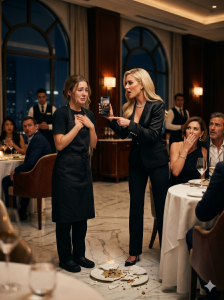
She let it fall.
I saw her fingers open.
I heard it explode against the marble.
The crack echoed through the room.
Conversations stopped.
Every eye turned.
Then she gasped like she was in a movie and pointed right at me.
“This girl bumped me!”
I hadn’t touched her.
I wasn’t even close enough.
But she was already standing, hand over her chest, acting offended.
“She’s been hovering the whole night,” she snapped. “This is exactly why places like this go downhill. They hire girls who look desperate and hope guests won’t notice.”
A man at table twelve frowned.
A couple near the window whispered.
Someone started filming.
Then she took it further.
“Search her bag,” she said. “I bet she switched something out. Look at her. She obviously can’t afford one plate in this room.”
That line landed exactly the way she wanted.
Public.
Cruel.
Calculated.
I felt the heat crawl up my neck.
Not because I was guilty.
Because she knew what she was doing.
She wanted the room to see me as small.
Poor.
Replaceable.
She wanted to humiliate me before the truth had a chance to breathe.
The floor manager walked over, trying to de-escalate.
“Ma’am, let’s calm down.”
“No,” she said, turning toward her phone. “Do NOT protect her. People need to see how these places treat paying guests.”
Then she aimed the camera at me.
At my apron.
At my face.
At my shoes.
I had worked twelve hours already.
My wrists ached.
My hair smelled like butter and smoke.
And suddenly I was the villain in a lie she built in thirty seconds.
That was the moment I stopped being embarrassed.
And started paying attention.
Because when liars get too comfortable, they always overperform.
She kept talking.
Too much.
Too fast.
She called me a thief without using the word.
She claimed I had touched her table three separate times.
She said her “authentic bracelet” had almost been scratched too.
Authentic.
That word made me almost smile.
I looked at her wrist again.
Bad engraving.
Cheap shine.
Wrong clasp.
Then I looked at the manager.
Then at the phone filming me.
Then at the ceiling camera over the private dining section.
And I knew exactly what I needed to do.
I didn’t argue.
I didn’t cry.
I didn’t beg.
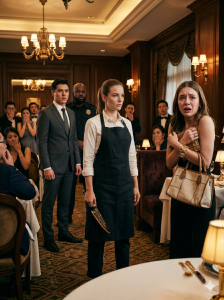
I turned, walked back to the service station, unrolled my knife case, and took out the black-and-gold chef’s knife my grandfather had given me when I started training on the line.
It wasn’t flashy.
It was beautiful.
Custom handle. Family initials. Impossible to mistake.
The room noticed.
So did she.
Her eyes narrowed.
“What is that supposed to mean?” she asked.
I closed the knife roll gently.
Then I faced the manager and said, very clearly:
“Before anyone touches my bag, pull the security footage. And have someone verify what she’s wearing.”
For illustrative purposes only
Silence.
Real silence.
Not restaurant silence.
Shock silence.
The influencer blinked. “Excuse me?”
I looked at her bracelet.
Then her bag.
Then the logo on her belt.
“You want a public accusation,” I said. “Let’s do public facts.”
Her friend lowered the phone a little.
The manager stared at me.
He knew the knife.
Only senior staff and family knew the knife.
His whole expression changed.
“Call security,” he said quietly. “And bring the recording from camera four.”
That’s when she laughed.
Too loud. Too brittle.
“Oh my God. Are you serious? She’s trying to distract from what she did.”
But the room had shifted.
People weren’t looking at me anymore.
They were looking at her.
At the bag.
At the bracelet.
At the panic she was trying to hide under attitude.
The manager asked if we could step into the private office.
She refused.
Of course she did.
She wanted witnesses when she thought she was winning.
So the footage was brought to the host stand screen.
In full view of the front dining section.
Her own livestream was still running.
And there it was.
Crystal clear.
No bump.
No collision.
No accident.
She lifted the plate.
For illustrative purposes only
Turned slightly toward her phone.
Opened her fingers.
Dropped it.
Then pointed at me before the shards had even stopped moving.
A woman at the bar said, “Wow.”
Another guest muttered, “She planned it.”
Her face went white.
But we weren’t done.
The assistant manager, who had previously worked in luxury retail before hospitality, asked to inspect the items she had been flaunting all night.
At first she refused.
Then security stepped closer.
Then the man with her—boyfriend, sponsor, whatever he was—looked like he wanted the floor to swallow him.
Under pressure, she handed over the bag.
Counterfeit.
The bracelet.
Counterfeit.
The belt.
Counterfeit.
The ring.
Not diamond.
Not even close.
And because she had been livestreaming inside a private fine-dining venue while making false theft accusations against staff, the legal side hit fast.
Very fast.
Our restaurant had posted filming rules at the entrance and inside the menu booklet.
My grandfather had insisted on that years earlier after a guest once tried to shame a server online for attention.
The rules were simple.
No commercial filming without approval.
No defamatory content involving staff.
No interference with service.
No false public allegations.
She broke all of them.
On camera.
While wearing counterfeit goods in a venue that partnered with luxury brands for events.
That part mattered more than she understood.
One of our seasonal sponsors had legal representatives on-site that night for a private tasting upstairs.
They came down after hearing the noise.
The moment they saw the footage and the fake items being displayed as real luxury on a monetized livestream, everything changed.
My grandfather finally stepped out from the back.
He didn’t raise his voice.
He never had to.
He looked at me first.
Not her.
Me.
“Are you alright?” he asked.
That was the moment the whole room understood.
Not because he was angry.
Because of the way he said it.
Like family.
Because I was family.
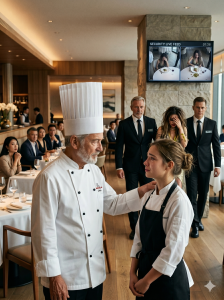
He put a hand on my shoulder and turned to the influencer.
“You publicly accused my granddaughter of theft in my restaurant,” he said. “You damaged property on purpose, violated house policy, and broadcast false claims for profit.”
For illustrative purposes only
She looked around like someone might save her.
No one did.
Not her friend.
Not the man at her table.
Not the strangers who had been impressed by her for the first ten minutes.
No one.
She tried tears next.
Then outrage.
Then denial.
Classic order.
“It was a misunderstanding.”
“It slipped.”
“She’s twisting this.”
But facts are stubborn things.
Especially on video.
Security escorted her out in full view of the dining room.
Not dragged.
Not touched roughly.
Just firmly.
Legally.
Publicly.
And because her livestream had caught the accusation, the footage of the real moment spread even faster than her fake victim act.
By morning, people were clipping side-by-side videos.
Her version.
The security version.
The fake luxury close-ups.
The comments were brutal.
Not because anyone bullied her.
Because nobody believed her anymore.
Brand deals vanished.
Her account was suspended pending fraud complaints and policy violations.
Two platforms removed her monetization within the week.
The man she came with posted a statement distancing himself.
A reseller publicly confirmed the bag she wore was counterfeit.
And the worst part for her?
It wasn’t the money.
It was the humiliation.
Her whole online identity was built on being admired.
And now every time people saw her, they remembered the moment she pointed at a working girl and tried to bury her to save herself.
As for me, I cried later.
Not there.
Not in front of them.
In the pastry walk-in, with the door shut, where nobody could see me shake.
My grandfather found me ten minutes later.
He didn’t give me some dramatic speech.
He handed me a towel and said, “You did exactly right. Calm first. Facts second. Let liars build their own trap.”
That meant everything.
A month later, he offered me a formal place in the chef training program.
Not because I was family.
Because, as he put it, “You protected the house under pressure.”
I still keep that black-and-gold knife wrapped in cloth when I’m not using it.
Not as a trophy.
As a reminder.
Some people wear fake status.
Some people carry real discipline.
Those are not the same thing.
And eventually, public truth catches up with public cruelty.
So let me ask this plainly—
If someone publicly humiliates a young worker to protect their own image, and gets exposed with proof in front of everyone, should they be forgiven quickly… or should consequences stay public too?
If you believe lies should be exposed, share this. If you believe workers deserve dignity, stand on that.
