

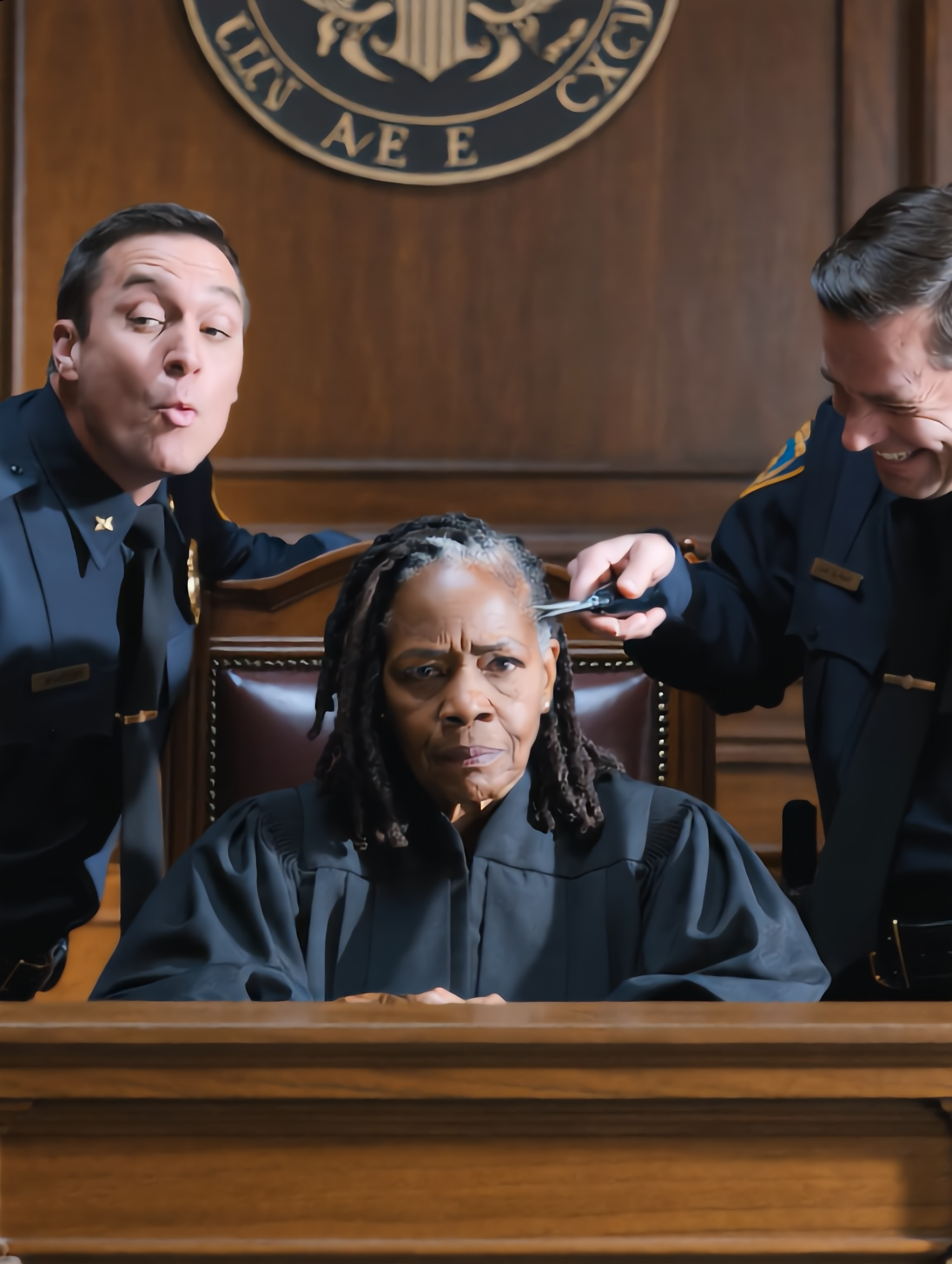
Claudia kept her head raised as they forced her through the doorway. The overhead fluorescent bulbs hummed loudly, harsh and relentless, casting a sickly glare over the tight space that would serve as their stage of dominance. The door shut with a sharp click behind them, isolating her with her aggressors, while courthouse activity continued faintly beyond the walls.
The security room was small, frigid, and bare, its concrete surfaces reflecting the unforgiving fluorescent glare that drained color from everything. A single metal chair was fixed to the floor in the center, a sight that tightened Claudia’s stomach. The air carried the odor of stale coffee mixed with chemical cleaners. “Have a seat, your honor,” Rick sneered, pushing Claudia toward it.
She kept her footing despite the cuffs, refusing to stagger. Her gaze swept the room, absorbing every corner and every face. Wallace leaned near the door with crossed arms, wearing the same pleased smirk. Brent moved behind her in slow circles, like a predator sizing up prey.
The enclosed space seemed to shrink with every passing second. “You know,” Rick said, leaning close enough that his breath reached her. “I’ve been wanting to meet you for a long time. Heard you were some hotshot judge who thinks she knows everything about police work. Claudia met his gaze steadily. I know enough about the law to recognize multiple violations happening right now.
Brent’s hands pressed down on her shoulders, forcing her into the seat. Still speaking like a judge? Maybe we need to remind you who’s really in charge here. The fluorescent hum filled the silence as Rick opened a metal cabinet in the corner, the scrape of a drawer breaking the tension.
When he turned, electric clippers were in his hand, the cord flicking loosely like a threat. “You know what they do in prison?” Rick asked, plugging them in. The device buzzed alive with an ominous tone. They take away everything that makes you feel special. “Your clothes, your jewelry,” he grinned. “Your hair.
” Claudia’s pulse pounded, though her voice stayed controlled. This won’t end well for any of you. Oh, I think it will, Brent said from behind her, fingers digging into her shoulders. Nobody’s going to believe you over three respected officers. Right, Wallace? Wallace shifted slightly, uneasy but silent.
Just don’t leave any marks. Rick brought the buzzing clippers near her face, letting the vibration brush her skin. Want to beg? Might make me go easier on you.” Claudia kept her eyes forward, her silence cutting deeper than words. Rick’s frustration flared, his face reddening. The first pass of the clippers carved through her neatly styled hair.
Dark strands dropped to the floor in uneven clumps, scattering like debris. Rick worked carelessly, intentionally patching and unevening her hair, taking visible pleasure in the disorder.
Smile. Brent pulled out his phone, capturing photos while Rick continued. This is definitely going in my personal collection.
Delete those, Wallace warned from the door. Can’t have evidence. Relax, Brent replied without stopping. These are just for us. A little souvenir of our quality time with the honorable judge. Claudia focused on steady breathing as more hair fell. She thought of every case she had ruled on, every voice that had trusted her courtroom.
Those memories anchored her. Each pass of the clippers only strengthened her resolve. Rick stepped back, examining his work with a laugh. Not exactly courthouse appropriate anymore, is it? Might need to invest in a wig. Brent circled her again, phone still recording.
Any final words of wisdom from the bench? Claudia said nothing, her stare locking onto him until he shifted uncomfortably. Her scalp stung where the clippers had scraped too close, but she gave no reaction. “Getting boring now,” Rick muttered, irritated by her composure.
He brushed loose hair from her shoulders roughly, each motion meant to humiliate. “Maybe we should give her a matching prison tattoo.” “That’s enough,” Wallace said, finally pushing off the door. “You’ve made your point. Get her out of here before someone comes looking. Rick yanked off the handcuffs with unnecessary force, then tossed Claudia’s badge onto the floor where it clattered across concrete and hair.
“Go tell your boss what happens when you cross us,” Brent said, opening the door. “I’m sure they’d love to hear all about your little makeover.” Claudia rose slowly, steady despite everything. She bent with calm precision, picked up her badge, and placed it in her pocket. Strands of hair clung to her clothing.
She did not brush them away. They trailed behind her as she walked out, their presence lingering. The hallway’s brightness hit her exposed scalp. Her briefcase sat untouched on the conveyor belt. Claudia retrieved it with controlled movement.
She felt their eyes waiting for her to collapse, to react. Instead, she straightened and walked toward the courtroom, each step deliberate, leaving them behind.
The federal courtroom was crowded wall to wall, filled with reporters, activists, and tension. Sunlight streamed through tall windows, stretching across polished wood benches. At the defense table, Rick Donnelly and Brent Karns sat with forced confidence, uniforms crisp, badges bright.
The clerk stood and announced nervously. All rise.
The United States District Court for the Eastern District is now in session. The Honorable Judge Claudia Hayes presiding. The rear doors opened heavily. A wave of shock moved through the room as Claudia entered. Her scalp showed angry red marks where the clippers had scraped too deep. Uneven patches from the assault were visible under the lights.
Claudia walked steadily toward the bench, expression unreadable, movements controlled. Her black robe rested over her arm like armor.
Whispers spread quickly. Oh my god, what happened to her hair? Is that really Judge Hayes? Someone attacked her.
At the defense table, Rick and Brent froze as recognition hit them. Color drained from their faces instantly. Their lawyer leaned in urgently, whispering with frantic gestures. Claudia climbed the steps to the bench without pause.
She slipped into her robe with practiced precision. When she sat, the room seemed to tighten around her presence. “Good morning,” she said evenly. The microphone carried her voice through the silent chamber. This is case number 2023 CR 405, United States versus officers Richard Donnelly and Brent Karns on charges of civil rights violations under Color of Law.
Rick’s leg shook uncontrollably. Brent stared forward, jaw locked. Their attorney scribbled rapidly, glancing up in panic. Are both parties ready to proceed? Claudia asked calmly.
The prosecution rose. Ready for the United States, your honor. The defense stood abruptly. Your honor, the defense requests an immediate sidebar. Denied, Claudia replied.
Are you prepared to proceed, counsel? But, your honor, a simple yes or no will suffice. The attorney swallowed hard. Yes, your honor, but we have serious concerns about your concerns are noted. You may be seated.
Claudia addressed the jury, twelve citizens sitting rigidly. Members of the jury, you will hear testimony today regarding a pattern of misconduct by officers Donnelly and Karns spanning several years. The prosecutor opened a binder. The United States calls Maria Rodriguez as our first witness.
A trembling elderly woman approached and was sworn in. She described her son’s beating during a traffic stop and falsified reports claiming resistance. Claudia remained composed, ruling precisely. Only subtle gestures—fingers touching her scalp, eyes sharpening at the defendants—betrayed anything beneath her control.
Witness after witness followed. A young man described being choked unconscious. A shop owner spoke of missing footage after evidence was planted. Each testimony built the case. Rick and Brent sank lower in their seats, whispering urgently to their attorney.
As lunch neared, Claudia checked the clock. “We’ll recess for 1 hour,” she said, striking the gavvel. “Court will reconvene at 1:30 p.m. The room erupted in noise as she left the bench. Reporters rushed out. Activists murmured in disbelief and outrage at the irony unfolding.
“All rise,” the clerk called.
Claudia exited calmly toward chambers, robe trailing behind. Rick and Brent watched with hollow expressions.
In chambers, afternoon light stretched across her desk. A knock preceded Marcus Lee and two marshals. Her clerk entered with concern. Deputy Wallace is here as requested, your honor,” Marcus said.
Wallace entered with relaxed arrogance, hand near his holster, smirking. You wanted to see me, Judge Hayes? Claudia did not offer a seat. She opened a file.
Deputy Wallace, I’ve spent my lunch hour reviewing your personnel file, the complete version, not the sanitized one you’ve managed to maintain for public view. Wallace’s smirk faded. My file is clean.
27 years of service, 27 years of documented harassment, racial profiling, and abuse of power, Claudia replied sharply. All buried through connections. She read aloud.
March 2015, complaint by Maria Gonzalez, interpreter, describing humiliating searches and comments. Wallace shifted. That was a routine security check. July 2017, Claudia continued, citing discrimination claims. That’s protocol. September 2019, more misconduct claims. Wallace’s face reddened.
These are all lies and misunderstandings. There are 47 similar complaints in this file. Claudia said steadily. All dismissed. Until now.
Marcus placed a recorder on the desk. Wallace’s voice played: Hold her down tight. Let’s show this one what happens when they don’t know their place. Wallace reached toward his holster, but marshals closed in.
Claudia continued the recording—laughter, encouragement, orders to erase evidence.
Your badge, Deputy Wallace. Claudia said firmly. You can’t. Your badge now.
You are suspended effective immediately, pending federal charges for civil rights violations, conspiracy, and obstruction of justice. Wallace trembled, then removed his badge and threw it onto the desk.
Cuff him,” Claudia ordered. The marshals moved in.
As Wallace was led out, Marcus warned of backlash. Let them,” Claudia said, touching her scalp. The pain only strengthened her resolve.
Outside, staff watched Wallace being escorted away, stunned and vindicated. Claudia gathered her robe, steady and resolute, preparing to return to court where justice continued unfolding.
Marcus held the door open for her, his loyalty clear in every small motion. “The afternoon session is about to begin, Your honor.” Claudia gave a slight nod and squared her shoulders. The burden of duty settled over her like armor. She had taken an oath to uphold justice, and today, despite the personal sacrifice and the approaching storm, she intended to keep it.
Claudia sat alone at her kitchen table, absently pushing pasta that had gone cold across her plate. The television murmured in the background, its blue glow stretching uneasy shadows across the room. She had not turned on the lights. After the violence of the day, the darkness felt strangely grounding. Breaking news in the federal courthouse scandal.
The anchor’s voice broke into her thoughts. Controversy erupts as longtime courthouse security deputy Wallace Jenkins is arrested on federal charges. Footage showed Wallace being escorted in handcuffs, his expression twisted in fury. The broadcast shifted to Rick and Brent’s police union representative at a podium, his exaggerated outrage carefully performed.
This is a clear abuse of judicial power, the union rep declared. Officers Donnelly and Karns are decorated veterans being railroaded by a judge who’s clearly lost her objectivity. Judge Hayes’s actions today prove she’s emotionally compromised and unfit to preside over this case. Claudia’s fork struck the plate sharply.
She lifted her wine glass, her grip steady despite the anger rising in her chest. The union rep was replaced by a panel of commentators, each offering their judgment of her fitness to serve. “The judge’s behavior shows clear signs of emotional instability,” a silver-haired legal analyst said. “Any defendant would be right to question her impartiality after today’s display.
” “But what about the allegations that these officers assaulted her?” a younger voice pushed back. “Doesn’t that warrant—” “Allegedly assaulted,” another cut in. “We only have her word for what happened this morning. Where’s the security footage? Where are the witnesses?” Her phone vibrated. Marcus’ message read, “Turn on channel 7. Denton’s making his move.”
Claudia changed the channel. District Attorney Harold Denton appeared, his practiced smile filling the screen, every word carefully measured. While any allegations of misconduct must be taken seriously, Denton said, adjusting his tie, we must also ensure our judicial process remains untainted by personal vendettas.
I’ve spoken with colleagues who share my concerns about Judge Hayes’s objectivity in this matter. Outside, chanting drifted through the windows. Claudia moved to the living room and peered through the curtains. Protesters split into two groups across her lawn. One side held signs reading justice for Judge Hayes and end police brutality.
The other shouted angrily, “Back the blue and remove the biased judge.” Her phone buzzed again. “Marcus, Denton’s meeting with Chief Judge tomorrow. Sources say they’re discussing removing you from the case. Need to talk ASAP.” A police cruiser rolled slowly past, its spotlight sweeping across her home. Claudia didn’t react.
Let them try to intimidate her. She had endured worse and still stood.
The television continued. Sources close to the department suggest officers Donnelly and Karns were responding to credible threats of courthouse disruption. Their attorney claims Judge Hayes became combative during a routine security check. Claudia muted it, appetite gone.
She carried her wine glass into the bathroom and switched on the harsh fluorescent light. Her reflection stared back—bare scalp marked with raw red patches where the clippers had cut too deep. The words echoed in her mind: emotionally unstable, personal vendetta. The repeated question: Where’s the evidence?
They believed they could bury this, just as they had buried Wallace’s complaints. They believed they could paint her as unstable, discredit her, break her as they had others. Her hand moved over the roughened skin of her scalp. Each mark told the truth they wanted erased.
Her bare head was not shame. It was proof of what they had done.
Outside, chanting intensified. Her phone kept buzzing with warnings and demands for her removal. The muted television showed her entering the courtroom earlier—bald, steady, unshaken.
Claudia leaned toward the mirror, holding her own gaze. Her eyes were steady, her expression firm. No victim stared back—only resolve, only certainty.
“They won’t break me,” she whispered. The words were not hope. They were fact.
The protesters could shout. The union could threaten. The district attorney could maneuver. But they had revealed themselves too clearly.
Now she understood exactly what she was facing.
Her fingers brushed her scalp once more, then she straightened. A judge looked back at her in the mirror—not broken, not diminished, but bound by oath and purpose.
“And that’s exactly what I intend to do.”
“They won’t break me,” she said again, stronger.
The reflection held steady, as if agreeing.
Morning light poured through the tall windows of Claudia’s chambers, stretching across her desk in long bands. The air felt unfamiliar against her bare scalp, and whispers followed her through the courthouse corridors—some respectful, some uneasy.
Marcus paced in front of her desk, gripping a thick manila envelope. His usual composure had been replaced with tension. Someone slipped this under my apartment door last night, he said, placing it down. No name, no note—but judge… his voice dropped, this is dynamite.
Claudia opened it carefully, spreading the contents across the desk. Internal affairs reports, civilian complaints, medical files, email chains—years of buried misconduct.
Look at the pattern, Marcus said, pointing. Donnelly and Karns have been together for six years. Every complaint, Wallace appears in security. Internal affairs buries it. The union blocks it.
Claudia’s fingers stopped on a photograph of a bruised young man. The report labeled it unfounded.
How many? she asked.
Twenty-seven complaints in six years, Marcus said. All buried. All involving minorities or protesters. And only the official ones.
A knock interrupted them. Marcus moved to hide the documents, but Claudia raised a hand. “Enter.”
A man stepped in—early forties, plain clothes, detective’s badge clipped to his belt. Exhaustion sat in his eyes. He closed the door softly.
Detective Alan Price, he said quietly. I’m sorry, Your honor. But he glanced at Marcus.
“My clerk stays,” Claudia said. “What can I do for you?”
Price exhaled, relief visible. I’ve been waiting for someone to stand up to them. After what happened to you yesterday… he shook his head. I can’t stay silent anymore.
Claudia gestured to a chair. He sat, hands clasped tightly.
I worked narcotics with Donnelly and Karns for three years, he said. I saw them plant evidence, falsify reports, beat suspects. Always the same targets.
When I reported it, Wallace made the files disappear. When I pushed harder, my cases collapsed.
Marcus placed a legal pad in front of him. We’ll need dates, names.
I kept everything, Price said. Notes, original reports, recordings. I knew someone would need it.
You understand the risk? Claudia asked softly.
They’re already coming for me, Price replied. Reassigned my partner. Cut my overtime. But he looked at her. My daughter asked me why police hurt a judge. She’s twelve.
Claudia’s hand brushed her scalp without thinking.
You don’t have to do this, she said.
Yes, I do. He met her eyes. You stood up. So I will too.
Marcus began recording as Price laid out years of abuse and coverups—names, dates, patterns protected by a system built to hide them.
There’s more, Price added. The chief judge, Denton—they meet monthly with the union. They decide what gets buried.
A sharp knock cut him off. The bailiff entered.
Your honor, Chief Judge Morton requests your presence immediately.
Claudia stood and adjusted her robe. Detective Price, my clerk will take your full statement.
“We’ll need everything documented, everything verified.” Price rose, determination replacing exhaustion in his eyes. “Whatever you need, Your honor. I’m all in now.”
Marcus moved at once. Claudia gathered the files from her desk. “Secure copies of everything, multiple locations, and get me the courthouse surveillance logs for the past six months.”
“All of them,” she added, then turned back to Price. “Are you absolutely sure?”
“If you stand, I’ll stand,” he repeated without hesitation.
Claudia nodded and slid the files into her briefcase. What had begun as a case against two officers was expanding into something far larger—the system that protected them, the officials who enabled them, the machinery of injustice itself. All of it would be brought into the light.
Her hand brushed her bare scalp again, fingers lingering on the rough patches left by their clippers. What they intended as humiliation had become something else entirely—fuel for exposure they could no longer contain.
Marcus opened the chamber door. Beyond it stretched the courthouse corridors, filled with the same powerful figures who believed they controlled everything. But today, those halls would begin carrying a different weight—truth.
The afternoon sun poured through the tall courtroom windows, casting sharp shadows across Detective Alan Price as he took the witness stand. His hands trembled during the oath, but his voice held steady. From the bench, Claudia watched closely, aware of the hostility radiating from the gallery. The air felt dense, charged.
“Detective Price,” the prosecutor began, “how long did you work with Officers Donnelly and Karns?”
“Three years in narcotics,” Price said clearly. “From 2020 to 2023.”
“And what behavior did you observe during that time?”
His gaze flicked briefly toward Rick and Brent. “They had a system. They targeted specific people—minorities, protesters, anyone without resources to fight back. They planted evidence, falsified reports, used excessive force.”
Murmurs spread through the courtroom. Rick’s jaw tightened.
“Can you give specific examples?” the prosecutor pressed.
Price opened a small notebook. “March 15th, 2021. Marcus Washington. Officers Donnelly and Karns claimed they found drugs in his vehicle. I saw Officer Donnelly place that evidence before the search.”
Gasps broke out. A man in the back stood and left quickly.
“July 8th, 2021,” Price continued, voice strengthening. “Sarah Chen, peaceful protester. She was beaten in custody and charged with assaulting officers. Deputy Chief Williams ordered body cam footage deleted.”
More reactions rippled through the room. With each account, Rick’s composure eroded, his grip tightening on the table.
“The pattern extended upward,” Price said. “Monthly meetings involving Chief Judge Morton, DA Denton, and union representatives. They decided which cases would disappear and which officers would be protected.”
Rick suddenly shot up. “You lying piece of—”
Chaos erupted. Bailiffs rushed in as he lunged forward, shouting threats at Price. Spectators stood, voices overlapping in shock.
Claudia struck the gavvel. “Order!” Her voice cut through everything. “Officer Donnelly, sit down or be removed and held in contempt.”
Rick struggled as bailiffs restrained him, still yelling.
“Remove Officer Donnelly,” Claudia ordered coldly. “Add witness intimidation to his charges.”
As he was dragged out, Price remained seated, breathing hard but steady. Brent stared at him with restrained fury.
“Do you need a recess?” Claudia asked.
“No, Your honor,” Price replied. “I need to finish.”
The testimony continued—documents, recordings, reports, all entered into evidence as the defense unraveled further. By the time Claudia called recess, the courtroom was buzzing with shock and disbelief. Reporters rushed out, voices already broadcasting fragments of what they had heard.
Price was escorted out under protection. Brent followed with his attorney, eyes filled with silent threats. Claudia remained a moment longer, taking in the weight of what had been exposed.
Later, in the courthouse parking lot, the sunlight had shifted low when she reached her car. She stopped.
It had been vandalized.
“TRAITOR” was sprayed across the driver’s side in violent red strokes. Tires slashed. Windows shattered. Paint eaten away in patches.
Claudia stood still, studying it with clinical calm. Around her, people reacted—gasps, whispers—but she barely registered them.
The message was escalation. First humiliation. Now destruction.
She touched her scalp again. No fear surfaced—only clarity.
At that moment, Marcus received a call in his office. Lydia Cruz’s name flashed on his phone. He answered immediately.
“Marcus,” she whispered urgently, “I need to see you. Now. Parking garage, level B2. Please.”
Moments later, she appeared in the dim garage, pacing nervously between pillars.
“I can’t keep it anymore,” she said quickly. “They know I have it. They’re watching me.”
“Have what?” Marcus asked, though he already suspected.
She pulled out a USB drive. “Footage. From that morning. Everything in the security room.”
Marcus took it carefully.
“Chief Judge Whitaker called me in,” she added. “He told me to forget what I saw.”
Her voice broke. “I think they’re moving people already.”
Marcus secured the drive. “We’ll protect you.”
But her eyes were panicked. “Whitaker isn’t just covering it up. He’s part of something bigger.”
She left quickly, and Marcus immediately called Claudia.
Less than three hours later, Claudia’s voice came through the line. “They fired her.”
Marcus cursed. “The footage is gone. Chain of custody erased.”
“Where are you?” she asked.
“Almost there.”
When he arrived, she was at the window, watching the city lights.
“He’s smiling,” she said quietly. “Whitaker. After destroying her career.”
Marcus placed the drive on the desk.
“He’s confident,” Claudia said. “That’s how he’s always operated.”
She opened a hidden compartment in her drawer and placed the drive inside a small safe.
“This isn’t just about the assault anymore,” she said. “It’s about the system protecting itself.”
The lock clicked shut.
In the silence, her voice hardened. “Not this time.”
Whitaker and Denton are only symptoms of something deeper. She touched her bare scalp, fingers lingering over the rough patches left by the officers’ brutality. We thought we were dealing with a few corrupt cops, but it goes far beyond that. She stood and moved to the window, looking down at the courthouse steps where protesters still gathered every day.
The judiciary—the very system meant to restrain power and protect rights—has been compromised. And Whitaker—she turned back to Marcus, expression hard—he isn’t just part of the corruption. He’s refined it.
Marcus gathered the files with careful, deliberate movements. “So what do we do?”
Claudia watched young lawyers hurrying up the courthouse steps, their faces bright with ambition. How many of them would eventually learn to stay silent? How many would be forced to choose between conscience and career?
“We do our job,” she said at last. “We follow the law. We protect the innocent. And we expose the truth—no matter how ugly it is, no matter how high it reaches.”
The morning news struck like a wave. Claudia sat in her kitchen, coffee untouched and growing cold as headlines flooded the screen.
Federal judge accused of assaulting deputies flashed across the ticker. Above it, a cropped security image showed Claudia at the metal detector, her raised hand frozen mid-motion—Wallace’s aggression conveniently cut from frame.
Her phone buzzed nonstop—judges, journalists, old classmates. Most were cautious, some already distancing themselves. One message read: “Maybe it’s time to step back and let things settle.”
A radio voice filled the room with manufactured outrage. We’re talking about a sitting federal judge who confronted officers and then fabricated accusations to cover her actions. If she’s this unstable, how can she remain impartial?
Claudia switched it off, hands steady despite the heat rising in her chest. It was coordinated. Whitaker’s influence was everywhere. She expected retaliation—but not this fast, not this broad.
Her phone rang again. Marcus’ voice was tight. “Judge, turn on channel 4.”
She did. Outside the courthouse, crowds packed the steps—signs raised high in the morning light. RESIGN NOW. NO BIASED JUDGES. SUPPORT OUR POLICE.
“They’re being brought in,” Marcus said. “Union organizers, off-duty officers, paid demonstrators. Since dawn. Our supporters are being held across the street under ‘security concerns.’”
Claudia watched a man shouting through a bullhorn, his anger clearly performed. “Any word from Allan?” she asked.
Silence. Then Marcus, lower: “That’s why I called. Allan was attacked last night. ICU at Memorial.”
The room seemed to tilt. “How bad?”
“Multiple fractures. Internal bleeding. Whoever did it knew exactly how to avoid killing him.”
Claudia was already moving. “I’m going there.”
“Judge—reporters are outside your home.”
She paused at the door, peering through the peephole. News vans lined her street.
“Back entrance,” she muttered.
Twenty minutes later, she entered Memorial Hospital through a service corridor, cap pulled low over her bare scalp. The ICU nurse recognized her and silently guided her to Allan’s room.
The sight stopped her.
Allan lay heavily bandaged, his face swollen and bruised, tubes feeding into him as monitors beeped steadily.
“He’ll live,” the nurse said quietly. “But recovery will take time.”
Claudia pulled a chair beside him. The injuries were precise—meant to cripple, not kill. A message.
Allan’s eyes opened slowly. “Judge Hayes…”
“I’m here.” She took his hand.
“They wanted the files,” he whispered.
“What files?”
“My safe… years of evidence.” He coughed weakly. “I didn’t give them up.”
“You should have,” she said.
“No.” His grip tightened. “They prove everything. Cover-ups. Payoffs. Witness intimidation. It all leads back to Whitaker and Denton.”
“They nearly killed you.”
“But I’m still here.” A faint, broken smile. “The files are safe. Hidden.”
“Where?”
“Not yet. Too soon. Wait for the right moment.”
His eyes drifted.
“This has to end,” Claudia said softly. “All of it.”
“I know,” he whispered. “That’s why I trust you.”
He slipped into sleep. Claudia stayed beside him long after, watching each fragile breath.
When she left, night had fallen. She drove carefully, avoiding known routes, arriving home under dim streetlight. Most reporters were gone. A few lingered.
At her door, something caught her eye. An envelope, taped at eye level.
Inside was a photograph of Allan unconscious, blood pooling beneath him. On the back:
NEXT TIME WE WON’T STOP.
Claudia placed it calmly into an evidence bag.
They wanted fear. They wanted retreat.
Instead, they had escalation.
She touched her scalp again, then looked toward the courthouse in the distance—lit like a fortress under siege. Protesters filled the steps. Police barricades funneled chaos into narrow paths.
She could hear the competing chants even from here.
Marcus met her at the entrance. “Morning, judge. It’s getting worse out there.”
“Nothing new,” she said, though it was.
Inside, tension vibrated through the halls. Security watched everyone. Trust had eroded completely.
A commotion erupted ahead—men in dark suits moving quickly through the building. FBI badges visible.
“Federal investigators,” Marcus murmured. “They arrived minutes ago.”
Agent Diana Chen stopped when she saw Claudia. “Judge Hayes. We need to speak with you.”
In her office, Chen spoke bluntly. “We’ve opened a federal investigation into systemic corruption in this courthouse.”
“About time,” Marcus muttered.
“The attack on Detective Price triggered it,” Chen added. “We’re looking at Whitaker, Denton, and evidence suppression.”
Claudia nodded. “I have files.”
“We’ll need them.”
A knock interrupted.
A court officer entered. “Judge, they’re ready for you.”
The courtroom was full. Rick and Brent sat stiffly at the defense table, their confidence reduced but still present. The gallery buzzed.
Before Claudia could sit, Whitaker stepped into her path.
“A word.”
“In open court, Chief.”
His smile tightened. “This has gone far enough. Recuse yourself or face review.”
“Is that a threat?”
“A warning.” His voice lowered. “Think about your legacy.”
“I am.” She stepped past him. “That’s why I’m staying.”
Silence fell as she took the bench.
Marcus passed a note: Security footage recovered from three sources. They can’t suppress it all.
Claudia allowed herself a faint smile. Truth didn’t need permission. It spread. It found cracks.
She lifted the gavvel.
“Court is in session.”
Outside, the noise continued—but muted, distant. Inside, only facts mattered.
Rick and Brent shifted uneasily as new evidence began to surface. Agent Chen observed from the gallery. Whitaker stood at the back, expression dark.
Marcus leaned in. “They can try to bury you,” he whispered. “But not this.”
Claudia’s hand rested on her robe. They had tried to take her dignity. Instead, they revealed what she was willing to become.
Light poured through the windows.
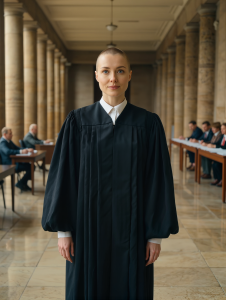
This was her court.
And the truth, finally, would speak without restraint.
The morning sun struck her shaved head, turning it into something like a beacon—unavoidable, unflinching, defiant. She could feel every gaze in the room settle on her, and she understood that this moment would define far more than a single case. It would shape what justice meant in this courthouse. Marcus stood at her side, organized and ready, the files aligned, the evidence prepared.
Agent Chen watched closely from the gallery. Even Chief Judge Whitaker, for all his influence and threats, could not halt what was already in motion. Claudia held her robe like armor, her spine rigid, her resolve burning steady. There would be no more hesitation. Only truth.
The courthouse at night felt like a different place entirely.
Shadows stretched long across empty corridors, and every step echoed with the weight of silence and secrets. Claudia sat alone in her chambers, case files spread across her desk under the soft glow of a lamp. The day’s protests had finally faded, leaving behind torn placards and a lingering unease in the air.
Her fingers drifted to her bare scalp again, tracing the uneven patches left by the assault. It had become an unconscious ritual—pain remembered, and resolve reinforced. A neatly stacked pile of death threats sat nearby, each one documented and filed. Fear would not silence her.
A knock broke the silence.
“Judge Hayes,” the night guard said from the doorway. “Sorry to disturb you. This was just dropped at security.”
He held out a plain manila envelope.
“At this hour?” she asked, checking the clock—11:23 p.m.
“A young woman dropped it off. No name. Hoodie. Said it was urgent.”
He placed it on her desk. “Do you want me to stay?”
“No,” Claudia said gently. “I’m fine. Thank you.”
When he left, she studied the envelope. No markings. No return address. Just her name, typed. Cautious by instinct, she opened it carefully.
A flash drive fell out, along with a handwritten note:
Judge Hayes, I’m sorry I ran. They threatened my family, but I couldn’t let them bury the truth. The footage is all here, unedited, timestamped. Use it wisely.
Claudia’s breath tightened. Lydia.
Her hands shook slightly as she inserted the drive into her laptop. A single file appeared, dated the day of the incident.
She hesitated.
Then pressed play.
The courthouse entrance appeared on screen. There she was, walking through the metal detector. Wallace’s expression—clearly visible—shifted into contempt as he summoned Rick and Brent.
“I am a federal judge,” her recorded voice said calmly.
“Sure you are, sweetheart,” Brent laughed.
The footage continued—her restraint, her composure, the moment she was seized and forced away.
Then the angle changed.
Lydia’s phone camera.
The holding room.
The clippers.
Rick’s expression, twisted with enjoyment. Brent’s grip too tight on her shoulders. Wallace watching, not intervening.
The sound of laughter filled the room as her hair fell away in uneven clumps.
“This will teach you respect,” Rick said.
“Smile for the camera,” Brent added, snapping photos.
Claudia watched without looking away.
She did not break. Not once. Even in the footage, she remained composed—unyielding in a way that now felt larger than the moment itself.
She paused the video on Rick’s laughing face.
How many others had there been?
How many had stayed silent?
The answer settled heavily in the quiet room.
Using this would not just expose three officers. It would detonate the structure protecting them—the judge, the DA, the union, all of it.
Her career would be questioned. Her motives attacked. Her credibility turned into a battlefield.
But she already understood something simpler.
This was the reason she became a judge.
She closed her briefcase and opened it again, as if testing what it now contained. Years of law had prepared her for arguments.
Not for this.
Outside, the courthouse steps were already filling for tomorrow. Protest signs littered the plaza. News vans would return with dawn.
Claudia removed the flash drive, holding it between two fingers. So small. So final.
Lydia had risked everything.
Now it was her turn.
She placed the drive inside her briefcase.
Her reflection in the dark window showed a still figure—bald, composed, unshaken.
They had meant humiliation.
They had delivered evidence.
At midnight, she closed the briefcase.
Tomorrow would change everything.
But tonight was certainty.
The courthouse was already alive with anticipation by morning.
Every seat filled. Every wall lined. Reporters shoulder-to-shoulder with activists and observers. The air felt compressed, electric.
Outside, barricades strained under opposing crowds—chants colliding through the stone walls.
Rick and Brent sat stiffly at the defense table, their confidence eroded into unease. Their attorney shuffled papers with forced control.
The prosecution table was empty.
DA Denton was absent.
When Claudia entered, the room shifted.
Her robe moved behind her like a quiet statement. The light caught her shaved head, and the entire room seemed to register it at once.
She did not react.
She simply sat.
“Court is now in session,” the bailiff announced.
Claudia opened her file.
“Before testimony begins,” she said evenly, “the court will enter new evidence into the record.”
A pause.
“I present the complete disciplinary file of Deputy James Wallace.”
The defense attorney stood immediately. “Objection—these are sealed personnel records.”
“Overruled,” Claudia said.
Her voice did not rise.
“These were sealed to conceal misconduct.”
She began reading.
The gallery shifted as each entry landed—dated reports, buried complaints, patterns of violence.
The system revealed in fragments.
Then she reached the final entry.
“April 22nd, 2023. Deputy Wallace assisted in the illegal detention and assault of a federal judge.”
She looked directly at Rick and Brent.
“That judge was me.”
Silence collapsed across the courtroom.
Then she pressed a button.
Screens around the room lit up.
The footage began.
Clear. Undeniable.
Gasps spread like fire. Chairs shifted. Someone whispered a prayer. Others looked away but could not stop watching.
The holding room. The laughter. The clippers.
Rick stood suddenly. “This is fabricated—”
“Sit down,” Claudia said.
Brent tried next. “We had cause—”
“You will sit down,” she repeated, colder now.
The bailiff moved.
Claudia’s gaze never left them.
“You chose cruelty,” she said. “You chose humiliation. You chose it because you believed your badges protected you.”
The defense attorney stood again. “Your Honor, this proves bias—”
“This proves assault,” Claudia interrupted, “on a federal judge in a courthouse.”
A shift at the back of the room.
Federal agents entered.
Agent Martinez stepped forward.
“Department of Justice. Civil Rights Division.”
The courtroom stilled again.
“We are opening a full federal investigation into this courthouse, the police department, and the district attorney’s office.”
Claudia nodded once.
“Then the record will reflect full cooperation.”
Her voice carried to every corner.
“This is no longer about one incident. It is about a system that protected itself while violating the rights of the people it claimed to serve.”
Reporters rushed out.
The story had already escaped containment.
Rick and Brent sat frozen, the reality finally settling in.
Across the room, Whitaker stood rigid.
But he said nothing.
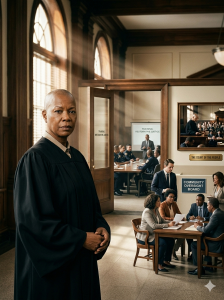
Sentencing day came under a heavier silence.
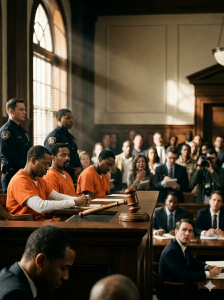
Rick and Brent wore orange now. No uniforms. No authority. Only restraint.
Wallace sat separately, hollowed out by his plea.
Whitaker was gone—indicted.
Denton had resigned.
Claudia entered with measured calm.
“Be seated,” she said.
She reviewed each file.
Wallace first.
“Eight years federal custody,” she concluded.
No emotion. Only record.
Then Rick and Brent.
They did not speak.
They did not need to.
The evidence had already spoken for them.
When the sentences were read, the room did not cheer.
It exhaled.
A system had finally been forced to acknowledge itself.
Claudia closed the final file.
Her hand rested briefly on the bench.
Not in relief.
In recognition of what it cost.
Then she stood.
“Court is adjourned.”
Officer Donnelly, Claudia began, her voice steady. “Throughout this trial, you have shown no remorse. You maintained that your actions were justified, even when confronted with overwhelming evidence of your cruelty.”
Rick’s jaw tightened, but he remained silent.
Officer Karns, you attempted to present yourself as the more reasonable partner, yet the evidence showed you were often the one driving escalation, encouraging aggression while concealing yourself behind Officer Donnelly’s more visible brutality.
Brent kept his eyes lowered, refusing to meet her gaze.
Your actions represent the most severe abuse of police authority. You targeted citizens based on race, fabricated charges to justify unlawful arrests, and used violence to silence those who questioned you.
Claudia lifted another document. “The pre-sentencing report lists 32 prior complaints against both of you, all suppressed by a corrupt system.” The gallery stirred at her words.
Several of those complainants were present in the courtroom, finally witnessing accountability after years of silence.
Richard Donnelly, this court sentences you to 12 years in federal prison, followed by 10 years of supervised release.
She turned.
Brent Karns, this court sentences you to 15 years in federal prison, followed by 10 years of supervised release.
Both of you are permanently barred from any law enforcement position and must complete extensive civil rights training prior to release.
Their attorney rose immediately to object, but Claudia continued, her voice rising above him. The sentences reflect not only your assault on me, but your sustained pattern of abuse against this community.
You violated your oaths, betrayed your badges, and turned your authority against the people you were sworn to protect.
Her gaze moved across the packed courtroom—the young public defender they had once humiliated, the court interpreter still bearing the scars of past violence, and the many others who had been forced into silence.
“Let today’s ruling make something clear,” Claudia said, her voice filling the chamber. “The law is not a shield for the powerful. It is a safeguard for the people. No badge, no robe, no office grants immunity from justice.”
Applause broke out across the gallery. The bailiff did not intervene.
“This court has one final order,” she continued once the room settled. “All case files previously sealed by Chief Judge Whitaker will be reviewed by an independent commission. Every complaint suppressed, every voice ignored, will be heard.”
Rick and Brent were led away in chains, their defiance reduced to silence. Wallace followed with his head bowed. Years of unchecked authority ended in the sound of metal cuffs.
Reporters rushed out, already broadcasting the developments. Attorneys embraced their clients. Some wept openly. The system, long stalled by corruption, had finally begun to move.
Claudia remained at the bench, watching it all. She thought of that morning in the holding room—the clippers, the laughter, the humiliation meant to break her. Instead, it had exposed something far larger than them.
The federal investigation was widening daily, reaching into other departments, other courthouses. Whitaker’s indictment had opened sealed archives. Denton’s resignation marked only the first collapse in a much larger structure.
Weeks later, the courthouse no longer felt the same.
The halls had changed—not just in appearance, but in atmosphere. Where intimidation once lingered, accountability now took its place.
Claudia walked through the corridors, her steps measured on polished stone. Staff nodded as she passed. A young public defender quietly said, “Thank you,” as they crossed paths.
Even the new security officers moved differently now—disciplined, professional, no longer relying on dominance.
Through glass walls, she saw officers in mandatory training sessions on bias and conduct. In another wing, oversight officials reviewed complaint files openly. Public reports were displayed in the lobby, tracking misconduct, responses, and resolutions.
Marcus caught up to her. “Judge Hayes, have you seen the news?”
She had not needed to.
The announcement had already spread: her nomination as chief judge of the district. The statement praised her role in exposing corruption and driving reform.
“It’s on every network,” Marcus added.
Claudia adjusted her robe lightly. “The position isn’t what matters. It’s what we do with it.”
In her chambers, community leaders waited.
Reverend Thompson stepped forward. “You did what decades of protest couldn’t—you turned personal harm into systemic change.”
Dr. Rodriguez nodded. “Oversight boards are already working. Complaint response times are down significantly.”
Professor Chen added, “Other districts are adopting the reforms. They’re calling it the Hayes model.”
Claudia listened, noting the shift in tone—from frustration to belief.
“This is only the beginning,” she said. “These changes have to survive beyond any one person.”
Later, alone in her chambers, she stood before the mirror.
Her hand rose to her scalp—not in habit, but recognition. What had once been intended as humiliation had become something else entirely. A symbol.
Some women had begun shaving their heads in solidarity. Young lawyers wore cropped hair in quiet protest. What was meant to diminish her had become a form of resistance.
On her desk lay the ongoing reforms—training protocols, accountability systems, community oversight frameworks. The scope of work was vast.
But for the first time, it felt possible.
A knock came. Lydia stood at the door, now reinstated as oversight coordinator.
“The afternoon session is ready.”
Claudia nodded and reached for her robe. It no longer felt like authority alone—it felt like responsibility.
Her walk to the courtroom was different now. New clerks passed with purpose. Former staff had become witnesses willing to speak. Community representatives now held formal seats in the process.
Marcus handed her the docket.
“Ready, Your Honor?”
“Always,” she said.
The gallery was full again—but transformed. Not tense, not fearful. Present. Engaged.
Public defenders sat with confidence. Officers stood with restraint learned through accountability. Civilian observers recorded proceedings openly.
“All rise,” the bailiff called. “Court is now in session. The Honorable Judge Claudia Hayes presiding.”
She took her seat and surveyed the room.
Law students. Reform advocates. Citizens who once had no voice.
The gavl rested in her hand. No longer just order imposed—but justice applied with transparency.
She brought it down.
The sound echoed clearly.
Cases would proceed. Rights would be heard. Accountability would continue.
And this time, it was not performance.
It was justice.
