

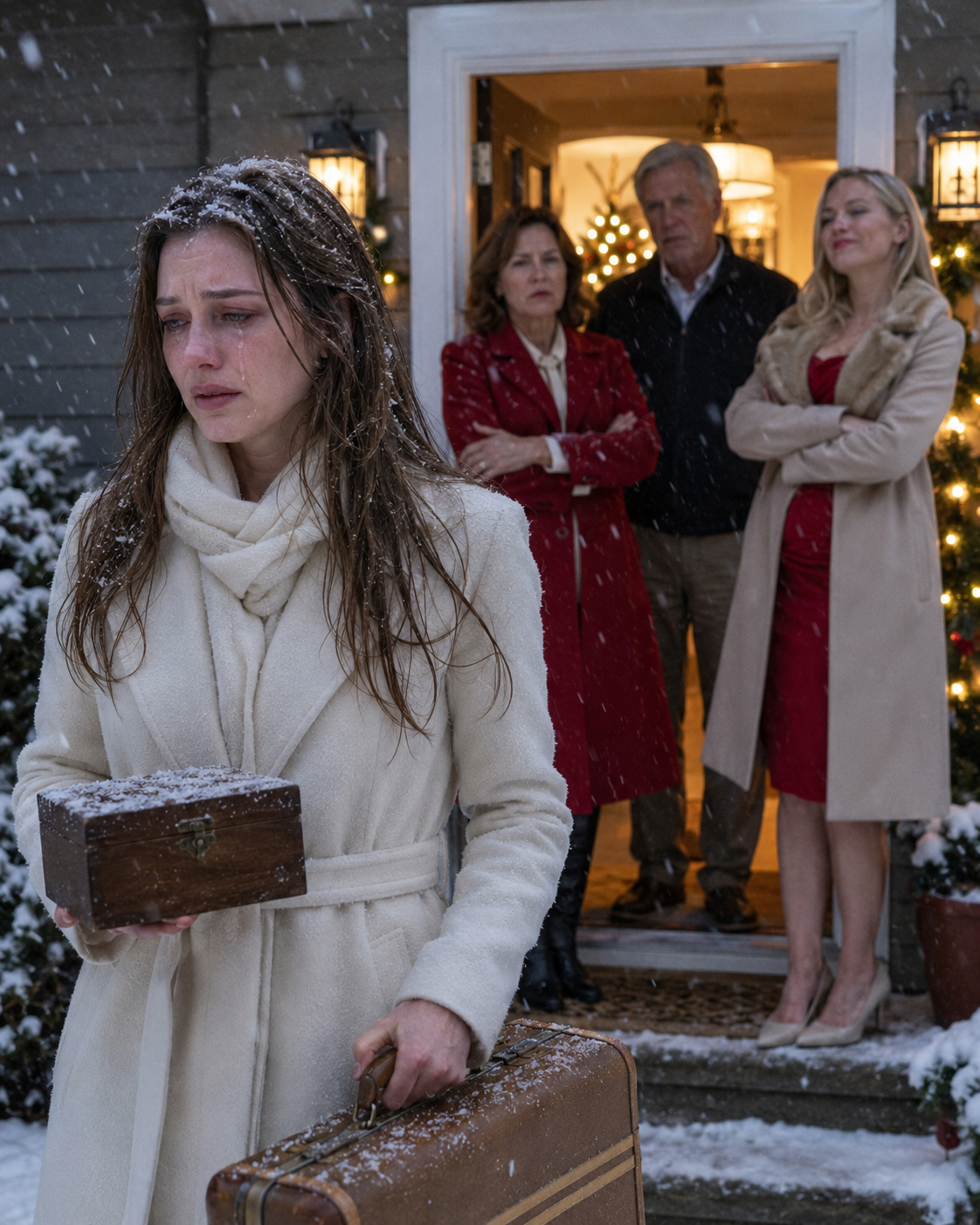
My parents kicked me out before the Christmas turkey had even made it into the oven. My sister Madison stood behind them in a red cashmere sweater, smiling as she whispered, “Back to your place, loser.”
Snow whipped across the porch as my father pushed my suitcase toward me.
“Enough, Claire,” he snapped. “You’ve embarrassed this family long enough.”
I stared at him. “By losing my job?”
“By failing at everything,” Madison answered for him.
Six months earlier, the marketing company I worked for had folded. Since then, I’d been freelancing out of a tiny apartment while I rebuilt my savings. To Madison, who leased a Mercedes and posted pictures from restaurants she couldn’t actually afford, that made me pathetic.
Mom crossed her arms.
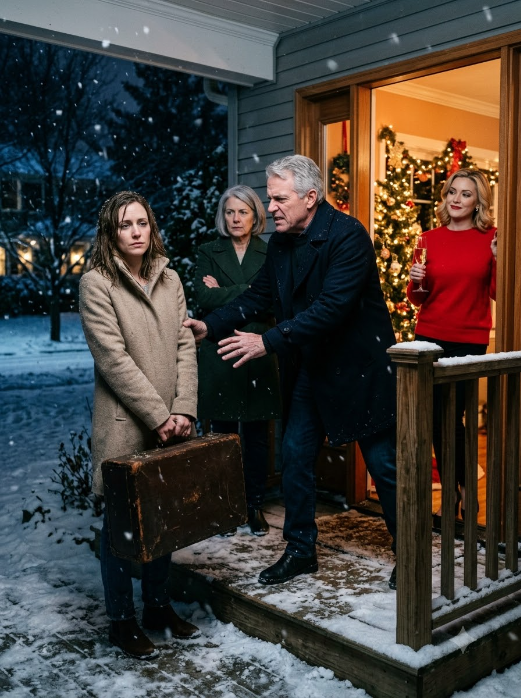
“Your sister is getting engaged tonight. We don’t need your negativity ruining Christmas.”
I nearly laughed.
I had cooked half the dinner.
I had bought Mom’s medication.
And three weeks before, Dad had quietly asked me for $4,000 because his business account was “temporarily tight.”
But I didn’t say a word.
That was something Grandpa Arthur had taught me.
“When people think silence means weakness,” he once told me, “let them keep thinking.”
Grandpa had died eight months earlier. Unlike my parents, he never measured people by cars, titles, or social media posts.
At his funeral, his attorney handed me a small cedar box.
“Your grandfather specifically instructed that only you receive this.”
Madison had laughed.
“What’s inside? His old fishing hooks?”
I hadn’t opened it.
Grandpa had taped an envelope across the lid.
OPEN ONLY WHEN YOUR FAMILY SHOWS YOU WHO THEY REALLY ARE.
Christmas morning made that clear enough.
I hauled my suitcase through the snow toward my dented Honda while laughter spilled out from behind the closed front door.
Then Madison opened it again.
“Oh, Claire?”
I turned.
She lifted Dad’s champagne glass.
“Don’t come crawling back when Ethan and I take over Dad’s company.”
Dad laughed behind her.
Something inside me went cold.
Not broken.
Cold.
An hour later, I walked into First Cedar National Bank with Grandpa’s box tucked under my coat.
The lobby was nearly empty.
I gave the receptionist my name and said, “I need someone to help me understand what my grandfather left me.”
Ten minutes later, branch manager Thomas Reeves invited me into his office.
He looked worn out until I set the cedar box on his desk.
Then every bit of color drained from his face.
“Where did you get that?”
“My grandfather. Arthur Hale.”
Mr. Reeves stared at me, then stood abruptly, closed the blinds, and locked the office door.
The click sounded unnaturally loud.
“Miss Hale,” he said slowly, “you need to sit down.”
I didn’t.
“What is this?”
He looked at the box again.
“Your grandfather didn’t leave you a keepsake.”
He swallowed.
“He left you control.”
Part 2
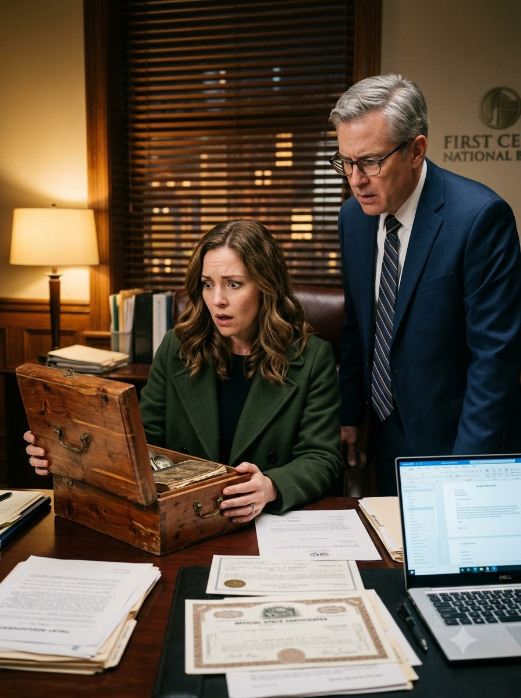
Mr. Reeves used a brass key hidden beneath the cedar lining.
Inside were trust documents, stock certificates, bank instructions, and a sealed digital drive.
My hands only began shaking once I saw the numbers.
Grandpa had owned sixty-two percent of Hale Development — the company my father had spent twenty years telling everyone was his.
“It was never transferred to your father,” Reeves explained. “Arthur retained controlling ownership through a private trust.”
“And now?”
“Now the controlling beneficiary is you.”
I stared at him.
My father’s house, the company headquarters, two rental properties, and even the land under Madison’s luxury townhouse had all been purchased through subsidiaries owned by that trust.
But there was more.
Grandpa had suspected Dad and Madison were siphoning company money.
The drive held bank records, emails, and copies of unauthorized loans.
Madison had used company guarantees to finance her lifestyle.
Dad had signed off on them.
Nearly $1.8 million was exposed.
“They thought your grandfather was too sick to notice,” Reeves said.
I remembered Grandpa’s final months. Everyone called him confused.
Everyone except me.
Then Reeves played a video.
Grandpa appeared on the screen in his old gray cardigan.
“Claire,” he began, “if you’re watching this, they finally chose greed over you.”
My throat tightened.
“I gave your father opportunity. I gave your sister patience. They mistook both for permission.”
He explained that I had ninety days after opening the box to decide whether to take control or dissolve the trust’s involvement entirely.
Then he smiled.
“You always had the clearest head in this family. Don’t use power because you’re angry. Use it because it’s necessary.”
I cried for exactly thirty seconds.
Then I called a lawyer.
By afternoon, Christmas back at my parents’ house had apparently turned magnificent.
Madison posted photos online.
Her diamond engagement ring sparkled beneath the caption:
THE HALE EMPIRE’S NEXT CHAPTER.
I nearly admired the timing.
At 4:17 p.m., Dad called.
“You left some junk here.”
“Keep it.”
He sighed dramatically. “Claire, maybe today got emotional.”
Interesting.
Not cruel.
Emotional.
Then he went on, “I need that four thousand you promised to replace next month.”
“I already gave you four thousand.”
“Yes, but Madison’s engagement party deposits are due.”
I looked across the conference table at attorney Lena Cross.
She shook her head silently.
I smiled.
“No.”
Dad’s voice hardened instantly.
“Excuse me?”
“You heard me.”
“You’re living in a shoebox and suddenly you’re arrogant?”
Madison grabbed the phone.
“God, Claire, stop being bitter. Ethan’s family has connections. Dad is making me executive vice president in January.”
Lena slid a document across to me.
Emergency suspension of corporate spending authority.
I signed.
Madison kept talking.
“One day you’ll realize some people are simply meant for more.”
“I already have,” I said.
At 9:00 the next morning, Dad’s corporate cards stopped working.
By noon, Madison’s Mercedes lease payment bounced because the company reimbursement account had been frozen.
At 2:00, Dad stormed into First Cedar demanding answers.
Mr. Reeves gave him only one sentence:
“The controlling shareholder has ordered a forensic audit.”
Dad called me seventeen times.
I picked up on the eighteenth.
“What did you do?” he roared.
I looked at Grandpa’s cedar box.
“Nothing yet.”
Then I added quietly:
“But you should probably cancel Madison’s engagement party.”
Part 3
They didn’t cancel it.
That turned out to be their final mistake.
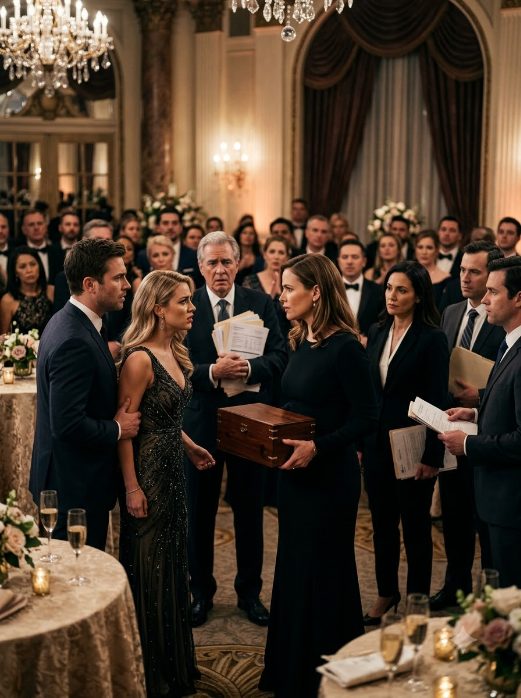
Madison insisted the party go on at the Hale Grand Hotel, another property partly owned through Grandpa’s trust. Two hundred guests showed up Saturday night expecting champagne, speeches, and the announcement of Madison’s promotion.
I arrived in a simple black dress.
Madison spotted me and nearly laughed.
“You actually came?”
Dad marched over.
“You freeze company accounts, humiliate me at my bank, and then walk into my event?”
“Your event?”
His jaw tightened.
“Don’t play games.”
Madison stepped close enough that I could smell her perfume.
“Whatever stunt you’re pulling, Grandpa is dead. Dad owns the company.”
“No,” said a voice behind me.
Lena Cross approached with two accountants and a process server.
“He doesn’t.”
The room seemed to shrink.
Dad stared at her.
Lena handed him the trust documentation.
“Arthur Hale retained sixty-two percent controlling ownership. Upon his death, those voting rights passed to Claire Hale.”
Madison laughed, too loudly.
“That’s impossible.”
I set Grandpa’s cedar box on the cocktail table.
“That’s what you said about the box.”
Dad flipped through the pages.
His expression changed.
First disbelief.
Then fear.
Then calculation.
“Claire,” he whispered. “We’re family.”
I almost smiled.
Twenty-four hours earlier, I had been an embarrassment.
Now I was family.
Lena continued.
“The forensic audit also identified approximately $1.8 million in unauthorized loans, reimbursements, and transfers.”
Ethan, Madison’s fiancé, slowly turned toward her.
“What loans?”
“Nothing,” Madison snapped.
One of the accountants opened a folder.
“Eighty-three thousand dollars in company funds used for personal travel. One hundred forty-six thousand for vehicles. Two hundred twelve thousand transferred through a consulting entity registered to Miss Hale.”
Ethan stepped back.
Madison’s face fell apart.
“Dad approved everything!”
Every eye turned toward him.
Dad hissed, “Shut up.”
Too late.
I had never planned to humiliate anyone in public.
They did that to themselves.
I stepped forward.
“Effective immediately, Dad, you’re suspended as president pending the audit. Madison, your employment offer is withdrawn. All company-funded personal benefits are terminated.”
Madison stared at me.
“You can’t take my house.”
“The company owns the land beneath it.”
Her lips parted.
“And your mortgage lender received inaccurate financial disclosures backed by company guarantees. My attorneys will handle it.”
Dad grabbed my arm.
“After everything we gave you?”
I looked at his hand until he let go.
“You gave me a suitcase in the snow.”
Silence.
Then Ethan lifted Madison’s engagement ring off the table, where she’d set it beside her champagne.
“I think this belongs to my family until we talk.”
“Ethan!”
He walked out.
Three months later, the audit led to civil fraud claims against Dad and Madison. Dad gave up his executive position and sold off most of his personal assets to cover part of the losses. Madison lost her townhouse, her car, and the consulting company she’d used to funnel payments.
Neither went to prison — the evidence pointed to financial misconduct, but the settlement and restitution agreement resolved most of the claims.
I was fine with that.
Prison would have let them call themselves victims.
Living with the consequences gave them no such comfort.
A year later, Hale Development posted its strongest quarter in six years.
I didn’t become CFO.
Instead, I hired someone qualified and took the chairwoman’s seat Grandpa had set aside for me.
On Christmas morning, I drove out to his old cabin overlooking Cedar Lake.
His cedar box sat beside the fireplace.
Snow fell outside.
My phone buzzed once.
A message from Madison:
Can we please talk?
I turned the phone facedown.
Then I poured coffee, watched the snow settle over the lake, and finally understood Grandpa’s last lesson.
Revenge wasn’t about making them feel the cold I’d felt outside that door.
It was building a life warm enough that I never had to knock on their door again.
