


My husband texted me: “I just inherited millions of dollars! Pack your things and get out of my house!” When I got home, the divorce papers were already sitting on the table. I signed them without hesitation and said: “Good luck—but you forgot one thing…” He and his mistress traded knowing smiles. Months later, I was flourishing in my new life… while he was left drowning in regret, trying to track me down again.
I never thought forty-two years of marriage would end with a text message.
But there it was—lit up on my phone at three in the afternoon while I stood in our suburban Sacramento bedroom, folding laundry.
I just inherited millions. Pack your things and get out of my house.
My hands went still around one of Robert’s white button-down shirts—the same kind I had washed and pressed for decades. This was the man who once promised to love me for better or worse, for richer or poorer. Apparently “richer” came with new terms.
My name is Margaret Chen—most people call me Maggie. I was sixty-seven that fall. A retired schoolteacher. Grandmother of three. And until that moment, Robert Chen’s wife.
We lived in a modest three-bedroom house in a quiet Sacramento neighborhood, where the maples turned deep red every autumn and neighbors still greeted each other by name. It wasn’t extravagant—but it had been our life. Or so I thought.
Looking back, the months before that message had felt… off.
At first the shifts were subtle. Then they became impossible to miss.
Robert had started hitting the gym—something he’d never bothered with before. A new cologne appeared. His phone suddenly had a passcode. He began staying late at work more often, coming home buzzing with a restless energy I didn’t recognize.
The signs were right there. Plain to see.
But trust has a way of blinding you.
And I trusted him.
Then his uncle Lawrence passed away.
In forty-two years, I’d met the man twice. Wealthy. Eccentric. A tech investor who lived wherever suited him and never settled anywhere. When Robert got the call, he didn’t look grief-stricken.
He looked… charged.
“He left everything to me,” Robert said that evening, pacing the living room as golden light slanted through the blinds. “Everything, Maggie. We’re talking millions.”
I was thrilled. Genuinely thrilled.
I started imagining what it might mean for us.
Trips we’d always postponed. Helping our daughter Jessica with her mortgage. Building college funds for the grandchildren.
But something in Robert’s face unsettled me.
A coldness I’d never seen there before.
“This changes everything,” he said.
And the way he said everything made my stomach clench.
Over the following weeks, while lawyers untangled the estate, Robert changed so fast it barely felt real. Designer suits. Talk of “fresh starts.” A trace of perfume that wasn’t mine.
I wasn’t naïve.
I just wasn’t ready to face it.
Then came the second message.
The divorce papers are on the kitchen table. Sign them. This is my inheritance, my money, my house. You contributed nothing.
Nothing.
That word cut deeper than anything else could have.
Nothing.
I had worked while he finished school. Raised our children. Handled every bill, every crisis, every holiday, every detail of our shared life. Stood beside him through loss and failure and fear.
Nothing.
My hands were shaking as I walked into the kitchen.
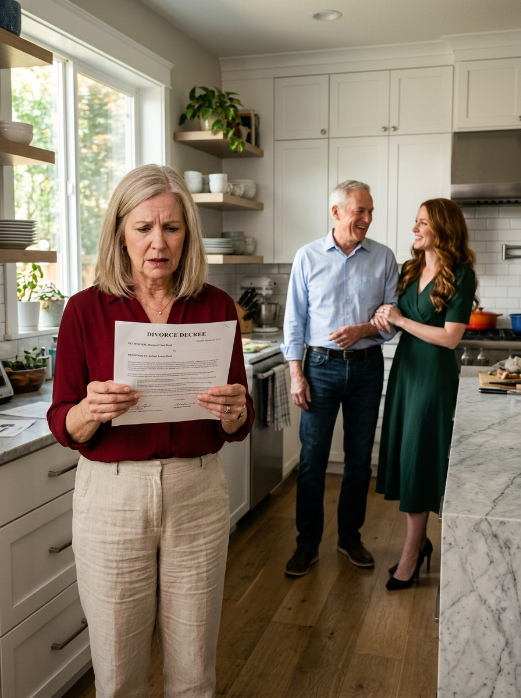
The papers were right where he said they’d be—laid out neatly on the table where we’d shared thousands of meals. His signature already scrawled across the pages.
Then I heard a car pull up.
The front door opened.
Robert walked in.
He wasn’t alone.
She trailed in behind him—young, polished, sure of herself. Maybe mid-thirties. The kind of smile that already believed it had won.
“Oh, good,” Robert said, casual as ever. “You’re still here.”
He tossed his keys on the counter like it was any ordinary evening.
“Maggie, this is Vanessa. Vanessa, this is—well. Soon to be my ex-wife.”
Vanessa offered a small, almost bright wave.
“Sign the papers, Maggie,” Robert said, loosening his tie. “Let’s not drag this out. Take your personal things. I’ll even give you ten thousand dollars to get started somewhere else. But this house, this life—it’s mine now.”
I looked at him.
Truly looked at him.
At a man who believed money had rewritten the past.
At a woman standing in my kitchen as if she’d always belonged there.
And suddenly, everything in me went still.
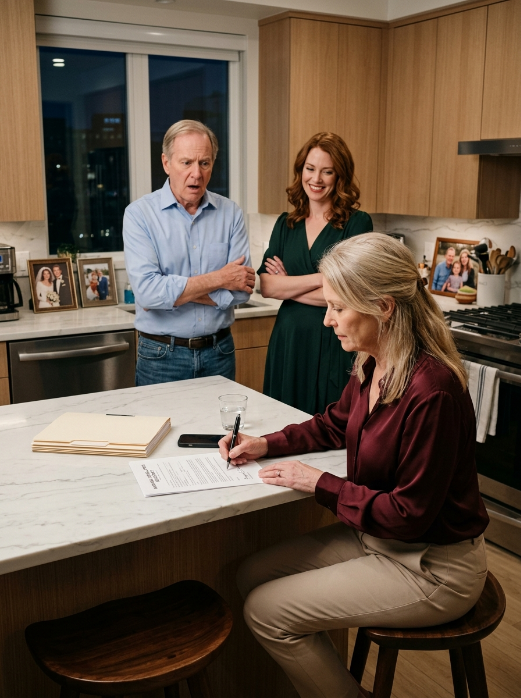
“Of course,” I said, picking up the pen. “I’ll sign.”
He blinked, caught off guard. He’d expected tears. Rage. A scene.
Instead I signed each page cleanly. The same signature I’d once written on our marriage certificate forty-two years before.
I slid the papers back across the table.
“I wish you luck,” I said calmly. “But Robert—you forgot something.”
He barely registered it. He was already smiling at Vanessa.
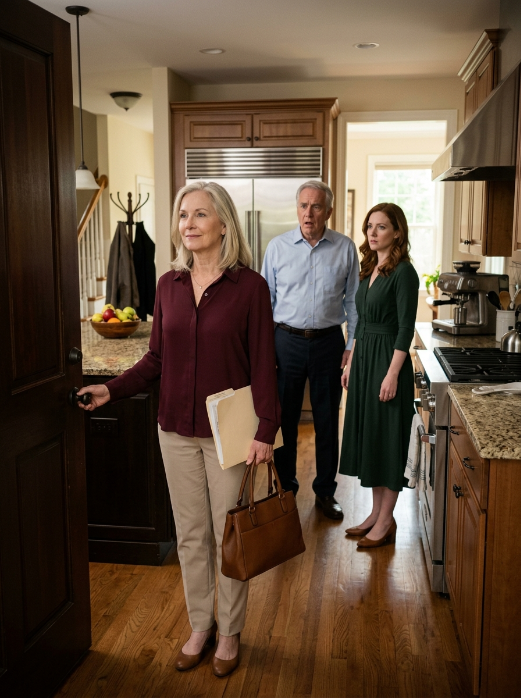
I picked up my purse and headed for the door. Then I stopped and turned back.
“You forgot that this house is in my name,” I said. “Only mine. It has been for twenty-three years.”
The look on his face—
That moment—
It almost made all of it worth it.
Almost.
I drove to Jessica’s in a fog, gripping the wheel as the sun sank low. I felt cold despite the heat.
Jessica opened the door, took one look at my face, and pulled me inside.
“Mom, what happened?”
I told her everything.
Her expression went from worried to furious in seconds.
“That man…” she muttered, dropping her voice because Tyler was in the next room. “Mom, you cannot let him get away with this.”
“I’m not going to,” I said quietly.
That night, lying in her guest room, sleep wouldn’t come.
My thoughts kept spinning—then sorting—then calculating.
What did I still have?
What could I protect?
What could I rebuild?
One thing was certain.
The house was mine.
Twenty-three years earlier, when Robert’s mother was diagnosed with dementia, we’d put the house solely in my name to shield it from potential nursing-home claims. Robert had agreed without a second thought at the time. He’d probably forgotten that deed existed. But what else did I actually have?
Our bank accounts were joint. Our retirement funds would be split. I had my teacher’s pension, small but reliable. Robert’s 401(k) was much bigger—and in California, I knew half of it was mine. The inheritance, though, was a different question entirely.
I opened my laptop and started digging into California family law, the screen’s glow burning into my eyes as the hours slipped by.
Inheritance received during a marriage was usually treated as separate property.
Unless it had been blended with shared funds.
Unless he’d made careless moves.
Unless he’d treated it as joint money before suddenly claiming it as his own.
I still didn’t know the details.
I didn’t know where the money was, how much of it there was, or what he’d already done with it.
Had he moved it? Spent it? Hidden it? Promised it to someone?
A sharp jolt of fear rose in my chest, and I had to shut the laptop and steady my breathing.
What if I ended up with next to nothing?
I was sixty-seven. I had a pension, some savings, a house. But what about healthcare? The future? The years when you’re not supposed to have to start over?
Then his words came back to me.
You contributed nothing.
And something in me shifted. Hardened.
Fear, I realized, was exactly what Robert was banking on. Fear would make me settle for less. Fear would make me grateful for scraps. Fear would make me small.
By six the next morning, Jessica found me at her kitchen table, surrounded by printouts, handwritten notes, and a cold cup of coffee.
“Mom, did you even sleep?”
“I need a lawyer,” I said. “A good one. The best divorce attorney in Sacramento.”
Jessica sat across from me and pushed a fresh cup of coffee into my hands.
“I know someone,” she said. “Rebecca Torres. She handled Amanda’s divorce last year. She’s tough. Really tough.”
“Good,” I said. “I need tough.”
She studied me for a moment.
“What are you planning?”
I met her eyes.
“Your father thinks he can toss me aside after forty-two years. He thinks that inheritance makes him untouchable. He thinks I’m weak.”
“You’re not weak, Mom.”
“He’s about to find out how wrong he is.”
I pulled out my phone and started a list.
First: document everything—every asset, every account, every property.
Second: secure what was mine—the house, my pension, my share of the savings.
Third: find out exactly what Robert had inherited and what he’d done with it.
Jessica reached over and squeezed my hand.
“What can I do?”
“Help me remember,” I said. “Everything. Every sacrifice. Every time I backed your father’s career, his schooling, this family. I need all of it.”
The next few days blurred into constant motion.
I opened a new bank account and moved half of our joint savings. I redirected my pension deposits. I pulled together tax returns, mortgage papers, insurance documents, old emails, retirement statements—and the deed to the house.
Then I walked into Rebecca Torres’s downtown office. The sleek glass building made me feel briefly out of my depth—until I met her.
Hope, it turned out, could show up in sharp heels with silver streaks through black hair.
“Mrs. Chen, your husband has already made several serious mistakes. I’m going to make sure he pays for every one of them.”
She moved fast. Within forty-eight hours she’d filed a formal response to Robert’s divorce petition and demanded full financial disclosure. Every account. Every asset. Every transfer. Every dollar from Lawrence’s estate.
“He has thirty days to comply,” she said. “But I doubt he’ll be honest.”
“What happens if he lies?”
Her smile was exact.
“Then we catch him. And judges have no patience for liars—especially ones hiding money during a divorce.”
Then she suggested something I never expected to need.
A private investigator.
Days later, I sat across from a former detective named Marcus Webb, looking through photographs of my husband’s secret life.
“They’re not being subtle,” Marcus said, sliding the images toward me.
Restaurants. Hotels. Shopping bags.
Robert’s arm around Vanessa.
Robert laughing.
Robert looking at her the way he used to look at me.
I made myself focus. “Where’s the money coming from?”
Marcus pulled out bank records.
“That’s the interesting part. He opened a private account two weeks after his uncle died. That’s where the inheritance went. But he’s moving money—and spending it fast.”
He pointed to the transactions.
“A new car. Sixty thousand. Jewelry. Fifteen thousand for a bracelet.”
My stomach turned.
“Can we use this?”
“Absolutely,” he said. “If he used marital funds on an affair, that matters. And if he mixed separate money with shared assets, that matters even more.”
Meanwhile, Robert was starting to unravel a little.
I could hear it in the way he called Jessica—trying to sound offhand, failing to hide the cracks.
“He wanted to know where you were staying,” she said. “What you were planning. I told him you were with a friend and that you’d hired a lawyer.”
“How did he take it?”
“He laughed,” she said, jaw tight. “Said you couldn’t afford a good lawyer. Said you’d come crawling back once you realized you had no options.”
I looked down into my coffee and said, “Arrogant people make mistakes.”
Robert made them in bunches.
Two weeks later, Rebecca got his financial disclosure packet. It was incomplete in ways so obvious they were almost insulting. He’d listed the house as his asset even though the deed was solely in my name. He’d undervalued his 401(k). He’d listed Lawrence’s inheritance as separate property not subject to division and valued it at 2.3 million dollars.
Rebecca’s eyebrows went up.
“That’s a substantial inheritance,” she said. “But here’s the detail I care about.”
She turned another page toward me.
“He deposited the inheritance into his new account, yes. But then he moved five hundred thousand dollars into your joint account for three days before pulling it back out.”
I stared at the page.
“What does that mean?”
“It means he commingled the funds,” she said. “The moment he blended inherited money with a marital account, he created a serious problem for himself. At minimum, part of that money is now subject to division. Depending on how the court sees it, possibly more.”
Something opened up in me—not relief exactly, not yet, but possibility.
The real breakthrough came a week later.
Marcus called and told me to get to his office right away. When I arrived, he had Vanessa’s Instagram pulled up on his computer.
“Look at the last month,” he said.
I scrolled through photos of expensive dinners, designer shopping bags, the diamond bracelet, hotel balconies, champagne. Then my breath caught.
Vanessa and Robert were standing in my living room.
My living room.
In my house.
The photo had gone up three days earlier.
The caption read: New beginnings in our beautiful home.
“She’s been living there since the day after you left,” Marcus said quietly. “That’s what the metadata suggests.”
Then he scrolled further.
Another photo. Vanessa’s hand angled to catch the light. A massive ring on her finger.
The caption: He finally made me the happiest woman alive. Can’t wait to start our forever.
Posted the day before.
Robert had proposed to her in my house, using money that might legally be at least partly mine, while we were still married.
When I showed the posts to Rebecca, her eyes went sharp.
“Oh,” she said. “This is perfect.”
I stared at her. “Perfect? He’s engaged to another woman.”
“Mrs. Chen,” she said, calm and focused, “your husband just handed us proof of everything we need. Proof of the affair. Proof that he moved another woman into the marital home. Proof that he spent potentially shared funds on her. Proof that he’s behaving recklessly while a divorce is pending. We’re filing for emergency relief.”
She started typing before she’d even finished the sentence.
“I’m asking the judge to remove both Robert and Vanessa from your home immediately and freeze any accounts that may hold those inherited funds until we sort out what belongs to whom.”
My hands were shaking.
“Will it work?”
Rebecca met my eyes.
“You’ve been patient. You’ve been methodical. You’ve gathered the evidence. Now we stop reacting and start striking.”
For the first time since Robert’s text, I smiled. A real one. My house wasn’t going anywhere, and neither was I.
The emergency hearing was set for Thursday at nine.
I wore my navy suit, the one I used to wear to parent-teacher conferences when I needed to project calm authority. Rebecca coached me in the parking lot.
“Speak clearly. Stay calm. Only answer what you’re asked.”
Judge Patricia Morrison looked like a woman who’d heard every excuse a person could invent. Steel-gray hair, sharp glasses, a level stare. Robert sat across the courtroom beside a jittery young lawyer who kept fussing with his tie. Robert himself looked almost at ease, as if this were a minor inconvenience rather than the start of his unraveling.
That changed once Rebecca stood.
She laid out the Instagram posts, the bank records, the purchase receipts, the evidence of commingled funds, the proof that Vanessa had moved into my home.
Judge Morrison went through the documents with mounting displeasure.
“Mr. Chen,” she said finally, “you moved your fiancée into the marital residence while divorce proceedings were pending?”
Robert’s lawyer shot up.
“Your Honor, my client believed he had the right to occupy the home.”
“The home titled solely in Mrs. Chen’s name?” the judge asked.
A pause.
“Yes, Your Honor, but—”
“And you’ve been posting photos from inside this home on social media? You and your fiancée?”
I watched Robert’s composure crack at the edges.
The hearing ran an hour. Rebecca was sharp, almost clinical. By the time Judge Morrison ruled, the courtroom felt colder than when we’d walked in.
“Mr. Chen,” she said, “you have forty-eight hours to remove yourself and Miss Vanessa Cooper from Mrs. Chen’s home. All accounts containing funds that may have originated from the inheritance are hereby frozen pending full financial discovery. You are barred from purchases over five hundred dollars without court approval. Mrs. Chen is awarded temporary spousal support of four thousand dollars per month. Court will reconvene in thirty days for a full hearing on asset division.”
The gavel fell.
Robert’s face darkened alarmingly. He started to rise, but his lawyer pulled him back into his seat. I walked out of that courtroom on unsteady legs while Rebecca gathered her papers with brisk satisfaction.
“We won,” I said, in a voice that barely sounded like mine.
“We won round one,” she said. “Now comes the part where he retaliates.”
She was right.
That evening my phone filled with messages. First Robert: You’re going to regret this. I will destroy you. You’ll get nothing.
Then messages from numbers I didn’t recognize, hurling insults, accusing me of trying to steal what was his. Jessica called in a panic to say Robert had shown up at her workplace and started shouting in the parking lot about the judge, about his money, about me. Security had walked him out. Then my son David called, confused and upset, echoing the version Robert had fed him.
By nightfall I was sitting in Jessica’s guest room, phone in hand, feeling the walls press in.
Then the doorbell rang.
I heard Jessica’s voice downstairs, loud and furious. I stepped onto the landing and looked down.
Robert and Vanessa stood in Jessica’s entryway.
Robert’s face was flushed. Vanessa clung to his arm, her expression a mix of fear, indignation, and something theatrical.
“Maggie!” Robert called out when he spotted me. “Get down here. We need to talk.”
“The court gave you forty-eight hours,” I said quietly. “You need to leave my daughter’s home.”
“Your daughter?” He let out a bitter laugh. “She’s my daughter too. And you’ve turned her against me. You’ve turned everyone against me.”
Vanessa lifted her chin.
“You’re acting like a bitter woman who can’t stand to see him happy. That money is his. His uncle left it to him, not you.”
“That money was commingled with marital assets,” I said, surprising myself with how steady I sounded. “The judge already acknowledged that.”
“The judge is wrong,” Robert snapped, moving toward the stairs.
Jessica stepped in front of him.
“Dad, stop. You need to leave.”
He stared at her like he no longer knew her.
“Or what? You’ll call the police on your own father?”
“Yes,” Jessica said. “I will.”
Something in her tone finally landed. He stopped. His chest heaved once. Then he looked up at me with a dark fury that chilled me.
“This isn’t over, Maggie,” he said. “You think you’ve won? You haven’t. I’ll make sure you lose everything. The house. The money. Your reputation.”
“Dad,” Jessica said sharply. “Get out.”
Vanessa tugged at his arm.
“Come on,” she muttered. “She’s not worth it. Let her have her little victory.”
They left, but the threat lingered like smoke in the walls.
I stayed at Jessica’s for three more days, worn down to the bone. But on the fourth morning I woke with a strange clarity. Robert had shown me exactly who he was now: desperate, volatile, scared. Desperate people slip up. My job was to be ready when he did.
The call came on a Tuesday afternoon from an unknown number.
“Maggie? It’s Linda.”
Robert’s sister.
We’d always gotten along, or so I’d believed.
She asked if we could meet for coffee. My gut told me it wouldn’t be a friendly visit, but I agreed. We met at a Starbucks near her office downtown. Linda looked tired and uneasy, the way people do when they’ve been sent to carry someone else’s shame.
She stirred her latte far longer than necessary before speaking.
“Robert asked me to talk to you,” she said finally. “He’s a mess, Maggie. He’s not sleeping. He’s lost weight. This whole thing is wrecking him.”
I said nothing.
“He wants to make you an offer. A settlement.”
“What kind of offer?”
“You drop the court case, accept the divorce terms he originally proposed, and he’ll give you three hundred thousand dollars cash. No strings attached.”
A few months earlier, three hundred thousand dollars would have sounded like an unimaginable sum. Enough for a small condo. Enough for years of careful living. Enough to tempt fear into disguising itself as practicality.
“And what does he get?” I asked.
Linda looked into her cup.
“He keeps the inheritance. The house—well, you’d sign it over to him, he’d sell it, and your share of the proceeds would count as part of the three hundred thousand.”
I stared at her.
“So I’d get nothing from the house I’ve owned for twenty-three years.”
“Maggie, the house is worth maybe four hundred thousand. He’s offering you almost that in cash, and you’d skip legal fees, skip a trial, skip all this stress. The inheritance is separate property. Any lawyer will tell you that. You could fight this out to the end and walk away with less.”
I kept my voice even.
“Did Robert tell you he moved the woman he was seeing into my home the day after I left? Did he tell you he’s already spent around a hundred thousand dollars on her? Did he tell you he proposed to her while we’re still married?”
Linda flinched.
“He said you were twisting things.”
“I’m not twisting anything. There are photographs, bank records, court filings.”
Her hands tightened around the paper cup.
“He’s still my brother.”
“I know,” I said. “And I’m sorry you’re caught in the middle of this. But the answer is no.”
“Three hundred thousand, Maggie. That could be more than you end up with after all of this.”
“Then I’ll get less,” I said. “But I won’t be bought off, and I won’t reward what he did.”
Linda left looking defeated.
I sat there a while after she was gone, staring into my lukewarm coffee, asking myself the question frightened women ask when men try to rattle them with uncertainty: Am I being foolish?
Maybe I was. But this wasn’t only about money anymore. It was about whether Robert could believe he could discard me, erase me, and face no consequences.
That same week, Jessica talked me into attending a support group for women going through divorce. We met in a community center across town. I walked in feeling self-conscious and fragile, bracing for pity. Instead I found eight other women, ranging from their thirties to their seventies, sitting in a circle with coffee and store-bought cookies and the kind of hard-won honesty that steadies a room.
The facilitator, Dr. Sarah Kim, welcomed me warmly. I listened first.
Jen, whose husband had drained their accounts and moved to Mexico.
Patricia, whose ex-spouse had tried to turn their children against her.
Carol, who’d discovered the man she married had been living a second life in another state.
When it was my turn, I told my story. The words came easier than I expected. And when I finished, no one looked at me with pity.
“You’re doing the right thing,” Carol said firmly. “Standing up for yourself. A lot of us didn’t. We took whatever scraps we were handed because we were scared.”
“My ex tried the same thing,” Jen added. “A settlement that was a fraction of what I was owed. I almost took it. I’m glad I didn’t.”
That group became an anchor. Week after week they handed me back something the marriage had quietly drained out of me and the divorce had then torn away: perspective. Through them I also found practical help. Carol connected me with women from her church who helped me move some belongings out of storage and into a bright one-bedroom rental overlooking a small park. It wasn’t much, but it was mine. Clean, quiet, sunlit in the mornings.
David came to visit not long after I moved in.
He’d kept his distance since the separation, torn between loyalty and disbelief, but he sat in my new living room and listened as I laid out the bank records, the court documents, the photographs.
“Dad told me you were exaggerating,” he said quietly. “That you were making him look worse than he is.”
“I have never lied to you, David.”
“I know,” he said. “I know that now.”
He rubbed a hand over his face and suddenly looked younger, almost like the boy who used to wait for me after school in the library. “I just didn’t want to believe he could do this.”
We hugged, and another piece of my world slid back into place.
Rebecca called a few days later with an update. Robert had moved out of the house, but he was fighting nearly everything and gearing up for a long legal battle.
“Are you sure you want to keep going?” she asked. “He can drag this out for a year or more.”
“I’m sure,” I said.
And I meant it. I had something now that I hadn’t had at the start of all this: support. Witnesses. Community. I was no longer alone inside his version of events.
Then, on a Saturday morning without warning, Robert showed up at my apartment.
I was watering herbs on the windowsill when the knock came, loud and insistent. Through the peephole I saw him standing there alone, holding a cheap bouquet of grocery-store carnations—the kind he used to buy when he’d forgotten an anniversary.
Every instinct told me not to open the door.
And yet part of me—the part that had loved him for forty-two years—wondered whether, finally, he’d come to his senses.
I opened the door with the chain still on.
“Maggie,” he said, his voice low and worn out. “Please. Five minutes.”
“Say what you need to say from there.”
“I can’t do this through a crack in the door.”
His eyes were red. Weary. For one foolish second I let myself imagine remorse.
Against my better judgment, I unhooked the chain.
Robert stepped inside.
And then Vanessa emerged from the stairwell behind him with a faint smile.
My stomach dropped.
“What is this?”
I moved to shut the door, but Robert caught it with his hand.
“Wait. Just wait. Vanessa wanted to come too. She wanted to apologize.”
Vanessa walked in like she owned the place, heels clicking against my laminate floor, her cashmere sweater soft and expensive under my very modest kitchen light.
“Mrs. Chen,” she said in a syrupy tone, “I want you to know I feel terrible about all of this. About how things happened.”
I crossed my arms.
“Get to the point, Robert.”
He set the carnations on my counter.
“I’ve been talking with Vanessa, and we both agree this fight is pointless. It’s costing everyone. The lawyers are draining money. The court battles are exhausting. For what?”
“You tell me,” I said. “You’re the one who told me to leave.”
“I was angry,” he said. “I’d just inherited all that money, and it felt like—like it was finally my turn to have something that was just mine.”
Vanessa slipped her arm through his as if to steady the performance.
“But we’ve realized,” she said, “that fighting isn’t making anyone happy. So we want to propose a compromise.”
Here it came.
Robert pulled out his phone and showed me a document.
“We’ve drafted a new settlement. You get the house. We sign it over free and clear. You get four hundred thousand from my 401(k), and we cover your legal fees to date.”
“That’s generous,” Vanessa said, as though I’d asked for her opinion.
“And in return?” I asked.
Robert hesitated.
“You drop all claims to the inheritance. You acknowledge it’s separate property. And you agree not to pursue any further claims about financial waste or the affair.”
I looked from one of them to the other.
“So what you want is for me to take a smaller deal and quietly vanish.”
“We want everyone to move forward,” Vanessa said, her tone sharpening. “Robert and I are getting married. We’re building a life together. This hostility isn’t helping anyone.”
Something cold and very clear settled over me.
“I do not want him back,” I said.
Vanessa’s smile flickered.
Robert shifted, irritated now that the remorseful act wasn’t landing.
“Then what do you want, Maggie?” he asked. “Revenge? To make me suffer because I fell in love with someone else?”
“You did not fall in love,” I said quietly. “You had an affair. While I was caring for your mother in her final months, you were building a life with someone else. Then you inherited money and decided I’d served my purpose.”
Vanessa’s expression hardened completely.
“You know what your problem is?” she said. “You’re bitter. Robert finally found happiness, and you can’t stand it. That money is his. Eventually the court will agree, and you’ll end up with nothing but legal bills. We’re trying to help you.”
“Help me?” I gave one short laugh. “By offering me less than half of what I may legally be owed? By asking me to sign away my rights and pretend none of this happened?”
Robert’s face changed. The softness drained out of it.
“You’re making a mistake, Maggie. This offer won’t come again.”
“Good,” I said. “I don’t want it.”
His jaw tightened.
“Fine. We tried to be reasonable. If you want a fight, you’ll get one.”
Vanessa stepped forward.
“You think you’re going to win? His uncle’s will is airtight. The inheritance is his. Every dollar you spend fighting this is a dollar you won’t have later.”
“We have resources you can’t imagine,” Robert added. “I can drag this case out for years. I can bury you in fees.”
My heart was pounding, but my voice held steady.
“What I want is for both of you to leave my apartment now.”
“You’re going to regret this,” Vanessa said. “When you’re living alone in some tiny place, wishing you’d taken the deal—”
“Out,” I said.
Robert grabbed her arm and pulled her toward the door. At the threshold he turned back.
“I tried, Maggie. Remember that. I tried to make this easy for you.”
The door slammed behind them.
I stood there shaking.
Then I sat down on the couch and wrapped my arms around myself, because for a few minutes they’d managed to wake the fear back up. They were right about one thing: this could stretch on for years. Robert had money. I was paying legal fees. What if I lost? What if the inheritance stayed entirely his and I was left with debt, exhaustion, and nothing else?
Then I pictured Vanessa’s face. Robert’s threats. Their confidence that fear would break me.
And the fear turned into something harder.
They needed me to be afraid.
Because afraid women give up.
I called Rebecca and told her everything.
“They came to your apartment?” she said. “Did you record it?”
“No.”
“Next time, do. But tell me every word.”
I did. Every threat. Every manipulation. Every number.
When I finished, she was quiet for a beat.
“Then they’re scared,” she said. “Really scared. People don’t show up to make threats like that unless they know they have a problem.”
“So what do we do?”
“We keep pushing,” she said. “And we prepare for trial.”
The final hearing was scheduled for a Tuesday in late March, nearly six months after Robert had sent the text that ended my marriage and, strangely, began the rest of my life.
I barely slept the night before, but I wasn’t nervous in the old way anymore. I’d moved past that into a kind of calm certainty. I’d done everything I could. I’d told the truth. I’d gathered the records. I’d weathered the threats. The rest was up to the judge.
Rebecca met me outside the courthouse, briefcase full of documents. Robert was already inside with a new attorney—slick, expensive, the kind of man who made a career of shielding wealthy clients from consequences. Vanessa sat behind him in the gallery in a demure dress, her expression carefully arranged into innocence.
My children were there too. Jessica sat directly behind me, one hand on my shoulder. David sat beside her, jaw set. Both had agreed to testify if it came to that.
When Judge Morrison entered, the room rose.
Rebecca went first.
She laid out the timeline: Lawrence’s death on October 15. Robert’s text demanding I leave on October 29. Divorce filing on November 2. Vanessa moving into my house on November 5. The transfers of inheritance money through joint accounts. The purchase records showing money spent on Vanessa—jewelry, a car, travel, luxury shopping. The social media posts. The ring.
“Your Honor,” Rebecca said, “Mr. Chen received an inheritance of 2.3 million dollars. Within six weeks, he had moved or spent more than six hundred thousand. He claims the funds were separate property, but he commingled them. He used marital assets to support another relationship. He occupied property titled solely in Mrs. Chen’s name without her consent. He failed to make complete and honest disclosures.”
Robert’s lawyer stood.
“Mrs. Chen is bitter about the end of the marriage. The inheritance was clearly separate property under California law. Mr. Chen’s uncle left it to him and him alone. What he chose to do with his own money is his business.”
“It became partially or wholly community property the moment he deposited it into a joint account,” Rebecca replied. “And even if this court accepts that some portion remained separate, the expenditures on Miss Cooper were drawn from commingled funds. That’s indisputable from the banking record.”
Judge Morrison turned to Robert.
“Mr. Chen, is it true that you moved Miss Cooper into your wife’s home without her consent?”
Robert stood. I could hear the coaching in his careful, remorseful tone.
“Your Honor, I believed I had a right to occupy the residence. It had been our marital home for more than twenty years. I didn’t realize—”
“The deed has been in your wife’s name alone since 2003,” Judge Morrison interrupted. “Are you telling me you didn’t know that?”
He paused too long.
“I had forgotten.”
“You forgot who owned your house?”
His lawyer jumped in with talk of emotional strain following his uncle’s death and the marriage’s collapse, but Rebecca was already back on her feet.
“Let’s talk about timing,” she said. “Mr. Chen’s uncle died on October 15. Two weeks later, Mr. Chen demanded his wife leave. Three days after filing for divorce, he moved Miss Cooper into the home titled solely in Mrs. Chen’s name. That was not grief. That was calculation.”
“That’s not true,” Vanessa blurted from the gallery.
Every head turned.
Judge Morrison’s expression could have frozen glass.
“Miss Cooper, you are not a party to these proceedings. You will remain silent or you will be removed.”
Vanessa sat down, red-faced.
Then Rebecca called me.
I took the stand and answered questions about my marriage, my work, the years I supported Robert through business school, the household finances I managed, the care I gave his mother, the reason the house had been placed in my name.
“And when did you first learn about your husband’s relationship with Miss Cooper?” Rebecca asked.
“The day he told me to leave,” I said. “He brought her into our home. Into my home.”
Robert’s lawyer objected when Rebecca asked how that had felt, but Judge Morrison allowed it as relevant to support.
I looked straight at Robert when I answered.
“It made me feel like forty-two years of my life had been reduced to convenience. Like the moment he had money, I became disposable.”
Robert looked away.
Cross-examination came next. His lawyer tried to paint me as vindictive, angry, eager to grab an inheritance that wasn’t mine. But by then, calm had become one of my strongest weapons.
“Mrs. Chen,” he said, “isn’t it true that you’re simply upset your husband found happiness with someone else?”
“No,” I said. “I am upset that he had an affair, spent marital assets on another woman, and tried to take my home.”
Then Robert testified.
He spoke of a marriage that had supposedly been empty for years. He said he’d fallen in love. He said the inheritance was rightfully his. He tried to sound wounded, misunderstood, weighed down by circumstances bigger than himself.
Rebecca took him apart line by line.
“You testified the marriage was loveless,” she said. “Yet six months before your uncle died, you took a trip to Hawaii with your wife, correct?”
He shifted.
“Yes, but—”
“And in September, one month before your uncle’s death, you celebrated your forty-second anniversary at her favorite restaurant?”
“That doesn’t mean—”
“And you moved Miss Cooper into the home only after asking your wife to leave and filing for divorce, correct?”
He stumbled there.
“Yes.”
“How much money did you spend on Miss Cooper between October and January?”
“I don’t recall the exact amount.”
Rebecca slid a document toward him.
“According to the records you produced in discovery, the amount was one hundred twenty-seven thousand dollars. Is that correct?”
“If that’s what the records show.”
“Yes or no, Mr. Chen?”
“Yes.”
“And did you ask your wife’s permission before spending those funds on another woman while she was living in a rented apartment?”
“She’s not another woman,” he snapped. “She’s my fiancée.”
“The label isn’t the point,” Rebecca said. “The money is.”
Then came Vanessa.
At first she was composed, framing their relationship as some tragic, noble love that had arrived too late. But under questioning, she unraveled.
“When did Mr. Chen first tell you about his inheritance?” Rebecca asked.
“I don’t remember exactly.”
“Was it before or after your relationship began?”
Vanessa glanced at Robert.
“After.”
“How long after?”
“Maybe a few weeks.”
Rebecca placed printouts of text messages on the stand.
“These messages, obtained through subpoenaed phone records, show you discussing Mr. Chen’s uncle’s failing health in September, before his death. In one message, you wrote: Once you get that money, we can finally be together. Do you remember sending that?”
Vanessa went pale.
“That was out of context.”
“Did you send it?”
A long pause.
“Yes.”
No one spoke for a moment after that. The silence in the courtroom weighed more than any raised voice.
Judge Morrison ended proceedings for the day and said she’d reconvene at nine the next morning for closing arguments and her ruling.
Outside the courthouse, Rebecca let out a slow breath.
“We got them,” she said.
For the first time in months, I believed her completely.
I arrived early the next day with Jessica and David beside me. Whatever happened now, I knew I’d already survived the hardest part: the humiliation of being told I was nothing. The rest was numbers and law.
Judge Morrison took her seat promptly at nine.
“I have reviewed the testimony and evidence,” she began. “I am prepared to rule.”
My heart hammered against my ribs, but my face stayed still.
“First, regarding separate versus community property: Mr. Chen received an inheritance of 2.3 million dollars. Under California law, inheritance is generally separate property. However, Mr. Chen deposited these funds into a joint account held by both parties for three days before transferring them elsewhere. The moment those funds entered a community account, they became commingled.”
She looked at Robert over her glasses.
“Accordingly, I find that the inheritance, as handled in this case, is subject to equal division.”
Robert’s face went white.
“Second, regarding waste of assets: Mr. Chen spent one hundred twenty-seven thousand dollars on Miss Cooper during the marriage and separation period from commingled funds. This constitutes waste of community assets. That amount shall be charged against his share and awarded to Mrs. Chen.”
Vanessa half-rose from her seat in the gallery.
“This is ridiculous—”
“Sit down,” Judge Morrison said, without raising her voice, “or I will hold you in contempt.”
Vanessa sat.
“Third, the property at 1847 Maple Drive is titled solely in Margaret Chen’s name. It is her separate property. Mr. Chen has no claim to it.”
Relief hit me so hard I had to clasp my hands together to keep them from shaking.
The house was mine.
“Fourth, Mr. Chen’s 401(k) will be divided equally. Each party shall receive three hundred forty thousand dollars.”
“Fifth, the remaining inheritance, after deduction for waste, shall be divided equally between the parties.”
I did the math almost without thinking. The house. My half of the retirement. My share of the inheritance. The reimbursement for what he’d spent.
Robert was walking away with far less than the triumphant future he’d pictured.
“Sixth, permanent spousal support is awarded in the amount of three thousand dollars per month until Mrs. Chen’s death, remarriage, or further order of this court.”
Robert’s lawyer stood.
“Your Honor—”
“I am not finished.”
The courtroom fell still again.
“Seventh, given Mr. Chen’s actions—his unauthorized occupation of Mrs. Chen’s property, the dissipation of community assets, and his failure to provide complete and truthful financial disclosures—he is ordered to pay Mrs. Chen’s attorney’s fees in full.”
Rebecca stayed composed, but I could feel the satisfaction coming off her.
Then Judge Morrison said something I will never forget.
“Finally, I want to address what became clear during testimony. Mr. Chen, you treated your wife of forty-two years with contempt and cruelty. You carried on an affair, flaunted that relationship, and attempted to strip Mrs. Chen of both her home and her financial security. This court does not look kindly on such conduct.”
Robert’s hands curled into fists on the table.
“The divorce is granted,” she continued. “Mrs. Chen is awarded the marital residence in her sole name, her share of all accounts and inheritance as outlined, permanent spousal support, and attorney’s fees. Mr. Chen, you have thirty days to comply with the ordered transfers. This court is adjourned.”
The gavel struck.
Jessica squeezed my hand so hard it hurt. David wrapped an arm around my shoulders. Rebecca leaned in and whispered, “Congratulations, Maggie. You won.”
I looked across the courtroom.
Robert sat frozen, staring at the table as if the grain of the wood might somehow undo what had just happened. His attorney was already gathering files. Vanessa shot him a look full of anger, then turned and walked out without a word.
Outside, standing in the spring sunlight on the courthouse steps, I took the deepest breath I’d taken in six months.
It was over.
Yes, I’d won in court. But that wasn’t the whole of it.
I had reclaimed my dignity. My self-respect. My future.
Six months later, I sat on my patio watching the Sacramento sunset, a glass of wine in hand. I’d repainted the house, filled it with plants and framed artwork, and wiped away every trace of the life that once made me feel small. In December, I traveled to Italy alone and spent two beautiful weeks enjoying pasta, wine, and the quiet pleasure of rediscovering myself. I started painting again. Joined a book club. Volunteered at the library. My bond with Jessica and David grew deeper and more honest—because no one was pretending anymore.
I even started seeing a retired professor with gentle eyes and patient hands, though I kept that to myself at first. There was no rush. Happiness didn’t need an audience.
Through Linda, I heard how quickly Robert and Vanessa’s life fell apart. She left him just weeks after the ruling, furious over how much money he’d lost. She moved back in with her parents, and her carefully curated social media presence vanished. Robert ended up alone in a small condo, after a string of poor investments drained much of what he had left. He eventually left his job, the scandal costing him more than he’d expected. Our children kept their distance.
One afternoon, Linda told me, “He asks about you.”
“What do you tell him?” I asked.
“That you’re doing well,” she said.
That was enough.
I was sixty-eight, divorced—and happier than I’d been in years.
Looking back, that text message didn’t destroy my life.
It gave it back to me.
For too long, I had made myself smaller, quieter, easier to overlook. I accepted crumbs and called it love. Robert believed money would buy him freedom, admiration—maybe even a younger future. Instead, it brought him loneliness and consequences.
In the end, what I learned was simple, hard-earned, and worth every sleepless night:
It is never too late to stand up for yourself.
Dignity matters more than comfort.
And your worth has never depended on someone else choosing to see it.
