

**A Midnight Intrusion: One Woman’s Terrifying Escape from Her Husband’s Criminal Past**

My husband shook me awake in the middle of the night. “Get up—backyard, now!” His voice was low but urgent, cutting through the heavy silence of our suburban home. Disoriented and still half-asleep, I stumbled out of bed, grabbing our two young children from their rooms. We hurried downstairs in our pajamas, the cool night air hitting us as we slipped out the back door and crouched deep into the overgrown bushes at the edge of our yard. My heart pounded so loudly I was sure it would give us away. When I peered through the leaves and saw who walked into our house, my hands started shaking uncontrollably.
I didn’t move. I didn’t breathe. My mind refused to catch up with what my eyes had already confirmed. Two shadowy figures moved confidently through our living room, their silhouettes visible against the faint glow of a flashlight. They weren’t breaking in—they had a key. Or perhaps my husband had left the door unlocked for them. The realization sent a wave of nausea through me. This wasn’t a random burglary. This was something far more calculated, far more personal.
The men stayed inside for less than ten minutes. I counted every agonizing second, my arms wrapped tightly around my children, who whimpered softly in confusion. I whispered soothing words, trying to keep them calm even as terror clawed at my own chest. The house, our supposed safe haven in this quiet Colorado suburb, had become a stage for something sinister.
When they finally emerged, they carried a duffel bag—ours. I recognized the faded red strap immediately. It had been stored in the hall closet for years, used for family trips to the mountains or weekend getaways. Now it held secrets I couldn’t yet comprehend. They loaded it into a waiting black SUV parked at the curb and drove away without urgency, their taillights fading into the darkness like nothing extraordinary had happened.
My husband remained inside.
I waited until the house went dark again. Five minutes. Ten. Every second felt like glass scraping my nerves raw. The bushes scratched at my skin, and the damp ground seeped through my thin pajama pants. My children’s breathing was the only sound anchoring me to reality. What had I just witnessed? Who were these men, and what did they want from us?
Finally, I heard the back door open quietly.
“Come out,” he whispered into the night.
I didn’t respond. My body felt frozen, betrayal rooting me in place.
He stepped closer to the bushes. “It’s safe now.”
*Safe.* The word echoed mockingly in my mind.
I stood slowly, my legs shaking, holding both kids close. “What was that?” I demanded in a fierce whisper. “Who were those men?”
He exhaled heavily, rubbing his face with both hands as if trying to wipe away the exhaustion—or the guilt. “I didn’t want you involved.”
“Involved in what?” My voice cracked despite my effort to stay quiet. “You just let strangers into our house.”
“They weren’t strangers,” he said flatly.
That answer terrified me more than anything else. The casual tone, the implication that this was somehow normal, sent ice through my veins.
Back inside, the house looked untouched. No broken doors. No signs of a struggle. Just an unnatural stillness that made the familiar space feel alien. The furniture sat exactly as we had left it. Toys still scattered on the living room floor from the children’s playtime earlier that evening. It was as if the intrusion had never happened—except for the missing duffel bag and the heavy weight now pressing on my chest.
He sat at the kitchen table, the overhead light casting harsh shadows across his face. After a long silence, he finally told me the truth.
Three years earlier—before we moved to this quiet suburb in Colorado—he had been involved in an illegal online gambling ring. Not small-time bets. Large money. Dangerous people. He claimed he’d gotten out, paid most of what he owed, but one debt remained. His words spilled out in a monotone, like he was reciting a script he had rehearsed many times in his head. I listened, barely blinking, as the life I thought we had built together began to unravel.
“They came tonight to collect,” he said. “I gave them cash. Documents. A hard drive.”
“What hard drive?” I asked, my voice barely above a whisper.
He hesitated, staring down at his hands.
“Answer me.”
“It had names,” he admitted. “Proof. Insurance, in case something went wrong.”
“And now?” I asked.
“They have it.”
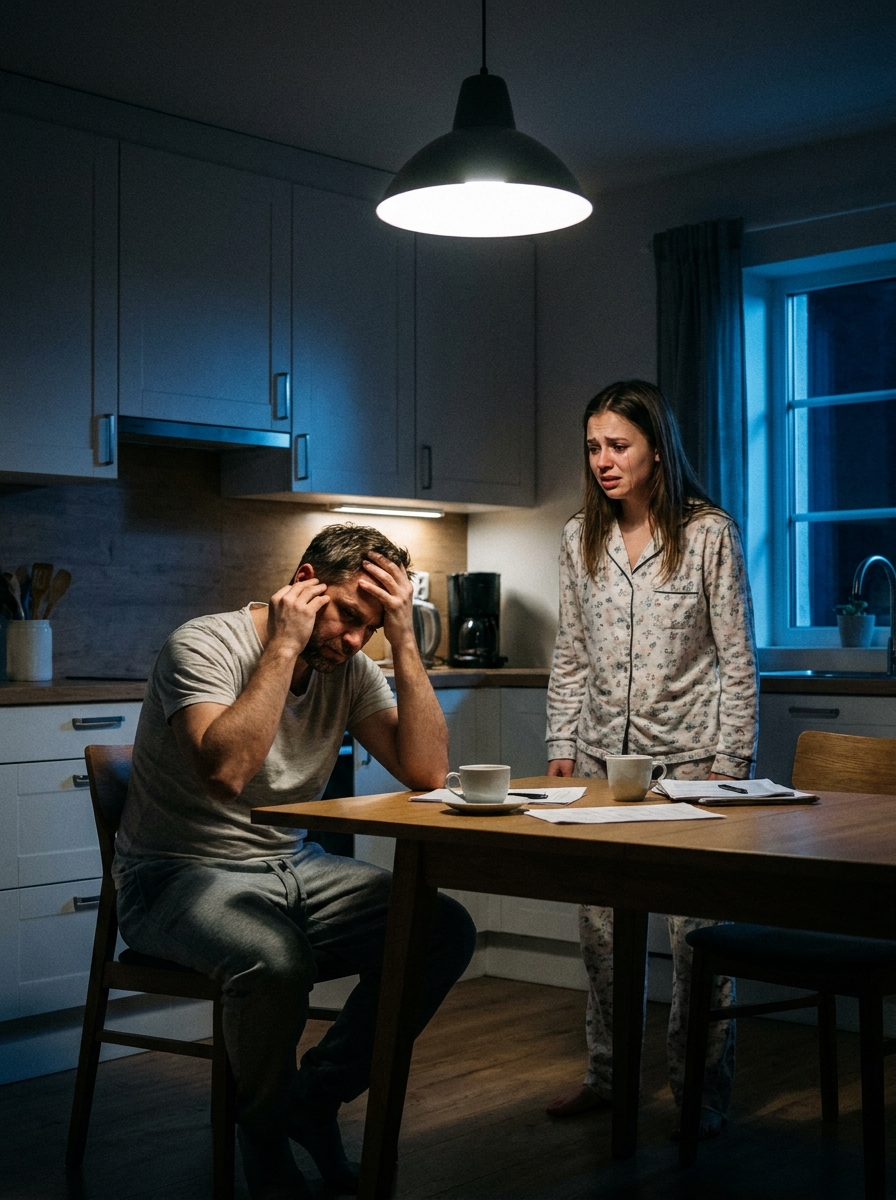
I felt sick. The room seemed to spin. “You brought this into our home. Around our children.”
“I protected you,” he insisted, his eyes finally meeting mine. “That’s why I woke you. That’s why I made you hide.”
“You didn’t protect us,” I said, the words tasting bitter. “You used us as leverage.”
His face hardened, the vulnerability from moments earlier vanishing. “You’re alive, aren’t you?”
Those four words hung in the air between us, cold and dismissive. In that moment, something inside me shifted irreversibly. The man I had married, the father of my children, was someone I no longer recognized.
The next morning, while he slept, I called a lawyer. My hands trembled as I dialed, but determination steadied my voice. By afternoon, I had learned more than I ever wanted to know. My husband wasn’t just a former gambler. He was a facilitator—money laundering, shell accounts, offshore transfers. The people who came that night weren’t simply collecting a debt.
They were cleaning up loose ends.
And we were one of them.
The lawyer’s words painted a grim picture. The gambling ring my husband had been part of operated across state lines and international borders. Large sums of money flowed through digital channels, disguised as legitimate investments. He had not only participated but helped build parts of the infrastructure. The hard drive he surrendered contained names of key players, transaction records, and enough evidence to dismantle sections of the operation—if it fell into the wrong hands. By handing it over, he had bought us temporary safety, but at what cost?
I spent the rest of the day in a fog, going through the motions for the children’s sake. Lunch was made. Toys were picked up. Smiles were forced. Inside, I was screaming. How long had this shadow been hanging over our family? How many lies had I unknowingly lived with?
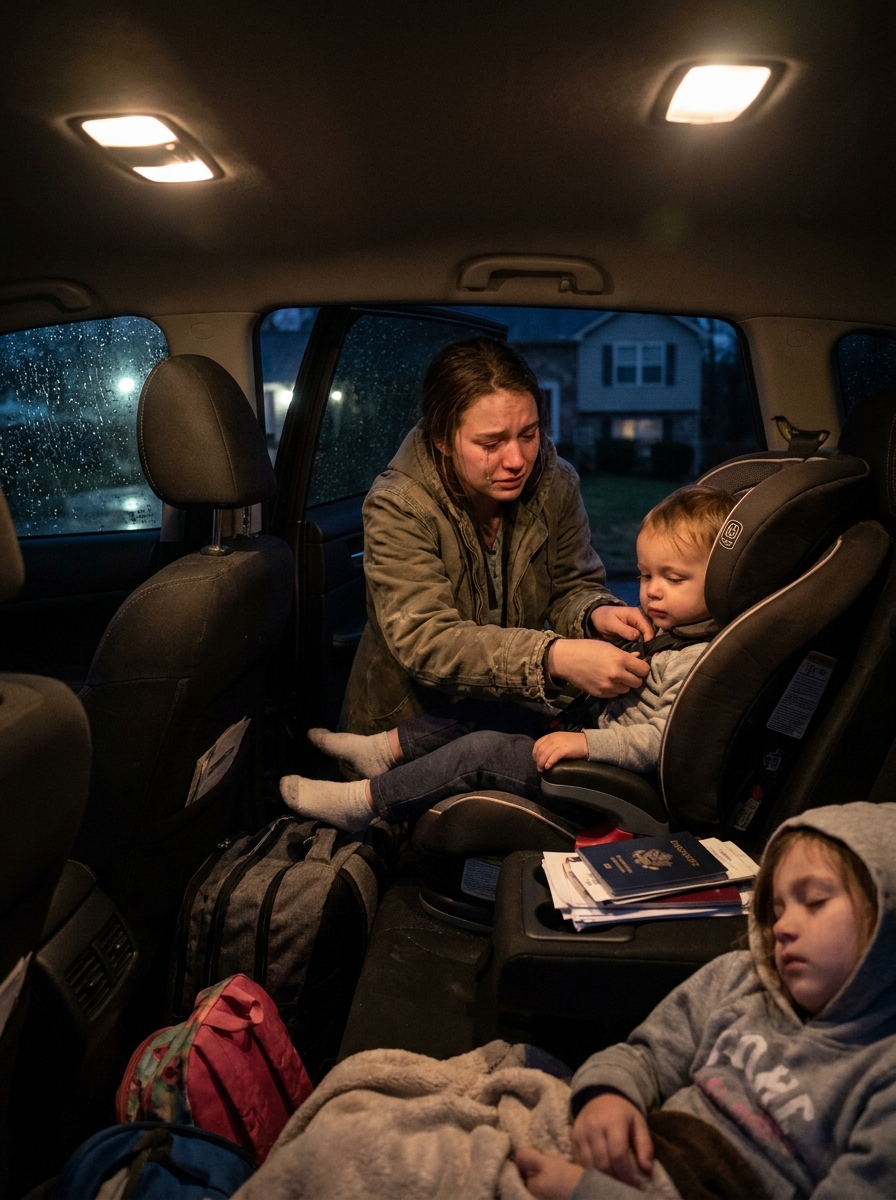
That evening, while he was still at work, I packed bags. Passports. Birth certificates. Clothes for the kids. I moved with mechanical efficiency, choosing only essentials. Sentimental items stayed behind—photographs, wedding gifts, the life we had pretended was normal. Every zipper I closed felt like sealing away a chapter I could never reopen.
As I buckled Liam into his car seat, he looked at me with wide, trusting eyes. “Mommy, are we going on a trip?”
“Yes,” I said softly, brushing his hair back. “A long one.”
I didn’t tell my husband where we were going.
I didn’t tell him goodbye.
We drove through the night, the highway lights blurring past as miles separated us from Colorado. My children eventually fell asleep in the back, unaware of the gravity of what was happening. I gripped the steering wheel until my knuckles turned white, replaying every conversation, every late night my husband had spent “working,” every unexplained deposit or sudden trip. The pieces fit together now, forming a puzzle I wished I had never solved.
We stayed with my sister in Oregon for two weeks. Her home became a temporary sanctuary—filled with whispered conversations late into the night, tears, and cautious planning. She asked few questions at first, sensing the fear in my eyes. I told her only what she needed to know. The authorities found us on the fourteenth day—not to arrest me, but to ask questions.
Someone had tipped them off.
Not my husband.
The investigators were professional but persistent. They already knew significant portions of the story. Federal agents had been monitoring the gambling ring for months. My husband’s name had surfaced in connection with several accounts. The visit that night, they explained, was likely a final extraction of compromising materials before the network collapsed. By surrendering the hard drive, my husband may have saved our lives in the immediate sense, but he had also painted a target on our backs.
I cooperated fully, providing every detail I could recall. Statements were taken. Safe houses were discussed. The reality of witness protection loomed, a future stripped of identity and rooted in constant vigilance. My children’s innocent faces flashed in my mind constantly. What kind of life was this for them?
Looking back now, weeks after that fateful night, I realize how fragile our sense of security truly is. We build homes, plant gardens, enroll children in schools, all while believing the walls we raise can keep danger at bay. But sometimes the danger lives inside those walls, sleeping beside you, sharing your meals, whispering promises of protection even as it invites chaos through the front door.
My husband’s choices—made long before our suburban dream—had rippled outward, threatening everything I held dear. The love I once felt has been replaced by a steely resolve to protect my children at all costs. I no longer wonder if I made the right decision by leaving. I only wonder how long we can stay hidden.
The authorities continue their investigation. More arrests are expected. My sister’s home no longer feels safe, so we move again soon. New names, new places, new beginnings forged from the ashes of betrayal.
I think about that faded red duffel bag often. Once a symbol of family adventures, now a vessel that carried away proof of my husband’s double life. It left with the intruders that night, but it took something far more valuable with it—my trust, my future as I had imagined it, and any illusion that our quiet suburban life was ever truly ours.
For now, my children and I keep moving forward, one careful step at a time. The road ahead is uncertain, but it is ours. And for the first time in years, it feels like freedom—fragile, terrifying, but undeniably ours.
