

The air inside the penthouse on the fifty-second floor of the Millennium Tower felt thin, artificially chilled, and heavy with the fragrance of white lilies and a sense of unearned arrogance.
I stood quietly in the corner of the guest bedroom, pressing the creases out of my worn flannel shirt. My name is Clara. I am sixty-five years old, and my hands bear the thick, pale scars of forty years spent working corn and soybean fields in the harsh soil of the Midwest. I sold that land—four generations of family heritage, the tractors, the silo, even the ground where my husband was laid to rest—to come to California. I did it to support my son Julian’s dream.
Tonight was the launch celebration for Lumina Systems, his tech startup. The headlines were buzzing with news of a massive new valuation. The penthouse was packed with venture capitalists, angel investors, and the city’s so-called elite.
The heavy mahogany door to my room suddenly slammed open.
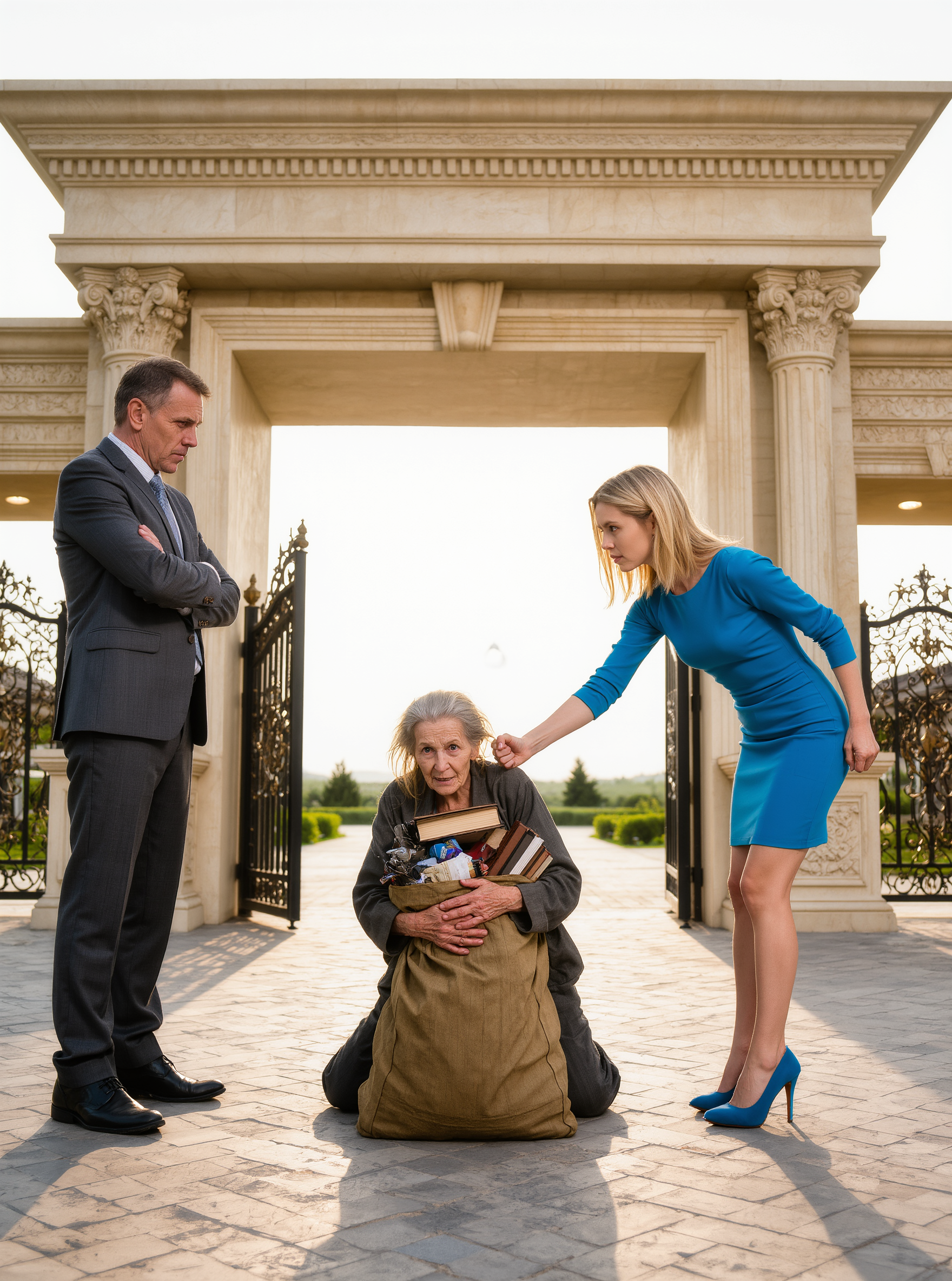
My daughter-in-law, Victoria, stood in the doorway. She was beautiful in a sharp, calculated way—all sharp angles, perfectly styled blonde hair, and a ruthless ambition that radiated from her like heat rising off asphalt. She was draped in silk and diamonds.
But in her manicured hands, she wasn’t holding a glass of champagne to celebrate with me. She was holding a cheap black polyester apron.
“We have a situation,” Victoria announced, her voice tight with strain as she strode into the room.
“Oh,” I said, clutching my quilted sewing bag to my chest. “Do you need me to move my things? The caterers can use the closet—”
“No, Clara. You don’t understand.” Victoria shoved the black apron into my chest. The fabric was rough and carried a faint scent of industrial bleach. “One of the catering staff called in sick. They’re short-handed at the washing station.”
I looked down at the apron, then back at her. “You want me to help the caterers?”
“I want you out of sight,” Victoria hissed, her polished facade fracturing to reveal the cruelty beneath. She gestured toward my plain cotton slacks and worn loafers. “Look at this place, Clara. Look at the guests arriving. We have senators out there. We have the board of directors. And then there’s… you.”
I felt the air drain from my lungs.

“You look like the help,” she continued, her voice dropping to a vicious whisper. “You look like a maid we forgot to fire. You bring down the property value of this penthouse just by standing in the hallway. I will not let you wander around with your farm-town stories and ruin the aesthetic of this night. So, you will put on this uniform, you will go into the catering kitchen, and you will wash the crystal flutes until the last VIP leaves.”
“Victoria!” I gasped, the shock rattling through my teeth. “I am Julian’s mother.”
“And Julian agrees with me,” a voice said from the doorway.
I looked past Victoria. My son, Julian, was standing there. He wore a bespoke Italian suit that cost more than my first car. A heavy gold Rolex circled his wrist. He had heard every word his wife had said.
“Julian?” I whispered. “Son?”
I waited for the boy I raised to step forward. I waited for him to remember who paid for his college tuition, who financed his first server rack in our barn, who held him when his father died from a sudden stroke. I waited for him to defend my dignity.
Julian glanced at his wife, polished and gleaming. Then he looked at me, worn and grey. He exhaled, checking the time on his heavy watch.
“Victoria has a point, Mom,” Julian said, his voice completely devoid of warmth. “It’s a massive night for the company. Optics matter. You… you don’t fit the brand. Put the apron on and stay in the kitchen. I’ll make it up to you tomorrow.”
He turned on his expensive leather heel and walked back toward the music and the clinking glasses. Victoria gave me a hollow, triumphant smirk and followed him.
The silence that settled over the room was heavier than the fog drifting across the Golden Gate Bridge outside.
I looked down at the black polyester apron in my scarred hands. I didn’t cry. The tears that threatened to fall were burned away by a sudden, searing realization: He loves the illusion more than he loves me.
I slowly untied the apron strings. I let the cheap fabric slide through my fingers, pooling on the polished hardwood floor like an oil spill. I picked up my worn leather purse.
I walked out of the guest room, passed the kitchen without a glance, and slipped into the service elevator. As the metal doors closed, cutting off the glittering party, I pulled out my phone.
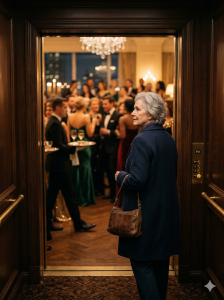
Cliffhanger: I wasn’t calling a taxi to head to the airport. I was dialing a private, unlisted number in the Financial District, preparing to set off a chain reaction that would reduce my son’s empire to ashes.
The lobby of the Wells Fargo Sovereign Wealth Headquarters on Montgomery Street felt like a cathedral of cold marble and tinted glass. It was nearly nine at night, but money never truly rests.
I stepped through the revolving doors, clutching my worn leather purse like a shield. A tall security guard in a sharp suit immediately moved into my path, his eyes scanning my flannel shirt and practical shoes with instant, practiced disdain.
“Ma’am, the retail branch is closed,” he said, his tone laced with false politeness. “If you’re looking for the cleaning staff entrance, it’s around the back.”
“I am not the cleaning staff,” I said, my voice steady and hard as flint.
I reached into my purse and pulled out a small, heavy black metal card. It bore no numbers—only a gold biometric chip and the crest of the bank’s private tier.
“I am here to see Harrison Vance, the Regional Director of Wealth Management,” I said firmly. “Tell him Clara Miller is in the lobby.”
The guard’s eyes widened in shock as he recognized the sovereign-tier identifier—a card reserved for clients whose liquid assets exceeded nine figures. “Right away, Mrs. Miller. My deepest apologies. Please, follow me to the private elevator.”
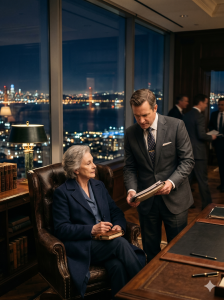
Five minutes later, I was seated in a plush leather armchair in a corner office overlooking the glittering stretch of the San Francisco Bay. Harrison Vance, a man who managed the fortunes of tech magnates and old-money dynasties, personally poured me a cup of Earl Grey tea.
“Clara,” Harrison said gently, taking a seat across from me. “It is always an honor. But I must admit, I’m surprised to see you tonight. I thought you were at the Millennium Tower, celebrating Julian’s IPO launch.”
“I was,” I said, leaving the tea untouched. “Until my son and his wife decided I was too embarrassing to be seen by their guests. They tried to force me into a maid’s uniform to wash dishes in the back.”
Harrison froze, the porcelain teapot hovering midair. His jaw tightened. “I see.”
I turned toward the window, tracing the outline of the distant bridge. “Julian believes he’s a self-made titan of industry, Harrison. He gives speeches about pulling himself up by his bootstraps. He tells the media his initial seed funding came from a faceless Midwestern investment group called the Apex Vanguard Fund.”
“Yes,” Harrison replied slowly. “A narrative we carefully crafted, exactly as you instructed three years ago.”
“He doesn’t know,” I said, bitterness finally threading through my voice, “that Apex Vanguard is just me. Me, selling four hundred acres of prime farmland. Me, cashing in his father’s life insurance policies. Me, leveraging every ounce of sweat equity my family built over a century.”
“He remains completely unaware that you are his sole angel investor,” Harrison confirmed. “I have acted as the proxy board member to preserve that illusion for him. You wanted him to feel confident. You wanted him to believe he was independent.”
“I wanted him to be a good man,” I corrected sharply. “I was the Trustee. He was the beneficiary. But the Trust was never a blank check.”
I opened my purse and pulled out the original notarized deed to the Apex Vanguard Trust. I flipped to the third page and pointed a scarred finger at Section 4, Paragraph B.
The Clawback Provision.
“Read it to me, Harrison,” I instructed.
Harrison adjusted his glasses and read aloud. “‘The Trustee reserves the absolute right to revoke all funding, seize all collateral assets, and demand immediate repayment of all outstanding debts if the Beneficiary demonstrates gross moral turpitude, breaches fiduciary duty, or fails to uphold the foundational ethical standards of the Trust.’”
I met Harrison’s eyes. “He cast his mother aside tonight to protect an image. He has lost his soul.”
Harrison closed the folder. The warmth in his expression vanished, replaced by the cold, precise focus of a financial executioner. “What are your instructions, Clara?”
I placed my hands flat against the mahogany desk.
“I want to activate the Clawback,” I said. “Pull the liquidity from Lumina Systems. Freeze their corporate operating accounts. Cancel all corporate credit lines.”
“Done,” Harrison replied, drawing his keyboard closer. “And the penthouse at the Millennium Tower? It was purchased through a private company loan, fully backed by your Trust’s guarantee.”
“Revoke the guarantee,” I ordered. “Call the note due immediately. Foreclose on the property.”
Harrison’s fingers moved rapidly across the keyboard. The keystrokes echoed like gunshots in the quiet office.
“The financial protocols are in motion, Clara,” Harrison said, glancing up at the monitors. “By the time we finish this tea, Julian will be completely bankrupt. Shall I call him to inform him?”
I stood, my eyes narrowing. “No. We’re not calling him. Contact your security team, Harrison. We’re going back to the party.”
The drive back to the Millennium Tower felt completely different from the drive there. The fog had thickened, pressing against the windows of Harrison’s chauffeured Bentley like damp cotton, but inside the car, my mind was unnervingly clear.
I wasn’t a heartbroken mother crying in the backseat. The grief had burned away, leaving behind a cold, calculated resolve. I had spent my entire life nurturing things—seeds, soil, livestock, my son. Tonight, I was going to learn how to rip something out by the roots.
Harrison sat beside me in his immaculate charcoal suit, scrolling through his tablet, monitoring the collapse of Julian’s financial empire in real time.
“The primary accounts are locked,” Harrison murmured. “The payroll transfer scheduled for midnight has been intercepted and redirected to the Vanguard holding account. The bank’s legal team has officially issued a default notice on the penthouse.”
“Good,” I replied simply.
The Bentley pulled into the private underground garage of the tower. We bypassed the service elevator I had been relegated to an hour earlier. Harrison swiped his master VIP card, and the private glass elevator carried us straight up to the fifty-second floor.
Two of the bank’s private security contractors—men built like brick walls, dressed in dark suits with earpieces—stood beside us as we ascended.
As the elevator slowed, the muffled sounds of the party filtered through the glass. The upbeat rhythm of a live jazz quartet. The crisp, expensive clinking of crystal champagne flutes. The low, confident murmur of the city’s elite mingling.
The elevator chimed and slid open, delivering us into the grand marble foyer just outside the main ballroom of the penthouse.
Through the narrow gap in the heavy double oak doors, I could see the spectacle inside. The room glowed with warm golden light. Waiters in crisp white shirts—wearing the very uniform Victoria had tried to force on me—circulated with trays of beluga caviar and oysters.
And there, standing on a raised acrylic platform at the center of the room, was my son.
Julian held a microphone in one hand and a crystal flute in the other. Victoria clung to his arm, a glittering accessory projecting the ultimate image of success.
“Ladies and gentlemen, partners and friends,” Julian’s voice rang through the speakers, dripping with a nauseatingly false humility. “When I started Lumina Systems, I had nothing but a laptop and a vision. I didn’t have handouts. I didn’t have a safety net.”
A bitter smile tugged at the corner of my mouth.
“I built this company on grit,” Julian continued to the captivated crowd. “I built it on the principle that true value comes from hard work, relentless innovation, and knowing exactly who you are. We secured our backing from the Apex Vanguard Fund because they recognized one simple truth: I am a self-made man who refuses to compromise on excellence!”
The room erupted into applause. Venture capitalists nodded in approval. Senators lifted their glasses.
Julian beamed, turning to Victoria, who kissed his cheek for the cameras.
“So please,” Julian called over the applause, raising his glass high. “Raise a glass to the future of Lumina Systems! To the visionaries! To the—”
He never finished. I didn’t wait for the applause to fade. I lifted my scarred hand and shoved the heavy oak doors open, the wood slamming against the marble walls with a thunderous crack that echoed through the suddenly silent room.
The jazz band cut off mid-note, a saxophone letting out a weak, squeaking stop.
Every head in the grand room turned toward the foyer. The glittering elite of San Francisco parted like the Red Sea as I walked into the center of the ballroom. I was still dressed in my faded flannel shirt and sensible loafers. Harrison Vance moved in perfect step at my right, holding a black leather portfolio. The two imposing security guards took up positions by the exit.
Julian froze on the platform, his champagne glass suspended in midair. The color drained from his face so quickly he looked sick.
Victoria’s manicured hand flew to her throat.
“Mom?” Julian breathed into the microphone, the word echoing across the silent, cavernous room. He quickly lowered it, his eyes flicking nervously toward the whispering crowd. “Mom, what are you doing? I thought Victoria told you to wait in the—”
He stopped himself, realizing the mic was still live. He dropped it onto the acrylic podium with a sharp thud and hurried toward me, his face twisting into a mask of panic and anger.
“What is the meaning of this?” Julian hissed under his breath as he reached me, grabbing my elbow. “Are you out of your mind? You’re ruining the launch! Get back in the kitchen!”
I didn’t flinch. I looked down at his hand on my arm, then up into his terrified eyes.
“Take your hand off me, Julian,” I said, my voice carrying the quiet, lethal authority of a matriarch who had finally run out of patience.
He released me as if burned.
Before he could speak, a chorus of digital chimes shattered the silence.
It began with a single buzz from the Chief Financial Officer’s pocket—a nervous man standing near the ice sculpture. Then Victoria’s phone lit up on a cocktail table. Within seconds, several executives were staring at their screens, their faces draining of color in unison.
The CFO pushed through the crowd, sweating heavily, abandoning all decorum. “Julian,” he gasped, his voice shaking loud enough for nearby guests to hear. “Julian, we have a catastrophic problem. The bank… Vanguard has pulled our entire line of credit. The operating accounts are at zero. The midnight payroll transfer just bounced. We’re completely insolvent.”
“That’s impossible!” Julian shouted, losing his polished composure. He yanked his phone from his jacket. His screen was flooded with red alerts. TRANSACTION DECLINED. CREDIT LINE REVOKED. ACCOUNT FROZEN. He looked up wildly. “Who authorized this?! Get the bank on the phone! Call the Apex Vanguard proxy! I’m the CEO—I demand to know who’s behind this!”
“You don’t need a phone, Julian,” I said, my voice cutting cleanly through his panic.
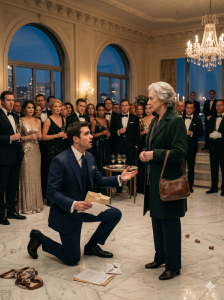
I turned to face the room of investors, senators, and social elites. They watched in stunned, breathless silence.
“My son loves to tell a story about grit,” I said clearly. “He likes to talk about the faceless Midwestern investors who believed in him. He likes to pretend he built this empire from nothing.”
I turned back to him.
“You forgot where the money came from, son,” I said, my voice hard as iron. “You thought you were self-made. You were just a boy spending his father’s death benefit and his mother’s sweat.”
Julian stared at me, his mouth opening and closing like a fish out of water. “Mom… what are you talking about?”
Harrison Vance stepped forward, opening his portfolio.
“Allow me to clarify, Mr. Miller,” Harrison said crisply, his voice echoing in the silent room. “Your mother, Clara Miller, is the sole trustee, chairwoman, and capital provider of the Apex Vanguard Fund. She holds the debt on your company. She owns the intellectual property behind your software. And, as of twenty minutes ago, she executed a legal Clawback provision due to gross moral turpitude.”
Victoria let out a strangled gasp.
“You… you are Apex?” Julian whispered, his knees visibly trembling.
“Yes,” I said. “And I’ve just removed you. Furthermore, without my trust’s guarantee, the bank has foreclosed on this penthouse. You have one hour to vacate before security escorts you out.”
“Mom, please!” Julian cried, his voice cracking into a desperate wail. The facade was gone. He dropped to his knees on the marble floor, clutching the hem of my flannel shirt. “Mom, don’t do this! I’m sorry! I was stressed! Victoria pushed me! We can fix this—just bring the money back!”
I looked down at him. I felt nothing but a deep, hollow pity.
“I’m retiring, Julian,” I said softly, stepping away from his grasp. “I’m going back to the land. I’m going to buy a small cottage and plant a garden. And you’re going to learn how to build something from nothing.”
Julian wept into his hands, begging for another chance. But the true blow came from his right. Victoria, realizing she was now tied to a bankrupt man about to be thrown out, slowly reached for her left hand.
She didn’t scream. She didn’t cry. She didn’t kneel beside the man she claimed to love.
Instead, she stood still, her eyes scanning the room, calculating—cold and precise. The venture capitalists she had been charming were already grabbing their coats, heading for the exits, eager to distance themselves from the fallout. The aura of success had vanished, replaced by the stench of failure.
Victoria looked at Julian, collapsed on the floor. Her expression hardened into pure, self-preserving ice.
She lifted her right hand and grasped the massive three-carat diamond engagement ring on her left finger—a ring bought with corporate funds backed by my money. With one sharp motion, she pulled it off.
She walked to the acrylic podium, picked up Julian’s half-full champagne flute, and dropped the heavy diamond into the glass. It sank with a dull, final clink.
“I have a personal brand to maintain, Julian,” Victoria said flatly. “I cannot be legally tied to a fraud.”
She turned on her heel, her silk dress whispering as she moved, and headed for the private elevator. She didn’t look back. Not at him. Not at me. She simply disappeared, taking what remained of Julian’s pride with her.
The room emptied quickly after that. The jazz band packed their instruments in tense silence. The catering staff—the same people Victoria had tried to make me join—quietly cleared away the caviar stations.
Within thirty minutes, the magnificent penthouse on the fifty-second floor was nearly empty.
Julian sat alone on the edge of the platform, his head buried in his hands, his expensive Italian suit wrinkled and ruined.
I stood near the door with Harrison.
“Are you ready to go, Clara?” Harrison asked gently.
“Yes,” I said.
I walked over to Julian one last time. He looked up at me, his eyes red and swollen.
“You took everything from me,” Julian whispered hoarsely. “My company. My wife. My home.”
“No, Julian,” I replied steadily. “I didn’t take anything. I simply stopped funding the illusion. You loved the title, the image, the brand more than the mother who built it for you. Now you’re the CEO of nothing. And I’m finally free from pretending you were a good man.”
I turned and walked away. The heavy oak doors closed behind me, sealing him inside his empty glass cage.
Epilogue
Six months later, San Francisco’s fog was a distant memory.

I stood in the backyard of a small, sunlit cottage in a quiet Midwestern valley. I wore my faded flannel shirt, my hands deep in rich, dark soil, planting heirloom tomatoes.
Tech blogs reported that Lumina Systems had been liquidated under a ruthless Chapter 7 bankruptcy. Julian had moved into a cramped studio apartment in Oakland, trying to find work as a mid-level manager, but his reputation had been burned to ash within the industry. Victoria had already filed for a quick, uncontested divorce.
I stood up, brushing the dirt from my brow, and gazed out over my small, quiet garden.
Some families shatter loudly, in chaos and fury. Others decay slowly from within, blinded by the harsh glare of status and wealth. My family fell apart because we chose to worship an illusion.
But out here, with the sun warming my face and soil beneath my nails, there were no illusions. Only the truth of what you plant—and the reality of what you harvest.
That night in the Millennium Tower didn’t mend my broken heart. It did something far more important. It gave the wound a name.
And once a wound is named, once the infection of a toxic illusion is finally cut away, you can begin the long, quiet process of healing. I was no longer an angel investor. I was no longer a discarded prop in my son’s performance.
I was simply Clara. And for the first time in a very long while, I was the richest woman in the world.
If you’d like more stories like this, or want to share what you would have done in my place, I’d love to hear your thoughts. Your perspective helps these stories reach others, so feel free to comment or share.
