

When I was six, I made a promise to my best friend that someday we’d go to prom together. Twelve years passed, and then he was standing in my living room in a navy suit, corsage in hand, while my mother pulled me upstairs, locked my bedroom door, and made me listen to something she’d hidden from me for six years before she’d let me leave with him.
Micah and I became friends in first grade for two simple reasons.
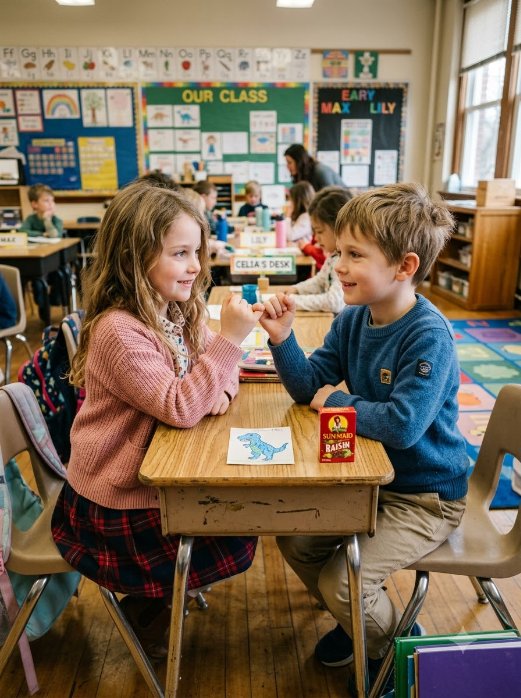
We both couldn’t stand raisins, and we both were obsessed with dinosaurs.
Our teacher used to hand out those little boxes of raisins at snack time. One day I was trying to slip mine under a napkin when the boy next to me leaned in.
“Good idea,” he whispered.
I glanced over and saw he’d done the exact same thing.
That settled it.
By lunch, we’d figured out that Micah was convinced raisins were “grapes that had gone bad,” that I could sketch almost any dinosaur as long as no one expected accuracy, and that neither of us could sit still and quiet when we could be cracking each other up instead.
Micah had Down syndrome, but at six years old, that mattered far less to me than the fact that he cheated shamelessly at dinosaur trivia.
He always knew the answer before he even finished asking the question.
When I called him out, he’d insist it wasn’t cheating — he’d just “studied harder.”
He was also brutally honest about my art. The first time I showed him a T. rex I was proud of, he examined it with total seriousness, and I braced myself for a compliment.
Instead he said, “It looks like a potato with tiny arms.”
I shoved him.
He cracked up so loud our teacher split us apart.
That was Micah for you. He could infuriate me and crack me up in the same thirty seconds.
A few months later, our teacher told the class she was getting married.
To a room of six-year-olds, this was the most thrilling news imaginable. Everyone started yelling ideas about cake, flowers, music, what she should wear.
Micah put his hand up and declared that when he got married, he wanted chocolate cake and zero slow songs, because slow songs were boring.
A boy across the table laughed.
“You’re not getting married.”
Micah’s brow furrowed. “Why not?”
The boy shrugged like the answer was obvious.
“Who’s going to marry you?”
The room went weirdly still.
Then the boy added, “Nobody will.”
I remember the look on Micah’s face more clearly than almost anything else from that year.
His smile vanished.
He didn’t fight back. He just dropped his eyes to the table.
I didn’t really understand what the other boy meant or why he’d said it, but I understood he’d wounded my friend.
“That’s not true,” I snapped. “Somebody will love Micah.”
The boy looked at me and laughed.
“Then you marry him.”
A few kids giggled at that.
Our teacher jumped in fast, but the damage was already done.
After school, Micah was oddly quiet while we waited for our rides.
Eventually he turned to me and asked, dead serious, whether I thought anyone would ever love him.
At six, I had no idea how to answer something that big.
So I gave the only answer a six-year-old could.
“Maybe I will.”
His face lit up instantly.
“Really?”
I suddenly felt like I’d agreed to something way bigger than I meant to, so I tacked on the first condition that came to mind.
“But before any of that, we have to go to prom.”
Micah had zero idea what prom was.
I explained it was this big dance people went to when they were almost grown up.
He thought it over, then stuck out his pinkie.
“Promise?”
I hooked mine around his.
“Promise.”
By that night, I’d nearly forgotten the whole thing.
Micah hadn’t.
Somehow, across twelve years of growing up, neither of us ever forgot the other, either.
We drifted through different classrooms, different friend groups, completely different interests.
I was into art.
Micah was into baseball with an intensity I never got.
He could recite a player’s batting average from three seasons back but couldn’t remember where he’d left his own backpack.
He spent years trying to get me hooked on baseball stats.
I dragged him through museums and tried to convince him that staring at one painting for ten minutes wasn’t boring.
Neither of us won the other over.
Even so, we stayed tight.
When we were twelve, my parents split up.
That was the first time I understood adults could promise something forever and still break it.
Dad moved into an apartment about twenty minutes away. Mom tried to act like everything was fine, but I’d hear her crying when she thought I was asleep.
I got angry at both of them.
Then I went quiet.
At school, I’d sit through lunch without touching my food most days. I talked less. Some days I just wanted everyone to leave me alone.
Micah seemed to get that without needing to be told.
He never sat down next to me and demanded to know what was wrong.
He never told me to look on the bright side.
He just sat down.
Sometimes he’d ramble about baseball while I stared at my tray. Sometimes he’d complain about homework or tell me some ridiculous story about his cousin.
And sometimes he’d just sit there with me, saying nothing at all.
At the time, I barely registered what he was doing.
Years later, I’d realize how rare that was.
Micah never acted like he could fix me.
He just made sure I never felt alone.
When I bombed my first driving test at sixteen, he showed up at my door with two ice creams.
I asked why he’d brought two when it was just the two of us.
“One’s because you tried,” he said.
I smiled, figuring he was being sweet.
Then he added, “And one’s because you drove really badly.”
I almost threw both cones at him.
A few months after that, I decided I was done with art after a girl in my class trashed one of my paintings.
Micah didn’t give me some inspirational speech about chasing my dreams.
Instead, he dug up one of my old dinosaur drawings from elementary school and taped it inside his locker.
When I demanded to know why he’d display something so awful, he told me he couldn’t let me quit until I finally learned to draw a dinosaur that didn’t look like a potato.
I laughed even though I didn’t want to.
That was Micah’s usual method.
No big emotional speeches.
He just stuck around long enough for the worst of it to pass.
When my first serious boyfriend dumped me junior year, Micah showed up with chocolate ice cream and sat with me on the front steps.
I cried.
He let me.
Then, after a while, he calmly announced he’d always thought the guy was an idiot.
I pointed out he’d gone to two baseball games with him.
Micah shrugged.
“People can become idiots later.”
That was the first time I’d laughed all day.
So when senior prom rolled around, going with Micah never felt like some leftover childhood obligation to me.
He was my best friend.
There was nobody else I wanted next to me.
Micah, though, apparently needed to make sure of that himself.
One afternoon in February, he found me at my locker and asked if I remembered first grade.
I teased him, pretending I didn’t.
His face fell so fast that I immediately admitted I was kidding.
Then he held out his pinkie.
For a second, we were six again.
I remembered raisins hidden under napkins, terrible dinosaur drawings, and a sad little boy asking if anyone would ever love him.
“Prom?” I asked.
Micah nodded.
“Prom.”
Then he proudly informed me he’d already bought his bow tie.
Back in November.
I stared at him.
“You bought the tie three months before you even asked me?”
He shrugged, totally confident.
“I knew you’d say yes.”
I did.
On prom night, I was upstairs wrestling with an earring when the doorbell rang.
My aunt, who’d spent the last hour curling my hair, called up that Micah was here.
Before I could respond, I heard him from downstairs.
“She said two minutes fifteen minutes ago.”
I yelled down that he was a traitor.
He laughed.
Everything felt completely normal.
Until Mom opened the front door.
I heard the door open, then a strange silence.
Not the comfortable kind.
The kind that makes you freeze mid-motion because you sense something’s shifted.
I walked toward the stairs.
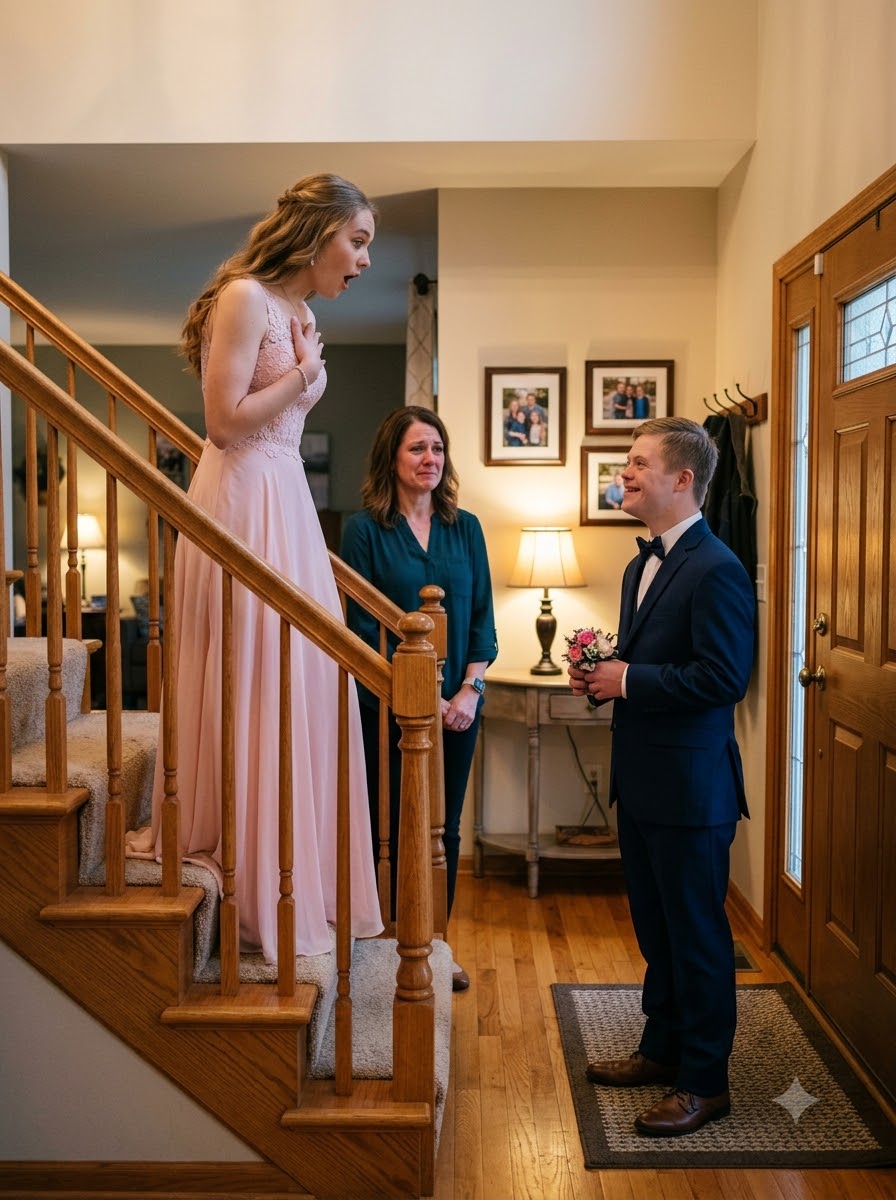
Micah stood just inside the doorway in his navy suit, bow tie straight, holding a small corsage, looking pleased with himself. He held a small corsage in one hand and looked so proud of himself that I almost laughed.
Mom stood in front of him.
She wasn’t smiling.
She was looking at him like she’d just remembered something she’d spent years trying to bury.
Micah noticed too.
“Mrs. Palmer, are you okay?”
Mom blinked and pasted on a smile.
“Of course.”
But I know my mother.
She wasn’t okay.
When Micah spotted me on the stairs, his whole face lit up.
He raised the corsage and explained the florist had added rosemary because rosemary meant remembering.
Then he grinned at me.
“I remember promises.”
Behind me, Mom made a small sound.
I turned around.
Her eyes had welled up.
Before I could ask what was wrong, she told me to follow her upstairs.
I protested that Micah was waiting, but something in her tone stopped me cold.
“Just a minute, Celia.”
Once we got to my room, Mom shut the door.
Then she locked it.
That scared me more than anything else she’d done so far.
“Mom, what’s going on?”
She stood there a moment, hands pressed together.
Then she said, “You can go with Micah tonight. But first I need you to hear something.”
I tried to make light of it.
“Is this the midnight curfew talk?”
“No.”
Her voice wavered.
I stopped smiling.
Mom sat on the edge of my bed.
“There’s something about Micah I’ve never told you. Something that happened after your dad left.”
My stomach dropped.
“What does Dad have to do with Micah?”
“Nothing directly.”
She looked down.
“You were twelve. You’d basically stopped eating. You barely talked to me. I could tell you were hurting, but you wouldn’t let me close.”
I swallowed hard.
I’d spent years trying to forget that version of myself.
Then Mom said something I wasn’t expecting.
“Micah knew.”
I stared at her.
She told me that one afternoon, not long after the divorce, she’d shown up early to get me from school.
She’d been sitting alone in her car, crying, when someone tapped on the passenger window.
It was Micah.
He’d seen her crying and asked if I was okay.
Mom tried to wave him off, but Micah told her I’d stopped eating lunch and barely spoke to anyone some days.
“He noticed all of that?” I asked quietly.
Mom gave a sad little smile.
“He noticed more than I did.”
That stung.
She told me she’d admitted to Micah that she didn’t know how to help me.
Micah had sat with that for a second.
Then he’d said, “I don’t know how to make Celia happy. But I can stay with her.”
My eyes stung.
Suddenly those lunches replayed in my head, completely differently.
The chair scraping in next to mine.
Micah going on and on about baseball while I pushed food around my tray.
The days he said nothing at all because somehow he understood silence was what I needed.
Mom’s voice dropped lower.
“I asked him to promise he’d stay close to you.”
I turned to face her.
“You asked a twelve-year-old to look after me?”
“I know how that sounds.”
“Mom.”
“I was scared, Celia. You wouldn’t talk to me, and he was the one person you still let in.”
She wiped her cheek.
“He said yes without even hesitating.”
I didn’t know what to feel.
Part of me was moved.
Part of me was angry my mother had placed that on a child.
But she wasn’t finished.
“There’s something else I’m ashamed of,” she said.
For years, she admitted, she’d worried my friendship with Micah had turned into an obligation.
Every time I stood up for him when someone left him out, every time I chose him over some event he wasn’t invited to, she’d wondered if I was giving up too much.
She’d looked at his Down syndrome first and our friendship second.
My chest tightened.
“You thought I stayed friends with him out of pity?”
“No. Not exactly.”
“But you thought I was sacrificing things for him.”
Mom didn’t answer.
That silence said enough.
I got up and walked to the window.
For years she’d watched us and assumed I was the one doing all the giving.
Meanwhile Micah had been right beside me through my parents’ divorce, my worst days at school, my heartbreak, my failures, every stupid crisis that had once felt like the end of the world.
Mom started crying softly.
“I kept asking myself what Micah needed from you,” she said. “I never once asked what you needed from him.”
That took all the anger out of me.
I turned back around.
She looked smaller somehow.
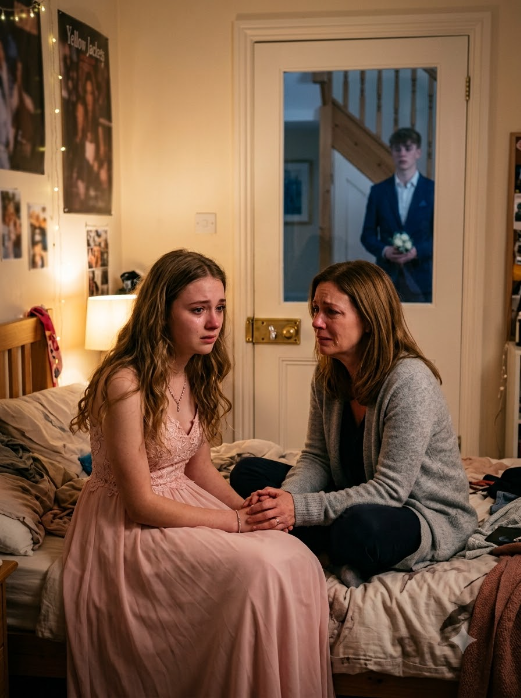
“When he walked through that door tonight and said he remembered promises, I remembered the one he made to me six years ago. And I realized he’d kept it this whole time.”
I couldn’t get words out.
“He never told you. He never held it over you. He just stayed.”
Mom reached for my hand.
“And I finally realized you did the same for him.”
For a moment neither of us spoke.
Then I remembered what she’d said downstairs.
“You said I could go to prom on one condition.”
Mom nodded.
“What is it?”
She squeezed my hand.
“I don’t want you walking down those stairs because six-year-old Celia made a promise. I don’t want you going because you think Micah needs you, and I don’t want you going because I once asked him to watch out for you.”
Her eyes locked on mine.
“I want you to go only if eighteen-year-old Celia is choosing him.”
I stared at her.
Then I laughed through tears already running down my face.
“Mom, of course I’m choosing him.”
Her shoulders dropped like she’d been holding her breath for years.
“The promise isn’t why I’m going.”
“I know that now.”
“It’s just the reason Micah bought a bow tie four months too early.”
Mom laughed.
When we finally headed downstairs, Micah looked between me and Mom, clearly suspicious.
“You took forever.”
“She talks a lot,” I said.
Mom shot me a look, then walked over to him.
For a second she seemed unsure what to say.
Finally she touched his arm gently.
“Micah, thank you for being there for Celia.”
He frowned like she’d thanked him for something completely unremarkable.
“She was there for me too.”
Mom’s eyes filled again.
This time, she smiled.
“Yes. I know.”
Prom itself wasn’t the movie kind of magical.
Micah stepped on my shoe during the first slow song.
I accused him of being a terrible dancer.
He blamed my dress.
I reminded him he’d had twelve years to get ready.
He said the promise only covered showing up to prom, not learning to dance.
We laughed so hard people turned to stare.
Later, when my feet started killing me, Micah carried my heels.
When he got too hot, I carried his jacket.
Nothing dramatic happened.
No one applauded.
No one treated our night as some huge moment.
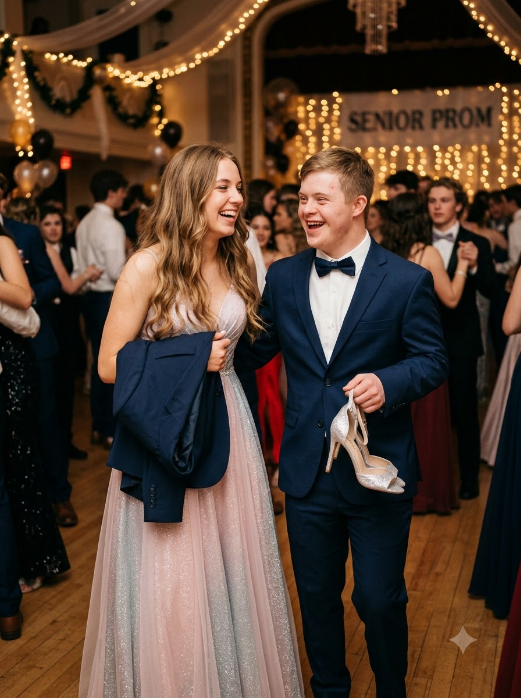
We were just two eighteen-year-olds having a good time.
And that was exactly how I wanted it.
For years my mother had watched Micah and me and tried to figure out which one of us was taking care of the other.
That night, she finally let it go.
Because there wasn’t one answer.
Micah had stayed beside me when my family fell apart.
I’d stayed beside him when people made him feel like he didn’t belong.
He made me laugh when I wanted to vanish.
I stood up for him when people underestimated him.
Neither of us was rescuing the other.
We were just friends.
After prom, Mom was still up when we got home.
Micah handed me my shoes at the door, reminded me not to lose the corsage, and told Mom I’d danced “almost correctly.”
I told him to go home.
He laughed the whole way down the driveway.
Later, heading up to my room, I noticed an old photo tucked into the corner of my mirror.
Mom must have found it while we were out.
Micah and I were six in it, sitting side by side at school.
His pinkie was hooked around mine.
Both of us grinning.
I stood there staring at those two kids for a long time.
At six, I thought I’d only promised him one dance.
I didn’t know that boy beside me would sit through my loneliest lunches, show up with ice cream after my worst days, keep my terrible drawings, and quietly keep a promise to my mother I never even knew about.
And Micah hadn’t known I’d still be beside him twelve years later either.
Maybe that’s why the promise still mattered.
Not because it obligated either of us to stay.
But because, after all those years, we both still wanted to.
