

The drive leading up to the towering wrought-iron gates of Eleanor’s estate felt like I was walking straight toward my own downfall.
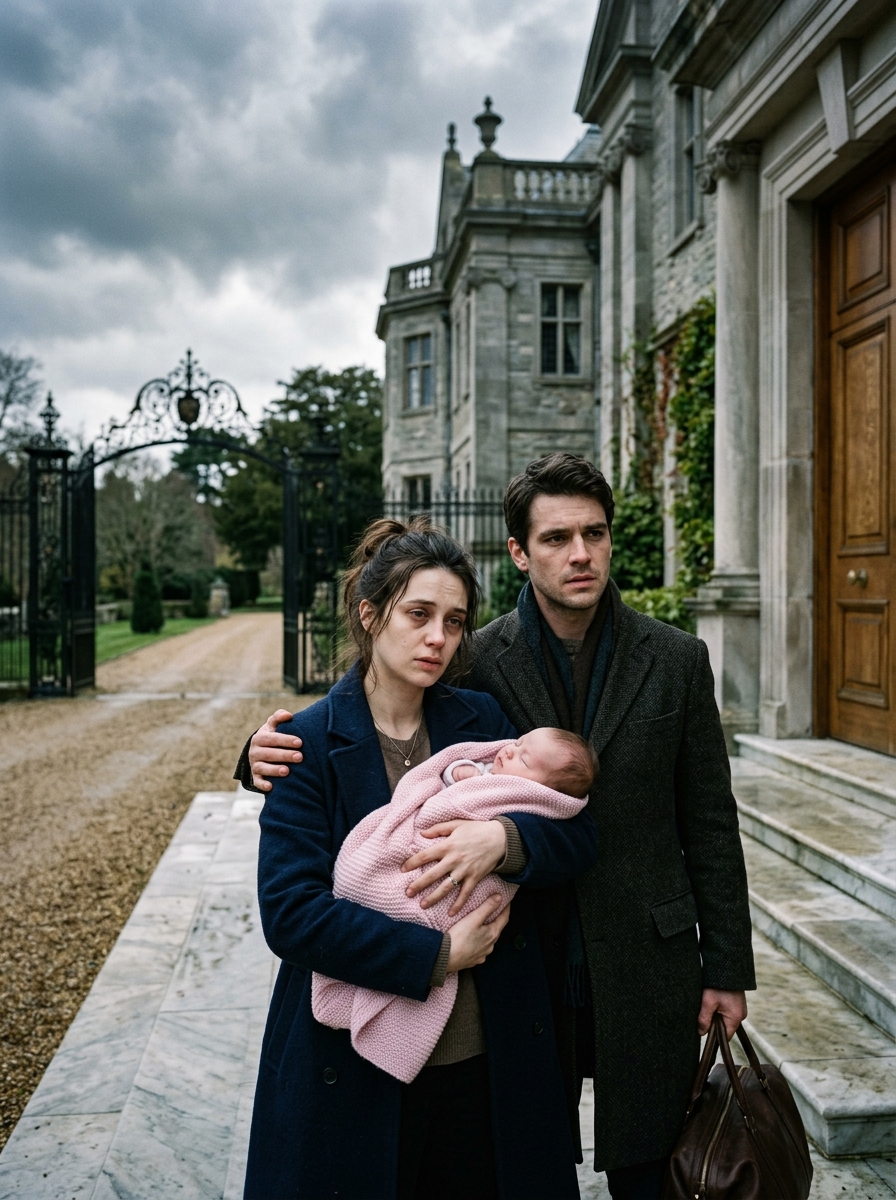
I was completely worn out. My body still ached, still trying to recover from the brutal thirty-six-hour labor that had ended only four days earlier. Sitting quietly in the passenger seat of our sedan, I lowered my eyes to the tiny, delicate bundle sleeping against my chest.
Lily.
She slept peacefully, her tiny chest rising and falling in a soft, steady rhythm. She was perfect. To me, and to my husband, Mark, she was the most beautiful thing we had ever seen. But as the enormous gates slowly opened, revealing endless manicured lawns and the sprawling stone mansion beyond them, my stomach twisted into a painful knot.
I already knew what awaited us inside.
Eleanor, Mark’s mother, had never bothered hiding her contempt for me. From the moment Mark introduced me to her five years earlier—a public school teacher with an average upbringing and a modest bank account—she had made it painfully clear that I did not belong in their world. I lacked pedigree. I didn’t come from wealth. I didn’t know the influential people she valued, and I certainly didn’t vacation in the “right” places. To Eleanor, I was simply an outsider who had somehow convinced her golden son to settle for an ordinary life.
When we discovered I was pregnant, I foolishly believed a grandchild might finally close the distance between us. I convinced myself that maybe, just maybe, the sight of new life would soften the cold, aristocratic walls around her heart.
I was unbelievably naive.
Mark reached across and rested his large, warm hand over mine. I squeezed it tightly, drawing comfort from his steady presence. He had always been my safe place. Despite constant pressure from his family to marry within their elite social circle, he had chosen me. And through every passive-aggressive remark, every intentional exclusion from family gatherings, and every icy glare over crystal wine glasses, he had remained firmly by my side.
“Are you okay?” he asked softly, his eyes fixed on the winding driveway ahead.
“I’m terrified,” I admitted quietly. “What if she… what if she doesn’t love her, Mark?”
“She’s her grandmother, Sarah. She’ll love her,” he replied firmly, though I caught the faint hesitation in his voice. Nobody knew his mother better than he did. “And if she doesn’t, that’s her loss. Lily has us. That’s all that matters.”
He pulled the car up beside the grand entrance, where a valet immediately hurried over to open my door. I stepped out carefully, holding Lily securely in my arms. The late afternoon air was cool and crisp, carrying the scent of expensive flowers and approaching rain.
Together, we climbed the broad marble staircase. Before Mark could even touch the handle, a silent housekeeper opened the heavy oak doors for us. We stepped into the enormous foyer, a cavernous space dominated by a sweeping staircase and a massive crystal chandelier scattering cold light across the polished floors.
The house practically vibrated with quiet luxury. Eleanor was hosting one of her infamous afternoon teas for the women on her country club committee. From the drawing room came the soft clinking of fine china and the polished murmur of privileged conversation.
“She couldn’t clear thirty minutes from her schedule?” I muttered, resentment rising inside me. “We’re bringing her first grandchild home, and she’s entertaining guests?”
Mark’s jaw tightened. “Let’s just get this over with.”
We made our way toward the drawing room. My heart pounded so hard I worried it might wake the baby. I adjusted the soft pink knitted blanket wrapped around Lily, making sure she stayed warm. She had a small reddish birthmark on her left cheek—a port-wine stain the pediatrician assured us was harmless and could even fade over time. Mark and I thought it made her even more beautiful, like a tiny kiss from the universe.
But as we approached the doorway, a wave of dread settled heavily over me. Eleanor demanded perfection in everything. In her home. In her appearance. In her son.
And now she would judge my daughter.
Mark entered the room first, clearing his throat. The low hum of conversation stopped instantly. A dozen perfectly styled heads, adorned with understated diamonds, turned toward us.
And there, seated in a high-backed velvet chair at the center of the room, was Eleanor.
As always, she looked flawless. Her posture was stiff, her expression impossible to read. She lowered her teacup onto the saucer with a sharp, deliberate click. She didn’t smile. She didn’t stand to greet us. She simply stared with eyes as cold and gray as the stone walls surrounding her estate.
“Mark,” she said, her voice slicing through the silence like a scalpel. “You’re late. We expected you before the tea service began.”
“We’re here now, Mother,” Mark replied, his tone respectful but strained. He motioned for me to step forward. “We brought her. We brought Lily.”
I forced my legs to move, carrying my precious daughter toward the center of the room. The silence was unbearable. I felt like an exhibit under inspection. Every woman in that room watched me carefully, judging my exhausted face, my simple clothes, and the baby in my arms.
I stopped a few feet away from Eleanor’s chair. I tried to offer a polite smile, but my lips barely moved.
“Hello, Eleanor,” I said softly. “Meet your granddaughter.”
Eleanor remained silent. Slowly, she rose from her chair, her gaze locked entirely on the pink bundle in my arms. She stepped closer, the heavy scent of her expensive perfume nearly suffocating me. She didn’t look at me. She didn’t acknowledge Mark.
She extended one perfectly manicured hand.
Instinctively, I tightened my hold on Lily, a fierce protective instinct screaming through my body. But I forced myself to remain still. She had to see the baby. This was the moment I had dreaded for months—and the moment I secretly hoped might change everything.
Eleanor’s fingers closed around the edge of the soft pink blanket.
Then, with a swift, almost aggressive motion, she pulled it back.
CHAPTER 2
The soft pink knitted blanket slipped from my hands as Eleanor jerked it backward with a force that startled me.
Time seemed to stop completely inside that massive, crystal-lit drawing room. The muted ticking of a grandfather clock in the hallway suddenly sounded as loud as a hammer striking steel. Every woman in the room, seated elegantly in velvet chairs with expensive china cups suspended near their lips, froze in place.
Eleanor stared down at my daughter.
Lily remained peacefully asleep, completely unaware of the hostile atmosphere surrounding her. Her tiny chest rose and fell steadily. But beneath the harsh glow of the chandelier, the left side of her face was fully exposed. The port-wine stain stretched from beneath her temple down toward her jawline, a deep reddish-purple mark resembling watercolor brushed across her perfect porcelain skin.
I watched Eleanor’s expression carefully. I noticed the way her perfectly Botoxed brow attempted to crease, the way her lips pressed together so tightly they nearly vanished into a thin, bloodless line.
She didn’t just look shocked.
She looked disgusted.
A visible shudder passed through her rigid body. It was only the slightest movement, but in the suffocating silence of the room, it felt deafening. She took a small step backward, releasing the blanket as though it had suddenly burned her hand.
“What is that?” she whispered. Her voice was barely audible, yet it carried clearly across the Persian rug.
My throat instantly went dry. I tried to speak, tried to remember the pediatrician’s reassuring explanation about capillary malformations and vascular birthmarks, but no words came out.
“It’s a birthmark, Mother,” Mark said. His voice dropped into a dangerously low tone I rarely heard from him. He stepped closer to me, his shoulder brushing mine in silent support. “It’s called a port-wine stain. She’s perfectly healthy.”
Eleanor slowly lifted her eyes from Lily’s sleeping face and fixed them on me. The contempt in her expression was suffocating. It was the kind of look reserved for something filthy scraped off the bottom of a shoe.
“A birthmark,” she repeated, venom dripping from every syllable. She slowly glanced around the room, deliberately making eye contact with the women from her country club committee. Quiet gasps and hushed whispers rippled through the wealthy crowd. “Look at it. It is a blemish. A disfigurement.”
“Stop it, Eleanor,” I finally managed to choke out, my maternal instincts overpowering my fear. I pulled the blanket back over Lily’s cheek, shielding her protectively against my chest. My hands trembled so violently I feared I might drop her. “Don’t talk about her like that.”
“Don’t you dare raise your voice to me in my own home, you insolent girl,” Eleanor snapped, her aristocratic mask finally cracking to reveal the bitter, cruel woman underneath. She pointed a trembling, diamond-covered finger directly at my face. “I knew this would happen. I warned him. You bring nothing but common, diluted blood into this family. And now look what you’ve produced.”
“Mother!” Mark roared. The sheer force of his voice rattled the china cups against their saucers. Several older women physically jumped in their seats.
But Eleanor had lost control. Years of quiet, passive-aggressive resentment toward me had finally found a target. She had always hated me for taking her son away, but now, faced with a grandchild who failed to meet her impossible standard of flawless country-club perfection, her hatred exploded into open cruelty.
“It is a bad omen,” Eleanor hissed, her eyes fixed on the pink bundle in my arms. “A physical manifestation of a cursed union. I will not have that… that thing associated with the family name. I will not have my friends whispering behind my back about the defective grandchild hidden away in the shadows.”
Hot tears stung my eyes instantly. I couldn’t breathe. My chest tightened painfully, my legs felt heavy as stone. The humiliation was unbearable. Standing in the center of a room full of strangers while my beautiful, innocent four-day-old daughter was called a curse—a defective thing meant to be hidden away.
“We are leaving,” Mark said. His face had gone completely pale, his jaw clenched so tightly a muscle twitched violently in his cheek. He reached for my arm, gently but firmly guiding me toward the doorway. “Come on, Sarah. We are done here.”
“Oh, you’re not just leaving,” Eleanor sneered, her voice climbing into a shrill, hysterical pitch. She turned sharply toward the heavy oak doors. “Security! Marcus! Get in here right now!”
The doors swung open immediately. A massive man in a dark suit—Marcus, the head of the estate’s private security—quickly stepped into the room. He looked confused, his eyes darting between Eleanor, the horrified women at the tea party, and Mark.
“Ma’am?” Marcus asked cautiously in his deep voice.
Eleanor pointed directly at me, her hand trembling with rage. “Remove this woman from my property. Immediately. Drag her out by the hair if you have to. And make sure she takes that deformed mistake with her. They are trespassing.”
Marcus hesitated. He had known Mark since Mark was a teenager. He glanced at my husband and swallowed hard. “Mr. Mark, I…”
“Do your job, Marcus!” Eleanor shrieked. “Or you are fired this instant! Get her out of my sight!”
Marcus reluctantly took a heavy step toward me.
I recoiled immediately, backing up until my shoulders pressed against the cold wooden doorframe. I wrapped both arms tightly around Lily, twisting my body protectively around her. Panic flooded through my veins, cold and sharp. This was no longer just a family argument.
This was a physical threat.
But Marcus never took a second step.
Mark moved with a speed and aggression I had never witnessed before. He didn’t simply step between me and the guard—he closed the distance entirely, shoving both hands hard against the center of Marcus’s chest. The massive guard stumbled backward, his boots skidding across the polished hardwood floor.
“You lay one finger on my wife,” Mark snarled, his face inches from the guard’s, “and I swear to God, Marcus, I will put you in the hospital. Do you understand me?”
Marcus immediately raised his hands in surrender, retreating toward the wall. “I’m sorry, Mr. Mark. I’m not touching them.”
Mark kept his eyes locked on him for one long, agonizing moment before slowly turning to face his mother.
The silence in the room became absolute. The women seated in the velvet chairs looked as though they were watching a slow-motion car wreck unfold. Nobody even dared breathe.
Eleanor stood tall, desperately trying to maintain her commanding presence, but I could see the faint tremble in her posture. She had never been challenged like this before. Not by her late husband, not by her staff, and certainly never by her obedient golden-child son.
Mark slowly walked back toward the center of the room. He didn’t yell. He didn’t scream. When he finally spoke, his voice was deathly calm—which somehow made it infinitely more terrifying.
“You want to talk about bad omens, Mother?” Mark asked quietly, his eyes locked onto hers.
“I am protecting this family’s legacy, Mark,” Eleanor replied, though her voice wavered slightly. “Someday, you will thank me for this.”
“Legacy,” Mark repeated, tasting the word like poison. A dark, humorless smile touched the corners of his mouth. “You really have no idea, do you?”
Eleanor frowned. “Idea about what?”
Mark reached into the inner pocket of his tailored jacket. The rustle of fabric became the only sound in the enormous room. He pulled out a thick legal envelope, folded neatly in half.
“For five years, I have watched you belittle the woman I love,” Mark said steadily, his voice carrying clearly to every gossiping socialite in the room. “I told myself you were simply set in your ways. I told myself it was generational. I made excuses for your cruelty because you were my mother. But today… today you looked at my innocent child, your own flesh and blood, and you called her a mistake. You ordered a man to drag my wife out of this house.”
He stepped even closer to her.
“So, we are done making excuses,” Mark said. He tapped the thick envelope lightly against his palm. “Do you know what this is, Mother?”
Eleanor stared at the envelope, her eyes narrowing suspiciously. “I have no interest in your melodramatics, Mark. Leave.”
“This,” Mark announced, raising his voice just enough for everyone in the room to hear clearly, “is the finalized transfer of the family trust. The trust Father established before he died. The trust that controls this estate, the country club you cherish so much, and every liquid asset used to pay for these little tea parties.”
The color drained instantly from Eleanor’s face. The rigid posture she had carried for decades suddenly seemed to cave inward. “You… you don’t have the authority. The trust doesn’t mature until…”
“Until I turn thirty-five, or until I produce an heir,” Mark interrupted, his voice lowering into a cold, unforgiving whisper. He motioned toward me, toward the sleeping baby in my arms. “Meet the heir, Mother. She was born four days ago. And as of this morning, when my attorneys filed these papers, I became the sole executor of the estate.”
A collective gasp swept across the room. One woman dropped her teaspoon, and it clattered loudly against her saucer.

Eleanor stumbled backward, blindly reaching for the back of her velvet chair to steady herself. “You wouldn’t.”
“I already did,” Mark replied. He tossed the heavy envelope onto the mahogany tea table directly in front of her. It landed with a dull, final thud. “You don’t own this house anymore, Eleanor. You’re merely a guest here now. A guest surviving entirely on my generosity.”
Eleanor stared at the envelope as though it were poisonous. Her chest rose and fell rapidly. The full weight of what was happening had begun crashing down on her.
“And considering the way you treat my family,” Mark continued, his voice stripped of every trace of affection, “your generosity officially ends today. You have thirty days to pack your belongings and leave this property.”
“Mark!” Eleanor screamed, the sound ripping violently from her throat. It was no longer an order—it was a desperate, panicked plea. “You cannot do this! This is my home! I am your mother!”
“You stopped being my mother the second you looked at my daughter with disgust,” Mark replied. He didn’t blink. He didn’t flinch. He stood in front of her like an immovable wall of stone. “Thirty days. I suggest you begin searching for a smaller condo. Because you are cut off. Not another dime of family money will go to you. Not a single cent.”
Then he turned his back on her, the ultimate act of dismissal.
He walked over to me and wrapped his arm protectively around my waist. The tension that had locked my spine finally shattered, and I leaned heavily into him as tears spilled freely down my cheeks, soaking into the collar of my shirt.
Lily shifted slightly in her sleep, releasing a tiny sigh against my neck.
“Let’s go home, Sarah,” Mark whispered softly, pressing a kiss against my temple.
We walked out of the drawing room without another glance behind us. In our wake, the silence finally broke with the sound of Eleanor collapsing into her chair, her breathless, jagged sobs echoing beneath the crystal chandelier while the wealthy friends she had tried so desperately to impress sat silently ignoring her.
CHAPTER 3
The heavy oak doors of the estate slammed shut behind us, the sound echoing across the manicured driveway like a gunshot.
I didn’t breathe properly again until Mark had settled me safely into the passenger seat of our sedan. My hands trembled so violently that I fumbled with the seatbelt twice before he leaned over, gently brushing my hands aside with his warm fingers to buckle it for me.
He didn’t speak. His jaw remained locked tight, muscles twitching beneath his skin.
He walked stiffly around the hood of the car, every movement mechanical and rigid. Above us, the sky had darkened, bruised gray clouds rolling over the massive estate, perfectly mirroring the storm that had erupted inside.
The moment he started the engine, heavy raindrops began striking the windshield.
The drive away from the country club neighborhood felt painfully slow. The winding roads lined with ancient oak trees and towering iron gates belonging to other wealthy families felt like a maze we were desperately trying to escape.
I lowered my gaze to Lily.
She was still asleep, her tiny chest rising and falling in perfect rhythm. The soft pink blanket remained tucked securely around her, but I gently folded one edge back just enough to reveal her cheek.
The port-wine stain glowed a deep rose color against her pale skin.
Fresh tears burned down my cheeks. I traced the edge of the mark lightly with the tip of my finger, barely touching her delicate skin. To me, it looked like a constellation. Like a piece of artwork.
It shattered my heart that her own grandmother had looked at this beautiful, innocent child and seen something monstrous.
A defect. A bad omen.
“I’m sorry,” Mark finally said, breaking the heavy silence inside the car. His voice sounded rough and strained, like broken glass scraping together.
I looked over at him. His eyes remained fixed on the road, but his knuckles had turned white from gripping the steering wheel so tightly.
“Mark, no,” I whispered, reaching across the console to rest my hand on his forearm. “You have nothing to apologize for. None of this is your fault.”
“It is my family,” he said bitterly, the words sounding poisonous in his mouth. “It is my mother. I brought you into this. I made you stand there in front of those vultures while she… while she…”
He couldn’t finish the sentence. Instead, he slammed the heel of his hand against the steering wheel in one sharp motion that made me flinch.
“I should have done this years ago,” he muttered, his voice trembling with rage and grief. “I should have cut her off the first time she made some snide remark about your clothes. The first time she ‘accidentally’ left your name off the holiday invitations. I let this go on for too long, Sarah. I kept trying to preserve the peace.”
“You were trying to be a good son,” I said softly, rubbing slow circles against the tense muscles in his arm. “You wanted to believe she could change. That says something good about your heart, Mark. Not something weak.”
He shook his head slowly, a single tear slipping from the corner of his eye and trailing down his jaw.
“She called my daughter a mistake,” he whispered, the pain in his voice tearing straight through me. “She ordered a man to put his hands on my wife.”
“And you stopped him,” I reminded him firmly. “You stood up for us. You protected us. You sacrificed everything for us today.”
At the next red light, Mark finally turned to look at me. The harsh fluorescent glow from the streetlamp illuminated the exhaustion carved deep beneath his eyes.
“I didn’t lose anything that mattered,” he said with complete certainty. He reached over and brushed a knuckle gently across Lily’s tiny cheek, right over the birthmark. “This is my everything. You and her. The house, the money, the trust… it’s all just noise. It’s poison.”
Twenty minutes later, we pulled into the driveway of our modest three-bedroom home.
It looked nothing like the imposing stone fortress we had just left behind. The paint along the porch railing had started chipping slightly, the lawn was a little overgrown because Mark hadn’t had time to mow it since I went into labor, and the neighbor’s child had left a tricycle abandoned near the sidewalk.
But as I stared at the warm yellow glow spilling from the living room window, it looked like a castle.
It looked safe.
We hurried inside to escape the biting rain.
The moment I stepped through the doorway and locked the deadbolt behind us, an enormous weight I hadn’t even realized I was carrying seemed to slide from my shoulders.
The house smelled like fresh coffee, vanilla, and baby powder. It smelled like us. It smelled safe.
I carried Lily directly to the nursery. It was a tiny room painted soft sage green, filled with secondhand furniture we had spent weekends sanding and repainting together. It wasn’t designer. It wasn’t curated by an expensive decorator. But every inch of it overflowed with love.
I laid Lily carefully into her crib, pulling a soft cotton blanket gently over her legs. Then I stood beside the railing for a long time, simply watching her breathe.
I was a mother now. I had a fierce, instinctive responsibility to protect this tiny human from a world capable of unimaginable cruelty. And today I had learned something horrifying.
Sometimes the cruelest monsters didn’t hide beneath beds.
Sometimes they wore Chanel suits and hosted afternoon tea.
I heard the floorboards creak softly behind me. Mark wrapped his arms around my waist and rested his chin gently against the top of my head. He felt solid. Grounding.
“She’s perfect,” he whispered into my hair.
“She is,” I agreed softly, leaning back into him.
We remained there inside the quiet sanctuary of the nursery for nearly twenty minutes before the adrenaline finally drained from our bodies. My knees weakened suddenly as the lingering exhaustion from childbirth crashed over me again.
Mark guided me carefully into our bedroom, pulling back the duvet and helping me settle against the pillows.
“I need to make some calls,” he said gently, brushing hair away from my face. “The lawyers need to know exactly what happened today. Eleanor isn’t going to accept this quietly. She’s going to fight.”
“Can she reverse it?” I asked, fresh panic cutting through my exhaustion. “The trust? Can she legally challenge you?”
Mark’s expression hardened immediately into cold determination. “No. My father designed the terms to be ironclad. He knew exactly what she was like. He knew she would burn through the family fortune trying to maintain her social status if she had unlimited access. He built the trust to bypass her the moment I became of age and produced an heir to continue the legacy.”
He sat at the edge of the bed, dragging a hand through his hair.
“She’s been surviving on an allowance,” Mark explained quietly. “A massive allowance, yes. But she doesn’t actually own the house. She doesn’t own the cars. Everything belongs to the trust. And as of this morning, I am the sole executor. I control every account.”
“Thirty days,” I whispered, remembering the ultimatum he had given her. “You really gave her thirty days to move out?”
“I gave her thirty days because of a lingering sense of legal obligation,” Mark replied darkly. “If it were entirely up to me, I would have ordered Marcus to throw her into the rain this afternoon.”
He leaned down and kissed my forehead gently. “Get some sleep. I’ll handle the fallout.”
But sleep never came.
Even though my body desperately needed rest, my mind refused to stop racing. I lay staring at the ceiling, replaying the scene in the drawing room over and over again. The disgust on Eleanor’s face. The harsh, violent way she ripped the blanket away.
And the fallout arrived quickly.
It started the very next morning.
I was seated at the kitchen island nursing Lily when Mark’s cellphone suddenly began vibrating violently against the granite countertop.
He had already been awake for hours, pacing the living room with a mug of black coffee while handling nonstop calls with his legal team. He walked into the kitchen, glanced at the caller ID, and his jaw immediately tightened.
Then he pressed speakerphone and set the phone down.
“Hello, Aunt Caroline,” Mark said flatly, without emotion.
Caroline was Eleanor’s younger sister. She was practically identical to my mother-in-law, only with slightly less money and a far more desperate need for social status.
“Mark, what on earth is happening?” Caroline’s shrill voice burst through the speaker, breathless and dramatic. “Your mother called me at three in the morning completely hysterical! She said you threatened to throw her out into the street!”
“I didn’t threaten her,” Mark corrected calmly, sipping his coffee. “I issued her a formal thirty-day eviction notice. My lawyers will send the physical paperwork by courier this afternoon.”
A stunned silence rang through the line.
“You… you can’t possibly be serious,” Caroline sputtered. “Mark, she is your mother! She is a widow! Where exactly is she supposed to go?”
“She has friends,” Mark replied coldly. “She has you. I’m sure one of you can spare a guest room while she figures out how to live within her new financial reality.”
“Her new financial reality?” Caroline’s voice climbed higher in disbelief. “Mark, she said you cut off her access to the accounts. Her credit cards were declined this morning at the country club! Do you understand how humiliating that is for her?”
A sharp wave of anxiety twisted through my chest. Eleanor’s cards being declined publicly in front of her wealthy social circle. For a woman who valued appearances more than oxygen, it was probably her worst nightmare.
She was going to lose her mind.
“That sounds like her personal problem, Caroline,” Mark said indifferently.
“Mark, please,” Caroline shifted tactics instantly, trying to sound calm and reasonable. “I know Sarah must be upset. I know she’s hormonal and emotional after the birth. But you are overreacting. Eleanor was just… shocked! She was worried about the baby’s health. You know how she worries.”
My blood instantly turned cold.
Concerned about the baby’s health. They were already rewriting the story. Already trying to transform Eleanor into the victim—a loving grandmother whose innocent reaction had supposedly been exaggerated by an unstable, emotional daughter-in-law.
Mark slammed his coffee mug onto the granite countertop so hard I thought it might crack.
“Do not ever, ever speak about my wife that way again,” Mark snarled, his voice vibrating with dangerous intensity. “She is not hormonal. She is not overreacting. My mother called my newborn daughter a mistake and a bad omen. She ordered security to drag Sarah out of the house. I stood there and heard every single word.”
“She didn’t mean it like that!” Caroline pleaded desperately, clearly rattled by Mark’s fury. “She just wasn’t expecting… a disfigurement!”
“Hang up,” I whispered to Mark, my stomach churning violently. I couldn’t listen anymore. I pulled Lily tighter against my chest.
Mark leaned closer to the phone. “Listen very carefully, Caroline. If you, or anyone else in that pathetic little social circle, ever refers to my daughter’s birthmark as a disfigurement again, I will personally ensure that not a single cent from the family trust ever reaches any of your bank accounts. Are we clear?”
“Mark, you can’t…”
“Are. We. Clear?” Mark repeated, his voice dropping into a terrifying growl.
“Yes,” Caroline whispered, sounding genuinely frightened.
Mark ended the call. The silence inside the kitchen immediately became heavy and suffocating.
“They’re going to try to destroy us socially,” I said quietly, staring down at Lily’s sleeping face. “She’s going to tell everyone in town that I turned you against her. That I’m keeping her granddaughter away from her.”
“Let her talk,” Mark said, stepping over and wrapping his arms around my shoulders. “Her social circle means absolutely nothing to me. Let them gossip. Let them whisper. We don’t need them.”
But it wasn’t just gossip.
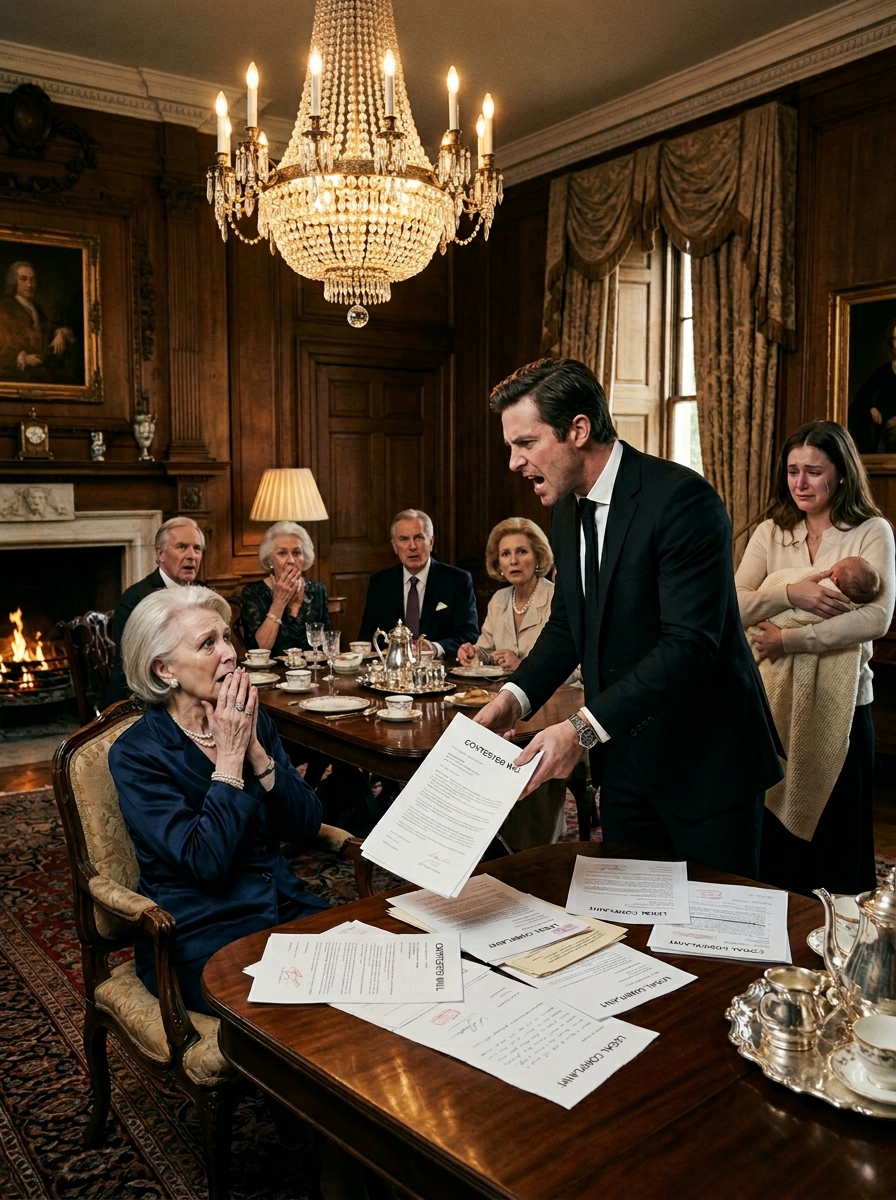
Over the next five days, our small home turned into a fortress under attack.
The phone rang nonstop. Relatives I hadn’t heard from in years, old family acquaintances, and even the pastor from Eleanor’s elite church all called trying to interfere. Every single one repeated the exact same script. She’s your mother. She’s grieving. You need to forgive her. You can’t destroy the family.
Mark blocked every number.
He took leave from his architectural firm and stayed home with me, becoming a solid wall between our family and the outside world. He intercepted the mail, sending Eleanor’s furious handwritten letters back unopened.
He became immovable.
But I could see the strain wearing on him. The dark circles beneath his eyes deepened by the day. I noticed the way his jaw tightened every time a car slowed near our house.
He was fighting on two fronts at once: shielding us at home while battling his mother’s increasingly aggressive legal attacks.
Then, on the sixth day, the real storm arrived.
It was Tuesday afternoon. The rain had finally passed, leaving behind thick, suffocating humidity. Mark had retreated to his home office to review blueprints for a client, trying to catch up on neglected work.
I sat in the living room folding piles of tiny baby clothes on the couch while Lily slept peacefully nearby in her bassinet.
The sudden sharp ring of the doorbell made me jump.
We weren’t expecting deliveries. We had specifically told everyone we weren’t ready for visitors yet.
I set aside a tiny pink onesie and cautiously walked to the front door, peering through the peephole.
My stomach dropped instantly.
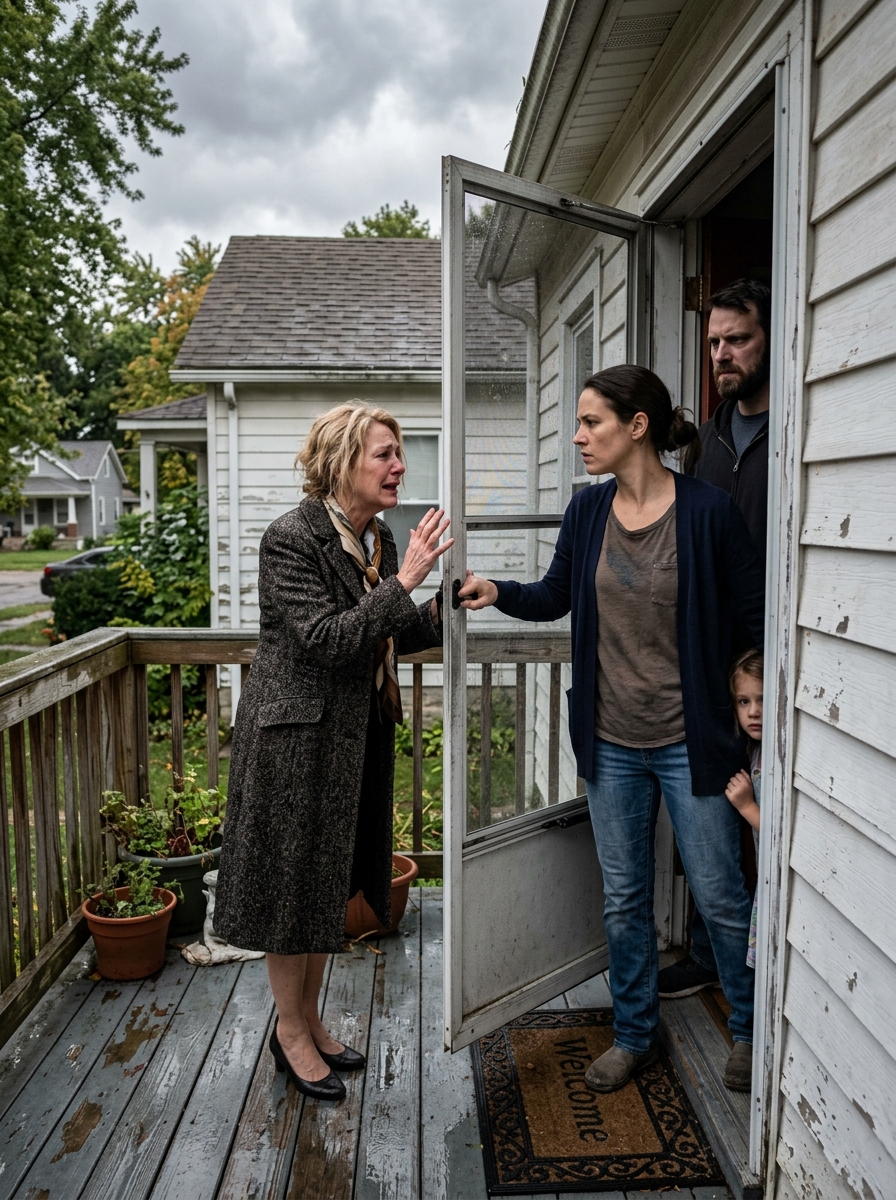
Standing on our worn front porch, looking absurdly out of place in her tailored designer suit and oversized sunglasses, was Eleanor.
She looked awful.
Even beneath the expensive sunglasses, I could see the tight strain in her features. Her posture, normally flawless and upright, sagged slightly. Six days without access to her accounts and six days of public humiliation had clearly taken a brutal toll.
She pressed the doorbell again, holding it obnoxiously for three long seconds.
“Sarah, I know you’re in there,” her voice carried through the heavy door, muffled but unmistakable. “Open the door. We need to talk.”
Panic surged through my chest. My immediate instinct was to run for Mark. To hide behind him and let him deal with her.
But halfway through turning away, I stopped.
I looked over at Lily sleeping peacefully in her bassinet.
This woman had looked at my child and called her a mistake. She had tried to have me physically thrown into the street. And now she stood on my porch demanding attention like royalty expecting obedience.
Something deep inside me snapped. A cold, unshakable reservoir of maternal fury I didn’t even know existed suddenly surged through my veins.
I wasn’t the intimidated daughter-in-law desperate for approval anymore.
I was a mother.
And this was my house.
I unlocked the deadbolt. The loud metallic click echoed through the small entryway.
I pulled the door open, but I didn’t move aside to let her enter. I stood firmly in the doorway, blocking the entrance with my body.
Eleanor took a small step forward, clearly expecting me to yield. When I didn’t move, she stopped, her lips compressing into a thin line of irritation.
She removed her sunglasses, revealing red-rimmed eyes surrounded by dark shadows. The pure hatred in her stare when she looked at me was breathtaking.
“What do you want, Eleanor?” I asked. My voice remained astonishingly steady. It didn’t shake at all.
“I’m here to speak to my son,” she demanded, entitlement dripping from every word. “Move aside, Sarah.”
“Mark is working,” I answered coldly, folding my arms across my chest. “And even if he wasn’t, he has nothing left to say to you. His attorneys have already made his position crystal clear.”
Eleanor gave a sharp, bitter laugh. “His attorneys. You mean the attorneys you manipulated him into hiring? Do you really think you’ve won, you little gold-digger?”
I didn’t even flinch. Five years ago, those words would have driven me into tears. Now they sounded weak and pathetic.
“I don’t care about the money, Eleanor,” I replied evenly. “I never did. That’s the part you never understood. I love Mark. I love our life. The only person obsessed with the trust fund is you.”
Her face twisted into something ugly and furious. She stepped closer to the screen door, manicured fingers gripping the wire mesh tightly.
“You think you’re clever,” she hissed, dropping every ounce of aristocratic composure. “You think producing a child suddenly means you control everything now. You poisoned him against me. You turned one emotional misunderstanding into a hostile takeover of my entire life!”
“A misunderstanding?” I repeated, my voice rising slightly as anger finally cracked through my calm. “You called your own granddaughter a bad omen. You looked at a four-day-old baby with disgust.”
“I was shocked!” Eleanor snapped back, her voice shrill with desperation. “I expected a perfect child, and instead you handed me… that! Any grandmother would have reacted!”
“No,” I cut in sharply, stepping closer until we were nearly face-to-face through the screen. “A normal grandmother would have seen a beautiful baby. A normal grandmother would have kissed her cheek and told her she was loved. You are sick, Eleanor. You are toxic, and you are broken.”
Eleanor gasped and staggered backward as though I had physically slapped her. Nobody ever spoke to her that way. Nobody dared.
“How dare you,” she whispered, her hands trembling. “I am Eleanor Vance. I built this family’s reputation! I…”
“You built a house of cards,” a deep, furious voice thundered from the hallway behind me.
I turned immediately. Mark stood at the end of the hall, his face dark with fury. He had obviously heard everything.
He walked up behind me and rested a heavy protective hand on my shoulder. There wasn’t a trace of affection or pity in the way he looked at his mother. He stared at her the way someone stares at a venomous snake that wandered too close to their home.
“Mark,” Eleanor’s tone shifted instantly. The venom disappeared, replaced by desperate pleading. She clasped her hands tightly in front of her chest. “Mark, please. You have to stop this nonsense. The lawyers froze my checking account. I couldn’t even pay the landscapers this morning. This has gone far enough.”
“It’s not nonsense, Mother,” Mark replied coldly. “And you should have fired the landscapers five days ago. You can’t afford them anymore.”
“You are my son!” she cried, tears finally spilling down her carefully made-up face. “You can’t do this to me! I gave you everything! I raised you!”
“You raised me to function as a prop in your perfect country-club fantasy,” Mark answered steadily. “And the moment my family didn’t fit your image, you tried to discard us. So I discarded you first.”
“I’ll sue you!” Eleanor screamed, vulnerability evaporating instantly into feral desperation. “I’ll drag that trust through probate court for decades! I’ll claim you’re mentally unstable! I’ll destroy your career, Mark! I’ll destroy her!”
She pointed a shaking finger directly at me.
Mark never raised his voice. He never lost control. He simply stared at her with terrifying calm.
“You can try,” Mark said softly. “But you don’t have the money to hire a lawyer anymore, Eleanor. I checked. Outside the trust accounts, you have less than two thousand dollars to your name. And as for ruining my career?”
He let out a short, humorless laugh.
“I’m an architect. I build things with my own hands. You never had the power to destroy me. The only power you ever had was the power I allowed you to have. And I’m taking it back.”
He reached past me and grabbed the heavy front door.
“You have twenty-four days left to vacate the estate,” Mark said, locking eyes with her one final time. “If you ever come to my house again, I will have you arrested for trespassing. Goodbye, Eleanor.”
Then he slammed the door shut, instantly cutting off her hysterical screaming.
He threw the deadbolt into place.
The silence that settled over the hallway afterward felt deafening. I stood frozen, my heartbeat pounding so hard I could feel it in my teeth.
Mark turned toward me. The fury drained from his face, leaving only overwhelming exhaustion and heartbreak behind.
He pulled me tightly into his arms, burying his face against my neck and holding me so firmly I could barely breathe.
“I’m so sorry she came here,” he whispered, his voice breaking apart. “I’m so sorry, Sarah.”
“It’s okay,” I whispered back, wrapping my arms around him and holding him together the same way he was holding me. “We’re okay. We’re safe.”
But as I held my husband and listened to the muffled sound of his mother’s car tires screeching violently out of our driveway, a cold knot of dread tightened deep inside my stomach.
Eleanor was a woman who had never lost anything in her life. She was cornered now—stripped of her money, her status, and her pride.
And cornered animals were the most dangerous of all.
The battle over the trust fund might have ended.
But I knew with absolute certainty that the war for our family had only just begun.
CHAPTER 4
The days after Eleanor’s explosive visit to our front porch became some of the most emotionally draining of my life.
I existed in a constant state of anxious hyper-awareness. Anytime a car slowed too long in front of our house, my chest tightened instantly. Whenever the mail carrier shoved a thick pile of envelopes into the mailbox with a heavy thump, my stomach twisted painfully. At night, I checked every lock three separate times before bed, then stood silently at the front window peeking through the blinds into the still suburban street.
Mark wasn’t handling it any better. The exhaustion etched into him seemed to age him years within days. He hired a private security company to install advanced cameras around the property, and he spent endless hours inside his home office surrounded by legal documents and empty coffee cups while strategizing with attorneys.
Eleanor had spent her entire adult life never hearing the word “no.” She wielded her husband’s fortune like a weapon, crushing anyone who threatened her social dominance. Now that she’d been stripped of that power and cornered, we knew retaliation was inevitable.
And retaliation came.
Two weeks after the confrontation on our porch, the doorbell rang.
It wasn’t Eleanor.
It was a stern-faced woman carrying a clipboard beside a uniformed police officer.
Child Protective Services.
An “anonymous” report had accused our household of being unsafe and hostile. The report claimed Mark had violent tendencies and alleged that our newborn daughter was suffering from severe untreated physical trauma we were intentionally concealing from doctors.
I nearly collapsed right there in the entryway. The cruelty behind it was almost beyond comprehension. Eleanor had taken Lily’s port-wine stain—the same birthmark she’d labeled a bad omen—and twisted it into an accusation of abuse.
Mark’s calmness was terrifying.
He didn’t argue. He didn’t raise his voice or block the entrance. Instead, he politely invited the social worker and officer inside with cold, detached composure.
He walked them through our bright, spotless living room. He showed them Lily’s nursery, warm and peaceful with soft blankets and sunlight spilling through the curtains while she slept quietly in her crib. I handed over a thick folder containing every pediatric record from the hospital, all signed by one of the top neonatal specialists in the state clearly documenting the harmless nature of her vascular birthmark.
The social worker spent less than twenty minutes in our home.
She reviewed the immaculate medical records, looked at our healthy, adored baby, then turned toward Mark with visible sympathy softening her expression.
“I’m so sorry for this intrusion, Mr. Vance,” she said while closing her clipboard. “Unfortunately, disgruntled relatives often attempt to weaponize our agency during financial or custody conflicts. I’ll be closing this case immediately. It’s obvious this home is filled with love and proper care.”
Mark escorted them to the door, thanked them politely, and locked the deadbolt behind them.
Then he walked back into the living room, picked up his phone, and called his lead attorney.
“I want the transition stipend terminated,” Mark said into the phone, his voice stripped completely of warmth. “I don’t care if it leaves her with nothing except the clothes she’s wearing. End the temporary allowance. Immediately.”
He ended the call and looked at me.
The final fragment of filial loyalty inside him—the last tiny part still grieving the mother he thought he had—died in that moment.
“She tried to take our daughter,” he whispered, his hands trembling with a rage so intense it seemed to drain the air from the room. “She tried to have Lily taken from us.”
“She failed,” I said fiercely, crossing the room and wrapping my arms tightly around his waist. “She failed, Mark. She can’t touch us anymore. She has no power here.”
That failed CPS report became Eleanor’s final desperate move.
And it destroyed her completely.
Once Mark’s attorneys cancelled the transition stipend they had initially arranged, Eleanor lost every remaining financial cushion she had. The thirty-day eviction order moved forward with ruthless legal efficiency.
Through the gossip chain—mostly hysterical voicemails from Aunt Caroline that Mark ignored completely—we eventually learned about Eleanor’s spectacular downfall.
On the thirtieth day, a private sheriff’s deputy escorted her off the estate.
In her arrogance, Eleanor had assumed her wealthy country-club friends would rally behind her. She believed she could reinvent herself as a tragic high-society victim, betrayed by an ungrateful son and manipulative daughter-in-law.
She was wrong.
High society is viciously fickle.
The second the women on her committees realized Eleanor no longer controlled access to the Vance trust fund, that she could no longer host extravagant luncheons or secure exclusive charity gala tables, she instantly became a burden instead of an asset. Her calls were ignored. Lunch invitations were answered with polite but icy excuses. The same women who sat in her drawing room nodding along while she insulted my daughter abandoned her the moment her credit cards stopped working.
Eventually, she moved into Caroline’s cramped two-bedroom condo on the less fashionable side of town.
According to the rumors, living together became miserable almost immediately. Eleanor, stripped of her mansion and servants, grew increasingly bitter and impossible to please. Caroline, who had spent her entire life beneath her sister’s shadow, quickly lost patience with caring for a dethroned queen.
Eventually, the silence from Eleanor became permanent.
The storm finally burned itself out, leaving us standing safely in the sunlight afterward.
Three months passed.
Lily was thriving beautifully. The port-wine stain on her cheek remained vibrant and beautiful, a splash of color Mark and I kissed dozens of times every single day. She smiled, cooed, and filled our imperfect little home with a happiness so overwhelming it sometimes felt too large for my chest to contain.
Mark’s architectural firm flourished as well. Without the constant pressure of his mother’s expectations hanging over him, he poured himself completely into his work. He landed two enormous commercial contracts that secured our future independently from the family trust.
Then the invitation arrived.
A thick cream-colored envelope embossed with heavy gold lettering.
It had been forwarded from Mark’s attorneys.
The Annual Summer Solstice Gala at the Crestview Country Club.
It was the most prestigious event of the year. For over two decades, Eleanor had ruled this gala completely. She controlled the floral arrangements, selected the menu, and personally curated the guest list to publicly exclude anyone who had ever crossed her.
Mark tossed the invitation onto the kitchen counter with a dry scoff.
“Straight into the trash,” he said, turning back toward the stove where he was making pancakes.
I picked up the heavy invitation card and traced my fingers across the raised gold lettering.
I thought about the day we drove through those massive iron gates toward the stone estate. I remembered the terror squeezing my chest and the way those women stared at me like I carried some contagious disease.
I remembered Eleanor ripping the blanket away from my sleeping baby.
“No,” I said softly.
Mark turned around slowly, spatula still in hand, confusion pulling at his brows. “No what? You don’t want me to throw it away?”
“I think we should go,” I said quietly, lifting my eyes to his. The realization settled over me like cold, clear water. “I think we need to go, Mark.”
“Sarah, why would we willingly walk back into a room full of those vultures?” he asked, crossing toward me. “They’re horrible people. We have nothing to prove to them.”
“We don’t,” I agreed. “But I do have something to prove to myself. For five years, I hid from that world. For five years, I let your mother convince me I was less than human because I didn’t own designer clothes or carry a famous last name. Three months ago, I ran crying out of that house.”
I placed the invitation carefully back onto the counter and met his gaze directly.
“I’m done running. That trust belongs to your family. The country club exists because of your father’s legacy, and you control that legacy now. We aren’t walking in there as guests anymore, Mark. We’re walking in as the owners. And I want to walk through those doors with my head high so I never have to fear those people again.”
Mark stared at me silently for a long moment.
Then I saw it ignite in his eyes—respect mixed with fierce pride. Slowly, a smile spread across his face.
“Alright,” he said quietly. “If we’re doing this, then we’re doing it properly.”
The night of the gala arrived warm and fragrant with blooming jasmine.
We left Lily home with a highly recommended private nurse who came fiercely protective and thoroughly vetted for the evening. I stood before the bedroom mirror taking slow, steady breaths.
I wasn’t wearing some flashy designer gown.
Instead, I chose a sleek emerald-green dress that fit perfectly. Elegant. Understated. Powerful. My hair was pinned up, exposing the graceful line of my neck. Behind me, Mark stood in a sharply tailored black tuxedo, his hands resting gently at my waist.
“You look breathtaking,” he murmured against my shoulder before kissing it softly.
“I feel terrified,” I admitted, my stomach twisting nervously.
“Don’t,” he replied, his voice low and steady. “You are the most powerful woman in that room, Sarah. And I’m standing right beside you.”
The drive to Crestview Country Club felt completely different this time.
I wasn’t a frightened lamb walking toward slaughter anymore.
I was a mother. A wife. A survivor returning to reclaim her peace.
When Mark pulled our sedan to the grand entrance of the clubhouse, the valet hurried forward immediately. He opened my door, surprise flickering briefly across his face when he recognized Mark.
“Mr. Vance,” the valet said respectfully. “Welcome back, sir. Good evening, Mrs. Vance.”
We stepped onto the red carpet stretched across the marble staircase. The clubhouse glowed warmly beneath the night sky while a live string quartet drifted through the summer air.
The moment we entered the ballroom, the reaction was immediate.
The room overflowed with the city’s elite. Diamonds sparkled beneath crystal chandeliers while expensive perfume and champagne filled the air.
Someone near the entrance recognized Mark and whispered to another guest.
Within seconds, a visible ripple spread through the ballroom. Conversations faded. The lively chatter dissolved into tense whispers. Heads turned toward us. Eyes followed us.
These were the same people who had watched Eleanor humiliate us.
The same people who had helped ostracize me.
But when Mark placed his hand firmly against the small of my back and guided me forward, the crowd parted effortlessly before us.
Like the Red Sea.
We didn’t lower our eyes. We didn’t shrink away.
We walked directly into the center of the room.
A woman wearing a silver gown—one of the same women seated in Eleanor’s drawing room that awful afternoon—hurried toward us. She looked visibly nervous, her smile stretched tight with panic.
“Mark, darling,” she said brightly. “And Sarah. You look absolutely radiant. We’re simply thrilled you decided to attend tonight.”
It was hypocrisy perfected.
Three months earlier, she had stared at my daughter in horror. Now, because my husband controlled the financial foundation of their entire social world, she practically bowed.
“Thank you, Brenda,” Mark replied politely, though his tone remained perfectly detached.
He didn’t stop walking, leaving her awkwardly stranded in the middle of her fake pleasantries.
And suddenly I realized something deeply liberating.
I wasn’t afraid of these people anymore.
All I felt was pity.
Their entire world depended on fragile layers of money and status. Strip the wealth away, and there was nothing left underneath.
We stayed at the gala for about an hour. Mark shook hands with nervous board members accepting their groveling apologies for previous “misunderstandings.” I sipped sparkling water, smiled politely, and allowed the undeniable reality of our presence to erase the lingering ghosts of my old insecurities.
We were heading toward the foyer to leave when a loud commotion suddenly erupted near the entrance.
The string quartet vanished beneath the sound of a shrill, hysterical voice bouncing across the marble walls.
“Take your hands off me! Do you know who I am? I founded this gala! I am Eleanor Vance!”
Mark and I froze instantly.
We exchanged a look as a cold spike of dread shot through me.
Then we hurried toward the foyer.
A crowd had already gathered, watching with fascinated horror.
And there, standing in the middle of the entrance hall, was Eleanor.
The sight of her was truly startling.
She wore a gown that had to be at least ten years old, hanging loosely from her noticeably thinner frame. Her hair, normally sculpted into flawless perfection with enough hairspray to survive a hurricane, looked wild and disheveled. Even from across the foyer, the dark circles beneath her eyes were impossible to miss.
She was attempting to shove past Marcus, the towering head of security.
The same man she had once ordered to drag me out of her home.
“Ma’am, I’m asking you to step back,” Marcus said calmly but firmly, his broad arms folded across his chest as he blocked her path completely. “Your name is no longer on the guest list. Your membership to this club was revoked two months ago.”
“My membership is legacy!” Eleanor screamed, her voice cracking with desperation. She grabbed the front of Marcus’s jacket, trying to physically push him aside. “This is my club! These are my friends! Let me inside!”
“Marcus.”
Mark’s voice cut cleanly through the foyer.
It wasn’t loud, but it carried a level of authority that silenced the entire room instantly.
Marcus turned toward him, visibly relieved. “Mr. Vance. Sir. I apologize for the disturbance. I’ve already asked her to leave.”
Eleanor froze.
Slowly, she turned her head, her frantic bloodshot eyes landing on Mark before shifting toward me.
The contrast between us was almost painful.
I stood there calm, steady, protected, and loved.
She stood there looking like the shattered ghost of a woman, desperate to claw her way back into a world that had completely abandoned her.
For one brief moment, the old Eleanor resurfaced. She straightened her posture, trying to summon the cold aristocratic superiority that had defined her entire life.
“Mark,” she snapped, smoothing the front of her outdated gown. “Tell this idiot to let me inside. It is humiliating enough that you’ve forced me into exile. I will not be denied entry to my own summer gala.”
Mark remained silent for a long moment.
He simply looked at her.
The complete lack of anger in his eyes somehow felt even crueler than rage would have. There was nothing there except cold, detached pity.
“You did this to yourself, Eleanor,” Mark finally said quietly. “You chose pride over family. You chose cruelty over love. And now you’re left with exactly what you wanted. Nothing.”
Her entire facade collapsed instantly.
The arrogance disappeared, replaced by raw panic. She looked around the foyer at the wealthy socialites silently witnessing her humiliation. None of them stepped in to help. None of them defended her. They avoided her gaze, sipping champagne and pretending she was a complete stranger.
“Please,” Eleanor whispered, her voice breaking apart. Tears spilled down her cheeks, smearing her makeup. She stepped toward Mark with trembling hands. “Mark, please. Caroline threw me out. I have nowhere else to go. I have no money. Please, I’m your mother. Don’t do this to me. I’ll apologize. I’ll do anything you ask.”
It was one of the most pathetic and heartbreaking things I had ever seen.
Mark closed his eyes briefly, his jaw tightening hard. I knew this hurt him deeply. No matter what she had done, she was still the woman who raised him.
But the damage she caused had been irreversible.
Before Mark could answer, I stepped forward.
I released his hand and slowly walked toward the woman who had tried to destroy my life.
The entire foyer seemed to stop breathing.
I halted about three feet away from her.
Eleanor looked at me with wide fearful eyes, waiting for me to scream at her. Waiting for me to humiliate her publicly the way she had humiliated me.
But I didn’t.
“I forgive you, Eleanor,” I said.
My voice remained calm, steady, and loud enough for everyone in the foyer to hear clearly.
Eleanor blinked in shock. “You… you do?”
“I do,” I continued, holding her gaze. “I forgive you for what you said about my daughter. I forgive you for the way you treated me. I forgive you because holding onto that anger is poisonous, and I refuse to let your toxicity anywhere near my family.”
A flicker of desperate hope sparked in Eleanor’s eyes. She stepped forward slightly. “Sarah, thank you. Thank you. I can change. We can still be a family…”
“No,” I interrupted gently, lifting my hand just enough to stop her.
The hope vanished from her face instantly.
“I forgive you for my peace, not yours. Forgiveness is not the same thing as access. It is not reconciliation. You showed us exactly who you are, Eleanor. You proved that you are fundamentally incapable of loving anyone unconditionally.”
I looked at the broken, sobbing woman standing in front of me, and the very last trace of fear I carried inside me disappeared into the warm summer night.
“You wanted to protect your legacy,” I said softly. “Well, you succeeded. This is your legacy now. Standing alone in a foyer begging for scraps from the life you destroyed yourself.”
Then I turned away from her and walked back to Mark.
He immediately took my hand, his grip warm, steady, and impossibly strong.
“Marcus,” Mark said quietly, though his tone carried absolute finality. “Call her a cab. Charge it to my personal account. Let her go wherever she wants. But if she ever steps foot on this property again, contact the police.”
“Yes, sir,” Marcus replied with a nod.
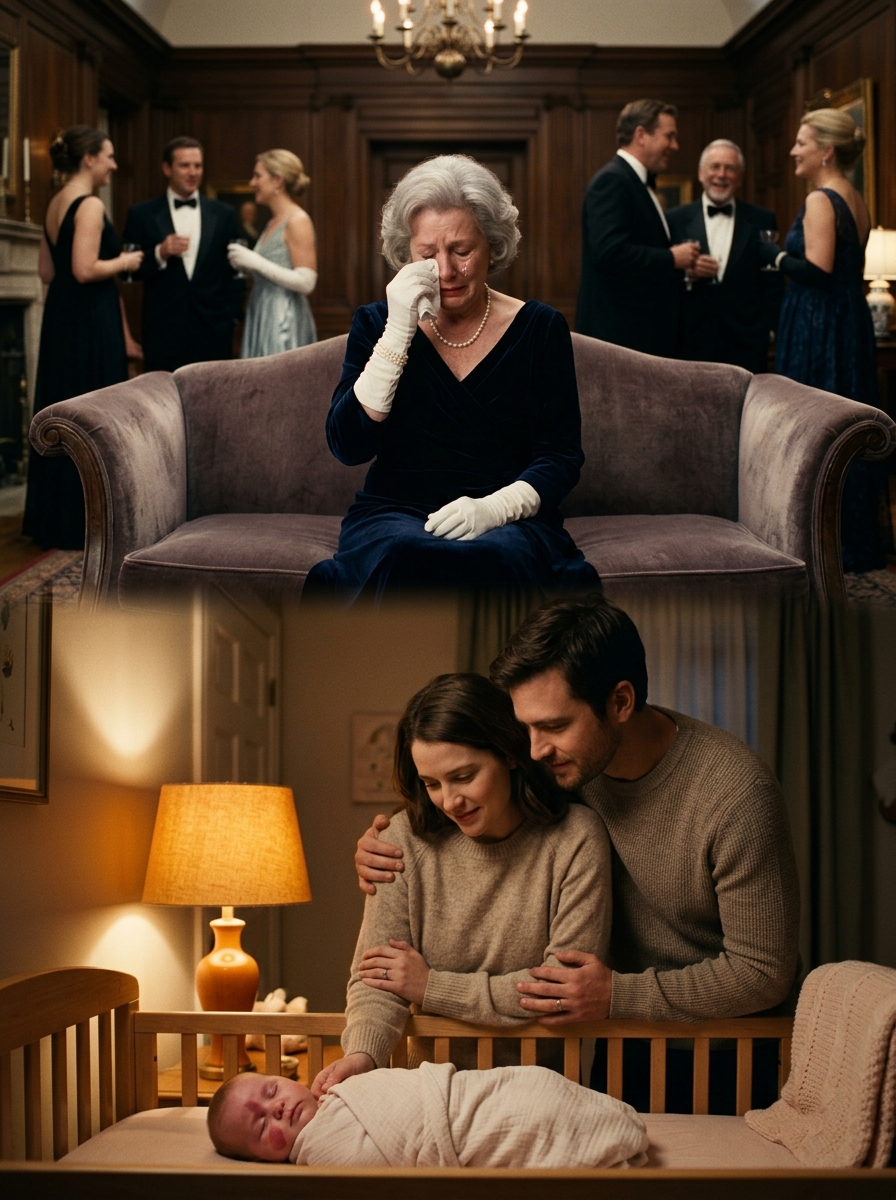
We walked out of Crestview Country Club, leaving Eleanor Vance standing there crying into her hands while surrounded by the deafening silence of the very people she had sacrificed her family trying to impress.
Neither of us spoke during the drive home.
We didn’t need to.
That suffocating chapter of our lives had finally closed for good.
When we stepped through the front door of our modest, slightly cluttered, absolutely perfect home, the quiet felt peaceful. The nurse sat on the couch reading a book. She smiled warmly and told us Lily hadn’t made a single sound all evening.
Mark paid her, and we went straight to the nursery.
The soft yellow glow from the bedside lamp bathed the room in warmth. I leaned over the crib and looked down at my beautiful daughter.
Her tiny chest rose and fell in a calm, rhythmic pattern. I reached out carefully, brushing my fingers across the soft curve of her cheek directly over the rich rose-colored port-wine stain.
Mark wrapped his arms around me from behind, resting his chin gently on my shoulder while looking down at the family he had fought so fiercely to protect.
We didn’t own a sprawling estate.
We didn’t belong to high society.
We didn’t have the approval of the elite.
But standing there in that tiny room, held by a husband who loved me without hesitation while our beautiful daughter slept peacefully before us, I understood something with absolute certainty.
We were the richest people in the world.
