

I had flown countless times for my corporate consulting work, but nothing in all those years prepared me for the moment a flight attendant pressed a heavy plastic PA microphone into my hand and instructed me to apologize to the entire first-class cabin.
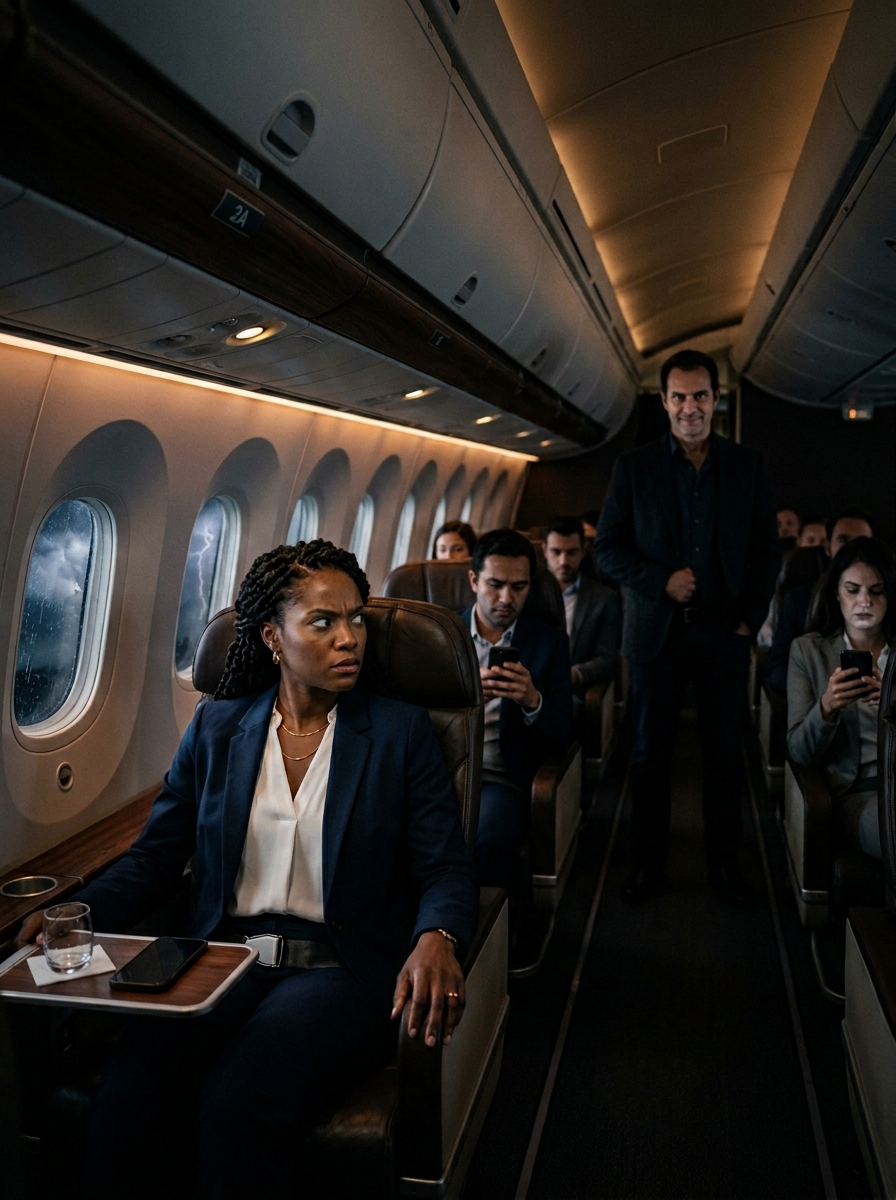
I was departing from JFK on a rainy Friday night, headed home to Los Angeles.
It had been an exhausting week packed with negotiations, boardroom meetings, and nonstop living out of hotel rooms and suitcases.
All I wanted was to settle into my window seat, slide on my noise-canceling headphones, and sleep until the plane touched down in California.
I had reserved Seat 2A almost three months earlier.
I purchased it using miles I had earned myself.
When you are a Black woman working your way through corporate America, you learn to value these small, carefully guarded moments of comfort and peace.
You earn your place, and you hold onto it.
I boarded early with the rest of Group 1, tucked my carry-on into the overhead compartment, and eased into the soft leather seat beside the window.
The cabin was peaceful, filled with the gentle hum of the vents and the quiet rustling of wealthy passengers arranging briefcases and cashmere blankets.
I closed my eyes, allowing the exhaustion to settle over me.
Ten minutes later, boarding was nearly complete when the mood in the cabin suddenly shifted under a wave of chaotic energy.
I heard her before I ever saw her.
A sharp, demanding voice slicing through the calm murmur of the plane.
“Careful with that! It is vintage Prada, do not just shove it in there like common luggage!”
I opened my eyes and saw a woman in her late fifties standing in the aisle beside my row.
She radiated loud, unmistakable wealth—thick gold bracelets clattering together, an enormous diamond ring, and a flawlessly tailored beige trench coat.
But it was the frantic, aggressive way she carried herself that instantly made me uneasy.
Standing behind her was a little girl.
She appeared to be seven or eight years old, though she was so tiny and delicate it was difficult to tell.
The contrast between the woman and the child was unsettling.
The woman looked as though she had walked straight out of a luxury boutique on Fifth Avenue, while the little girl was nearly swallowed by a faded gray hoodie streaked with dirt.
Her jeans were frayed along the hems, and her sneakers looked badly worn.
The girl never lifted her eyes.
Her chin stayed pressed to her chest, shoulders curled inward, hands shoved deep into the oversized hoodie pockets.
The woman finished scolding the flight attendant over her luggage and shifted her attention toward my row.
She glanced at her boarding pass, then stared directly at me.
She didn’t smile. She didn’t greet me politely.
She simply stood there, looking at me as though I were garbage that had somehow blown across her manicured lawn.
“You are in my daughter’s seat,” she said.
Her tone wasn’t asking. It sounded like an order to leave.
I blinked in confusion and straightened in my seat.
“I’m sorry?” I answered evenly. “This is 2A. I believe I have the correct seat.”
“I booked 2B and 2C,” the woman snapped, flicking her manicured hand dismissively. “My daughter needs the window. She has severe flight anxiety. You need to move to the aisle seat so she can sit there.”
I glanced at the little girl.
She hadn’t moved at all. She didn’t seem nervous about flying; she looked completely detached from everything around her, almost lifeless.
“Ma’am, I reserved this window seat months ago,” I replied politely but firmly. “I am not moving to the aisle.”
The woman’s face darkened into an ugly shade of red.
It was the expression of someone who had never heard the word ‘no’ before.
“Listen to me,” she hissed, leaning over the armrest and crowding into my personal space. “I do not know how you got this ticket, or who paid for it, but I am telling you to move. Now.”
The microaggression lingered thick and poisonous between us.
I felt the familiar heat of exhaustion and frustration rise in my chest, the protective armor I wore every day tightening around my ribs.
“I am not moving,” I repeated, my voice dropping lower, calm and unwavering. “Please take your assigned seat.”
She released a loud, offended gasp dramatic enough to make passengers several rows back turn around.
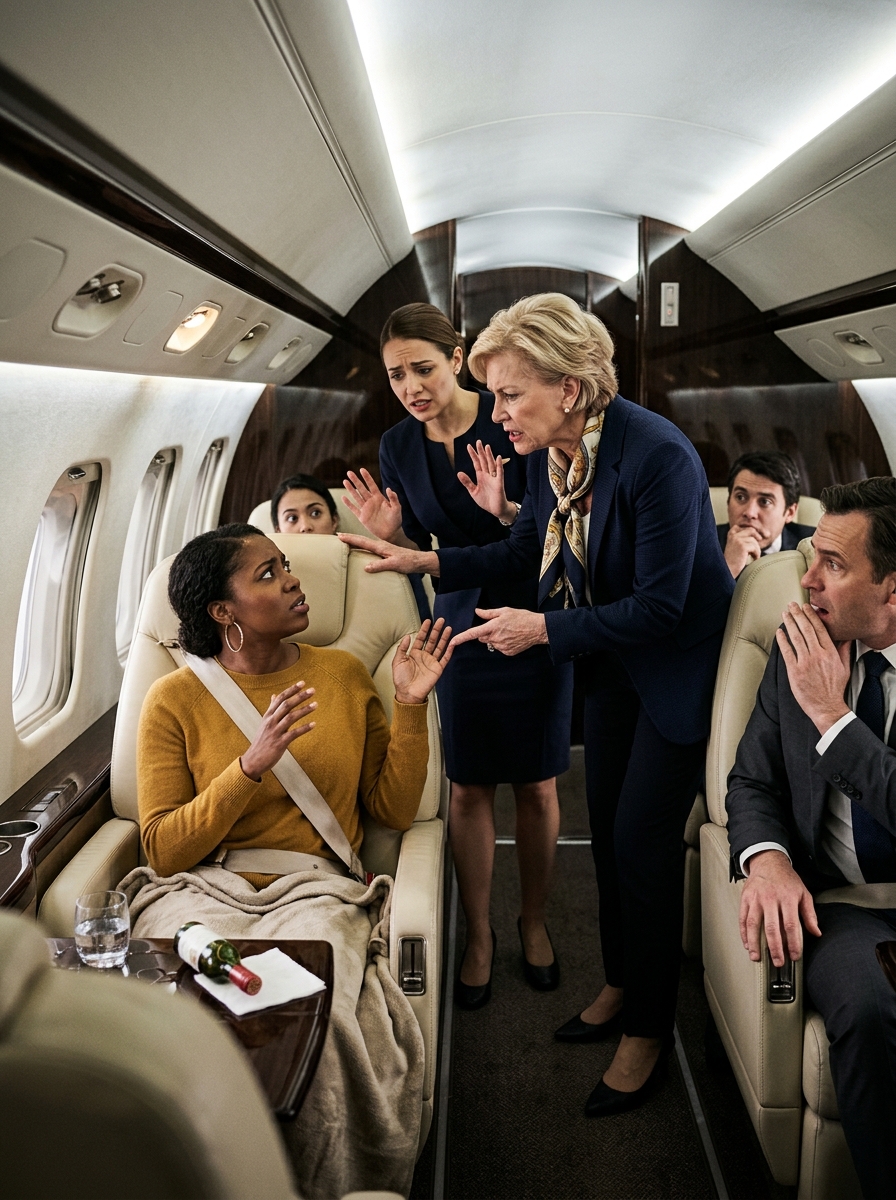
“Excuse me! Flight attendant! I need a flight attendant right now!” she nearly screamed.
A tall, impeccably groomed male flight attendant hurried over. His name tag read ‘Thomas’.
“What seems to be the problem, Mrs. Vance?” Thomas asked.
He knew her name. Of course he did. She was probably one of those elite-status passengers who flew this route constantly.
“This woman is refusing to accommodate my child,” Mrs. Vance lied smoothly, her voice trembling with fake distress. “She is being incredibly hostile. My daughter is terrified, and this woman is creating a deeply unsafe environment for us.”
I stared at her in complete disbelief.
The little girl still stood silently in the aisle, almost invisible behind the woman’s expensive coat.
Thomas turned toward me.
His warm customer-service smile disappeared instantly, replaced by a stiff, authoritative expression.
“Ma’am,” Thomas said coldly, his tone clipped and patronizing. “I am going to have to ask you to switch seats to accommodate the child.”
“No, you are not,” I replied, refusing to break eye contact. “I paid for 2A. I am sitting in 2A. If she wanted a window seat for her daughter, she should have booked one.”
Thomas let out a heavy, exaggerated sigh clearly intended to show everyone nearby that I was being unreasonable.
“Ma’am, you are causing a disturbance,” Thomas warned, lowering his voice into something threatening. “Mrs. Vance is a valued premium member. Her daughter has medical anxiety. If you cannot be cooperative, I will have to find you a seat in economy.”
The sheer nerve of the threat felt like a slap across the face.
He was fully willing to downgrade me, a paying first-class passenger, simply because a wealthy white woman demanded my seat.
“I am not moving to economy,” I replied, my voice trembling slightly with restrained anger. “And I am not causing a disturbance. She is.”
The cabin had gone completely silent.
Every passenger in first class was staring at us.
I could feel the weight of their judgment. I noticed the older man across the aisle shaking his head while muttering something to his wife.
I knew exactly what they were seeing.
An angry, stubborn Black woman ruining their quiet Friday evening flight.
They didn’t care about the truth. They only cared about appearances.
Mrs. Vance folded her arms, a smug smile tugging at the corners of her mouth.
“She is clearly unstable,” Mrs. Vance whispered loudly to Thomas. “I don’t feel safe sitting next to her now. I want her removed from the flight.”
Before I could fully process the sheer absurdity of her demand, the captain’s voice crackled through the overhead speakers.
“Ladies and gentlemen, this is your captain. We are currently holding at the gate due to a minor passenger dispute in the forward cabin. We will push back as soon as the situation is resolved. Thank you for your patience.”
A wave of collective groans rolled through the cabin.
Now I had become the reason everyone was delayed.
Thomas leaned in close, his face only inches from mine.
“Listen to me very carefully,” Thomas hissed, dropping every trace of professionalism. “You have delayed my flight. You have harassed a premium passenger. I am giving you exactly one option.”
He straightened, angling his body so the entire cabin could hear him.
“You will gather your belongings. You will move to seat 18E in the main cabin. And before you go, you will apologize to this cabin for disrupting their evening. If you refuse, I will call Port Authority and you will be removed from this aircraft in handcuffs.”
He reached toward the wall panel, detached the red emergency PA microphone, and extended it toward me.
The humiliation settled over me like a crushing, suffocating weight.
Hot tears of pure rage burned at the back of my eyes.
This wasn’t about policy. It was about breaking me. About forcing me into submission.
I looked at the microphone in his hand.
I looked at Mrs. Vance, now comfortably seated in 2B, watching me with a cold, triumphant satisfaction.
In that instant, I understood that resisting them would end with me in a police holding cell.
The system was built to shield her and punish me.
My hands shaking, I slowly unbuckled my seatbelt.
I reached out and took the cold plastic microphone from Thomas.
I rose unsteadily in the narrow aisle between the seats, my legs heavy as stone.
Then I turned to face the first-class cabin.
Dozens of eyes locked onto me—some irritated, some impatient, all waiting.
I pressed the side button on the microphone.
A sharp burst of static exploded through the speakers.
“Go ahead,” Thomas ordered behind me. “Apologize.”
I drew in a breath, preparing to swallow my pride, preparing to deliver the hollow apology they demanded.
But as I lowered my gaze, I saw the little girl.
She had finally taken her seat in 2C.
Her oversized hood had slipped back slightly.
And for the first time since boarding, she looked up.
Not at the cabin. Not at Mrs. Vance.
At me.
Her eyes were wide, bloodshot, and filled with a raw terror that stole the air from my lungs.
This wasn’t flight anxiety.
It was the look of a child in immediate danger.
Mrs. Vance suddenly reached out and grabbed the girl’s knee, her manicured nails digging into the faded denim.
“Keep your head down, Lily,” Mrs. Vance hissed, her voice stripped of anything resembling warmth.
The girl recoiled, shrinking into the leather seat.
As she pulled back, the sleeve of her oversized gray hoodie slipped upward.
My heart slammed against my ribs.
I froze, microphone still pressed near my lips, the entire cabin waiting for my words.
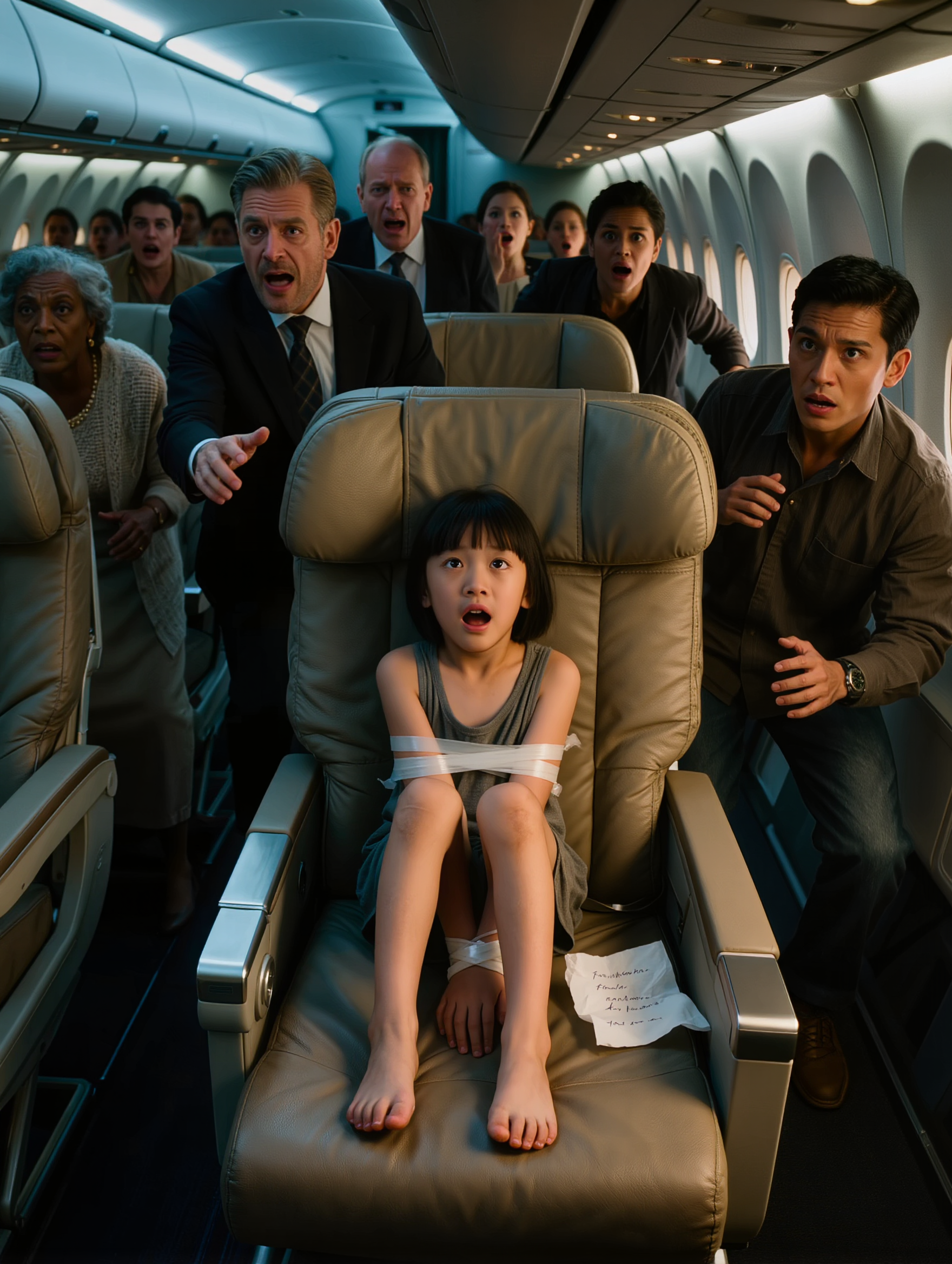
Wrapped tightly around the girl’s thin, pale wrist was a thick plastic zip-tie.
It was so tight it bit into her skin, leaving a deep purple welt.
Beneath it, barely visible, was a torn cocktail napkin.
I stared at it, my mind struggling to accept what I was seeing.
The girl noticed.
With trembling urgency, she turned her wrist just enough.
Just enough for me to read the jagged blue writing on the napkin.
HELP. NOT MY MOM.
The fury inside me vanished instantly, replaced by a cold, violent surge of adrenaline.
This wasn’t a dispute over a seat.
This was a kidnapping.
I looked at Mrs. Vance.
She was watching me, waiting for my apology.
I looked at Thomas, practically vibrating with impatience to remove me.
They wanted me to speak.
They wanted compliance.
My grip tightened on the microphone until my knuckles went white.
My thumb stayed pressed on the broadcast button.
But I did not apologize.
Chapter 2
The static from the emergency microphone hissed through the cabin speakers like a warning signal, freezing the entire aircraft in place.
Every passenger in first class was locked on me.
They were waiting for compliance. Waiting for humiliation. Waiting for me to break.
Thomas stood just behind me, arms folded, radiating the satisfaction of someone enforcing what he believed was order.
Mrs. Vance remained in 2B, perfectly composed, legs crossed, wearing a small, victorious smile.
She looked entirely at ease in her control.
But I wasn’t looking at either of them anymore.
My focus was locked on the little girl in the oversized gray hoodie.
My mind spun rapidly, trying to reconcile what I had just seen.
HELP. NOT MY MOM.
Those jagged blue letters burned into my vision.
And the zip-tie—tight, deliberate, bruising the child’s wrist.
This wasn’t confusion. It wasn’t a custody disagreement.
This was restraint.
A hostage situation, hidden in plain sight, inside a grounded aircraft at JFK.
A cold wave of adrenaline crashed through me, wiping away everything else.
I had spent fifteen years negotiating high-stakes corporate deals—reading liars, predators, and power plays.
My brain snapped into that same survival framework.
Patterns. Motives. Control.
And suddenly, the entire scene reassembled itself.
Mrs. Vance wasn’t just a wealthy, entitled passenger.
She was orchestrating something.
The luxury accessories weren’t status symbols—they were camouflage.
The loud entitlement wasn’t emotion—it was strategy.
She understood exactly how people reacted to authority, wealth, and perceived victimhood.
She knew that if she performed outrage loudly enough, the system would automatically protect her.
And it had almost worked.
She had used bias, assumptions, and social conditioning as a shield.
If I had been removed quietly, the child would have disappeared with her at landing.
The realization hit me like a physical удар, knocking the breath out of me.
“Well?” Thomas snapped behind me. “Everyone is waiting. The captain is waiting. Apologize so we can move this aircraft.”
I tightened my grip on the microphone.
My thumb stayed pressed down.
I knew that if I shouted “She kidnapped this girl,” it would collapse instantly against me.
Thomas already saw me as the problem. The disruption. The threat.
If I escalated, I would be restrained within seconds.
And she would simply reposition the narrative.
I needed proof. Immediate, undeniable proof.
Something the entire cabin could see at once.
I took a slow breath, steadying myself.
Then I lifted my gaze directly to Mrs. Vance.
For the first time, her expression flickered.
Just a fraction of uncertainty.
She sensed the shift.
“Ladies and gentlemen,” I said into the microphone.
My voice carried clearly through the speakers—steady, controlled, unshaken.
“My name is Marcus,” I lied, deliberately, creating confusion and delay. “I am a federal agent, and I am declaring a Level 4 security threat in the forward cabin.”
Silence dropped instantly over the aircraft.
Thomas froze.
“Hey! What are you doing? Give me that!” he shouted, reaching toward me.
I shifted my body, blocking him in the narrow aisle.
“No one approaches me,” I said into the microphone. “Cockpit is instructed to initiate lockdown protocols and contact Port Authority tactical response immediately.”
I didn’t know if the cockpit could hear it—but everyone else could.
And that was enough.
Then I turned back to Mrs. Vance.
Her mask broke.
Not into anger.
Into something far colder.
She moved suddenly, violently grabbing the little girl and pulling her tight against her body.
The child let out a muffled sound, trembling.
“Let her go,” I said into the microphone, stepping forward.
“This passenger is currently restraining a bound hostage in seat 2C,” I broadcast across the entire aircraft. “The child is tied with industrial zip-ties. This is an active human trafficking situation.”
The cabin erupted into total chaos.
A collective wave of horrified gasps swept through first class.
The older man in seat 3A, the same one who had been judging me moments earlier, nearly leapt from his seat, eyes blown wide in shock.
“What the hell is going on?” he shouted, looking wildly between me, Thomas, and Mrs. Vance.
“She is crazy!” Mrs. Vance suddenly screamed, her voice high-pitched and frantic, trying to reassert her victim story. “She is a deranged lunatic! Help me! Somebody help me, she is attacking my daughter!”
But the spell had already broken.
The illusion collapsed, and the passengers were no longer automatically on her side.
Thomas stood frozen in the aisle, mouth open, eyes darting helplessly as he struggled to decide what to believe or what procedure to follow.
“Ma’am, please, give me the microphone,” Thomas stammered, his authority fully unraveling into panic.
I ignored him. I couldn’t afford to lose control of the situation for even a second.
The microphone stayed pressed to my lips.
“Passenger in 3A,” I said into it, locking eyes with the older man who had stood up. “Look at the child’s left wrist. Look at it right now.”
He leaned forward, peering over the seatback.
Mrs. Vance realized what was happening.
Panic flashed across her face as she violently twisted the girl’s arm, trying to shove it under the thick folds of her beige trench coat.
But the child, sensing this might be her only chance, fought back.
With a sudden burst of desperate strength, she kicked and threw her weight sideways, yanking her arm free from Mrs. Vance’s grip.
The sleeve of the dirty gray hoodie slid all the way up to her elbow.
The thick black industrial zip-tie was suddenly exposed under the bright cabin reading lights.
Deep purple bruising and the torn cocktail napkin with frantic blue ink were fully visible to the man in 3A, the couple in 3C, and Thomas, who finally stepped around me to see.
“Oh my God,” the older man whispered, going pale. “Oh my God, she’s tied up! The kid is tied up!”
“Call the police!” the woman in 3C screamed, scrambling backward and pressing herself against the window in terror.
Thomas stared at the zip-tie, his eyes bulging.
The reality of what he had almost enabled—the crime he had nearly helped cover up—hit him like a freight train.
He staggered back, grabbing the galley wall for support, his face draining to an ashen gray.
“Captain!” Thomas shouted, abandoning all composure. “Captain, we need security! We need police now!”
The cabin shifted from tense confusion to explosive panic.
Passengers in the main cabin began unbuckling and standing to see past the curtain, trying to understand the screaming.
Mrs. Vance understood it was over.
Her cover was gone. The trap had snapped shut. She was trapped inside a metal tube with nowhere to run.
But predators don’t simply surrender.
She shoved the little girl away with brutal force, slamming her into the window. The child’s head struck the reinforced glass with a sickening thud.
The girl collapsed forward, sobbing uncontrollably, her bound hands pulled tight to her chest.
Mrs. Vance rose in the aisle.
Her perfectly styled hair was slightly disheveled, her expensive beige coat hanging open to reveal dark, utilitarian clothing beneath.
She stared directly at me.
There was no fear in her eyes—only cold, calculating rage.
“You should have just moved to the back of the plane,” she whispered.
Her voice was so low and chilling it cut straight through the screaming cabin.
It wasn’t a threat. It was certainty.
Before I could fully process it, she reached deep into her trench coat.
She wasn’t reaching for a phone or passport.
The motion was sharp, practiced, lethal.
The older man in 3A shouted a warning—but it was already too late.
She pulled her hand out, and the cabin lights flashed off cold steel in her grip.
Chapter 3
The harsh overhead lights caught the metallic edge of the object as it came free.
It wasn’t a gun. It wasn’t a traditional knife.
It was a solid steel tactical pen—designed to break glass or pierce bone—disguised as an expensive fountain pen.
She must have carried it through TSA inside her vintage Prada bag, unnoticed by agents who only saw a wealthy first-class passenger.
The cap was off, revealing a jagged tungsten-carbide spike.
In the tight first-class aisle, it became a close-range weapon.
Time slowed to a crawl.
I heard panicked breathing all around me.
I heard rain drumming softly against the aircraft fuselage.
And I saw complete, unwavering intent in her eyes.
She didn’t shout. She didn’t warn.
She lunged.
A violent, efficient motion aimed straight for my throat.
I had no space to retreat. The galley wall was behind me, and Thomas was frozen, blocking the only exit forward.
Instinct took over.
I raised my right hand, still gripping the heavy plastic emergency PA microphone, and swung.
The impact was explosive.
Plastic struck steel with a brutal crack.
A shockwave ripped through my arm to my shoulder.
The red microphone casing shattered instantly, exploding into fragments across the aisle.
Her strike was deflected, the steel tip slamming into the overhead bin just inches from my face.
It punched through the plastic like paper.
She grunted in rage, ripping the spike free and twisting for another attack.
But the deflection gave me what I needed: a single second.
I lunged forward.
I drove my full weight into her chest, slamming her into the bulkhead by the boarding door.
The impact echoed like a gunshot.
Her coat offered no protection, but her grip stayed locked on the weapon.
“Get her hand!” I shouted. “Someone grab her hand!”
For a split second, no one moved.
The bystander effect froze the cabin. First class passengers, unprepared for violence, simply watched.
They waited for someone else.
But authority was frozen too.
Thomas was pressed against the wall, completely unable to act.
Mrs. Vance caught her breath.
She snarled and twisted violently, trying to drive the spike toward my ribs.
I grabbed her wrist with both hands, digging into her sleeve.
She was terrifyingly strong.
Adrenaline made her feel unbreakable.
We wrestled in the narrow aisle, knocking over a tray table and shattering a champagne glass on the floor.
The sharp scent of alcohol filled the air.
“Let go of me, you stupid bitch!” she hissed, spitting as she spoke. “You have no idea who you are dealing with!”
“I don’t care!” I shouted back, my muscles screaming with lactic acid as I fought to keep the sharp steel spike from reaching my body.
Slowly, agonizingly, she started to gain control over me.
The tip of the spike edged closer and closer to my collarbone. I could feel the coldness radiating off the metal.
Then, suddenly, a heavy force slammed into Mrs. Vance from the side.
It was the older man from seat 3A.
He had finally broken through his shock. He threw himself over the armrest, locking his arms around her waist and yanking her violently off balance.
“Get the weapon!” he shouted, face flushed with strain.
The sudden shift in momentum threw Mrs. Vance sideways.
I used the opening, wrenching her wrist downward at a painful angle.
She screamed as her grip finally gave way.
The steel tactical pen fell from her hand, striking the armrest of 2B and vanishing beneath the seats.
Now disarmed, Mrs. Vance didn’t stop.
She changed strategy instantly.
If she couldn’t win by force, she would use leverage. And her leverage was the child.
She drove her elbow into the older man’s face with brutal force. A sickening crack of cartilage echoed as his nose broke on impact.
He cried out, collapsing back into his seat as blood poured down his chin, soaking his white shirt.
Free of his grip, Mrs. Vance lunged toward the window seat.
Straight at the little girl.
The child was still pressed against the reinforced window, knees pulled tight to her chest, zip-tied wrists trembling uncontrollably.
“No!” I screamed, realizing exactly what she intended.
She was going to take the child hostage. If her hands reached the girl’s neck, everything would instantly turn into a lethal standoff.
I threw myself across seat 2B without hesitation, ignoring my own safety.
The moment Mrs. Vance’s manicured hands reached for the hood of the girl’s filthy gray sweatshirt, I slammed into her shoulders.
My momentum carried us both over the armrests.
We crashed hard onto the floor in the tight space between the seats and the bulkhead.
It became pure, blinding chaos.
Elbows and knees collided in the cramped space. We could barely move, but she fought like a cornered animal.
She clawed at my face, her nails ripping a burning gash down my cheek.
Hot blood immediately spilled, running down my jaw.
I pinned her right arm under my knee, driving my shin into her bicep to keep her down against the carpet.
“Help me hold her down!” I shouted, looking up at the shocked faces above the seats.
Finally, the spell broke completely.
Two men from the main cabin forced their way through the curtain and rushed forward.
They dropped onto her, grabbing her legs and free arm, forcing her flat against the airplane floor.
She thrashed violently, screaming curses and threats, promising to ruin all of our lives.
But it was over.
She was restrained. The immediate danger had been contained.
I slowly pushed myself upright, my entire body shaking from the adrenaline crash.
My chest heaved. My cheek burned. My hands were slick with a mix of spilled champagne and the older man’s blood.
The cabin was pure chaos.
The woman in 3C was sobbing uncontrollably.
The older man in 3A held a napkin to his broken nose, groaning in pain.
Thomas was finally moving again. He stood near the cockpit door, frantically shouting into the interphone, his hands shaking so badly he could barely hold it.
“We have a security breach! Violence in the forward cabin! We need Port Authority immediately! Gate 42, immediate breach!”
I ignored everything around me.
I turned away from the men restraining Mrs. Vance.
I looked at seat 2C.
The little girl was still there.
Curled into herself, impossibly small, her face buried in the torn fabric of her hoodie.
She made a low, broken keening sound—the sound of a child completely overwhelmed by terror.
My breath shook as I tried to steady myself.
I wiped the blood from my cheek with my sleeve, careful not to frighten her further.
I stepped toward her slowly, deliberately, keeping my movements gentle.
“Sweetheart?” I whispered, voice thick.
She flinched hard, recoiling from me as if my voice itself hurt her.
“It’s okay,” I said softly, lowering myself into a crouch so I was at her eye level. “You’re safe now. I promise, no one is going to hurt you anymore.”
I didn’t reach for her. I didn’t touch her.
I just stayed there, still in the wreckage of first class, giving her space to see I wasn’t a threat.
Slowly, hesitantly, she lifted her head.
Her eyes were red, swollen, hollow with exhaustion.
She looked at me, then past me—toward the men holding Mrs. Vance down.
When she saw the woman fully restrained, when she understood the danger was over, something inside her finally broke loose.
The tension drained from her body all at once.
She exhaled a long, shaking breath, and whatever had been holding her together collapsed.
She slid off the seat and fell into my arms.
I caught her, wrapping her tightly against me.
She felt impossibly light—sharp bones beneath the heavy hoodie.
She buried her face into my shoulder and began to cry.
Not loudly. Not dramatically.
Just deep, silent, uncontrollable sobs that shook her whole body.
I held her close, resting my chin on her head.
“I’ve got you,” I whispered, tears spilling down my face. “I’ve got you. You’re safe. You’re going home.”
As I held her, my eyes drifted across the floor near the bulkhead.
Mrs. Vance had stopped struggling. She lay face down, breathing hard, pinned firmly by the men holding her.
But her eyes weren’t on them.
They were locked on me.
Cold. Empty. Calculating.
As she shifted slightly, something slipped from the inside pocket of her torn beige trench coat.
It fell softly onto the carpet near my shoe.
I looked down at it.
And the blood in my body turned to ice.
It was a boarding pass.
But not hers.
And not the child’s.
A third boarding pass.
Seat 18E.
The exact seat Thomas had tried to force me into.
The name printed on it was male: “Vance, Richard.”
My heart stopped for a moment.
She wasn’t alone.
This entire confrontation—the demand for my seat, the staged racial dispute, the pressure to push me to the back of the plane—was never really about a window seat.
It was a coordinated, tactical operation.
They wanted me in 18E. They wanted me out of the first-class cabin.
I slowly lifted my head, looking beyond the horrific scene unfolding in first class.
Through the open curtain separating the cabins, I saw the main section.
Dozens of passengers were standing in the aisles, phones raised, filming the chaos, their faces drained of color.
But in the middle of the aisle, about ten rows back, stood a man.
He wasn’t filming. He wasn’t panicking.
He was looking straight at me, completely expressionless, his right hand resting casually inside the pocket of his dark jacket.
And as our eyes locked across the screaming, chaotic cabin, he slowly, deliberately smiled.
Chapter 4
That smile wasn’t unhinged.
It wasn’t the desperate, entitled rage Mrs. Vance had shown moments earlier.
It was something colder—the calm, hollow smile of a trained predator realizing the primary plan had failed and switching immediately to contingency mode.
Richard Vance.
The name on the abandoned boarding pass rang in my head like a warning bell.
I looked down at the thick airline cardstock on the bloodied carpet of first class, then back up at the man standing in the middle of the main cabin.
Seat 18E.
The realization hit with such force my knees nearly gave out.
This entire event—the disrespect, the demands, the engineered confrontation—was not random.
It was a coordinated human trafficking operation unfolding in plain sight.
Mrs. Vance’s attempt to take my seat hadn’t been about entitlement or a window view for a “nervous” child.
It was a calculated move to isolate and control me.
They had assessed me the moment I sat down.
A Black woman alone in first class. They knew exactly how the system—and airline staff—would interpret a wealthy white woman claiming she felt “unsafe.”
They had weaponized bias as a tool.
If I had complied…
If I had accepted the humiliation and let Thomas force me to move…
I would have been marched down the aisle and placed directly into 18E.
Trapped beside Richard Vance.
While I sat in the back of the plane, distracted and contained, Mrs. Vance would have maintained full control of the bound child at the front.
And Richard Vance?
With his hand still resting in that jacket pocket, I already understood.
A quiet threat. A concealed weapon. Control enforced in silence until landing.
Refusing that seat hadn’t just been defiance—it had disrupted a coordinated trafficking pipeline.
And now the enforcer was moving.
A sudden shift in the main cabin snapped me back.
Richard Vance pulled his right hand out of his jacket pocket.
It wasn’t a firearm. Metal would have been difficult to pass through TSA even for someone like him.
Instead, the cabin lights caught something dark, matte, and serrated.
A ceramic composite tactical blade.
Undetectable by metal scanners. Capable of cutting through restraints or flesh with no resistance.
A scream tore through row ten as passengers saw it.
The main cabin exploded into chaos.
People shoved past each other, climbing over seats, scrambling toward the rear exits.
Luggage tumbled from overhead bins, striking heads and adding to the panic.
Richard Vance didn’t run.
He walked.
Slow, controlled, deliberate—pushing a terrified teenager aside with a single brutal motion, eyes locked on mine the entire time.
He was coming for the child. To finish what had been interrupted.
“Get back!” I screamed, my voice ripping through my throat.
The men still holding Mrs. Vance down looked up, faces pale with fresh fear.
“He has a knife! Block the aisle!” I shouted, pointing toward the curtain.
But panic froze them.
The bystander effect took hold again.
The older man with the broken nose slumped, dazed and bleeding.
Thomas let out a broken sound, dropped the interphone receiver, and backed away entirely—then turned, opened the crew rest door, and locked himself inside.
We were alone.
The little girl clung to my legs, shaking violently, eyes locked on the advancing man.
I wasn’t law enforcement. I wasn’t military. I was a corporate negotiator.
But looking at the bruises on her wrists, something deeper took over.
I wasn’t letting him reach her.
I grabbed her shoulders, lifted her small body, and shoved her into the tight gap behind seat 1A, hiding her from view.
“Do not move. Do not make a sound,” I said, low and firm.
I turned, scanning the wrecked cabin for anything usable.
My eyes landed on the heavy metal beverage cart abandoned near the galley wall.
I ran for it.
Adrenaline made it feel weightless.
I gripped the handles, released the brake, and shoved the cart hard down the aisle.
It crashed cleanly into the gap between the first-class cabin and the main cabin, wedging itself tightly between the armrests of row four.
It formed an immediate, solid metal barricade.
Richard Vance reached the curtain at the exact moment the cart locked into place.
He stopped on the opposite side of the trolley, studying the barrier with a calm, mildly irritated focus.
He was less than six feet from me.
Up close, his eyes were completely lifeless. There was no humanity behind them—only a cold, hollow absence of empathy.
“You are making a very serious mistake,” Richard said.
His tone was eerily even, smooth, almost conversational. He sounded like he was commenting on the weather, not standing armed with a ceramic blade on a hijacked aircraft.
“The police are already on their way,” I shot back, my chest heaving, fists clenched tight. “Port Authority is coming right now. You are trapped in a metal tube. There is nowhere to go.”
Richard gave a quiet, dismissive laugh.
“Do you have any idea how much money that cargo is worth?” he asked, tilting his head toward the space where I had hidden the little girl.
He called her cargo. Not a child. Cargo.
“She has very important buyers waiting for her in Los Angeles,” Richard went on, tightening his grip on the black ceramic handle of the blade. “Buyers who do not tolerate delays. You are a civilian. This is not your concern. Move the cart, let me retrieve my property, and you walk off this plane alive.”
“She is not property!” I screamed, fury surging fresh through my chest.
“Everything is property,” Richard replied flatly.
He lifted his foot and kicked the metal beverage cart with brutal force.
The cart lurched forward, wheels screeching across the carpet and tearing into it.
It slid another foot toward me, the impact nearly knocking me off balance.
He kicked it again.
Locks snapped under the pressure, spilling bottles and cans across the floor.
He was forcing his way through.
I stepped back, grabbing the heavy glass bottle of pre-departure champagne from the galley counter.
I gripped it by the neck, ready to swing the moment he broke through.
“Last chance,” Richard Vance said, stepping onto the lower rail of the jammed cart, preparing to climb over it.
He raised the ceramic blade, aiming its serrated edge at my chest.
I lifted the champagne bottle, bracing myself.
Then the entire aircraft jolted violently.
Not a shift in weight—a deafening, thunderous impact from outside near the boarding door behind me.
Before Richard could react, the reinforced exterior door blew open.
The force shoved freezing rain and roaring wind into the cabin.
“PORT AUTHORITY POLICE! NOBODY MOVE! DROP THE WEAPON! DROP IT NOW!”
The command tore through the cabin, accompanied by blinding tactical lights slicing through the dimness.
Armored officers in dark gear flooded through the doorway.
Red laser sights swept across the cabin, locking onto seats, walls, and faces.
At least four red dots settled on Richard Vance.
“DROP THE KNIFE OR WE WILL FIRE!” an officer shouted, rifle raised.
Richard froze.
For the first time, his composure cracked.
He looked at the officers, at the overwhelming force, then slowly opened his hand.
The ceramic blade clattered onto the cart.
In seconds, officers vaulted over the barricade and slammed into him, forcing him down with brutal precision and cuffing his hands behind his back.
Others moved to Mrs. Vance, dragging her up and pressing her against the bulkhead for search.

“Clear! Subject one secure!”
“Subject two secure! Weapon neutralized!”
The chaos of civilians was replaced by the sharp, controlled commands of the tactical team.
A gloved hand suddenly grabbed my shoulder and pulled me back.
“Are you hit? Ma’am, are you injured?” a paramedic asked, shining a light into my eyes.
I blinked hard, adrenaline collapsing through my body.
“I’m not… I’m okay,” I said shakily. “The little girl. You need to get the little girl.”
I pointed toward the space behind seat 1A.
A female officer immediately knelt, holstering her weapon.
She reached in gently and pulled the trembling child into her arms.
As she lifted her, the girl turned her head toward me.
Through tears and exhaustion, she met my gaze.
She didn’t speak, but the gratitude in her eyes was overwhelming—deep, silent, and unforgettable.
I watched as medics wrapped her in a thermal blanket and carried her out into the terminal.
The next hours blurred into flashing lights, holding rooms, and relentless questioning.
I was escorted by federal agents into a private office at JFK.
My cheek was cleaned and bandaged. My hands were bruised and swollen.
I sat under harsh fluorescent light as FBI agents took my statement.
They confirmed what I had already understood.
Richard and “Mrs. Vance” were not their real identities.
They were part of an international trafficking network.
They used luxury travel, false identities, and first-class access to move abducted children.
The girl—Chloe—had been taken from a playground in Ohio three days earlier.
Her parents were now waiting to reunite with her at JFK, where she was safe in a medical unit.
A female agent finally closed her file and looked at me.
“You saved her life today,” she said quietly. “If they’d gotten her to Los Angeles, she would’ve disappeared within hours.”
I stared at the dried blood on my blazer.
“They almost got away with it,” I said. “They used the flight attendant. They used my race. They knew exactly how to make me the problem.”
The agent nodded slowly.
“Predators use whatever works,” she said. “They rely on people looking away. But you didn’t.”
Before I left, there was one last encounter.
Walking through the terminal with a Port Authority escort, I saw Thomas.
He sat on a bench surrounded by supervisors and officers, uniform wrinkled, face pale, shaken apart.
He saw me and stood immediately, hands trembling.
“Ma’am,” he choked out. “I… I am so sorry. I didn’t know. I thought I was just… I almost—”
He couldn’t finish.
I stopped in front of him.
“You didn’t care about peace, Thomas,” I said coldly. “You cared about obedience. A wealthy white woman made a demand, and you decided I was the problem without asking a single question.”
He flinched.
“I told you to look at the child,” I continued. “But you were too busy threatening me and forcing an apology.”
I leaned in slightly.
“You almost got her killed. And you almost got me killed. Don’t ever assume again who belongs in first class.”
I turned away before he could respond.
I collected my bag and stepped outside into the damp New York night.
The rain had stopped.
I checked my phone, ignored the missed calls from work, and booked the next first-class flight to Los Angeles.
I was exhausted. I was shaken.
But watching the planes rise into the dark sky, I felt something steady settle inside me.
I had held my ground.
And a little girl was going home because of it.
