


I Raised My Niece as My Own After My Sister Died — Eight Years Later, She Spotted a Woman at the Beach and Whispered, “Aunty… She Has My Butterfly Mark”
The Mark Beneath the Changing-Room Wall
For eight years, I was certain my sister was gone.
I’d stood in front of a closed casket, said my goodbyes, and left carrying the one-year-old she’d left behind.
From that point on, Ruth became my whole world.
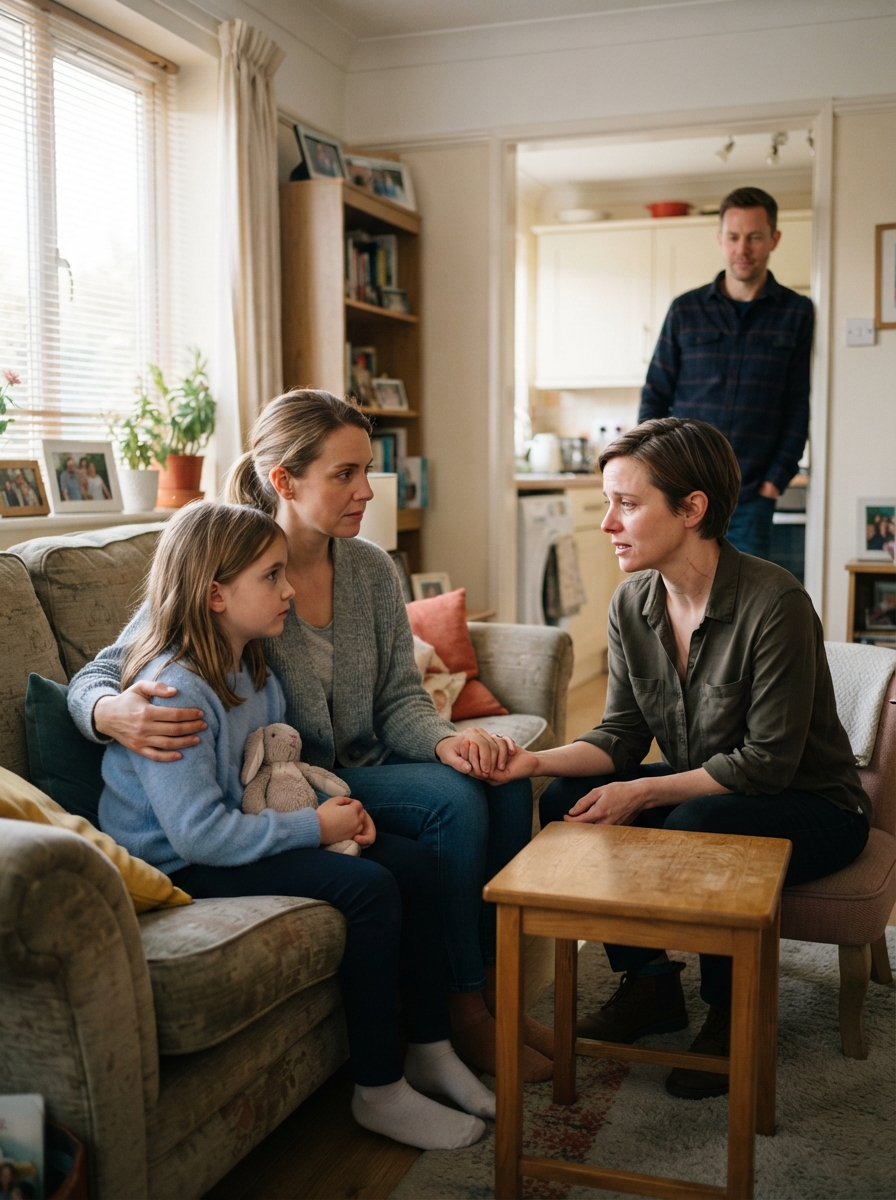
I figured out how to warm bottles at 3 a.m., how to soothe a toddler shaken by nightmares, how to braid hair even though my early attempts looked more like knotted rope.
I handled school paperwork. I sat by hospital beds through fevers. I marked every lost tooth, every birthday, every tiny milestone.
Whenever Ruth asked about her mother, I told her stories.
I believed every one of them myself.
Then, on one sunny beach afternoon, everything I thought I knew came apart.
Ruth and I were tucked inside a wooden changing stall near the boardwalk. She’d turned eight by then — sharp, observant, endlessly curious.
Her hair was still damp from swimming, and I was wrestling a clean T-shirt over her head.
Midway through, she went completely rigid.
The shirt was bunched over her face, blocking her eyes and nose.
“Aunty Jess,” she whispered.
I chuckled. “What’s wrong, sweetheart? Head stuck?”
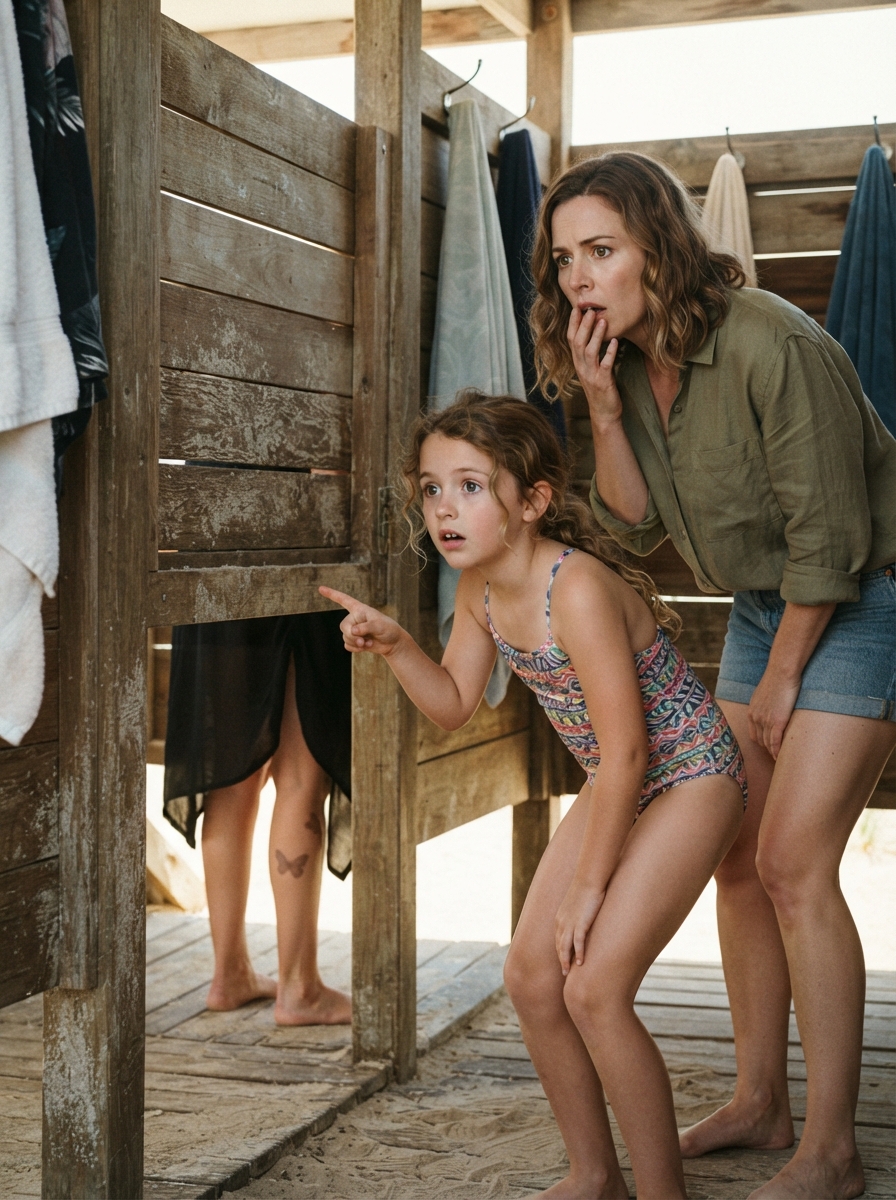
She tugged the shirt down just enough to see and pointed toward the sliver of space under the divider separating our stall from the next.
“Look.”
At first, all I saw were a woman’s bare feet and calves.
Then she adjusted her towel.
On the outside of her calf sat a small birthmark shaped like a butterfly.
My hands went numb.
It wasn’t just similar to Ruth’s.
It was an exact match.
Same delicate wings.
Same uneven border.
Same spot on the calf.
Ruth glanced down at her own leg, then back through the gap.
“She has my butterfly,” she said softly.
The beach noise faded away.
I couldn’t hear the waves, the gulls, the kids laughing outside anymore.
Only my own heartbeat, pounding.
I knew exactly one other person who carried that mark.
My older sister, Joan.
Ruth’s mother.
The woman I’d buried eight years before.
[For illustrative purposes only]
The Woman Who Wouldn’t Turn Around
The woman next door moved fast.
I heard fabric rustling, a beach bag snapping shut, sandals scraping against wood.
Then she was gone from the stall.
I threw our curtain open before I’d even gotten both sandals on right.
“Stay here with Andy,” I told Ruth.
Andy, my boyfriend, was waiting close by with our towels and bags.
Ruth grabbed my arm. “But where are you going?”
“I just need to talk to someone.”
“Aunty—”
“Please, Ruthie. Stay with Andy.”
My voice came out sharper than I meant it to, but fear had already taken over.
The woman was hurrying toward the boardwalk, head down, wrapped in a loose blue cover-up.
“Wait!” I called out.
She didn’t stop.
I chased after her, weaving through families with umbrellas and teens wrapped in towels.
“Joan!”
She froze.
Just for a second.
But I caught it.
Then she picked up her pace even more.
That was all the confirmation I needed.
I trailed her past the outdoor showers and finally closed the gap near the rinse station. My lungs burned, sand filling my half-buckled sandals.
“Turn around,” I demanded.
She kept her face turned.
“You’ve got the wrong person,” she said.
Her voice was strained and quiet, but something in me recognized it instantly.
“No,” I said. “I don’t.”
She shut her eyes.
“Please, Jess.”
Hearing my name from her nearly shattered me.
“Say it again.”
Slowly, she turned around.
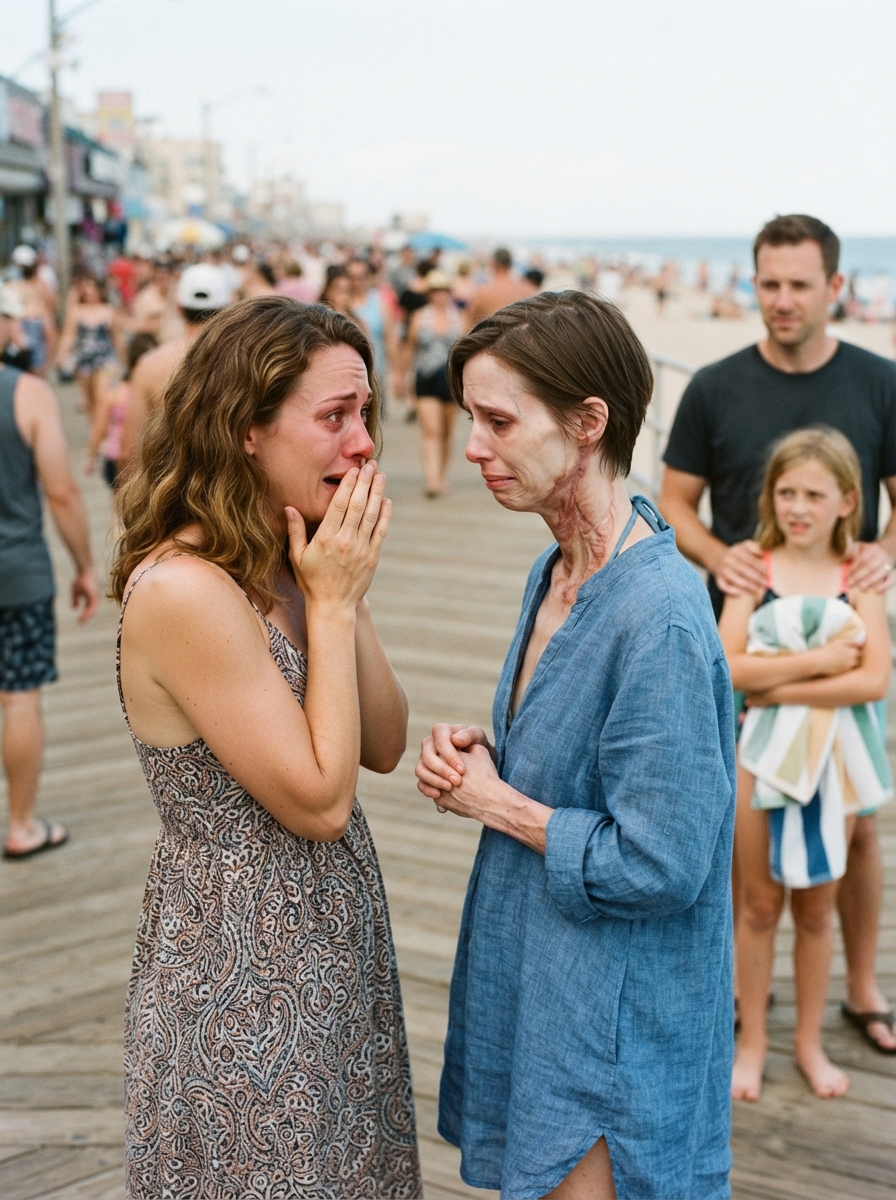
Her face was thinner than I remembered. Her hair had been chopped short, and pale scarring ran along one side of her neck, disappearing under her collar.
But her eyes hadn’t changed.
Still the same deep brown eyes I’d grown up alongside.
The same eyes that had teased me, protected me, cried with me.
“Jess,” she whispered again.
My legs nearly buckled.
“You’re dead.”
Joan pressed a hand over her mouth as her eyes filled.
Behind me, I heard Ruth calling out.
Andy was walking over with Ruth beside him, the beach bag over his shoulder, her towel in hand.
He glanced between me and the stranger in front of me.
Then his expression shifted.
“Jess?” he asked carefully.
“Take Ruth down toward the water,” I said. “Build a sandcastle with her. Make one of those mermaids she loves.”
Ruth wouldn’t budge.
She kept staring at Joan.
Then looked at me.
“Is that lady my mommy?”
The question sliced through the air.
Joan flinched like she’d been hit.
Ruth’s fingers gripped my wrist tighter.
“Why does she have the same birthmark as me?”
I knelt down and put both hands on her shoulders.
“Sweetheart, I need to talk to her first.”
“But is she my mommy?”
My throat closed up.
For eight years, I’d answered Ruth’s questions about her mother with total certainty.
Now, for the first time, I had no idea what was true.
“I think she might be,” I admitted.
Ruth’s eyes welled up instantly.
I kissed her forehead.
“Go with Andy for a bit. Stay where I can see you both. I’ll explain everything once I understand it myself.”
Andy crouched beside her. “Come on, kiddo,” he said gently. “We’ll stay close. Your aunt can see us the whole time.”
Reluctantly, she let him lead her off.
Once they were far enough not to hear, I turned back to my sister.
“Start talking.”
The Funeral That Should Never Have Happened
Joan glanced around nervously. “I can’t do this here.”
A bitter laugh escaped me. “You vanished for eight years and turned up next to your own daughter in a beach changing room. You don’t get to pick the setting.”
“Jess—”
“No. You let me bury you.”
My voice shook as the memories flooded back.
Eight years earlier, Joan had taken Ruth to an old farmhouse for the weekend.
Joan had been twenty-six then — young, overwhelmed, too proud to ask for help.
That night, the farmhouse burned.
Ruth was found nearly fifty yards from the building, sitting in the grass beside the family dog, crying for her mother.
No one could explain how a one-year-old had ended up that far away alone.
A body was pulled from the wreckage.
Officials told us it was Joan.
The damage ruled out a standard identification, so the casket stayed closed.
I buried my sister on a cold, gray morning.
Then I brought her baby home.
For weeks, Ruth woke up crying for her mother, reaching toward any woman with hair like Joan’s.
I couldn’t give her back the person she wanted, so I gave her everything else I had.
My time.
My home.
My patience.
My future.
Now the woman I’d mourned stood right in front of me.
Alive.
“You let Ruth grow up thinking you were gone,” I said. “You let me raise her while she cried for you.”
“I saved her,” Joan whispered.
I stopped cold. “What did you say?”
“The night of the fire,” she said. “I carried Ruth out through the side door. The dog followed us. I set her down far enough from the house and told him to stay put beside her.”
My chest tightened. “So that’s how she ended up in that field?”
Joan nodded.
It was the answer to a question that had haunted me for years.
“Then why didn’t you stay with her?”
“There was another woman inside.”
I stared at her. “Who?”
“Someone from work. She’d just moved to town and was staying with me for a bit. You never met her. She tagged along because I didn’t want to drive alone with a baby.”
Joan wrapped her arms around herself.
“She was asleep in the back room. After I got Ruth outside, I went back for her.”
Her voice wavered.
“I remember the smoke. Trying to reach the hallway. After that — nothing.”
She looked down at her shaking hands.
“The next clear memory I have is waking up in a hospital. My purse, my ID — all burned. I couldn’t talk properly for a while. I was confused, badly hurt, unable to tell anyone who I was.”
I tried to follow along, but anger kept surging up in me.
“By the time your memory came back, we’d already buried the other woman?”
“Yes.”
“When did it come back?”
“Not all at once. First just flashes — a baby crying, your face, our childhood home. More came back over the following weeks.”
Her eyes lifted to mine. “Eventually, it all came back.”
“Everything?”
“Yes.”
“You remembered your daughter?”
She nodded.
“You remembered me?”
Another nod.
“Then why didn’t you come home?”
Joan’s face crumpled. “I was afraid.”
[For illustrative purposes only]
“Fear Doesn’t Explain Eight Years”
I stared at her, stunned. “Afraid of what?”
“That people would blame me for the other woman’s death. I went back in for her, but I’m the one who lived.”
“You were trying to save her.”
“I knew that, logically. But I didn’t feel innocent. I thought everyone would ask why she died and I didn’t.”
Her fingers drifted to the scars on her neck.
“I was burned. I couldn’t sleep. I had panic attacks. I couldn’t stand looking in a mirror.”
Her voice dropped to barely a whisper.
“I thought Ruth would be scared of me.”
“She was a baby.”
“I was scared of myself.”
I shook my head.
That might explain hiding for a week. Maybe a month.
It didn’t explain eight years.
“So you just decided not to come back?”
“I saw you with Ruth once.”
My anger paused. “What?”
“A few months after the fire. Outside a grocery store. Ruth was in the cart, eating crackers.”
Joan gave a broken little smile.
“You were wiping crumbs off her face with your sleeve because you couldn’t find a napkin. She laughed at you, and then you started laughing too.”
I remembered that day.
I’d been running on empty. Ruth was teething. I hadn’t slept properly in three nights.
“You looked exhausted,” Joan went on, “but Ruth looked safe.”
“And that was enough for you?”
“I told myself she was better off with you.”
“No.”
I stepped closer.
“You told yourself a story that made abandoning us sound noble.”
Joan flinched.
“You didn’t spare Ruth any pain,” I said. “You just handed it to me and walked away.”
Tears streamed down her face. “I’m sorry.”
“Do you know how many nights I talked to your photograph?”
She stared at me.
“When Ruth had a fever that wouldn’t break, I asked your picture what to do. When she cried for you at night, I was furious at you for leaving her. Then I hated myself for being angry at someone I thought was dead.”
“I’m so sorry.”
“You owe me years’ worth of that word, Joan. Don’t spend it all in one afternoon.”
She nodded, wiping her face.
For a few seconds, neither of us said anything.
Then she looked toward the shoreline, where Ruth stood beside Andy.
“Can I see her?”
“No.”
The word left my mouth instantly.
Joan’s face fell apart.
“Not like this,” I added. “Not because she spotted your leg under a changing-room wall. Not because you finally got tired of hiding.”
“I don’t want to take her from you.”
“You couldn’t.”
I squared my shoulders.
“I’m her legal guardian. I’m the one her teachers call. I know her doctor’s name, her favorite bedtime story, which side of the bed she sleeps on when she’s scared.”
Joan lowered her eyes.
“You don’t get to walk back into her life and shake up everything she trusts.”
“I know.”
“Do you?”
“I don’t want to take her,” she repeated. “I just want to stop being a ghost.”
For the first time since I’d seen her, Joan sounded entirely genuine.
I looked toward Ruth.
She stood stiffly next to Andy, watching us.
Andy raised a hand slightly, silently checking if I was okay.
I wasn’t.
But I was still upright.
And Ruth needed me upright.
“You’re going to give me your real number,” I told Joan. “Tomorrow, we meet somewhere quiet. You don’t contact Ruth or go near her until I decide how to handle this.”
Joan nodded quickly. “All right.”
“If you vanish again, I won’t come looking.”
Her eyes held mine.
“I’ll tell Ruth exactly who you are.”
Joan swallowed. “I won’t run again.”
I took her phone, called my own number, and saved the contact.
I didn’t label it “Sister.”
Just one word.
Joan.
The Hardest Conversation at Our Kitchen Table
That evening, Ruth sat at the kitchen table in her pajamas.
Andy had made grilled cheese, cut into triangles the way she liked it.
Normally she’d have cleaned her plate.
That night she barely touched it.
After a few minutes, she pushed the plate aside.
“Was that lady really my mommy?”
I sat across from her. “Yes, sweetheart.”
Her bottom lip trembled. “But you said she died.”
“I believed she had.”
“Did you lie to me?”
“No.”
I reached across and took her small hand.
“I told you what everyone believed was true. I would never knowingly lie to you about something this important.”
Ruth looked at Andy. “Did you know?”
“No, kiddo,” he said. “I found out today, same as you.”
She turned back to me. “Is she moving in here?”
“No.”
“Am I going to live with her?”
“No.”
I answered fast and firm, leaving no room for doubt.
“This is your home. I am your home. Nothing about that changes tonight.”
Some of the tightness left her shoulders.
“So what does change?”
“We take it slow,” I said. “We’ll talk to someone who understands complicated family stuff. Joan will have to be honest. And you get to feel whatever you feel.”
“Can I be angry?”
“Yes.”
“Can I want to know her and still be angry?”
“Yes.”
Ruth stared at her untouched sandwich.
“What if I don’t want to know her at all?”
I squeezed her fingers. “That’s allowed too.”
She looked at me, searching my face. “You won’t leave me?”
“Never.”
That night, Ruth slept in my bed.
She curled into my side the way she used to as a toddler, one hand fisted around my pajama sleeve.
I stayed awake long after she’d drifted off.
I watched her breathe and thought through everything Joan’s return might change.
Then I reminded myself of the one thing that wouldn’t.
Ruth would never have to face any of it by herself.
Rules for Coming Back
The next afternoon, I met Joan at a quiet café.
Without the beach’s glare and crowds around her, she looked smaller.
Not like a ghost.
Not even like the sister I remembered.
Just a tired woman who’d spent eight years running from one terrible decision.
“I set up an appointment with a family counselor,” I told her. “Ruth meets with them first. Then me. Eventually, maybe all three of us together.”
Joan nodded.
“You don’t speak to Ruth alone until the counselor says it’s appropriate.”
“All right.”
“No arguing?”
“No, Jess. I know I don’t have that right.”
“One more thing.”
She waited.
“When Ruth asks why you stayed away, you don’t put that on me.”
“I’d never do that.”
“You’re the one who left,” I said. “I didn’t hide her from you. I didn’t take your place. I raised her because everyone told me you were dead and there was no one else.”
Tears gathered in Joan’s eyes. “I’ll tell her that.”
“And you don’t ask her to call you Mommy.”
Pain crossed Joan’s face instantly, but she nodded. “I won’t.”
“She can call you Joan. She can call you nothing. That’s her call.”
“I understand.”
“No,” I said quietly. “You’re starting to understand.”
[For illustrative purposes only]
“You’re Joan for Now”
Weeks later, Joan came over for her first scheduled visit.
She perched nervously on the edge of the living room sofa.
Ruth sat beside me, knee pressed firmly against mine.
Andy stayed in the kitchen — not part of the conversation, but near enough for Ruth to sense him there.
For a long moment, Joan just looked at her daughter.
Then she took a shaky breath.
“Your aunt didn’t keep me away from you,” she began. “I stayed away because I was hurting and scared, and I made the wrong call.”
Ruth’s fingers slid into mine. “Were you scared of me?”
Joan shook her head immediately. “Never. I was scared I wouldn’t be good enough for you.”
I leaned toward Ruth. “When grown-ups are scared or mess up, it’s never the kid’s fault.”
Ruth nodded, though she kept her eyes on Joan.
“Do I have to call you Mommy?”
Joan’s face tightened with pain.
But she gave the right answer.
“No. You don’t have to call me anything your heart isn’t ready for.”
Ruth glanced up at me. “Can Aunty Jess still be my Aunty-Mom?”
Before I could respond, Joan spoke. “She earned that.”
My throat tightened.
Ruth leaned into me. “Then you’re Joan for now.”
Joan blinked back tears. “For now is more than I deserve.”
The visit lasted under an hour.
Joan didn’t ask for a hug.
She didn’t bring a big gift.
She didn’t promise to make up for lost time.
She simply stayed.
When it was time to go, Ruth gave a small wave.
Joan waved back and left alone.
It wasn’t forgiveness.
But it was a start.
Home Is the Person You Run Toward
Three months later, Ruth had a school presentation.
I got there early, like always.
Andy carried her poster board under one arm, a chocolate bar tucked in his pocket as a surprise for after.
Joan showed up a few minutes before it started.
She didn’t sit with us.
She took a seat quietly near the back.
Ruth stood at the front, paper butterflies glued across her display.
Her voice shook at first, then steadied with every sentence.
When she finished, the room broke into applause.
Ruth scanned the crowd.
She spotted Joan.
She spotted Andy.
Then she ran straight for me.
I opened my arms and she crashed into them.
Over her shoulder, I watched Joan take it in.
Hurt flickered across her face before she could hide it.
But she didn’t leave.
She stayed seated, clapping for her daughter.
Afterward, Ruth pulled Andy aside to show off the glitter on the butterfly wings.
Joan came over and stood beside me.
“She runs to home first,” she said quietly.
I watched Ruth laugh as Andy failed to brush glitter off his sleeve.
“Yes,” I said.
“I get it now.”
I looked at my sister.
“Then keep showing up until Ruth stops wondering if you will.”
Joan nodded. “I will.”
I still don’t know if my sister and I will ever fully mend what broke.
Some wounds don’t vanish just because the person who caused them finally says sorry.
Trust doesn’t rebuild in one emotional conversation.
It rebuilds through ordinary days.
Through answered calls.
Through appointments kept.
Through showing up when no one’s watching.
Joan gave Ruth life once.
I gave Ruth a life every single day after.
Those two truths didn’t have to compete.
Ruth was never asked to choose between the woman who brought her into the world and the woman who raised her.
She was allowed to love slowly.
She was allowed to stay angry.
She was allowed to be curious.
Most of all, she was allowed to feel safe.
Because real love doesn’t put the weight of adult mistakes on a child’s shoulders.
Real love tells the truth gently.
It stays present even when the truth stings.
And it never makes a child prove where home is.
Ruth already knew.
