

“Don’t pretend you’re some kind of saint, Claire. You married a dying man because you could smell money.”
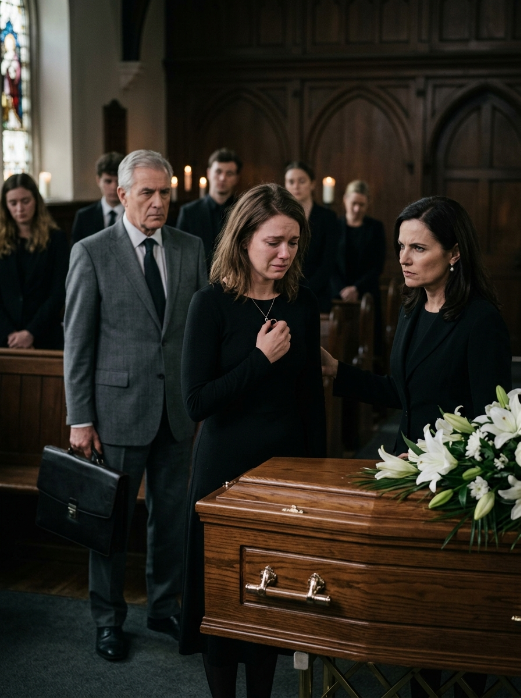
Those were the words my cousin Vanessa spoke during the funeral service, standing right in front of Ethan Cole’s casket, with seventeen people watching who could hardly bring themselves to look at me.
I stayed silent.
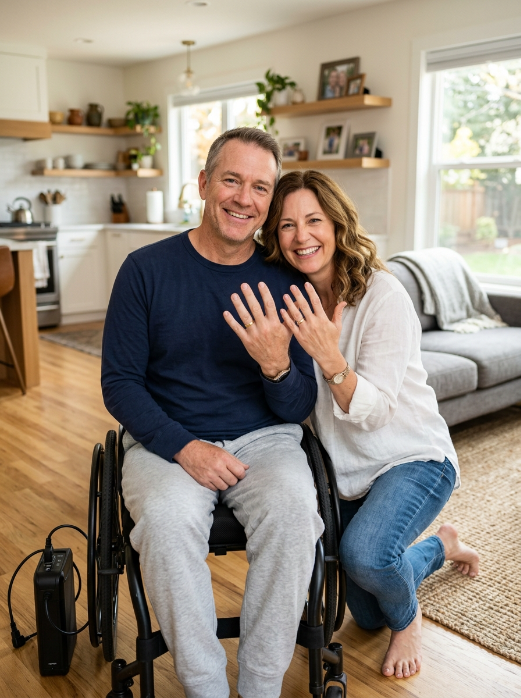
I gripped my wedding ring so hard inside my fist that the metal left a deep indentation in my palm. Ethan hadn’t been able to slide it onto my finger properly during our ceremony — his hands trembled too much. In the end, I had to guide his fingers myself while Father Michael, a priest from Chicago’s Lincoln Park neighborhood, murmured a blessing in Ethan’s living room.
Ten days.
That was how long my marriage lasted.
Ten days spent making chicken soup, organizing medication bottles, reading novels aloud once he no longer had the strength to hold them himself, and playing Scrabble at a small table where a mug of chamomile tea always sat growing cold.
I had been volunteering with a companionship program for terminally ill patients in Chicago. Three times a week I visited people who had no family nearby. Some wanted a meal. Some wanted quiet. The very first thing Ethan asked of me when I walked into his home was a game of Scrabble.
“Do you know how to play?” he asked.
“Yes.”
“Do you cheat?”
“Only when the situation demands it.”
He smiled as if he’d just found one more reason to keep breathing a little longer.
He was forty-two, battling advanced cancer in a modest Andersonville house crowded with old books, wilted plants, and photographs turned face-down against the wall. He never mentioned his family, and he rarely asked about mine. But he remembered exactly how I liked my coffee, that my hands were almost always cold, and that I couldn’t stand it when people acted as if illness were the only subject worth discussing.
One afternoon, mid-game, he tried to tell me something about his teenage years. His mouth opened, but nothing came out. The disease had started affecting his speech. I watched his jaw clench and his fingers grip the edge of the table.
I refused to look at him with pity.
Instead, I turned toward the window and said,
“Have I ever told you about the nurse who locked herself in the hospital supply closet and came out wearing a box of diapers like a crown?”
I kept piling on absurd details, one after another, until Ethan finally let go of the table.
When I finished, he studied me quietly.
“You did that deliberately,” he murmured.
“I have absolutely no idea what you mean.”
But from then on, he looked at me as if I’d revealed a door neither of us had known existed.
A week later he showed up in a freshly pressed shirt, a hint of cologne trailing after him, and a small velvet box set beside the Scrabble board.
“Marry me, Claire.”
The grocery bag slid out of my hand.
“Ethan, we’ve only known each other for four months.”
“Four extremely competitive months.”
I didn’t laugh.
Then the humor drained from his face.
“This morning I filled out hospital paperwork. When I got to the line marked ’emergency contact,’ there was no name I could write there. I don’t want the last chapter of my life to end with a nurse signing forms in my place. I want someone holding my hand.”
I told him he deserved more than someone’s sympathy.
He said,
“That’s why I’m asking you. You’re the only person I know who never makes kindness feel like charity.”
I said yes.
My Aunt Margaret called me reckless. Vanessa said I was humiliating myself. My brother Ryan shouted that if Ethan had anything of value, everyone would assume I was after it.
I married him anyway.
Ten days later, Ethan died with my hand under his.
And at the funeral, while Vanessa accused me of trading my dignity for an inheritance that didn’t even exist, a man in a gray suit came up to me and said,
“Mrs. Claire, my name is Mr. Whitmore. I was your husband’s attorney. Ethan asked me to wait until today to tell you who he really was.”
I couldn’t answer him.
Just then, Mr. Whitmore pulled a sealed envelope from his briefcase. The moment I saw my name written across it in Ethan’s shaking handwriting, something inside me seemed to crack before I even knew what it held.
What that letter revealed was almost too much to take in.
Mr. Whitmore wouldn’t hand me the envelope at the funeral home.
“Ethan was very specific about this,” he said. “He wanted you to read it at home, away from the people who had already made up their minds about the kind of woman you were.”
Vanessa let out a humorless laugh.
“Of course. The attorney and the mysterious widow. How convenient.”
I paid her no attention.
I walked out of the funeral home clutching the envelope to my chest beneath a gray sky heavy with rain and exhaust. My phone buzzed the whole cab ride home — messages from relatives, from people who had never once visited Ethan but suddenly had plenty of opinions about our marriage.
“I’m sure he left you the house.”
“You’ve really hit a new low.”
“Aunt Margaret says you shouldn’t even bother showing up to Grandma’s memorial.”
I turned my phone off.
When I got to my apartment in Rogers Park, Mr. Whitmore was already waiting on the sidewalk, holding a folder, an old novel, and a brown paper bag tied shut with red string.
“Before we go up, there’s something I need to prepare you for,” he said.
“What?”
“Ethan didn’t just leave you belongings. He left you a memory.”
I didn’t understand what he meant.
We went upstairs. My living room was a mess — unwashed cups by the sink, a blanket tossed over the couch. Everything felt far too ordinary for the kind of truth about to fill the room.
I opened the envelope.
Claire,
Our meeting wasn’t chance.
Before I was your husband, I was the stuttering boy who lived three houses down from you on Maple Street in Pilsen.
The paper slipped from my hands.
“No,” I whispered.
Mr. Whitmore bent down and retrieved it.
“Do you remember him?”
I couldn’t breathe.
Maple Street.
A yellow apartment building.
A bicycle repair shop.
A jacaranda tree scattering purple blossoms across the sidewalk every spring.
I’d lived there until I was thirteen, before my parents died in a car accident on Interstate 88. After that I went to stay with an aunt in Aurora, then bounced from house to house as if my whole life could fit inside a black garbage bag.
I never went back.
“There was a boy,” I whispered. “Quiet. Thin. Always lingering behind the bike shop.”
“Ethan,” Mr. Whitmore said.
I shook my head.
The Ethan I remembered kept his eyes down and always had grease under his fingernails. The Ethan I’d just buried argued with me about books, told terrible jokes, and pretended to be offended every time I played a questionable word during Scrabble.
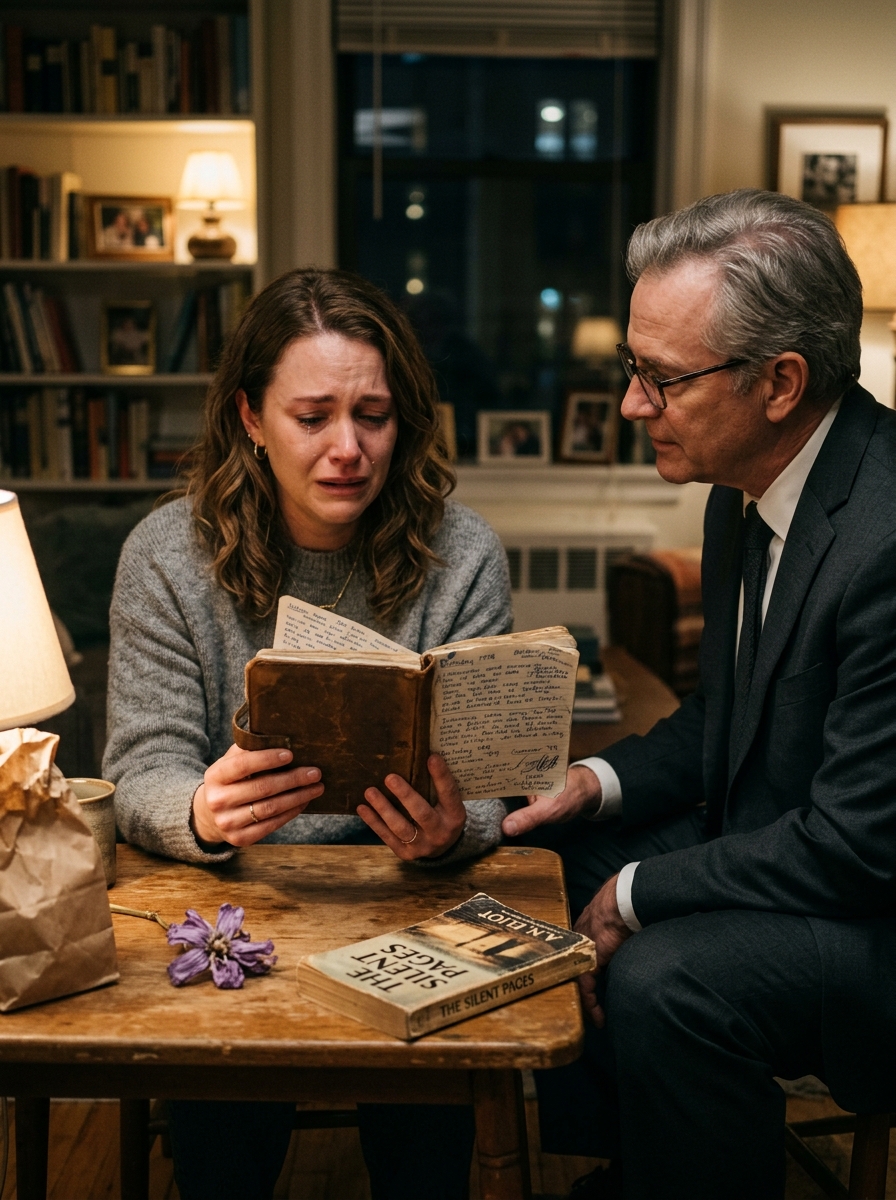
Mr. Whitmore untied the paper bag and pulled out a worn leather notebook.
“This was meant for you.”
On the first page, Ethan had written my name.
Claire, age fourteen.
I hope that wherever she is, someone asks whether she has eaten today.
I turned the page with shaking fingers.
Claire, age fifteen.
I hope no one ever packs up her life again without asking her permission.
Claire, age eighteen.
I hope she laughs loudly, even when it makes other people uncomfortable.
There was an entry for every birthday I’d lived through.
One for each year.
As if Ethan had quietly kept a candle lit all this time for a girl who had disappeared from the neighborhood.
“Why would he do this?” I asked.
“Because you once gave him something you don’t even remember giving,” Mr. Whitmore replied.
The letter went on.
One afternoon, a customer humiliated me outside my grandfather Walter’s bike shop because I couldn’t explain why his bike wasn’t ready. My words locked up. He yelled at me. I thought everyone who saw it would remember me that way forever.
But you didn’t look at me like I was broken.
You sat down on the curb and started telling me about a stray cat that, according to you, hated milk and attacked people’s shoelaces.
The memory hit me all at once.
I’d been twelve.
Ethan had been sixteen.
I’d found him sitting outside the shop with his eyes red and angry. I hadn’t said, “You poor thing.” I hadn’t told him, “Don’t cry.” I’d just talked and talked about a made-up cat until he could stand again.
I’d forgotten the whole moment.
He never had.
Mr. Whitmore set the old novel on the table.
“There’s something else.”
He opened the book. Pressed between two pages was a dried purple jacaranda blossom, so delicate it was nearly crumbling.
“You put it there,” he said. “Ethan said you told him, ‘So you’ll never lose your place.'”
The room seemed to tilt.
“So he knew who I was the whole time.”
“Yes.”
“And he still never said anything?”
Mr. Whitmore lowered his eyes.
“He was afraid you might marry him out of guilt instead of choosing to freely.”
Before I could respond, someone pounded on the door.
Three sharp knocks.
I opened it.
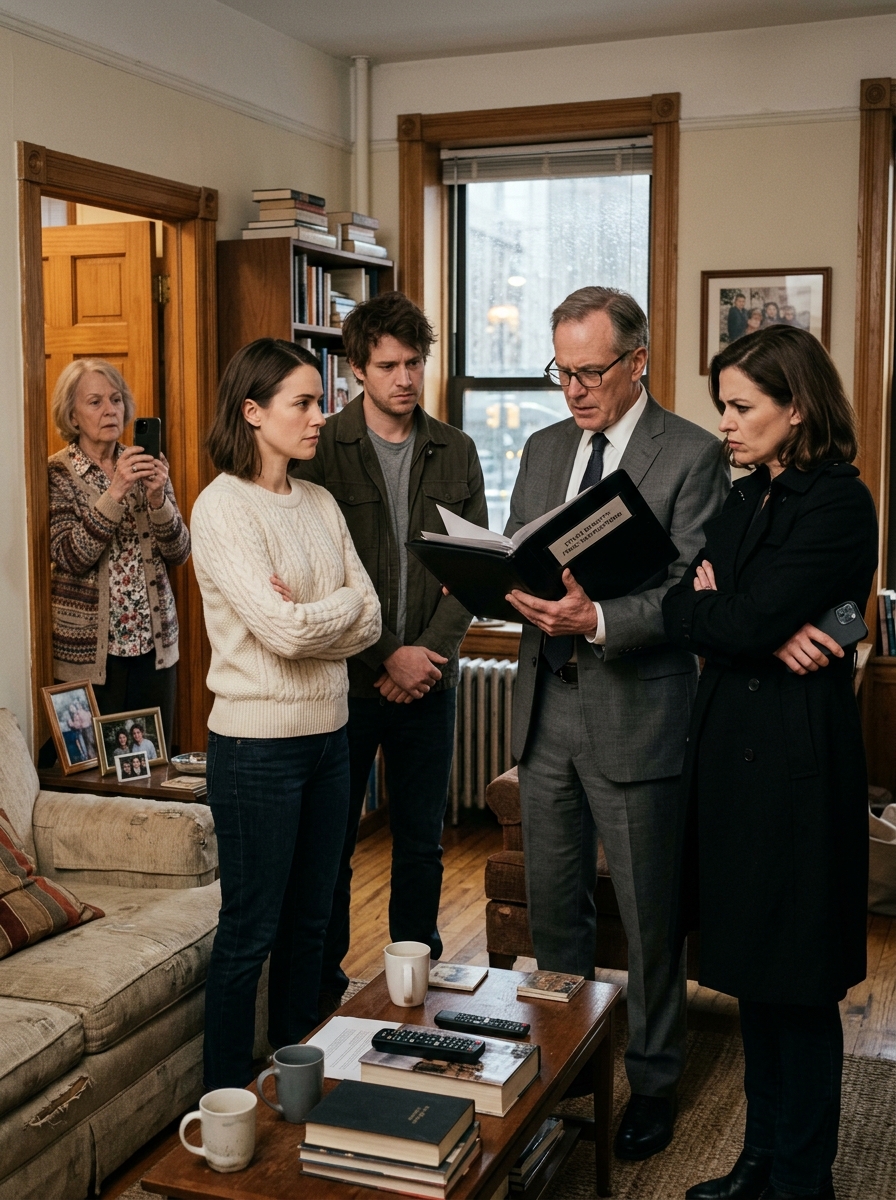
Vanessa stood there, Ryan behind her, and Aunt Margaret holding up her phone, already recording.
“Well,” Vanessa said, “now we’re finally going to find out how much the dead man left you.”
Right then, Mr. Whitmore closed his folder with a look that made all three of them freeze.
“Excellent,” he said. “I was about to read Ethan Cole’s final instructions, and witnesses may come in useful.”
Vanessa walked in uninvited, as if my apartment were just another space where she had permission to spread her bitterness.
Aunt Margaret hovered near the door, still filming. Ryan wouldn’t meet my eyes — the look of someone who knew he was part of something cruel but had already waded in too deep to pretend his hands were clean.
“Mr. Whitmore,” Vanessa said, arms crossed. “We just want transparency. My cousin married a dying man. Her family deserves to know if she pressured or manipulated him.”
“Whose family?” Mr. Whitmore asked.
Vanessa blinked.
“Claire’s.”
“Interesting,” he said. “Because from what I understand, when Claire lost her parents at thirteen, that same family shuffled her from house to house until she stopped being convenient.”
My aunt lowered her phone slightly.
“That has nothing to do with this.”
“It has everything to do with it,” I said, speaking up for the first time.
My voice stayed quiet, but it didn’t waver.
“It matters because all of you taught me that being alone was just normal.”
Ryan’s jaw tightened.
“Don’t start, Claire.”
“No,” I said. “Today’s the day I finally do.”
Mr. Whitmore opened the folder.
“Ethan Cole left specific instructions. First, his house in Andersonville is not to be sold. It will become a community library and a support space for grieving teenagers.”
My cousin laughed loudly.
“So he didn’t leave you anything after all.”
Mr. Whitmore went on.
“Second, he named Claire Bennett director of the trust that will fund the project for the next ten years.”
My cousin’s laughter died.
“A trust?”
“Ethan taught history for sixteen years. He also inherited several properties from his grandfather, Walter Cole, and sold them off before his illness worsened. The money isn’t meant for luxury. It’s meant to keep a promise.”
My aunt raised her phone again.
“What promise?”
Mr. Whitmore looked at me.
“To build a place where no grieving young person is ever made to feel like a burden.”
My knees nearly buckled.
Ethan hadn’t left me a fortune to flaunt.
He’d left me a responsibility.
He’d given me a way to carry his kindness forward without turning it into a monument.
But Vanessa still wasn’t satisfied.
“That’s lovely. But it doesn’t prove she didn’t manipulate him.”
Mr. Whitmore pulled out another sheet of paper.
“He also prepared a letter for Claire’s relatives, in case they accused her.”
Aunt Margaret stopped recording.
“You don’t have to read that.”
“Yes,” I said. “Read it.”
Mr. Whitmore took a slow breath.
To anyone who has come this far believing Claire took something from me:
Claire gave me ten days without fear.
I asked her to marry me because I didn’t want my life to end with a blank line on a hospital form and a stranger signing in my place. She told me I deserved better than pity. That’s why I chose her.
Since she was a child, she has known how to do the hardest thing: stay beside someone without taking over, care without humiliating, and remain without demanding their soul in return.
Ryan dragged a hand over his face.
Vanessa stared at the floor.
Mr. Whitmore continued.
If you’re reading this because you want to tally up what Claire gained, understand this:
Claire had already lost more than any of you were willing to see.
She lost her parents.
She lost her home.
She lost her neighborhood.
Then she lost the ability to trust that her own blood would ever stand up for her.
Don’t take her peace from her too, just because suspicion comes easier to you than love.
The silence turned almost unbearable.
Aunt Margaret turned off the recording.
“Claire,” she said, in a tone I’d never heard from her before. “We didn’t know.”
“Yes, you did,” I answered.
I didn’t raise my voice.
There was no need to.
“You knew I never had a permanent place for my things. You knew I cried in bathrooms that weren’t mine. You knew that every Christmas someone asked how much longer I planned to stay. But it was easier to call it circumstance than to call it what it was — abandonment.”
Ryan stepped closer.
“I was young.”
“I was a child.”
He stopped where he stood.
Mr. Whitmore laid one last page on the table.
“There’s one more thing.”
He took out a ring of keys.
“Ethan asked that you visit his house tomorrow. There’s a locked room only you’re meant to enter.”
Vanessa muttered,
“How theatrical.”
Mr. Whitmore looked straight at her.
“No,” he said. “How patient.”
The next day, I went alone.
Ethan’s house still smelled of tea, books, and medicine. The Scrabble board was still on the table, the tiles from our last game tucked inside a green cloth pouch. In the kitchen I found a list in his unsteady handwriting.
Buy bread.
Water the fern.
Tell Claire about the drawer if there is time.
There hadn’t been time.
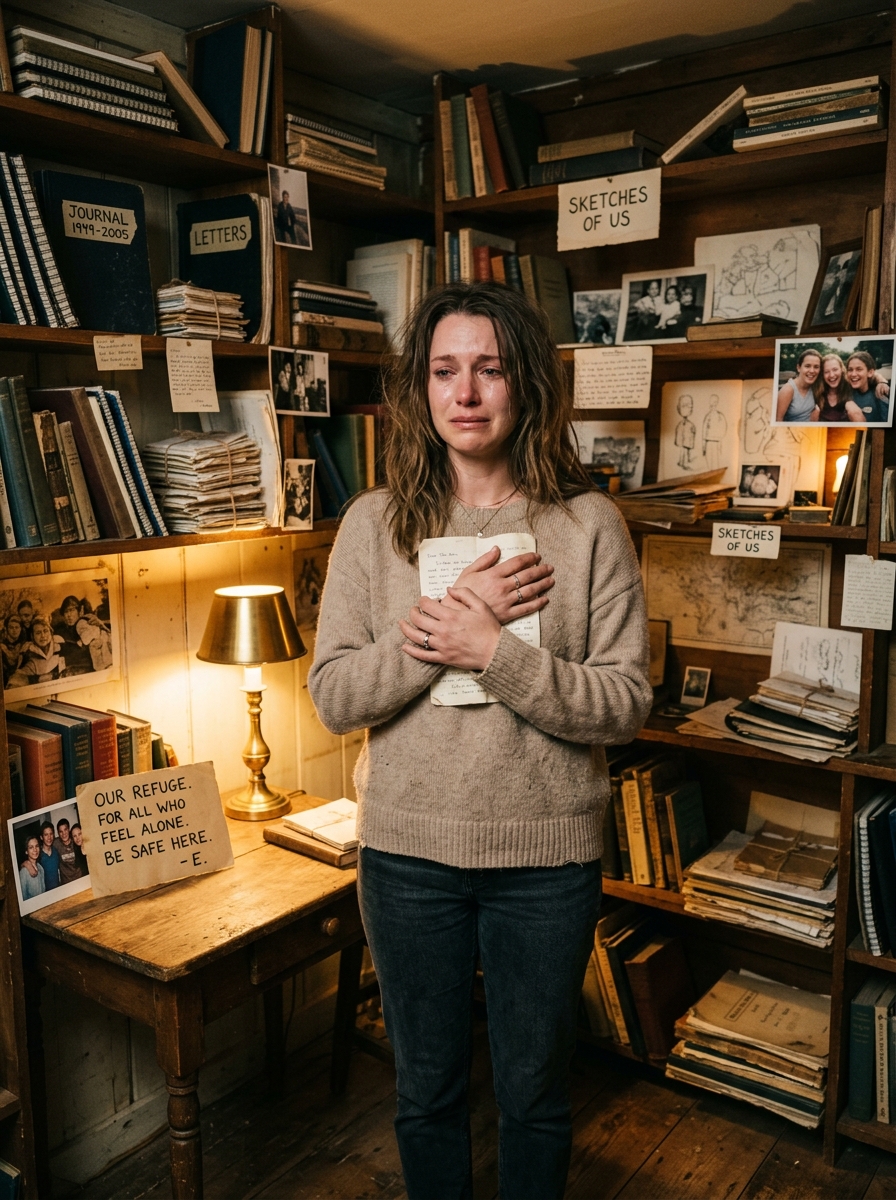
The locked room was at the back of the house.
The key stuck before it finally gave.
There was no pile of money inside.
No boxes of jewelry.
No dark secrets.
Just shelves.
Shelf after shelf after shelf.
Notebooks, letters, photographs of old streets, newspaper clippings about programs for orphaned kids, books for young readers, warm lamps, and a wall covered in maps of neighborhoods across the city.
In the center stood a table with a handwritten sign.
For those who were once packed away as though they belonged nowhere.
I covered my mouth with my hand.
One last letter sat on the table.
Claire,
If you’re reading this, it means I wasn’t able to tell you myself.
I didn’t search for you looking to collect on some emotional debt.
You didn’t become my wife because of that one afternoon on the curb.
You became my wife because even without remembering me, you were still the kind of person who made the world feel easier to breathe in.
When you changed the subject in my living room that day, while I couldn’t get a word out, I knew the girl beneath the jacaranda tree was still in there.
Not unchanged.
Not untouched.
But still there.
And I understood something I hope you never forget:
The kindness that felt small to you became the compass of my whole life.
I sank to the floor.
I cried harder than I had at the funeral.
Not out of guilt.
Not out of pity for him.
I cried for the boy who had kept a fragile flower for over twenty years.
For the man who had written wishes for me on every birthday and asked for nothing back.
For the husband who gave me ten days of simple love and a lifetime of purpose.
Six weeks later, the library opened.
I didn’t put together some elegant ceremony.
I invited no politicians.
I served strong coffee, sweet rolls, and set up long tables across the room.
Neighbors came.
Ethan’s former students came.
Volunteers from the hospital came.
Three teenagers, sent over by a county child-services social worker, came too.
One of them, a fifteen-year-old boy in a black hoodie, wouldn’t come inside at first.
He stayed on the curb, staring down at his sneakers.
I sat down next to him.
I didn’t ask where it hurt.
I didn’t tell him it would be fine.
I just pointed at a thin cat crossing the street and said,
“I’m almost certain that cat controls a criminal organization.”
The boy looked at me, confused.
Then, despite himself, he smiled.
In that moment, I understood Ethan hadn’t really disappeared.
Sometimes a life doesn’t change because of some dramatic rescue. It changes because someone refuses to treat your pain like a spectacle.
Someone sits beside you and talks about cats, or books, or food, or anything else that reminds you pain isn’t the only thing you are.
Months later, I went back to Maple Street.
The bike shop was gone.
The yellow apartment building had been replaced by a modern complex.
But the jacaranda tree was still standing, old and twisted, still dropping purple blossoms across the sidewalk.
I brought Ethan’s novel with me.
I opened it to the page where the dried flower still waited.
I held it between my fingers.
It was so fragile it was almost dust.
“You spent your whole life thanking me for something I never even realized I’d given you,” I whispered.
The wind stirred the branches.
For a moment, I thought about tucking the flower back into the book.
Instead, I let it drift down beside the roots of the jacaranda tree.
Not as a goodbye.
As a homecoming.
That afternoon, I went back to the library and set Ethan’s Scrabble board on the first table.
Next to it, I placed a small handwritten sign.
Here, no one has to explain their pain before they are worthy of company.
And whenever someone walks in looking for somewhere to sit without feeling like a burden, I think of him.
Of Ethan.
Of the boy behind the bike shop.
Of the man who loved me without ever turning that love into a debt.
I also think of the girl I used to be, the one who talked about an imaginary cat without knowing she’d just helped save a life.
Maybe that’s why I keep telling this story.
Because none of us ever knows which small act of kindness will go on living inside someone else forever.
