


PART 1
“If my mother moves in here, what will the business partners think when they see her sleeping in the maid’s room?”
Elena Morales heard those words from the doorway, a black trash bag of clothes in one hand, her cane in the other. Her son Ricardo’s house, tucked inside a gated community in Bosques de las Lomas, looked more like a hotel than a home — marble floors, security cameras, immaculate bougainvillea.
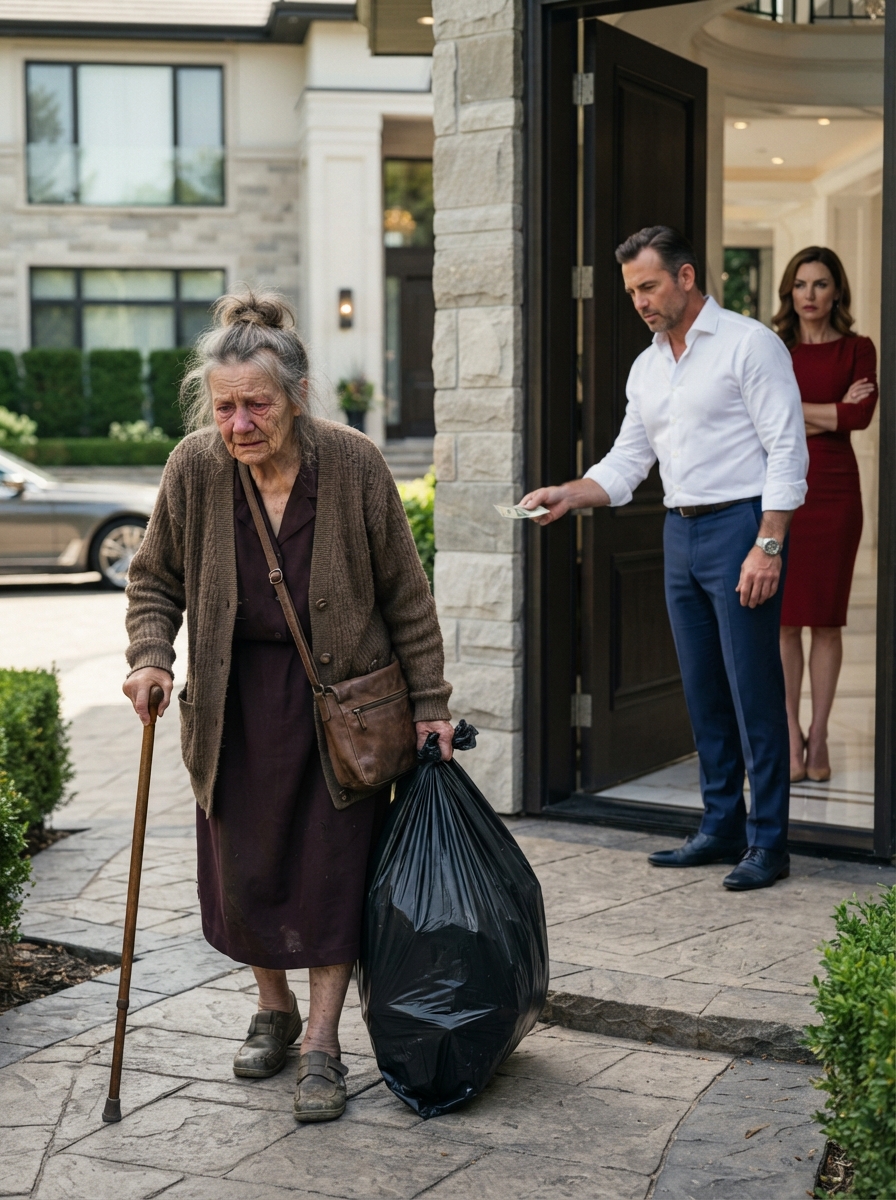
But there was no room in it for her.
“Ricardo,” she said, fighting to keep her voice steady, “I’m not asking for money. Just a bed for a few days. The bank took my house this morning.”
Her son appeared in a crisp white shirt, an expensive watch, wearing the pained look of a man staring at a stain on his rug.
“Mom, don’t make this into a scene. I’ve got investors coming for dinner. Clara’s putting together a charity event. Can you imagine if they saw you like this, with that bag?”
Like this.
Elena glanced down at her worn shoes. Forty years ago, those same hands had sold tamales and pawned earrings so Ricardo could study business at the Tec. Back then he’d promised her:
“Someday I’m going to lift this whole family up.”
Now he was lifting her off the sidewalk only to shove her right back down.
Clara, her daughter-in-law, peered out from behind him, sparkling water in hand.
“Doña Elena, it really wouldn’t work. My pilates instructor uses the guest room when she stays over, and Ricardo’s office is completely off-limits.”
“I could sleep in the kitchen,” Elena whispered. “On a mat.”
Ricardo’s jaw tightened.
“No. I’ll wire you money for a cheap hotel. Just not here.”
Before she could respond, Clara pushed the door shut with a hollow smile.
“Let’s take this outside. The neighbors gossip.”
The deadbolt clicked louder than any slammed door.
Martín, her youngest, was waiting in his beat-up pickup. A bricklayer, renting an apartment in Iztapalapa, weeks without steady work. When he saw his mother return looking lost, he didn’t ask a single question. He just turned the key.
“Take me to Patricia’s,” Elena said.
Dr. Patricia Morales lived in Coyoacán, in a modern house with an attached private clinic. She came out in a white coat, phone pressed to her ear, radiating an urgency that clearly outranked her own mother.
“Mom, why didn’t you call first?”
“I don’t have a home anymore, sweetheart. The bank foreclosed because of your father’s debts. Martín took me in, but there’s four of them crammed into two rooms. I just need somewhere to stay while I sort things out.”
Patricia didn’t even invite her inside. She dug through her designer bag, pulled out a 500-peso bill, and pressed it into her mother’s palm.
“Take this for food and a cab. There are decent nursing homes out there. I work in the ER, Regina’s got after-school activities, my husband’s dealing with audits. I can’t take this on right now.”
Elena stared at the bill. It was almost exactly what she used to hand Patricia for textbooks back when there was barely enough for dinner.
“So I can’t even come inside?”
Patricia sighed. “Please don’t make this harder than it already is.”
The gate clicked shut.
That night, in Martín’s apartment, Elena watched her daughter-in-law Lucía counting loose coins on the table. Her grandson Diego lay on the couch with a fever. Martín opened a drawer and pulled out a small velvet box.
“I’m going to pawn our wedding rings,” he said, voice cracking. “That’ll cover medicine, electricity, and food.”
Lucía cried, but slid off her ring.
“I married you. Not the gold.”
Elena wanted to scream no, but shame closed her throat. While her wealthy children toasted champagne in mansions, the only one who still called her “mother” was pawning his marriage vow just so she wouldn’t go hungry.
PART 2
At dawn, Elena was sweeping the hallway of the building when a woman knocked urgently at the door.
“Doña Elena Morales?”
It was Berenice, an old neighbor from the Portales area who used to help clean the Morales house years back. Her hair was tied up, her hands rough from work, and she clutched a yellowed envelope tight against her chest.
“Sorry to show up like this,” she said, “but the new owners hired me to clean your old house. Yesterday we moved that big wardrobe from the bedroom — Don Aurelio’s. Taped behind it, I found this.”
Elena recognized the handwriting before her fingers even touched the paper.
“For Elena. Keep it safe.”
Her knees buckled. Martín helped her into a chair. Lucía shut off the stove. They all watched as she opened the envelope with shaking hands.
Inside were bank documents, a trust fund policy, and a short letter from Aurelio.
“My Elena: if I don’t get the chance to explain this myself, find Attorney Zambrano. This is so you never have to depend on anyone.”
Elena could barely breathe. One page held a number that blurred her vision: 27,800,000 pesos, tied to a trust Aurelio had set up using proceeds from a family warehouse sale in Querétaro. She’d believed all that money had gone to hospitals, medications, debts — but a portion had sat untouched, quietly growing.
“Does it still exist?” Martín asked.
“I don’t know,” Elena murmured. “I need to get to the bank.”
That same afternoon, a manager at a bank on Reforma Avenue reviewed the papers for nearly an hour. Then he looked at her, serious.
“Señora Morales, the trust is still active. Since no beneficiary ever came forward, it was frozen. With interest and adjustments, the balance is substantial. You’re the primary beneficiary.”
Elena closed her eyes. Her house had been seized while her rescue slept behind a wardrobe the whole time.
Attorney Zambrano, an older man in a gray suit, confirmed it all.
“Aurelio came to see me once he already knew he was sick. He told me: ‘My wife is good to the point of letting people walk all over her. Help me protect her once I’m gone.’ I assumed he’d already given you the papers himself.”
Elena wept quietly.
“Don’t tell your other children yet,” the lawyer warned. “Money changes people’s faces fast. Let’s secure your legal standing and your will first.”
But greed beat prudence to the door.
Three days later, two luxury SUVs pulled up outside Martín’s building. Ricardo stepped out in dark sunglasses; Patricia arrived with her husband Octavio, a bank manager. They walked in uninvited, scanning the peeling walls with visible disgust.
“Mom,” Ricardo said, “we heard about Dad’s trust.”
Elena felt the air go heavy. “How?”
Octavio adjusted his tie. “An alert triggered at the bank. Standard asset security protocol.”
Patricia spoke like she was addressing a confused patient.
“Mom, that’s too much money for you to manage. At your age you could sign it all away by mistake. We need a mental evaluation and power of attorney. Ricardo and I will handle it. We’ll set you up with a monthly allowance.”
Martín stood. “When she had nowhere to sleep, you shut the door on her.”
Ricardo jabbed a finger at him. “You’re the problem here. You’ve got her locked up in this place just to keep everything for yourself. Cooperate, or we report you for elder abuse and manipulation.”
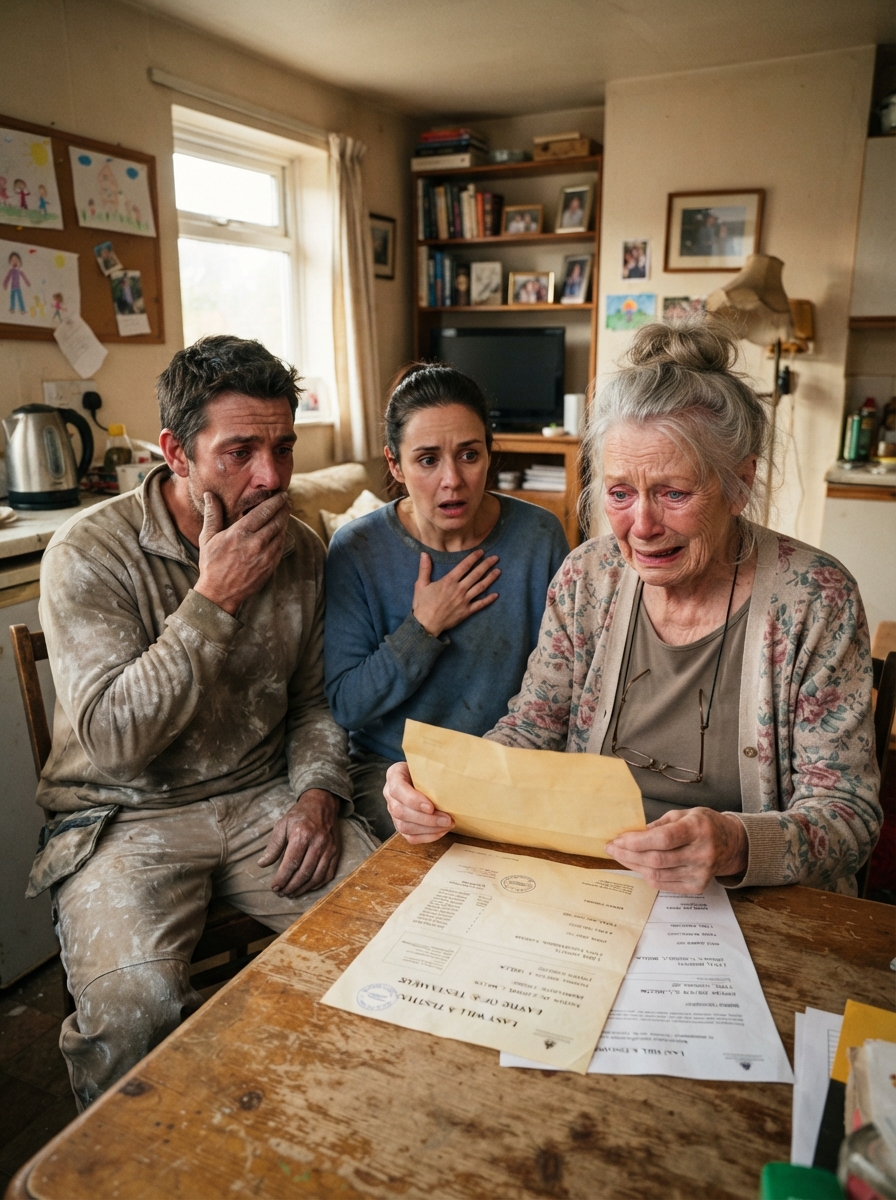
Elena looked between her three children. In the eyes of the older two, she saw no concern — only calculation.
That’s when she understood: the real test hadn’t been poverty. It was what each of them did once she had nothing left to give.
PART 3
That night, sleep never came for Elena. The small apartment sat silent except for the hum of the old fridge and Diego’s cough, already easing thanks to medicine bought with the pawned rings. Martín sat on the floor, eyes fixed on the door as if he expected Ricardo to return with police in tow.
“Mom,” he said quietly, “if he reports me, who’s going to believe me over him? He’s in magazines. Patricia’s a doctor. Octavio works at a bank. I’m just a bricklayer who can barely make rent.”
Elena looked at him with a new kind of ache. Her youngest had inherited Aurelio’s hands — broad, scarred, made for hard labor, not threats.
“They’ll believe you,” she said, “because we’re going to tell the truth.”
For the first time in years, her voice didn’t waver.
The next morning, before sunrise, she rode a public van downtown. Lucía packed her coffee in a thermos with a bean roll. Along the way, watching the city wake up between tamale carts and rushing office workers, she remembered every time she’d stayed silent just to hold the family together.
She’d stayed silent when Ricardo stopped visiting because “the neighborhood wasn’t safe.” Stayed silent when Patricia skipped the hospital to see Aurelio because of a conference in Cancún. Stayed silent when the bank explained “foreclosure” to her like they were discussing a piece of furniture instead of a lifetime of memories.
That silence had left her without a home. It wasn’t going to leave her without dignity too.
Attorney Zambrano met her with a thick folder.
“Funny how millions appear, and suddenly so do children worried about a mother they ignored for years.”
“They want me declared incompetent.”
“Then we’ll do the exact opposite. Today an independent forensic psychiatrist evaluates you. If you’re lucid, it gets fully documented. Then we sign a protective trust and a will nobody can touch.”
The evaluation ran two hours. The doctor asked about dates, memories, simple arithmetic, family decisions, and why she wanted to protect the money. Elena didn’t cry. She just told the truth — the foreclosure, the closed doors, the 500-peso bill, Martín and Lucía’s wedding rings.
At the end, the doctor signed a final report: Elena Morales was fully mentally competent, understood her assets and decisions completely, and grasped the legal consequences.
That afternoon, sitting across from her lawyer, Elena made the hardest call of her life.
“I want to buy a modest house,” she said. “Solid, three bedrooms, somewhere Diego can have a yard and Martín never has to worry about being thrown out again.”
Zambrano wrote it down.
“I want to buy back Martín and Lucía’s rings. And set them up in an honest business — a hardware store, or a small diner, something they know how to work for, not something to show off.”
“And Ricardo and Patricia?”
Elena closed her eyes.
“For the grandchildren — all of them — yes. An education fund paid straight to their schools, with no way for the parents to touch a peso of it. For Ricardo and Patricia, nothing directly, not for now. Not because I hate them. But I already gave them my youth, my home, my savings, even my silence. All I’ve got left are my final years, and I won’t hand those over too.”
“It’s a harsh call,” the lawyer said, “but not an unjust one.”
“I also want to donate part of it to a soup kitchen for elderly people. Because no mother should have to find out on the street what she’s actually worth to her children.”
A week later, everyone was called to Zambrano’s office. Elena arrived with Martín and Lucía. She wore a simple blue dress, hair pulled back, shoes clean. She didn’t look rich. She looked at peace — which is a far harder thing to buy.
Ricardo was already there, scrolling his phone. Clara sat with arms crossed. Patricia sat beside Octavio with a medical folder in hand, as if she could still diagnose her mother as unfit.
“Let’s begin,” Zambrano said. “First, I want everyone aware that Señora Elena Morales was evaluated by an independent specialist. The report confirms she has full mental and legal capacity. Any attempt to pursue an incompetency claim will be met with a lawsuit for fraud and financial elder abuse.”
Patricia flushed red. “That’s completely exaggerated!”
“What’s exaggerated, Doctor, is trying to legally lock away your mother after refusing her a roof over her head.”
The room went cold.
Zambrano continued:
“The trust left by Don Aurelio Morales belongs solely to Doña Elena. She’s signed irrevocable instructions. Part of it will fund a home purchase in the joint names of Elena Morales and Martín Morales, securing her permanent residence and care.”
Ricardo slammed a hand on the table. “Of course! The bricklayer gets the house!”
Martín’s fists clenched, but Elena raised a hand first.
“No, Ricardo. The bricklayer gave me a roof when the businessman slammed a door in my face.”
The silence that followed felt like stone.
“Capital will also fund a neighborhood hardware store, run by Martín and Lucía under accounting oversight. An education fund will be established for all the grandchildren — Diego, Regina, Bruno, and Camila — paid directly to their schools. No parent will have access to withdraw cash.”
Octavio shifted in his seat. Patricia blinked rapidly.
“And us?” she asked.
Zambrano turned a page. “Ricardo Morales and Patricia Morales will receive no direct distributions from the trust.”
“Mom!” Patricia shouted. “How could you do this to us? I’m your daughter!”
Elena looked at her with a calm it had taken forty years to build.
“When I showed up at your house with a trash bag of clothes, I was your mother then too. When you handed me 500 pesos through the gate, I was your mother then too. When you suggested a nursing home just so I wouldn’t be an inconvenience, I was your mother then too.”
Patricia dropped her gaze, but Ricardo shot to his feet, furious.
“This isn’t finished. We’re suing. We’ll prove Martín manipulated you.”
“The only one who tried to manipulate me was you — wanting to hand me an allowance from my own money.”
Right then, Octavio’s phone buzzed. He answered irritated, but his face drained of color fast.
“Yes, counsel… an internal audit? No, I only checked the alert as routine protocol… unauthorized access to private trust data — what does that mean?”
He stood, pale. The bank had flagged that Octavio had accessed private trust information without authorization.
Ricardo’s phone rang seconds later. He stepped into the hallway, but everyone could hear him through the door.
“What do you mean the investor’s pulling out? They can’t freeze the Polanco project! That money’s supposed to clear next week… A tax audit? What reports?!”
He came back with his face wrecked. Clara looked at him like she’d just discovered her husband wasn’t a fortress — just a fragile front.
Zambrano closed the folder.
“My client’s assets will not be used to bail out failing businesses, debts, or careers.”
Ricardo looked at his mother with a mix of hatred and fear. “So you’re just abandoning us?”
Elena felt a sharp pull in her chest, but held his gaze.
“No. You let go of me first. I just stopped falling.”
The words hung in the room, heavy.
The months that followed brought a bitter harvest. Octavio was fired from the bank. Patricia’s clinic launched an investigation into irregular supplier contracts. Ricardo lost his investors; the Polanco project collapsed entirely once reports of inflated valuations and hidden debt surfaced. His restaurants closed. Clara took the kids and left for Monterrey. The mansion in Bosques de las Lomas showed up in a foreclosure listing months later.
Elena didn’t celebrate. Every piece of news still hurt — a mother never fully stops being a mother, even after learning to defend herself. But she no longer ran to sell what little she had left to rescue the ones who’d never once protected her.
With Zambrano’s help, she bought a house in a quiet Tlalpan neighborhood — white walls, a yard with a lemon tree, a kitchen where Lucía laughed again making chilaquiles. Diego got his own room. Elena’s bedroom faced the yard. That first night, she cried without fear. Not from sadness — from deep relief.
The hardware store was named “Aurelio & Son.” Martín knew nails, cement, pipes, and tools the way other men knew silk ties. Lucía ran the books with strict discipline. By the entrance, Elena hung a smiling photo of Aurelio.
“Your father really knew how to build things,” she told Martín the day they opened.
“And you taught us never to give up,” he answered.
The very first thing they did with their profits was buy back the pawned wedding rings. Martín returned it to Lucía in the same kitchen where, months before, they’d been counting spare coins. No music, no expensive flowers — just a long, tight embrace and a small boy clapping.
Nearly a year later, Elena was walking with Martín near the Observatorio metro station. Under a pedestrian bridge sat a man on cardboard, beard overgrown, jacket stained, a half-empty water bottle beside him. Next to him, a single black trash bag.
Elena stopped.
It was Ricardo.
For a split second she saw him again as a little boy, sprinting home in a dirty uniform shouting, “Mom, look!” Then she saw the grown man locking her out because the neighbors might see her.
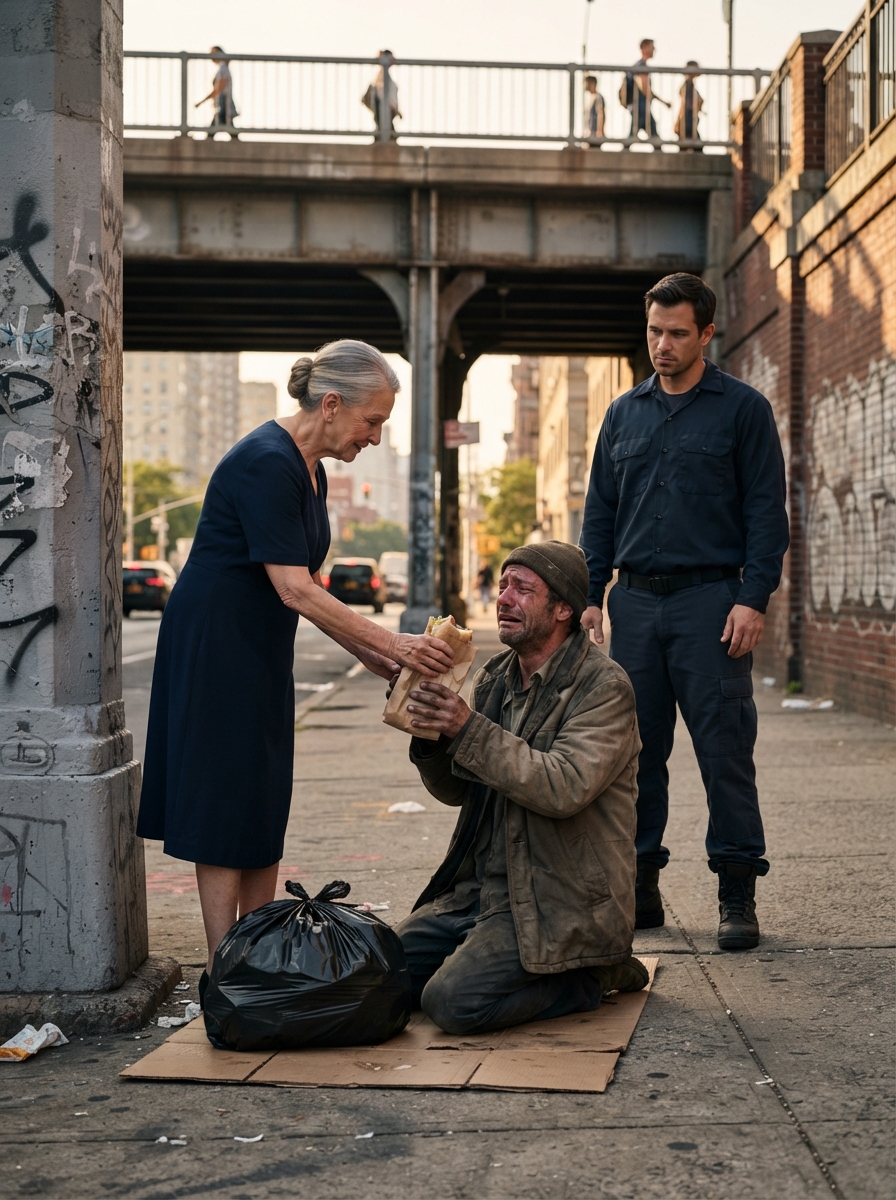
“Mom,” Martín said softly, “we can go if you want.”
Ricardo looked up. Recognizing her, he tried to stand, but his legs gave out.
“Mom…”
The word came out broken, stripped bare of any pride.
Elena walked toward him slowly. She was carrying two milanesa sandwiches meant for lunch at home. She pulled one out and handed it to him.
“Eat.”
Ricardo broke down, sobbing hard.
“I don’t deserve anything from you. I shut you out. I was embarrassed to be seen with you. And now people look at me the exact same way I used to look at you. I lost everything, Mom. Everything.”
Elena felt her heart crack, but her spine stayed straight.
“Son, feeding you doesn’t mean I’m handing my life back over to you. You can come by the hardware store if you need honest work. You’d start carrying sacks, cleaning, learning from the ground up. If you need shelter, I’ll help you find something temporary. But my home and my trust are protected. I won’t wreck Martín and Lucía’s peace to save your pride.”
Ricardo nodded, crying over the sandwich. “I understand. For the first time, I really understand.”
Martín rested a hand on his brother’s shoulder — not full forgiveness, just a small door left unlocked.
That afternoon, Elena sat beneath her lemon tree. Diego came home from school proudly showing off a reading medal. Lucía was brewing hibiscus water. Martín sorted invoices from the hardware store.
The money hadn’t given her back the lost house, the years of exhaustion, or the humiliation of that bill passed to her through a gate. But it had given her something worth far more: the power to choose.
She’d learned that family isn’t measured by last names, framed photos, degrees, or new trucks. Family shows itself when everything falls apart and someone — even with almost nothing — makes room for you at their table.
And from that day on, Elena Morales promised her door would always be open to anyone who came with love, humility, and honesty. But never again to anyone who mistook a mother’s heart for a bank account waiting to be drained.
Disclaimer: This content may be created by AI for entertainment purposes. Any resemblance to real persons, events, or places is coincidental.
