

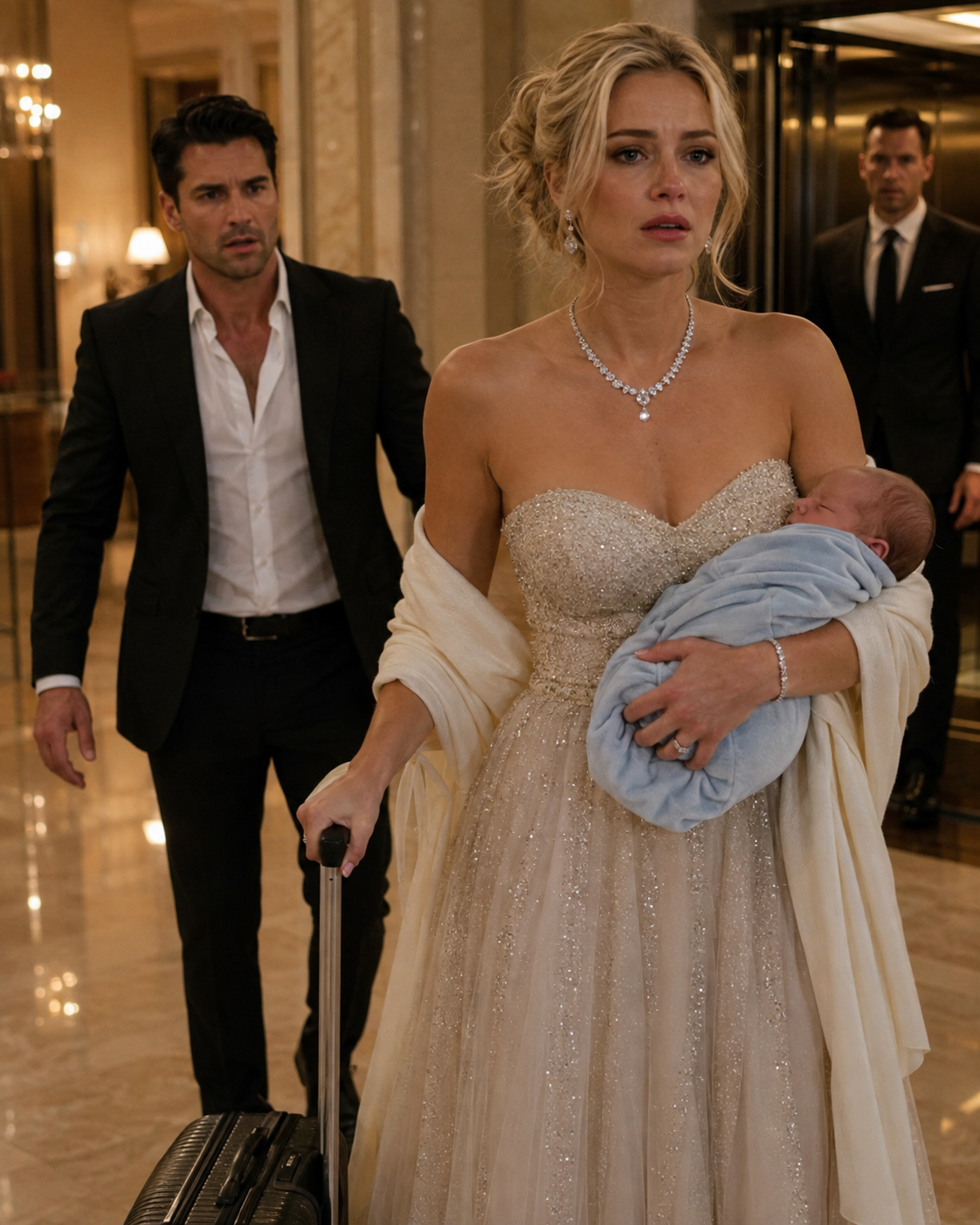
Real Family
Hours after giving birth to our son, I heard my husband tell his mistress she was his “real family.” By the time he noticed I’d overheard him, I had already decided he would never again dictate where I went, what I owned, or how small I made myself just to keep him comfortable.
Part 1
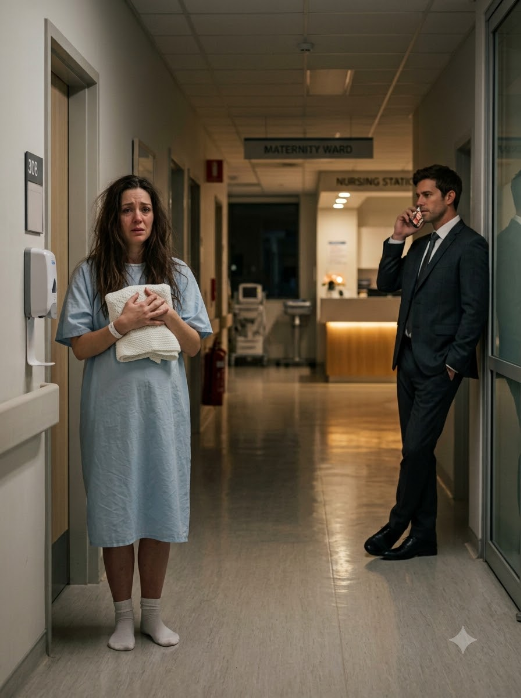
The maternity corridor smelled of disinfectant and stale coffee. My body was still raw from labor and I wasn’t cleared to be out of bed, but something drew me into the hallway while a nurse ran routine checks on my newborn son.
Then I heard Ryan’s voice from around the corner.
“I’m exhausted,” he said, with a low laugh. “This whole thing has been a mess. Honestly, I just want to go home to my real family.”
I froze completely.
My fingers dug into the thin hospital gown as I waited for him to catch himself, to mention me, our son, the life we’d built. He didn’t.
Vanessa answered in that same soothing tone I’d heard too many times during his “work calls.”
“You’ve done enough,” she said. “You don’t owe anyone anything anymore.”
“Exactly,” Ryan exhaled. “You’re the only one who understands me.”
Two years of marriage rearranged themselves inside my head in an instant. I’d quit my job because he said we didn’t need the stress. I’d relocated for his career, eaten dinner alone while he worked late, and told myself patience was the same thing as love. I’d believed the sacrifice would eventually come back to me.
Then, behind me, my newborn began to cry — and that sound is what saved me.
I went back into the room without confronting Ryan, without demanding anything, without giving Vanessa the satisfaction of knowing she’d hurt me. When I lifted Eli against my chest, something in me went perfectly still and calm. Ryan thought I was weak. Vanessa thought she’d already won. Neither of them understood that the woman they believed they’d discarded no longer existed.
The weeks that followed blurred into bottles, pain, and no sleep, inside an expensive apartment where the city lights glittered outside while I learned exactly how lonely a marriage could feel. Ryan came home late smelling of expensive soap and indifference, asking “How’s the baby?” without lifting his eyes from his phone. Eventually I stopped asking him for help and started learning to manage alone — bottle in one hand, baby in the other, tears cried silently. I learned that abandonment doesn’t always look like someone walking out the door. Sometimes it sleeps right beside you while giving everything else to someone else.
So while Ryan assumed I was simply worn down, I was quietly preparing. I reopened the bank account I’d closed when we married, contacted my old employer, gathered Eli’s paperwork, and copied every financial record I could find. Then I called the one person Ryan had forbidden me to speak to — my older brother, Damian.
He picked up on the first ring. “Clare?”
“I need you to come get me and Eli,” I forced out.
A long silence, then his voice went cold. “Did Ryan hurt you?”
“Not the way you mean.”
“Tell me where you are.”
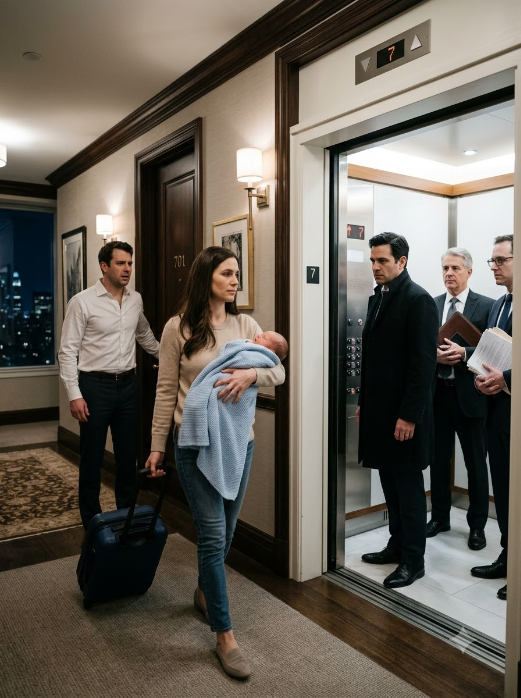
That night, while Ryan showered before another suspiciously late “meeting,” I packed one suitcase, wrapped Eli in his blue blanket, and left my wedding ring on the kitchen counter. As I reached the elevator, the apartment door opened behind me. Ryan looked from the suitcase to our son.
“Where do you think you’re going?”
Before I could answer, the elevator opened — and Damian stepped out with two men Ryan clearly recognized. For the first time since I’d married him, fear replaced the arrogance on his face.
Part 2
Ryan’s eyes moved between Damian and the two men. He recognized Samuel Grant first — the attorney who’d handled my father’s estate and still counseled the Rowan Family Trust, a leather folder tucked under his arm. The second man was Daniel Cross, the independent forensic accountant on the audit committee at Rowan Medical Systems, whom Ryan had spent weeks dismissing as an outsider who didn’t understand how modern companies worked. Damian saw him differently: as the first person in three years willing to ask why millions had gone to consultants with no actual employees.
“What did you tell them?” Ryan demanded.
“The truth.”
His voice softened instantly — the tone he used whenever he wanted people to read my objections as instability. “You gave birth less than a month ago, Clare. You haven’t slept. Put the suitcase down and we’ll talk tomorrow.”
“No.”
“You’re not taking my son anywhere.”
“You didn’t hold him for the first four hours after we got home.”
“That has nothing to do with custody.”
“Neither does your need to control where I go.”
He stepped into the hallway, blocking the elevator. Damian moved forward. “Get out of her way.”
“This is my marriage.”
“It stopped being private the moment she called me too afraid to leave her own apartment.”
“I never threatened you,” Ryan said.
“No,” I answered. “You just made sure I had no income, no car in my name, no family nearby, and no account you couldn’t watch.”
“I supported you.”
“You isolated me.”
Damian let out a short laugh when Ryan accused him of hating him. “I disliked you after you talked my sister into leaving the company she helped build. I started hating you when I found out what you did after.”
Then Daniel opened his briefcase. “I have a notice for you.” Ryan had just been placed on administrative leave from Rowan Medical Systems pending investigation into related-party payments, unauthorized guarantees, and possible misuse of shareholder credentials — approved by written board consent forty minutes earlier. “You cannot suspend me in my own home,” Ryan said. Damian answered flatly: “I called an emergency vote because fourteen million dollars moved through three companies connected to Vanessa Cole.”
The name hung in the hallway. I felt no shock — only confirmation.
Samuel then handed over formal papers: I was revoking every power of attorney, voting proxy, medical authorization, and account permission Ryan had ever held. “You cannot make legal decisions in your condition,” Ryan tried. Samuel produced a signed declaration from my obstetrician confirming I had full decision-making capacity.
“Clare,” Ryan said, “once you leave, you can’t just come back and pretend nothing happened.”
“That’s the first honest thing you’ve said tonight.”
“Where will you go?”
“Somewhere you don’t control.”
“I have a right to know where my son sleeps.”
“You’ll hear from our attorneys.”
“Our attorneys?”
“I represent Clare individually,” Samuel said.
Ryan’s gaze dropped — to the suitcase, then to the ring on the counter. He finally understood I hadn’t packed to scare him. I’d packed to leave. He reached for Eli. I stepped back. Damian moved between us. “Do not touch her.”
“He is my child.”
“And Clare is his mother.”
The elevator doors began closing; Ryan wedged a hand between them, forcing them open. “Clare — if you leave with Eli, I will file for emergency custody before morning.”
“You already drafted the papers,” I said, and watched his expression change. I’d found the draft in the cabinet under his printer: a petition for emergency temporary custody, describing me as unstable, unemployed, dependent, and a flight risk — written before Eli was even born.
“We have a copy,” Samuel said.
Ryan’s hand fell away. I stepped into the elevator with Damian, Samuel, and Daniel behind me. As the doors shut, Ryan stood alone under the apartment lights, his expression no longer heartbroken — only calculating, already deciding which lie to try next.
Part 3
Damian brought us to a trust-owned townhouse on the Upper East Side, private and untraceable to anything of Ryan’s. It didn’t feel comfortable so much as it felt like the absence of someone else’s permission — and I had forgotten what that was like.
A nurse Damian hired checked on my recovery while Eli slept nearby. Damian stood at the window, and when he turned around his eyes were wet.
“How long?” he asked — meaning the affair.
“The control,” I corrected myself.
“It didn’t start as control,” I told him. “It never does.”
I thought back to how Ryan had chosen our restaurants because I “worked too hard,” reviewed my contracts because he “understood finance better,” managed our investments, and picked our Manhattan apartment — conveniently closer to his office and farther from mine. Each decision looked reasonable alone. Together they built a life engineered entirely around him.
We talked about the year our father died, when Damian and I had clashed over the company — Damian as CEO, me overseeing design, him often talking over me and treating my caution like nerves. Ryan had positioned himself as the only one who understood how sidelined I felt, then joined the company as a strategist, and within eighteen months convinced me that working near my brother was ruining our marriage. I resigned. He called it freedom.
Damian laid out what Daniel had found: fourteen-point-two million dollars paid to Vale Consulting, North Shore Strategy, and VCS Advisory — Vanessa Cole’s initials — for services no one could confirm. Some payments were authorized under my own credentials, even though I hadn’t logged into the company system since resigning. Ryan had gained access under the excuse of managing trust paperwork, then reused that same verification to reset my corporate login.
Samuel arrived with worse news: a voting proxy, apparently bearing my signature, granting Ryan authority over my fourteen-percent share block for ten years — created using my signature from our marriage license, timed to activate the moment I had a child. My father’s trust had kept my shares under an independent trustee until I had a child or turned forty, meant to protect me during unstable years; Ryan had once called that restriction proof the family didn’t respect me. Now I understood why he’d needed it gone: outside investors had offered to buy Rowan Medical Systems, a sale the board had rejected — unless my fourteen percent tipped the vote. A sale that would move manufacturing overseas, split off research, and cost nearly two thousand jobs at the company my father built after my mother’s death, a company meant to make hospitals safer.
For that, Ryan stood to collect a twenty-six-million-dollar bonus, and Vanessa’s companies another eight.
Ryan hadn’t wanted a son for fatherhood’s sake. Eli’s birth simply unlocked my vote. That explained his absence during labor, and the relief in his voice telling Vanessa she was his real family — as if my body had just finished the last step of a transaction.
Samuel also asked what I’d signed during my final month of pregnancy — hospital forms, insurance changes, estate updates, a revised budget, papers Ryan told me to sign quickly so I wouldn’t stress. I hadn’t signed the proxy or a corporate guarantee, but enough real signatures existed for him to copy. I had signed a power of attorney, believing — as Ryan told me — it only applied in case of emergency surgery. The version actually filed gave him immediate authority over banking, property, litigation, and healthcare, already revoked. And already used: a twenty-million-dollar credit line, secured against my shares, meant to fund a “medical-technology acquisition” but funneled instead into a holding company he shared with Vanessa — an apartment in Tribeca, a house in Connecticut, investment accounts, a stake in a private aviation company.
The “late meetings” apartment was probably the very one he shared with her. I felt strangely detached. The affair had hurt. The theft made everything clear.
Damian slid over one more document — a letter from a psychiatrist I’d never met, Dr. Evan Mills, describing me as suffering severe prenatal anxiety, obsessive behavior, paranoia toward my husband, and likely postpartum instability, recommending Ryan supervise my finances and Eli’s care if my condition worsened. He’d never evaluated me directly — only relied on “information” Ryan provided. Attached was a draft guardianship petition and an admission form for a private postpartum facility in Connecticut: thirty days, no unsupervised calls the first week, temporary custody to Ryan. Vanessa was named as proposed temporary liaison for my shares during my “treatment” — meaning she would vote them.
If I had broken down in that hospital, screamed, tried to flee without support, he could have used it as proof. He didn’t need me hospitalized forever — just gone long enough for the vote.
Real family hadn’t only been an emotional line. Ryan had planned a future where Vanessa took my job, my home, and maybe my son, while I disappeared behind a diagnosis built from his own descriptions.
“File everything,” I told Damian.
“Corporate, civil, and criminal?”
“All of it.”
Part 4
Ryan filed for emergency custody at 6:12 the next morning, claiming I’d suffered an acute postpartum breakdown, taken Eli without proper supplies, and placed him with relatives hostile toward him. He attached Dr. Mills’s letter, photos of my packed suitcase, my text to Damian, and a statement from Vanessa describing herself as a longtime family friend who’d witnessed my “increasing instability” and irrational jealousy over her “professional relationship” with Ryan — mentioning nothing about the affair, the hallway, or the stolen credit line.
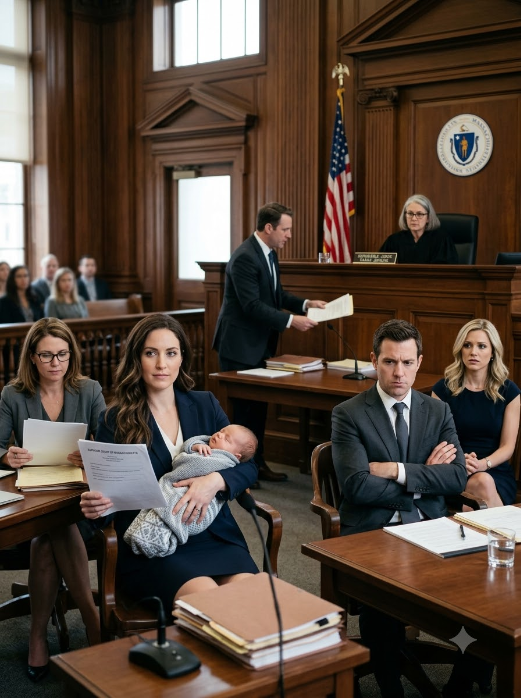
I attended the hearing remotely with Eli beside me. Ryan appeared in a dark suit, telling the judge his only concern was my safety and our child’s wellbeing — the same voice that had fooled investors, doctors, friends, and once, me.
My attorney, Elena Torres, presented Dr. Shah’s evaluation — normal cognition, no psychosis, no impairment to parenting — along with hallway security footage showing me leaving calmly, properly supplied. Samuel confirmed I had independent housing and funds.
Then Elena questioned Ryan directly. When had he first worried about postpartum psychosis? During pregnancy, he said — though he’d never contacted any of my actual doctors, believing I’d “refuse help.” Had Dr. Mills examined me? No — he’d relied on Ryan’s “detailed observations.” Had Ryan told the doctor about his relationship with the woman proposed to manage my corporate affairs? “My private life is irrelevant to Clare’s condition,” he said — then admitted, no, he hadn’t. Had he told Mills he expected a twenty-six-million-dollar bonus if my shares approved the sale? “Yes.” Had he prepared a voting proxy carrying my disputed signature? “I believed she signed it.” Prepared by whom? “My office.” Which employee? His eyes shifted. “Vanessa Cole.”
The judge denied his emergency request. Temporary custody stayed with me; Ryan got short supervised visits pending investigation. He left blaming Damian for manipulating the process — but his first lie had already failed. I hadn’t collapsed. I hadn’t come home. The court had heard my voice before he could replace it with his own.
Part 5
Vanessa reached out three days later, from an unknown number: I need to speak to you before Ryan destroys everything. I forwarded it straight to Elena, and we arranged a meeting with attorneys present.
She arrived pale and without makeup, unable to meet my eyes. She claimed not to know where Ryan was — despite living with him. I told her the Tribeca apartment was partly funded through my stolen shares; she insisted he’d told her the money came from his compensation. “Ryan’s compensation could not purchase that apartment,” I said.
Slowly it came out: he’d been moving money from far more than just Rowan — client accounts, investment funds, employee benefits — nearly forty million total. She was telling us, she said, because he’d emptied their joint accounts overnight and transferred the funds offshore, leaving her holding every vendor approval. “You signed them,” I said. “He told me they were temporary.” “You knew the companies used your name.” “I never got all the money.” “Only the apartment, the house, the jewelry, the salary, the travel?” She flinched. I didn’t soften it.
She produced a recorder — she’d been taping him for six months, ever since his promises kept shifting after each favor. In one recording, Ryan discussed activating my voting rights, submitting the Mills letter, and moving me to Connecticut “if she becomes difficult.” Asked what would happen to the baby, he said Vanessa would help — “until custody is settled,” and then, laughing, told her not to ask about titles before the deal closed. She admitted he’d promised marriage once things were “emotionally over” with me — a phrase that dissolves nothing.
Another recording was from the night of Eli’s birth: Vanessa suggesting Ryan stay with me, Ryan asking why, since nurses were there and she was his “real family.” The very words I’d overheard — except the conversation kept going after I’d walked away. Asked about me, Ryan called me “the bridge. Once we cross, we don’t keep carrying it.”
I had quit my career, moved cities, carried his child, handed him access to my accounts — and in his private language, I was infrastructure. Useful only until he reached the other side.
Part 6
Vanessa agreed to cooperate with prosecutors, without immunity, in exchange for a chance at reduced charges. Her records showed Ryan had been planning since before our wedding — researching my father’s trust while we were engaged, asking how a spouse might gain voting control if a beneficiary became incapacitated, calculating exactly when my shares would activate. An old message to Vanessa read: Clare trusts anyone who makes her feel heard. Damian does half the work by dismissing her.
Damian read it in silence, then walked out. I found him by the elevators. “He used the way I treated you,” he said. “I thought I was protecting the company.” “You often treated me like a mistake instead.” “I’m sorry.” It wasn’t enough to undo the years between us — but it was a start. “You made it easy for Ryan to play my defender,” I told him. “I know.” “But I chose him.” “Yes.” “Don’t turn this into a story where you failed to rescue me.” “What should I turn it into?” “One where we both learn.” He nodded, and for the first time since our father’s death, we spoke like siblings instead of rivals.
Part 7
The board met a week after I left. Walking back into Rowan Medical Systems felt like returning to a burned house — my father’s name in the lobby, an old photo of the three of us at the research center’s opening. I’d been certain, at twenty-eight, that I’d spend my whole life there. Ryan had spent years telling people I’d left because I couldn’t handle it. I was there to vote.
Daniel’s audit found forty-three million diverted through Ryan’s network — fourteen million to Vanessa’s companies, nine million through false acquisitions, eleven million from employee medical-benefit reserves, the rest offshore. Ryan, present with counsel, called it “temporary liquidity” ahead of the sale. “You stole from employee benefits,” Damian said. “I reallocated capital.” “To your mistress’s companies.”
Ryan turned to me. “Clare, this entire performance ends if you confirm the proxy.” “You forged it.” “You signed dozens of documents during pregnancy.” “Not that one.” Samuel’s forensic report showed the signature had been copied from our marriage license, complete with the same scan defect, and that the listed notary had been abroad on the supposed signing date. The board voided the proxy; my shares returned to me directly. The sale needed fifty-one percent — Ryan’s coalition had forty-eight.
“Clare,” he said quietly, “think about Eli’s future.” “I am.” I voted against the sale, then voted to terminate him for cause and refer the audit to law enforcement. Both passed. As security walked him out, he said, “You have no idea how to run this company.” “I know enough not to fund my apartment with employee healthcare money.” He left without another word.
Part 8
Two weeks later, Ryan was arrested trying to board a flight to Zurich, carrying two passports — one real, one under a different name with his same photo — plus encrypted drives, bearer certificates, and over eighty thousand in cash. He claimed he was meeting investors; the one-way ticket said otherwise, as did a message he’d sent Vanessa: If Clare refuses the sale, I’m done pretending this is recoverable.
The arrest reshaped the custody case. His lawyers argued the fraud had nothing to do with fatherhood — until prosecutors produced a draft email to Dr. Mills, written two hours after I left the apartment, describing me as removing our child “without consent” and “fixated on imagined infidelity,” requesting documentation to support sole custody and financial control. He hadn’t been afraid for me. He’d been building his next lever.
Mills surrendered his files and admitted he’d never actually met me — he’d been paid through a consulting arrangement to produce “risk assessments” of executives’ spouses. I wasn’t his first: one woman had lost her business in a divorce after he called her delusional; another had been placed under temporary guardianship while her husband moved her assets.
Part 9
The criminal case took nearly two years. I rebuilt a life that no longer revolved around Ryan — returning to Rowan Medical Systems as a board director rather than an executive, reopening my professional certification, consulting on product safety three days a week, visiting Eli at the company’s childcare center between meetings. The first time I cashed my own paycheck again, I sat in my car and cried; the amount wasn’t extraordinary, but the account was mine. Ryan had once told me leaving work would make me more “feminine and peaceful.” Financial dependence hadn’t brought peace — it had made every disagreement cost something. Damian and I slowly rebuilt too, learning to ask instead of assume, to disagree without treating it as abandonment.
Part 10
Vanessa testified for four days, admitting the affair had started eight months before my pregnancy, and that she’d helped build the shell companies, signed the false invoices, submitted the forged proxy, and given the statement calling me unstable — knowing full well I’d just given birth. Asked what “real family” had meant to her, she said: that he would choose her. Prosecutors played a recording of Ryan telling an offshore adviser that Vanessa was useful because everything sat in her name, so if the transfers were challenged, she’d absorb the impact first. She’d been a shield, not a partner. I’d been a bridge. Neither of us had been family — to Ryan, family meant whoever carried the risk while he kept the reward.
Part 11
My testimony opened with the hallway — the smell, the pain of walking after labor, Ryan’s voice, the words real family. His attorney objected that the affair was irrelevant to the fraud charges; the prosecutor argued it established Ryan’s relationship to the woman receiving the stolen funds. The judge allowed it.
On cross, his attorney walked me through my exhaustion, my pain, my emotional state after childbirth, suggesting I might have “misunderstood” a private conversation or taken a figurative phrase literally. I answered plainly: he’d said it to the woman receiving company money through shell entities. Asked why I’d used the word need in my text to Damian, I said I hadn’t felt endangered — I’d felt controlled. Asked whether Ryan had ever struck me, I said no. “Control doesn’t begin with a fist,” I told the jury. “He had my income, my passwords, my voting credentials, my medical narrative, and a petition ready to take my baby from me. He didn’t need to hit me. He needed every institution to believe his version of me instead.”
Part 12
Ryan was convicted of wire fraud, conspiracy, identity theft, forgery, embezzlement, theft from employee-benefit funds, obstruction, and attempted unlawful control of trust assets. Mills pleaded guilty to falsifying records. Vanessa’s cooperation earned her a reduced sentence, but she lost every asset tied to the scheme.
At sentencing, Ryan spoke of pressure — Damian never respecting him, the trust making him feel like an outsider, me choosing the family company over our marriage. The judge wasn’t moved. “You repeatedly describe other people’s boundaries as the cause of your crimes,” she said. When he claimed he’d loved me, she pointed to the forged proxy: “You studied her vulnerabilities… You prepared to hospitalize her after childbirth so you could control her shares.” “She was not thinking clearly,” he tried. “You hired a doctor who never examined her.” “I made poor decisions.” “A poor decision is singular,” the judge said. “Your conduct was a system.” She sentenced him to decades in federal prison. As deputies led him out, he looked at me and said, “Tell Eli I tried.” I said nothing. Tried to do what — secure an inheritance, close a sale, control his son’s mother? He still believed intention could be renamed until it looked like love.
Part 13
The divorce finalized six months later. Ryan’s original proposal offered me the apartment if I waived claims to his investments; my attorneys traced its down payment straight to my own inherited funds. I could have kept it. I sold it instead — too many rooms where I’d learned to disappear. Part of the proceeds restored the employee-benefit fund; part built an independent trust for Eli; the rest bought a small house near the river, deed in my name alone. I kept the wedding ring for years, not to hold onto the marriage but because throwing it away felt like pretending I’d never loved him. Eventually I melted it into a plain pendant — nothing inscribed, nothing promised, just something changed rather than erased.
Part 14
When Eli turned six, he asked why his father lived far away. “Your father broke serious laws,” I told him. “Did he hurt people?” “Yes.” “Did he hurt us?” “Yes.” “Did he hit you?” “No.” “Then how?” “He tried to control my money, my work, and what people believed about me.” “Why?” “Because I had something he wanted.” “What?” “A vote.” “That sounds small.” “It was written on paper. But it decided a lot of people’s jobs.” “Did you give it to him?” “No.” “Was he mad?” “Yes.” “Are you glad you said no?” I looked around the room I’d chosen every piece of. “Yes.”
Part 15
Years later I returned to St. Jude’s for a patient-safety conference. The maternity hallway had been renovated — no more burned-coffee smell, softer lighting — but I knew the exact corner. I stood there a while. A nurse rolled an empty bassinet past; somewhere a newborn cried, and it carried me straight back to the moment Eli’s voice had saved me. Ryan’s words had drained two years of marriage in seconds; then my son cried, and I remembered someone in the world needed more from me than endurance. He needed a mother who could show him that love doesn’t require disappearing.
People later framed Damian’s arrival as the turning point — the elevator opening, my brother stepping out with an attorney and an accountant, fear replacing Ryan’s arrogance. It looked like a rescue. It wasn’t the beginning. The beginning was earlier: reopening my own account, copying the records, calling the brother I’d been forbidden to call, packing one suitcase, leaving the ring on the counter, walking toward the elevator without waiting for permission. Damian didn’t give me the courage to leave. He arrived because I had already chosen to go.
Part 16
Rowan Medical Systems survived — the sale rejected, most of the stolen money recovered, tighter controls placed on related-party contracts. The employee fund was restored in full. Daniel became audit committee chair; no executive could approve a vendor tied to family or a romantic partner without independent review. Damian led the company another eight years before handing it to an outside successor; I stayed on the board but declined the chair. My father’s company no longer needed to prove which sibling had won. Eli’s shares sat inside a protected trust that no parent, spouse, or forged letter could touch.
Part 17
After her release, Vanessa wrote to me — no request for forgiveness, just an admission that she’d let Ryan’s description of an “empty marriage” excuse what she was doing: signing papers she knew I hadn’t approved, telling herself he’d make it legal once the sale closed. She wrote that when he called her his real family, she thought she’d won — and that she understood now he never had a real family, only people assigned to roles. She’d been one of them. I read it once, filed it with the case records, and didn’t answer. Understanding didn’t require reunion.
Part 18
On Eli’s tenth birthday, Damian gave him our father’s old drafting compass — the tool he’d used to draw perfect circles. Eli’s first attempt came out uneven; he tried again. Watching him, I thought about how Ryan had placed himself at the center of my life and trained every distance in it to serve him — my job, my family, my money, my silence, my body, even Eli’s birth. Leaving hadn’t just removed Ryan. It let me choose a new center — not Damian, not the company, not motherhood alone, but my own judgment. From there, every relationship had to be built on consent, not orbit.
Part 19
Hours after giving birth, I heard my husband call his mistress his real family. At the time, it felt like a final verdict on my worth — that I’d failed to stay interesting, failed to stay independent, failed to build a marriage strong enough to hold his loyalty.
Years later I understood the words said nothing about my value. They revealed his definition of family: whoever approved the transaction, carried the liability, stayed useful. Vanessa was “real” because she was helping him take my vote. I was “unstable” because I refused to hand it over. He called himself a father because Eli’s birth had unlocked the asset he wanted.
That night, I stopped accepting his labels. I wasn’t useless, unstable, dependent, or a bridge. I was Clare Rowan — a mother, an engineer, a shareholder, a woman who had once made herself small and then learned that taking up space required no one’s permission but her own.
When Ryan opened that apartment door and demanded to know where I thought I was going, I didn’t yet grasp the size of what he’d built behind our marriage. I only knew I’d heard enough. Then the elevator opened, Damian stepped out with the evidence Ryan thought was still hidden, and fear finally replaced arrogance on my husband’s face.
But he had already lost by then — the moment I reopened my own account, copied the documents, called my brother, packed Eli’s blanket, and left the ring on the counter to walk toward the door. The elevator didn’t carry my rescue up to me. It arrived after I’d already rescued myself.
