

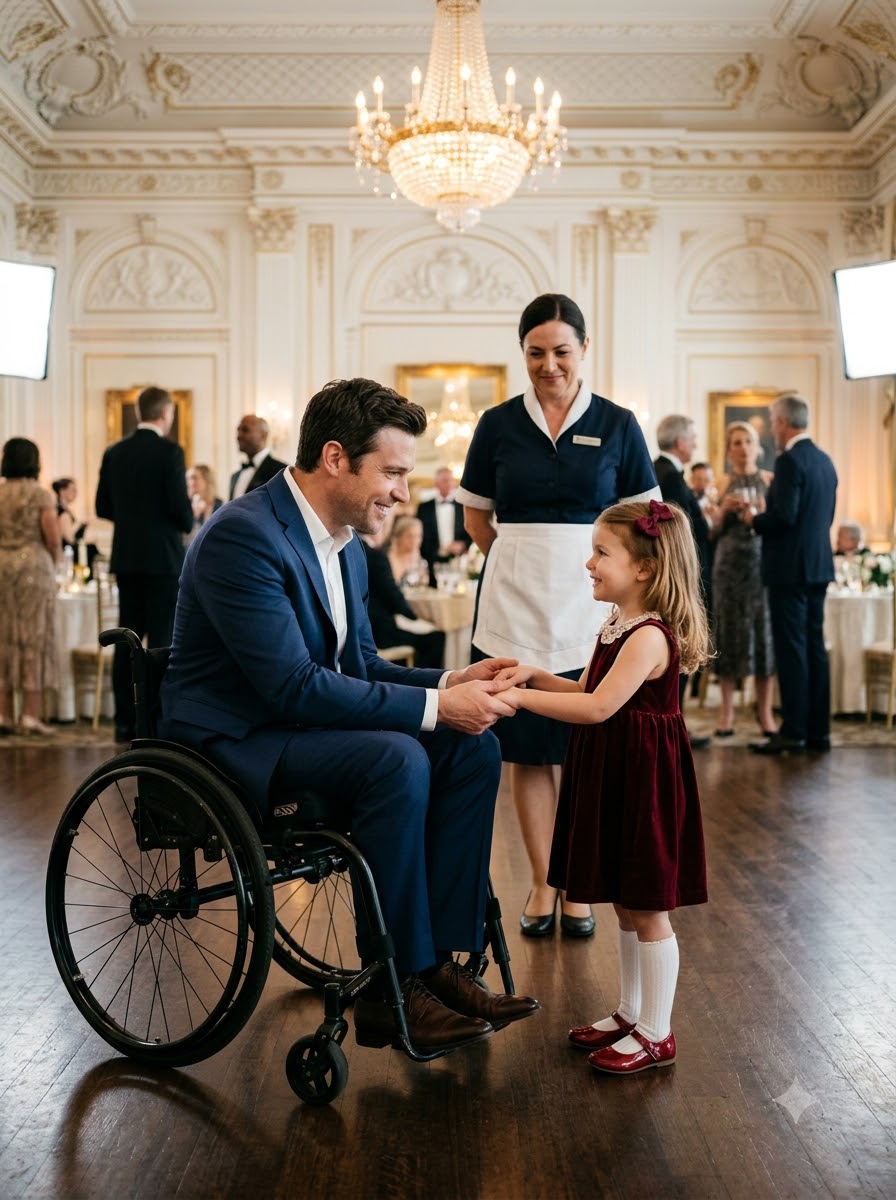
Rain tapped softly against the tall glass windows of a private rehabilitation hospital in Chicago, smearing the skyline into long, wavering streaks of light that seemed unsure of their own direction. From his hospital bed, Nathaniel “Nate” Harrington stared down at the streets without really taking them in. The reflection in the glass was harder to look at than the medical reports stacked neatly on the table beside him.
At thirty-eight, he still carried himself with composure — a man built on discipline and precision. But his body no longer answered the way it used to. Where strength once lived, there was now only stillness.
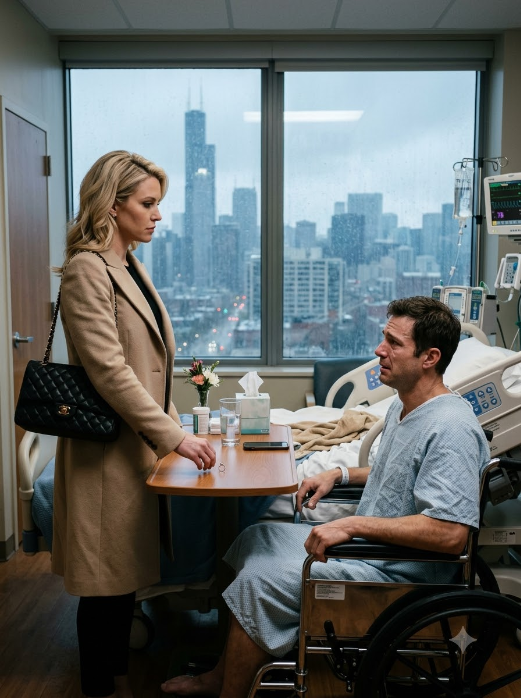
He heard uncertain footsteps behind him before the voice came.
“I need to leave,” said Vanessa Reed, quietly, as if speaking softer might dull the weight of it.
Nate shut his eyes — not from shock, but from recognition. He’d sensed this moment approaching with every visit she’d made, each one dressed in strained smiles and quiet distance. He tried to reach for her, but his arm shook and dropped short, his muscles failing him where they’d once moved without hesitation.
“Vanessa…” he said, her name suddenly strange in his mouth.
She swallowed hard. Tears welled up, but they weren’t tears of pleading. They were lighter, freer — carrying relief rather than sorrow.
“I tried,” she said quickly. “I really did. But I can’t live like this. I can’t watch you like this.”
Like this.
The words reduced him to a condition instead of a person. Vanessa pulled the engagement ring off her finger and set it on the bedside table. The diamond met the metal with a quiet finality louder than any shout.
“After seven years?” Nate asked, his voice growing thin. “Now?”
She looked away. “The doctors were certain. You won’t walk again. And I’m still… me.”
The heart monitor picked up his racing pulse, beeping sharp and urgent. But Vanessa was already gathering the designer bag he’d given her the previous Christmas, heading for the door with the resolve of someone who’d chosen not to look back.
When she left, the room felt bigger — hollower — as if even the walls had pulled away.
The Slow Vanishing
In the weeks that followed, concern came in waves, then slowly faded.
At first, friends stopped by with flowers and careful, rehearsed encouragement. They lingered awkwardly at the foot of his bed, offering optimism that sounded thin. Soon visits turned into messages. Messages turned into short texts. Polite. Distant. Enough to seem courteous — never enough to feel like presence.
Only Caleb Dawson stayed.
Business partner. Closest friend. The one person who didn’t pretend positivity could undo paralysis.
On the day Nate was discharged, Caleb wheeled the sleek new chair down the hospital corridor as gray light settled over Chicago.
“We’ll figure this out,” Caleb said, though his voice wavered.
Nate didn’t look up. “Don’t lie. I saw the calls you didn’t answer. I saw the messages you erased before handing me your phone. They all vanished, didn’t they?”
Caleb stopped walking.
“Not all of them,” he said quietly. “I’m still here.”
Nate let out a slow breath. “Because you want to be… or because you feel like you have to?”
Caleb said nothing.
The silence felt like an answer.
A House Too Big
Nate’s lakefront home north of the city had once felt like a victory. Now it felt like a museum — every sound bouncing back his own frustration.
Caregivers came and went, let go quickly. One spoke too tenderly. Another sighed too much. A third wore that same look of pity mixed with unease — a look Nate knew instantly.
“You don’t need another nurse,” Caleb said one evening. “You need someone to run the house.”
Nate nodded once. “As long as they don’t talk. And as long as they don’t look at me like I’m a project.”
That’s how Isabella Cruz came into the picture.
She rang the doorbell early one cold morning, dressed plainly, her dark hair tied back neatly, her posture steady. There was no hesitation in her eyes. No forced gentleness.
“Mr. Harrington?” she asked.
Nate laid out the terms right away. “You clean. You leave. No questions. No talking. And no pity.”
Isabella held his gaze without flinching. “That works for me.”
Something in her steadiness unsettled him.
For weeks, the routine held. She arrived before sunrise and left before the evening shadows stretched across the hardwood floors.
What Nate didn’t know — because Isabella was afraid of losing the job — was that she had a daughter.
For illustrative purposes only
The Child Behind the Door
Sofia was five. Curious. Watchful. Too sharp for her own good.
When her preschool shut down unexpectedly for renovations, Isabella had nowhere else to turn.
“You stay quiet,” Isabella murmured that first morning, straightening Sofia’s small backpack. “You draw, you play, but you don’t leave the room.”
“Is he scary?” Sofia asked.
Isabella paused. “He’s not scary. He’s just very sad.”
For a few days, Sofia followed the rules exactly, coloring on the floor, humming to herself. But curiosity has a way of slipping past rules.
One afternoon, she spotted a study door left slightly open.
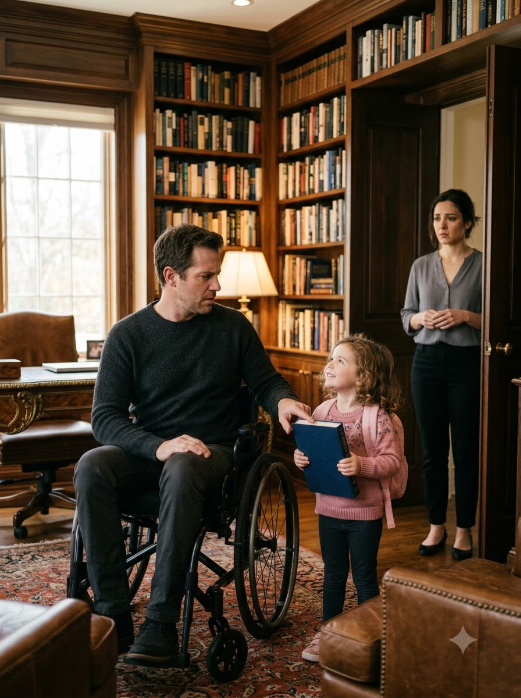
Inside, Nate stretched toward a high bookshelf, jaw tight with frustration as his fingers grazed a navy-blue book just out of reach. His wheelchair was wedged awkwardly against the wall. His arm trembled with the effort.
“Damn it,” he muttered.
Sofia stepped closer.
“Do you want help?” she asked, her voice small but sure.
Nate turned sharply. “Who are you?”
She stepped back, then lifted her chin. “I’m Sofia. I came with my mom.”
Irritation flared. “Your mother brought a child here?”
“My school closed,” Sofia explained quickly. “I promised to be quiet.”
He started to wave her off, then stopped himself. Arguing with a five-year-old felt pointless.
“Which book?” she asked again.
Without knowing quite why, he pointed.
Sofia climbed onto a nearby chair, pulled the book down easily, and handed it to him with a smile that didn’t wait for permission. Her small fingers brushed his hand — without fear.
“Why do you use that chair?” she asked plainly.
He tensed. Adults never asked that directly.
“My legs got hurt,” he said finally. “They don’t work anymore.”
She thought about this, then rested her small hand over his.
“When I fall, my mom kisses it better,” she said. “Do you want me to try?”
He went still — undone by how simple it was.
“Sofia?” Isabella’s voice carried down the hallway.
She appeared a moment later, pale with worry. “I’m so sorry. I didn’t realize she’d left the room.”
Nate breathed out slowly. “She can stay,” he said, stiffly. “But teach her that this chair is normal. I don’t want a scene.”
Isabella nodded, holding back tears. “Thank you.”
That night, Nate realized he hadn’t thought of Vanessa once.
The Drawing
The peace broke one morning.
“Get out.”
His voice filled the house.
Isabella rushed downstairs to find Sofia in tears, holding crumpled paper. Nate’s face was red with anger.
“She went through my things.”
Isabella picked up the drawing.
It showed Nate standing — smiling — beside a woman in a bright dress. Taped to the corner was a torn photo Nate had hidden away because he couldn’t bring himself to throw it out.
“I just wanted you to be happy,” Sofia cried. “My mom said you were sad. In my picture, you’re standing.”
Caught in his own pain, Nate said the words he’d regret most.
“Leave.”
Isabella carried Sofia out. The door closed with finality.
On the back of the drawing, uneven letters read: “For the sad uncle. I hope you smile.”
Nate broke down.
The Apology
Two days later, Caleb tracked down Isabella’s address.
The apartment building was old. The stairwell narrow. Caleb carried Nate up without a second thought.
Isabella opened the door warily. Sofia hid behind her.
“I came to say I’m sorry,” Nate said. “I shouldn’t have shouted.”
Sofia peeked around her mother. “You won’t yell again?”
He shook his head. “I promise.”
She handed him her stuffed rabbit like a sealed deal.
“Okay,” she said. “I forgive you.”
Something eased inside his chest.
“I want you both to come back,” he added. “And… I want you to come with me somewhere important.”
Isabella hesitated. “I don’t belong in your world.”
Nate touched his wheelchair lightly. “Neither do I anymore.”
The Night That Changed Everything
The charity gala shone with chandeliers and expectation.
Vanessa showed up — polished, remote.
“I didn’t expect to see you here,” she said.
“I’m exactly where I need to be,” Nate replied.
Her eyes flicked dismissively toward Isabella and Sofia. “Is this your new family?”
Before Isabella could pull back, Sofia stepped forward.
“Don’t be mean,” she said. “He’s kind.”
Vanessa scoffed.
Nate kept his voice level. “She gave me dignity when others couldn’t.”
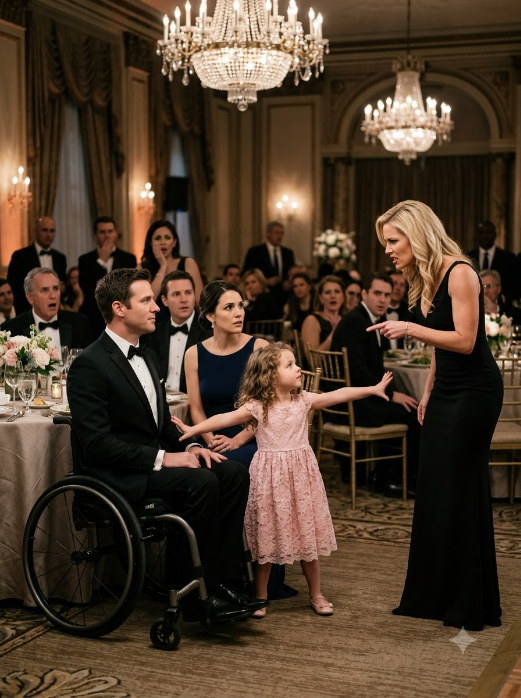
When Vanessa slapped him, the sharp sound cut through the ballroom.
Sofia immediately planted herself in front of him, arms spread wide.
“Don’t hurt my friend.”
Whispers spread. Vanessa walked out without a word.
Nate rested a hand on Sofia’s shoulder. “Thank you.”
On stage, Nate spoke plainly.
“I didn’t grow stronger,” he said. “I grew softer. And that’s what saved me.”
He announced the opening of an inclusion center built on dignity — not appearances.
The applause was genuine.
A Different Kind of Family
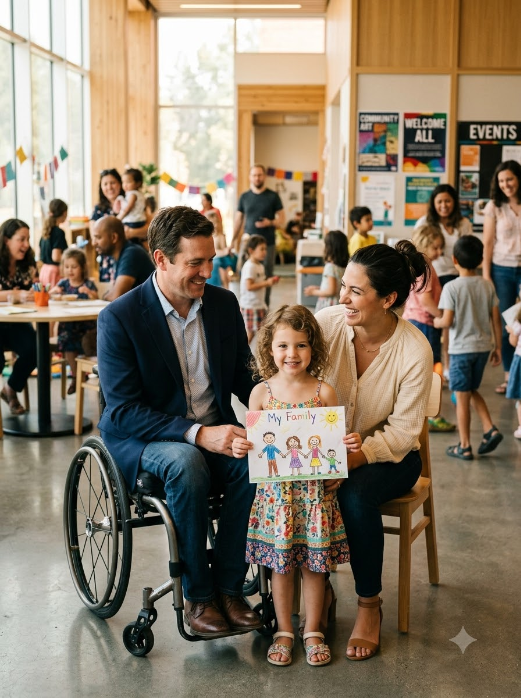
A year later, the Harrington Inclusion Center was full of life.
Isabella ran community programs. Sofia dashed proudly through the halls.
At the anniversary celebration, Sofia held up a new drawing: three figures holding hands.
“Family isn’t about blood,” she announced confidently. “It’s about care.”
Nate smiled, warmth spreading across his face.
“Then yes,” he said. “We are family.”
He never got his legs back.
But he had reclaimed his world.
