

I’m thirty-seven, a billionaire real estate developer whose family owns restaurants, property, shipping businesses, private clubs, and some of Boston’s most valuable real estate.
At 7:30, I was supposed to propose to Sloane Barrett beneath the glass ceiling of my family’s private conservatory overlooking the Charles River.
My navy suit had been custom-tailored on Newbury Street. My grandfather’s cuff links were secured at my wrists, and a diamond ring worth more than most people’s homes rested inside my jacket.
Sloane was gorgeous, intelligent, sophisticated, and belonged to exactly the kind of influential family my own wanted to associate with.
Profitable.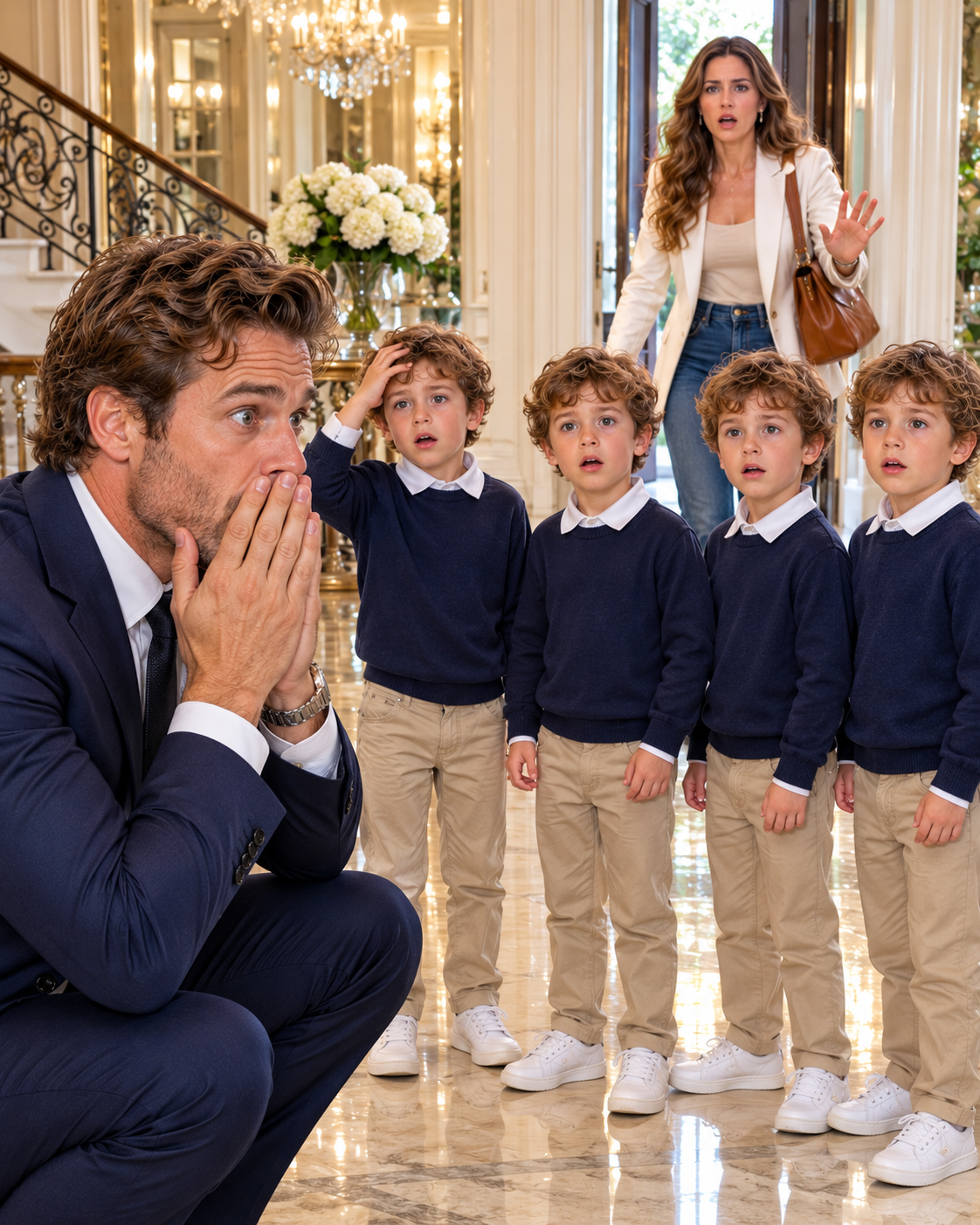
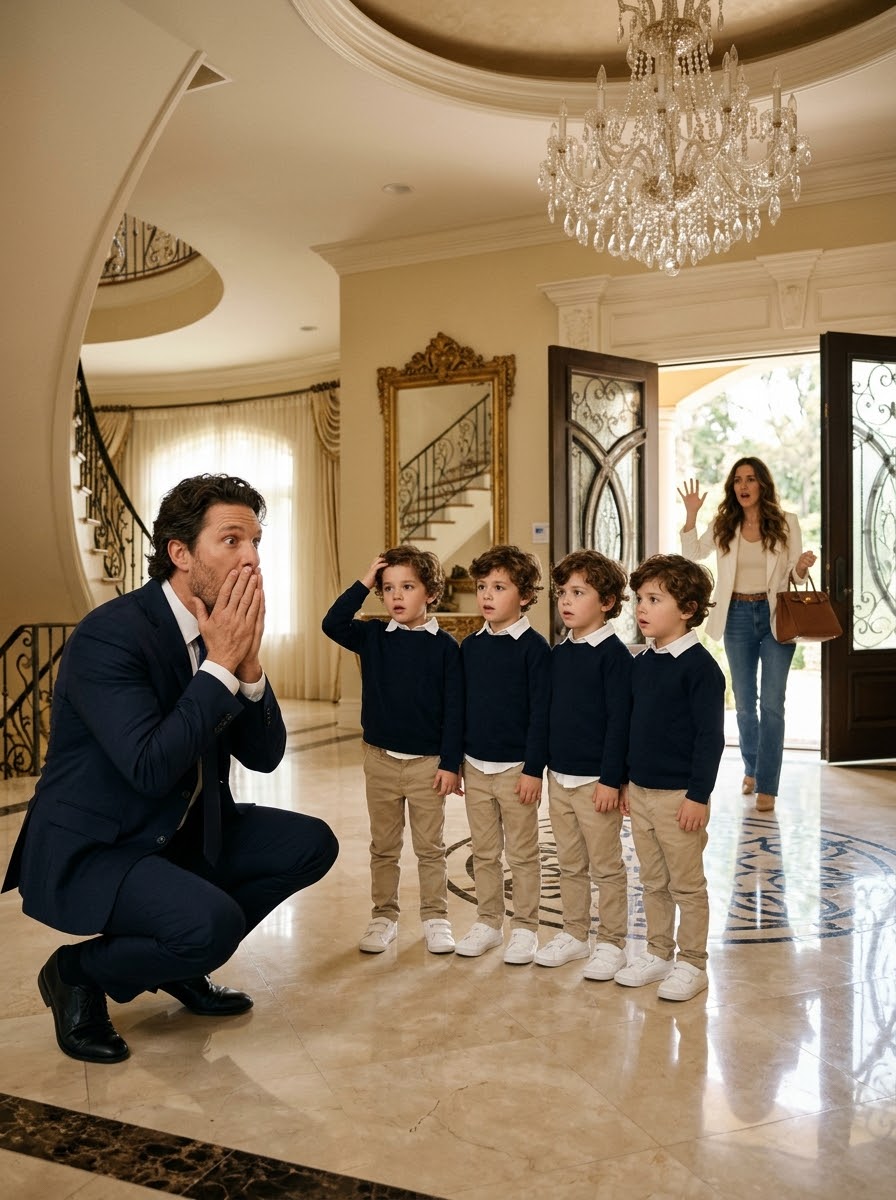
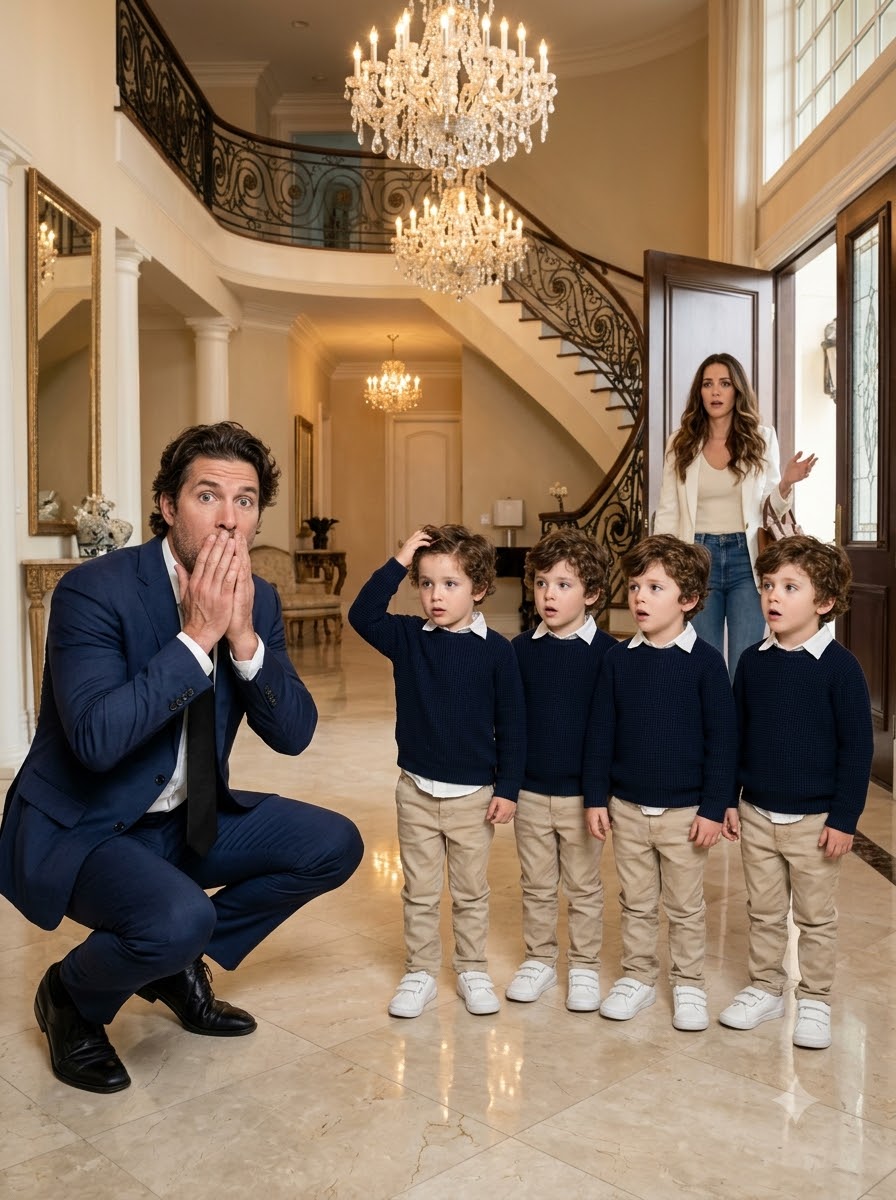
It felt like looking at a photograph of myself when I was six.
I had entered billion-dollar negotiations knowing an entire company could fall apart because of one wrong decision.
“How old are you?” I finally asked.
“Six.”
A woman I had loved so deeply that I once imagined abandoning every expectation my family had ever put on me.
My hand instinctively reached toward the ring inside my jacket.
A woman called, “Boys? Are you almost finished?”
The boys immediately rushed toward the doorway.
In less than an hour, some of Boston’s most influential business families would be expecting to witness my proposal to Sloane Barrett.
And four six-year-old boys with the exact face I had as a child were running straight toward her.
“Mom!”
“Mom!”
She looked from the boys to me.
“Dominic,” she whispered.
Hearing my name spoken in her voice brought six years of memories crashing back.
The last night I had seen her, standing outside my family’s townhouse with tears in her eyes while I waited for an explanation that never arrived.
The four boys surrounded her, all of them studying me with unmistakable curiosity.
Elena rested one hand on the shoulders of the two boys closest to her.
“Come on,” she said quietly.
“Mom, do you know him?” one asked.
“Yes,” she answered.
“Can we talk?”
“Not here.”
“I agree.”
“Then please step aside.”
The boys walked past me one after another.
“You look like us,” he said.
“I know,” I replied.
“Are you famous?”
“No.”
“My mom says famous people are usually tired.”
“She may be right.”
“Leo, outside.”
“How long have you been here?” she asked.
“About ten minutes.”
“Did you speak to them?”
“Only enough to learn their names and ages.”
“You asked their ages.”
“They look like me.”
“That doesn’t mean what you think it means.”
“Then tell me what it means.”
“You don’t get to walk into a bathroom and demand answers as though six years are a scheduling inconvenience.”
“I’m not demanding anything.”
“You are standing there looking at my children as if they belong to you.”
“They may.”
“Give me fifteen minutes.”
“I have less than an hour before I’m expected somewhere.”
“Then you should go.”
“I won’t.”
“You were always stubborn.”
“You were always the one person who could make me change my mind.”
“There’s a private sitting room upstairs.”
“I’ll follow you.”
“No.”
“You will wait there, and you will not approach the boys again until we’ve spoken.”
“I’m not a danger to them.”
“I didn’t say you were.”
“You implied it.”
“I implied nothing.”
“Then why are you treating me like a stranger?”
“Because you are one.”
Elena collected the boys and led them toward the staircase.
For months, I had pictured myself kneeling beneath the conservatory’s glass roof while Sloane Barrett covered her mouth and said yes.
I had envisioned my parents’ relief, my grandfather’s approval, and the photographs appearing in the society pages the following morning.
Because it represented a future I had been preparing to embrace while standing above a past I had never understood.
The private sitting room smelled of lemon polish and old money. Heavy drapes framed a view of the river that had been painted a dozen times for my family’s annual reports. I stood at the window with my hands in my pockets, the diamond ring a hard, unwanted weight against my ribs. Ten minutes. Fifteen. My phone buzzed once—Sloane’s name lighting the screen—then went dark when I ignored it.
The door opened without a knock.
Elena stepped inside and closed it behind her. She had changed from the casual sweater I’d glimpsed downstairs into a simple black dress that still managed to look expensive. Six years had sharpened the edges of her face and put a new caution in her posture, but her eyes were exactly the same: the color of wet stone after rain.
“They’re with the hostess,” she said. “Coloring. She’ll keep them occupied.”
“Thank you.”
She didn’t sit. “You have forty minutes before your life becomes someone else’s business. Say what you need to say.”
I turned from the window. “They’re mine.”
“You don’t know that.”
“I know what I looked like at six. I know the shape of my own mouth and the way my left eyebrow lifts higher than the right when I’m curious. Four of them. Identical. Don’t insult both of us by pretending it’s a coincidence.”
Her jaw tightened. “A DNA test will take days. You don’t have days. You have a proposal waiting.”
“Then give me the truth instead of a lab result.”
Elena exhaled slowly, as if she had been holding the same breath since the bathroom doorway. “I found out three weeks after that night outside your townhouse. Four heartbeats. The doctor called them a miracle and then looked at my insurance card and stopped smiling.”
“You never called me.”
“I called your father’s office. Three times. The third time his assistant told me that if I contacted the family again they would pursue legal action for harassment. Two days later a man in a suit met me outside my apartment with a check for two hundred thousand dollars and a nondisclosure agreement. He said the family preferred ‘clean exits.’”
The floor seemed to tilt. “My father paid you to disappear.”
“Your father paid me to vanish before the pregnancy showed. The NDA was specific: no contact with you, no public acknowledgment, no attempt to claim support. Breach would mean they would take the children and make sure I never saw them again. I signed it in the back of a town car because I was twenty-six, terrified, and alone.”
“You could have come to me.”
“You were inside that townhouse when I stood on the sidewalk crying. You watched me leave. You didn’t follow.” Her voice cracked on the last word, then steadied. “I told myself that was my answer.”
I remembered the night with sudden, sickening clarity: the argument we had started because I had postponed our weekend trip again for a closing. The way she had said she was tired of being an afterthought. The way I had let her walk away because I believed, with the arrogance of a man who had never been refused anything important, that she would cool off and return. My mother had come downstairs an hour later and told me Elena had called to say it was over, that she was moving to Chicago for a job. I had believed it because it was easier than believing she simply didn’t want the life I was offering.
“They lied to me,” I said. “They told me you left for a job. They told me you didn’t want to be reached.”
“I know.” Elena’s hands were clasped so tightly her knuckles had gone white. “I read the society pages for two years. I watched you build the waterfront project. I watched you become exactly what they wanted. And every night I put four boys to bed who asked why they didn’t have a father.”
The room was quiet except for the distant clink of silverware from the dining room below. I pulled the ring box from my jacket and set it on the table between us. The diamond caught the light and threw it back, sharp and cold.
“I was going to propose to Sloane Barrett in thirty minutes,” I said. “Because my family decided it was time, and I had stopped arguing with them six years ago.”
Elena looked at the box, then at me. “Are you going to?”
“No.”
“Dominic—”
“I need their names.”
She hesitated, then gave them to me one by one, as if each was a small surrender. “Leo. The one who asked if you were famous. Caleb. He talks less than the others. Marcus. He’s the one who always has a scraped knee. And Julian. He has your temper when he’s tired.”
I repeated them silently, testing the weight of four new truths. “Do they know anything?”
“They know their father lives far away and that we don’t talk about him. They know I love them more than anything. That’s been enough until tonight.”
My phone buzzed again. Sloane. Then a text from my mother: *Guests are arriving. Where are you?*
I silenced it. “I want to meet them properly. Not in a bathroom. Not like this.”
“They’re six. They don’t need their world rearranged in one night because you suddenly discovered a conscience.”
“I’m not rearranging anything tonight. I’m canceling a proposal and telling my family the truth. Tomorrow I want a lawyer who doesn’t work for my father. I want a DNA test if that’s what you need to feel safe. And I want to know what you need—money, space, time, a house with a yard, whatever it is—so that those boys never again wonder why their father isn’t there.”
Elena studied me for a long moment. The caution was still there, but something else had joined it: the same stubborn hope I remembered from nights when we had planned futures neither of our families would have approved.
“They have a soccer game on Saturday,” she said finally. “Field three at the park near my apartment. Nine a.m. If you show up, you show up as a friend of their mother’s. Nothing more until we figure out the rest.”
“I’ll be there.”
She nodded once, then moved toward the door. At the threshold she paused. “The man with the check. He said your grandfather had approved the amount. I always wondered if that was true.”
“I’ll find out.”
After she left I stood alone with the ring box and the river and the life I had been ready to accept. Downstairs, my mother’s text arrived again, more insistent. I opened the box, looked at the diamond one last time, and closed it. Then I walked out of the sitting room, down the service stairs, and into the cool November air where the Charles moved dark and indifferent beneath the bridges.
The conservatory was already half full when I arrived. Crystal glasses, low laughter, the particular perfume of people who measured worth in square footage and school ties. Sloane stood near the glass wall in a silver dress, talking to my mother. She looked beautiful and certain. When she saw me her smile widened, then faltered at whatever she read on my face.
“Dominic,” my mother said, crossing to me. “You’re late. The Barretts are here. Your grandfather is asking—”
“I’m not proposing tonight.”
The words landed in the space between us like a dropped glass. Conversation nearby stuttered and died. My mother’s smile remained fixed, but her eyes went sharp.
“What did you say?”
“I’m not marrying Sloane. I’m not marrying anyone right now. And I need to speak with Father and Grandfather before anyone else hears it from the staff.”
Sloane had reached us. “Dominic, what’s going on?”
I looked at her—the woman I had chosen because she fit, because she asked for nothing I wasn’t already prepared to give—and felt the last of the evening’s script dissolve. “I’m sorry. You deserve someone who is actually choosing you. That isn’t me.”
She stared at me for three full seconds, then turned and walked toward the exit without another word. My mother made a small, furious sound and followed her. I kept walking until I found my father and grandfather near the bar, both of them holding scotch they hadn’t yet tasted.
“We need to talk,” I said. “About Elena Moretti. And about the four sons I’ve apparently had for six years.”
My father’s face went still. My grandfather set his glass down with deliberate care.
“Not here,” my father said.
“Yes, here. Or I can say it louder.”
They moved with me to a side alcove shielded by a potted orange tree. The party continued behind us, oblivious.
“She signed an agreement,” my father said quietly. “She was compensated. She chose to leave.”
“She was threatened with losing the children if she contacted me. You told me she took a job in Chicago. You let me believe she didn’t want me.”
My grandfather’s voice was low and even. “The family name does not survive scandals involving four illegitimate children and a woman from no particular background. We protected you.”
“You protected a version of me that doesn’t exist anymore.” I looked at both of them—the men who had taught me how to close a deal and how to keep a secret—and felt something permanent shift. “I will be at a soccer field on Saturday morning. After that I will be retaining counsel who does not answer to this family. If either of you attempts to contact Elena, intimidate her, or interfere with those boys, I will make the original NDA and the payments public. Do you understand?”
My father started to speak. My grandfather raised one hand, stopping him.
“You would burn what we built,” the old man said.
“I would rather burn it than keep living inside the lie you built it on.”
I left them there and walked back through the conservatory. People watched me pass. Some already knew something had gone wrong; the rest would know by morning. Outside, the November wind cut across the river. I pulled out my phone and typed a single message to the number Elena had given me before she left the sitting room.
*Saturday. Field three. I’ll be the one who looks like their father.*
The reply came ninety seconds later.
*They already know what you look like. Try not to be late.*
I stood on the sidewalk until the cold reached the bone, then started walking toward the only future that had ever actually belonged to me. Behind me the conservatory glowed like a ship that had already left the dock. Ahead, somewhere in the city, four boys were probably still coloring, unaware that the shape of their lives had just changed. I intended to be there when they found out. I intended to stay. And for the first time in six years, the weight inside my jacket felt like nothing at all.
