

PART 1
My manager mocked me for the babies I was told had died, everyone expected me to disappear for crossing a dangerous man, but no one knew the truth—the triplets staring at me had the same hazel eyes I remembered seeing in the mirror during my pregnancy.
I barely noticed the knife slipping beneath my thumbnail as I chopped vegetables.
Rosalie’s Diner had never been this quiet.
The sizzling grill, the clattering dishes, and the loud regulars all faded the moment Dante Ricci walked through the front door.
He looked like danger dressed in an expensive suit.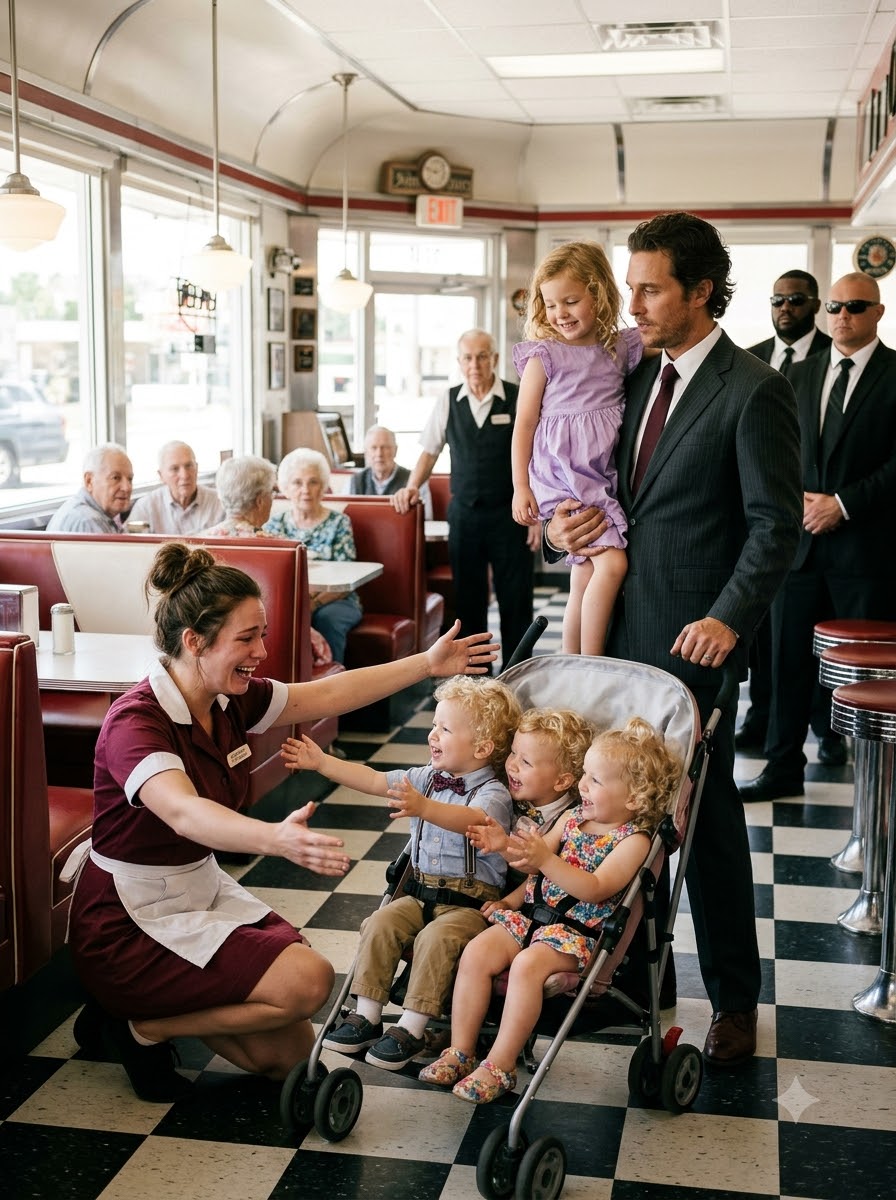
Four armed bodyguards surrounded him while he pushed a stroller carrying three screaming toddlers.
Everyone knew his reputation.
They whispered that he controlled half the city, owned people who should never be owned, and that anyone who crossed him simply vanished.
I lowered my eyes.
I had already survived the worst day of my life fourteen months earlier.
I entered the hospital expecting to bring home my triplets.
Instead, I woke after an emergency delivery to condolences, paperwork, and endless apologies.
No babies.
No chance to hold them.
Just a nurse repeating, “I’m so sorry.”
Since then, grief had become my shadow.
I buried myself in double shifts because heartbreak didn’t pay the rent.
“Booth in the corner,” my manager, Wendell, barked. “Nobody else wants to wait on him.”
When I reached the table, my breath caught.
Two little boys.
One little girl.
Dark curls, chubby cheeks, and unmistakable hazel eyes exactly like mine.
Trying to ignore the feeling twisting inside me, I picked up a stuffed rabbit one boy had dropped.
“Well, aren’t you the serious one?” I whispered.
His crying stopped instantly.
His brother fell silent next.
Then the little girl stretched both arms toward me.
“Mama.”
The boys echoed her.
“Mama.”
Everything inside me shattered.
Dante stood so slowly it made my pulse race.
“What did you do?” he asked, in a voice calm enough to terrify everyone nearby.
“Nothing,” I whispered. “I swear… I don’t know why they’re calling me that.”
Without taking his eyes off me, he ordered one of his men to dig into my entire past: my name, my address, even my hospital records.
Before I could speak again, Wendell rushed over, desperate to save himself.
“She’s unstable,” he sneered. “She lost triplets last year. We’ve only kept her because we felt sorry for her.”
Dante’s cold stare shifted toward him.
“So you humiliate a grieving woman because you think it impresses me?”
Unable to breathe, I stumbled outside into the rain.
Moments later Wendell followed, fired me on the spot, and called my dead children nothing more than an excuse.
“My babies were never an excuse,” I said.
He walked away without another word.
Then the alley door opened again.
Dante stepped outside carrying the little girl in his arms.
She reached for me with tiny trembling hands, looked into my eyes as if she had always known me, and whispered the one word that changed everything.
“Mama.”
PART 2
By two in the morning, the top floor of Ricci Freight Tower in downtown Chicago was under a quiet lockdown.
Guards in charcoal suits stood at every corridor.
Down the hall, in a nursery that looked like it belonged in a magazine, three toddlers slept side by side in matching cribs, their small chests rising and falling.
I had stood over them for twenty minutes, not touching, afraid they would vanish if I did.
Now I sat in a leather armchair in Dante’s study, wrapped in a borrowed cardigan, holding tea I couldn’t taste.
My name is Marnie Calloway, and I was twenty-six years old, and I had been told fourteen months ago that my children were dead.
Across the table sat Dante, his attorney, Bridget Hale, a retired Chicago PD detective named Silas Ortega, and a physician from a private clinic who had drawn blood from all four of us at midnight.
Bridget opened a thick folder.
“The DNA results are back,” she said. “Marnie, the children are yours. Biologically, without question.” She paused, then looked at Dante. “And they are not his.”
I looked at him sharply.
Dante stood by the window, his jacket off, sleeves rolled up.
The city glittered behind him.
He did not look like the man from the diner anymore.
He looked tired.
“They’re not mine,” he said quietly. “I never claimed they were. Let me explain.”
Silas took over, laying out papers.
Three weeks earlier, a nurse named Joanne Pike had walked into a church in Cicero and asked to speak to a priest.
She couldn’t sleep, she said.
She had falsified three death certificates at St. Jude Memorial, fourteen months before, on the orders of the hospital’s administrator, Dr. Victor Sterling.
The babies had been born alive.
Healthy.
They had been quietly handed to a private adoption broker who sold infants to wealthy couples without paperwork.
The priest was Dante’s cousin.
“I don’t run an orphanage,” Dante said, almost dryly. “But I don’t tolerate that kind of business in my city. My people found the broker’s safehouse in Gary, Indiana, and brought out three children. Nobody at that house knew whose they were. Only that they’d been bought and sold.” His jaw tightened. “I was told they had no one. I had no intention of keeping them. I was going to place them with a family I trust.”
“Then why were they in my diner?”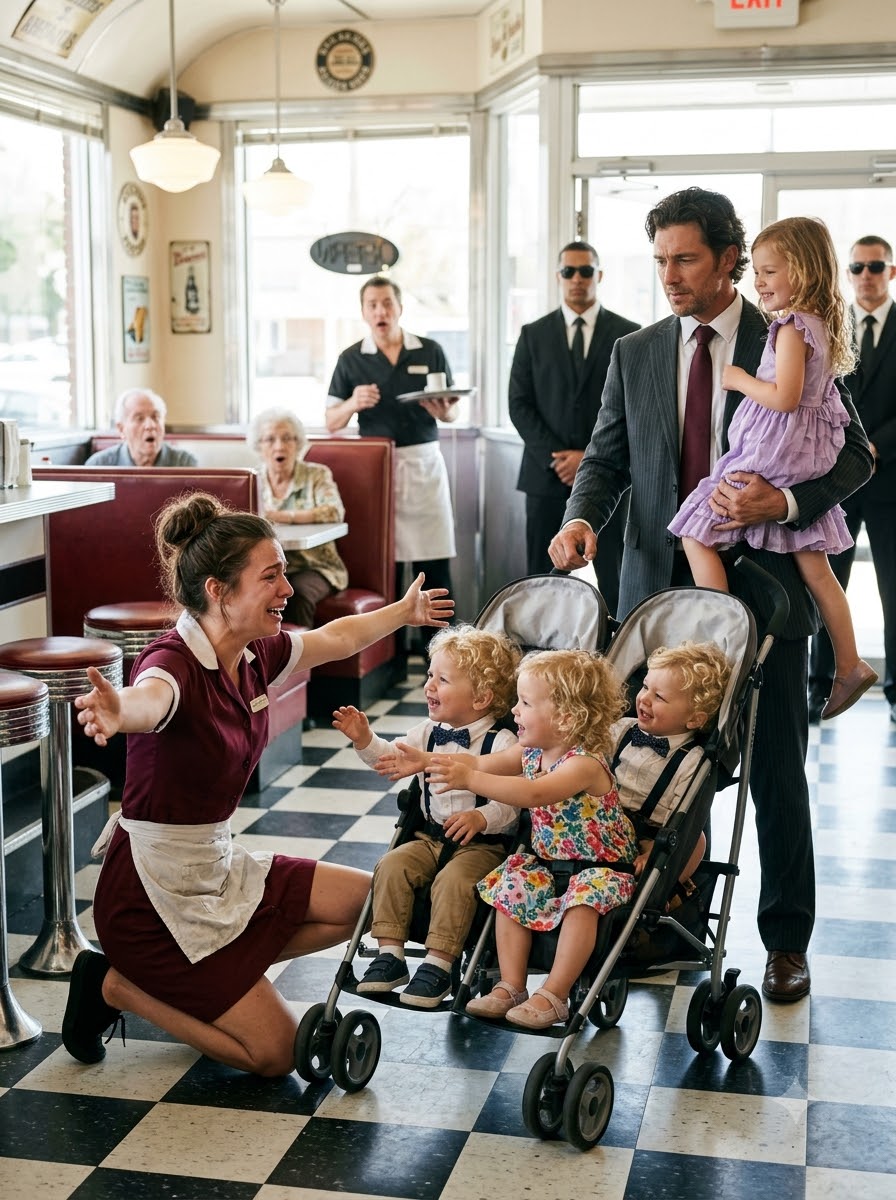
“Because the nurse gave me one more thing.”
Silas slid a photocopied page across the table: a hospital intake form with my name, address, and, circled in pen, my employer.
“She said the mother had survived. She said the mother had never stopped working. I thought I would just look, and then decide how to tell you.”
He met my eyes.
“I didn’t expect them to know you.”
I put my hand over my mouth.
Dante crossed the room and, to my surprise, knelt in front of my chair.
The man whose name made grown men go quiet took my trembling hands in both of his.
“They took fourteen months from you,” he said. “I can’t give those back. I can give you the truth, and I can see that the people who did it answer for it.”
“With a gun?” I asked.
A faint, sad smile crossed his face. “With a courtroom. Bridget insists.”
Bridget cleared her throat. “I do insist. Ms. Calloway, the Cook County State’s Attorney’s office has already been briefed. The nurse has agreed to testify in exchange for leniency, and she brought documents with her. We have the original delivery logs, a second set of records Dr. Sterling kept off the books, and a ledger of the broker’s buyers. Sterling’s hospital board meets at ten tomorrow morning. There will be federal agents in the room.”
“And I’ll be there,” I said.
Nobody argued.
PART 3
At ten the next morning, the boardroom on the sixth floor of St. Jude Memorial held thirty people at a long mahogany table.
Doctors, trustees, lawyers.
At the head sat Dr. Victor Sterling, silver-haired and polished, presenting a plan to expand the maternity wing.
I walked in wearing a navy dress Bridget had bought me and the only pair of shoes I owned.
Dante did not come in with me.
He waited in the lobby, as agreed, because Bridget did not want anyone saying the mob had stormed a hospital.
Instead, behind me came two FBI agents, an assistant state’s attorney, and a woman in a gray cardigan named Joanne Pike.
Dr. Sterling’s smile didn’t falter until he saw her.
“Dr. Sterling,” I said, “my name is Marnie Calloway. Fourteen months ago, you told me my triplets died in this building.”
The room went still.
“Ms. Calloway,” he said smoothly, “I’m very sorry for your loss, but this is a private meeting…”
“Your nurse says otherwise.”
Joanne Pike stepped forward.
Her hands were shaking, but her voice was steady. “I signed the certificates, Dr. Sterling. You told me to. I’ve kept the originals.”
Sterling rose. “This is slander. Security…”
“Security has been asked to stand down,” said the lead agent, producing a badge. “Dr. Victor Sterling, you are under arrest for kidnapping, conspiracy to commit child trafficking, falsification of medical records, and wire fraud.”
The sound that went through that boardroom was something between a gasp and a groan.
Two trustees stood up so fast their chairs fell.
One of them, a heavyset man named Gordon Bell, tried to leave through a side door and found an agent already there.
The broker’s ledger had named three trustees as clients, and one of those clients had been sitting at that table with a coffee in his hand.
Dr. Sterling did not struggle.
He just looked at me, and what I saw in his face was not guilt.
It was irritation, as though I were a billing error.
“You were never supposed to find out,” he said.
“I know,” I said. “That was the whole plan.”
They led him out in handcuffs through the same corridors where I had once been wheeled, numb, past a row of nurses who stared and said nothing.
I stood in the empty boardroom afterward and realized my hands had stopped shaking.
Wendell, the diner manager, was not part of any conspiracy.
I want to be clear about that.
He was only a small, cruel man who had mocked a grieving woman because he thought it would please a powerful one.
When the story broke on the evening news, with Dr. Sterling’s face on every screen, Rosalie, the diner’s elderly owner, came back from Florida and fired him in front of the whole staff.
She personally called to apologize to me.
I told her I’d think about it.
I did, for about an hour, and then I said yes, and asked for the keys.
The trial took nine months.
The broker was convicted first, and he talked.
The ledger led to fourteen buyers across four states, and eleven other children, some of them now toddlers, some nearly school age, were located and returned to birth parents or placed in safe homes.
Dr. Sterling was sentenced to thirty-eight years.
Nurse Pike, who had done a terrible thing and then done the hardest right one, served eighteen months and wrote me a letter every year afterward.
I answered the first.
I’m still deciding about the rest.
Dante came to the sentencing, in the back row, in a plain gray suit.
We spoke only once afterward, in the courthouse hallway, with the babies asleep in their stroller between us.
“I won’t pretend I’m a good man,” he said. “But I’d like to be a decent neighbor, if you’ll allow it. The children shouldn’t lose the people who found them.”
“What does that mean?”
“Whatever you want it to. Birthday parties. Emergency babysitters. A man with a lot of unfortunate acquaintances who will never come within five miles of you.” He hesitated. “A friend.”
I looked at him for a long moment.
His reputation was true.
I wasn’t naive about that.
But I had also seen him kneel on a marble floor at two in the morning, and I had seen the three small faces that had stopped crying in his arms before I ever walked into that diner, because they had been safe with him.
“Friends call before they show up,” I said.
For the first time, he laughed, an actual laugh.
“I can do that.”
We never became more than that, not in the way people at the diner liked to speculate about.
He stayed in their lives the way an odd, loyal uncle might, sending a ridiculous number of presents, attending every birthday in a suit that made the other parents nervous, and never once crossing a line I hadn’t drawn.
When the triplets turned five, he showed up with three tiny bicycles and a helmet for each, and Wendell’s replacement, a cheerful young cook, asked whether he was somebody’s grandfather.
Dante said he was “something like it” and never explained.
I kept the diner.
Rosalie sold it to me for one dollar and a promise to keep her pie recipe.
I hired people who needed second chances, and I fired nobody for being sad.
The triplets are named Theo, Gus, and Poppy.
Theo is serious, Gus is a menace, and Poppy has the loudest laugh in the state of Illinois.
They have my eyes, hazel, wide and a little too watchful, and sometimes I catch them looking at the world the same way I once did, as though waiting for someone to prove it was safe.
On the anniversary of the day they came back, I take them to the alley behind the diner.
It’s just an alley, with a dumpster, a rusted fire escape, and a crooked door.
But I stand there with a child on each hand and one on my hip, and I tell them the story the way I tell it every year, in the version fit for small ears.
“Once upon a time, someone said you were gone. And your mama didn’t believe it, even when everyone said she should.”
“Why not?” Poppy asks, every year.
I smooth her curls.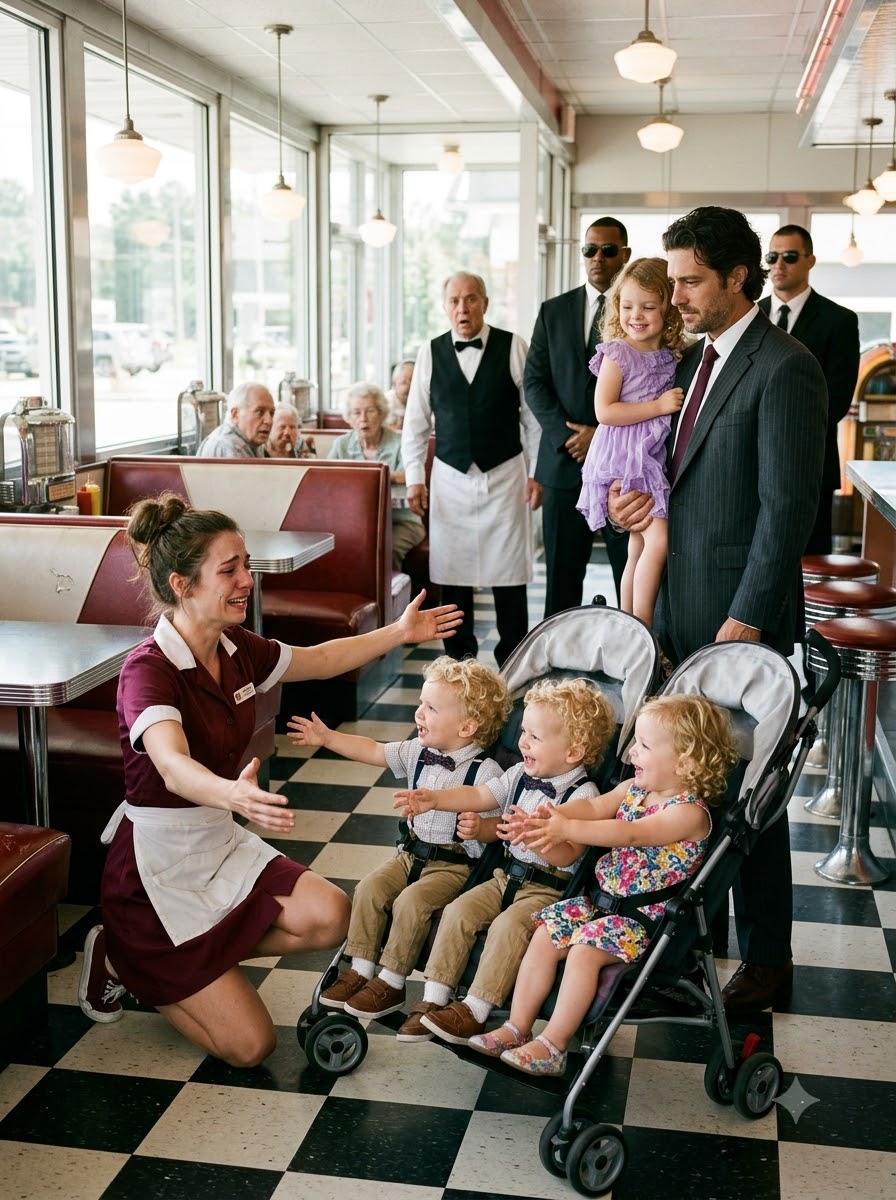
“Because mamas know,” I say. “And because you knew me, too.”
And Gus, who is five now and misses nothing, always says the same thing, slipping his small hand into mine.
“Mama.”
The same word, in the same alley, in the same rain-colored light.
It still undoes me.
I hope it always will.
