


Part One: The Weight of Everything Money Could Buy
The villa contained fourteen rooms, a number Daniel Avery had never personally counted but knew from the architectural plans his assistant had tucked away somewhere in the tidy sprawl of his office. He occupied maybe four of them on any regular basis — the bedroom, the study, the kitchen in the mornings, the terrace in the evenings, when the city below settled into something that, from far enough away, resembled order. The other rooms existed in the way costly things exist when they’re owned instead of lived in: flawlessly kept, beautifully furnished, and waiting.
He was thirty-two, and he possessed more than most people would gather across several lifetimes. On the Tuesday morning that would later become the pivot point for everything that followed, he lay in bed with the silk sheets bunched around him, feeling the peculiar, unanchored heaviness of a man who has achieved every goal he set and is only now grasping that the striving itself had been the point.
The company — Avery Capital, a private investment firm he’d built out of a modest inheritance and an outsized appetite for work — occupied the thirty-first floor of a downtown glass tower, employed sixty-three people, and managed assets that showed up in the financial press as figures with so many zeros they lost any real meaning. He’d built it in eight years through sheer intelligence and will, and through his particular willingness to outwork the competition — which had been, at the outset, his only true edge over them. By the time his other advantages piled up — reputation, connections, the compounding returns of early wins — the work habit was so deeply woven into him that he couldn’t have said where it stopped and he began.
He hadn’t taken a vacation in three years. He hadn’t read a novel in two. He hadn’t, as far as he could recall, spent an afternoon free of an agenda — no call to return, no pending decision, no problem waiting for his particular brand of focus.
He had a fiancée, Sofia Marchetti, beautiful in a way that photographed well, who moved through the social world his success had opened up to him with the ease of someone born into it — which she had been. He’d met her at a charity dinner two years into the company’s rise, back when he was newly important enough to be invited to such events and still new enough to find them worthwhile. She’d laughed at something he said, and the laugh had seemed real, and she was very beautiful, and he’d thought: yes — this is what the life is meant to include.
Three years on, he was less sure of what was real and less sure of what the life was meant to include, and that uncertainty carried the particular weight of something that had been lingering at the edge of his mind for a long while and was now demanding to be faced head-on.
He looked at the ceiling. It was very high and very white and gave nothing back.
The bedroom door opened.
Part Two: Sofia
She wore the red suit — the one reserved for meetings she considered important, which were the ones centered on other people’s judgment of her, which was most of them. She wore it as she wore most things: as a deliberate statement, nothing left to chance, every piece coordinated with every other piece. Her perfume arrived in the room a beat before she did — heavy, expensive, the kind of scent built to announce an entrance.
“Don’t forget,” she said. “Wedding planner. Today.”
No good morning. No question about how he’d slept, which had been badly, though she had no way of knowing that from the sheets. He watched her cross to the mirror and study her reflection with the same rigor she brought to everything — her face just another surface requiring correct management, any flaw to be fixed before she left the house.
He’d tried to push back the wedding planner meeting. The business deal he was in the middle of — a complicated acquisition demanding his daily attention, with a closing deadline that would not move — had turned the last three weeks into a constant juggling of urgent things, and the wedding preparations, which Sofia regarded as the most urgent thing of all, couldn’t wait, not from where she stood. The venue needed confirming. The caterer needed deciding. The flowers — apparently a specific bloom, sourced from a specific place, available only in certain seasons and requiring an early booking — needed ordering.
He’d offered to let his assistant handle it. Sofia had turned to him with the look she reserved for things he said that struck her as genuinely baffling.
“It’s our wedding, Daniel.”
“I know what it is.”
“Then act like it.”
He’d agreed to go to the meeting. He was going to go to the meeting. He was still in bed on the morning of the meeting, turning all of this over, when the knock came.
Part Three: Emma
She’d worked for him for five years — longer than anyone else on his household staff. He hadn’t specifically hired her; she’d come with the villa when he moved in, passed along from the previous owner’s household the way certain fixtures are, and she’d simply stayed, through several rounds of staff turnover, because she was good at her job in the way people are good at things that matter to them rather than merely employ them.
Her name was Emma Reyes. She was twenty-nine — a fact he knew from her employment file, not from anything she’d told him, since in five years they hadn’t had many conversations that went beyond the running of the household. She had dark hair pulled back, a face that was composed without being shut off, and a way of moving that was so efficient it was almost invisible — present when something was needed, gone when it wasn’t, the gold standard of household service, which he’d always valued without ever examining why.
She came in carrying his breakfast, made exactly the way he liked it, meaning she’d been in the kitchen sometime before seven-thirty preparing it, which wasn’t part of her official morning duties. He noticed and filed it away the way he filed small things he meant to think about more, later.
Sofia’s reaction to Emma’s entrance was the particular performance of someone who considers certain people beneath acknowledgment: a slight tightening of the expression, a small turn of the body away, the treatment of a person as furniture that isn’t quite positioned right. Without looking at Emma, she said: “While you’re here, change the sheets right away.”
The tone was that of someone who has decided, permanently and without room for appeal, that a whole category of person doesn’t warrant courtesy. Not cruel, exactly — cruelty at least implies engagement. Just absent. The absence of the register one human uses to address another.
Daniel watched Emma take this in. Her hands, steady until then as she set down the tray, shifted almost imperceptibly — the small motion of someone absorbing a blow and choosing not to let it show. She said of course, and moved toward the linens.
“Sofia,” he said.
She looked at him.
“Please speak to her respectfully.”
Sofia glanced at Emma, then back at him, wearing the expression of someone asked to do something so pointless it barely merits a reply. She rolled her eyes. She went back to her phone.
It was such a small moment. Four seconds, maybe. He’d stepped in before, mildly, during similar moments — had made some comment about tone, smoothed things over, told himself it was a matter of social style rather than character. But watching Emma cross the room with that small catch in her hands, watching Sofia return to her phone with total indifference, as though the interaction had already been processed and dismissed as irrelevant, he felt something shift in how he understood things.
Not a decision. Not yet. A recognition.
He lay there after they’d both gone and held the recognition up to the light.
In three years, I have never seen her genuinely care for anyone except herself.
The thought had the quality of something he’d known for a long time in a peripheral way — the way you know things before you’re ready to face them directly. He looked at it now. He turned it over. It held from every angle.
And beneath it, the question he’d been avoiding: Do you love me? Or do you love what I am?
He wasn’t sure. And he understood, lying there in the silk sheets with the morning light pouring through the huge windows, that talking it out wouldn’t make him sure, because Sofia was good at conversations, and what he needed wasn’t her words but her actions when the words weren’t performing.
He needed to change the conditions. He needed to take away the thing she valued and see what was left.
He reached for his phone and called his oldest friend.

Part Four: The Plan and Its First Night
Mark Chen had been Daniel’s friend since university, where they’d been assigned adjacent rooms freshman year and discovered, through shared walls and a mutual bout of insomnia, that they thought about things in compatible ways. Mark had gone into medicine — cardiology, then a private practice serving a mostly wealthy clientele, which suited him, since his manner was precise and slightly reserved, and the wealthy tended to prefer precision over warmth from their doctors. He was the one person in Daniel’s life with whom Daniel was completely honest, which is the definition of a best friend even if neither of them would put it that way.
Mark heard out the plan. He went quiet for a moment when Daniel finished laying it out.
“You want to fake a spinal injury,” he said.
“A serious one. Wheelchair. Indefinite prognosis.”
“And you want me to be the doctor who delivers the news.”
“You’re the only person whose medical judgment Sofia wouldn’t question.”
Another pause. “This is either the clearest thinking you’ve done about this relationship, or the least clear.”
“Probably both.”
“What are you expecting to find?”
Daniel considered it. “I expect to find out that she leaves,” he said. “I just need to see how fast, and what she says on the way out.”
“And if she stays?”
He hadn’t fully worked that part out. “Then I’m wrong about her,” he said. “And I’ll have to figure out what that means.”
Mark agreed, with the reluctance of a man who has examined a bad idea from every angle and hasn’t found a better one on offer, and added one condition: Daniel would go to actual therapy afterward, regardless of the outcome. Daniel agreed.
The story moved through their social circle at the speed alarming news always travels — faster than good news, more thoroughly, embellished by people passing along something that feels significant. By evening, the accepted version was that Daniel Avery had been hurt during a training session, that the spinal damage was serious, and that the prognosis was guarded, the wheelchair permanent for the foreseeable future.
Sofia arrived at the private clinic in a car she’d apparently driven herself instead of calling a driver, which Daniel noted and filed away. She wore black — a different black from the red suit, dressed for the occasion the way she dressed for every occasion. She was already crying when she entered his room, whether from genuine feeling or rehearsal he couldn’t tell from the inside of it.
She held him. She said the right things. She said his name the way she said it when she wanted something from him, and he had always read that as tenderness and now found himself listening for the difference. She held his hand and studied his face with the expression of someone either feeling what they’re performing or performing what they’re feeling — in Sofia’s case, not always distinguishable.
For two hours, he nearly believed her.
Then Mark arrived with the full prognosis — delivered in the careful, measured language of medicine, weighted with its particular sense of permanence — and something changed in Sofia’s face. Not dramatically. Not a theatrical crumbling of composure. Something subtler: a recalculation, an internal shift, the look of someone who has taken in new information and started working out what it means for her.
She left within the hour.
Back at the house, surrounded by the fourteen rooms and the quiet, she announced — with the specific practicality of someone who has already moved past shock into logistics — that the nurses would come the next day, that the meetings and agreements would need addressing, that the wedding plans required serious revision. She said she needed time to think. She said she’d be back. She kissed his forehead the way you kiss something you’re no longer sure belongs to you.
Then the door closed, and the house went very quiet.
Part Five: The Corridor
He heard her before he saw her — soft movement in the corridor, the near-silence of someone who has learned to move through a house without disturbing it.
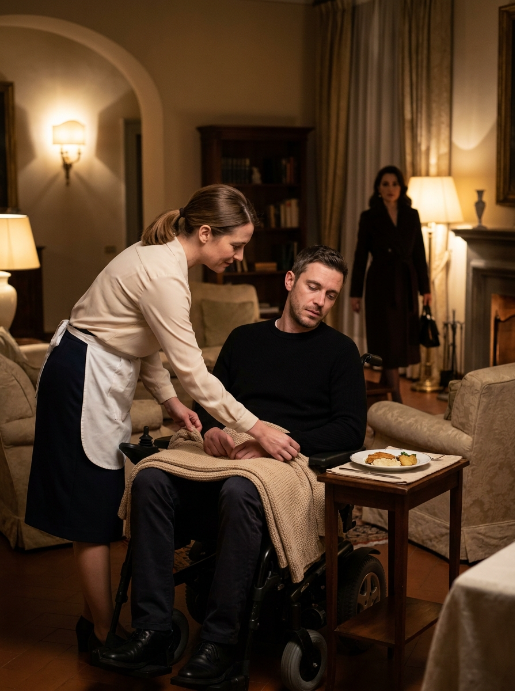
Emma appeared in the doorway of the sitting room, where Daniel had positioned himself in the wheelchair with the particular discomfort of a man pretending to need something he doesn’t, discovering that the pretense carries its own weight. She looked at him with her usual calm, level regard — not the slightly averted look some staff gave, the careful management of eye contact that signals someone performing a role. Just looked at him.
“If you allow me,” she said, “I can stay and help you tonight.”
He started to say the things people say when they want to decline an offer without giving offense — that she didn’t need to, that it wasn’t necessary, that arrangements were already in place. He said: “You don’t have to do that, Emma. It’s not—”
“I know,” she said. “It’s not required.” She held his gaze. “I would like to, if you’ll allow it.”
There was something in the offer that went beyond the ordinary carrying out of household duties — something in it that was, he recognized, a choice. She was choosing, and the choosing was visible in her face, and he didn’t know what to do with that visibility.
“All right,” he said. “Thank you.”
She’d arranged things he hadn’t asked for and wouldn’t have thought to ask for — the room set up to make getting around easier, a meal that was neither elaborate nor careless, the blanket over his knees set at just the right warmth, placed without comment. She worked without seeking acknowledgment, giving her full attention to the task rather than to the impression she was making.
At some point in the evening, he said something he hadn’t planned to say and that surprised him even as he said it: “Do you ever find this work… limiting?”
She looked up from what she was doing. A pause — brief, considered. “I find it exactly what it is,” she said. “Most of the time that’s enough.”
“Most of the time?”
Something small crossed her face. “There are days when it’s harder to remember why things matter,” she said. “But I think everyone has those days.”
He wanted to keep talking and didn’t know how to do it without crossing the line that five years of employer and employee had drawn, a line he still wasn’t sure should be crossed. So instead he said: “Thank you. For tonight.”
She nodded, and the moment folded back into the ordinary texture of the evening.
Part Six: The Phone Call
He woke sometime in the dead middle of the night — two, maybe three, the hour when the city below had finally dropped its act of activity and simply was itself, quiet and indifferent. For a moment he was disoriented, the unfamiliarity of the sitting room asserting itself before the reason he was there caught up with him — and then he heard the voice.
Emma’s voice. From the corridor — not the one right outside, but farther off, near the kitchen, the part of the house that was hers in the small, limited way domestic workers have private corners. She was on the phone, speaking quietly, the way people speak when they’re trying not to be overheard and haven’t thought much about acoustics.
He stayed very still.
“I won’t be able to come home for a few days, Mama.” Her voice carried a different quality than the one she used inside the house — softer, more open, the register of someone not performing composed competence but simply talking. “Something difficult has happened to Mr. Avery. Yes.” A pause — she was listening. “I know it’s not technically my job. But I can’t leave. Not right now, when he’s alone.”
He heard her breathe. Heard her listen.
“Mama, it doesn’t matter what I feel,” she said. The gentleness in her voice was the gentleness of someone repeating something they’ve said many times, a fact made peace with even if the peace isn’t complete. “I’ve always known it can’t go anywhere. I just — someone should be there. Until the nurses come. Until he has people around him.” A pause. “He doesn’t know. He won’t know. That’s fine.”
She said goodnight to her mother. The soft click of the phone being set down. Then silence, then the quiet movement of someone making her way back through the house, navigating the dark with the ease of someone who has lived there long enough to know it blind.
He lay still for a long time.
Part Seven: What the Darkness Showed
He’d expected the plan to reveal one thing. It had revealed several.
What it revealed about Sofia wasn’t, in the end, a surprise — it confirmed what he’d started to fear, and confirmation, even of something bad, is cleaner than uncertainty. She’d arrived in black and cried at all the right moments and left once the demands of the situation outweighed the benefits of staying. He didn’t think she was a villain. He thought she’d understood, from the start and better than he had, that what she had with him was a mutually beneficial arrangement, and that once the terms shifted enough, the benefit no longer justified the investment. That was honest, in its own way — the honesty of someone who has never lied to herself about what she wants, which was more than he could say for himself.
What it revealed about himself was harder to sit with.
He’d been running all of his relationships — not just this one — through the same framework he applied to business: weighing usefulness, managing results, optimizing for a return. He’d treated the people in his life as variables in equations he was solving, and he’d been skilled enough at it that no one had noticed, or maybe everyone had noticed and decided the output was worth the participation. He’d mistaken this for intimacy.
He hadn’t noticed Emma. He’d employed her, found her work satisfactory, occasionally registered that she was excellent at her job. He hadn’t noticed her the way you notice a person — hadn’t wondered what she wanted, what her days looked like outside the villa’s fourteen rooms, what she went home to on the days she went home. He hadn’t asked, in five years, whether she was happy.
He hadn’t asked because he hadn’t needed to. The equation didn’t call for it.
Now he lay in the dark, replaying her voice, telling her mother that she’d always known it couldn’t go anywhere, that her feelings didn’t matter, that she just wanted to be there for him. The complete absence of calculation in it. No strategy anywhere.
He thought about Sofia, who had calculated everything and still left.
He thought about Emma, who had calculated nothing and had stayed.
Part Eight: The Morning
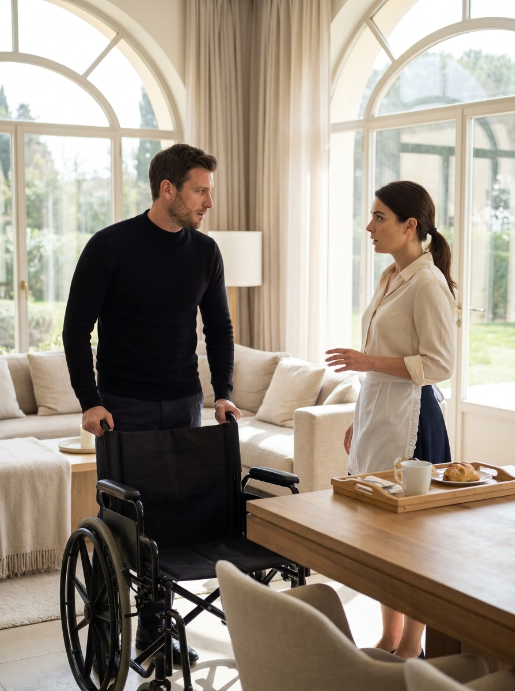
He was at the window when she appeared in the doorway at seven-thirty — the same time as always, the same careful knock, the same composed expression. She carried the breakfast tray with the same steadiness as ever.
He looked at her in a way he hadn’t before — not as a piece of the household machinery, not as a presence that came and went depending on what he needed, but as the specific person she was. She wasn’t remarkable in the ways the world usually noticed — not Sofia’s manufactured shine, not the surface brilliance his world had trained him to read as significance. She was something quieter and more solid. She was the one who had stayed.
“Emma,” he said, before she could start setting up breakfast.
She looked at him. Something in his voice must have been different, because her expression shifted slightly — a small alertness, a question forming behind her composure.
“Last night,” he said. He stopped. He started again. “I wasn’t asleep. When you were on the phone.”
A long pause. He watched her face work through it — the realization moving in stages: first grasping what he was saying, then what he’d heard, then the specific weight of someone caught in a private moment they hadn’t meant to share, assessing the damage.
“Ah,” she said. Her voice was very even.
“I want to tell you something,” he said. “And I want to ask you something. Can I do both?”
She looked at him for a moment. Then: “Of course.”
He told her, first, that he wasn’t injured — that the wheelchair had been a test, that Mark had set it up, that what he’d been testing was something he was no longer sure deserved testing. He told her plainly, without the softening that would have made it easier to say and harder to hear. He watched her face move through something complicated — partly surprise, partly not, the look of someone who has sensed things she hadn’t been told and is now getting them confirmed.
“I’m sorry,” he said. “For the deception. I don’t think it was — I thought it was necessary, and I’m no longer sure it was, or that it was the right kind of necessary.”
She was quiet. She set the tray down on the side table — carefully, deliberately — and looked at her hands a moment. Then she looked at him.
“Why are you telling me this?” she asked.
“Because you deserve to know the truth,” he said. “And because —” He stopped again. He found, to his own surprise, that the directness that carried him through every business conversation was harder to find in this one. “Because I heard what you said to your mother. And I want you to know that I heard it. Not as an employer taking in useful information. As—” he looked at her, “someone who’s been seen very clearly by another person, probably for longer than he deserved.”
Emma looked at him with the specific expression of someone working out whether what she’s hearing is what it sounds like, or whether there’s another reading she should be steering toward.
“I’ve worked here for five years,” she said, slowly.
“I know.”
“And in five years you never—” She stopped. Reconsidered. “What are you saying, Mr. Avery?”
“I’m saying I’ve spent a considerable amount of time and energy looking in the wrong direction,” he said. “And that I’d like, if you’re willing, to start looking in the right one.” He paused. “And I think you might stop calling me Mr. Avery.”
Another long pause. Emma glanced at the window, then at the tray, then at him.
“This is—” she started.
“Extremely unusual,” he said. “Yes. I know.”
“I was going to say unexpected.”
“Is there a difference?”
Something moved across her face — not quite a smile, but the moment before one, the shift in muscle that comes right before a smile is decided on. “I think there might be,” she said.
Part Nine: What Comes After Clarity
He ended things with Sofia that day. The call was short — Sofia took the news with the same practical efficiency she brought to most things, asked two specific questions about the property, said she hoped he was well in the tone of someone closing an account rather than a relationship, and said goodbye. Afterward he felt not grief but a clean, faintly disorienting sense of closure — the way a complicated negotiation feels when it finally resolves.
He called Mark next and told him the plan had worked, which Mark took in with the dry response of someone who hasn’t quite been proven wrong but also hasn’t quite been proven right.
“What did you learn?” Mark asked.
“Several things I should have learned earlier,” Daniel said. “And one thing I didn’t expect to learn.”
“The maid.”
A pause. “Her name is Emma.”
A longer pause on Mark’s end. “Daniel.”
“I know.”
“This is—”
“Extremely unusual,” he said, for the second time that day. “I know.”
“She works for you.”
“She worked for me. I’ve offered her a position that doesn’t involve household service and she’s said she needs to think about it, which is the most Emma thing she could have said.”
“You’ve already offered her a job.”
“I offered her a role in the company. She has a degree in business administration that I somehow never knew about in five years, which is—”
“Part of a larger problem.”
“Yes.”
Mark went quiet for a moment. “Are you happy?” he asked, a question he didn’t typically ask, which told Daniel how seriously he was taking it.
Daniel looked out at the city below, going about its business in that indifferent, enormous way it always did. He gave the question the care it deserved. “I think I’m starting to understand what happy means,” he said. “Which is different from what I thought it meant. And probably closer to what it actually is.”
Part Ten: What Is Real
Emma didn’t say yes right away. This turned out to be one of the things about her that clarified the most — that she didn’t treat his interest as a circumstance to be steered toward a particular outcome, didn’t run the angles and accept on the basis of the calculation. She needed time to believe what was happening was what it seemed to be, and she took that time without apologizing for it, which was the right call.
She took three weeks.
In those three weeks, he learned things he hadn’t known in five years, because for the first time, he started asking. She’d grown up in a family of modest means — her mother worked at a school, her father had been ill for several years, and the illness had shaped the family’s finances the way prolonged illness does. She’d studied business administration with a specific goal of building a career in management, had taken the household position as a temporary measure during a hard year, and had stayed because the stability mattered and because — she said this with the matter-of-fact honesty that was characteristic of her — she’d been comfortable there, in the qualified way people are comfortable in situations that aren’t quite right but are manageable.
Her feelings for him had grown gradually, over years, the way feelings grow between people in proximity who pay attention to each other, and she’d managed them with the practical clarity of someone who understands the boundaries of a situation and has decided not to make those boundaries someone else’s problem. She’d told her mother about them because she told her mother most things. She’d told no one else.
She said yes on a Sunday, her day off, in the kitchen of her small apartment — not his kitchen, hers, which she’d brought him to see specifically so they’d meet on equal footing rather than in the house that was his, and that had for five years been the place marking the distance between them most clearly. The kitchen was small and warm, herbs on the windowsill, photographs on the refrigerator, the whole character of a space that belonged to someone who lived in it rather than merely occupied it.
She said yes, and he said thank you, which wasn’t a romantic thing to say and which she told him later was exactly right.
He didn’t stop being who he was — didn’t stop being the person who worked long hours and moved through the world with the intensity of someone who has built things from nothing and knows the cost of losing focus. But he began to understand that attention wasn’t owed only to the things he was building. It was owed, too, to the people he was building them for and with. That clarity about what mattered wasn’t something achieved once and carried forward, but something practiced daily, in the choices about what you looked at and what you let yourself see.
He thought, sometimes, about the wheelchair — about the specific, slightly uncomfortable irony of a man who’d staged a disability to test the people around him and discovered, in the process, that the disability wasn’t physical. That what had been impaired, for years, was the quality of his attention toward the people who were present and real and not performing anything, except, in the quiet of a corridor at two in the morning, the simple truth of caring about another person with no expectation of return.
He thought about Emma’s voice in the corridor, telling her mother: He doesn’t know. He won’t know. That’s fine.
He thought: I know now.
And the knowing wasn’t a transaction, wasn’t an equation, wasn’t an optimization. It was the thing underneath all of that — the thing that made the rest of it worth doing. The simple, fundamental human act of seeing someone clearly, and letting yourself be seen by them in return.
He’d staged a test to find the truth.
What he found, in the end, was simpler and more complete than any answer a test could have given him.
He’d found out what it looked like when someone stayed.
End
