

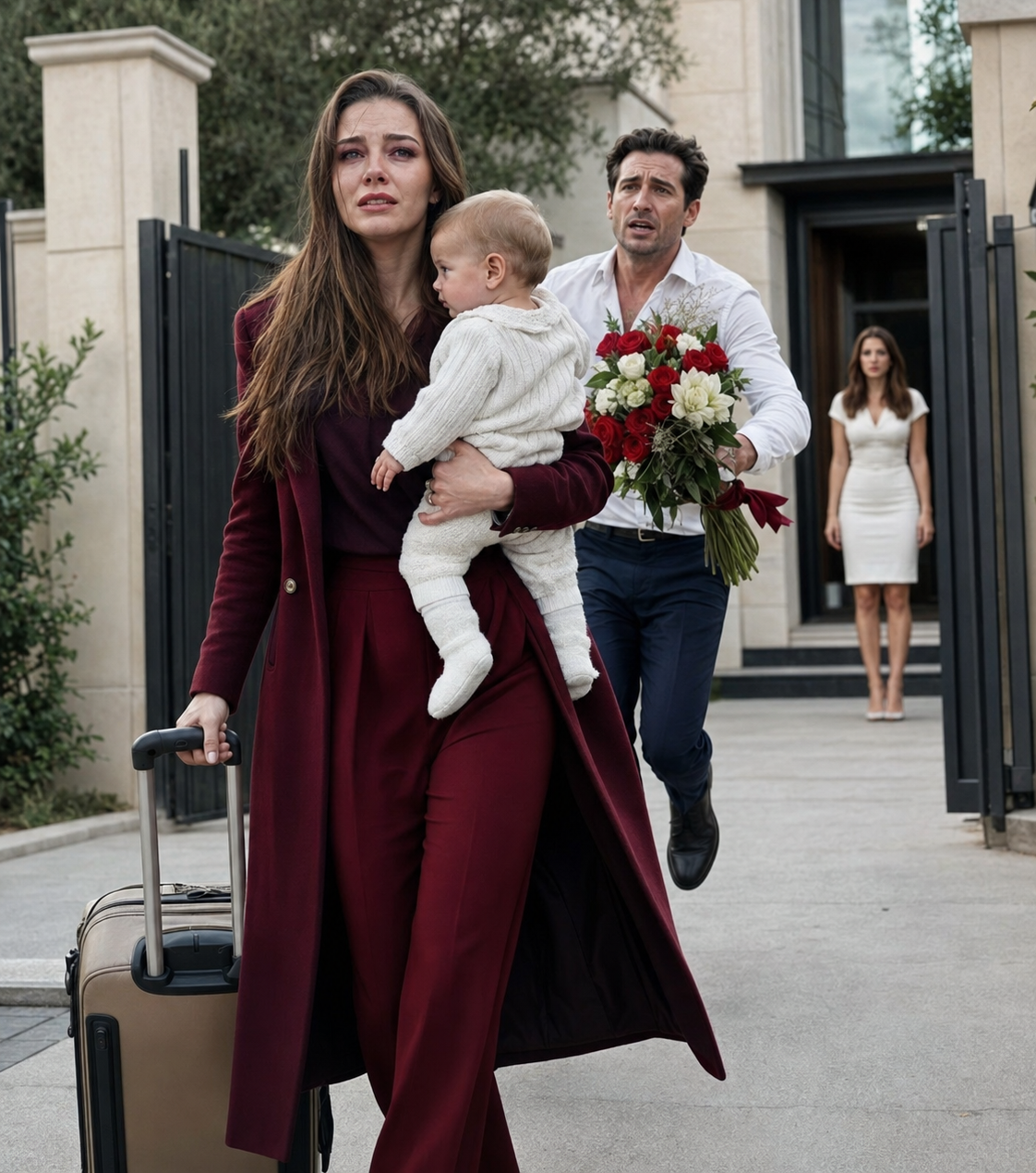
He Returned With Flowers, but His Family Was Gone
Grant Keaton stepped through the front door of his Belle Meade home holding a bouquet of pale ivory roses, wearing the easy smile of a man convinced he had gotten away with another lie.
He had spent nine days at a coastal resort near Charleston with Tessa Vaughn, the woman he had been secretly involved with for nearly a year. He had told his wife, Corinne, that he needed to inspect a luxury development and meet with several investors.
The actual business meetings had taken up less than a single afternoon.
The rest of the trip had been oceanfront dinners, lavish gifts, and promises Grant never meant to honor.
He expected to walk in and find Corinne in the nursery with their newborn son, Owen. He pictured her worn out, subdued, and simply relieved that he was finally back.
Instead, the house was dead silent.
No bottles sat drying by the sink. No folded baby blankets lay across the sofa. The bassinet that used to sit near the living room window was nowhere to be seen.
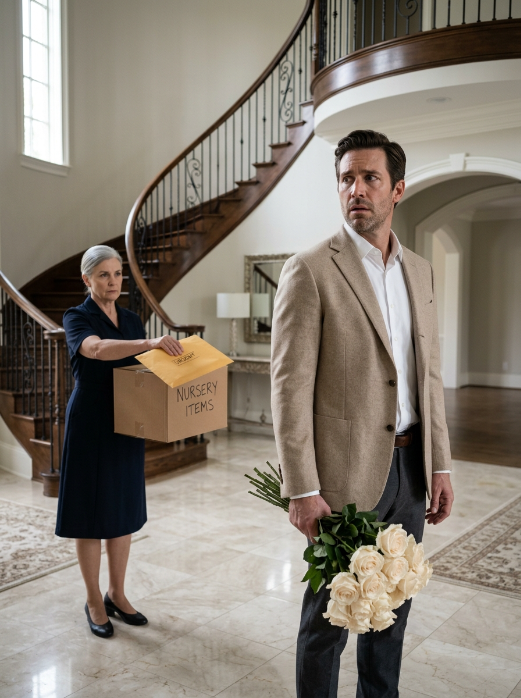
Mrs. Pearl, the housekeeper who had been with the family for six years, stood near the staircase holding a cardboard box.
Grant set the roses on the entry table.
“Where is Corinne?”
Mrs. Pearl looked at him without any warmth.
“She left twelve days ago.”
Grant stared at her.
“Left for where?”
“She didn’t say. She only told me you weren’t to touch anything in your office until you’d read what she left for you.”
The smile fell from Grant’s face.
Mrs. Pearl handed him a thick envelope.
Written on the front, in Corinne’s hand, were four words.
For Grant, when he returns.
The Evidence Inside the Envelope
Grant walked into his office and closed the door.
He braced himself for an emotional letter full of accusations. Corinne had always stayed calm, even when she was disappointed. In the final months of her pregnancy, she had barely argued with him at all. She had simply gone quiet.
Grant had read that silence as weakness.
Inside the envelope were bank statements, hotel receipts, property records, jewelry invoices, and copies of wire transfers.
Every page was arranged in order by date.
There was the suite in Charleston.
There were the dinners by the sea.
There was a diamond bracelet Grant had told Corinne was a retirement gift for a senior employee.
There was also a monthly payment for Tessa’s apartment in downtown Nashville.
Grant flipped through the pages faster.
At the bottom of the last statement, Corinne had written:
While I spent the final weeks of my pregnancy attending appointments alone, you paid for another woman’s apartment. While I stayed awake with our newborn, you booked a private villa. I hope the life you chose was worth the one you abandoned.
Grant’s hands started to shake.

Before their marriage, Corinne Whitaker had worked as a forensic financial analyst. She had walked away from a promising career after Owen was born because Grant kept telling her the family needed her at home.
He used to joke that she had traded spreadsheets for baby blankets.
Now he understood she had never lost her ability to trace money.
Grant opened his laptop and tried to log into the company’s main account.
A red notification flashed across the screen.
Access temporarily restricted pending legal review.
He immediately called his attorney, Wesley Crane.
“Something’s wrong with the accounts.”
Wesley didn’t speak for several seconds.
“Your wife filed for an emergency order to protect shared assets.”
“She can’t do that without my approval.”
“She didn’t need your approval. She needed evidence that family or business funds were being handled improperly.”
Grant sank back into his chair.
“This is a misunderstanding.”
“Then answer one thing honestly. Did you send company money to Tessa Vaughn?”
Grant glanced toward the closed office door.
Three months earlier, he had wired Tessa six hundred thousand dollars, labeling it a consulting advance even though she had never done a day of work for the company.
Before he could respond, his phone buzzed with a message from an unknown number.
It held a photo of baby Owen lying inside a hospital incubator.
A short caption followed.
While you were celebrating by the ocean, your son was receiving urgent care.
Grant’s breath caught in his chest.
The Call He Had Chosen to Ignore
Grant rushed out into the hallway.
“What happened to Owen?”
Mrs. Pearl slowly lowered her box.
“His skin turned unusually yellow the day after you left. Mrs. Keaton called the pediatrician, and they told her to bring him in right away.”
Grant remembered Mrs. Pearl mentioning, during one of their brief calls, that the baby looked yellow.
He had been sitting by the hotel pool at the time.
He’d told her that newborns often looked different in their first few weeks, then asked her not to interrupt him again unless it was truly important.
“Why didn’t anyone tell me he was hospitalized?”
Mrs. Pearl’s expression hardened.
“Your wife called you six times.”
Grant scrolled through his call log.
The calls were all there.
He had let three of them go unanswered. Tessa had silenced the phone during dinner. Later, she had picked up one call and told Corinne that Grant wasn’t available.
Mrs. Pearl reached into a kitchen drawer and pulled out a small flash drive.
“Mrs. Keaton wanted me to give you this once you’d read the documents.”
Grant went back into his office and plugged the drive into his computer.
A recording began to play.
Tessa’s voice filled the room.
“Corinne, you need to accept that Grant is no longer happy with you. He says being at home feels like watching the same gray day over and over.”
Corinne’s voice stayed even.
“Why are you calling me?”
“Because I want you to stop pretending you still have a marriage. He gave me enough money to start my own business, and we’re looking at houses together.”
There was a pause.
Then Corinne asked one last question.
“How much money did he give you?”
Tessa laughed.
“Six hundred thousand. He said it was nothing compared to what he’d spend once he was free.”
Corinne answered quietly.
“Thank you for confirming that.”
The recording stopped.
Grant sat staring at the blank screen.
Corinne hadn’t vanished out of confusion.
She had built her case piece by piece.
The Partner Who Chose the Company
Grant snatched his keys and ran for the garage.
Before he reached the car, Wesley called again.
“Don’t go anywhere until you hear this.”
“My son is in the hospital.”
“And your business partner just submitted an internal report to the board.”
Grant froze.
Everett Shaw had been Grant’s closest friend since college. Together they had built Keaton and Shaw Development from a two-room office into one of Tennessee’s most respected residential firms.
“Everett would never turn on me.”
“He didn’t turn on you. He chose not to lose the company, his reputation, and sixty-three employees over your decisions.”
According to Wesley, Corinne had noticed unusual payments while going through household tax records. She had brought the pattern to Everett.
Everett had ordered an independent review.
The early findings showed Grant had signed off on inflated invoices, hired vendors that existed only on paper, and funneled project funds into personal accounts.
The money sent to Tessa hadn’t come from Grant’s private savings.
It had come from a community housing project.
The room seemed to tilt around Grant.
“How much did they find?”
“Nearly one and a half million dollars over two years.”
Grant shut his eyes.
At first he had skimmed small amounts, telling himself he’d pay it back after the next profitable deal. Then the amounts grew.
A car. An apartment. Vacations. Gifts.
None of it had been necessary. He had only wanted to feel admired.
“Corinne forced Everett to choose,” Wesley went on. “Either he reported what he’d found, or he risked losing everything alongside you.”
Grant got in his car and drove toward the children’s medical center.
The Woman Behind the Glass
The neonatal floor was bright, quiet, and tightly controlled.
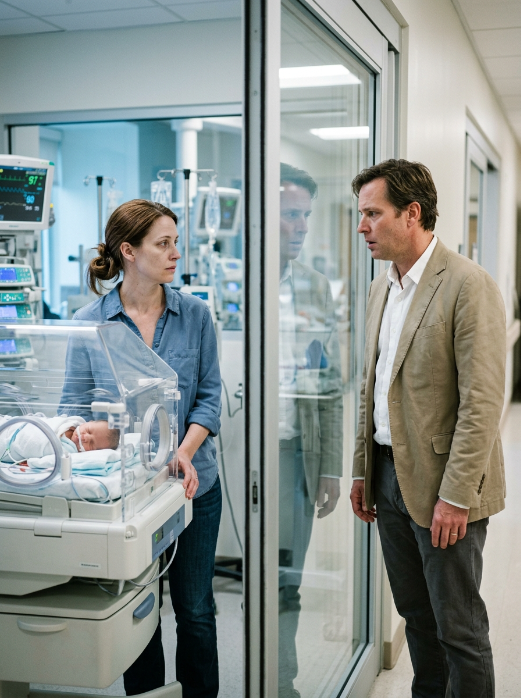
Grant found Corinne standing behind a glass partition beside a doctor. She wore jeans, a soft blue blouse, and her hair pulled back in a simple knot.
She looked worn out.
But something about the way she carried herself had changed. She no longer looked like a woman waiting for someone else to decide what happened next.
She held a notebook, listening closely as the doctor explained Owen’s progress.
Grant tapped lightly on the glass.
“Corinne.”
She turned.
For two seconds, their eyes met.
Grant expected anger. He might have even preferred it.
Instead, he saw distance.
Corinne turned back to the doctor.
Grant’s phone rang.
It was Tessa.
“My card got declined in front of everyone.”
Grant stepped away from the glass.
“Owen is in intensive care.”
“I’m sorry, but what does that have to do with the apartment payment?”
Grant said nothing.
“Grant, are you listening? The landlord expects the money tomorrow.”
He hung up.
Tessa hadn’t asked whether Owen was recovering.
She hadn’t asked how Corinne was holding up.
In that moment, Grant finally faced a truth he’d been avoiding for months. Tessa had never loved him. She had loved who his money let her become.
The Agreement
An email arrived from Corinne’s attorney.
The proposed settlement was straightforward.
Grant would return all recoverable business funds.
He would give up his ownership stake in the development firm.
The family home would go into a protected trust for Owen.
He would provide ongoing financial support and would not approach Corinne or the baby without permission.
In return, Corinne would not pursue further personal claims beyond what was needed to protect herself and their child. The company review, however, would proceed regardless.
Grant had twenty-four hours to respond.
The neonatal doors opened, and Corinne stepped into the hallway.
Grant approached carefully.
“Please give me five minutes.”
“You already had nine days.”
“I didn’t know Owen was this sick.”
Corinne’s face didn’t move.
“You chose not to know.”
“I made a terrible mistake.”
“A mistake is missing an appointment or forgetting an important date. You invented cover stories, moved money, ignored my calls, and left when your son was only three weeks old.”
Grant lowered his voice.
“We can still fix our family.”
Corinne looked toward the room where Owen was resting.
“While I was signing medical forms by myself, you were drinking champagne with someone who picked up my calls and told me not to bother you.”
Grant’s eyes widened.
“Tessa answered?”
“She told me you needed peace and that I was ruining your trip.”
Corinne drew a slow breath.
“I’m not doing this out of revenge. I’m doing it because Owen deserves security, and the people at your company deserve to keep their jobs.”
A tall doctor approached them. His badge read Dr. Reid Calloway.
He had known Corinne since college and had walked her through Owen’s treatment from the first night.
“His numbers are improving,” Reid said. “Tonight still matters, but he’s responding well.”
Corinne closed her eyes in relief.
Grant watched Reid rest a respectful hand near her shoulder, without actually touching her.
There was no hidden romance between them.
Reid was simply present.
That was more than Grant had managed to be.
What Tessa Truly Wanted
That evening, Grant drove to Tessa’s apartment.
He found her packing clothes, handbags, and unopened gifts into three large suitcases.
“You’re leaving?”
Tessa didn’t look up.
“Your accounts are frozen, your company is investigating you, and reporters might start asking questions. Of course I’m leaving.”
“You told me you loved me.”
She finally turned to face him.
“I loved the life we had. Don’t confuse comfort with commitment.”
Grant explained that the transfer she’d accepted was tied to company funds and that she might be questioned about it.
Tessa set the apartment key and the extra credit card on the table.
“Then tell them I didn’t know where the money came from.”
She wheeled her suitcase toward the door.
“What about everything we planned?”
Tessa gave him a tired smile.
“You planned it. I enjoyed it.”
Then she was gone.
Grant stood alone in the expensive apartment he had paid for while Corinne sat beside their hospitalized child.
For the first time, he understood how empty his fantasy had really been.
The Price of His Choices
The next morning, Grant accepted Corinne’s terms.
He gave up his share of Keaton and Shaw Development. Everett used its value to restore project accounts and protect the company’s employees.
Grant sold his luxury car and several personal investments. The house was placed in a trust for Corinne and Owen.
His professional licenses came under review, and he was permanently barred from any financial leadership role at the company.
Before leaving the attorney’s office, Grant made one last visit to the hospital.
With Corinne’s permission, he read through Owen’s medical records.
Every page carried Corinne’s signature.
She had attended every consultation, approved every test, and stayed through every hard night.
The line reserved for the second parent was almost entirely blank.
Near the end of the hallway, Grant saw Corinne holding Owen against her chest. The baby was stable and expected to go home soon.
Reid walked beside them, carrying a small bag of medical supplies.
Grant kept several feet of distance.
“Corinne, I’m not going to make excuses anymore.”
She stopped walking.
“I’m sorry.”
Corinne studied him for a moment.
“I hope those words eventually change how you live. Right now, they can’t change what happened.”
Grant nodded.
For once, he didn’t ask her to comfort him.
Learning to Live Without Applause
Grant moved into a modest apartment outside Franklin and took a job as a junior drafting specialist for a small construction company.
He no longer attended award dinners or courted wealthy investors.
He measured kitchens, corrected ventilation plans, and visited ordinary homes where every dollar counted.
At first, the work felt degrading.
Then something shifted.
Grant started actually listening to the people who would live in the spaces he designed.
An older woman needed wider hallways for her walker.
A young family needed better airflow because they couldn’t afford high utility bills.
A child needed a ramp so he could reach his own bedroom without help.
For years, Grant had designed buildings to impress magazines. Now he was learning to design spaces that made daily life easier.
Three months later, Everett met him at a quiet café.
He handed Grant an envelope from Corinne.
Inside were photos of Owen smiling, holding a stuffed elephant, and trying to sit up on his own.
A short note came with them.
Owen is growing stronger. I am not sending these photographs to erase the past. I am sending them so you understand that he survived, and so you might choose to become someone different.
Grant cried at the table.
From that day on, he made every required payment on time. He never showed up at Corinne’s home uninvited. He stopped demanding forgiveness as though it were just another thing owed to him.
The Father Who Stayed
Two years later, Reid stopped by Grant’s workplace.
He set a folder down on the drafting table.
“Corinne and I are getting married.”
Grant had seen it coming, but hearing it still stung.
“Does Owen call you Dad?”
“He has for almost a year now.”
Reid opened the folder.
“I want to adopt him legally. I need to be able to make medical decisions, provide permanent protection, and take full responsibility for him, the way I already do.”
Grant stared at the papers.
“Are you trying to erase me?”
“No. When Owen is old enough, he’ll know the truth. Corinne and I won’t ever lie to him about it. But knowing where he came from isn’t the same as living without stability.”
Grant later met Corinne at a café in East Nashville.
“Do you really want me to give up being his father?”
Corinne answered gently.
“I want you to think honestly about what being a father actually means.”
She leaned forward.
“Do you know which food upsets his stomach? Do you know the song he asks for before bed? Do you know which hand he reaches out with when he feels unsure?”
Grant had no answer.
“Reid knows,” she continued. “He was there for fevers, appointments, first steps, and sleepless nights. You’ve provided financial support, and I respect that. But Owen needs a parent who is present, not just a name on a document.”
Grant looked at the papers for a long moment.
Refusing would preserve his legal title.
It would not make him a father.
He signed.
A Different Kind of Life
Several months later, Corinne told Grant that his former company shares had been undervalued in the first settlement.
She sent him the difference.
Grant thought about starting another development firm, but he no longer wanted the kind of life that had once made him feel powerful and hollow at the same time.
He bought a small property outside Asheville, North Carolina, and opened a nursery specializing in native plants and water-conscious gardens.
Working with plants reshaped his sense of responsibility.
A plant didn’t care about promises.
It couldn’t survive on expensive pots, impressive words, or occasional attention.
It needed steady, consistent care.
Corinne later launched a nonprofit financial education program that helped women spot hidden debt, protect shared assets, and rebuild professional confidence after difficult relationships.
She rarely spoke about Grant in public.
When asked how she’d rebuilt her life, she would say:
“I don’t celebrate what happened to me. I celebrate remembering that I still had the skills to protect my child and myself.”
Grant read those words in a magazine years later.
A photo showed Corinne, Reid, and twelve-year-old Owen standing together at a community event.
They looked at peace.
Grant expected to feel jealous.
Instead, he felt grateful that Owen had grown up surrounded by people who stayed.
The Young Man at the Garden Gate
Ten years after signing the adoption papers, Grant was trimming a row of roses when the bell at the nursery gate rang.
A teenage boy stood outside with a backpack over his shoulder.
He had Grant’s dark eyes, but his expression was open and calm.
“Are you Grant Keaton?”
Grant slowly set the gardening shears down.
“Yes.”
“My name is Owen Calloway. Corinne is my mother.”
Grant’s knees went weak.
“Does she know you’re here?”
“Yes. My parents told me the truth when they felt I was old enough to understand it. I asked to come meet you.”
The word parents stung, but Grant knew Reid had earned it.
They sat together under a wooden pergola.
Owen pulled a small box out of his backpack. Inside was an old wristwatch that had belonged to Grant’s grandfather.
“Mom said this belongs to you.”
Grant held the watch carefully.
“Do you hate me?”
Owen shook his head.
“I don’t approve of what you did. But Mom taught me that people should be held responsible for their choices without being treated like they can never change.”
Grant looked down.
“Reid is your father.”
“He is,” Owen said. “And you’re my biological father. I didn’t come here to replace anyone. I came because I wanted to understand the part of my history I’d never seen.”
Grant told him everything honestly.
He talked about the lies, the money, his pride, and the moment he realized every important medical form had been signed without him.
He didn’t ask Owen to call him Dad.
He didn’t ask for a place at holidays or in family photos.
He only said:
“Don’t become the man I was. Never confuse admiration with love, and never assume someone will keep waiting just because they once loved you.”
They talked until the afternoon light softened.
When Owen finally stood up to leave, he hesitated.
“Would it be all right if I visited again?”
Grant smiled through his tears.
“This gate will always be open. But you should only walk through it when you choose to.”
Owen hugged him.
It wasn’t the embrace of a son coming home, because Owen already had a home with Corinne and Reid.
It was something quieter, and more meaningful than that.
It was the choice of a young man who understood the past without letting it control his future.
As Grant watched Owen walk away, he fastened his grandfather’s watch around his wrist.
He had lost his marriage, his company, and the right to raise his son because of his own decisions.
None of those losses could be undone.
But he had finally learned that real regret wasn’t about demanding another chance.
It was about becoming better even when no one had promised to forgive him.
A family isn’t protected by expensive houses, beautiful gifts, or public appearances, because real security comes from honesty, responsibility, and the choice to stay present when the people we love need us most.
Silence should never be mistaken for weakness, because a quiet person may simply be watching closely, gathering courage, and preparing to reclaim a life others assumed she was too dependent to protect.
A single apology cannot undo a long pattern of deliberate choices, but sincere regret can still be the start of a better life when it’s followed by humility, patience, and lasting change.
Children remember far more than financial support, because the person who comforts them through hard nights, shows up to their appointments, learns their fears, and celebrates their progress becomes part of how they understand love.
Betrayal often exposes not only who hurt us, but also the strength, knowledge, and independence we may have forgotten while trying to hold on to a relationship that no longer respected us.
Forgiveness doesn’t always mean reconciliation, restored trust, or a return to the past, because sometimes it simply lets people move forward without carrying anger into whatever comes next.
Real responsibility begins the moment a person stops blaming circumstances, temptation, or other people and finally accepts that a pattern of repeated decisions—not one unlucky moment—created the consequences they’re now facing.
The love that lasts is rarely the loudest or most glamorous, because genuine love usually shows up in ordinary acts of care, difficult conversations, quiet sacrifices, and the willingness to stay when life turns inconvenient.
A person can change without getting back everything they lost, and sometimes the most honest kind of growth is learning to live differently without treating that improvement as a bargain for forgiveness.
Our past may stay part of our story forever, but it doesn’t have to become the final word on who we are, especially when we choose to stop repeating the harm and start building something useful for others instead.
