

I knew the exact moment he decided he was going to humiliate me again.
If you’ve never been the only Black kid in a crowded airport security line, it’s hard to explain how it feels. It’s a very specific kind of hyper-awareness. You keep your boarding pass ready. You make sure your pockets are completely empty. You remove your hoodie before they even ask, fold it neatly into the gray plastic bin, and stare straight ahead. You do everything perfectly so there’s not even a reason for them to look at you twice.

But when a uniformed man has already decided who you are because of your skin color, perfection doesn’t change anything.
His name tag read VANCE.
Officer Vance was a thick-necked man with a buzz cut and a habit of chewing the inside of his cheek while scanning the crowd. He didn’t really look at people; he looked through them. Yet every time I entered Terminal B, his eyes locked onto me like I was a flashing warning light.
This was the third time in two months I was flying out of this airport to see my mom back home. And it was about to be the third time Officer Vance pulled me out of line.
The first time, I thought it was just bad luck. I was 19, drained from midterms, in sweatpants with a worn backpack. I stepped through the millimeter-wave scanner. No beep. No alert on the screen.
Still, Vance stepped directly into my path, one hand resting on his belt.
“Random check, sir. Step over to the mat.”
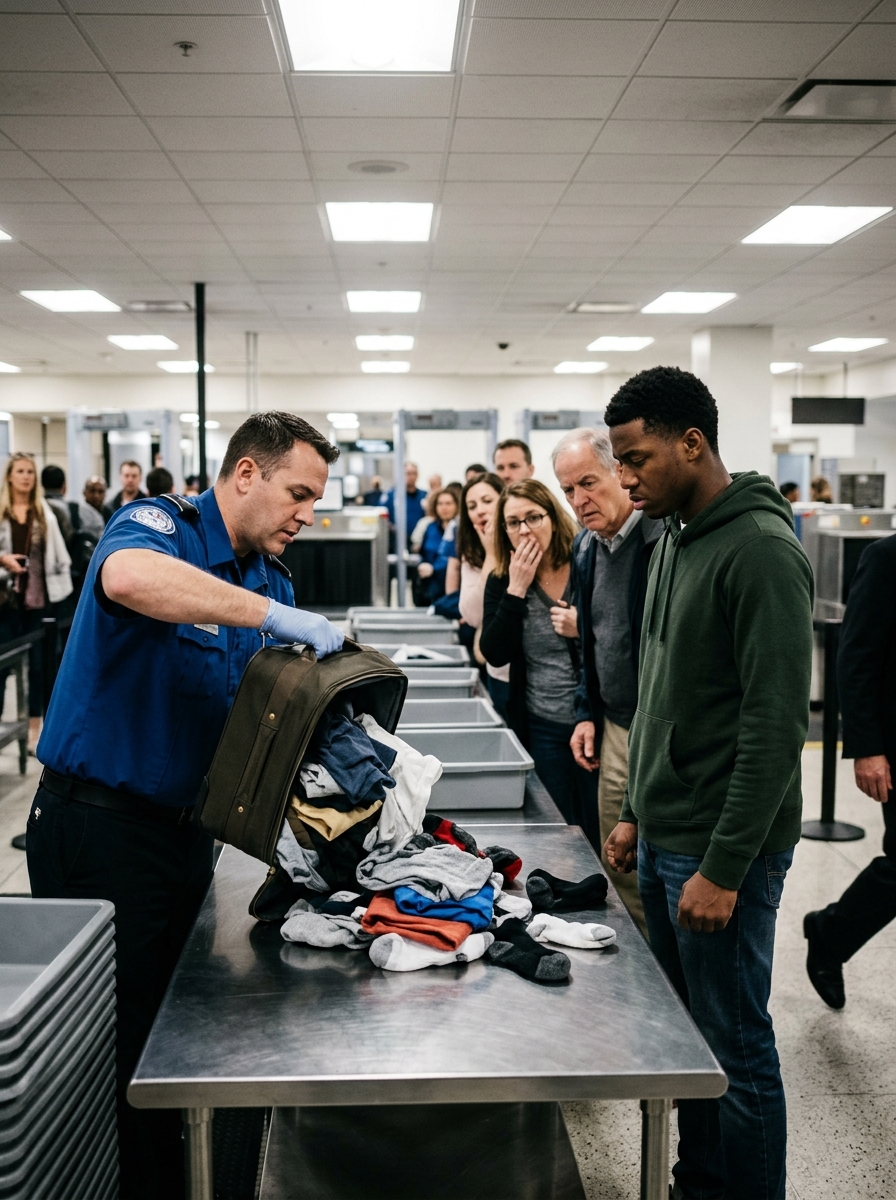
He said “sir,” but the tone carried something else entirely. It was a command filled with contempt. For five minutes he patted me down, rough and invasive, digging into my pockets, dragging his knuckles a little too hard along my inner thighs. Around us, middle-aged white businessmen in suits and families heading to Disney World walked by. I felt their eyes on me. I saw a woman pull her purse closer to her chest.
I just stood there under the fluorescent lights, my face burning with a shame so intense it made my stomach ache. I hadn’t done anything wrong, but Vance made sure everyone in that terminal saw me as a threat.
The second time, a month later, was worse.
I dressed up that time. Button-down shirt, decent shoes. I thought maybe looking like a young professional would help. But the moment I reached the conveyor belt, he was already there. Waiting.
“Bag check,” he barked, snatching my carry-on before I could react. He dumped everything I had neatly packed onto a metal table in front of dozens of strangers. He held up my underwear. He squeezed my toothpaste. He took his time, making sure I would miss my boarding group. When he finally shoved everything back toward me, he leaned in close—so close I could smell stale black coffee on his breath.
“Watch yourself, kid,” he whispered, a smug little smirk on his lips. “I’ve got my eye on you.”
I didn’t say a word. I just packed my bag with shaking hands, went to the bathroom, locked myself in a stall, and broke down from suffocating anger. You don’t know what it feels like to have your dignity stripped in public while being forced to say “Yes, officer.” If I spoke up, I was the “angry Black guy.” If I defended myself, I was “resisting.” He controlled every outcome. He knew it. And he enjoyed it.
But today was the third time.
Today was different.
I stood in line, duffel bag on my shoulder. The terminal was packed with the Monday morning rush. The line crept toward the checkpoint. Up ahead, I saw him. Vance. Leaning against the metal detector, arms crossed, scanning the crowd.
Then his eyes landed on me.
His jaw tightened. The smirk returned. He leaned toward the female agent beside him and muttered something. She looked uneasy and turned away.
My heart hammered hard against my ribs. The familiar panic rose again. Every instinct told me to turn around, to leave, to avoid what was coming.
Not this time, I told myself. Breathe.
I placed my bag on the belt. Took off my shoes. Walked to the scanner.
I stepped in. Hands raised. The machine hummed.
Silence. Green screen. Clear.
I stepped out and reached for my bin.
Before I could touch it, Vance slammed his boot onto the conveyor’s lower rack, stopping it. He stepped into my space, blocking my exit.
“Well, well,” Vance said loudly, making sure everyone behind me could hear. “Looks like we’ve got a random selection. Step out of the line, sir. Hands where I can see them.”
The chatter died down. Dozens of eyes turned. A man in a gray suit shook his head. Heat rose in my neck.
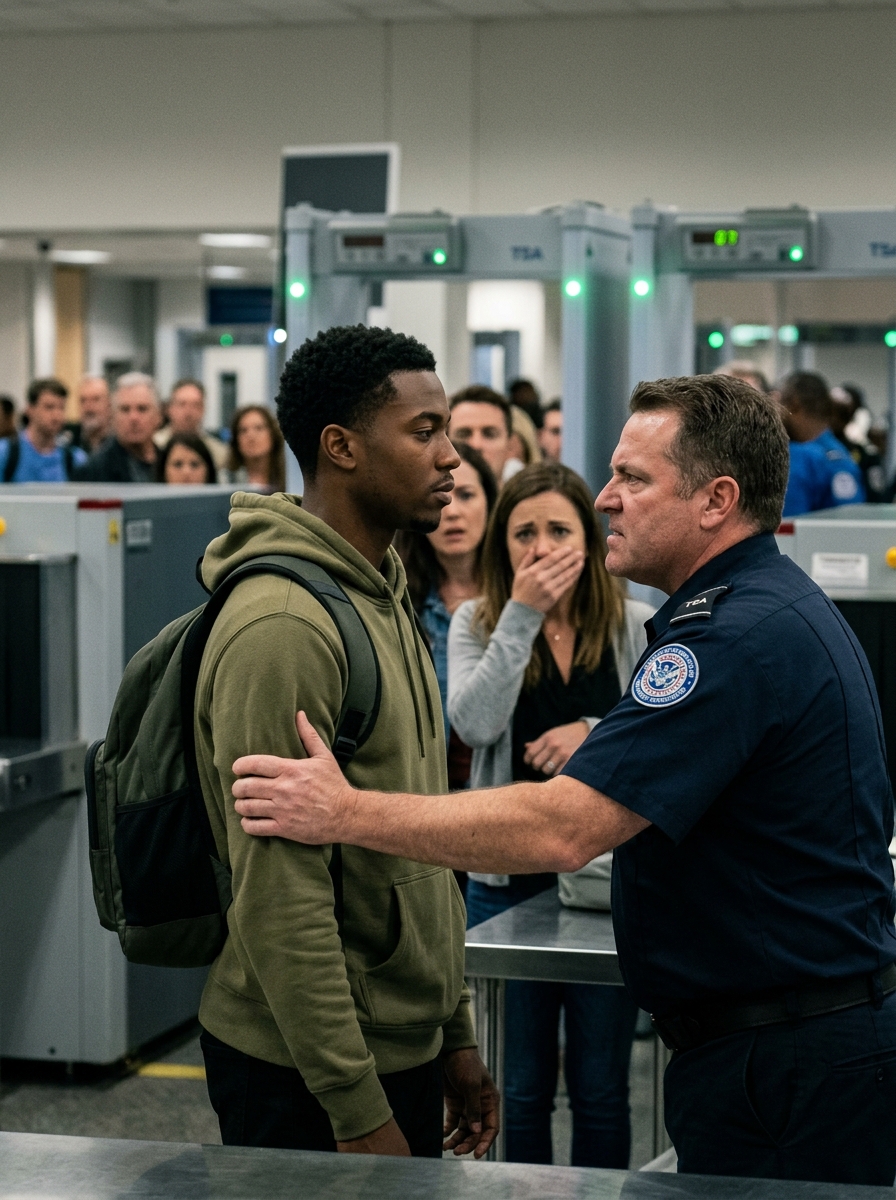
Vance grabbed my bicep hard, trying to pull me toward the search mat.
But I didn’t move. I planted my feet on the ugly airport carpet, looked him dead in the eye, and did the one thing he didn’t expect.
I smiled.
“Actually, Officer Vance,” I said calmly, my voice clear across the checkpoint. “I don’t think you want to do that today.”
His smirk disappeared. His eyes narrowed. Something dark crossed his face. He opened his mouth to bark an order—completely unaware that two men in sharp black suits had just stepped out from behind the frosted glass door of the TSA manager’s office, walking straight toward his blind spot.
Chapter 2
Time fractured into slow, stretched seconds.
If you’ve ever been in a moment where your safety feels suspended by a thread, you know it. Terminal B faded into a dull hum—the rolling suitcases, the distant boarding announcements, the restless movement of people all dissolving into noise.
All I could hear was my heartbeat and Officer Vance exhaling sharply through his nose.
My smile wasn’t arrogance. It was simply the last thing he expected from a 19-year-old Black kid he thought he had cornered. In his world, I was supposed to be afraid. Supposed to look down, apologize, submit. That was the script he depended on.
When I smiled, I broke it. And I saw the exact moment his mind stalled trying to process that.
“Excuse me?” Vance said, his voice dropping low, stripped of its public tone. “What did you just say to me, boy?”
Boy. The word hit like a blade dressed as casual speech. A year ago, it would have shaken me. My father’s voice had once told me, “You swallow your pride, because your pride won’t keep you alive.”
I had followed that. The first time Vance searched me. The second time he humiliated me in front of everyone. But swallowing it doesn’t erase it—it just builds pressure inside you.
“I said,” I repeated steadily, “I don’t think you want to do this today, Officer Vance.”
His grip tightened painfully on my arm. He stepped closer, invading every inch of space, his voice dropping further.
“You’re refusing a federal screening,” he growled. “That’s a federal offense.”
To my side, Agent REYES shifted uncomfortably. “Vance… the machine was clear.”
“Back off,” he snapped without looking at her.
Behind me, people watched. Some annoyed. Some judgmental. All assuming the same thing: I was the problem.
“Step on the mat,” Vance ordered again.
I didn’t move.
“Call them,” I said.
That threw him.
“What?”
“Call airport police,” I said. “Because I am not stepping on that mat until you explain what ‘behavioral anomaly’ I committed when the scanner showed green.”
His jaw tightened. “You’re resisting.”
“I’m standing still. You’re the one holding me.”
Then he pressed his radio.
“Dispatch, this is Vance—”
“Cancel that request.”
The voice cut through everything.
The entire checkpoint froze.
Vance stopped mid-sentence.
Two men in black suits had already closed in. No uniforms. No insignias on their jackets—just an unmistakable authority.
The taller one stepped forward, silver hair, cold eyes, a badge clipped at his belt.
“Let him go,” he said evenly.
Vance released my arm instantly.
“I was conducting a standard—” Vance started.
“We know exactly what you were doing,” the man replied. “We’ve been watching you.”
Then he turned slightly toward me.
“Mr. Carter, correct?”
“Yes, sir,” I said quietly, rubbing my arm where his grip had been.
“My name is Special Agent Harris, Office of Internal Affairs,” he said, loud enough for Vance to hear every word. “I apologize for the delay. We needed to allow the interaction to run its course so we could fully document the procedural violations. You are cleared to proceed to your gate. Your bags have already been cleared by Agent Reyes.”
Harris looked toward the female agent. Reyes immediately moved, practically pushing my duffel bag onto the rollers toward me, giving a quick, apologetic nod.
I grabbed my bag. It felt surprisingly light in my hands.
Vance, on the other hand, was suddenly crushed under a weight he hadn’t seen coming.
“Sir,” Vance said urgently, stepping toward Harris. “This is a misunderstanding. This passenger was behaving suspiciously. He has a history of—”
“A history of what, Vance?” The second man, the one holding the folder, finally spoke. His tone was sharper, more cutting than Harris’s. “A history of flying out of Terminal B while Black? Because according to your own bodycam logs—which we pulled last night—that appears to be the only shared factor in 87% of your ‘random’ secondary screenings over the past quarter.”
A collective gasp rippled through the line of passengers. The businessman in the gray suit who had glared at me earlier suddenly looked down at his expensive shoes, his face burning with secondhand shame. The mother with the toddler pulled her child closer, but now she was staring at Vance like he was the threat.
The silence that followed was total.
Vance opened his mouth, but nothing came out. The thick-necked officer who had promised to ruin my trip was gone. In his place stood a man realizing, in real time, that his career, pension, and authority were collapsing.
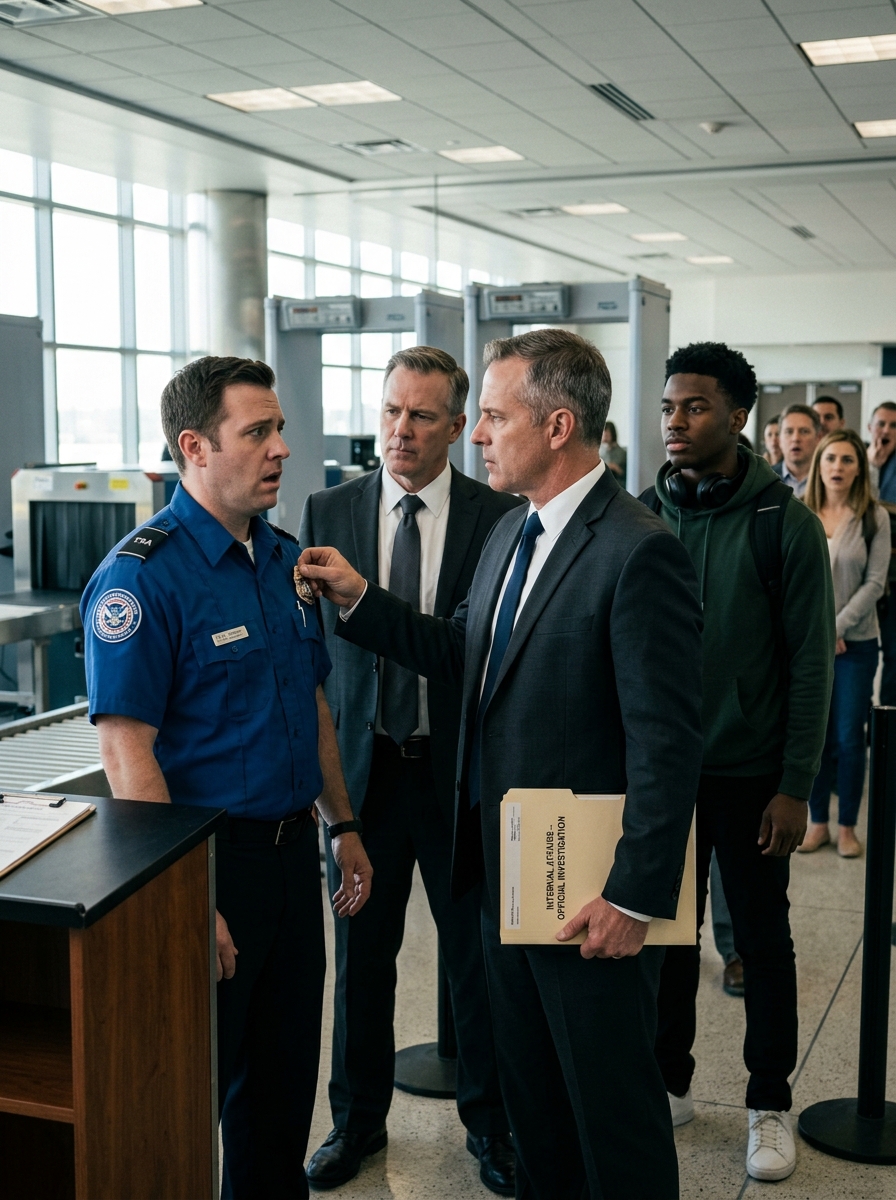
“Officer Vance,” Agent Harris said, voice dropping into a flat, clinical tone. “Remove your badge. Power down your radio. Hand both to Agent Miller. Your clearance to this area is revoked immediately.”
Chapter 3
There’s a particular sound metal makes when it drags across hard plastic. A hollow, final click.
I’ll never forget it.
It was the sound of Officer Vance unfastening his silver badge. His hands—the same ones that had searched me, gone through my belongings, and gripped my arm hard enough to bruise—were shaking uncontrollably.
He struggled with the clasp. The man who had dominated the checkpoint moments ago now looked deflated, his shoulders sinking inward, his jaw slack, his expression stripped of control. He couldn’t meet Agent Harris’s eyes. He stared down as he finally freed the badge and handed it over to Agent Miller.
Miller took it without a word and slipped it into his suit pocket. It vanished, and with it went Vance’s authority.
Next came the radio. He unclipped it from his belt, the cord dangling uselessly.
“My union rep,” Vance stammered, voice breaking. “I want my union rep here. You can’t do this to me like this. Not in front of… not in front of the passengers. This violates protocol.”
Agent Harris didn’t react. No anger. No satisfaction. Just cold procedural focus. Vance had become a problem to be removed.
“Your union representative, Mr. Gallagher, was notified ten minutes ago,” Harris said evenly. “He is waiting in the administrative wing. He has already confirmed he will not be contesting your immediate suspension. You are no longer defensible. Your locker is being cleared.”
A heavy-set TSA officer from Lane 4—DAVIS on his badge—stepped forward.
“Hold on, Harris,” Davis said defensively. “You’re destroying his career over a random check? The machine glitches. We have discretion. If he thought the kid looked suspicious—”
Agent Miller turned sharply toward him, eyes cold. He opened his folder and pulled out a highlighted sheet.
“Discretion, Officer Davis?” Miller’s voice cut through the silence. “Is that what we’re calling this? Over the past ninety days, Officer Vance initiated 142 secondary searches. 120 of those were African American males between 16 and 30. That’s an 84% targeting rate in a terminal where that group makes up under 12% of traffic.”
He stepped closer. “Are you prepared to defend that on record, Officer Davis? Because your bodycam audit is next. Or we can move it up to today.”
Davis went pale. He raised his hands slightly and backed away. “No, sir. I’m just… manning my lane.”
He turned his back immediately. The silence among the staff shifted. Loyalty collapsed the moment consequences became real.
Vance watched it happen. Completely alone now.
And I felt it—the pressure I’d carried for months beginning to lift.
“Agent Reyes,” Harris said.
She straightened instantly. “Yes, sir.”
“Escort Mr. Vance to the administrative wing via the back corridor. He is no longer permitted in passenger areas.”
“Yes, sir.” She approached Vance. No sympathy in her face now—only fatigue. “Let’s go.”
Vance didn’t look at me. Didn’t speak. He turned and walked away, his steps heavy, shoulders collapsed, escorted out as a civilian.
When the frosted glass door shut behind him, something inside the terminal changed.
Normal sound returned—rolling suitcases, distant announcements, a baby crying. But Lane 3 stayed still for a moment longer, like the air itself hadn’t reset.
My hands were shaking now. The adrenaline crash hit all at once.
Agent Harris turned to me. His expression softened slightly.
“Mr. Carter,” he said quietly, lowering his voice so only I could hear. “I want to apologize on behalf of the agency. What happened to you was not security. It was harassment.”
I nodded, unable to speak yet.
Agent Miller stepped forward and handed me a business card.
“Your uncle, David,” he said faintly, almost approving. “He forced the Inspector General’s hand within a day. We were already building a case on Vance, but your case made it actionable. You handled yourself well.”
I took the card. My fingers were still unsteady. “Thank you,” I managed.
“Go catch your flight,” Harris said. “You’re cleared.”
I turned toward the line.
Everyone had been watching.
Now the way they looked at me had changed.
The man in the gray suit avoided my eyes immediately, suddenly fascinated by his shoes. His earlier judgment had collapsed into embarrassment.
The mother with the toddler looked at me differently now—no fear, just quiet shame. She gave a small, hesitant nod.
I didn’t return either. I didn’t have the energy to absolve anyone.
I walked away.
The concourse felt different now. Not lighter exactly—just quieter inside my head. The constant pressure to shrink myself, to anticipate suspicion, was gone.
I sat near the windows overlooking the tarmac. Planes moved under a gray sky. I leaned my forehead against the glass.
My phone shook in my hand. I almost dropped it twice before unlocking it and calling “Uncle David.”
He answered immediately.
“It’s done,” I said, voice breaking.
A long exhale came through the line. “Good,” he said. “Are you hurt?”
“No,” I said. “He grabbed me. But I didn’t move. I stayed calm.”
“I’m proud of you,” he said, voice tightening. “You didn’t just survive it—you ended it.”
“It didn’t feel brave,” I admitted.
“It doesn’t need to,” he said softly. “It just needs to be done.”
We stayed on the phone as my breathing steadied, as the tremor in my hands faded. Then he told me to get on my flight.
“Your mom’s waiting,” he said.
“Thanks, Uncle D. For everything.”
I hung up the phone.
I stayed seated for a few more minutes, watching a baggage handler hurl suitcases onto a conveyor belt outside. The terminal around me carried on with its ordinary rhythm—delayed flights being argued over, overpriced coffee being bought, travelers hurrying toward their gates.
No one around me had any awareness of what had just taken place at Checkpoint Bravo. No one knew that a small, invisible conflict had just unfolded—and been resolved.
“Now boarding Group A,” the gate agent announced over the loudspeaker.
I got to my feet. Picked up my bag. Didn’t check my pockets. Didn’t adjust my hoodie. Didn’t scan the room for eyes on me.
For the first time in a long time, I simply walked onto the plane like everyone else.
Chapter 4
The aircraft tilted left, its deep engine hum vibrating through the floor and into my shoes.
I was in seat 14F, watching through the scratched oval window as the city shrank below, swallowed by a thick layer of clouds. Takeoff usually made my stomach drop. This time, I felt nothing like that. I just felt light. Strange, almost unreal lightness.
The woman next to me—a grandmotherly type in a floral cardigan reading a thick paperback thriller—offered me a small plastic bag of pretzels.
“Here you go, hon,” she said with a warm smile. “I never eat these things. Too much salt for my blood pressure.”
“Thank you, ma’am,” I replied, taking it.
It was a small, ordinary exchange—nothing remarkable at all. But holding that flimsy bag of pretzels, something unexpectedly rose in my chest. My throat tightened. I turned toward the window so she wouldn’t notice my eyes glassing over.
It wasn’t about the food. It was about something simpler: basic human decency.
For months, my presence in public had been filtered through suspicion. Officer Vance had stripped away my ability to assume I was just another person moving through the world. Through his lens, I wasn’t neutral—I was a problem, an anomaly, a threat. He made me question my own existence in public space.
That kind of repeated humiliation doesn’t just hurt in the moment. It rewires you. I had started monitoring myself constantly—my posture, my pace, my tone, even my stillness. Wondering if anything I did might be interpreted as “wrong.” Slowly turning myself into something careful and restricted just to avoid attention.
But sitting beside a stranger who only saw a tired college student, I realized something had shifted back into place.
I had my ordinariness again.
I leaned my head against the cool plastic wall of the cabin and let the steady vibration of the plane pull me into a broken, exhausted sleep.
When we landed in Atlanta, the feeling of solid ground hit harder than expected.
I moved through the crowded concourse of Hartsfield-Jackson without hesitation. No scanning. No second-guessing. No checking faces at the exits. I followed signs like anyone else, just another traveler dissolving into the flow.
Outside, the humid Georgia air wrapped around me as I stepped through the sliding doors.
My mom’s silver Honda Accord was already idling at the curb. Before I could reach her, she threw the car into park and rushed out, moving faster than I’d ever seen her move.
She’s small—barely five-foot-two—but when she wrapped her arms around my neck, it hit like impact.
“Marcus,” she exhaled into my shoulder.
Nothing else needed to be said. I felt it in her grip—the leftover fear she had been holding. Uncle David had already called her after speaking with me, and she had spent the past hours tracking my flight, carrying a worry she couldn’t act on.
“I’m okay, Mom,” I said quietly, setting my duffel bag down and holding her back. “It’s over.”
“I know, baby. I know,” she said, pulling back just enough to look at me. Her eyes were red and damp, scanning my face as if checking for damage. Her hands stayed on my cheeks, steady but trembling. “I was so scared, Marcus. When your uncle told me you were going to confront him… I almost came to the airport myself.”
“Uncle David handled it. Internal Affairs was already there.”
“Internal Affairs is still part of the system, Marcus,” she said sharply, voice shaking. “And the system doesn’t always protect us, even with evidence. You know that. I know that. A badge and a gun will always carry more weight than what we say. If that agent had escalated… if he had panicked…”
She stopped, unable to finish.
We both knew what she meant. We both knew the stories that lived underneath that kind of sentence.
“Let’s go home, Mom,” I said, lifting my bag into the trunk.
The drive was quiet. Not uncomfortable—just heavy. The radio played softly. Outside, familiar landmarks passed by: the Waffle House, pine trees, old storefronts fading into memory as I watched them slide past like I’d been gone far longer than a semester.
At home, the smell of pot roast and garlic mashed potatoes filled the kitchen the moment we walked in.
We sat at the table and ate. I didn’t realize how hungry I was until the first bite hit me. My body had been running on adrenaline for too long.
“Your uncle is filing a permanent injunction,” my mom said quietly. “He called while you were on the plane. He wants Vance flagged so he can’t work anywhere in law enforcement again.”
“Good,” I said. “He shouldn’t be able to do that to anyone else.”
“He won’t,” she said, covering my hand with hers. “You made sure of that.”
“I didn’t feel brave,” I admitted.
“You don’t have to feel it,” she said softly. “You just have to do it anyway.”
I stared down at my plate, the weight in my chest returning—not fear this time, but everything I’d been holding for months finally settling.
The real impact didn’t fully register until weeks later, back at school.
Life had resumed its normal pace—classes, assignments, late nights in the library. The incident started to blur at the edges, becoming something distant but still present.
Then one afternoon, my phone buzzed.
Uncle David.
I answered. “Hey.”
“Are you sitting down?” he asked, voice carrying a kind of satisfaction I’d never heard from him before.
“Yeah. What is it?”
“I got the final report from Internal Affairs,” he said. Papers shuffled in the background. “You should hear this.”
I closed my laptop. “They fired him?”
“They did more than that,” he said, almost amused. “He appealed through his union, tried to argue profiling was ‘behavioral assessment.’ He wanted severance and his pension intact.”
“Did he get it?”
“No,” my uncle said. “Because your case triggered a full audit. Once you forced the intervention, they opened his entire record.”
He paused.
“And they found a pattern. Not random. Not close. Statistically impossible. And bodycam audio confirmed it—derogatory remarks, racial language, all of it.”
A chill ran through me.
“This wasn’t just termination,” he continued. “His union dropped him. He’s permanently barred from federal and state law enforcement. No security work either. It’s over.”
I sat there in silence.
I hadn’t set out to end anything. I just didn’t want it to keep happening.
My uncle’s voice softened slightly. “You started the chain reaction, Marcus. Everything after that was accountability catching up.”
When the call ended, I looked at myself in the mirror for a long time.
I didn’t feel like anything had been erased. The fear was still there somewhere. But it wasn’t controlling the room anymore.
Six months later, I was back in another airport line for Thanksgiving.
Same duffel bag. Same routine.
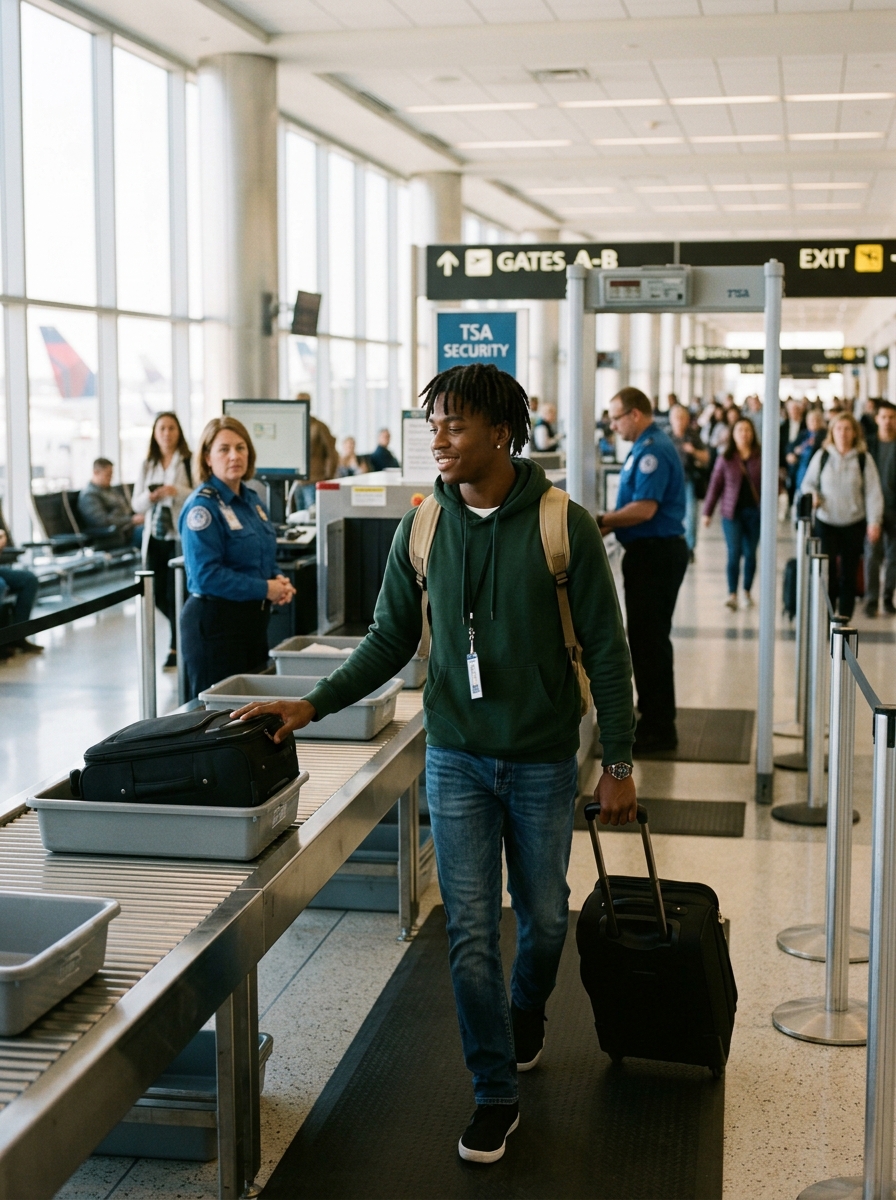
But when I reached the scanner, there was no Vance. Just a bored officer checking the clock.
I stepped through. Green screen.
No interruption. No mat. No hands on my arm.
I picked up my bag and walked forward.
No one stopped me.
No one looked twice.
And for the first time, invisibility didn’t feel like erasure.
It felt like peace.
