

The Morning We Met Again
Thirteen years after my former husband walked out of our home, I saw him again beneath the bright glass roof of a convention center in Indianapolis.
I had imagined that moment in a dozen different ways over the years, usually while folding laundry or waiting in the school pickup line, but none of those imaginings prepared me for the sight of him standing beside his wife and their teenage son, looking at me as though I had arrived to spoil something that belonged to him.
My sons, Julian and Miles, were just behind me, carrying their competition folders and wearing the navy blazers they had borrowed from the school debate team.
They were seventeen now, tall enough to look me in the eye without lifting their chins, but I still felt the old instinct to put myself between them and anything that might hurt them.
My former husband, Graham, noticed me first.
His expression changed so quickly that I could almost see him reaching back through the years, trying to find the woman he remembered.
“Meredith?” he said.
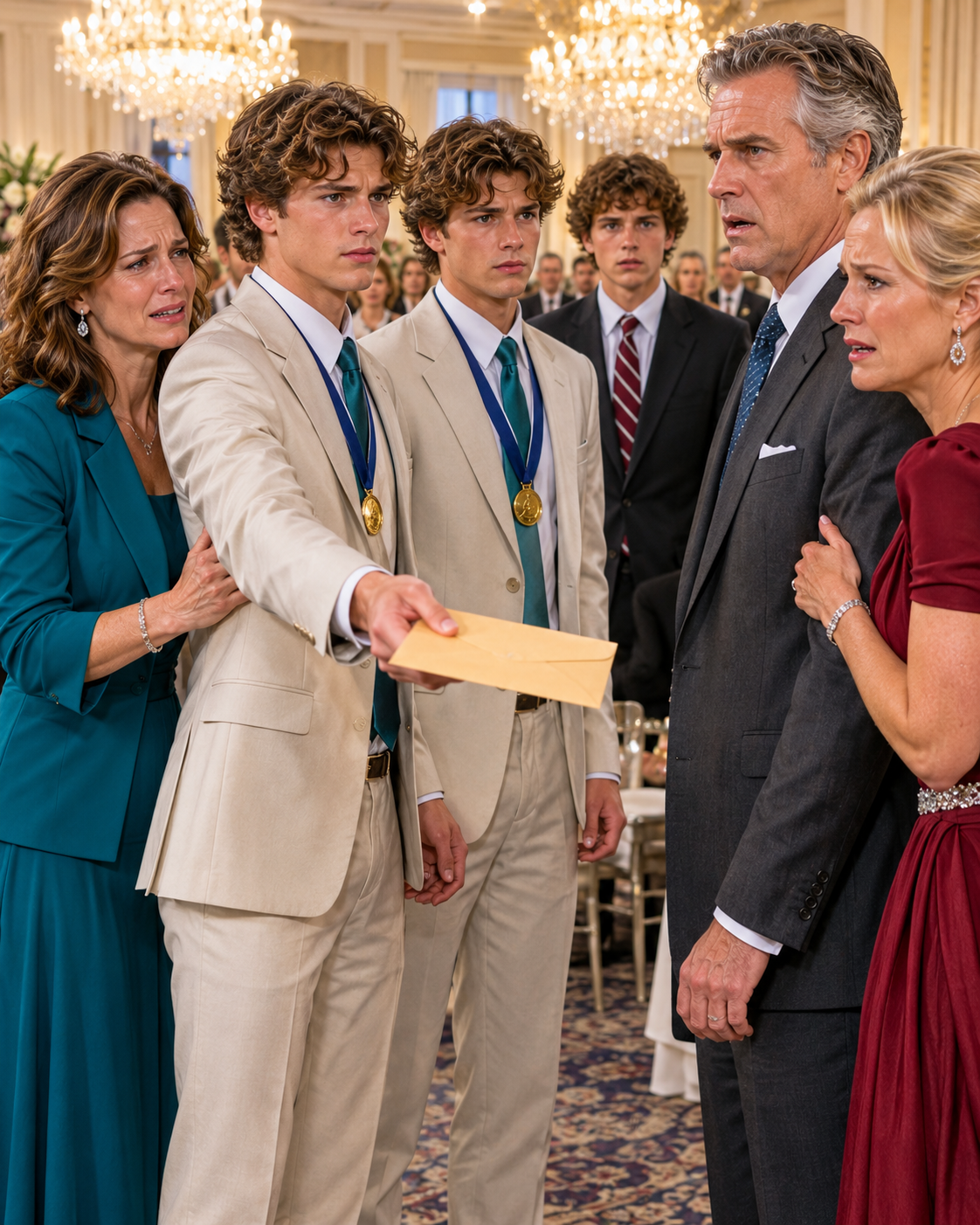
Then his face tightened. “What are you doing here?”
The woman beside him, Vanessa, stepped forward before I could answer.
She had a polished, practiced smile and a pale blue silk scarf arranged just so around her neck.
“This event is for registered students and their families,” she said, glancing at my boys’ folders. “I’m sure you’ll want to check with someone at the desk.”
I held my sons’ registration papers where she could see them.
“We did,” I replied. “They’re registered. The competition is open to students from across the state.”
Graham leaned closer, lowering his voice as if that might make his words less ugly.
“How could you show up here today?”
A few parents in the registration line turned to look.
I could feel my sons behind me, but I didn’t turn around.
I had spent years learning how to keep my voice steady when life gave me very little reason to.
“I’m here for my children,” I said.
Graham let out a humorless breath. “This weekend is important to our family. We’ve spent months preparing Owen.”
“It matters to my family, too.”
For a moment, none of us moved.
Then I turned toward the check-in desk and called to my sons.
“Come on, boys. We have to pick up your badges.”
One of them walked beside me, close enough that our shoulders touched.
The other followed, quiet and watchful.
We did not look back until we reached the wide hallway leading to the auditorium.
“That was him, right?” Julian asked.
“Yes,” I said.
Miles kept his eyes on the carpet. “Our father?”
I paused, because there was no gentle way to answer a question that had waited thirteen years.
“Yes,” I told him. “That was your father.”
Neither boy said anything else.
We found our seats among families from high schools all over the state, while students carried poster boards and laptops toward the exhibit tables.
I assumed the encounter had left them stunned.
I didn’t yet know they had been preparing for it in their own way, gathering letters and photographs for months, determined that if their father ever stood close enough to hear them, he would finally understand what his absence had meant.
At four that afternoon, the lights dimmed for the awards ceremony.
The auditorium settled into a hush, then filled with applause as the coordinator announced the winners in applied mathematics.
“The gold award goes to Julian Bennett, from Westfield Public High School.”
My hands flew to my mouth.
Julian stood, looking startled for half a second before he gave his brother a quick, proud smile and walked toward the stage.
The next award was for physical chemistry.
“The gold award goes to Miles Bennett, who also earned the highest overall score in this year’s statewide competition.”
The room erupted in applause again.
I turned just enough to see Graham several rows behind us.
He had come to celebrate his younger son, Owen.
Now he watched my boys walk to the stage one after the other, their medals shining against their blazers.
A woman near him looked at the program in her lap.
“Those are the Bennett twins from Westfield,” she whispered to her husband. “Their mother raised them on her own, didn’t she?”
Her husband nodded. “Looks that way. They’ve done remarkably well.”
Graham heard them.
His eyes stayed on the stage as Julian shook the coordinator’s hand and Miles stepped forward to accept his medal.
When Miles turned, the resemblance became impossible to miss: the same hazel eyes as Graham, the same square chin, even the same slight crease between his brows when he concentrated.
The ceremony continued around us, but I could feel something shifting in the rows behind me.
Graham had walked past his own sons that morning without recognizing them.
Now he was watching the young men they had become.
When the last award was presented, I expected the boys to return to their seats.
Instead, Miles came down from the stage and walked toward the row where Graham was gathering his coat.
Julian followed, stopping beside his brother.
Graham stood slowly.
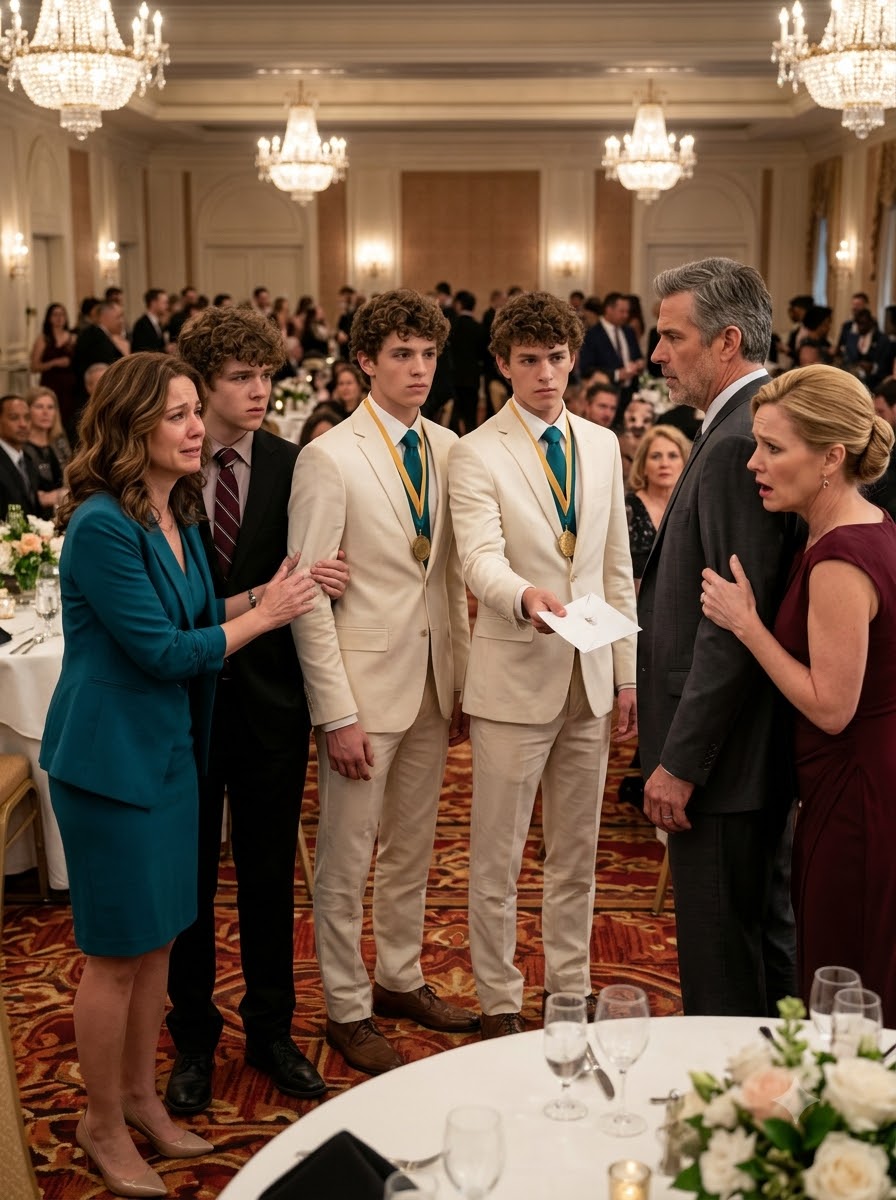
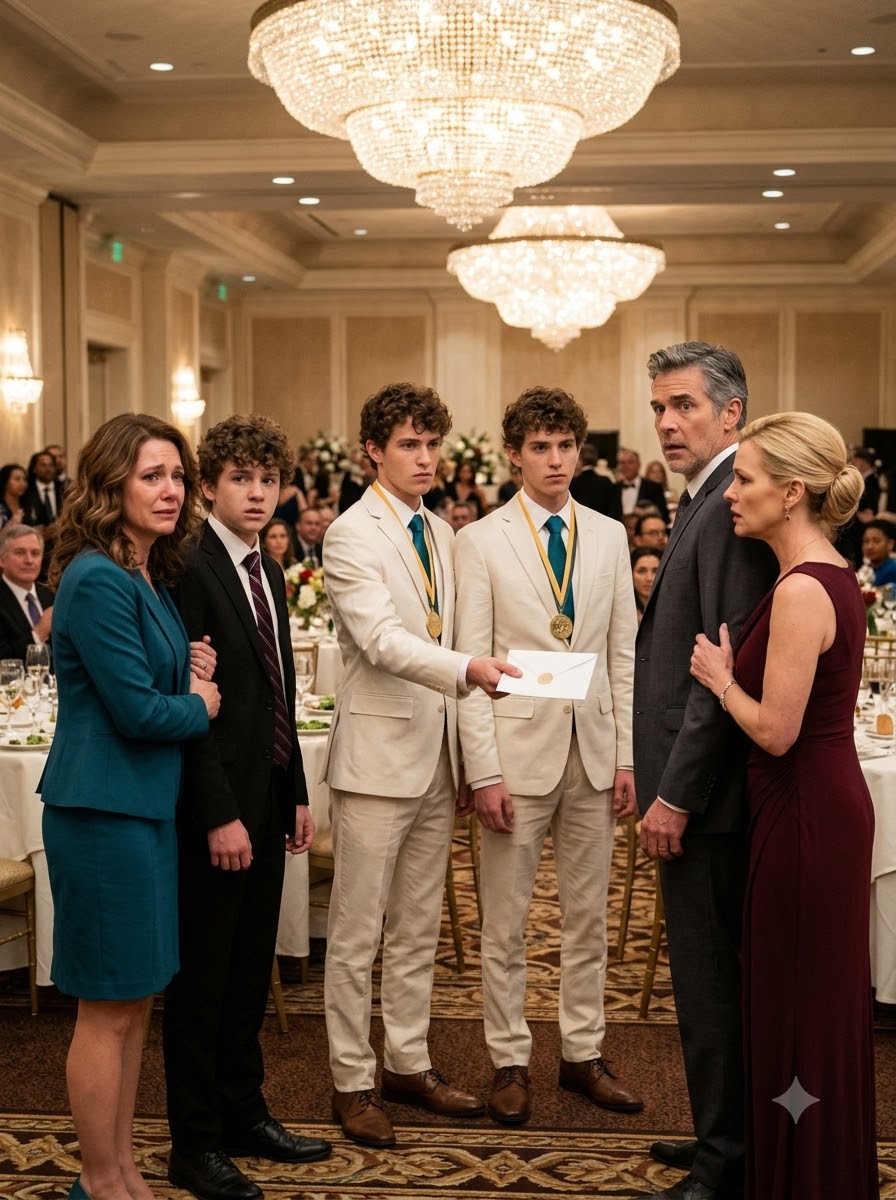
Miles held out a thick envelope tied with a faded blue ribbon.
“Dad,” he said, his voice calm, “Julian and I have been carrying this around for a long time.”
The Letters We Kept
Graham stared at the envelope, then at the faces of the boys standing in front of him.
Around us, families were filing out, exchanging congratulations and looking for coats, but in that small space between the seats, the years seemed to gather all at once.
“What is it?” Graham asked.
“It’s for you,” Miles said.
Graham took the envelope.
He looked toward me as if he expected me to explain, but I had no explanation to offer.
I had spent thirteen years explaining his absence to two little boys who waited by the window on Saturdays, and I was finished trying to make those years sound simpler than they were.
“Open it,” I said.
Vanessa came to stand beside him.
Their son, Owen, stayed a step behind her, watching my sons with a troubled expression.
Graham untied the ribbon with unsteady fingers.
Inside were old school photographs, folded pages, birthday cards, and copies of letters written in handwriting that changed as the boys grew.
“Why didn’t I ever get these?” he asked.
Julian met his eyes.
“We sent them,” he said. “For years.”
Graham turned to me. “Did you keep their letters from me?”
The question stung, but I answered plainly.
“No. They kept copies of what they wrote.”
Miles pointed to the stack. “We wrote to you every year at first. We stopped mailing them when nobody answered, but we kept writing in our journals.”
Graham opened one of the cards.
Its cover had a crooked paper star glued to the front.
The message inside was written in uneven blue pencil, the letters large and careful.
“Dear Dad,” he read softly. “I got first place in the county math contest today. Mom says you’re good at math, too. I hope you like your new family.”
His voice faded before the last word.
He looked up at the boys.
“You knew I remarried?”
“Mom never hid that from us,” Julian replied.
I had told them the truth in small, age-appropriate pieces.
Their father had left when they were four.
He had visited them a few times that first autumn.
Then the calls and visits stopped.
I never told them he was a monster, because he wasn’t.
I also never told them he was secretly a good father who would return one day, because I couldn’t promise what I didn’t know.
“I didn’t want them to believe you left because they weren’t worth loving,” I said. “I told them you chose to leave our home, and that you had promised to stay in touch.”
Vanessa crossed her arms.
“There’s more to a separation than that,” she said. “Graham had reasons for leaving.”
I looked directly at her.
“Then he could have explained those reasons to his sons.”
Graham lowered his eyes to the letters. “I’m sorry,” he said.
Julian’s expression did not soften.
“What are you sorry for?”
“For not being there. For missing your birthdays, your school years, everything.”
“That’s an apology,” Miles said. “It isn’t an explanation.”
Graham took a breath, but before he could answer, Julian reached into the envelope and handed him a single typed page.
At the top, in bold letters, were the words: We did not bring this because we want your money. We wanted you to see what you chose to miss.
Graham read slowly.
The page described the boys’ memories: waiting by the front window, asking why their father never called, wondering whether they had done something wrong.
It ended with one sentence: We know you may have a different version of our history, and we want to understand why.
Graham looked from the page to me.
“I did write to you,” he said. “I sent letters. I sent packages. I thought you were refusing to let me see them.”
I felt the room tilt, just slightly.
For thirteen years, I had believed he had stopped trying.
For thirteen years, he claimed he had kept reaching out.
One of us had been wrong—or someone had made certain neither of us could hear the other.
“I never received a letter or a package from you,” I said. “Not one.”
Graham’s gaze flicked toward Vanessa.
“I mailed them to the address on file,” he said. “Some were returned. I was told you’d moved and didn’t want contact.”
“I moved six months after our divorce,” I replied. “I gave our attorney my new address, and I left a forwarding address with my parents. You knew where they lived.”
Vanessa’s composure had changed.
Her smile was gone, and her hands were held tightly together.
“This isn’t the place to reopen an old dispute,” she said.
“You’re right,” Graham replied. “But I’m not leaving until I understand what happened.”
He held up one of the returned envelopes.
The faded postal marking showed it had been sent back.
I had never seen it before.
“You were never supposed to see those,” Vanessa blurted.
The people nearest us went still.
Vanessa seemed to realize what she had said only after the words were out.
Graham’s voice dropped.
“What does that mean?”
She glanced toward Owen, then back at Graham.
“I meant this is an old matter. It should have stayed in the past.”
Owen stepped away from his mother.
“You told me Dad’s first family wanted nothing to do with him,” he said. “You said Meredith was unstable and that you were protecting us.”
I felt anger rise, but Julian touched my arm.
“That isn’t true, Owen,” he said gently.
Owen looked at his mother. “Did you keep Dad from seeing them?”
Vanessa stiffened. “You don’t understand what adults have to do to protect a household.”
“I understand you told me things that weren’t true,” Owen said.
Graham pulled another letter from the envelope.
It was written in his own hand, dated eleven years earlier.
He unfolded it, and his voice trembled as he read the first lines.
“Dear Meredith, please let me see the boys. I’ll meet you at the public library with a mediator if that makes you more comfortable. I’m not asking you to forgive me. I just want to be their father.”
I remembered that winter.
I had sat by the telephone, waiting for the call that never came.
The boys had waited by the window until the cold made them come inside.
We had both believed the other had closed the door.
Graham lowered the letter.
“Why did you do it?”
Vanessa’s face tightened.
“You were miserable every night,” she said. “You talked about the boys constantly, and I was trying to build a life with you. I had Owen on the way. I thought if you kept going back to the past, there would never be a future for us.”
“They were my children,” Graham said.
“You were barely keeping your career together. I thought I was protecting our family.”
Owen looked at her with hurt and disbelief.
“Don’t use me to explain it away.”
Graham turned back toward the twins.
“I want to talk to you both, somewhere quiet. I’ll answer whatever you want to ask.”
Julian looked to me.
I gave him no instruction, only a small nod.
“We’ll talk,” he said. “But not alone, and not today.”
“Whenever you’re ready,” Graham replied.
Miles held up a photograph of a storage unit with a brass lock.
“There’s more. We found a picture of a storage locker with your name on the containers. It’s on Route 6, outside the city.”
Graham stared at the image.
He knew the unit.
Vanessa had rented it years earlier for holiday decorations and old household items.
“We’ll go tomorrow,” he said.
“Tomorrow morning,” Julian corrected. “After we’ve had time to think.”
What the Records Revealed
That evening, we stayed at a hotel near the convention center.
Owen chose to come with us rather than return to Cincinnati with his mother.
He sat beside his half-brothers in the lobby, his backpack between his feet, and tried to make sense of a family history that had changed shape in a single afternoon.
Graham opened his banking records on his phone.
For three years, monthly payments had left his account under the label “child maintenance.”
The recipient was listed as the Bennett Family Trust.
I leaned over to see the routing information.
“That isn’t my bank,” I said.
Graham frowned. “I thought the account was set up through the law office.”
“I never opened a trust with you.”
Owen pulled an old tablet from his backpack.
“Dad, I found some scanned files in the family cloud folder last spring. I didn’t understand what they were then.”
The document on the screen was a power of attorney bearing Graham’s signature.
An amendment gave Vanessa authority to manage correspondence, financial transfers, and notices connected to his former marriage.
The notary stamp belonged to a firm where Vanessa had once worked.
Graham stared at the screen.
“I signed a packet of employment paperwork when I moved to the new firm,” he said. “I didn’t realize this was in it.”
Julian looked at him steadily.
“You never checked where the payments were going?”
Graham rubbed his forehead. “I was working long hours, and I trusted her. That isn’t an excuse. I should have checked.”
“You should have checked whether your sons were receiving the money,” Miles said. “Or whether they were receiving anything at all.”
Graham nodded. “You’re right.”
A call came in from our former attorney, Mr. Harlan.
Graham put it on speaker.
The older man sounded anxious before anyone had said more than hello.
“Vanessa called me today about the old family file,” he said. “I gather the past has come up.”
“We found letters and financial records,” Graham replied. “What did you know?”
Mr. Harlan was silent for a moment.
“I should have handled things differently,” he said. “Vanessa came to me before the final mediation. She had documents from your old firm and claimed a bookkeeping error would be reported as intentional misconduct unless I let her manage the forwarding paperwork. She told me you had agreed to let her handle the transition.”
Graham sat very still.
“That error was a software problem,” he said. “I corrected it as soon as I found it.”
“I know that now,” Mr. Harlan replied. “At the time, I believed her version and let myself be pressured. I should have verified everything and contacted you directly. I kept a box of the returned records in my office. I’ll bring it in the morning.”
I wanted to be furious with him, and I was.
But anger did not change what we needed next: a careful look at the records and a clear understanding of what had happened.
After the call, Owen sat quietly beside Julian.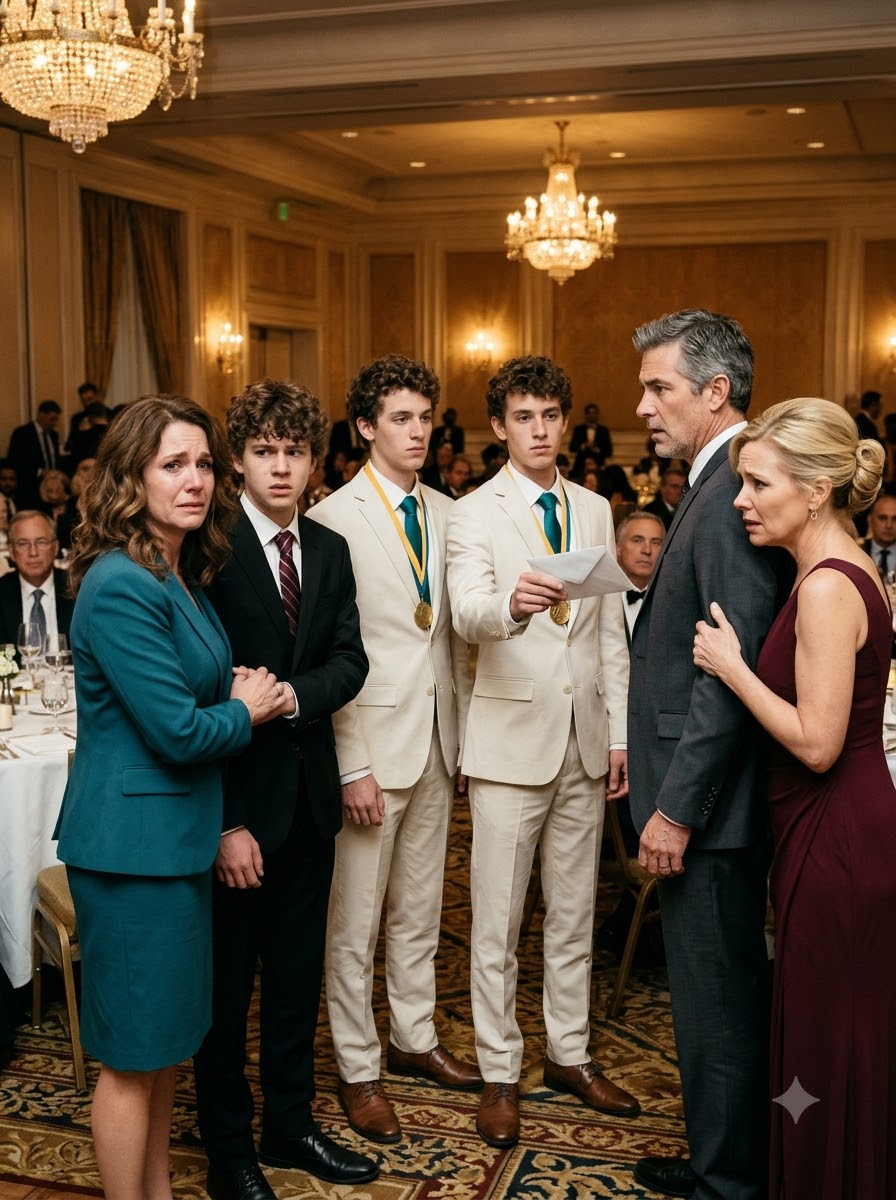
“I didn’t know,” he said. “When I found those files, I thought Dad had some old paperwork he’d forgotten. I didn’t understand the account names until I looked closer.”
Julian put a hand on his shoulder.
“You didn’t do this.”
“But I went to the school they paid for with that money.”
“You were a kid,” Miles said. “You didn’t choose where the money went.”
Owen’s shoulders eased a little.
He had grown up with a very different version of his father’s past, but he was not responsible for the choices the adults had made.
I told the boys I would cover the hotel bill.
Graham offered to pay, then stopped when I raised my hand.
“I’ve taken care of every roof over their heads for thirteen years,” I said. “I’ve got tonight.”
He accepted the answer without arguing.
At the elevator, Julian turned to me.
“Do you think he loved us?”
I thought of the letters, the unanswered calls, the years of silence, and the man who had signed documents without reading them and trusted someone else to make decisions about his children.
“I think he may have loved you,” I said carefully. “But love that never shows up still leaves a real hurt. We’ll find out what he’s able to do now.”
The next morning, a thin mist hung over the storage facility outside Indianapolis.
Mr. Harlan was waiting near the entrance with a cardboard file box.
Graham arrived with Owen, while Julian and Miles came with me in my car.
Owen led us to the unit.
He had found the key taped beneath the spare tire cover in Vanessa’s trunk and had taken a photograph of the locker after he discovered the old labels inside.
Graham unlocked the door.
The rolling metal panel rose with a low rattle, revealing rows of plastic containers, holiday decorations, boxes of old clothes, and three large bins marked with his name.
One label read: Graham Bennett—Returned Correspondence and Legal Notices.
No one spoke for several seconds.
Miles opened the first bin.
Inside were hundreds of envelopes, cards, and small parcels arranged in cardboard dividers.
Julian lifted a bundle tied with a faded blue ribbon.
I recognized my own handwriting on the top letter, dated eleven years earlier.
Graham unfolded it carefully.
“Dear Graham,” he read. “The boys keep asking when you’ll visit again. Julian made an airplane from craft sticks, and Miles won his school spelling bee. If you don’t want to see them, please tell me yourself so I can stop them from waiting by the window every Saturday.”
Graham sank onto an old folding chair, holding the paper in both hands.
“She told me you had filed a court order keeping me away,” he said.
“I never filed anything like that,” I replied. “I waited for you to call.”
Mr. Harlan opened his box of records and found the certified mailing receipts.
One envelope contained a custody petition I had filed through legal aid, hoping to make the support arrangements more dependable.
It had been returned with a note saying Graham no longer worked at that office.
Beneath the postal marking was a handwritten message in Vanessa’s distinctive script.
Graham looked at it for a long time.
Another container held two small silver watches, each engraved with one of the boys’ names and birthdays.
A note in Graham’s handwriting was tucked into the box: For Julian and Miles on their eighth birthday. I think about you both every day.
He looked at his sons, but did not reach for them.
“I bought these during a business trip,” he said. “Vanessa told me they were delivered and that you threw them away.”
Julian picked up one watch and ran his finger over the engraving.
“We waited on the porch that birthday,” he said. “We thought maybe you’d send a card.”
Graham bowed his head.
Mr. Harlan brought over a set of financial ledgers.
The maintenance payments had gone to an investment account registered under Vanessa’s former surname.
Over three years, about forty-five thousand dollars had been transferred there.
Some of the funds were later used for Owen’s private school tuition.
Owen turned away, looking down at the concrete.
“So that’s how it was paid.”
Mr. Harlan nodded. “That’s what the records indicate.”
Owen pressed his forehead briefly against the metal wall.
Julian walked over and stood beside him.
“You didn’t know,” he said.
“It still feels wrong.”
“It was wrong,” Miles replied. “But it wasn’t your choice.”
Graham asked Mr. Harlan to preserve and copy every document.
He wanted independent legal counsel to review the financial records and advise him about the proper next steps.
“I don’t want this hidden again,” he said. “Whatever it means for my career or my marriage, I want the facts documented.”
He looked toward me, then the boys.
“And I want to make things right where I can.”
I understood what he meant, but I also understood that no repayment could return a school concert, a birthday, or a Saturday afternoon when two small boys had sat by a window wondering whether their father still remembered them.
A Beginning With Boundaries
On Sunday afternoon, we met in a quiet room at a community center near the river.
The autumn trees outside the windows had begun to turn, and yellow leaves drifted across the parking lot whenever the wind picked up.
Graham sat at one end of the table with his legal papers in front of him.
I sat beside Julian and Miles.
Owen chose a seat across from them, close enough to join the conversation without feeling as though he had to take anyone’s side.
Graham began carefully.
“Thank you for coming. I know I don’t have the right to ask for an easy conversation, and I won’t ask you to forgive me today.”
Julian opened a notebook.
“We came to set some boundaries before anyone starts making plans for us.”
“I’m listening,” Graham said.
Miles spoke first.
“You can’t make up for thirteen years by buying us things or promising to pay for everything.”
“I understand.”
“You also can’t show up at our school or our events without asking,” Julian added. “If we invite you, you can come. If we don’t, you stay away.”
Graham nodded. “That’s fair.”
“And you don’t get to speak badly about Mom,” Miles said. “She raised us. She kept our lives steady when everything else wasn’t.”
Graham looked at me, his expression full of regret.
“Your mother did what I should have done. She made sure you knew the truth without asking you to hate me. I respect her for that, and I’ll never suggest otherwise.”
Owen shifted in his chair.
“What about the education fund Grandpa set up?” he asked. “You mentioned it before, Dad. Is it still there?”
Graham opened a leather folder and slid several copies of a trust proposal across the table.
“My father established an education fund for his grandchildren before he passed away. It has been tied up in an old family arrangement for years. I’ve worked with an independent trustee to restructure it as a scholarship foundation.”
Julian read the first page.
“Who decides where the money goes?”
“An independent board of educators,” Graham answered. “Neither Vanessa nor I will control the awards. The fund will cover your college expenses if you want to use it, and it will also offer scholarships to students across Ohio whose education has been affected by family separation or financial hardship.”
Miles studied the document.
“You’re making it so we don’t have to ask you for money?”
“Yes. I don’t want it to become a way to control your choices or earn affection. The board will manage it. You can accept the support or decline it.”
I looked through the documents.
The foundation would pay tuition directly to schools, with a separate independent board reviewing applications.
It was a careful proposal, and it placed the funds beyond the control of the people who had mishandled them.
“He also asked if I would serve as an honorary adviser,” I said. “I told him I’d consider it if you both were comfortable with the arrangement.”
The twins exchanged a glance.
“We’re comfortable with the foundation,” Julian said. “And Mom should be involved if she wants to be.”
Graham’s eyes glistened at the word Dad when Miles used it later in the conversation, but he kept his reaction quiet and gave the boys room to continue.
They spent an hour discussing college plans, scholarship rules, and what sort of contact would feel comfortable.
Graham did not ask them to promise anything.
He did not try to turn one conversation into a repaired relationship.
He answered their questions, including the hard ones, and when he didn’t know an answer, he said so.
By the time we left, evening had settled over the riverfront.
The city lights shimmered across the water, and a cool wind moved through the bare branches.
Graham walked with Owen toward their car, listening while his younger son talked about college applications.
Julian and Miles stopped beside mine.
“We’re going back to school tomorrow,” Julian said.
Graham nodded. “Have a safe drive. Good luck with your robotics presentation on Friday.”
Miles rested one hand on the car door.
“You can come watch, if you want. It starts at seven in the gym.”
Graham’s face brightened, then he caught himself and answered with care.
“Only if you’re sure. I’ll sit in the back, and I’ll leave whenever you want me to.”
“That’s fine,” Miles said.
Julian stepped forward first.
He offered his father a hand.
Graham took it, holding it for a moment without pulling him closer.
Then Miles gave him a brief hug.
Julian joined them, and the three of them stood together beneath the streetlamp, uncertain but willing to try.
Owen came over and stood beside me.
“Thanks for letting me be here,” he said.
“You’re their brother,” I told him. “There will always be a place for you at our table.”
On the drive home, my sons sat quietly in the back seat, their medals tucked beside the envelope of letters.
I caught their reflections in the rearview mirror and thought of the two little boys who used to press their hands against the living-room window whenever a car turned onto our street.
The years we had lost were still lost.
A new truth could not give them back, and an apology could not make the old questions disappear.
But for the first time, the silence had been replaced by facts, and the boys had been given the chance to choose what came next.
As the highway carried us south toward home, Julian rested his head against the window.
Miles held the silver watch in his palm, turning it gently under the passing lights.
I kept my eyes on the road and let the quiet settle around us.
We were not a repaired family yet.
We were only a family finally facing the same story, and for that evening, it was enough to begin.
