

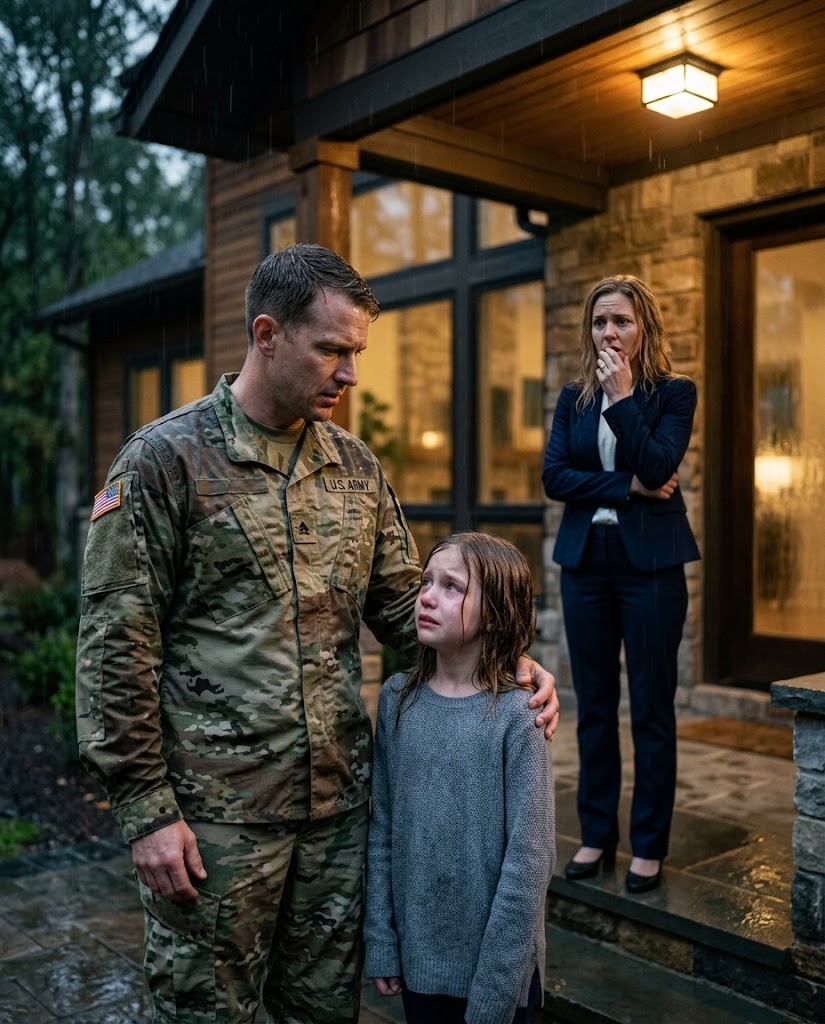
The night my father returned early from his overseas deployment, he wasn’t greeted by the loving household he’d spent months defending—instead, he followed the sound of a child sobbing through a raging storm and pried open a shed door that never should have been locked. What waited for him inside would shatter every belief he held about his home, his marriage, and the people closest to him.
The night my father came back from war, I was certain I would die inside a garden shed.
Rain pounded the wooden roof so violently it sounded like countless small fists striking above me. Each thunderclap made me flinch. The darkness felt like a living thing, closing in from every side. I sat pulled into the far corner of the shed, arms wrapped so tightly around my knees that they ached. Dust clung to my clothes. The stench of gasoline, mildew, and damp wood stung my nostrils. I had lost track of how long I’d been shut in there—maybe hours. In that blackness, time no longer meant anything. All I knew was this: if she came back before I was rescued, things would only get worse for me.
My name is Ava Reed. I was eight that summer, and up until a few months before, my life had felt uncomplicated. My father, Master Sergeant Ethan Reed, was everything to me. He never skipped a single school performance, made pancakes shaped like faces every Saturday morning, and always found a way to pull a laugh out of me when I was down. Right before he shipped out overseas with the Army, he crouched down beside me at the airport, brushed a piece of hair from my face, and gave me a smile. “Just a few months, Peanut,” he said. “Then I’ll be home. We’ll get the biggest ice cream sundae in Texas.” I’d giggled and promised him I’d hold his seat. Back then, I truly believed nothing would be different by the time he returned.
But everything shifted once he was gone.
My stepmother, Cassandra Vaughn, had been married to my dad for under two years. In the beginning she seemed pleasant—at least whenever he was around. She brought me birthday gifts, sat with me over homework, and used to call me sweetheart. But the instant his plane vanished into the clouds, something in her flipped like a switch. The kindness disappeared. The warmth was gone. All at once, nothing I did was right. Spill a little milk, and I was careless. Forget a chore, and I was lazy. Cry, and I was being dramatic. Each week the discipline grew crueler. Each week her resentment toward me seemed to deepen. And with Dad thousands of miles away, no one stood between us.
At first, I tried reaching him. But Cassandra always hovered close during our video calls. If I hinted that I was unhappy, she’d flash a sweet smile at the screen and remind me my chores were waiting. Once the call ended, the punishment that followed was always worse. Eventually I gave up trying. I told myself maybe I really did deserve it—maybe I just wasn’t good enough. That’s what she drilled into me nearly every single day. Children start to believe things once they hear them enough times.
A sudden gust shook the shed’s walls and pulled me back to the present moment. My eyes burned from crying. I wiped them with the sleeve of my oversized sweater—Dad’s old sweater. Even after months apart, it still carried a trace of his aftershave. I pressed my face into it and repeated the same words I’d been whispering all night. “Please come home, Dad.” The words vanished into the storm. No one answered.
That afternoon, Cassandra had accused me of taking money from her purse. I hadn’t touched it—I hadn’t even gone upstairs. But the truth never mattered to her. She grabbed my arm hard enough to leave red marks and hauled me across the backyard while I cried and pleaded with her to listen. Then she pushed me into the shed. Before I could escape, she slammed the door shut. I heard the metallic click of a chain looping around the handle. “Maybe a few hours alone will teach you some respect,” she yelled through the door. Then her footsteps faded away. I screamed until my throat was raw. No one came.
Through the crack in the wall, the sky kept darkening until every trace of sunset was gone. Dread wrapped around me like a heavy blanket. Every noise sent my pulse racing—branches scraping the roof, thunder rumbling overhead, a dog barking somewhere nearby. Then came a thought even more frightening: what if Dad didn’t get home for weeks? What if Cassandra just forgot about me? My chest tightened until breathing felt impossible.
Then I heard something.
A car door slammed shut.
I froze.
For a moment I was sure Cassandra had returned, and my stomach dropped instantly. Tears welled up again. Seconds later I heard footsteps crossing the yard—heavy, purposeful footsteps. Not hers. The rain drowned out most of the sound, but I could tell they were getting nearer. My heart slammed so hard I could hear it in my ears.
The shed’s handle rattled suddenly.
I gasped and pressed myself deeper into the corner.
The chain outside clanged.
Then a man’s voice broke through.
“Ava?”
Everything stopped.
I recognized that voice instantly.
For a split second, I thought I was dreaming it up.
“Ava? Honey, are you in there?”
My breath caught in my throat.
“Dad?”
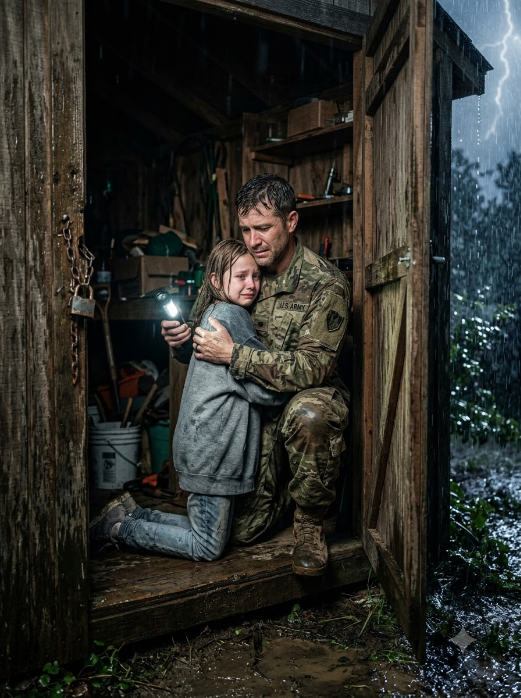
The chain rattled once more. Metal scraped against metal. The old door groaned open bit by bit. A flashlight beam cut through the dark. There in the doorway, drenched from the rain and still in his Army uniform, stood my father.
I burst into tears.
“Dad!”
I sprinted toward him so fast I nearly tripped. He dropped to his knees just in time to catch me. His uniform was soaked and freezing, but none of that mattered to me. I pressed my face against his chest and clung to him like he might vanish if I let go. His arms closed around me—tightly, almost desperately. I could feel him trembling. At first I assumed it was just from the cold rain.
Then I realized it was fear.
“Ava,” he murmured. “Sweetheart, what happened?”
I couldn’t get any words out. The crying wouldn’t let me.
Dad’s gaze swept slowly across the shed—the chain dangling from the outside latch, the padlock, the dirty floor, the blanket beneath me, the empty water bottle in the corner.
His face changed.
The confusion drained away.
The soldier in him surfaced.
His jaw clenched.
His eyes went cold.
And for the very first time, I saw something in my father that truly scared me.
Fury.
He gently tilted my chin up.
“Ava,” he said softly.
The steadiness in his voice unsettled me more than any shouting could have.
“Tell me who did this to you.”
Without thinking, I glanced toward the lit-up windows of the house.
My whole body tensed up.
Fear rushed back into me instantly.
Dad followed where I was looking.
And I could tell the exact second he understood.
I swallowed hard and leaned in close so only he would hear.
“She said she’d hurt me if I told you.”
My father’s expression turned lethal.
Then the front door of the house swung open.
And the woman who had locked me in the shed walked out onto the porch.
The instant Cassandra appeared on the porch, my whole body went stiff. Rainwater streamed off the roof’s edge behind her as she stood frozen under the yellow porch light. A bag of groceries slipped from her fingers and hit the wooden boards with a heavy thump. For several long seconds, nobody moved. My father stayed kneeling beside me, one arm curled protectively over my shoulders. Cassandra’s eyes darted from his uniform, to my tear-streaked face, and finally to the chain hanging off the shed door. I watched all the color drain out of her. She hadn’t planned on him coming home for another three weeks.
“Ethan?” she said, her voice faltering. “You’re back early.” My father’s tone stayed level. Too level. “Why was my daughter locked in a shed?” His question cut through the storm like a blade. Cassandra’s mouth opened, but no words came out at first. Then she gave a nervous laugh. “You don’t understand what’s going on.” “Then tell me.” “She was misbehaving.” I felt his arm tighten around me. “She was locked outside in a thunderstorm.” “She needed to be disciplined.” The words hung there in the rain.
Even as an eight-year-old, I could see the shift happening in my father’s eyes. Whatever confusion he’d walked in with was gone, replaced by a hard, terrible clarity—the kind a soldier might feel upon finally spotting an enemy hidden in plain sight. Without saying another word, he steered me toward the house. Cassandra tried to block our path, but he didn’t so much as glance her way. “Move.” That single word carried enough weight to make her step aside immediately.
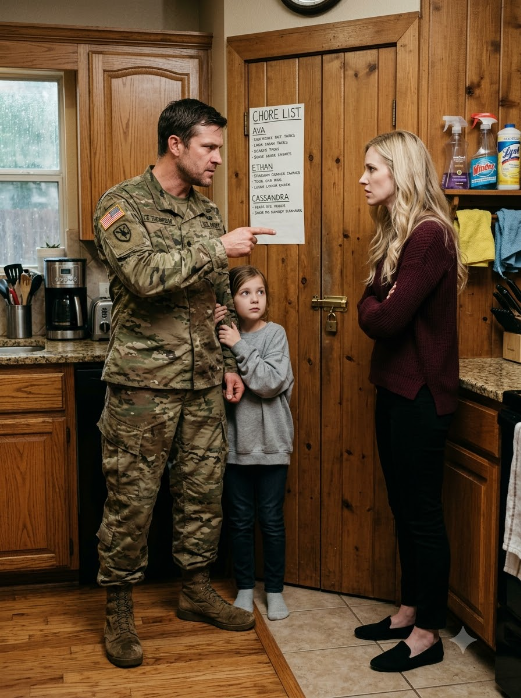
Once inside, the house felt different somehow. My father was noticing things he’d never registered before. The chore lists taped to the fridge, every one written in my handwriting. The cleaning supplies stacked outside my bedroom door. The thin mattress on my floor where my actual bed used to sit. He moved silently from room to room, taking in every detail. I trailed behind him while Cassandra kept talking, trying to explain it all away. She claimed I was a difficult child. She claimed I lied constantly. She claimed she was only teaching me responsibility. But the more she talked, the less convinced my father seemed.
Then he pulled open the pantry. And found the lock—a heavy metal latch fastened over the cabinet shelf where the food and snacks were kept. The kitchen went dead silent. “What is this?” he asked. Cassandra swallowed hard. “It’s for budgeting purposes.” “Budgeting?” She looked away. My father said nothing else.
Instead, he knelt down beside me. “Ava, sweetheart, tell me the truth.” I stared down at the floor, fear squeezing my chest. If I spoke up, Cassandra would make me pay for it later—she always did. My father gently lifted my chin. “You are safe.” Just three words. That was enough.
Everything came pouring out of me—the screaming, the punishments, the insults, the nights with no dinner, the endless chores, the threats, the shed. Every awful memory I’d buried for months spilled into the open at once. The longer I spoke, the whiter Cassandra’s face became. Several times she cut in to deny something, but my father shut her down immediately. By the time I’d finished, I was shaking too hard to breathe steadily.
My father sat perfectly still for a moment. Then he rose to his feet. “I want you out of this house.” Cassandra stared at him. “What?” “You heard me.” “You can’t be serious right now.” “I said leave.” Genuine panic flickered across her face for the first time. “This little liar has twisted your mind.” My father stepped closer. “No.” His voice dropped even lower. “You abused my child.”
The room seemed to freeze. For a second, I thought Cassandra might finally break down and apologize. Instead, she snapped. Months of buried resentment came pouring out all at once. She shouted about everything she’d sacrificed. She shouted about money. She shouted about how hard it had been, left alone during his deployment. Then, in a moment she could never take back, she screamed out the truth. “She isn’t even my daughter!” The words echoed through the house. Silence fell. My father looked at her as though seeing her for the very first time.
“No,” he said quietly. “But she’s mine.”
That night, Cassandra was gone. But the ordeal wasn’t over yet.
The next morning, my father brought me to see a pediatric specialist. Doctors found and documented bruises I’d thought had already healed. They weighed me and discovered I was seriously underweight for my age. They asked questions no child should ever have to answer. Every answer revealed another piece of what had happened. Soon social workers got involved, then investigators. Over the weeks that followed, more evidence came to light. Teachers described noticeable changes in my behavior. Neighbors mentioned hearing arguments. One neighbor even handed over security footage showing me doing yard work late at night while Cassandra watched from the porch. Each new piece strengthened the case against her.
Through it all, my father stayed by my side. He came to every appointment, every interview, every therapy session. Some nights I’d wake up screaming from nightmares and find him asleep in a chair next to my bed, afraid I’d be scared to wake up alone. Slowly, I started to believe I was actually safe. Then the investigators uncovered something none of us saw coming. Cassandra hadn’t acted alone. Financial records revealed she’d been quietly in contact with someone throughout my father’s entire deployment—someone who had encouraged what she was doing, someone who had helped conceal it. And when my father discovered whose name was attached to those messages, I watched every ounce of color drain from his face. Because the person on the other end of those texts was someone we both trusted completely: my grandmother. His own mother.
When the investigators revealed my grandmother’s name, I assumed it had to be some kind of mistake. My grandmother, Eleanor Reed, had always seemed so warm whenever she visited. She sent birthday cards in the mail. She mailed Christmas presents. She called me sweetheart and kissed my forehead hello. I couldn’t wrap my head around how her name could show up in hundreds of messages exchanged with Cassandra.
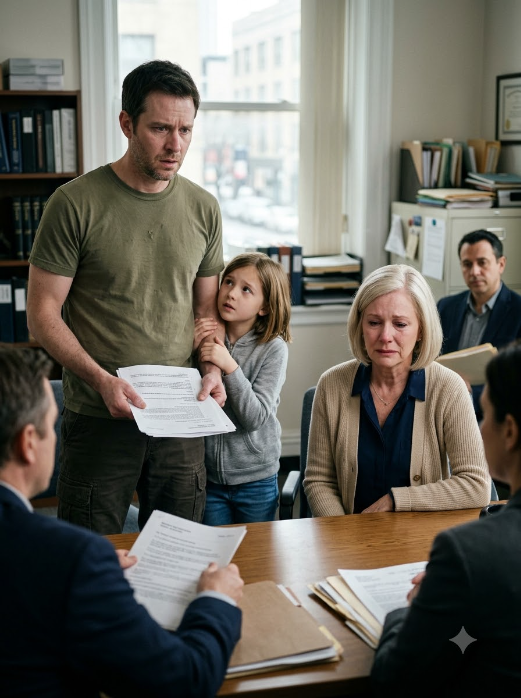
My father couldn’t make sense of it either. For days, he simply refused to accept it. Then the investigators laid it all out for him—texts, emails, bank transfers, voice recordings. There was no way to deny it anymore. As it turned out, Eleanor had never fully accepted me after my mother passed away. She believed my father devoted too much of his energy to me instead of rebuilding his own life. While he was overseas, she’d become Cassandra’s closest confidant. What started as complaints eventually turned into encouragement. Whenever Cassandra described the punishments she gave me, Eleanor rarely pushed back—sometimes she even suggested being stricter. Neither of them ever expected their private messages to surface.
That betrayal cut my father deeper than anything else had. He’d spent years risking his life overseas, believing his family was looking out for one another back home. Instead, the people he trusted most had let down the person he loved most of all. Me.
A month later, authorities formally charged Cassandra with child abuse and neglect. The court process dragged on for months. Throughout the hearings, she kept insisting she’d only been disciplining me. But the photographs, the medical records, the witness statements, and her own messages told an entirely different story. Eventually she took a plea deal that included probation, mandatory counseling, and a no-contact order regarding me. One line from the judge stuck with me afterward: “Children are not possessions. They are not targets for frustration. They are human beings deserving protection.” For the first time, I felt like someone had genuinely listened to me.
As for Eleanor, she was never criminally charged since she hadn’t directly taken part in the abuse. But her life changed permanently anyway. Friends found out what had happened. Relatives pulled away from her. Worst of all, my father cut ties with her completely. The day he told her his decision, I saw tears form in his eyes. “You were supposed to protect her,” he told her. From what he said, Eleanor broke down crying. She apologized. She begged him to forgive her. But some things can’t be undone just because someone finally feels sorry for them.
The year that followed wasn’t simple. Healing rarely is. I still flinched whenever voices got loud. I still stashed snacks under my bed, part of me still afraid food might disappear again. I still had nightmares about the shed. But every single time, my father was there—patient, steady, unshakeable. He never told me to just move past it. He never rushed my recovery. Instead, he helped me put myself back together, one day at a time.
Fridays became something special for us. Every week after school, we went to the same ice cream shop for the biggest sundae in Texas, just like he’d promised before he ever left. Sometimes we sat there cracking up over melted chocolate and whipped cream. Other times we barely said a word to each other. It didn’t matter either way. What mattered was that he kept showing up—again and again, consistent and dependable, the way real love always shows up.
Years went by. The grip of fear gradually loosened. Therapy helped. Time helped. Love helped. By the time high school started, I wasn’t that terrified little girl trapped in a shed anymore. I got involved in student leadership programs. I volunteered with groups that supported vulnerable kids. I discovered that helping other people made me feel stronger too.
One spring afternoon, almost a decade after that stormy night, I stood on a stage accepting a scholarship to study psychology. My father sat in the front row, his eyes shining with pride. After the ceremony ended, he pulled me into a hug. “Your mom would be proud of you.” Neither of us said anything for a moment. Then I smiled. “I learned resilience from both of you.” Years later, I became a licensed child therapist. Every single day, I worked with kids carrying fears that looked a lot like the ones I once carried myself. And every day, I tried to offer them the one thing I needed most when I was eight: someone who actually listened.
As for Cassandra, I heard she eventually relocated to another state once she’d finished her counseling requirements. We never spoke again. I don’t know if she genuinely changed. I hope she did—not for my sake, but for anyone else who might ever cross her path. Eleanor spent years trying to rebuild our relationship. Eventually my father agreed to limited, occasional conversations, but things between them never fully healed. Trust, once broken that badly, leaves scars that never completely fade.
My father retired from the Army not long after I graduated high school. He never remarried. Whenever people asked why, he’d just laugh and say he already had the most important job in the world—being my dad.
Last summer, the two of us stood together in the backyard of our old house. The shed was gone; my father had torn it down himself years earlier. In its place now stood a tall oak tree—strong, healthy, unshakeable. We sat beneath its shade as sunlight filtered down through the branches. “Do you ever think about that night?” I asked him. He gazed up at the tree for a long moment. “Every day.” “Me too.” He gave my shoulder a gentle squeeze. “But that’s not the story anymore.” I looked up at the oak swaying gently in the summer breeze, and for the first time, I understood he was right. The story was never really about a little girl trapped in a shed. It was about a little girl who survived. A father who came home. And a truth no child should ever have to forget: the people who truly love you don’t make you live in fear. They make you feel safe enough to grow.
