

A Black woman traveling on a passport like this? I don’t think so.
Officer Brett Wilson held Patricia’s passport between two fingers as though it were evidence from a crime scene. Patricia kept her voice steady.

“Sir, that’s a legitimate federal document. I’m a surgeon traveling to Geneva.”
“Sure you are.”
Wilson glanced toward Officer Davis.
“Tyler, you seeing what I’m seeing?”
Davis grinned.
“Looks fake to me, Brett.”
Wilson ripped off the cover. Davis snatched the pages and tore them apart. Together, they destroyed it piece by piece. Shredded fragments dropped to the ground.
“Federal offense, ma’am, using fraudulent documents.”
Wilson drew out handcuffs.
“You’re under arrest.”
Patricia’s phone rang. The screen showed James, State Prosecutor’s Office. She reached for it.
“I need to take that call.”
“No calls.”
Wilson snapped the cuffs onto her wrists.
“You can talk to your lawyer later. Though I doubt any lawyer can help you now.”
What happens when police destroy the wrong woman’s passport?
Seventy-two hours earlier, Patricia Anderson’s biggest worry had been her presentation slides. She sat at the kitchen table in their Boston brownstone, laptop open, reviewing the data for the hundredth time.
The International Medical Ethics Summit in Geneva. Two thousand physicians from sixty countries. Her research on implicit bias in emergency medicine would be livestreamed to 50,000 more viewers.
Three years of work. Ten thousand patient cases analyzed. The findings were damning.
Black patients waited 38% longer for pain medication. Black women died from pregnancy complications at nearly four times the rate of white women. Black children with appendicitis waited 34% longer for treatment.
The numbers didn’t lie. The system did.
Patricia grew up in Detroit. Her mother worked two jobs just to feed three children. Their apartment had peeling paint and winters cold enough to see your breath indoors, but her mother had one rule that never changed.
“Education is your way out.”
Harvard Medical School had seemed impossible back then. Now Patricia had the degree framed on her wall. She had made it out. Now she devoted her career to helping others do the same.
Her phone buzzed. A text from James.
“Working late again. Big case goes to jury tomorrow. Love you. Don’t forget to pack your good shoes.”
She smiled. James always focused on the small things.
They met eighteen months earlier at a criminal justice reform fundraiser. He was the keynote speaker. She was there supporting a colleague. He joked that prosecutors and doctors both deal with life and death decisions. She corrected his statistics on wrongful convictions. He asked her to dinner before the event ended.
Six months later, he proposed at the same place they met.
James Anderson. The state’s top prosecutor. The man who put six corrupt Riverside police officers behind bars. A prosecutor who made powerful people uneasy. The one who never backed down.
But they kept their marriage fairly private. His cases created enemies. Death threats weren’t uncommon. The fewer people who knew about his family, the safer everyone remained.
Patricia closed her laptop. Her flight left Saturday morning, 6:48 departure. She would arrive in Geneva with time to spare.
She had no idea that Saturday morning would change everything.
Saturday arrived cold and clear. Patricia dressed with care. Navy suit. Professional. Confident. Her conference badge hung from a lanyard. Her carry-on held three days of clothes and a backup hard drive with her entire presentation.
Her passport sat in her purse. Valid for another three years. Stamps from medical conferences in London, Tokyo, Singapore, Johannesburg.
She kissed James goodbye at 5:30. He had stayed up waiting for her despite his exhausting case. That was James. Always present. Always protective.
“Call me when you land,” he said.
“I will. Good luck with the verdict.”
“They’re guilty. Jury knows it. I know it. Even their lawyers know it.”
She touched his face.
“Then come home and rest. You’ve earned it.”
Metropolitan Regional Airport, Terminal 3.
6:48 in the morning meant crowds, rushing business travelers, families managing luggage. The usual chaos of a Saturday departure rush.
Patricia joined the security line. Seventeen people ahead of her. She checked her watch. Ninety minutes until boarding. Plenty of time.
The line moved steadily. Shoes off, laptop out, liquids in a bag. She had done this many times before.
Then she reached the passport check station.
Officer Brett Wilson sat there scrolling his phone. He looked bored. Nineteen years on the job showed in how little attention he gave most travelers. White passengers passed through in seconds.
Patricia handed him her passport. Wilson’s eyes flicked to it, then to her, then back again.
Something shifted in his expression.
He held it longer than necessary, turned it over, lifted it toward the light. His jaw tightened.
“Anderson. That your married name?”
Patricia kept her voice neutral.
“Yes.”
“You travel a lot?”
Wilson flipped through the pages slowly.
“I’m a surgeon. I present at medical conferences.”
“Uh-huh.”
Wilson called over his shoulder.
“Tyler, come look at this.”
Officer Davis approached. Wilson showed him the passport. They whispered.
Behind Patricia, the line stretched longer. A white businessman in an expensive suit shifted impatiently. A young mother tried to quiet two children. An elderly Black woman watched with narrowed eyes.
Davis nodded at whatever Wilson said. Then both officers turned back to Patricia with new suspicion.
“Ma’am, we need to verify some information.”
Wilson stood, still holding the passport.
“I’ve been through this checkpoint many times. That passport is completely legitimate.”
“We’ll determine that.”
Wilson motioned to his supervisor, Rachel Morrison. She arrived, listened to the quiet explanation, then studied Patricia with a cold, measured look.
Morrison nodded.
“Additional screening required.”
They took Patricia’s passport into a back office. Davis positioned himself to block her from following. She stood there, carry-on at her feet, the line growing behind her.
Her phone buzzed. A text from her colleague, Dr. Stevens.
“Safe travels. Can’t wait to hear your presentation. You’re going to change how we treat patients forever.”
Patricia checked the time. 7:03. Seventy-five minutes until boarding.
The businessman behind her spoke loudly.
“Can we move this along? Some of us have important meetings.”
The elderly Black woman two spots back met Patricia’s eyes. Her expression said she understood exactly what was happening. She had seen it before.
A young woman pulled out her phone. Emma Johnson, twenty-eight, traveling to visit family, began recording. Something felt wrong.
Wilson returned holding Patricia’s passport like evidence.
“We’re going to need enhanced secondary screening.”
“Based on what specific irregularity?”
Patricia kept her tone steady, professional. She refused to give them leverage.
“Based on my professional judgment.”
Wilson’s voice made clear that questioning him was not acceptable.
“I’d like to speak with your supervisor.”
“You’re looking at the senior officer on duty.”
Patricia felt the pressure closing in. She knew the data. She had studied it. Black travelers were stopped far more often than their share of passengers. She had presented on bias in security screening.
She had just never expected to become part of the statistic.
Behind her, Emma continued filming. The elderly woman, Judge Margaret Williams, watched closely. Thirty-two years on the federal bench had taught her to recognize unlawful detention instantly.
The departure board updated.
Flight 462 to Geneva. Now boarding in sixty-eight minutes.
Wilson examined Patricia’s wedding ring.
“That real gold?”
The question landed like an insult.
“Excuse me?”
“Just wondering how you afford international travel and expensive jewelry.”
The meaning was clear without being spoken. The assumption underneath everything.
Patricia took a slow breath.
“I’m a Harvard-trained surgeon. I can afford my own jewelry and my own travel.”
Wilson’s expression hardened. She had challenged him in front of witnesses.
He lifted the passport again, gripping it with both hands.
Everything escalated quickly.
“This passport shows signs of tampering.”
Patricia stared at him.
“That’s impossible. It’s a legitimate State Department document.”
“We’ll determine what’s legitimate.”
Wilson’s voice carried through the checkpoint.
“Ma’am, falsifying federal documents is a felony offense.”
The crowd went silent.
“I have never falsified anything.”
Patricia’s voice stayed steady, but fear flickered beneath it.
Fear of being dismissed. Of being erased. Of her credentials meaning nothing.
Davis stepped closer.
“That’s what everyone says when they get caught.”
“Where were you really born?” Wilson leaned in.
“Detroit, Michigan, as stated in the biographical page of my passport.”
“Convenient answer.”
Wilson looked at Davis.
“And your husband? Where’s he from originally?”
Patricia paused carefully.
“Why is my husband’s background relevant to passport verification?”
“I ask the questions. You answer them. That’s how this works.”
Margaret Williams stepped out of the line. At sixty-eight, she recognized injustice immediately.
“Officer, I’ve been observing this interaction. This woman hasn’t done anything wrong.”
Wilson barely acknowledged her.
“Ma’am, step back or you’ll miss your flight.”
“I’m retired federal judge Margaret Williams. I’ve presided over thousands of cases. I know harassment when I see it.”
“I don’t care if you’re the Queen of England. Step back.”
Margaret didn’t move. She began documenting everything, recording badge numbers, times, and exact quotes.
Wilson turned back to Patricia, eyeing her ring again with visible doubt.
“Just wondering how someone in your situation affords all this.”
The words hung heavy. Clear in meaning.
Someone in your situation.
Patricia understood.
“I’m a pediatric trauma surgeon. I’ve saved over two hundred children’s lives. I can afford my own jewelry.”
Wilson’s jaw tightened. She had challenged him again, in front of everyone, in his airport.
Rachel Morrison appeared beside him.
“Brett, maybe we should run this through federal verification before…”
“Rachel, I’ve got this.”
Wilson held the passport up to the light one last time. He dragged his thumb across the pages with theatrical suspicion.
“Yeah, this is definitely counterfeit. I can feel the texture’s wrong.”
“You can’t possibly determine…”
Patricia began, but Wilson didn’t let her finish.
“Federal regulations require immediate confiscation and destruction of fraudulent identification documents.”
“Don’t you dare.”
He yanked the passport cover from the binding.
The sound echoed through the terminal.
Patricia rushed forward.
“Stop.”
Davis seized her arm roughly.
“Don’t touch an officer.”
Wilson continued tearing. Photo page, visa pages, data page—each rip slow, deliberate, precise.
He was enjoying it. The control, the authority, the way this educated Black woman couldn’t stop him.
The fragments fell like snow across the floor.
“Oops.”
Wilson looked straight at Patricia and smiled.
“Guess you’re not flying anywhere today, Doctor.”
He air-quoted doctor, making it clear he didn’t believe her credentials either.
Patricia sank to her knees. She gathered the torn pieces with trembling hands. Tears streamed down her face.
Not sadness. Rage. Humiliation. The crushing helplessness of watching something essential be destroyed and being unable to stop it.
Around her, the crowd shifted and murmured. Emma’s phone kept recording. Margaret wrote furiously in her notebook.
The white businessman behind her stayed silent. He would be through security in minutes. No one would question his passport.
Wilson pulled handcuffs from his belt.
“Actually, you know what? We’re taking you into custody.”
Patricia looked up from the floor, fragments in her hands.
“On what charge?”
“Attempted use of fraudulent federal identification. Conspiracy to defraud the United States government.”
Wilson grabbed her arm and hauled her up.
“And assaulting a peace officer.”
“I never touched you.”
“You lunged at me when I secured the fraudulent document. I saw it. Tyler saw it. That’s assault.”
Davis nodded.
“She definitely came at you aggressively, Brett.”
It was a lie. Emma’s recording would later prove it. But in that moment, it was two officers’ word against one Black woman’s truth.
The cuffs snapped shut around Patricia’s wrists.
Cold metal. Immediate red marks.
Margaret Williams spoke, voice firm and authoritative.
“I’m calling my attorney right now. This is unlawful detention.”
Wilson looked at her.
“You want to join her? I can arrange that.”
Emma kept filming.
“I’m streaming this live. Eighteen thousand people watching.”
Wilson moved toward her.
“No filming in federal security areas.”
The departure board changed again.
Flight 462 to Geneva. Final boarding call. Gate B22.
Patricia’s presentation. Three years of research. Two thousand physicians waiting. Fifty thousand online viewers. All slipping away.
Her phone rang inside the confiscation bag. The screen lit up.
James. State Prosecutor’s Office.
She couldn’t reach it.
Wilson and Davis escorted her toward the detention room. Hands cuffed. Passport destroyed. Dignity stripped in front of witnesses.
No one intervened.
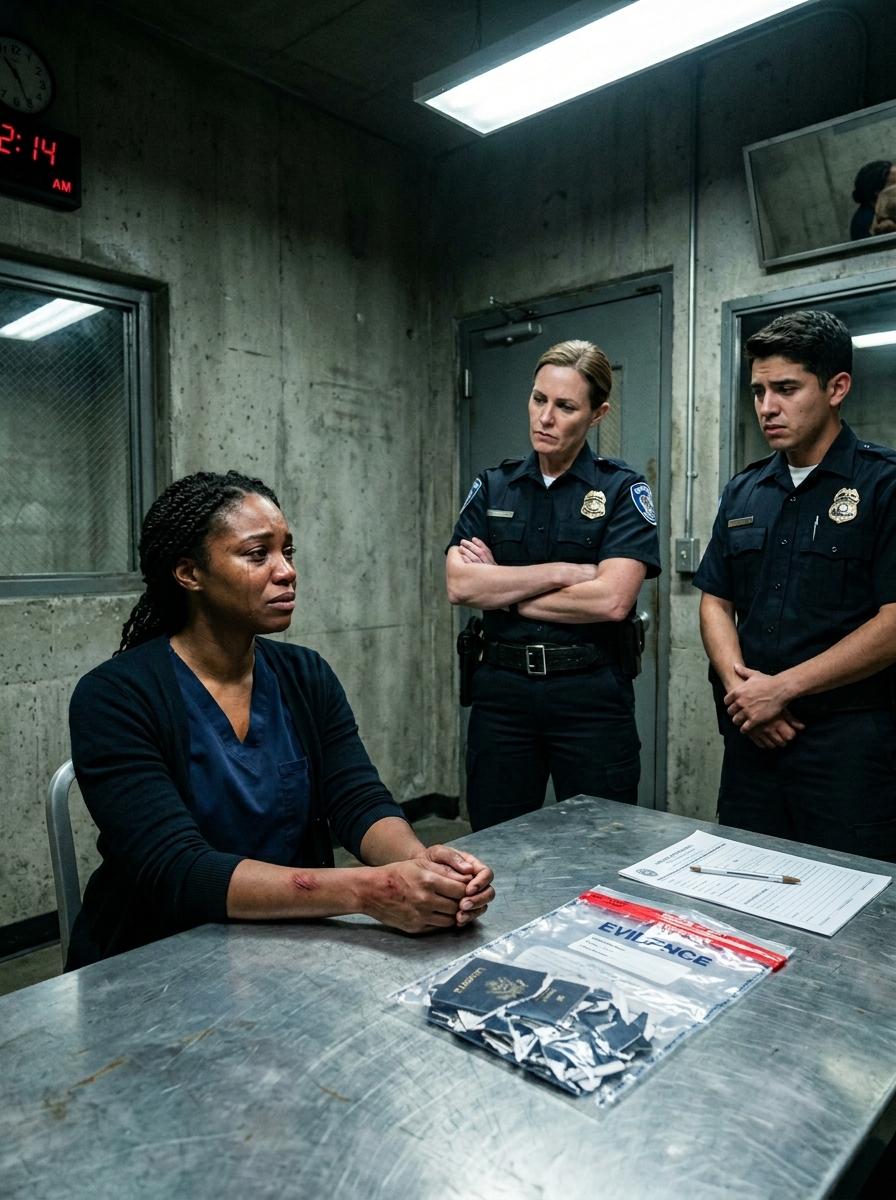
The interrogation room was exactly what it looked like—concrete walls, metal table, one-way mirror.
7:36 a.m. Patricia sat in cuffs, watching her life collapse.
Her phone sat sealed in an evidence bag. Conference badge beside it. Wallet. Keys. Everything that proved who she was—out of reach.
Twenty minutes until boarding. Pointless now.
Wilson sat across from her, boots on the table, deliberate disrespect.
“So, Doctor Anderson, where did you purchase that fake passport?”
Patricia steadied her voice despite the tears.
“I am a licensed pediatric surgeon. Harvard Medical School graduate. My credentials are publicly verifiable. This is racial profiling.”
“Oh, here we go.”
Wilson rolled his eyes.
“Everything’s about race with you people, right?”
Davis leaned against the wall.
“If you just cooperated, none of this would be happening.”
“I have the right to one phone call.”
“You’ll get your call. First, you answer my questions.”
Wilson opened a laptop and typed.
“Says here you’ve got outstanding warrants. Three unpaid parking tickets in Detroit.”
“I haven’t lived in Detroit in twelve years.”
“Says here it’s you. Same name. Amara Hayes.”
Patricia stared at him.
“My name is Patricia. Patricia Anderson, not Amara. You’re looking at the wrong person.”
“So now you’re claiming you’re not Patricia Anderson?”
Wilson leaned forward.
“Changing your story already?”
“That’s not what I said. You’re deliberately…”
She stopped. Exhaled. He was twisting everything—every sentence becoming evidence against her.
Davis pushed off the wall.
“Why are you being difficult? Just tell the truth.”
“I am telling the truth. You destroyed a valid federal document without cause.”
“We determined it was fraudulent. That’s our job.”
Wilson sounded bored.
“Based on nineteen years of experience.”
“Nineteen years isn’t a forensic standard. You need technical analysis, chain of custody, federal verification.”
“Don’t tell me how to do my job.”
The PA system crackled.
“Final boarding call for flight 462 to Geneva, gate B22.”
Patricia closed her eyes.
Gone. Her presentation. Her research. Two thousand doctors who would never hear it.
The irony pressed in on her—she was now living the very bias she had spent years documenting.
Wilson watched her reaction, satisfied.
“That your flight? Should’ve thought about that before using fake documents.”
Davis chuckled.
Patricia opened her eyes.
“I need to call my husband.”
“Husband can’t help you with federal charges.”
“He’s the state’s top prosecutor. Chief prosecutor for this entire state.”
Wilson didn’t react.
“Sure he is. And I’m married to the governor.”
Davis laughed.
“They always say that. Always.”
“His name is James Anderson. You can verify it in thirty seconds.”
“Lady, I don’t care if he’s the president. You committed a federal crime.”
Wilson stood.
“We’re transferring you to county jail.”
“For a passport dispute?”
“For forgery, assault on a federal officer, and whatever else we find.”
He headed for the door.
“Enjoy your weekend.”
The door opened abruptly. Rachel Morrison stood there, face drained of color.
“Brett, you need to come out here.”
“I’m in the middle of an interrogation.”
“The state prosecutor’s office has called three times. They’re asking specifically for Patricia Anderson.”
Her voice shook.
“And Channel 7 News is setting up outside. They’re saying she’s married to—”
Wilson froze for half a second.
“That’s impossible.”
Davis frowned.
“Wait… Anderson? Like the prosecutor who took down Riverside PD?”
Morrison nodded.
“Brett, if this is who they’re saying…”
“There’s no way.”
But Wilson already looked uncertain. He grabbed his phone and searched quickly.
The color drained from his face as results loaded.
State Prosecutor James Anderson. First Black chief prosecutor in state history. Known for aggressive corruption cases. Recently convicted six Riverside officers. Married eighteen months.
A photo loaded.
James Anderson at a legal gala.
Beside him—Patricia, smiling in the same navy suit she was wearing now.
Dr. Patricia Anderson, his wife.
Wilson stared at the screen.
“Oh my God.”
Inside the room, Patricia sat unaware of what was unfolding outside. She didn’t know about the calls. Didn’t know about the viral video. Didn’t know her story was spreading by the minute.
She only knew her flight was gone. Her research was gone. And two officers had destroyed her passport because of how she looked.
Her phone rang again in the evidence bag.
James. Fifth call.
No answer.
Outside, Wilson’s phone rang.
Chief Williams.
Ignored. Again.
Mayor’s Office.
Again.
State Capitol.
Davis watched him, panicking.
“What do we do?”
“We followed procedure. We had reasonable suspicion.”
“We destroyed the wife of the state’s top prosecutor.”
Davis’s voice cracked.
“And there’s video. He smirked. He called her doctor like it was a joke.”
“I was doing my job.”
“You were showing off.”
Silence fell between them.
Because both of them knew.
Wilson hadn’t seen a suspect.
He had seen a Black woman who challenged him—and decided to put her in her place.
And now she turned out to be married to the one prosecutor in the state who specialized in destroying officers who abused their power.
Rachel returned, pale.
“The regional director is here. The FBI is here. And…”
She swallowed.
“Prosecutor Anderson is here.”
Wilson gripped the desk.
“We just explain. It looked fake. It’s not our fault she’s married to—”
The door opened.
Chief Benjamin Williams entered first, uniform crisp, expression stone-cold. Behind him: airport director Douglas Paulson, two FBI agents, and finally James Anderson.
He walked in wearing a charcoal suit, calm but controlled. His eyes swept the room—mirror, evidence bag, torn passport fragments.
Then he saw the interrogation room.
Patricia.
Still in cuffs.
His jaw tightened.
When he spoke, his voice was quiet, controlled, dangerous.
“Would someone like to explain to me why my wife is in handcuffs?”
Wilson tried immediately.
“Sir, we had reasonable suspicion the passport was—”
“I didn’t ask you.”
James didn’t look at him. His eyes stayed on Patricia.
“Chief Williams. What happened?”
Williams gestured sharply.
“Remove those cuffs.”
Davis fumbled, dropped the keys, then unlocked them with shaking hands.
Patricia rubbed her wrists, red marks visible.
James entered the room and pulled her into his arms.
She broke instantly.
“I’m sorry… I’m so sorry…”
“I was in a classified briefing. I didn’t see your calls. I’m sorry.”
“They destroyed my passport…”
“I know.”
He pulled back and looked at her face—then at the table where the torn pieces sat.
Then he turned.
The room changed immediately.
The prosecutor was no longer the victim’s husband.
He was the state’s most powerful legal authority.
“I’m James Anderson. I oversee every criminal prosecution in this state.”
His voice was steady, absolute.
“Including cases involving law enforcement misconduct.”
Wilson tried to speak.
James raised one hand. Silence.
“That’s actually my specialty. Prosecuting officers who abuse authority.”
He pulled out his iPad.
“Would you like to see my record?”
On the screen: conviction after conviction.
Cases. Sentences. Headlines.
“Riverside PD corruption case. Six officers. Fifteen years each.”
“I prosecuted that.”
Wilson went pale.
“Officer Thompson. Evidence tampering. Eight years.”
“I prosecuted that too.”
Swipe.
“Metro Transit profiling case. $4.5 million settlement.”
“I led that prosecution.”
James looked directly at Wilson.
“I have a 94% conviction rate against law enforcement officers.”
A pause.
“Forty-nine officers in prison in eighteen months.”
“And as of one hour ago, the governor personally assigned me to investigate this airport.”
Director Paulson tried to recover the situation.
“Prosecutor Anderson, we had absolutely no idea your wife was…”
Patricia cut him off, her voice like steel.
“I shouldn’t have to be married to anyone powerful to be treated with basic human dignity.”
The room fell completely silent.
James nodded once.
“She’s right. The fact that I’m who I am shouldn’t matter. But since it does…”
He turned back toward Wilson and Davis.
“You’re about to understand exactly what that means.”
FBI Agent Robert Cooper stepped forward.
“Dr. Anderson, we confirmed your passport through federal systems. Nine seconds. It’s fully authentic and valid.”
He raised his tablet. Green verification marks filled the screen.
“Harvard Medical School, top 5% of your class. Michigan State medical license, active and in good standing. No criminal history. Clean record.”
Cooper looked directly at Wilson.
“These officers had no legal basis to detain you, interrogate you extensively, or destroy federal property.”
Wilson tried again.
“The texture felt off. The paper…”
“State your forensic document analysis training,” Cooper said flatly.
Wilson went quiet.
“That’s what I thought. You don’t have any. You acted on assumption rooted in bias.”
Chief Williams pointed toward Wilson and Davis.
“Both of you. In here. Now.”
They stepped forward like men heading toward judgment.
James brought up more data.
“Officers, let me show you something.”
The screen filled with statistics.
Black passengers made up 12% of travelers at this airport. Officer Wilson subjected Black passengers to additional screening 73% of the time.
He swiped.
Ninety-six accusations of fraudulent documents against Black passengers over five years. Confirmed fraud: zero.
Wilson stared at the floor.
White passengers: 8% stopped. Confirmed fraudulent documents found by others: fifteen.
James zoomed in on Wilson’s image.
“This shows consistent, intentional racial profiling across your entire career.”
“I don’t see color. I treat every passenger…”
“The data disagrees. Numbers don’t lie.”
James switched screens again.
“You know what else doesn’t lie? Video.”
Emma Johnson’s livestream appeared, crystal clear.
Wilson’s voice echoed.
“A Black woman with a Harvard degree flying first class? This passport is fake.”
The tearing. The pages scattering. The smirk.
“Guess you’re not flying anywhere today, sweetheart.”
The air-quote around doctor.
James paused the frame on Wilson’s expression.
“Three hundred sixty-two thousand people have seen this. Including the governor, the U.S. Attorney General, and major news networks.”
He turned toward Wilson.
“You didn’t just destroy a passport. You did it with satisfaction. Because you saw a Black woman who challenged you, and you decided to humiliate her.”
Patricia stepped forward into the center of the room, voice steady and controlled.
“You called me sweetheart. You questioned my wedding ring. You asked how I could afford travel.”
She moved closer to Wilson. He couldn’t meet her eyes.
“You saw a Black woman and assumed crime. Fraud. Incompetence.”
Wilson said nothing.
“I’m a Harvard-trained surgeon. I’ve saved 206 children. My research will change emergency care for Black patients.”
Her voice stayed level.
“And you treated me like I was nothing because of my skin.”
The door opened. Judge Margaret Williams entered holding a USB drive.
“Prosecutor Anderson, I’m retired federal judge Margaret Williams. I witnessed everything from the security line.”
She handed the drive to James.
“Full video recording and my sworn statement.”
Her eyes locked on Wilson.
“I identified myself as a federal judge. You told me you didn’t care if I was the Queen of England. You dismissed my testimony.”
She turned to James.
“In thirty-two years on the bench, this is one of the clearest civil rights violations I’ve ever seen.”
Davis broke down.
“I just followed Brett. I didn’t think…”
“You grabbed my wife’s arm,” James said quietly. “You backed false statements in an official report. That makes you an accomplice.”
Patricia looked at Davis.
“You laughed when he mocked my ring. You watched me be humiliated.”
“I’m sorry. I didn’t mean…”
“Sorry doesn’t bring back my presentation. It doesn’t erase what you did.”
Patricia’s voice cut through him.
“Sorry is just a word.”
Agent Cooper stepped forward.
“The FBI is already building national cases on airport civil rights violations. This incident, with video, witnesses, and a federal judge, is exactly what we need.”
“Good.”
James made a call.
“This is Prosecutor Anderson. Proceed with charges. Both officers. State and federal. No plea deals.”
Wilson staggered slightly.
“You can’t…”
“I can.”
James ended the call.
“Officer Brett Wilson, I am personally charging you with deprivation of rights under color of law, destruction of federal property, false imprisonment, filing false statements, conspiracy to violate civil rights, and hate crime enhancements.”
He paused.
“You are facing twelve to twenty-five years in federal prison.”
Wilson’s voice cracked.
“I was just doing my job.”
“Your job is to protect passengers, not terrorize them based on race.”
James turned to Davis.
“Officer Tyler Davis, accessory to civil rights violations, false statements, conspiracy. Eight to fifteen years.”
Davis collapsed into a chair.
“I have kids. I’ll lose everything.”
Patricia looked at him.
“I have a family too. Did you think about them when you destroyed my passport?”
Outside the windows, a crowd had formed. Two hundred travelers. Signs raised.
We saw racism.
Fire racist cops.
Justice for Dr. Anderson.
Emma’s livestream showed 392,000 viewers.
National attention. Real time.
James opened another file.
“This investigation didn’t start today.”
He brought up more data.
“For six months, we ran controlled testing. Two hundred passengers. Equal numbers Black and white. Identical valid documents.”
He let it sink in.
“Black travelers stopped: 78%. White travelers stopped: 4%.”
He swiped again.
“Average delay: 45 minutes for Black travelers. Eight minutes for white travelers.”
Another pause.
“Officer Wilson alone accounted for sixty-two stops of Black passengers. One white passenger.”
He looked up.
“That level of disparity is statistically impossible without intent.”
He switched again.
“$3.8 million in lost wages and opportunities due to missed flights. Twenty-three missed family emergencies. Three funerals. Five births.”
Patricia added softly.
“And psychological harm that cannot be measured.”
James turned to Rachel Morrison, who had been shrinking into the corner.
“Ms. Morrison, you dismissed five formal complaints against Officer Wilson.”
Her face went pale.
“I followed protocol.”
“Your protocol protected officers, not citizens.”
James displayed her signed dismissals.
“You’re being removed immediately. You’re also being named in a federal civil rights suit. We’re reviewing criminal obstruction charges.”
Morrison looked close to collapsing.
Chief Williams stepped forward.
“Officer Wilson, Officer Davis. You are both suspended without pay pending investigation.”
Wilson tried again.
“Chief, you can’t just…”
“Turn in your badges and weapons. Now.”
Shaking hands complied.
Wilson unclipped his badge of nineteen years. It felt heavier than anything he had ever held.
James wasn’t finished.
“Tomorrow at 9 a.m., I am filing a federal lawsuit against this airport, TSA, the city, and every official involved.”
Director Paulson tried to speak. James raised a hand. Silence.
“We are seeking twelve million dollars in damages. Funds will go directly to civil rights and anti-bias reform programs.”
His gaze moved across the room.
“This system ends today.”
Patricia walked to the window and looked outside. The chanting was louder now.
She turned back.
“I study how implicit bias kills patients. Doctors see Black skin and stop thinking clearly. They assume drug-seeking. They assume exaggeration. They assume dishonesty.”
She stepped forward.
“You did the same thing. You saw my skin and stopped processing facts.”
Wilson still couldn’t look at her.
“If this happens to me—with my education, my credentials, my husband—imagine what happens to everyone else.”
Silence filled the room.
James delivered the final line.
“You saw Black skin and stopped thinking. That is racism. And you will face the consequences.”
Wilson whispered.
“I have a family. Three kids. I’ll lose everything.”
Patricia stepped close.
“I have a family too. Patients who depend on me. Did you think about that when you destroyed my passport?”
James finished it.
“You didn’t just destroy a document. You prevented life-saving research from being shared with two thousand doctors. Research on bias that kills patients.”
Wilson had nothing left to say.
A voice outside called through the glass.
“Dr. Anderson, will you push for maximum sentencing?”
Patricia looked at James. A long silence passed.
Then she turned to the window, placing her hand on the glass. The crowd erupted.
She faced the room again.
“This is only the beginning. We will make sure this never happens again.”
James stood beside her.
“Every law enforcement officer in this state is going to learn there are real, serious, permanent consequences for racism.”
The camera captured Wilson’s face at that exact moment.
The precise second he understood his entire life was over.
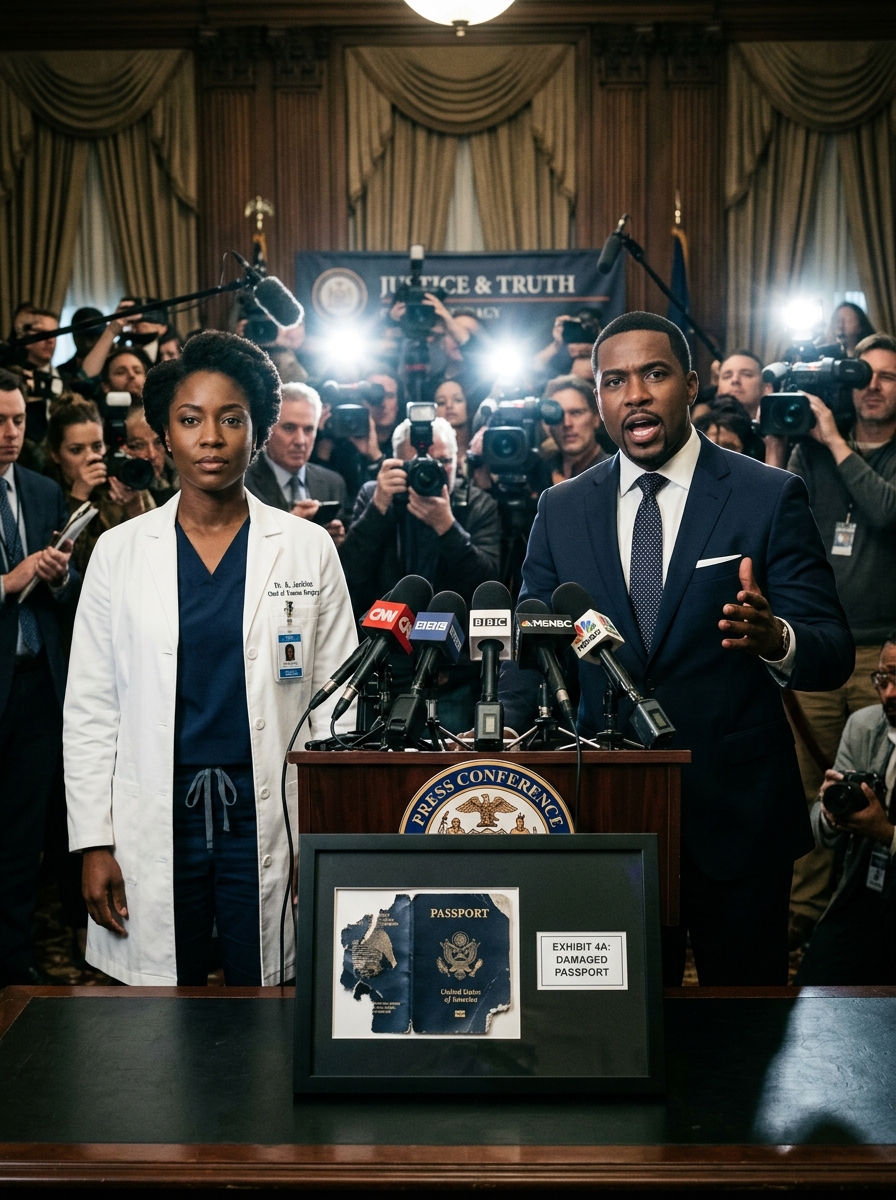
Two hours later, the airport conference room was overflowing with journalists. Fifty cameras, microphones packed together, flash bursts turning the room into strobing light.
James and Patricia stood at the podium, presenting a united front. Patricia’s torn passport was sealed in a clear evidence frame on the table—a physical record of what had been done to her.
James spoke first, his prosecutor’s voice filling the room.
“At 7:15 this morning, my wife, Dr. Patricia Anderson, a distinguished pediatric trauma surgeon and Harvard Medical School graduate, was racially profiled, falsely accused, and had her legitimate passport destroyed by Officer Brett Wilson.”
He paused, allowing the cameras to focus on the fragmented document.
“As this state’s chief prosecutor, I have spent my career holding powerful individuals accountable when they abuse that power. Today, that responsibility became personal.”
Patricia stepped up to the microphone.
“I’m a Harvard-trained surgeon. I’ve saved over two hundred children’s lives. I’ve published peer-reviewed research on implicit bias in emergency medicine.”
Her voice was steady and unwavering.
“Today, I was treated like a criminal. Not because of anything I did, but because of the color of my skin.”
The room fell completely silent.
“Officer Wilson didn’t verify my passport. He didn’t consult databases. He didn’t follow forensic procedures. He saw my Black skin, formed an assumption, and acted on racial bias.”
Patricia’s voice grew stronger.
“This is America’s original sin—the assumption that Black people are guilty until proven otherwise. And it continues every day in airports, hospitals, schools, and streets across this country.”
She looked directly into the cameras.
“But I had something most victims don’t: resources, a powerful husband, video evidence, and witnesses who spoke up.”
Emma Johnson sat in the front row. Margaret Williams beside her. Both nodded.
“We’re going to use every advantage we have to fight for those who don’t have any.”
James played the unedited footage for the press—Emma’s livestream, raw and unfiltered.
Wilson’s voice filled the room.
“A Black woman with a Harvard degree flying first class to Europe? This passport’s fake.”
The destruction. The smirk. The scattered pages.
“Guess you’re not flying anywhere today, sweetheart.”
Gasps rippled through reporters. Several visibly recoiled.
One veteran journalist from The Washington Post leaned toward a colleague and whispered, “In twenty-five years, I’ve never seen a clearer civil rights case.”
James outlined the consequences.
“Officers Wilson and Davis have been terminated. They are facing both state and federal charges. I will personally prosecute the state case. The U.S. Attorney will handle federal prosecution.”
A reporter called out.
“Will you consider a plea deal?”
“No. This will go to trial. Full transparency. Full accountability.”
“What sentences are you seeking?”
“Maximum allowed under law. Twenty-five years for Wilson. Fifteen years for Davis.”
The numbers landed heavily.
Patricia added, “We are filing a twelve-million-dollar civil rights lawsuit. Every dollar will fund civil rights organizations and anti-bias training programs nationwide.”
That evening, Patricia and James sat alone in their hotel suite. Neither was ready to return home.
Patricia finally broke down completely—twenty minutes of sobbing, all the fear, rage, and humiliation pouring out.
James held her without letting go.
“I was so scared,” she whispered. “Not of arrest. Not of charges. I was scared of being erased—of everything I’ve accomplished being reduced to nothing because of my skin.”
James’s own tears fell.
“You’re not invisible, Trisha. Not anymore. Your voice is going to change everything. I promise you that. I’m sorry I wasn’t there sooner.”
“You were there when it mattered.”
They stayed like that for a long time—silent, steady, recovering.
The next morning, the State Department called personally. The Deputy Secretary himself.
“Dr. Anderson, we are deeply sorry. Your passport replacement is being expedited immediately—twenty-four hours, hand-delivered by diplomatic courier.”
It arrived in a sealed diplomatic pouch with a gold-embossed seal, processed by direct order of the Secretary of State.
A handwritten note was enclosed.
“We are profoundly sorry. Your voice matters. Your work matters. You matter. — Secretary of State”
Patricia held the new passport in her hands, feeling its weight. It would take her to Geneva—but first, she had to process everything.
The national reaction exploded.
Within forty-eight hours, fifteen million people had watched Emma’s video. Hashtags like Justice for Dr. Anderson, End Airport Racism, and Traveling While Black trended globally.
Major outlets ran front-page coverage.
The New York Times: “How Dr. Patricia Anderson Became the Face of Airport Racial Profiling.”
The Washington Post: “When Privilege Exposes Injustice: One Woman’s Story.”
Television coverage ran nonstop. A former president issued a statement. Senators introduced federal legislation.
And thousands of Black travelers began sharing their own stories—accounts long ignored, now impossible to silence.
Patricia’s case had opened a floodgate.
Seventy-two hours later, termination hearings concluded. The police union initially threatened to fight, but public backlash was immediate and overwhelming.
Within a day, union headquarters received fifty thousand messages. The union president released a statement.
“While we support due process, the video evidence is overwhelming and disturbing. We will not contest these terminations.”
Wilson and Davis lost everything—benefits, pensions, futures. Wilson’s nineteen-year pension vanished. Davis’s eight-year pension disappeared.
Total loss: $2.8 million.
Two weeks later, federal indictments were issued. The U.S. Attorney announced charges: Wilson faced six federal counts with up to twenty-five years and a $250,000 fine. Davis faced four counts with up to fifteen years and a $150,000 fine.
State charges followed immediately from James—eight additional counts each.
Legal analysts were unanimous.
“The video makes this indefensible. They should plead.”
James responded publicly.
“No plea deals. This goes to trial. Full accountability.”
More victims came forward. Thirty-one additional complaints spanning Wilson’s career.
Investigative reporting followed.
“A Nineteen-Year Pattern of Bias: Officer Wilson’s Record” ran on the front page.
His life collapsed. His wife filed for divorce within a week. His children publicly distanced themselves. His home went into foreclosure. Lawsuits piled up—eighteen former victims seeking $28 million.
Wilson became a national symbol of abusive policing.
Davis took a different path. He wrote to Patricia.
A handwritten letter.
“Dr. Anderson, I know sorry is not enough. I participated in your humiliation. I failed to act when I should have. I want to testify against Wilson. And after my sentence, I want to dedicate my life to training officers on accountability and bias. I know I can’t undo this. But I want to try. — Tyler Davis”
Patricia showed James.
“Do we believe him?”
“Only actions matter.”
She nodded slowly.
“Then we’ll see if he follows through.”
The airport announced sweeping reforms: mandatory anti-bias training, body cameras, real-time public oversight, and independent civilian review boards.
James introduced the Equal Treatment in Travel Act. It passed with bipartisan support. Within months, multiple states adopted similar laws. A federal version followed. TSA launched its first nationwide audit.
Change had begun.
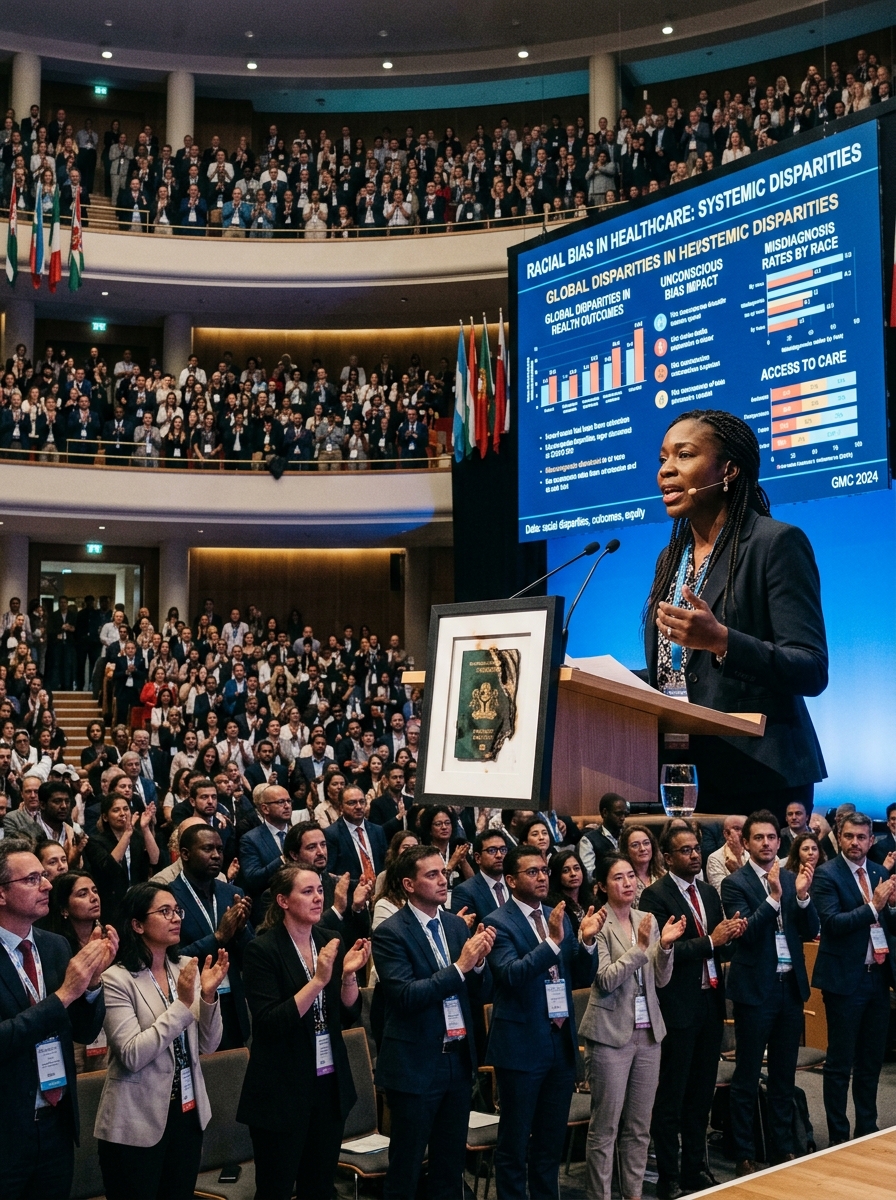
Six weeks later, Patricia stood on a stage in Geneva before 2,800 attendees.
She carried a framed object.
Her destroyed passport.
She placed it on the podium.
Silence fell.
“This was my passport six weeks ago—destroyed because an officer saw my skin and assumed guilt.”
Then came a standing ovation.
She waited.
“I study how implicit bias kills patients. How split-second assumptions based on race determine who lives and who dies.”
Her slides appeared.
Black patients received 38% less pain medication. Black women died at nearly four times the rate of white women. Black children waited 34% longer for treatment.
“Every number here represents a preventable death.”
She advanced the slide.
“When bias protocols are implemented correctly, these disparities drop by 52% in six months.”
The room leaned in.
“Bias can be unlearned. But first, we must admit it exists.”
Eight minutes of standing ovation. Medical professionals from sixty countries on their feet.
The conference chair stepped forward.
“In thirty-five years, this is the most important presentation we have ever hosted.”
Her paper was downloaded 284,000 times in a week. Ninety-two medical schools adopted it within two months. The WHO requested global use.
The passport was later donated to the Smithsonian National Museum of African American History and Culture, becoming the centerpiece of an exhibit.
Evidence of Everyday Racism, 2025.
Fifty thousand visitors in the first month.
A quote from Patricia appeared beside it:
“This passport represented my ability to share knowledge that saves lives. It was destroyed by bias—but became proof of the change we must make.”
Her voice narration followed.
“My story isn’t unique. It reflects millions who are judged before they speak, doubted before they’re seen, and questioned before they’re known.”
A pause.
“What made mine different was visibility. A husband in power. A judge who documented everything. A witness who pressed record. Strangers who spoke up.”
She looked into the camera.
“Most don’t have that. Their stories disappear.”
Emma Johnson appeared. Margaret Williams. Other witnesses.
“They didn’t have to help. But they did. That is what real action looks like.”
Impact data appeared.
“Since this case, 103 additional victims from twenty-eight airports have come forward.”
Patricia’s voice strengthened.
“One act of courage creates many more.”
Her tone shifted.
“Officer Wilson believed his badge protected him. He believed time and status made him untouchable.”
A pause.
“He was wrong.”
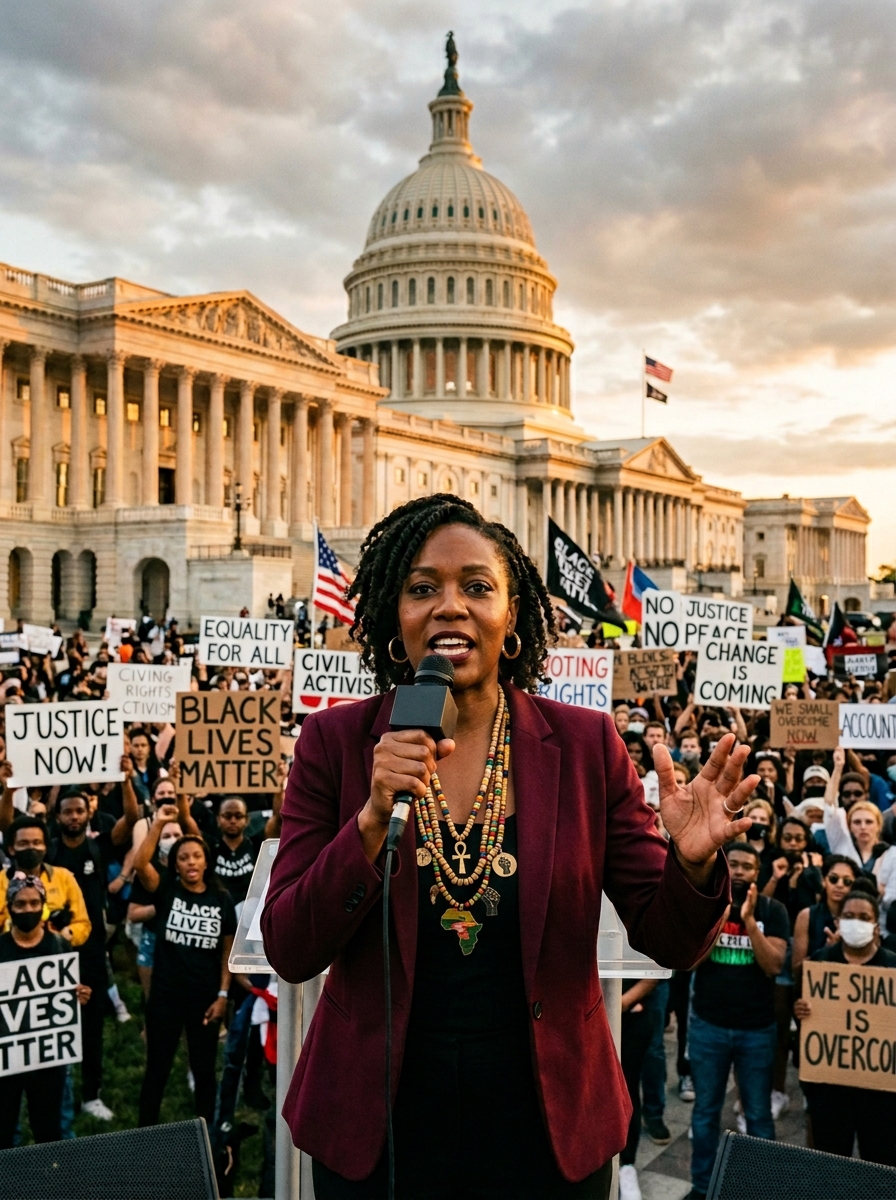
Patricia now stood in front of the U.S. Capitol. The visuals showed her shift from victim to advocate.
“No amount of power excuses cruelty. No uniform justifies prejudice. No seniority erases accountability. And ‘I didn’t know she was important’ is the worst possible defense because it admits you only treat people well when they have power.”
The screen faded to black. White text appeared.
What will you do the next time you witness injustice?
Pause.
Will you film it?
Pause.
Will you speak up?
Pause.
Will you intervene?
Longer pause.
Or will you look away?
Four seconds of black screen.
The choice is yours.
Choose courage. Choose action. Choose to be on the right side of history.
Patricia appeared once more, speaking directly into the camera.
“So I’m asking you. Yes, you watching this right now. Have you ever witnessed injustice and stayed silent? Have you seen someone mistreated because of their skin color and looked away? Have you thought someone should do something while you did nothing?”
She leaned in slightly, direct and personal.
“Today I’m telling you clearly. It is your place. It is all of our responsibility.”
Five actions appeared on screen.
One.
“If you see racism, film it. Your phone camera is a civil rights tool. Emma’s video didn’t just save me. It exposed a system, sparked reforms, and protected future travelers. Your ninety-second video could change a life.”
Two.
“If you witness profiling, speak up in the moment. Margaret Williams was sixty-eight. She could have stayed silent and caught her flight. Instead, she said, ‘This isn’t right. I’m a witness.’ Don’t assume someone else will act. Be that person.”
Three.
“If you have privilege, use it as protection for others. Step in if it’s safe. Use your race, class, or credentials to intervene. Call supervisors. Demand badge numbers. If you’re white and see a Black person being profiled, speak up. Your voice carries weight. That’s unfair, but it’s reality. Use it.”
Four.
“If you run an organization, audit your data. Track everything by race. Look for patterns. They exist. Officer Wilson profiled Black travelers for eight years. The data was there. No one checked. What gets measured gets managed. Start measuring.”
Five.
“If you see injustice and stay silent, you are complicit. Silence protects the oppressor, never the victim. Neutrality isn’t neutral. It sides with harm.”
Patricia’s final message landed with force.
“Officer Wilson tore my passport thinking he was destroying my dignity, my future, my voice. He believed he was putting me in my place—reminding me that people who look like me don’t belong.”
Her eyes hardened.
“Instead, he exposed a truth that could no longer be hidden. That racial bias still lives in systems designed to protect us. That ‘just doing my job’ is the oldest excuse for abuse of power. That the system protects the badge, not the victim—until we force it to change.”
A split screen appeared.
Left: Patricia on her knees gathering torn passport pieces, tears falling.
Right: Patricia at the U.S. Capitol podium, testifying before Congress, James beside her, surrounded by supporters.
Text overlay.
Six months later.
Equal Treatment in Travel Act passed in eight states.
Officers prosecuted in similar cases nationwide: thirty-four.
Additional victims who received justice: 103.
Airport racial profiling complaints reduced 68% nationally.
Body cameras mandated in 200+ airports.
Change is happening.
Patricia’s voice returned one last time.
“We’re not staying silent anymore. We’re not accepting ‘that’s just how it is.’ We’re demanding accountability. We’re demanding change. And we’re getting it. One case at a time. One video at a time. One voice at a time.”
The screen faded to black. Then white text appeared.
Dr. Patricia Anderson’s story could have been your story.
Let’s make sure it’s no one’s story ever again.
