

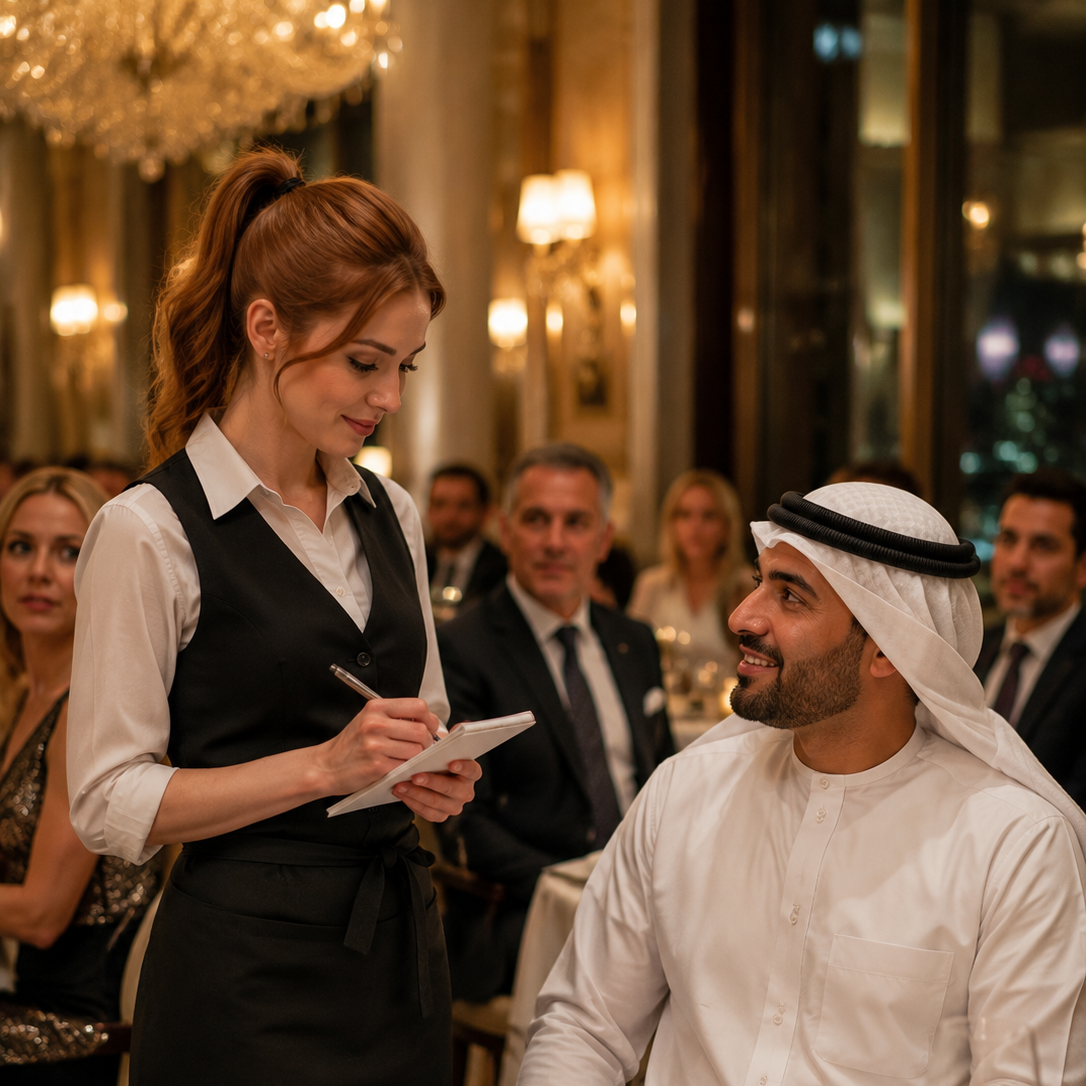
The sheikh insulted the waitress in Arabic in front of the whole restaurant, believing she was just a silly girl, but what the waitress did left everyone in the restaurant stunned, including the sheikh himself.
Inside one of the city’s most upscale restaurants, the typical ambiance of such a place filled the room: gentle live music, glasses clinking, hushed conversation. Pristine white tablecloths, fine dishware, dim lighting — everything appeared perfect. At a table near the center sat the sheikh alongside his business associates. They talked business, laughed together, and occasionally lowered their voices, but it was obvious he was the one calling the shots. At some point, a waitress came over to their table. A young woman with her hair pulled back neatly, a steady gaze, and self-assured posture. She paused politely beside them and, bending slightly, asked:
— Have you already decided what to order?
The sheikh didn’t glance at her immediately. He waited, almost as though making her stand there on purpose, then lifted his eyes slowly and gave a smirk.
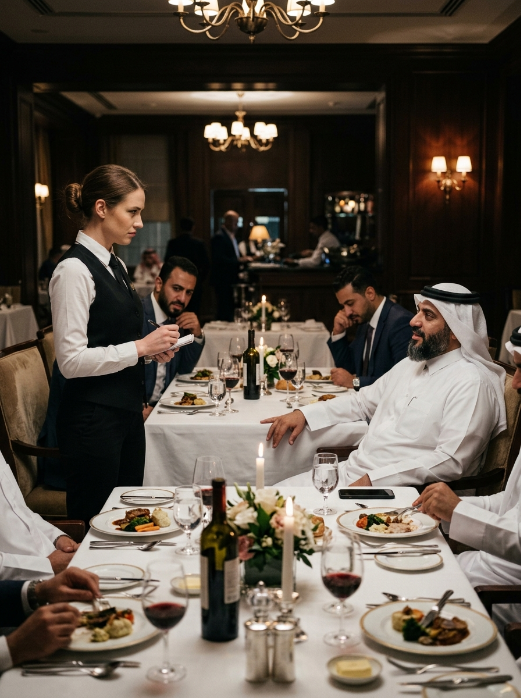
— Nobody called for you, — he said, dripping with sarcasm. — But since you’re standing here, jot it all down on your little notepad so you don’t get it wrong later. I know your type.
Someone at the table let out a soft laugh. The mood instantly turned tense, but the woman’s expression didn’t waver. She calmly took out her notepad and started writing. Feeling emboldened by the reaction, the sheikh kept going: — I hope you can at least count. Or should I spell everything out with my fingers? Then again… — he looked her over, — how would you even understand what we’re ordering. His associates glanced at each other. A few looked away, uncomfortable, but nobody spoke up. The waitress kept writing in silence, not interrupting, not reacting. Once finished, she closed her notepad carefully and turned to leave — but the sheikh, assuming she wouldn’t understand, turned to his companions and, in Arabic, with a smirk full of mockery, made a degrading comment. He used an insulting term for her and added that a woman like her would suit his harem perfectly, serving him for the rest of her days. A soft laugh rippled through the table. The sheikh assumed he was dealing with a simple-minded girl, but what she did next left everyone speechless.
The waitress halted. She turned slowly back to face the table. For a moment she just looked at him, then, in fluent, steady Arabic, she said:
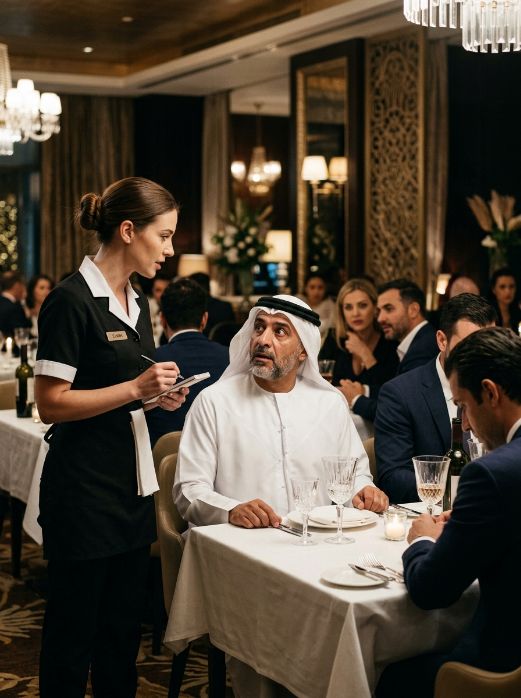
— Working as a waitress doesn’t mean I’m uneducated or clueless. What you said is insulting. I’ve long grown used to wealthy people assuming they can act however they please. But I am not a possession. I have a family — a husband and children. And I will never be your servant.
The restaurant fell so silent that a dropped fork at a nearby table could be heard. The young woman paused for a moment, then added evenly:
— Your food will be out in fifteen minutes.
She turned and walked off with that same steady confidence, never looking back. A thick silence settled over the table. None of the associates were smiling anymore. Some stared down, others busied themselves with their phones. The sheikh remained seated, watching her go, and for the first time all evening, he had nothing to say. He was still struggling to grasp how an ordinary waitress had just put him in his place in front of everyone.
