

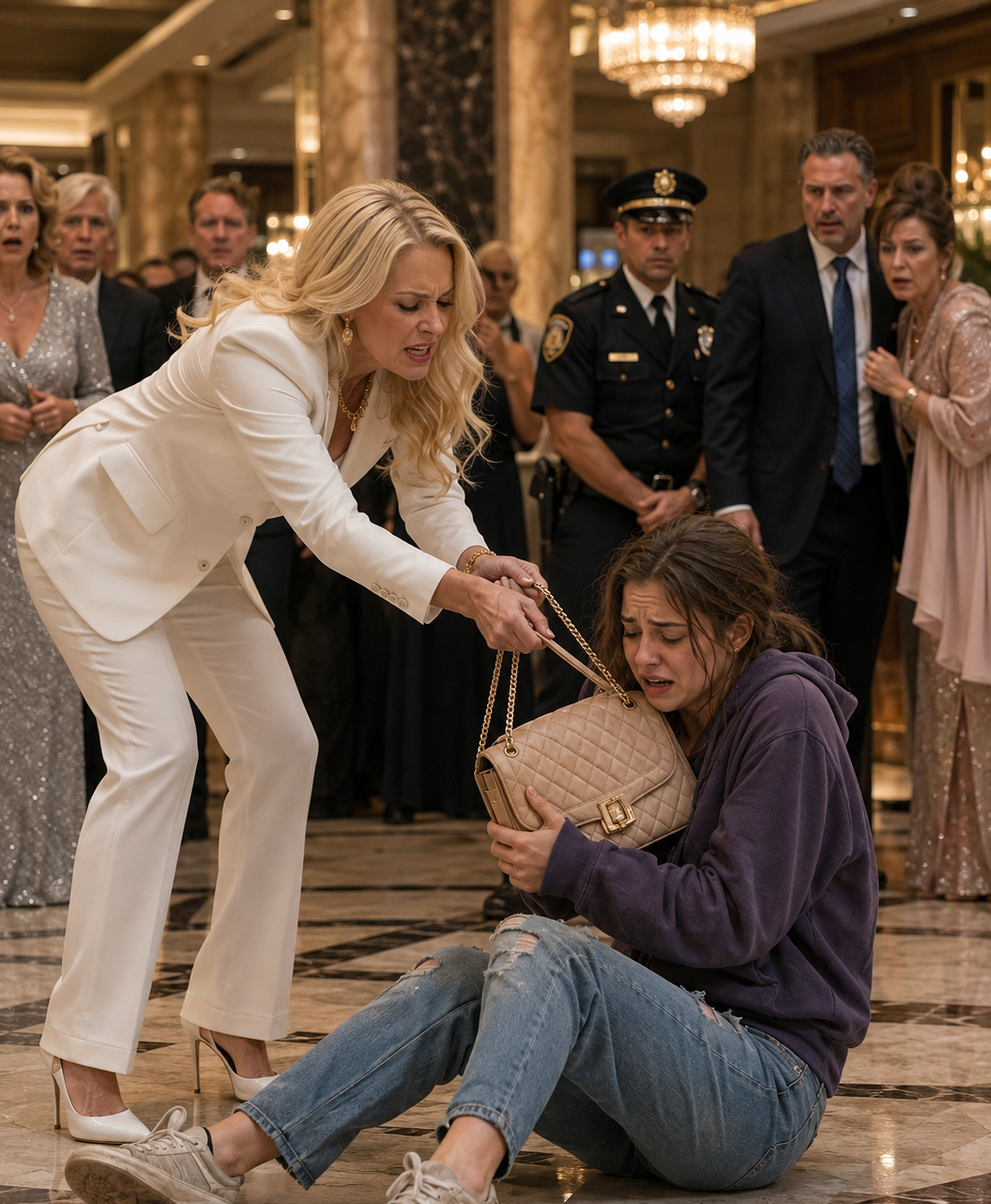
The woman was already crossing the hotel lobby toward the exit when it happened.
Her heels struck a calm, even beat against the marble floor — the kind of pace that belongs to someone who believes she’s done nothing wrong and is in no particular hurry. Her handbag hung from the crook of her left elbow, while her right hand pulled the collar of her beige coat tighter against the cool air drifting in from the revolving door up ahead.
Moments earlier, everything had seemed completely ordinary.
The Grand Elysian’s lobby hummed with the easy noise of a Saturday afternoon: hushed conversations drifting between the armchairs, the low rumble of suitcase wheels pulled by rushed travelers, the polite clink of glasses drifting over from the restaurant just around the bend. Somewhere, a pianist played something slow and continental. Golden light spilled from tulip-shaped fixtures onto guests coming and going, each one wrapped up in their own comings and goings, none of them paying much mind to anyone else.
Nobody noticed the woman in the beige coat.
And nobody had noticed the small boy sitting by himself near the entrance, either.
He’d been there for at least twenty minutes, perched at the very edge of a wingback chair beside the potted fern near the door — a quiet, motionless shape the crowd simply moved around, the way water moves around a rock. He wasn’t on a phone. He wasn’t restless. He was watching.
Then, without warning, he stood and bolted.
Fast.
Right at her.
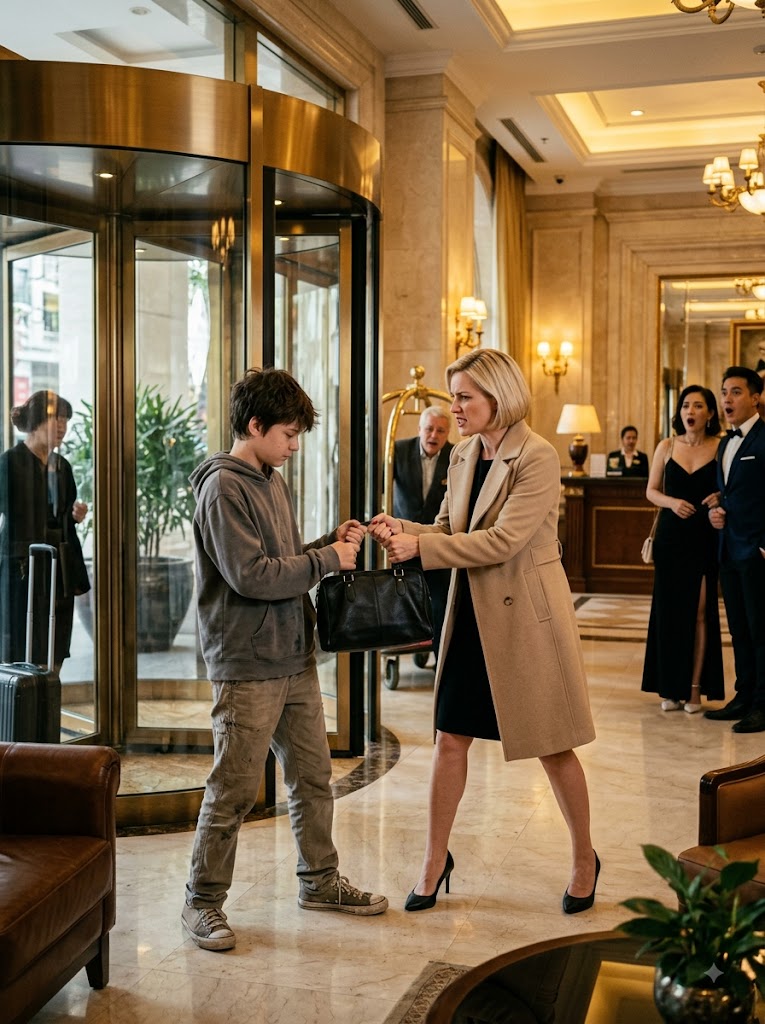
Before the doorman could react, before the receptionist could even glance up from her screen, the boy seized the handbag with both hands and refused to let go, bracing his feet apart like someone steadying themselves on a rocking boat.
The woman spun toward him, startled.
“Let go of it!” she snapped.
Her voice sliced through the ambient lobby music. Heads turned. A man in a suit stopped talking mid-sentence. Even the pianist paused.
The boy stood firm.
He looked to be no older than ten. Thin — not the slight build of a growing child, but the leanness that comes from missed meals. His dark hair hung in messy tangles over a pair of wary eyes, and his outfit — a grey hoodie and canvas pants — looked worn and faintly grimy, as if he’d spent more than one night somewhere other than a bed.
Even so, his grip held firm.
The woman yanked the bag hard.
“Hey!” she barked, her composed veneer beginning to slip. “Let go of me this instant!”
But the boy didn’t budge, and the bag swung sharply between them.
To anyone glancing over, it looked like a simple scene: a scruffy kid making trouble. Maybe a thief. Maybe a stunt. That’s what the bystanders assumed, their expressions shifting from surprise to mild annoyance.
Then they saw his face.
He wasn’t furious. He wasn’t panicked. He wasn’t even especially scared, given the circumstances.
He looked sure of himself.
The woman tugged again, harder this time, her knuckles going pale around the leather strap.
“I told you to let go. Now.”
The boy shook his head slowly.
His voice came out soft. Deliberate. Far steadier than you’d expect from a child his age.
“It’s not yours.”
The words cut through the noise of the lobby like a blade slicing silk.
A hush dropped over the room — sudden and complete.
It lasted only a second.
But that was enough for everyone there to feel the air in the room shift.
The woman went rigid. Color rose up her neck. Then she blinked, and her composure returned — though not quite as convincingly as before.
“Excuse me?”
The boy swallowed hard, but he didn’t look away. “I watched you take it. From the lounge. The lady set it down on the chair when she stepped away to the restroom. You walked by, glanced around, and then tucked the strap under your arm. I saw the whole thing.”
A stocky man near the front desk — silver cufflinks, the bearing of someone used to being the center of attention — stepped in.
“What’s going on here? Someone get the manager.”
Neither of them acknowledged him.
Because this had stopped being a simple squabble over a handbag. It had turned into something bigger, slower, and far more tense — the kind of standoff that demands an answer.
The woman let out a forced laugh, smooth and practiced, meant to make anyone watching feel silly for taking the moment seriously.
“You’re mistaken, sweetheart,” she said, her tone shifting to calm and faintly patronizing. “This bag is mine. I’ve had it with me all day. I think you saw something and got confused—”
“I saw you.” The boy’s voice stayed level, no anger in it. “You picked it up with both hands and slid the strap under your coat. Then you headed toward the elevator. But then you turned around and came back through the lobby instead of going up. Like you’d changed your mind.”
A young couple by the elevator — clearly newlyweds — froze in place. The receptionist had stepped out from behind the counter now, hovering nearby with the look of someone praying for a manager to appear.
The woman tightened her hold on the bag. Her jaw clenched along with it.
“This child isn’t right in the head,” she declared to the room. “I have no idea who he is or what he thinks he saw, but I’m a paying guest here, and I’d like him removed immediately.”
“That bag.”
The voice came from across the lounge. Everyone’s heads turned.
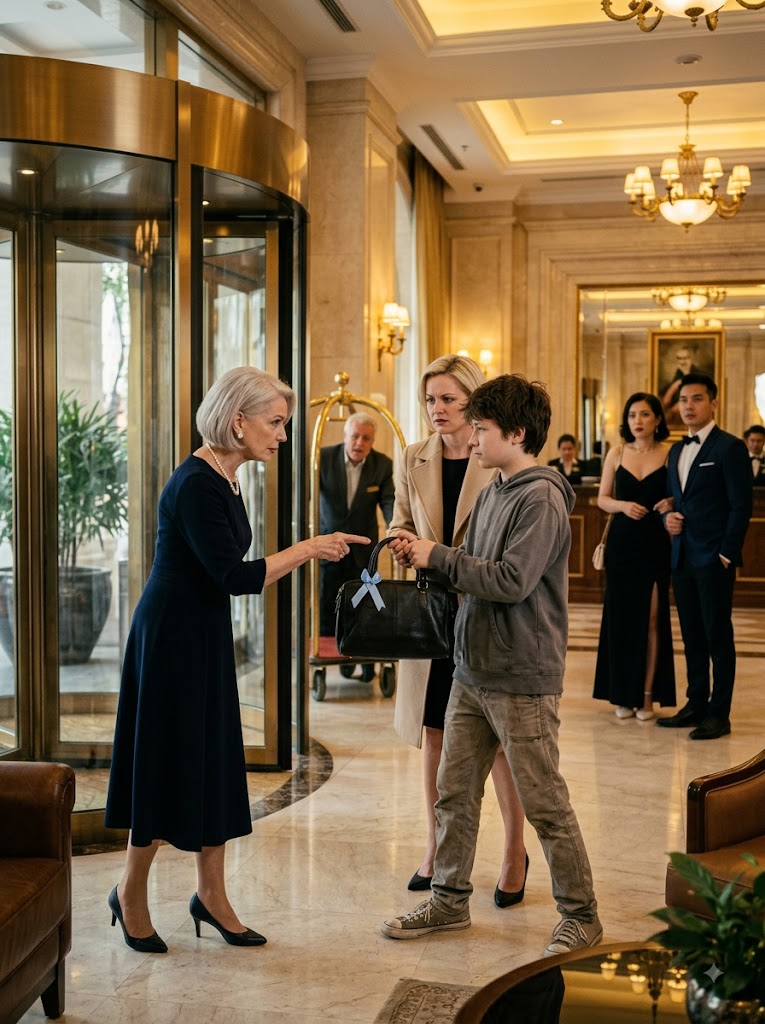
A woman in her late sixties had risen from a low linen sofa. She was petite and tidily dressed, with silver hair and the deliberate movements of someone whose knees no longer cooperated easily. She approached slowly, her eyes locked on the handbag with a look of dawning disbelief.
“That bag,” she repeated, her voice rising. “That belongs to me.”
Silence swallowed the lobby whole.
You could hear the hum of the air conditioning.
The woman in beige took a step back — small, but unmistakable. A retreat.
“You’re wrong,” she said. Too fast.
But fear had fully settled into her expression now, plain to see — her eyes darting toward the revolving door, her breathing shallow and just audible.
The older woman came to a stop in front of them. She studied the bag — not its brand or shape, but the handle. She pointed to a small blue satin ribbon tied neatly around the base of the left strap.
“I tied that ribbon on this morning,” she said softly. “My granddaughter gave it to me last Christmas. She told me it would help me spot my bag in a crowd.” Her voice caught, just barely, on the final word. “She’s eight.”
Nobody said a word.
The boy glanced up at the older woman. Something shifted across his face — not pride, not relief. Something closer to quiet recognition. He slowly let go of the bag, finger by finger. First one hand. Then the other.
As though he’d known all along that the truth would eventually speak for itself, and his only task had been to hold on until it did.
The hotel manager showed up two minutes later, a tall man in a charcoal suit who took in the scene in three seconds flat and gave a small hand signal that brought two security officers in from a side hallway. He addressed the woman in beige with calm professionalism, and her composure shrank with every word, and then a security officer, who had carefully taken the bag and placed it on the front desk, spoke up.
“Ma’am, we’re going to need to open this. For verification.”
“That is absolutely not nec—”
“Ma’am.”
She fell silent.
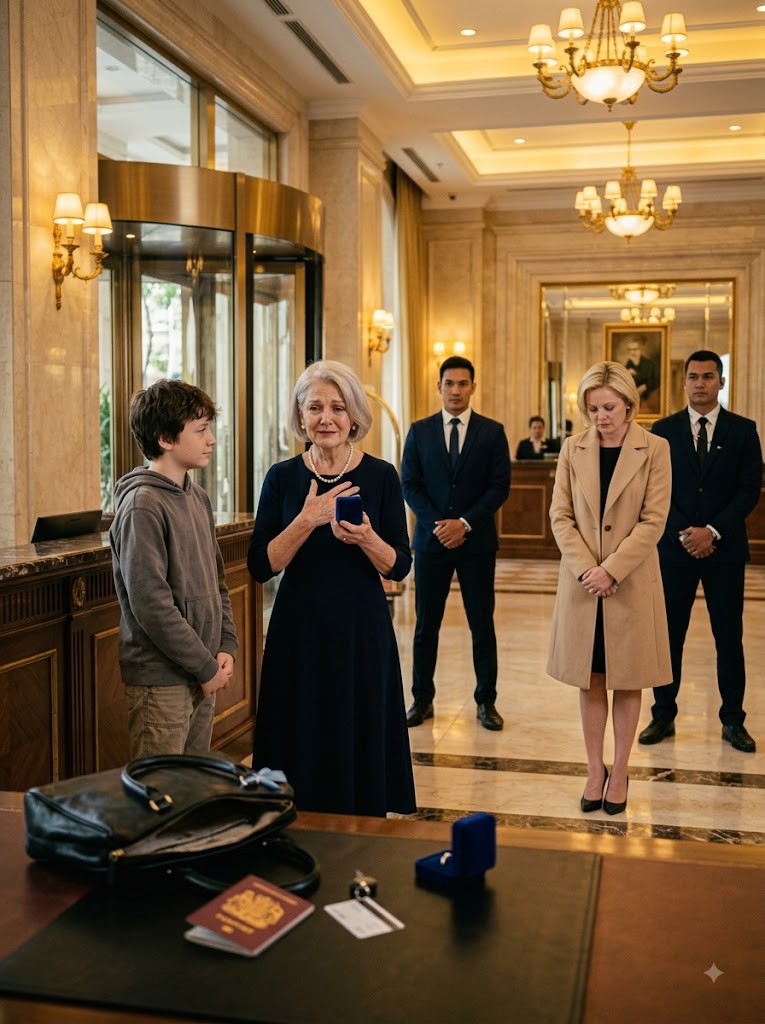
The manager unfastened the bag with the practiced neutrality of someone carrying out an official task. He lifted the contents out one at a time and set them on the desk.
A burgundy passport, a name stamped in gold on its cover.
A small velvet jewelry box, midnight blue, its clasp fashioned like a flower.
A hotel room key card, and a folded note with a room service order written in an elderly woman’s careful hand.
Nobody spoke.
The older woman pressed a hand briefly to her mouth. Then she reached out, picked up the jewelry box, and held it to her chest without opening it — the way someone holds something they thought was gone for good.
The woman in beige had given up trying to speak altogether. She stood motionless, and in that moment she looked remarkably small — smaller, even, than the boy beside her, who barely came up to her shoulder, who had no phone, no authority, nothing but a pair of sharp eyes and the nerve to use them.
A police officer showed up within fifteen minutes. The lobby gradually settled back into its usual rhythm — the suitcases, the murmured conversations, the pianist tentatively picking the melody back up somewhere around the fourth bar of what he’d been playing before.
The hotel manager knelt down to the boy’s eye level.
“What’s your name, son?”
The boy looked at him. “Minh.”
“Minh.” The manager nodded. “Where are your parents, Minh?”
A long silence.
“I don’t know,” the boy said, plainly and without any drama, the way children sometimes deliver the hardest truths.
The manager paused, then leaned toward the receptionist and murmured something. She nodded and stepped away.
The older woman — Mrs. Calloway, as it turned out, traveling alone from Edinburgh to see a daughter she hadn’t visited in two years — sat down beside Minh in the wingback chair near the fern. She still held the jewelry box.
“You saw me,” she said. It wasn’t a question.
“Yes,” he said.
“You could have told someone. A staff member. The doorman.”
He thought about it seriously. “I tried going to the desk. But she was already walking away. There wasn’t time.”
Mrs. Calloway studied him for a long moment — the worn hoodie, the dirty canvas shoes, the dark eyes that, she now realized, weren’t frightened at all. Just tired. Watchful. Far too old for someone only ten.
“Are you hungry?” she asked.
Another pause.
“Yes,” he admitted.
She rose, smoothed her skirt, and extended a hand.
“The restaurant’s just around the corner,” she said. “And I think I owe you a great deal more than a meal. But it’s somewhere to start.”
The boy looked at her hand. Then he stood and took it.
And the lobby carried on around them — the suitcases, the golden light, the guests too caught up in their own lives to notice — as the two of them walked toward the restaurant together, the old woman and the boy who wouldn’t stay quiet.
Behind them, on the front desk, the blue ribbon lay beside the velvet jewelry box.
Such a small thing, to carry so much weight.
