


I didn’t immediately look up when a heavy, irritated sigh cut through the cabin’s calm. My attention stayed fixed on the worn leather briefcase resting on my lap. Inside it lay more than four hundred pages of legal briefs—detailed records of systemic discrimination and civil rights disputes I was set to rule on by Monday morning.
I am a Federal Judge. For three decades, I have presided behind a mahogany bench in a black robe, deciding the outcomes of corporations, police departments, and municipalities. I have spent my entire adult life believing that education, dignity, and quiet compliance with the rules would eventually make society see me as an equal. Yet in Seat 2A of this commercial flight, none of that carried weight. In Seat 2A, I was not the Honorable Marcus Vance. I was simply a sixty-two-year-old Black man occupying a space someone decided I didn’t belong in.
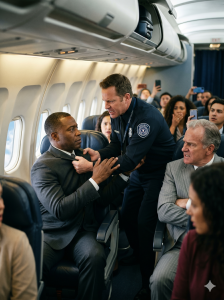
The calm broke when a flushed, broad-shouldered man in a beige linen suit boarded late. His boarding pass was for 2B, the aisle seat next to mine. I adjusted my legs to let him pass and gave a polite, practiced nod. He offered none in return; instead, his eyes swept over me—taking in my dark skin, silver hair, and quiet posture—before his jaw tightened. He turned away from me, snapped his fingers at the young flight attendant named Sarah, and said loudly, “I am a Platinum Medallion member. I fly this route twice a week. And I am not sitting next to… this.”.
A heavy, suffocating silence settled across the first three rows, finishing his sentence for him. Years of legal discipline taught me to bury anger beneath a controlled exterior, but under my ribs, an old, familiar exhaustion ignited. The man insisted I be moved, using his “comfort” as a shield to recast bias as a safety issue.
Visibly shaken, Sarah chose the easiest path. She bent down and whispered urgently, asking if I would consider changing seats for a travel voucher just to defuse the situation. Around us, the other passengers suddenly became deeply interested in the stitching of their armrests.
My voice came out slow and steady, a deep, resonant baritone: “I purchased this seat, ma’am. I have my boarding pass. I will not be moving.”.
Sarah swallowed hard and warned she would report me as a disruption. The man’s face deepened into a mottled red as he demanded she call security, labeling me “hostile”—the magic word that justifies v*olence.
Ten minutes later, airport police stepped onto the plane. Officer Miller stood over me, one hand hovering near his taser. He ordered me to collect my belongings and leave the aircraft. I kept my hands visible and asked under what authority I was being removed, noting I had broken no FAA regulations. He repeated that I was causing a disturbance and threatened to physically remove me if I did not comply.
In that moment, I wore no robe and held no gavel. I was entirely exposed to the physical f*rce of the state, deployed on behalf of a stranger’s prejudice. My hands trembled with a deep, volcanic anger at the realization that no amount of achievement could prevent the ground from being pulled out from under me.
“I am not moving,” I said, locking eyes with Officer Miller.
His expression hardened. He stepped forward, his heavy fingers gripping the lapel of my tailored charcoal suit, and pulled, attempting to drag me up from the seat by physical f*rce.
Part 2
The instant Officer Miller’s hand clamped onto the lapel of my jacket, nothing erupted outwardly. Instead, the world narrowed into an unbearable, clinical clarity. I could distinguish every fiber of his uniform, the cheap polyester straining across his shoulders. I could detect the stale metallic trace of airport coffee on his breath, mixed with the faint chemical sting of sanitizer from the flight attendant’s cart. His grip wasn’t just physical contact—it felt like an intrusion weighted with decades of memory: every civil rights case I had ever reviewed, every ruling I had ever delivered, and every warning my father once gave me about men in badges who never needed to look inward.
“Sir,” I said, my voice lowering into the tone I once used for the most defiant attorneys in my courtroom. It was calm, heavy, and absolute. “Remove your hand. Immediately.”
Miller didn’t hesitate. If anything, his grip tightened. I felt my tailored suit—bought years ago to mark a decade on the bench—crease under his fingers. He wasn’t just restraining me; he was asserting a kind of authority he believed this situation granted him. Behind him, Mr. Sterling leaned in slightly, a thin, satisfied expression forming as if he were watching a performance meant for his enjoyment.
Sarah had already backed away. Her hands hovered near her collarbone, anxiety written across her face. She wasn’t weighing justice—she was calculating inconvenience, delay, procedure.
“You’re coming off this plane, one way or another,” Miller grunted. He applied steady pressure, not yet explosive, but deliberately meant to unbalance me, to manufacture the appearance of resistance. That was the trap: if I reacted incorrectly, I would become what they already decided I was.
But I stayed anchored. I shifted my weight slightly, refusing to yield. Something long-buried tightened inside me—the memory of 1986, of cold rain in Georgia, of being pressed against a police cruiser for nothing more than suspicion wrapped in prejudice. I remembered how quickly dignity evaporated when authority decided it didn’t apply to you. I had spent my career constructing law as armor, yet here it was again—tested at point-blank range in economy-class leather seating.
“Officer,” I said, my tone turning colder, more precise. “You are currently committing a series of errors that will be the focal point of your life for the next several years. I am giving you one final opportunity to let go of my person.”
“Is that a threat?” Sterling interjected quickly, leaning forward with sudden theatrical concern. “Did you hear that, Officer? He’s threatening you!”
Miller leaned closer, face tightening. “I don’t take orders from you. You’re being non-compliant. I have the authority to remove you by f*rce.”
Slowly, deliberately, I reached into my inner jacket pocket—still pinned under his grip.
“Hands where I can see them!” Miller snapped, his posture shifting toward escalation. His hand moved toward his belt. The cabin stiffened; recording phones lifted; breaths were held.
I didn’t stop. I pulled out my leather credential case. Worn. Official. The seal of the United States faint but unmistakable. I opened it and held it steady at eye level.
“My name is Marcus Vance,” I said, and the silence that followed felt absolute. “I am a United States District Judge for the Northern District of Georgia. You are currently laying hands on a federal officer in the middle of an unlawful detention based on a discriminatory complaint. Every person in this cabin is a witness. That phone across the aisle is a witness. And now, Officer Miller, you are the defendant.”
Miller’s grip collapsed instantly. His hand fell away as though burned. He stepped back, disoriented, eyes darting between my face and the credential case. Color drained from his expression, leaving something hollow and uncertain.
Sarah made a small, panicked sound. “Judge… Judge Vance? I… we didn’t… I was just following the passenger’s—”
“You were following a whim, Sarah,” I cut in evenly. “You were following a prejudice. Airline policy does not supersede the Constitution, and it certainly doesn’t authorize you to use law enforcement as your personal bouncers for a disgruntled bigot.”
Sterling had gone still. The earlier arrogance drained out of him, replaced by unease. He no longer looked entertained—only cornered.
The cockpit door opened. The Captain stepped out, visibly confused, taking in Miller, then me, then the badge.
“What’s going on here?” the Captain asked.
“Captain,” I said without rising. “Your flight attendant and this officer have just attempted to forcibly remove a federal judge from his assigned seat because this gentleman next to me felt ‘uncomfortable’ sharing a row with a Black man. I suggest you call your corporate legal department immediately. I am not leaving this plane. But I suspect several other people might be.”
The Captain exhaled sharply, understanding the shift in stakes. He turned to Miller. “Officer Miller, I think you should step off the aircraft. Now.” Miller hesitated, tried to respond, but the Captain’s tone ended it. Defeated, Miller left the cabin. Sarah followed, shaken and tearful. Sterling was next, stripped of authority and composure, forced to pass me without eye contact.
As the aircraft finally pushed back, the adrenaline drained from my body, leaving something heavier behind. I had prevailed—but the victory felt unstable, incomplete. I hadn’t escaped the system; I had merely forced it to acknowledge itself.
Hours later, descending into Washington, D.C., vibration running through the frame of the plane, I checked my phone. The headline was already there: “Unruly Passenger Claims Judicial Immunity to Avoid Security Protocol on Flight 442.”
My stomach tightened. The narrative had already shifted. The airline’s statement framed me as disruptive, difficult, manipulative. The machinery was already rewriting what had happened.
I didn’t wait. I moved directly through the terminal toward the Skyway Alliance lounge. I bypassed security with controlled authority, leveraging presence and certainty rather than explanation. Inside, reporters clustered around CEO Elias Thorne.
“Mr. Thorne,” I said as I entered the circle. “You know my name. It’s currently being dragged through the mud by your PR department. I’m the ‘unruly passenger’ from Flight 442. The one your officer ass*ulted while your crew watched and cheered.”
Flashes ignited. The room shifted.
Thorne attempted composure, offering rehearsed apology and deflection, suggesting internal review and future discussion.
“They’ll believe me,” a voice said from behind me.
Elena stepped forward, holding her phone. “I recorded everything,” she said. “My brother works in your IT department in Atlanta. He sent me something. He sent me the ‘Red-Flag Protocol’ update from last Tuesday.”
The air changed instantly.
She showed the file. “Project Sentinel.”
Thorne’s composure fractured. The system had been exposed—algorithmic profiling embedded into operations, disguised as efficiency.
The press erupted into motion.
Moments later, federal authority arrived, moving to secure systems and records. I stood there as the room collapsed into consequence around me.
When I finally stepped outside into the D.C. air, cold and sharp against my skin, the weight of it settled fully. I had not only survived the system—I had forced it to reveal itself. But in doing so, I had also shown what I was willing to become inside it.
Part 3
The silence was the loudest presence in the room. It pressed in from every direction, heavy and suffocating after the chaotic storm at Reagan National.
The news cycle never stopped, of course. Skyway Alliance dominated headlines nationwide, and Elias Thorne’s name quickly became tied to corporate misconduct. Project Sentinel turned into the scandal of the moment, with commentators relentlessly breaking down its algorithms, its structure, and its unsettlingly precise racism. Yet all of it—the outrage, the debates, the noise—felt distant, as if it were being broadcast from another world entirely.
My life had contracted to the boundaries of my D.C. condo. Days passed under the dim glow of the television, measured by the slow, echoing tick of the hallway clock.
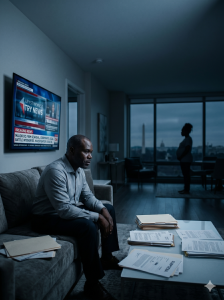
Phone calls from colleagues ceased. Emails stopped arriving. In the federal courthouse, greetings were polite but brittle, eyes avoiding mine. The looming judicial ethics review hung over everything like a quiet sentence already being served. I understood it. They understood it. The institution understood it.
David called every day. As a U.S. Attorney, he was consumed—coordinating with the Justice Department, preparing lawsuits, trying to manage the fallout. He kept insisting I had done the right thing, repeating that Project Sentinel was a rot that needed to be exposed. But his reassurance felt rehearsed, distant. Even when we spoke in person, his gaze rarely held mine. The victory felt hollow, incomplete.
At home, Sarah moved like a shadow. She drifted through the apartment with careful, restrained efficiency, caring for me in a way that was gentle but emotionally sealed off. The warmth between us—the laughter, the ease of decades—had vanished, replaced by a fragile, cautious quiet. I knew what she saw when she looked at me: a man who had jeopardized everything we had built together—career, reputation, future.
Skyway Alliance responded with controlled aggression. Mr. Sterling was quietly settled with a substantial payout and a strict nondisclosure agreement, disappearing from public view.
Officer Miller, unexpectedly, was elevated elsewhere in the narrative—celebrated in certain circles as a symbol of authority under attack. He became a fixture in cable commentary and fundraising campaigns, reframed as a victim of overreach. The story bent and twisted around him, reshaped by louder voices.
Elena vanished completely. After delivering the Project Sentinel data to David, she refused interviews, shut down her accounts, and disappeared from public reach. I tried to contact her to thank her, to help her, but she never responded. Her absence left a sharp, lingering guilt—an awareness that her courage had been pulled into a storm she never asked for.
One night, Sarah and I sat in the living room in near darkness. The silence between us had grown dense, almost physical. She picked up a framed photograph from the mantel—a wedding picture, bright with youth and certainty—and studied it for a long time.
“What happens now, Marcus?” she asked quietly.
I had no answer.
The ethics hearing was procedural, almost ritualistic. The panel was composed, professional, and precise. They examined my actions at the airport, my confrontation with Thorne, and my deviation from judicial norms with clinical detachment.
I offered no defense. I spoke plainly about anger, exhaustion, and the long accumulation of years spent under quiet pressure—of being judged, diminished, and contained. They listened without interruption, faces unreadable.
A week later, the decision arrived. Conduct unbecoming a judge. The recommendation: public censure and suspension. But there was an alternative—resign voluntarily, and the matter would end without formal record.
David was furious. He urged me to fight, insisting I had been right, that I was being made an example of. But I knew the truth was more complicated than right or wrong. I had stepped outside the boundaries I had spent my life enforcing. In that moment on the plane, I had ceased to be impartial.
Before deciding, I met Elias Thorne in a quiet bar away from the center of the city. He looked drained when he arrived, the confidence gone, replaced by fatigue.
“Why are you doing this, Vance?” he asked. “You’ve won. You’ve destroyed me, my company.”
“I didn’t do it for you,” I said. “I did it for them. For Elena. For everyone who’s been targeted and dismissed.”
He stared into his drink. “And you? What have you gained?”
The question landed cleanly. I had lost nearly everything—position, stability, certainty. But beneath it all, something else had formed: clarity. Uneasy, unpolished, but real.
That night, I told Sarah I would resign. She didn’t argue. She only nodded, a tear slipping down her face. She understood what the decision meant for both of us.
The next morning, I submitted my resignation.
The response was immediate and loud. Some called it courage, others called it collapse. I withdrew from the noise entirely, spending my days in silence, walking, reading, trying to make sense of the fracture that had opened in my life. I felt unanchored, drifting.
Then Elena called.
“Thank you,” she said softly.
“You don’t need to thank me,” I replied. “You were the one who took the risk.”
“It wasn’t just me,” she said. “You gave me the courage.”
Her words brought a brief, fragile steadiness.
But at home, the distance between Sarah and me widened. She began sleeping in the spare room. Conversations collapsed into short exchanges. I tried to reach her, but everything I said felt inadequate. The trust between us had been worn thin, stretched beyond repair.
One night, I found her packing a suitcase.
“I can’t do this anymore, Marcus,” she said, voice shaking. “I need to find myself. I need to know who I am without all of this.”
I didn’t stop her. I couldn’t.
She left the next morning. The apartment echoed with absence. I had dismantled something larger than myself, exposed something hidden, but in the aftermath, there was no victory to hold—only consequence.
Part 4
The weight of the world doesn’t magically disappear just because you change your address, your title, or your marital status. I learned that truth the hard way in the long, grinding months after Sarah left with her suitcase. It doesn’t lift—it simply shifts, settling into new places and pressing against different edges of your life.
The news cycle eventually moved on, as it always does. Skyway Alliance faded from front-page urgency, and Elias Thorne’s collapse became yesterday’s outrage. The world kept turning without pause, while I remained in it—quietly altered.
My anchor became a small community center, far removed from the polished marble and mahogany of the federal courthouse. My office there was cramped, cluttered, and constantly filled with the smell of aging paper and Mrs. Rodriguez’s cooking. She ran the place with a calm strength that didn’t need to announce itself, offering sweet tea like it was a form of stability.
That’s where I found a different kind of fight. I began working on predatory lending cases targeting minority communities—no headlines, no cameras, no applause. Just slow, grinding injustice embedded in contracts and financial fine print. The harm was deliberate, structured, and deeply familiar in its pattern.
One Tuesday, David came to see me. He looked worn down in a way success didn’t protect you from.
“Thorne pleaded guilty,” he said. “Big fine. Some jail time. Not enough, but… something.”
I nodded. “Project Sentinel?”
“Buried,” he replied. “Skyway’s under a consent decree.”
“And Miller?” I asked, already bracing.
David’s expression tightened. “Book deal. Cable news loves him. He’s suing you too—defamation, assault… everything.”
I wasn’t surprised. Miller was never the source of the problem, only its most visible expression. David left soon after, and I sat in silence, staring at peeling paint, understanding that none of this resembled justice—only outcomes.
Real justice, I realized, looked like Mrs. Garcia sitting across from me, terrified of losing her home and hoping I could find a way—any way—to keep her in it. That was the work now. Small, immediate, real.
That night, I returned to the house I once shared with Sarah. It felt чуж and hollow, every room echoing absence. I found her note where she had left it on the kitchen counter.
“Marcus, I need to find myself. I need to know who I am, outside of you, outside of us. I don’t know what the future holds, but I can’t stay here. Not now. I’m sorry. Sarah.”
I set it down gently. There was nothing left to argue with. She had done what she needed to survive. So had I.
Weeks became months. The files piled up. I learned the language of predatory contracts, the hidden clauses, the engineered traps. I no longer had robes or a bench, but I still had something sharper—clarity, sharpened by anger and purpose.
Then, one rainy Saturday, I looked up and saw her.
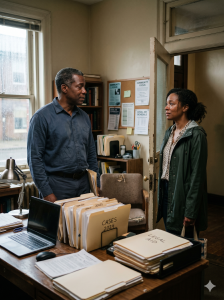
Sarah stood in my doorway.
She looked different—simpler, quieter—but her eyes were unchanged, still searching.
“Marcus,” she said softly.
I stood. “Sarah. What are you doing here?”
“I wanted to see you,” she admitted. “To see how you were.”
I gestured toward the stacks of case files. “I’m… here. Working.”
She stepped inside. “This is good,” she said. “What you’re doing.”
“It’s something,” I replied. “Not what I thought I’d be doing. But it’s something.”
Silence filled the space between us, heavy with everything we had survived.
“I’m sorry,” she said finally. “For leaving. For everything.”
“I know,” I said. “I understand.”
“I needed to find out who I was,” she said quietly. “Not just… part of us.”
“And now?” I asked.
“I’m still figuring it out,” she said with a faint, fragile smile. “But I’m getting there.”
“Me too,” I said.
We talked for a long time that day—about the flight, Thorne, the hearings, the cases, and everything we had lost. It wasn’t easy. There were pauses that hurt more than words, but we kept going anyway.
When she stood to leave, she said, “I don’t know what happens next, Marcus. But I’ll always care about you.”
“I’ll always care about you too,” I said.
She kissed my cheek—soft, lingering, not an ending so much as an acknowledgment of distance.
The world outside didn’t soften. Miller’s lawsuit still lingered. Anonymous threats came and went. Anger found its way into corners of my life I didn’t expect.
One night, walking home, I was confronted by a group of young men.
“You that judge?” one of them sneered. “Thinking you’re better than everyone?”
“Leave me alone,” I said.
“Or what?” he challenged.
I saw what they wanted—reaction, escalation, justification.
So I gave them nothing.
“I’m not going to fight you,” I said. “I’m going home.”
I walked past them. They shouted after me, but I didn’t turn around.
That night, I lay awake considering how easily everything could end—how simple it would be to disappear. But then I thought of Mrs. Garcia, and the others like her, still waiting for someone to stand between them and systems built to consume them.
So I stayed.
The Miller case eventually settled quietly. No triumph, no closure—just an ending that cost something.
The lending cases continued. Some we won. Some we didn’t. But slowly, pressure built. Lenders adjusted. Communities organized. Resistance spread in small, steady ways.
Then one afternoon, a young woman walked into my office.
“Mr. Vance?” she asked. “I need help.”
I smiled. “Tell me what happened.”
She sat down and began to speak.
And as I listened, I understood something simple and absolute.
This was the work.
Not the robes. Not the bench. Not the title.
Just this.
I am no longer Judge Marcus Vance.
I am simply Marcus Vance.
And the fight is still here.
