

PART 1
“We don’t serve people in here who look like they just stepped off the metro,” Fernanda announced, making no effort to lower her voice.
The man who had just walked in stood frozen before the glass door of a luxury watch boutique on Presidente Masaryk, in Polanco. He was dressed in a faded gray t-shirt, worn-out jeans, and sneakers so battered that anyone glancing his way might have thought he’d stumbled into the wrong place.
But he hadn’t.
This man was Mateo Herrera — owner and CEO of Grupo Herrera, one of Mexico’s most exclusive watch brands. Nobody at this branch had any idea. Worn down by endless meetings, hollow dinners, and rehearsed smiles, he’d decided to walk into one of his own shops disguised as a nobody.
He wanted to know how his staff treated people who looked like they had no money.
Fernanda, the most self-important saleswoman on the floor, looked him over as though he’d dragged mud across the marble.
“If you’re here to ask about prices, I’ll save you the trouble — they’re expensive.”
From behind the opposite counter, Lucía glanced up. Twenty-seven years old, her hair pulled back neatly, she carried herself with a calm that seemed almost impossible to shake. She set down the cloth she’d been using to polish a vintage piece and walked over.
“Good afternoon, sir. Welcome. Would you like me to show you something?”
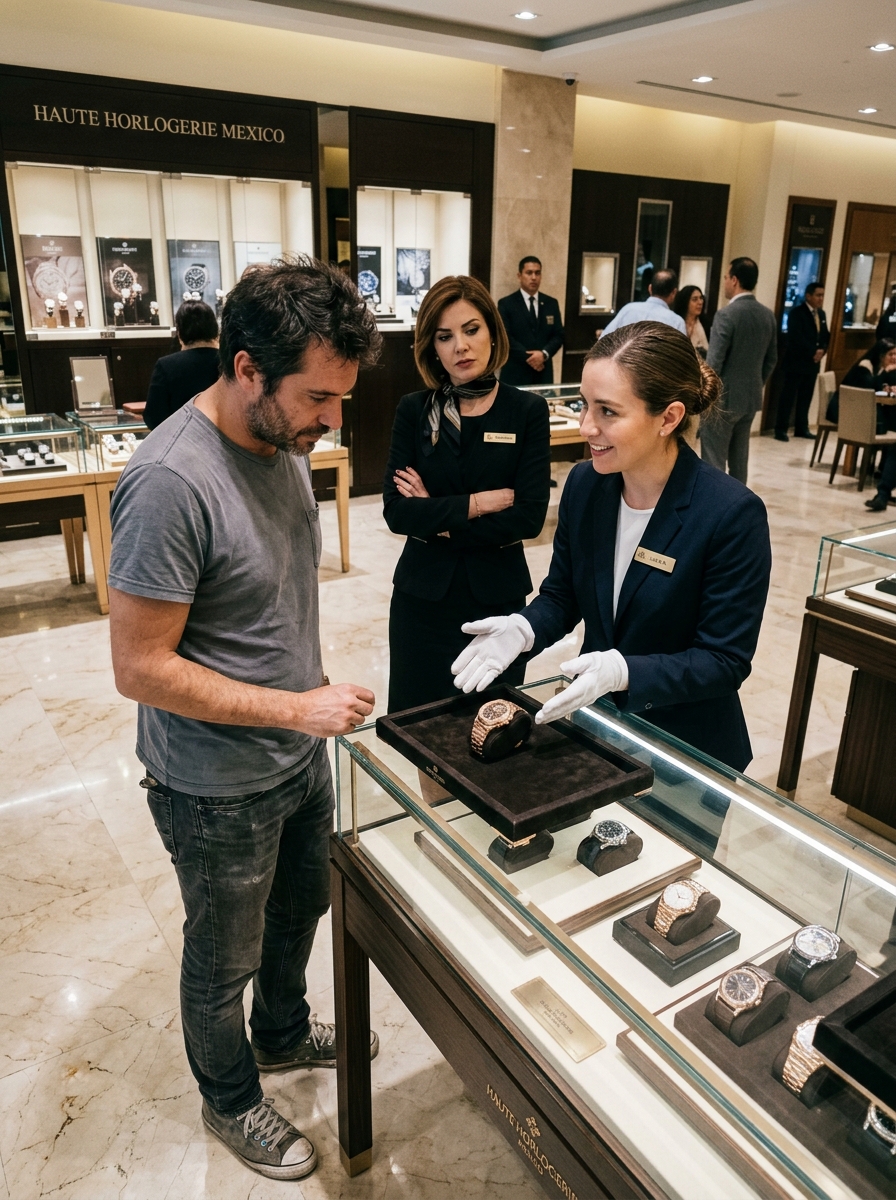
Mateo pointed to a watch with a rose-gold case and a black leather band.
“That one catches my eye.”
Fernanda gave a short, mocking laugh.
“That one’s worth more than his car — assuming he even has one.”
Lucía paid her no attention. She slipped on a pair of white gloves, opened the case, and began walking him through the mechanism, the design’s history, the craftsmanship done in Querétaro, and how few pieces existed. For twenty full minutes, she treated him as though he mattered more than anyone else in the shop that day.
Mateo watched her without a word. There was no pity in his face. No performance. Just respect.
“I’ll take it,” he said finally.
Fernanda stepped in at once, eyes widening.
“Excuse me?”
Mateo checked his back pocket. Then his front pocket. Then his chest. His brow furrowed.
“This can’t be right… I think I’ve lost my wallet.”
The silence that followed felt heavy enough to crush something.
Fernanda burst out laughing.
“I knew it! You see, Lucía? All that effort playing Mother Teresa, and this man just came in to waste our afternoon.”
Lucía drew a slow breath.
“Enough, Fernanda. He’s a customer.”
“A customer?” Fernanda scoffed. “He’s a beggar. And of course you’re defending him — you two probably recognize your own kind. You come from the bottom too, don’t you? From those neighborhoods where people think being nice is enough to get somewhere in life.”
Lucía’s expression hardened, but her eyes didn’t waver.
“Yes, I come from nothing. My mother sold tamales outside the Hidalgo metro station, and my father left us nothing but debt. But I work, I study, and I treat people decently. You wear the same uniform I do — the difference is I understand it means serving people, not humiliating them.”
Several customers turned to watch. Fernanda’s face flushed red.
Something struck Mateo in the chest. No one had ever stood up for his dignity while believing he was poor. No one.
Lucía turned back to him.
“Forget the watch for now. Let’s find your wallet. Was there anything important inside?”
“Yes,” Mateo murmured.
“Then let’s go look. Maybe it fell when you got out of the car, or somewhere along the sidewalk.”
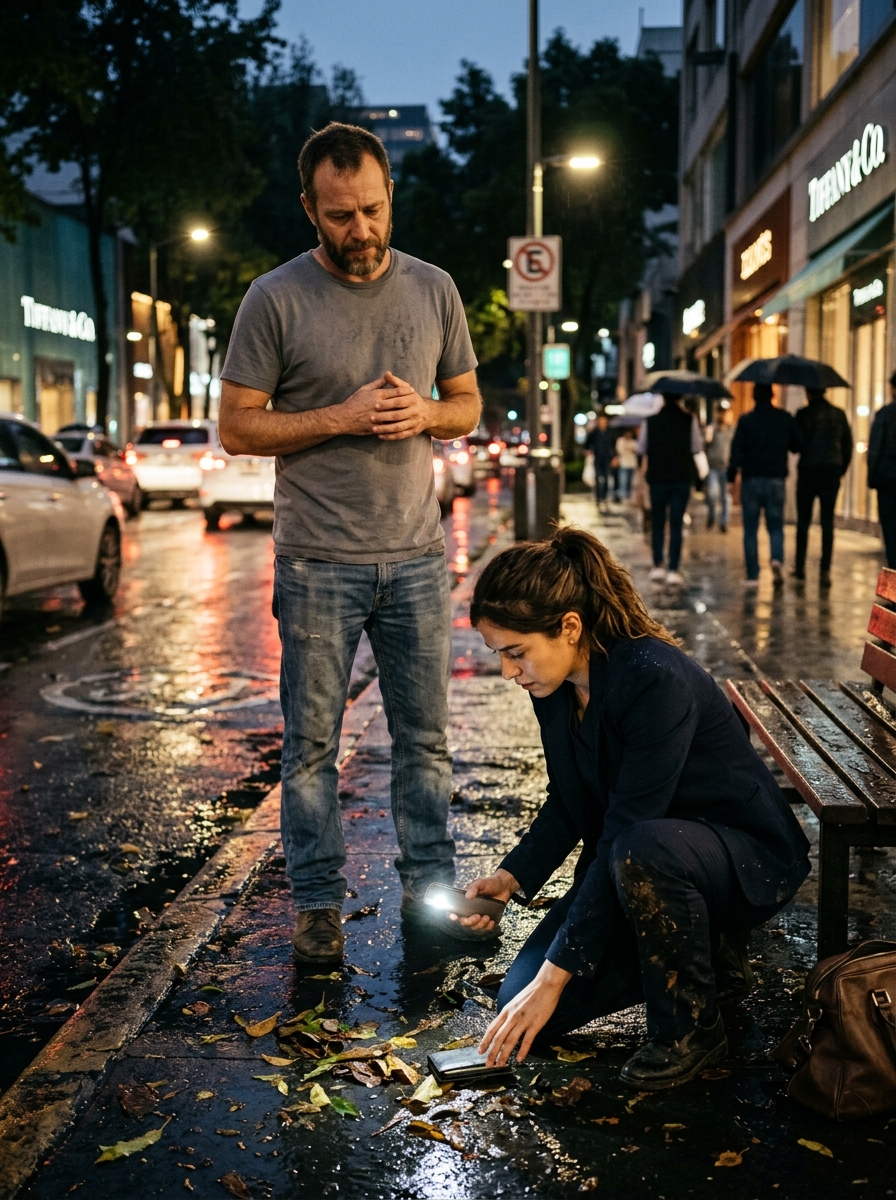
Without waiting to be asked twice, Lucía told the manager she needed a few minutes, grabbed her jacket, and went outside with him. They walked along Masaryk, checking around tree roots, under a bench, near a storm drain. Evening was falling over the city, and the air smelled of rain and exhaust fumes.
Lucía crouched down, unbothered by what it might do to her black trousers. She switched on her phone’s flashlight and sifted through dry leaves.
“You really don’t have to do this,” Mateo said, guilt burning inside him.
“Of course I do. Losing a wallet is a real problem. Money can be replaced — but your ID, your cards, everything else, that’s a nightmare to deal with.”
Mateo stared at his dirt-covered hands. This wasn’t a test anymore. It was cruelty.
He walked over to the beat-up rental car he’d used for his disguise, opened the door, and pretended to search underneath the seat.
“Found it,” he said, holding up the wallet. “How embarrassing. It slipped down inside.”
Lucía let out a long, exhausted breath, then laughed despite herself.
“Sir, I nearly fell into a storm drain because of you.”
Mateo smiled, but something inside him had cracked.
“Let me take you to dinner, at least.”
“Thanks, but there’s no need. Just be more careful with your things.”
Lucía headed back into the shop, her shirt a little dirty, her head held high.
That night, in his sprawling house in Lomas de Chapultepec, Mateo pulled up Lucía Ramírez’s employee file. Mother deceased. Father absent. Started university at twenty-four. Excellent academic record. No connections, no privilege.
He shut the folder, ashamed of himself.
He’d set out to test an employee’s character without realizing she’d spent years holding her life together through sheer will.
The next morning, when Fernanda spotted Lucía walking in, she smiled with a cruelty that chilled the room.
She had no idea what was coming.
PART 2
“Look who’s back — the champion of the poor,” Fernanda said loudly, in front of everyone. “Did the homeless guy propose, or did he just toss you some spare change?”
Mariana, another saleswoman, covered her mouth to stifle a laugh. The manager pretended not to hear. Lucía kept sorting inventory boxes behind the counter and said nothing.
But Fernanda wasn’t satisfied with silence. She wanted humiliation.
“While you’re at it, clean my display case,” she ordered. “You spent yesterday crawling around on the pavement, so you’re clearly good at that sort of work.”
Lucía swallowed her response. She needed this job. It paid for her room in Santa María la Ribera, her overdue tuition, and medicine for Doña Elvira, the neighbor who had raised her like a daughter after her mother’s death.
So she cleaned.
When she left that evening, she found Mateo waiting outside, leaning against an unremarkable car. This time he wore a blue shirt, his hair a little more tamed.
“Lucía.”
She stopped, startled.
“How do you know my name?”
Mateo nodded toward her name tag.
“Hard to miss it.”
Lucía laughed for the first time all day.
“Right. I forgot to take it off.”
He held out a small bag.
“I want to buy a watch for someone special, but not from a shop like that one. Do you know somewhere more down-to-earth, where they won’t make you feel small for asking the price?”
Lucía hesitated, then ended up walking him to a more modest shop near Reforma. On the way, they talked about simple things — tacos, traffic, the city’s unpredictable weather. Mateo came across a little awkward, but genuinely attentive, and it put her at ease.
Inside the shop, he picked out a small steel watch.
“For a girlfriend?” she asked, teasing.
“For a twelve-year-old boy,” Mateo said. “He’s in a children’s home. It’s his birthday.”
Lucía’s smile faded.
“You volunteer there?”
“Sometimes.”
She didn’t say anything more, but something shifted in her eyes. Lucía recognized that kind of quiet — the quiet of someone who has lost far too much.
That night, Mateo texted her.
“Did Fernanda give you trouble again?”
Lucía read it from her small room, a bowl of instant soup beside her.
“I’m fine. Don’t worry about it. People talk because they can. I work because I have to.”
Mateo’s grip tightened on his phone, anger building. In his private office, he pulled up the branch’s security footage. He watched Fernanda brush off customers, mock Lucía, dump extra work on her, pocket a commission that wasn’t hers, and badmouth her to the manager.
He saved every clip.
“They think they run my company,” he muttered. “They’ve forgotten who signs their contracts.”
That Sunday, Lucía went to a children’s home in Coyoacán, bringing notebooks and crayons. When she stepped into the courtyard, she froze.
Mateo was sitting on a bench, talking with a boy with messy hair. The watch they’d picked out together gleamed on the child’s wrist.
“Mateo?”
He stood up, genuinely caught off guard.
“Lucía… I didn’t know you came here too.”
She sat beside him.
“I grew up coming to this place. When my mother got sick, the nuns helped us with food.”
Mateo looked down at his hands.
“I grew up here too.”
Lucía stared at him.
“My parents died when I was ten,” he said. “My grandfather raised me after that, but then he died too. This house was all I had.”
Something in Lucía softened.
“My father didn’t die,” she said quietly. “There were times I wished he had. He drank, gambled, put his fists through walls so my mother would cry where no one could hear. When I started college, I had to leave and work. My mother died owing money to the hospital. That’s when I learned nobody’s coming to save you.”
Mateo wanted to reach for her hand. He didn’t dare.
Lucía wiped away a tear quickly, as if annoyed it had escaped at all.
“But that’s the past. We’re still here, aren’t we?”
Then she jumped up and ran off with the girls to teach them how to fold paper flowers.
Mateo watched her, his chest tight. It wasn’t curiosity driving him anymore. It wasn’t guilt either.
He was falling in love.
But he also realized something awful: the more he cared for her, the more unforgivable his lie became.
The next day, he decided to tell her the truth — never imagining it would tear everything apart.
PART 3
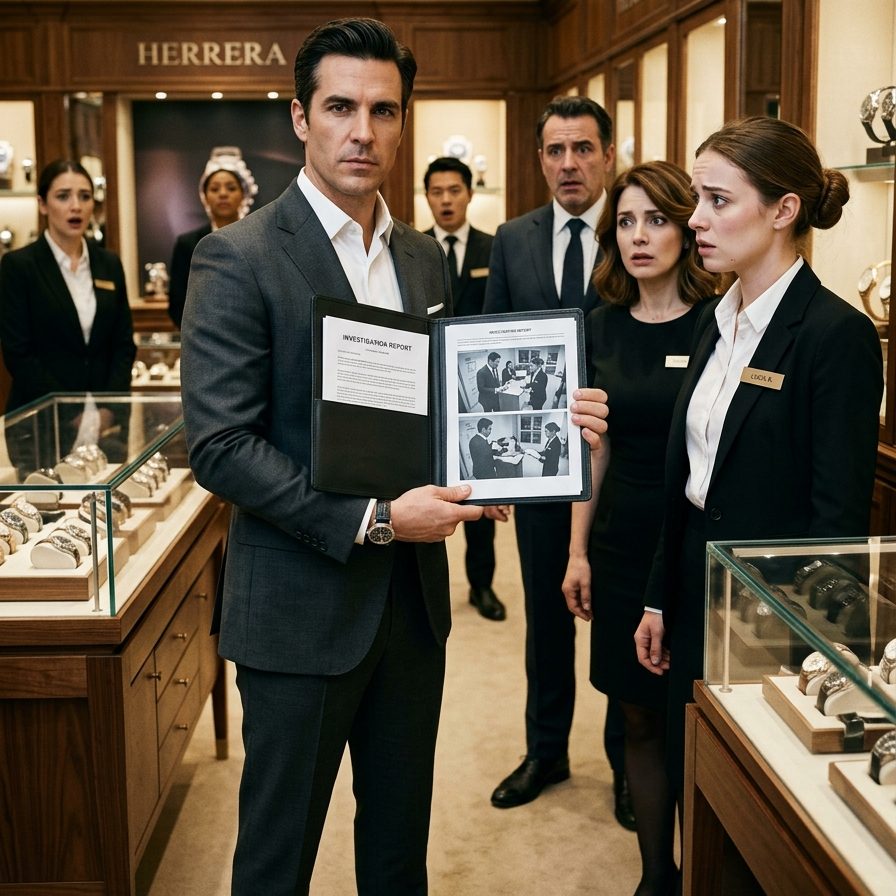
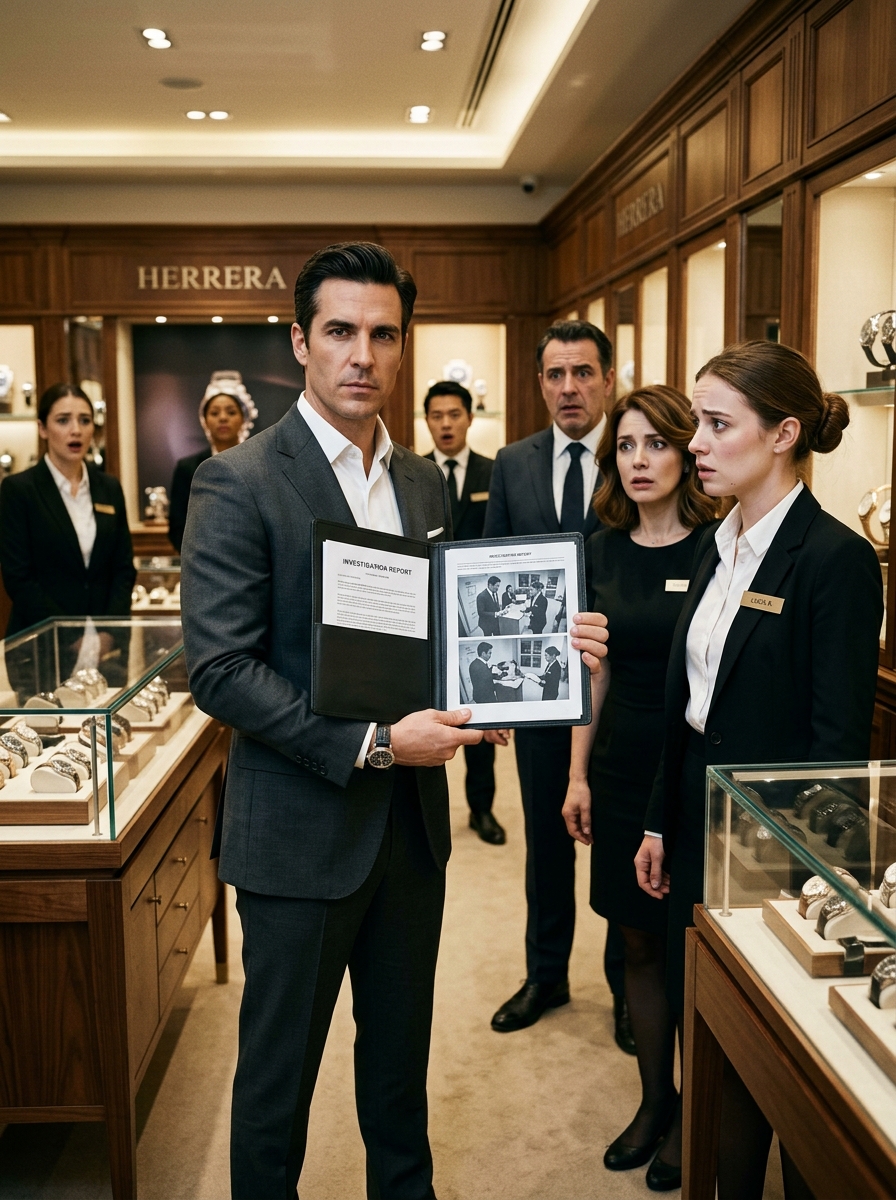
The watch shop was packed when Mateo Herrera walked in wearing a sharply tailored dark gray suit.
The chatter died instantly. His polished shoes echoed against the marble with a confidence that bore no resemblance to the man in the ragged t-shirt from days before.
Fernanda spotted him first.
“You again?” she sneered. “Finally found some decent clothes to borrow?”
Mateo didn’t even glance at her. He walked to the center of the floor, opened a black folder, and spoke in a tone that straightened the manager’s spine.
“Good afternoon. I’m Mateo Herrera, CEO and owner of Grupo Herrera.”
The room went silent.
Fernanda turned white. Mariana looked down. The manager felt his collar tighten around his throat.
Lucía let the cloth in her hands drop.
“Mateo?” she whispered.
He looked at her — pride and dread mixed together on his face.
“I came into this branch disguised as an ordinary man to see how customers were treated when they looked like they had no money. I found two things: arrogance in people who are supposed to serve, and dignity in someone who never needed anyone watching to do the right thing.”
He opened the folder.
“I have footage of mockery, discrimination, stolen commissions, and harassment. Fernanda, you’re fired. Mariana, HR will be reviewing your case. And you,” he said, turning to the manager, “are suspended for letting this go on.”
Fernanda began to cry.
“Mr. Herrera, I had no idea it was you.”
“That’s exactly the problem,” Mateo said. “It shouldn’t have mattered whether it was me.”
He turned toward Lucía.
“Lucía Ramírez is being promoted to senior consultant, effective immediately. Her salary will triple. And she’ll have my direct backing.”
He expected to see relief. Maybe a smile.
Instead, Lucía had gone pale.
“Was all of this a test?” she asked.
Mateo’s expression fell.
“Not exactly. I wanted to know the truth.”
“My truth, or your power?” Her voice cracked. “You watched me crawl along the sidewalk searching for a wallet that was never even lost. You let me tell you about my life while hiding the fact that you were my boss. And now you walk in here and reward me in front of everyone, like I’m the star of your monthly act of charity?”
“Lucía, I was trying to protect you.”
“I don’t need protection built on lies.”
The whole shop was watching.
“You never saw me as a person,” she went on. “You saw me as the answer to some question you were asking yourself — ‘are there still good people out there?’ I wasn’t put on this earth to prove humanity to a bored millionaire.”
Mateo took a step toward her.
“I’m sorry.”
“So am I.”
Lucía unpinned her name tag and set it on the counter.
“I need to get some air.”
No one tried to stop her.
That afternoon, Mateo waited for her at Parque México holding a large bouquet of red roses. He felt foolish but couldn’t help himself. When Lucía arrived, she was in a simple jacket, her eyes tired.
“Lucía, please. Let me explain.”
She looked at the flowers.
“Is this part of the act too?”
Mateo lowered the bouquet.
“No. I love you.”
Lucía shut her eyes for a moment, as though the words hurt.
“Don’t use that to fix what you broke.”
“I can give you stability. Help with school, with rent, with anything you need. You’d never have to worry about money again.”
She let out a tired, sad laugh.
“That’s exactly what you’re not getting. I spent years building myself up so I wouldn’t have to depend on anyone. I survived an abusive father, debt, funerals, jobs where I was treated like I was less than human. And the one time someone looked at me without pity, it turns out he was also sizing me up.”
Mateo felt the flowers growing heavier in his hand.
“I never meant to hurt you.”
“But you did.”
Lucía took a slow breath.
“I’m resigning. I’m not taking the promotion. I don’t want my future built on you.”
“Lucía…”
“If you ever talk to me again, let it be without disguises, without tests, and without trying to save me.”
She walked off beneath the park lights. Mateo didn’t follow. For the first time, he understood that loving someone wasn’t about giving them money — it was about respecting the space they needed to heal.
Six months later, a small flower shop opened on a quiet street corner in Roma.
It was called Flores de Lucía.
Nothing about it was large or extravagant, but every detail carried her touch: hand-painted clay pots, colorful ribbons, calla lily bouquets, marigolds out of season, roses wrapped in kraft paper. Lucía had built it from her own savings, a small loan, and countless sleepless nights.
The first month was hard. So was the second. But word spread among the neighbors. A woman came every Monday for flowers to leave at her late husband’s grave. A young man came asking for sunflowers to help him apologize. A little girl showed up every Friday for a single daisy for her teacher.
Lucía realized she didn’t want to sell luxury. She wanted to sell gestures.
One morning, while arranging white lilies, she noticed a black car pull up across the street.
Mateo stepped out.
He wasn’t dressed to impress. No oversized bouquet in his arms. Just a small pot of bougainvillea, its leaves still wet from the rain.
He stopped at the entrance without stepping inside.
“Hello, Lucía.”
She looked at him for a long moment.
“Hello, Mateo.”
He held up the pot carefully.
“I didn’t come to buy anything. I wanted to ask if this needs direct sun or shade. Someone told me you treat everyone well here, even people who have no idea what they’re doing.”
Lucía tried not to smile. She couldn’t stop herself.
“Depends. Care for it patiently, and it’ll bloom. Try to control it too much, and it’ll dry up.”
Mateo nodded, understanding they weren’t really talking about the plant anymore.
“Then I’ll learn to take care of it the right way.”
Lucía took the pot and placed it on the counter.
“I can walk you through it. But this time, no lies.”
“No lies,” he agreed.
Rain kept falling over Roma, washing over sidewalks, parked cars, and old wounds. There was no cinematic kiss, no grand declaration. Just two people standing face to face — for the first time, on equal footing.
And sometimes, after so much pain, that’s worth more than any perfect ending.
