

The Little Girl Asked for Food in a Restaurant Full of Millionaires. But the Necklace Around Her Neck Made One Old Man Tremble.
No one in the restaurant realized they were sitting beside a ghost.
Not the woman laughing behind her diamond bracelet. Not the men lifting glasses of wine worth more than a family’s monthly rent. Not the violinist near the fountain, coaxing gentle notes into the air as though grief could be wrapped in silk.
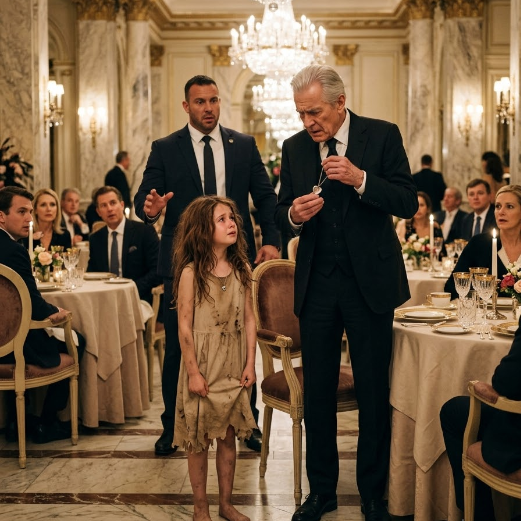
And certainly not the barefoot little girl standing in the middle of it all, shaking beneath the chandeliers.
Her name was Lily.
She was seven years old.
And she hadn’t eaten since the previous morning.
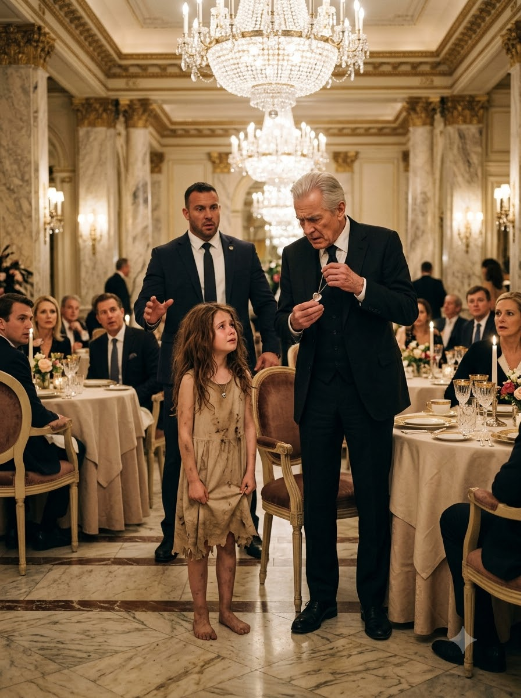
The restaurant was called The Aurelia Room, the kind of place where the wealthy gathered to murmur business deals over gold-rimmed plates and act as though the rest of the world simply didn’t exist. The floor gleamed like polished ice. The tables were dressed in linen as fine as wedding gowns. Crystal glasses caught the candlelight and threw it back.
Lily didn’t belong there.
Her dress had torn at the shoulder. Dust clung to her knees. Her hair, once carefully braided by loving hands, now fell loose around her thin face. Each step she took left a faint smudge on the immaculate floor.
But hunger had pushed her through the kitchen door.
Hunger had made her brave.
She came to a stop beside the table of an older man sitting by himself near the center of the room.
He had silver hair, sharp cheekbones, and the quiet stillness of someone who had once commanded a room without needing to raise his voice. His suit was black, his cuffs perfectly pressed, his expression impossible to read. He looked wealthy, but not happy.
Lily swallowed hard.
“I’m hungry,” she whispered.
The man’s knife stopped midway through his steak.
Slowly, he raised his eyes to her.
For a long moment, he only looked.
Lily clutched the edge of her dress with both hands. Her stomach clenched painfully, but she made herself speak again.
“Can I eat?”
Something shifted in the man’s face, almost too faint to catch.
But before he could respond, heavy footsteps rang out against the marble behind her.
A security guard marched forward, jaw clenched, hand reaching for Lily’s shoulder.
“You need to leave,” he barked. “Now.”
Lily flinched so hard her small shoulders jumped to her ears.
At the neighboring table, a woman in pearl earrings pulled back as though Lily were contagious.
“This is disgusting,” the woman muttered. “How did she even get in here?”
A few guests turned to stare. Some annoyed. Some merely curious. None kind.
Lily felt heat rush to her face. Her eyes burned. She wanted to run, but her legs refused to move.
Then the older man spoke.
“Stop.”
His voice wasn’t loud. But the room seemed to bend to it anyway.
The guard froze, hand still lifted. The woman’s mouth opened, then shut again.
The older man pushed back his chair and rose. He stood taller than Lily had expected, and suddenly the guard looked far less sure of himself.
The man’s gaze stayed locked on the little girl. Not on her ripped dress. Not on her bare, dirty feet. On her face.
Then Lily, nervous and embarrassed, raised a hand to her chest. Her fingers brushed the neckline of her dress.
And the silver necklace slipped free.
A small heart-shaped pendant swayed beneath the candlelight.
The older man’s face drained of color.
Every sound in the restaurant seemed to vanish. The violin. The clinking glasses. The murmurs. Even Lily’s own breath.
The man reached out slowly, as though the necklace might disappear if he moved too fast. His fingers closed around the tiny silver heart.
It popped open.
Inside were two worn initials.
A.M.
His hand started to shake.
Lily looked up at him, puzzled.
“Where did you get this?” he asked.
His voice had lost all its authority. It sounded shattered.
“My mom gave it to me,” Lily said.
The man’s lips parted. His eyes glistened with something sharp and aching.
“What is your mother’s name?”
Lily took a small breath.
“Anna,” she whispered. “Anna Miller.”
The old man stumbled back as though struck in the chest.
A chair scraped somewhere behind him. A waiter gasped. The security guard took an uncertain step backward.
The man braced a hand against the table to keep his balance.
“No,” he breathed. “No, that’s not possible.”
Lily gripped her necklace tighter. “Do you know my mom?”
The man finally looked at her, really looked, and something in his expression fell apart completely.
The silver-gray eyes. The small dimple in her left cheek. The way her bottom lip quivered when she was fighting back tears.
He’d seen that face before. Not on Lily. On a young woman standing at the foot of a grand staircase twelve years earlier, tears running down her cheeks while he shouted words he would regret every single night afterward.
Anna. His daughter. His only child.
The daughter he’d cast out.
The older man’s name was Edward Harrington, one of the richest men in the city. His buildings shaped the skyline. His name was etched into hospital wings and museum walls. People called him generous, brilliant, untouchable.
But twelve years earlier, he had been only one thing.
A proud father unable to forgive his daughter for loving the “wrong” man.
Anna had come home one rainy night, pregnant and trembling, begging for help.
Edward remembered every detail. Her soaked hair. Her shaking hands. Her voice saying, “Daddy, please. I have nowhere else to go.”
And he remembered his own voice, colder than any winter.
“Then go to the man you chose over your family.”
Anna had looked at him as though something inside her had just died.
Then she’d walked out. And never returned.
Edward searched for her afterward. Quietly at first. Then frantically. Private investigators. Old friends. Hospitals. Shelters. Every trace of Anna disappeared like mist.
For twelve years, he lived trapped inside the punishment of that single night.
And now a starving little girl stood before him, wearing the necklace he’d given Anna on her sixteenth birthday.
His voice trembled.
“Lily…” he whispered. “Where is your mother?”
The little girl lowered her eyes.
The whole restaurant seemed to hold its breath.
“She’s sick,” Lily said. “She told me to stay with her, but she wouldn’t wake up this morning. I tried to get help, but people kept walking away.”
Edward’s blood ran cold.
“What do you mean she wouldn’t wake up?”
Lily’s eyes welled with tears.
“She was breathing,” she said quickly, as though trying to convince herself. “Just… really slow. She told me yesterday that if I got scared, I should find somewhere with lights. She said rich people always have lights.”
Edward shut his eyes.
The words cut deeper than any blade could. His daughter had been dying somewhere in the city while he sat alone eating steak beneath crystal chandeliers.
He turned sharply toward the guard.
“Call an ambulance.”
The guard blinked. “Sir, I—”
“Now!”
The guard bolted.
Edward crouched down in front of Lily, ignoring the stares, the whispers, the scandalized faces around them.
“Can you take me to her?” he asked.
Lily nodded. Then her stomach growled so loudly that several nearby guests heard it.
The woman in pearls looked away, embarrassed for what seemed like the first time in her life.
Edward’s expression hardened. He turned toward the waiter standing nearby.
“Bring soup. Bread. Water. Quickly.”
The waiter hurried off.
Lily whispered, “I don’t have money.”
Edward’s eyes filled again.
“My dear child,” he said, his voice cracking, “you should never have needed money to be treated like a human being.”
The soup arrived within minutes. Lily ate slowly at first, then faster, unable to hold back. Edward watched every spoonful as though it were both a relief and an accusation.
When she finished, he draped his coat around her small shoulders. It swallowed her completely.
Then he took her hand.
The guests parted as they crossed the restaurant. No one laughed now. No one clinked their glasses.
The woman in pearls dropped her gaze as Lily passed.
Outside, rain had begun to fall over the city, silver and cold beneath the streetlights. Edward’s driver pulled the car up to the curb, but Lily shook her head.
“No car,” she said. “The alley is too small.”
So Edward Harrington, a man who hadn’t walked anywhere without a driver in years, followed a barefoot child through rain-slicked streets, past luxury storefronts, trash bins, shuttered bakeries, and sleeping figures huddled beneath cardboard.
Every step carried him farther from the world he’d built. And closer to the world his daughter had endured.
Finally, Lily stopped before a narrow alley behind an abandoned flower shop.
“She’s there,” she whispered.
Edward’s chest tightened.
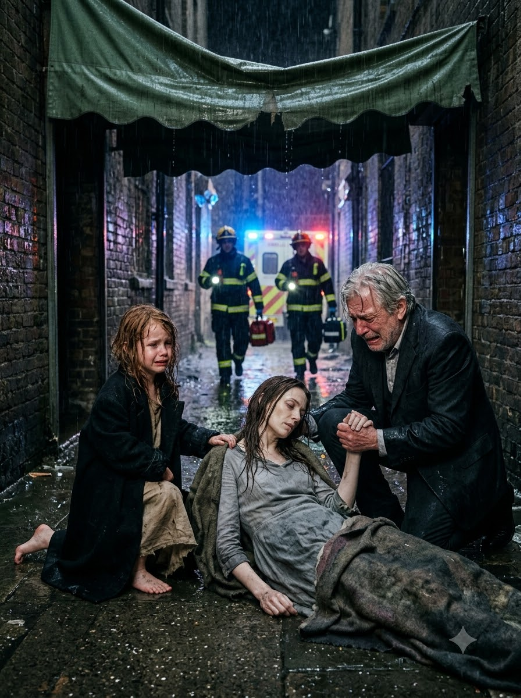
At the end of the alley, beneath a torn green awning, lay a woman wrapped in a thin gray blanket. Her face was pale. Her lips were cracked. Her dark hair, damp with rain, clung to her cheeks.
But Edward recognized her instantly.
“Anna.”
He dropped to his knees beside her. For a moment, he couldn’t breathe.
His daughter’s eyes fluttered open. Clouded. Weak. But alive.
She stared at him as though she were seeing a hallucination.
“Dad?” she whispered.
Edward broke down. Not a composed tear. Not a dignified tremble. A raw, terrible sound tore out of him as he clasped his daughter’s cold hand in both of his.
“Anna, forgive me,” he said. “Please, forgive me. I should have found you. I should have opened the door. I should have chosen you.”
Anna’s eyes shifted toward Lily.
“My baby,” she whispered.
“She found me,” Edward said. “She walked into The Aurelia Room wearing your necklace.”
Anna tried to smile, but pain twisted across her face.
“I told her…” she breathed, “if she ever saw a man with sad eyes sitting alone… to ask him for food.”
Edward went still.
“What?”
Anna’s fingers tightened weakly around his.
“I knew you ate there every Thursday,” she whispered. “I saw you once, through the window. Years ago.”
Edward stared at her, stunned.
“You knew where I was?”
Anna’s eyes filled with tears.
“I went to the restaurant door once,” she said. “When Lily was a baby. I was going to ask for help.”
Edward could barely get the words out. “Why didn’t you?”
Anna swallowed.
“Because I saw you laughing with reporters. They were calling you a great philanthropist.” Her voice shook. “And I thought… maybe you only loved suffering when it had your name on a plaque.”
The words broke him.
An ambulance siren wailed somewhere in the distance.
Edward pressed his forehead to Anna’s hand.
“I was a coward,” he whispered. “A proud, foolish coward. But I’m here now. I won’t leave you again.”
Anna looked toward Lily, then back at him.
“There’s something you need to know,” she said.
Edward lifted his head.
Anna’s voice was fading, but her eyes had turned suddenly clear.
“Lily isn’t my daughter.”
Edward froze.
Rain tapped against the awning.
Lily blinked. “Mama?”
Anna turned toward the child with unbearable tenderness.
“You are my heart,” she whispered. “But I didn’t give birth to you.”
Lily’s lips began to tremble.
Edward looked between them, struggling to understand.
Anna drew a shaking breath.
“Seven years ago, I found her outside a shelter. She was wrapped in a blue blanket, with a hospital bracelet still on her wrist. No name. No family. Just a note that said, Please let her live.”
Edward’s mouth went dry.
Anna went on, each word costing her effort.
“I kept her because no one had kept me.”
Lily began crying silently.
Anna touched her cheek. “I became your mother because love isn’t blood, sweetheart. Love is who stays.”
Edward’s thoughts spun. The necklace had led Lily to him, but she wasn’t his granddaughter.
Or was she?
The ambulance arrived. Paramedics rushed into the alley. Edward stepped back as they lifted Anna onto a stretcher.
Then one paramedic paused while checking Lily for injuries.
“Sir,” he said carefully, “this child has an old medical ID scar on her ankle. Some hospitals used to mark newborns that way.”
Edward’s heart lurched.
He knelt beside Lily and examined the faint mark near her ankle. A tiny number had been tattooed there.
H-417.
Edward stopped breathing.
He knew that number. Because seven years earlier, his wife had died after secretly funding a private maternity clinic for abandoned mothers. After her death, Edward found unusual records in her safe—records tied to babies hidden from dangerous families, corrupt officials, and traffickers.
One file had haunted him ever since.
Infant H-417. Female. Mother deceased. Father unknown. Protected placement failed.
The baby had vanished before Edward could trace her.
He had searched for her too. Not because she was family. Because his wife’s final letter had pleaded with him to.
Now Lily stood before him, wearing Anna’s necklace. Protected by Anna. Led back to him by hunger, mercy, and fate.
But the twist came three days later.
Anna survived. Barely.
Edward moved her and Lily into his mansion, not out of charity, but as family. Doctors visited. Warm meals filled the kitchen. Lily slept in a bed so soft she cried the first night, afraid she might dirty it.
Edward hired investigators to trace Lily’s origins.
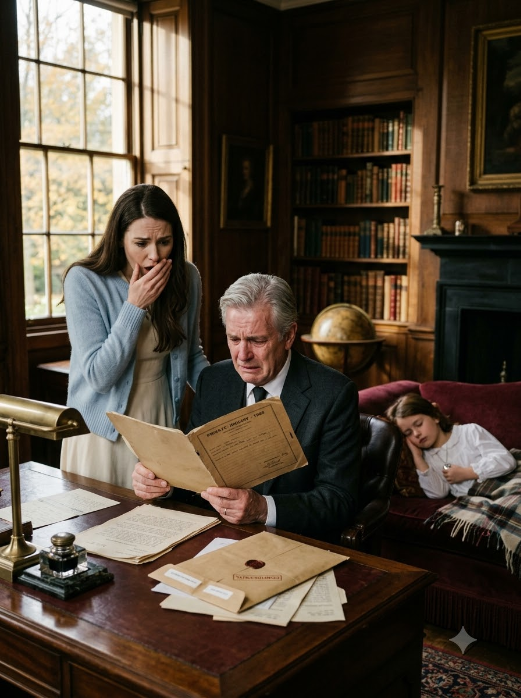
The results arrived in a sealed envelope.
Edward opened it in his study with Anna at his side and Lily asleep on the sofa, clutching the silver heart.
He read the first page. Then the second. Then his face drained of color.
Anna whispered, “Dad?”
Edward slowly lowered the papers. His hands were shaking again.
“Lily’s mother wasn’t just any woman,” he said.
Anna frowned. “Who was she?”
Edward turned toward the sleeping child.
“Her mother was Clara Harrington.”
Anna’s breath caught.
“My mother?”
Edward nodded, tears sliding down his face.
Before Clara died, she had discovered that one of the pregnant women at her clinic was carrying a child fathered by Edward’s older brother, a violent man determined to erase the baby to protect his inheritance. Clara hid the newborn under file number H-417.
Then Clara died in what everyone had believed was an accident.
But the records proved otherwise.
Edward’s brother had arranged it.
And Lily—the starving little girl thrown out of a restaurant—was the last living witness to the secret Clara had died protecting.
She wasn’t Edward’s granddaughter.
She was his niece. The rightful heir to half the Harrington fortune. The child his wife had saved. The child Anna had unknowingly raised. The child Edward had nearly let security throw out into the rain.
The next morning, Edward returned to The Aurelia Room.
This time, he didn’t sit alone.
Anna sat beside him in a soft blue dress, still weak but smiling. Lily sat between them, clean, warm, and wide-eyed, wearing the same silver heart necklace.
The woman in pearls was there again. So was the security guard.
Edward stood before the entire restaurant.
“I spent my life building towers,” he said, his voice steady. “But I was too blind to see the people sleeping in their shadows.”
The room fell silent.
He rested a hand on Lily’s shoulder.
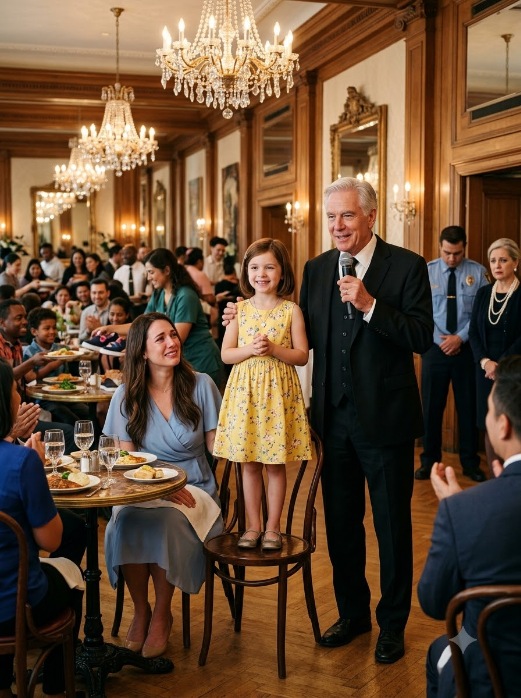
“This child came here hungry, and most of you saw an inconvenience. I saw one too—until her necklace forced me to look again.”
His gaze swept across the room.
“From today forward, this restaurant belongs to the Harrington Hope Foundation. It will serve the wealthy at night, but every morning and afternoon, its doors will open to hungry children and families. No questions. No shame. No one turned away.”
Gasps rippled through the crowd.
Then Lily climbed onto her chair, small but fearless.
“And shoes,” she said.
Edward looked down. “What?”
She lifted her chin.
“Some kids need shoes too.”
For the first time in years, Edward Harrington laughed through his tears.
“Yes,” he said. “Shoes too.”
The woman in pearls buried her face in her hands. The guard wiped his eyes. And the violinist, without waiting to be asked, began to play.
Years later, people would speak of Edward Harrington’s generosity, his foundation, his shelters, his hospitals, his kitchens.
But Edward knew the truth.
He hadn’t saved Lily.
Lily had saved him.
Because sometimes fate doesn’t arrive wearing wings.
Sometimes it arrives barefoot, hungry, and trembling beneath chandeliers.
Sometimes it whispers, “Can I eat?”
And sometimes, if the world is lucky, someone finally answers:
“Yes, my child. Come home.”
