


The mayor walked right past Rex Callahan as if he didn’t exist.
That was the first crack in Rex’s confidence.
One second earlier, he had been laughing at a mason on his knees in the mud.
Now the mayor was shaking that same mason’s hand in front of the entire construction site.
“Mr. Avery,” Mayor Elaine Whitaker said, loud enough for every worker, inspector, and foreman to hear, “thank you for coming down here personally.”
Rex blinked.
Brianna stopped smiling.
And Tom Avery, the man they had just treated like trash, simply nodded.
“Morning, Madam Mayor,” Tom said.
Nobody moved.
Even the crane seemed to stop turning.
The Liberty Crown Tower site sat in the middle of downtown, wrapped in steel, concrete dust, and political pressure. It was supposed to be the tallest building the city had seen in thirty years.
A symbol of jobs.
A symbol of progress.
A symbol Rex Callahan had used like a personal throne.
Rex was the general contractor.
He drove a black luxury truck.
He wore a white hard hat that never seemed to get dirty.
He called city inspectors by their first names.
He took donors to lunch and told local reporters he was “building the future with his bare hands.”
But Rex’s hands were soft.
Tom Avery’s were not.
Tom had spent forty years around brick, stone, steel, weight, pressure, and silence. His shoulders were bent from work, not weakness. His boots were old because he liked tools and clothes that had already proven themselves.
That morning, he had arrived before sunrise wearing a faded jacket and carrying a lunch pail.
Most workers assumed he was just another older mason brought in for finish work.
That was exactly what Tom wanted them to assume.
He walked the lower floors quietly.
He checked the stone panels.
He checked the mortar samples.
He checked the load-bearing decorative columns Rex had rushed to install ahead of schedule for a mayoral photo-op.
And then Tom found the problem.
The imported limestone panels listed in the contract were not the panels being installed.
The invoice said premium fire-rated stone.
The site had cheaper substitute panels.
The purchase logs said the right materials had been delivered.
The storage yard said otherwise.
Tom photographed everything.
Batch numbers.
Cracked corners.
Mismatched thickness.
Supplier markings ground down with a sanding disc.
Then he found the second problem.
A pallet of damaged panels had been staged near the east entrance, right where city officials would pass.
Too obvious.
Too theatrical.
Tom understood immediately.
Someone planned to blame a worker.
Someone disposable.
Someone people already ignored.
Unfortunately for Rex, he had chosen Tom.
At 10:17 a.m., Rex came storming across the site with Brianna Vale at his side.
Brianna was not listed as an employee.
Not officially.
But everyone knew she had a desk in Rex’s trailer, a company credit card, and more influence than any assistant should have had.
She wore a bright red coat and heels too clean for a construction site.
Rex pointed at the cracked panels.
“What the hell did you do?”
Tom looked up from his notebook.
“I didn’t touch those.”
Rex laughed.
Not because it was funny.
Because the crew was watching.
“Listen to him,” Rex said. “He thinks he’s in charge of stone quality now.”
A few men shifted uncomfortably.
Nobody spoke.
Rex stepped closer.
“You people come onto my site, break my materials, slow my schedule, and then act like victims.”
Tom closed his notebook.
“Your site?”
Rex’s smile sharpened.
“That’s right. My site.”
Then Brianna leaned toward Tom and said, “Maybe he doesn’t understand big projects. He looks like he should be patching chimneys.”
That got a small laugh from one of Rex’s foremen.
Rex enjoyed that.
He enjoyed it too much.
So he raised his hand and slapped Tom across the face.
The sound cracked through the jobsite.
Tom staggered one step.
His lunch pail fell.
Rex kicked it.
The metal lid popped open, and Tom’s sandwich slid into the wet mud near a tire track.
A thermos rolled under a stack of rebar.
An apple, bruised and packed in a napkin by Tom’s daughter, stopped at Rex’s polished boot.
Rex looked down at it.
Then he crushed it.
“Clean it up,” he said.
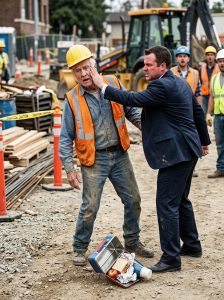
That was when the phones came out.
Workers.
Delivery drivers.
Two electricians on the second-floor platform.
Even a young inspector standing near the gate.
Tom looked at the mud on his lunch.
Then at Rex.
Then at the damaged panels.
He did not swing back.
He did not curse.
He did not even raise his voice.
That bothered Rex more than anger would have.
“What?” Rex snapped. “Nothing to say?”
Tom wiped his cheek with the back of his hand.
“You just made this very simple.”
Brianna laughed.
“Simple? Rex, he thinks he’s filing a complaint.”
Rex turned to the watching crew.
“Let me make something clear. This man damaged city-approved materials. He will be removed from this site. And if any of you back him up, you can leave with him.”
That shut people down.
Fear has a sound.
It is not always screaming.
Sometimes it is twenty good men looking at the floor because they have mortgages.
Tom understood that too.
So he reached into his canvas bag and pulled out the blue binder.
Rex barely glanced at it.
“You carrying coloring books now?”
Tom opened the binder.
Inside were printed invoices, supplier manifests, inspection notes, photos, and copies of emails.
Rex’s eyes flickered.
Just once.
But Tom saw it.
“You substituted the stone,” Tom said quietly.
Rex stepped closer. “Careful.”
“You billed the city for premium panels. You installed cheaper ones. Then you staged the damaged pieces to blame a laborer before the mayor’s visit.”
Rex’s face hardened.
Brianna’s hand dropped from his arm.
“You have no idea what you’re talking about,” Rex said.
Tom turned one page.
“Then you moved the difference through Callahan Site Logistics.”
Rex went pale.
That company name was not on the sign.
It was not on the public contract.
It was not something a “bricklayer” should know.
Brianna whispered, “Rex…”
Rex snapped at her, “Shut up.”
The whole site heard it.
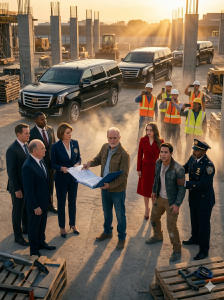
Then the SUVs arrived.
Three black city vehicles rolled to the gate.
The mayor stepped out first.
Behind her came the city attorney, two procurement auditors, and a police captain.
Rex forced a smile so fast it looked painful.
“Mayor Whitaker,” he called, walking toward her with both hands open. “You’re early. We were just handling a personnel issue.”
Mayor Whitaker did not slow down.
She walked past him.
Straight to Tom.
“Mr. Avery,” she said, reaching for his hand, “thank you for coming down here personally.”
The site fell into a silence so deep that someone’s radio crackled three floors up.
Rex stared at Tom.
“Mr. Avery?” he repeated.
The mayor turned.
“You two haven’t met properly?”
Rex swallowed.
Tom closed the blue binder.
“We met this morning.”
Brianna’s lips parted.
One of the older crane operators whispered, “Oh no.”
Mayor Whitaker looked at Rex.
“Thomas Avery is the lead design architect for Liberty Crown Tower.”
Rex’s mouth opened.
Nothing came out.
The mayor continued.
“He also chairs the structural review board for the city partnership. His firm owns final approval rights over all exterior stone, public safety finishes, and contractor compliance.”
A worker near the scaffold muttered, “That’s Tom Avery?”
Another said, “The Avery?”
Rex tried to laugh.
It came out thin.
“There must be some confusion. He was dressed as—”
“As a working man?” Tom asked.
That sentence landed harder than the slap.
Rex looked around.
The crew was watching him now.
Not with fear.
With realization.
Tom opened the binder again and handed the first packet to the city attorney.
“Contract section 14.2,” Tom said. “Material substitution without written approval. Section 19.6. Fraudulent billing. Section 22.4. Contractor removal for misconduct affecting public funds or worker safety.”
The city attorney nodded.
Rex’s voice changed.
“Tom. Let’s not do this in front of everyone.”
Tom looked at his lunch in the mud.
“You chose the audience.”
That line moved through the crew like electricity.
Brianna took one step back.
Then another.
Tom handed over a second packet.
“These are invoices from the approved supplier. These are the panels actually installed. These photos show the altered batch marks. These emails show Rex directing the substitution.”
Rex lunged forward.
“Those are private company documents.”
The police captain stepped between them.
“Don’t touch him.”
Rex froze.
Tom looked at Brianna.
“And these are the transfers to Vale Consulting.”
Brianna’s face drained.
The mayor turned to her.
“Are you Vale Consulting?”
Brianna said nothing.
Tom answered for her.
“She received consulting fees from the subcontractor after each approved change order. She is not on the payroll, but she used Rex’s company card for travel, hotel stays, and material vendor meetings.”
Workers began murmuring.
Rex pointed at Tom.
“He’s lying. He’s trying to take the project from me.”
Tom shook his head.
“No. You already took from it.”
The auditor stepped forward with a tablet.
“We verified the payment trail this morning.”
Rex looked at the auditor.
Then at the mayor.
Then at Tom.
For the first time all day, his power had nowhere to go.
Mayor Whitaker’s voice was cold.
“Mr. Callahan, as of this moment, Callahan Construction is suspended from all city-funded work pending investigation.”
Rex shouted, “You can’t do that.”
Tom turned another page.
“I can terminate him from Liberty Crown Tower.”
Rex’s face twisted.
“You?”
Tom removed a folded document from the binder.
It was not muddy.
It was sealed in plastic.
“The development board signed emergency authority over to the lead designer after the last safety audit. Your signature is on the acknowledgment.”
Rex stared at the page.
He had signed it six months earlier without reading it.
Because he thought paperwork was something assistants handled.
Because he thought rules were for smaller men.
Because he thought Tom Avery could not read a blueprint.
Tom took a pen from his jacket.
His hand was steady.
“In accordance with the compliance clause, your contract is terminated for cause.”
He signed.
The sound of pen on paper was almost nothing.
The effect was everything.
Rex’s knees seemed to loosen.
“You’re ruining me,” he whispered.
Tom looked at him.
“No. I stopped you from ruining people who trusted this building.”
Then Tom looked at the crew.
Every man and woman on that site stood still.
Electricians.
Welders.
Laborers.
Truck drivers.
Inspectors.
People Rex had threatened, underpaid, insulted, or ignored.
Tom raised his voice just enough.
“Nobody here loses a day’s pay because of what Rex did. The city has approved continuation funding. The replacement contractor starts under existing union rates. Anyone who reported safety concerns will be protected.”
A sound went through the site.
Not cheering.
Not yet.
Relief.
The kind people feel when someone finally says the thing they were afraid to say.
Then the young inspector near the gate stepped forward.
“I have video of the slap.”
Another worker said, “I have him kicking the lunch.”
A third said, “I’ve got Rex telling us to install the panels anyway.”
Then the dam broke.
People began speaking.
Quietly at first.
Then louder.
Rex turned in a circle, watching his kingdom become testimony.
Brianna slipped toward the parking area.
Tom saw her.
So did the police captain.
But she was quick.
By the time an officer reached Rex’s trailer, Brianna’s desk was empty.
Her laptop was gone.
Her red coat was found later in the back seat of a rideshare abandoned near the airport.
Investigators discovered she had emptied one of Rex’s personal accounts before leaving town.
Not company funds.
His funds.
The same man who had used her to show off learned he had been used too.
Rex was arrested two weeks later.
The charges were not dramatic rumors.
They were paper.
Wire transfers.
False invoices.
Public funds misuse.
Fraudulent procurement.
Witness intimidation.
Assault.
The video of him slapping Tom spread across local news before sunset.
But the part people shared most was not the slap.
It was Tom saying:
“You chose the audience.”
Rex’s friends stopped answering his calls.
His company trucks were repossessed.
His name was removed from the tower fence.
Several workers later admitted they had been afraid to report the material substitution because Rex threatened their jobs.
Tom made sure those statements went into the official record.
The damaged panels were removed.
The correct stone arrived.
The crew stayed employed.
And Tom did something Rex never expected.
He replaced the kicked lunch pail.
Not for himself.
For every worker on the site.
The following Monday, a long table appeared near the south entrance.
Coffee.
Sandwiches.
Apples.
Hot soup.
A sign beside it read:
RESPECT IS PART OF THE JOB.
No logo.
No speech.
Just food.
Tom’s daughter, Emily, came by that afternoon.
She was twenty-seven, a schoolteacher, and the person who still packed his lunch when she worried he was working too much.
She saw the bruise fading on his cheek.
Her eyes filled.
“You should’ve hit him back,” she said softly.
Tom smiled.
“No.”
“Why not?”
He looked up at the tower.
“Because then the story would have been about a fight.”
He picked up his hard hat.
“This way, it became about the truth.”
Months later, Liberty Crown Tower opened to the public.
The mayor gave a speech.
The city attorney stood nearby.
The workers stood in the front row, not the back.
Tom hated attention, but he walked onto the stage because the crew pushed him forward.
Mayor Whitaker handed him the ceremonial first-floor stone marker.
It did not have Rex’s name on it.
It had the names of the workers.
Masons.
Welders.
Laborers.
Operators.
Inspectors.
People whose hands actually built the skyline.
Tom ran his fingers over the engraved names.
Then he looked at the crowd.
“I’ve spent my life around buildings,” he said. “And I’ll tell you something most people forget. A tower doesn’t stand because one man at the top says it should. It stands because every hidden layer underneath does its job right.”
The workers went quiet.
Tom continued.
“That includes people nobody notices. People with dust on their boots. People eating lunch out of metal pails. People who get called replaceable by men who couldn’t last one week doing their work.”
A few people wiped their eyes.
Tom looked toward the upper floors.
“This tower belongs to them.”
The applause started in the back.
Then rolled forward.
Not polished.
Not polite.
Real.
Later that evening, Tom rode the elevator to the roof alone.
The city spread out beneath him in gold, blue, and glass.
Wind moved across the top of the finished tower.
For a long moment, he thought about the slap.
The mud.
The crushed apple.
The silence of the crew before they found courage.
Then he thought about Rex sitting in a county jail, waiting for sentencing.
He thought about Brianna disappearing with cash and leaving Rex to explain every signature alone.
He thought about the workers who still had jobs.
He thought about the building standing safe because the truth had been stronger than a rich man’s arrogance.
Tom rested one hand on the roof railing.
Below him, the city lights blinked on.
He did not feel revenge.
Not exactly.
He felt peace.
Because the best answer to humiliation is not always shouting back.
Sometimes it is letting a cruel man build his own trap in front of witnesses.
And then signing the paper that closes it.
So choose a side:
Was Tom right to stay silent until the mayor arrived, or should he have exposed Rex the second the slap happened? Share this if you believe workers deserve respect before titles, money, or power. ⚖️
