

My name is Imani. I’m a physician and the director of a community health center. But that afternoon, I was simply a mother returning home with groceries, unaware I was about to be publicly humiliated.
It was 4:48 p.m. when I turned onto Elmwood Drive. A radio segment about police reform was playing—an ironic coincidence. I lived in Riverside Heights, an upscale neighborhood lined with elegant colonial-style homes. My husband and I had moved there 14 months earlier. It was the sort of place where people jogged at sunrise, though I had noticed subtle, unsettling things—like an anonymous note asking if the maid would be staying overnight.
I noticed the patrol car parked two houses away but didn’t give it much thought. I pulled into my driveway, shut off the engine, and gathered my purse, briefcase, and two heavy reusable grocery bags. It was exactly 15 ft from my car to my front door—a path I had walked countless times.
I placed the groceries on the doorstep, just above the three concrete steps, and searched my purse for my house keys, my fingers brushing against the metal and the small photo charm of my smiling family.
“Excuse me, ma’am.” The firm, authoritative male voice came from directly behind me.
I turned to see Officer Derek Hutchkins standing at the base of my steps, his patrol car now fully blocking my driveway. It was 4:51 p.m., and I stood at my own front door, the keys warm in my hand.
“Can I help you, officer?” I asked.
He didn’t respond immediately. His eyes moved from my face to the grocery bags, then to the house behind me. “I need to see some identification. Now,” he said, the last word landing like a final, non-negotiable period.
My stomach tightened, but I kept my tone even, explaining that I was at my own home. He stepped closer; his overpowering cologne—a mix of citrus and something chemical—filled the air. Carefully, I retrieved my driver’s license from my purse and handed it to him.
He examined it, his lips moving slightly as he read my name: Imani Clark Richardson. “This address?” he asked. I confirmed that yes, I lived there. His expression suggested something wasn’t adding up in his mind, and he ordered me to step away from the door.
My pulse quickened as his hand rested on his weapon—a silent reminder of his authority. “I won’t ask again. Step down,” he warned.
I walked down the three steps to the driveway, now standing 10 ft from my own front door while my groceries remained on the doorstep. I gripped my keys in my left hand so tightly that the metal pressed painfully into my palm.
He moved to stand exactly where I had been, placing himself between me and my home. Then he began questioning me rapidly, asking how long I had lived there and what I did for a living.
“I’m a healthcare administrator and a physician,” I replied.
His mouth twisted into something between a smile and a sneer. “Right.” The disbelief and contempt in his voice were unmistakable. He looked me over and called it a “million-dollar neighborhood,” questioning how I could afford to live there on a healthcare salary.
“Who really owns this house?” he pressed, emphasizing the word ‘really’ like a weapon. He even asked if I had a “sugar daddy” or some “guilty white liberal” who had paid for it.
I cut him off, my voice steady though my eyes flashed, stating that my husband and I had purchased the home legally and that I was going inside.
“I didn’t say you could go,” he snapped.
I turned back and asked on what legal grounds I was being questioned at my own home. He stepped closer down the driveway, invading my space, and claimed he needed to search my vehicle because he supposedly smelled m*rijuana.
I knew it wasn’t true and clearly refused consent to any search. His expression hardened. He reached for his handcuffs and told me to place my hands behind my back. Fear surged through me—I only wanted to walk through my own front door.
Part 2: The Humiliation
My heart raced as he reached for his handcuffs. I told him I wasn’t hiding anything and that I wanted to call my attorney. Instead of responding, he grabbed my arm. I instinctively pulled back, telling him not to touch me. “You’re resisting,” he declared, tightening his grip painfully before shoving me hard against the driver’s side door of my car. I gasped as I was forced to press my hands flat against the warm metal hood.
He yanked open my car door and pulled out my work briefcase. Without even unzipping it, he flipped it upside down. My iPad slammed onto the concrete with a sickening crack. My medical journals and private papers scattered everywhere. He picked up my work ID—the one labeled ‘Director, Community Health Center’—glanced at my photo, and let out a short, mocking laugh. “Probably a fake,” he sneered, tossing it to the ground.
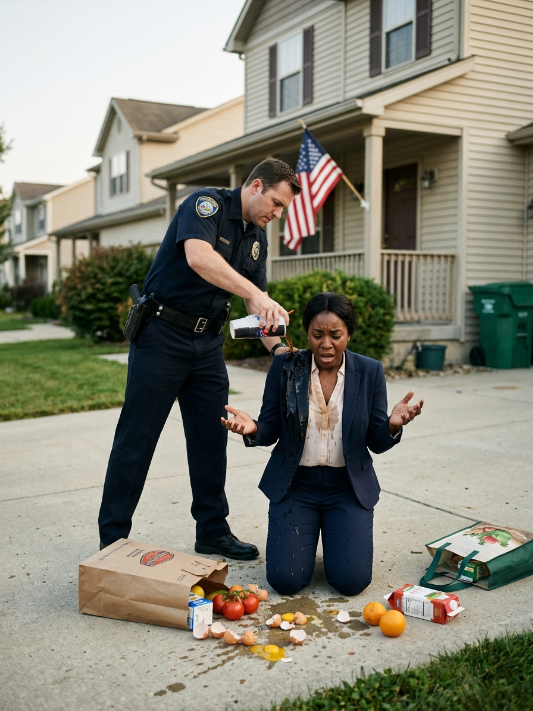
But he wasn’t finished. He walked up to my doorstep, grabbed the grocery bags I had carefully placed there, and carried them down to the driveway. With a look of clear satisfaction, he turned them upside down. Crushed tomatoes, broken eggs, and dry pasta spilled across the gray concrete like confetti.

“Clean it up,” he ordered, the command landing with brutal finality.
I looked at his rigid, expressionless face, then past him at my front door—just eight feet away. So close. Swallowing my pride, I knelt on the concrete, my house keys still clenched in my left hand so tightly that the metal edges cut into my palm.
As I bent down, trying to salvage a soaked medical journal, I heard him walk to his patrol car and return. Suddenly, an icy stream of liquid poured over my back.
He was dumping his large, 32-ounce cup of dark, sticky soda directly onto me. It soaked through my white blouse instantly, dripping into my hair, down my shoulders, and onto my ruined papers.
“Maybe this will teach you some respect,” his voice drifted down from above. “People like you need to learn your place when a badge is talking. People like you don’t belong in neighborhoods like this.”
For three agonizing seconds, I remained frozen, kneeling in a puddle of soda and broken eggs in front of my own home. I felt utterly humiliated. But as I slowly rose, my shock turned into cold, deliberate focus. I didn’t cry. I didn’t scream.
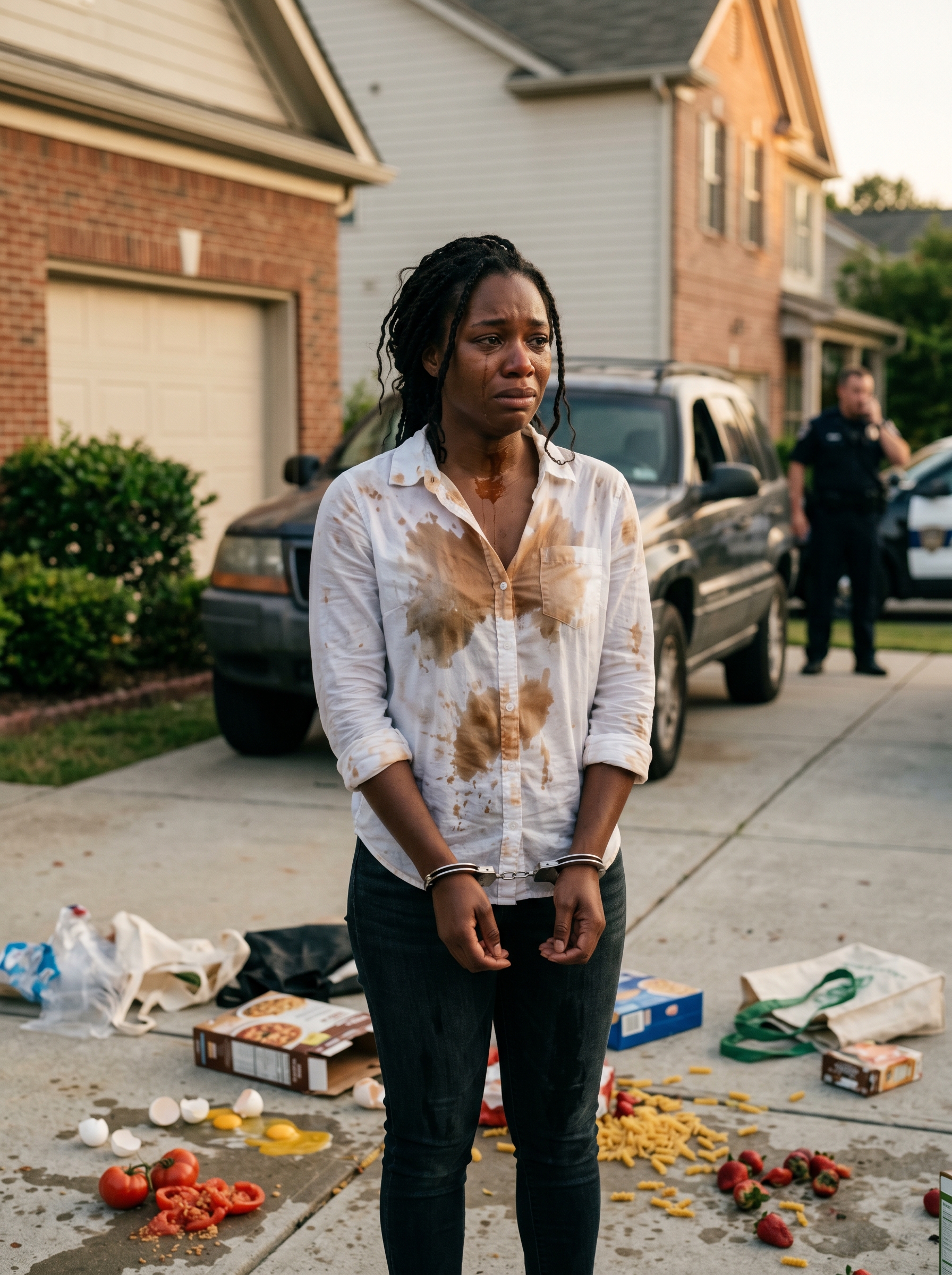
I reached for my phone to call my attorney, but his hand shot out, knocking it from my grip. It hit the driveway, the screen shattering instantly. “You’re not calling anybody,” he barked, twisting my arm behind my back and snapping tight, cold handcuffs around my wrists.
He thought he had stripped me of all power. He thought he could b*lly me into submission. But what he didn’t realize was that the disturbance had drawn attention. Across the street, my neighbors had stepped onto their porches. Phones were raised. Red recording lights blinked.
Every moment of his cr*elty was being captured.
Part 3: The Turning Point
My wrists throbbed with sharp pain against the cold, biting metal of the handcuffs. I stood in my own driveway, my white blouse clinging to me, completely soaked with the dark, sticky soda he had dumped over me. Around my sensible work shoes, my groceries—crushed organic tomatoes, broken eggs, scattered pasta, and smashed strawberries—lay in a humiliating, messy puddle. The air carried a harsh mix of citrus cologne, stale coffee, and sugary residue.
And yet, despite everything done to my body, my mind was crystal clear. I didn’t resist him physically. Instead, I let my complete silence and steady, unflinching gaze speak for me. I looked at Officer Derek Hutchkins and saw more than a prejudiced man—I saw a broken, toxic system standing between me and the safety of my own front door.
He believed he had taken all my power. He believed he could blly me into submission through fear. What he failed to realize was that his crelty had drawn witnesses. Across the street, neighbors had stepped onto their porches. Phones were lifted. Red recording lights blinked steadily. Every moment of his h*rassment was being documented.
Then another patrol car pulled up along the curb. No sirens—just flashing red and blue lights reflecting across neatly trimmed lawns and wide front porches. Sergeant Linda Morrison stepped out. She was a composed African American woman in her late forties, radiating authority the moment she arrived.
Her sharp gaze swept the scene, taking it all in within seconds: a Black woman tightly handcuffed, drenched, surrounded by ruined groceries and broken electronics, while neighbors recorded everything. It was bad—very bad.
Sergeant Morrison demanded a report. Hutchkins straightened, puffing his chest, trying to regain control. He claimed there had been “suspicious activity” and said I became belligerent. It was weak—transparent. Morrison saw through it immediately. Her eyes moved from the groceries to the house, then back to me.
“This woman is at her own front door,” Morrison said calmly, though her tone carried danger. She asked what crime I had committed. Hutchkins stumbled, scrambling, insisting he smelled m*rijuana from my car.
That was when Officer Brennan, the younger officer who had stood by in visible discomfort, finally spoke. “I smelled nothing,” he said quietly—then again, louder. “I smelled nothing when we arrived.”
Hutchkins shot him a venomous glare, but the truth had already surfaced.
Morrison approached me carefully. “Ma’am, are you alright?” she asked gently. It was the first time in thirty minutes anyone had treated me like a person. My composure cracked slightly. My voice trembled as I told her no—I was not alright. I explained I had been unlocking my door when I was unlawfully searched, my belongings destroyed, and I was verbally and physically a*saulted at my own home.
Morrison’s eyes hardened. She looked at my soaked back, the empty soda cup on the ground, and my work badge lying face-up in egg yolk. When I confirmed I was a physician and the homeowner, she turned toward Hutchkins, her gaze icy. She asked if he had poured his drink on me.
He tried to justify it, jaw clenched, muttering that I “needed to learn respect.” Morrison briefly closed her eyes in disgust. Without hesitation, she stepped forward and removed my cuffs. The release brought instant physical relief, though deep red marks remained etched into my skin—and the emotional weight lingered heavily.
The neighbors didn’t stay silent. Tom Carter called out that he had eleven minutes of clear video. Mrs. Patterson, an elderly woman with neatly styled white curls, announced she had already contacted the Chief of Police.
Hutchkins realized he was cornered. Like a trapped animal, he lashed out, unleashing the prejudice he had carried for months. He raised his hands and shouted that this used to be a “good, safe neighborhood” before “people like her started moving in.”
The silence that followed was crushing. Even the birds seemed to go quiet. He pointed at me, accusing me of lowering property values. He questioned how I could afford my home—suggesting drug money, fraud, or marrying a “guilty white liberal” for status. Every word exposed the deep r*cism behind his actions.
Then, from the ground, my shattered phone—lying in egg yolk and spilled pasta—began to ring.
The screen was cracked into a web of sharp lines, but the light still flickered. Sergeant Morrison picked it up. As she read the caller ID, the color drained from her face. She inhaled sharply and held the screen toward me.
It read: James – City Hall.
My husband.
In an instant, Morrison and I understood each other. She handed me the phone. My fingers, sticky with soda, tapped the green button, and I put it on speaker.
His familiar, warm, concerned voice filled the tense air. “Honey, I’m so sorry. The police budget meeting ran late. Just wrapping up now,” he said casually. Then he added the detail that changed everything: “Chief Donovan is right here with me. We’re discussing officer misconduct protocols. I should be home by 5:30.”
I kept my voice calm, even as adrenaline surged through me. “James, I am standing in our driveway. I need you to come home immediately.”
His tone shifted instantly—warmth replaced by sharp authority. “What’s wrong? Are you hurt?”
I met Hutchkins’s eyes. “I was stopped by a police officer while unlocking our front door. He forced me away, searched me illegally, destroyed our groceries, and poured his drink on me.”
The silence on the line grew heavy—dangerous. When James spoke again, it was no longer just my husband speaking—it was the Mayor.
“Put the officer on the phone,” he ordered.
Hutchkins’s hand trembled as he took the phone. “Who… who is this?” he stammered.
“This is Mayor James Richardson. Who is this?”
The color drained from Hutchkins’s face. In seconds, he transformed—from arrogant b*lly to shaken shadow. He gave his name and badge number weakly.
Then came the final blow. James explained he was sitting with the Police Chief, the City Attorney, and three city council members. “We were discussing police misconduct reform,” he said coldly. “You just became our case study. Sergeant Morrison, document everything. Officer Hutchkins is not to leave that location.”
The call ended.
Hutchkins’s legs nearly gave out. He stumbled backward, slipping on a crushed tomato, catching himself against his patrol car. Tears filled his eyes as he looked at me and asked, “Why didn’t you say something? That you’re the Mayor’s wife?”
I stepped toward him, still dripping with soda, my blouse clinging to me—but everything had changed.
“Say what?” I replied, my voice cutting through the quiet street. “That I’m human? That I deserve respect? That I have the right to enter my own home?”
He broke down, crying openly—pleading about his fifteen years on the force, his family, his pension. He begged for forgiveness, calling it a mistake. But I saw through it.
“You poured your drink on me while I was kneeling,” I said firmly. “You humiliated me. You told me people like me don’t belong. You meant every word.”
He wasn’t sorry for his cr*elty. Not for the profiling. Not for violating my rights. He was only sorry he had chosen the wrong target. His tears came from fear—fear of losing everything.
In the distance, the rising sound of sirens grew louder, signaling what was coming.
Accountability was only minutes away.
Part 4: Fuel for Change
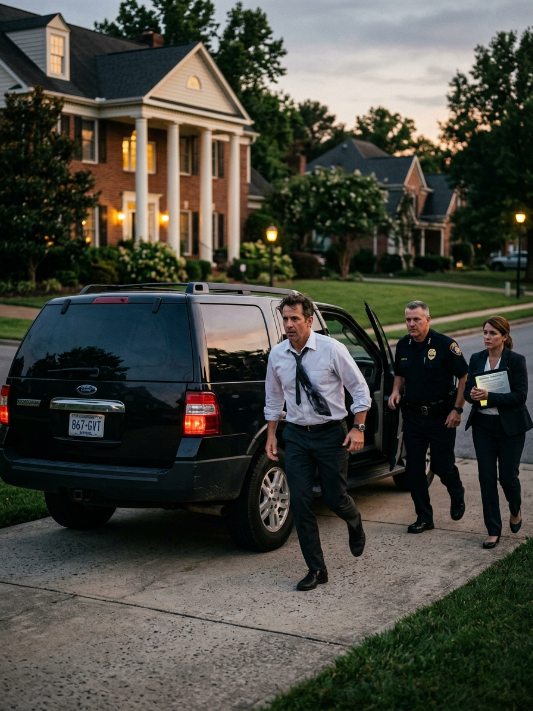
Twelve minutes later, a black SUV with city plates sped into our driveway. There were no sirens or flashing lights, but the urgency was undeniable. My husband, James, stepped out before the vehicle had fully stopped. His jacket was off, tie loosened, sleeves rolled up. Behind him came Police Chief Michael Donovan, his face set and serious, and our City Attorney, Sarah Carter, holding her iPad tightly.
James ignored everyone else and came straight to me, taking my hands in his. “Are you hurt?” he asked, his voice heavy with concern.
I shook my head. My rigid composure finally broke, and tears filled my eyes. “I’m angry,” I whispered. “I’m humiliated, but I’m not hurt”.
He took in the sight of my blouse soaked in dark stains, the shattered eggs, the ruined groceries, and my broken phone. Then his gaze shifted to our front door—I had been only eight feet away from safety.
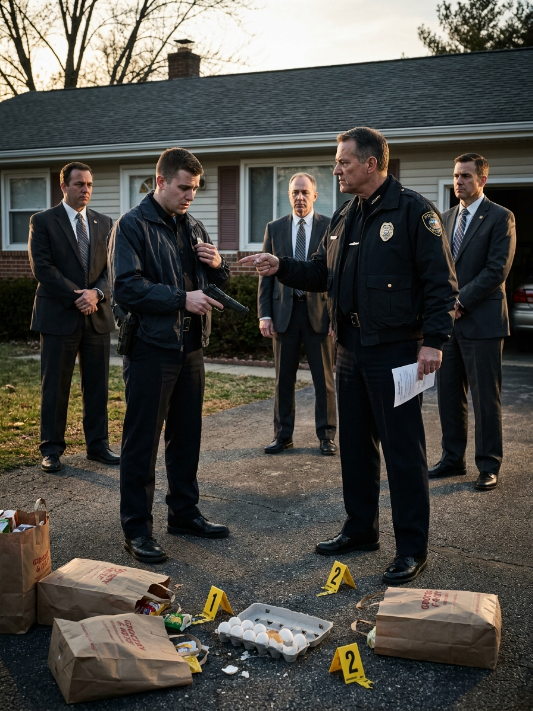
Chief Donovan stepped forward, surveying the scene. His expression hardened as he stopped in front of Hutchkins. “Officer Hutchkins, I’m placing you under immediate suspension,” he said sharply. “Badge, weapon, radio. Now”.
Hutchkins’s hands trembled as he removed his badge—the same shield he had used to trrorize me—and handed it over. He unholstered his weapon and unclipped his radio, crying openly. He pleaded about his family and pension, terrified of facing the consequences of his own crelty.
“You’ve served fifteen years on this force,” Chief Donovan said, his tone like stone. “You just ended all fifteen. You violated your oath, abused your authority, targeted a citizen based on race, conducted an illegal search, and a*saulted a civilian”.
Our City Attorney, Sarah Carter, carefully documented everything. She captured sixteen photos of my soaked clothing and the destroyed evidence, while my neighbor Tom Carter sent over his clear eleven-minute video.
Once the scene was under control, James gently squeezed my shoulder. “Let’s go home,” he said. Together, we walked up the three concrete steps. I inserted my key, turned it, and finally stepped inside. The door closed behind us, shutting out the nightmare.
But beyond those walls, the world was already reacting. Tom Carter’s video spread rapidly. By midnight, eight million people had watched a Black woman being drenched with soda on her own doorstep. The internet erupted with outrage, and hashtags like #JusticeForImani and #BlackWhileHome trended worldwide.
Within twenty-four hours, 5,000 people—diverse, grieving, and furious—filled City Hall plaza. I stood before them in a navy suit, my voice carrying across the crowd. “If this can happen to me—with my resources, my platform, my witnesses—imagine what happens every day to those without them,” I said. The crowd responded with a roar. This was no longer just my story; it was about dismantling a broken system.
And that’s exactly what we began to do. Internal Affairs reviewed Hutchkins’s record and uncovered twenty-one prior complaints, eighteen from people of color. Digital evidence revealed deleted messages and group chats filled with rcist slurs, mocking the “new Black family on Elmwood.” GPS data showed he had driven past my house forty-seven times in six months. This was not a single lapse—it was sustained, targeted hrassment.
The criminal trial began eight weeks later. I took the stand and recounted every moment. When the defense attorney pressed me, asking why I hadn’t identified myself as the Mayor’s wife to stop the a*sault, my answer was clear: “Because I shouldn’t have to prove my worth to enter my own home”.
The jury saw the video and read his messages. When Hutchkins testified, he fell apart. He couldn’t justify why he poured his drink on a kneeling, defenseless woman. The jury deliberated for just four hours before finding him guilty on all counts.
Judge Maria Torres issued a firm sentence: two and a half years in county jail, four years of probation, $100,000 in fines, and a lifetime ban from law enforcement.
But we didn’t stop there. I filed a civil suit against the city and secured a $4.5 million settlement. I donated all of it to a legal defense fund for victims of police misconduct. I was appointed chair of a civilian oversight board with real authority. We implemented mandatory body cameras with zero tolerance for “malfunctions” and introduced an early warning system to identify repeat offenders before they could harm others.
Six months later, at a packed town hall, I stood beside James and our newly appointed Police Chief—Commander Patricia Hayes, a reform-driven Black woman with twenty-five years of experience. We shared the results: community complaints had dropped by 34%, and use-of-force incidents had fallen by 41%. Real change was no longer just promised—it was happening.
Later that evening, long after the meeting ended, I stood quietly in my living room. My son Devon walked through the door after basketball practice. Normal. Simple. Safe. The way coming home should always feel.
I walked to my front door, opened it, and stepped outside. The evening air was calm and cool. I looked down at the concrete where my groceries had once been scattered, where the soda had soaked the ground, where I had been forced to kneel. The stains were gone, but the memory remained, etched deeply within me.
And I realized that memory was no longer just pain. It had become fuel—fuel for change, for justice, for the work still ahead.
My case reached resolution because I had privilege, resources, and witnesses. But justice should never depend on those things. It is a basic human right. Until every person—no matter their skin color, neighborhood, or name—can walk up to their own front door and feel safe, none of us are truly free.
I turned, walked back inside my home, and locked the door. It is my sanctuary, and it is my right.
If my story moves you, share it. Someone needs to hear they are not alone. If you ever face profiling or prejudice, document everything. Speak out. Find support, because your story matters. The truth deserves to be heard.
THE END.
