


The velvet felt like crushed stars against his fingertips.
Elias Thorne let his hand glide along the armrest of Seat A-12, front row center, and tried to recall the last time he had permitted himself to desire something purely for enjoyment. Six months, he calculated. Perhaps seven. The exact timeline grew indistinct when you spent eighteen hours a day combing through the financial decay of municipal government, following the trail of embezzled money through intricate shell corporations and falsified renovation contracts.
The Orpheum Theater loomed around him in shadow and gilt. Above, the ceiling curved like a baroque cathedral of crimson and gold, the frescoes depicting scenes from Orpheus and Eurydice seeming to stir in the dim pre-show lighting. The air held the familiar scent of old theaters—polish, dust, and the lingering memory of a thousand past performances. Elias had purchased this ticket three months earlier, setting aside $287 from his inspector’s salary, a indulgence he had labeled “field research” in his expense reports.
It was a lie. He had bought it because tonight marked the revival of The Tempest, and because twenty years ago, a production of the same play had shown a younger Elias Thorne that forgiveness could hold a kind of magic, even when the world seemed to offer only revenge.
He glanced at his watch. 7:42 PM. The curtain would rise in eighteen minutes. Around him, the audience shifted—polished socialites in evening wear, tourists gripping programs, a few devoted theatergoers with the quiet posture of those who came to listen rather than be seen. Elias wore his best suit, navy wool worn at the edges, with a tie he had ironed himself that morning. He looked, he knew, like a mid-level bureaucrat who had saved for months to afford this seat. Unremarkable. Invisible.
Exactly as intended.
His phone vibrated softly against his thigh. He did not look at it. He already knew the message. Target en route. ETA seven minutes.
Elias drew a slow breath, feeling the weight of the badge in his inner pocket. Not the theatrical emblem of a police detective, but the subdued insignia of the Office of the Inspector General for Municipal Integrity—a title that carried the authority to audit, to subpoena, to dismantle careers built on corruption. For six weeks, he had carried that badge while sitting in coffee shops opposite this theater, while studying architectural blueprints in dim archives, while observing Marcus Vane—the Commissioner of Cultural Affairs—divert millions from the Orpheum’s renovation fund into private accounts.

Tonight, the investigation would conclude.
But first, Elias wanted to witness Prospero forgive his enemies. He wanted to believe, if only for three hours, that justice and mercy could exist in the same breath.
The house lights dimmed slightly—a signal the performance was about to begin. A wave of murmurs spread through the audience. Elias pushed his glasses up and settled a little deeper into his seat.
And then he heard the voice.
“Absolutely not. I don’t care who’s sitting there. Move them.”
The words cut through the room with the brittle, entitled edge of a man who had not been denied anything in decades. Elias didn’t turn. He didn’t need to. He had listened to Marcus Vane’s voice in wiretaps and recorded meetings—studied its arrogant rhythm like a map of hostile terrain.
“Sir, please,” a younger voice answered—the usher, tense, barely audible over the growing noise of the crowd. “The seat is sold. The show is starting in—”
“Do you know who I am?” Vane’s voice rose, now carrying across the front rows. A hush spread outward. The sound of polished shoes striking marble grew closer. “I’m the reason this theater still has a roof. I approved the funds that kept these lights on. That seat”—a pause, heavy with contempt—“belongs to me by right, if not by purchase.”
Elias stayed motionless. Now he could see Vane at the edge of his vision—a tall man in a sharply tailored charcoal suit, silver hair swept back from a face favored by cameras and dreaded by auditors. Two assistants followed him, younger men with hard, practiced expressions. Behind them stood the usher—a college student in a red vest—hands trembling as he held a torn ticket stub.
“Sir,” the usher tried again, “I can offer you seats in the mezzanine, or I can refund—”
Vane stepped closer, close enough that Elias could smell the expensive, sharp woodiness of his cologne. He reached down and snatched the program from Elias’s lap.
“You,” Vane said, dropping his voice into a performative whisper that still carried. “Front row. You look like you file taxes for a living. Are you a clerk? A DMV employee?” He didn’t pause for an answer. He lifted the ticket stub the usher had dropped. “This is a counterfeit. I can tell from the paper stock. The holographic seal is missing the secondary watermark.”
Elias looked up. For the first time, he met Marcus Vane’s eyes. Pale blue, like ice over deep water, empty in the way of a man who had never doubted himself.

“Commissioner Vane,” Elias said quietly. His tone stayed even, carrying the soft Midwestern consonants of his upbringing. “The watermark is there. You’re holding it at the wrong angle. Tilt it toward the stage lights.”
Vane’s jaw tightened. He was not used to being corrected. “You’re telling me how to verify security features? Do you know what I do for a living? I oversee the cultural heritage of this city. I decide which artifacts are real and which are trash.” He flicked the ticket stub at Elias’s chest. It hit and dropped to the floor. “You’re trash. And you’re trespassing.”
He turned slightly toward his assistants. “Call security. Tell them we have a fraudster in a stolen seat. I want him arrested before the overture finishes.”
The audience had fallen into complete silence now. Elias felt the pressure of a hundred gazes on his back—pity, embarrassment, the passivity of the privileged who never step in when cruelty arrives dressed in a suit. He crouched, picked up the ticket stub, and smoothed it between his fingers. The paper was inexpensive, issued by a licensed vendor, but the seat itself had demanded something far greater than the $287 printed on its value. It had cost him six months without rest, six months bent over spreadsheets until the figures dissolved into haze, six months of understanding that Marcus Vane was not only stealing money, but eroding the trust that held the city intact.
Elias rose.
He was not a tall man—five-foot-ten, with the faint stoop of someone who had spent too many years over case files—but as he straightened, the atmosphere shifted. Stage light caught the silver at his temples, and behind wire-rimmed glasses, his gaze changed from the mild resignation of a man overlooked to the steady, analytical focus of a predator no longer pretending to be dormant.
“Commissioner,” Elias said, and his voice was no longer soft. It filled the space, carried from his diaphragm, resonating in the chests of those seated in row three. “Before you call security, you should understand two things.”
Vane turned, his hand already reaching for his phone. He hesitated, annoyed by the boldness of the interruption. “Enlighten me, fraud. Tell me why I shouldn’t have you dragged out in handcuffs.”
“First,” Elias said, slipping his hand into his inner jacket pocket, “this ticket is not counterfeit. I purchased it legally, with income earned as a public servant—income accounted for precisely to the last cent, unlike the $2.4 million you’ve funneled from this theater’s restoration fund into offshore accounts in Belize.”
The color drained from Vane’s face as though a curtain had dropped over him. His phone slipped slightly in his grip. “What did you—”
“Second,” Elias continued, drawing out the heavy, shield-shaped badge that had rested against his chest all night. He raised it, the gold catching the stage lights. “I am not a clerk, Commissioner. I’m Elias Thorne, Senior Inspector General for Municipal Integrity. And yes—I’ve been sitting in this seat for six weeks, waiting for you to walk in and claim what isn’t yours.”
The silence that followed was total. It had substance, density—like the stillness between lightning and thunder. Then, from the rear of the theater, came the sharp click of a seat folding as someone stood. Then another. Then another.
Vane’s mouth opened and closed, his throat working in spasms. “Thorne,” he whispered. “The Ghost. You’re the Ghost.”
“I prefer Senior Inspector,” Elias said, stepping forward. He gestured toward the aisles, where men and women in dark suits moved with precise coordination—agents who had been seated among the audience for weeks, observing Vane’s corruption with patient detachment. “Marcus Vane, you are under arrest for embezzlement, fraud, and abuse of public office. You have the right to remain silent, though I suspect you will struggle to do so.”
“I—I didn’t know,” Vane stammered, his polished composure cracking like glass. He reached out, gripping Elias’s sleeve with frantic fingers. “If I’d known who you were—if I’d recognized—”
“You assumed I was nothing,” Elias interrupted, his voice dropping into a whisper sharper than any raised tone. He peeled Vane’s hand away with controlled, deliberate precision. “Because I didn’t wear a thousand-dollar suit. Because I stayed quiet. Because I looked like the people you’ve built your career on stepping over.” He leaned closer, close enough to smell the sour panic beneath Vane’s cologne. “That’s your mistake, Commissioner. Power doesn’t always announce itself with ceremony. Sometimes it sits in the front row, holding a ticket it paid for with honest money, waiting for the monsters to reveal themselves.”
The agents arrived moments later. Vane’s wrists were pulled behind his back with the precise, practiced snap of handcuffs locking into place. The theater broke—not into disorder, but into something sharper, more overwhelming. Applause. It began in the mezzanine, a hesitant rhythm that spread downward until it filled the hall and made the walls seem to vibrate. The audience wasn’t applauding a performance; they were witnessing a judgment.
Elias stepped back and adjusted his glasses. He watched as they guided Vane up the aisle, the commissioner’s head lowered, silver hair that once looked dignified now limp and unkempt. At the exit, Vane turned for a final glance, his eyes locking with Elias’s across the distance.
Elias lifted the ticket stub he had kept the entire time—the inexpensive paper, the lawful purchase, the emblem of everything Vane had attempted to take. He held it up between two fingers, a gesture that was both acknowledgment and refusal.
Then the doors shut, and Marcus Vane was gone.
The applause dissolved into murmurs, the audience settling into stunned excitement. The house lights dimmed again. The overture began—a surge of strings that seemed to loosen dust from the rafters.
Elias sat.
He pressed the ticket stub flat against his knee and slipped it carefully into his breast pocket, beside the badge that now felt heavier than before. His hands trembled slightly—not from fear, but from the release that followed pursuit. Six weeks of tracking Vane’s theft of catering budgets, of tracing construction kickbacks, of sitting in cafés in plain suits while city officials joked about the “Ghost”—the investigator they believed was invisible.
But he had seen them. He had seen all of it.
Now, in the darkness, as music swelled and the curtain parted to reveal a painted island of illusion, Elias Thorne let his eyes close for a brief moment. Not in sleep, but in memory of why he had chosen the shadows—the man who took the front row not out of necessity, but because truth was clearest from there.
He remembered the small community theater in his childhood district, with its leaking roof and volunteer performers staging Shakespeare in public parks because they believed art belonged to everyone, not just those with platinum memberships. He remembered the funding cuts—cold, arbitrary decisions made in rooms where men like Vane spoke of “fiscal responsibility” while wearing watches worth more than the actors earned in a year.
That theater had closed. The roof had collapsed during a storm two winters later. Elias had stood among the ruins, holding a worn playbill from his first performance—The Tempest—and decided he would not become someone who watched from a balcony while the world fell apart. He would sit in the front row. He would see everything.
The actor playing Prospero stepped forward, his voice filling the hall: “Be not afeard; the isle is full of noises, sounds and sweet airs, that give delight and hurt not.”
Elias opened his eyes. Stage light washed his face in gold and amber tones. Around him, the audience leaned in, absorbed, unaware that the real drama had already unfolded among them—that the quiet man in the modest suit had dismantled a kingdom before the first scene had even begun.
He reached into his pocket and touched the ticket stub again. $287. After taxes, after pension deductions, after alimony payments that still left his account every month despite the divorce being finalized five years ago, $287 equaled forty hours of his life surrendered to the city. Forty hours spent reviewing spreadsheets, interviewing whistleblowers who shook in late-night diners at 2:00 AM, constructing cases against men who believed themselves divine because they controlled zoning permits.
He had paid for this seat with honest labor. That was why he had not moved when the usher approached him twenty minutes earlier, sweating, apologetic, explaining that “a very important city official” required the seat for his wife.
“I have a ticket,” Elias had said simply.
“Sir, I understand, but Commissioner Vane—”
“I have a ticket,” Elias repeated, and something in his expression then—no anger, no threat, only a settled certainty—had made the usher step back. “I paid for it. It’s mine.”
Now, as Prospero lifted his staff to summon the tempest, Elias let his eyes drift toward the empty aisle seat three rows back—Seat C-17. It was empty because its intended occupant was, at that moment, being fingerprinted in the basement of the municipal building three blocks east, his $4,000 suit exchanged for a jumpsuit the color of concrete.
Elias almost smiled. Almost.
The plan had been simple in idea, intricate in execution. For six weeks, he had been the ghost at the edge of Vane’s awareness—the man in the café queue, the nameless figure in the rear of city council meetings, the “accountant from the Comptroller’s office” asking harmless questions about depreciation schedules. He had observed Vane accepting envelopes in parked cars. He had documented him signing contracts that rerouted $2.4 million from the Orpheum’s historic preservation fund into shell companies tied to Vane’s brother-in-law.
And he had waited. Waited for the moment when arrogance outweighed caution.
Tonight had been that moment. The charity gala. The front-row seat Vane had insisted upon as his right, despite it being sold out. The assumption that whoever occupied it would be insignificant, replaceable, invisible.
Elias had known Vane would appear. Had known he would cause a scene. Had known that under public scrutiny, surrounded by wealthy, influential witnesses, Vane would expose the contempt for ordinary people that had driven his corruption.
The trap had closed exactly as intended. Not in a dim corridor with handcuffs, but beneath the gaze of an audience in evening dress.
On stage, Miranda stepped forward, innocent and curious, beholding the brave new world for the first time. Elias felt his chest tighten with something not quite emotion, not quite memory, but suspended between the two—an awareness that all of them were, in their own ways, shipwrecked on islands of their own design, waiting for storms to reveal who they truly were.
The house lights flared abruptly—not a planned cue, but a sudden, unforgiving wash of white that shattered the stage’s illusion. Elias turned his head slowly, already aware of what he would find.

Two uniformed officers stood at the aisle entrance, their expressions composed. Between them, looking markedly smaller than he had moments earlier, stood the usher—the young man who had tried to move Elias, who had been pushed around by Vane, who now watched the aftermath with wide, unsettled eyes.
“Mr. Thorne?” the lead officer called, his tone respectful, carrying the quiet deference of someone addressing authority without knowing its exact form.
The audience stirred. Heads pivoted. The actor portraying Prospero lowered his staff, visibly thrown, slipping out of character. In the orchestra pit, the conductor’s baton hung frozen as a note faded unfinished.
Elias rose.
He moved with the controlled calm of a man who had imagined this moment many times but refused to treat it as anything other than real. He stepped into the aisle, straightening his tie—a plain navy knit purchased for twelve dollars on sale. He adjusted his glasses, the wire frames reflecting the harsh overhead light.
“Officer,” Elias said with a nod. Then, to the usher: “Are you alright, son?”
The usher stared at him, speechless. His gaze moved from Elias to the officers, then back again to the man he had tried to relocate twenty minutes earlier—the quiet figure in the inexpensive suit who had refused to surrender his seat.
“You’re… you’re not just an accountant,” the usher whispered.
Elias’s mouth twitched, almost a smile. “No,” he said quietly. “I’m afraid not.”
He turned toward the audience. The house lights made individual faces hard to distinguish, but he felt their collective attention—the dense, shifting weight of curiosity and recognition. These were the city’s elite, the patrons and donors who had attended Vane’s events, who had funded his “Arts Preservation Initiative,” who had ignored the persistent leaks in the Orpheum despite millions raised to repair it.
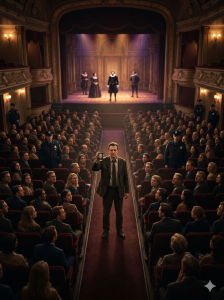
Elias reached into his jacket and drew out his badge. He held it up without flourish, simply letting it catch the light—the embossed seal of the Office of the Inspector General.
“Ladies and gentlemen,” he said, his voice steady and fully audible in the.
