


Act I: The Boy on the Stone Drive
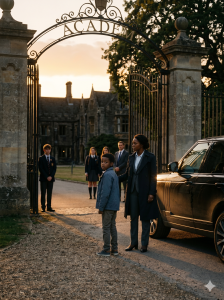
By the time our SUV rolled through the wrought-iron gates of St. Aldric’s Academy, the woman in beige had already pushed the child.
I watched him strike the polished stone drive through the tinted glass. His backpack slipped off one shoulder and slid across the pavement. The afternoon light caught the metal zipper and flared briefly, like a signal.
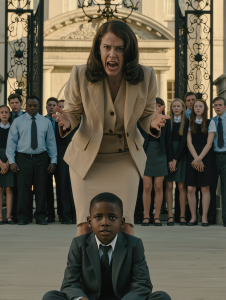
The woman loomed over him in a tailored beige suit that likely cost more than most families in the city paid in rent each month. Her heels were set apart, her finger pointed down, her expression locked in the kind of entitlement that confuses cruelty with control.
“Don’t you even think about going near my son,” she snapped.
Around her, the academy entrance went still in layers. Well-dressed parents paused mid-sip with coffee cups frozen in their hands. A couple of eighth-grade boys in neat navy blazers stopped whispering and stared. One mother raised a hand halfway to her mouth, then hesitated, deciding not to step in.
The boy on the ground didn’t cry.
That was the first thing I noticed when the SUV came to a halt beside the scene. He was rattled, without a doubt. Ashamed, unmistakably. But he didn’t break into the kind of panic the woman seemed to be waiting for.
He simply looked up.
“Kids like you don’t belong at this school,” she said as she moved closer.
Her tone wasn’t loud in any performative way. It was worse. Measured, refined, rehearsed. The kind of voice people use after years of saying cruel things and learning how to make them sound reasonable.
A low murmur spread through the onlookers.
No one stepped forward.
I opened the back door and stepped out into the afternoon light.
The academy entrance was exactly as it had been crafted to appear—ivy crawling over old brick, trimmed hedges, and a kind of old-money certainty set in stone. I had seen it in rain, snow, donor galas, and funerals. That day, it looked less like a school and more like a stage.
The woman in beige turned toward me only briefly, expecting, I assume, another spectator. Someone to impress, dismiss, or rise above. Then her gaze followed mine.
Not to her.
To the boy.
I walked past the gathered crowd and stopped a few paces away from him. He had already pushed himself up and was sitting straighter than many grown men under pressure. Dust marked one knee of his trousers, and there was a sharpness in his eyes that suggested the shove had hurt more than he was willing to show.
I lowered my head slightly.
“Young Master Castillo,” I said.
The words hit heavier than any shout.
The boy let out a controlled breath. “I’m alright, Mr. Valez.”
Somewhere behind me, someone in the crowd audibly forgot to breathe. The woman in beige took an unsteady step back. Her expression, so carefully built around anger, began to fracture into something else.
Recognition.
Not of me.
Of the name.
Castillo.
By then, I had spent twenty-two years managing the legal affairs of the Castillo family, and I knew the exact expression people wore when they realized history had just reached up through the floor and caught hold of them. It wasn’t confusion.
It was dread.
The woman looked toward the academy doors as though expecting someone to save her. No one came. She turned back to the boy, then to the black SUV, then finally to my face.
“What is this?” she asked.
I didn’t answer.
Instead, I bent down and picked up the boy’s backpack myself. That detail mattered. The crowd saw it. She saw it. A man in my position did not stoop for an unknown child in front of dozens of witnesses unless that child outranked every assumption in the room.
The headmaster appeared in the doorway moments later, moving faster than I had ever seen him move.
And the woman in beige seemed to understand, all at once, that she hadn’t merely shoved a Black boy outside an elite school.
She had put her hands on the one child this academy could not afford to dishonor in public.
What she didn’t yet realize was that the shove was only the smallest of her husband’s problems that afternoon.
Act II: The Family Behind the Name
St. Aldric’s Academy liked to tell a certain story about itself.
In its brochure version, it was all old values and modern excellence—tradition, leadership, scholarship, stewardship. A distinguished institution built for the future by families who believed discipline and culture belonged together.
Like most refined myths, it contained just enough truth to endure.
The school had, in fact, been built by a family.
Just not the family currently controlling the board.
It was founded by Alejandro Castillo, the son of a Cuban machinist and a Black schoolteacher from Savannah, who arrived in New England with two shirts, a scholarship, and a quiet rage toward doors that only opened for the “right” names. He built his fortune in shipping logistics and technology, then invested an extraordinary portion of it into the academy he had wished existed when he was ten.
A place where wealth did not outrank brilliance.
A place where influence did not outrank merit.
A place, in his words, “where children are not taught to confuse polish with worth.”
I still keep the original deed in my office.
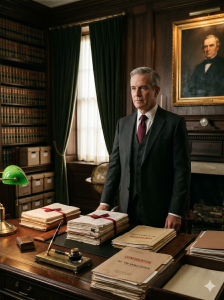
He signed it with a fountain pen, his grip so firm the paper nearly tore.
Alejandro’s only son, Rafael Castillo, inherited his father’s intellect and very little of his patience. He married Dr. Naomi Brooks, a trauma surgeon with a laugh like shattered glass and no patience for men who mistook board seats for moral authority. Together, they had one child.
Mateo.
He was ten when his father died.
Rafael’s aneurysm struck in an airport lounge between meetings. No warning. No dignity. Just a call at 4:12 a.m. and a widow not yet forty trying to hold herself steady long enough to process the words.
Naomi did what competent grieving women do when powerful institutions begin circling—she asked for the documents.
That was when the trouble started.
The academy had been placed under “interim stewardship” by a donor-heavy board for years, supposedly to smooth the transition while Rafael focused on the Castillo Foundation’s international work. In practice, it meant men with old money and polished spouses had been treating a merit-based institution like a private inheritance structure.
Legacy admissions quietly expanded.
Scholarship ratios quietly shrank.
Development funds quietly shifted into capital projects no one requested but everyone wealthy enough approved of.
Naomi noticed almost immediately.
So did I.
We began demanding answers about governance, donor influence, and the dormant succession clauses in Alejandro’s trust. Those clauses mattered because they were direct, precise, and nearly impossible to ignore once activated.
If no adult Castillo served as chair, governance reverted to the bloodline beneficiary through appointed trustees.
Mateo.
Not at eighteen.
Immediately, through legal guardianship and trust authority.
The Whitmores did not take that well.
Richard Whitmore, who had been acting as though the chairmanship were already a hereditary title, dismissed the clauses as “symbolic.” His wife, Caroline—the woman in beige—once described Naomi over lunch, in my presence, as “combative, emotional, and very difficult to work with.”
Men like Richard use that language when they want a woman removed politely.
Women like Caroline use it when they believe they are helping.
Naomi filed for enforcement.
Within two weeks, the rumors began.
She was unstable in grief.
She was manipulating the child.
She intended to sell academy land.
Someone even suggested—in a donor memo I still intend to see tested in court—that the school’s culture would suffer if “legacy tone” were disrupted too abruptly.
Legacy tone.
That phrase told me everything about what they feared.
Naomi did not live long enough to finish the fight. Leukemia took her nine months after Rafael, swift and unmerciful. In her final lucid week, she signed temporary trust instructions naming me and a retired federal judge as co-trustees until Mateo reached adulthood.
She also wrote one sentence in the margin beside Alejandro’s clause.
Make them say his name out loud.
I carried that sentence for nearly two years.
And on the afternoon Caroline Whitmore shoved Mateo onto the stone outside St. Aldric’s, I knew the moment had arrived.
Because what sat inside my briefcase was not merely a trust order.
It was the court-certified instrument removing Richard Whitmore from operational authority before sunset.
Act III: The Moment the Entrance Stopped Belonging to Them
Headmaster Laurence Pembroke arrived at our side pale and slightly out of breath, though he tried hard to appear composed.
“Mr. Valez,” he said, glancing between me and Mateo and then, with visible hesitation, to Caroline. “I believe there has been a misunderstanding.”
Caroline recovered first, as people like her usually do. Shame rarely outweighs self-preservation.
“This boy approached my son,” she said. “Aggressively. I was protecting my family.”
Mateo looked at her, then at me. He said nothing.
That, too, was significant.
Children raised near real power learn early that whoever speaks first in public conflict often ends up carrying the burden of proof. Mateo had his mother’s restraint, and I was grateful for it. If he had shouted or broken down, Caroline would have worn that reaction like justification.
Instead, she was left alone with her voice.
I turned to Pembroke.
“Your security cameras cover this entrance, I assume.”
He swallowed. “Yes, of course.”
“Good,” I said. “Preserve the footage.”
Caroline’s expression tightened.
The surrounding parents were no longer pretending to have somewhere else to be. The social atmosphere had shifted. They still stood neatly, still held their handbags and coffee, still maintained the posture of wealth—but now they were listening with the sharp focus of people sensing a private collapse turning public.
Caroline tried again.
“You cannot seriously intend to make an issue out of this absurd little incident.”
“No,” I said. “Your husband already did that.”
Richard Whitmore had appeared behind Pembroke, descending the steps with a fixed, practiced smile—the expression of a man hoping composure might still outrun consequence. He looked slightly older than I remembered, softened at the edges. Some men grow into wisdom. Richard had grown into comfort.
His eyes moved to Mateo.
Then to me.
Then to the black leather folio under my arm.
And something in him shifted.
“Gabriel,” he said, forcing warmth into his tone. “This can be handled privately.”
There it was again.
Privately.
The final shelter of institutions that know they are losing control.
“I’m sure it can,” I said. “But it won’t.”
I opened the folio and handed the top document to Pembroke first, not Richard. That choice was intentional. In places like St. Aldric’s, hierarchy is performance as much as structure. Whoever receives the document first is, for a moment, still considered legitimate.
Pembroke scanned the first page.
Then the next.
His face drained.
Richard stepped forward. “What is that?”
Pembroke looked up, and for the first time I saw him lose full control of his professional expression.
“It’s a court order,” he said.
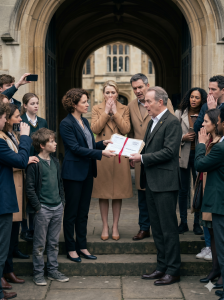
For illustrative purposes only
No one moved.
Caroline’s hand drifted to her necklace. Richard took the document and read it himself. I watched his eyes track downward—interim authority revoked, trustee succession activated, emergency governance transfer effective immediately, financial oversight restored, all board actions following Naomi Castillo’s petition subject to freeze.
His hand trembled once.
That was all it took.
Around us, phones began to rise.
The real sound of elite panic is not shouting. It is the quiet shift of people deciding who to inform first—spouses, attorneys, or the press.
Richard lowered the page slowly.
“You planned this,” he said.
“Yes,” I replied. “Your wife completed it.”
Mateo remained at my side in silence, dust still on his knee, while the institution his family built began, piece by piece, to turn back toward him in disbelief.
What the Whitmores still failed to grasp was that the shove at the gate was not the event.
It was only the evidence.
And inside the headmaster’s office, another file was already waiting—one that would make the court order seem like the mildest part of their afternoon.
Act IV: What Naomi Left Hindu
We moved into the headmaster’s office with all the grace of a family portrait being set on fire.
Pembroke shut the door, but the room had too much glass and too much foot traffic outside for true privacy. That suited me. Richard wanted containment. I wanted proximity—witnesses close enough to feel the weight of it.
Mateo sat in the leather chair by the window, hands folded in his lap in the same composed way Naomi used when she expected disappointment from men in expensive suits. He looked very young in that moment. That was the cruelty of it. Institutions force children to carry lineage when adults fail to.
Caroline stayed standing.
Women like her do not sit when they still believe posture can salvage control.
Richard read the order again, slower this time, as though careful pacing might uncover escape routes his panic had missed. “This only addresses governance,” he said. “It doesn’t prove misconduct.”
“I know,” I replied. “That’s what the second file is for.”
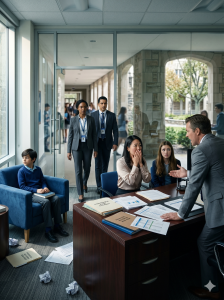
For illustrative purposes only
I placed Naomi’s archive on Pembroke’s desk.
Not all of it. I had no intention of giving Richard full sight before the auditors arrived. Only enough. Donor correspondence. Board minutes. Internal memos about scholarship reduction. Emails discussing “reputation risk” if Castillo oversight returned. One particularly corrosive chain where Caroline suggested the school’s “community aesthetic” would suffer if admissions remained “too aggressively egalitarian.”
Pembroke stared at the pages for a long time.
Richard did not.
Men like him learn early which truths not to meet directly.
Caroline leaned in anyway and read just enough for the color to drain from her face. “This is stolen material.”
“No,” I said. “It’s preserved material. There’s a legal distinction.”
Mateo spoke then.
His voice was quiet, almost fragile.
“Is that why they were mean to my mother?”
No one answered immediately.
The room could handle accusations of mismanagement, even bias, even discrimination—as long as everything stayed abstract. But a child asking a moral question removes abstraction entirely.
Richard rubbed a hand across his mouth.
“It was never personal,” he said.
Naomi would have laughed at that.
I did not.
“Then you misunderstand the meaning of the word.”
A knock came at the door.
Not courtesy.
Procedure.
Two audit officers from the state education endowment board entered with visible badges and neutral expressions precise enough to unsettle anyone with something to hide. Pembroke had not called them. I had. Their arrival was scheduled forty minutes after my vehicle entered the gates, assuming Richard might try delay, persuasion, or procedural containment.
Caroline looked between them and me as though still searching for a version of events she could outrun.
“You used the child,” she said.
I turned to her slowly.
“No,” I answered. “You did.”
Something in the room finally gave way.
Not loudly. Not dramatically. Just the quiet collapse of certainty. Richard no longer held the documents like shields. Pembroke no longer stood like a mediator. Even Caroline’s posture had shifted, less composed authority now and more recognition of consequence.
One auditor requested immediate access to financial records and admissions variance reports.
The other, with unsettling politeness, asked whether Mrs. Whitmore’s assault at the entrance had already been logged for insurance and disciplinary review.
Caroline turned toward her husband.
Not me.
That, more than anything, revealed what marriage had become inside their world—where influence was shared, but consequences were always negotiated downward.
Adrian appeared in the doorway without anyone noticing his arrival. His school tie was loose, his expression unreadable. He looked first at Mateo. Then at the dust still on the boy’s knee. Then at his mother, standing rigid beside the desk like something that had finally stopped functioning.
“Did she touch him?” he asked.
No one answered.
He didn’t need one.
Adrian closed his eyes briefly. When he opened them again, something in his expression had shifted—quiet, irreversible.
And I understood then that the Whitmores were about to lose something no board vote could restore.
Act V: The Name They Had to Say
By sunset, St. Aldric’s had become the kind of institution every privileged institution quietly fears becoming.
Visible.
Parents stayed long past their usual departure times. Faculty gathered beneath stone archways, pretending to discuss schedules. Three board members who had not appeared in person for years suddenly materialized within an hour, each wearing the expression of someone trying to be seen standing on the correct side of morality after the fact.
Richard attempted, briefly, to stabilize them.
He spoke of transition, misunderstanding, fiduciary complexity, and the importance of shielding children from adult disputes. Standard language. Sterile language. The kind used by people hoping no one notices what it is meant to conceal.
It did not hold.
Because the footage of the entrance had already spread beyond containment. Because Naomi’s records were too precise. Because Caroline’s words at the gate—trash, don’t belong, kids like you—had been heard by the wrong people at the wrong moment in the wrong season. And because systems tolerate quiet wrongdoing far more easily than public embarrassment.
Now they wanted distance.
Distance from Richard.
Distance from Caroline.
Distance from every memo, lunch, and vote that had quietly bent the school away from Alejandro Castillo’s intent and toward something safer for families who feared merit unless it resembled them.
I brought Mateo to the founder’s hall just before dusk.
Alejandro’s portrait still hung above the central staircase—one hand resting on a carved chair, gaze fixed toward a future full of children yet to disappoint him. Mateo stood beneath it in a rumpled uniform and looked up without speaking.
“He looks stern,” he said.
“He was,” I replied.
“Would he have liked me?”
I thought of Alejandro in his final years, coughing between meetings, still insisting every scholarship interview begin with the same question: What do you love enough to work for when no one is watching?
“Yes,” I said. “Very much.”
The emergency board session convened an hour later.
Richard Whitmore was removed unanimously.
Caroline’s access to school grounds was suspended pending review—and pending the civil exposure her conduct now carried on record. Pembroke submitted a conditional resignation, the kind of polished exit men draft when they want to preserve dignity while surrendering authority.
And Mateo Castillo—twelve years old, dust still on his knees—was formally recognized as primary beneficiary of the Castillo Educational Trust under temporary guardianship.
But the moment that mattered did not happen in the boardroom.
It happened back at the gates.
A maintenance worker had placed Mateo’s backpack carefully on a bench. The last parents were leaving in cars and hired drivers. Evening light softened into amber, turning the iron gates into dark silhouettes against the sky.
Adrian Whitmore approached alone.
No parents. No witnesses.
He stopped at a respectful distance and looked directly at Mateo.
“I’m sorry,” he said.
Nothing more.
No justification. No deflection. No inherited phrasing.
Just a boy refusing, perhaps for the first time, the language he had been raised in.
Mateo studied him for a long moment.
Then he nodded.
I watched that exchange longer than I expected to. Institutions decay slowly, but individuals sometimes step out of them in a single clear decision. Perhaps that was Naomi’s real victory. Perhaps Alejandro’s. The possibility that one generation refuses what the previous one normalized.
When the car arrived, Mateo turned back toward the school one last time.
“Will I have to come here every day now?” he asked.
I almost smiled.
“That depends,” I said. “Do you want to?”
He considered it with unusual seriousness.
“Only if kids who don’t have rich parents can still get in.”
There it was.
The entire inheritance, distilled into something simple and uncompromising.
Not legacy.
Not influence.
Not blood.
Fairness.
I opened the rear door for him, and he climbed in without ceremony. Before I followed, I looked back at the academy gates—the hedges, the stone, the carefully maintained certainty of it all.
Caroline Whitmore had shoved a child because she mistook silence and skin for insignificance.
She believed she was protecting a system.
Instead, she revealed it.
By the time our SUV rolled down the drive, the school no longer belonged to those who had used it as a mirror for their own importance. It belonged again—imperfectly, precariously, but unmistakably—to the family that built it for children who were never meant to hear you don’t belong here as truth.
And for the first time in years, I heard the name carried openly across the grounds—not hidden, not softened, not negotiated.
Castillo.
For illustrative purposes only
Said plainly.
Exactly as Naomi intended.
