


I’m James. I’m twelve years old, and I only wanted my teacher to recognize who I truly am.
I’ll never forget the morning I stepped into Jefferson Middle School, holding my poster board carefully wrapped in plastic to shield it from the light drizzle. I had worked on it for two weeks, refining every detail, even including the Pentagon insignia printed in full color. It displayed my father’s official portrait in dress uniform, four stars shining on each shoulder under studio lighting. I had also charted his deployment history across Iraq, Afghanistan, Germany, and South Korea. Twenty-eight years of service, compressed into a trifold presentation board.
My mother had helped me the night before, still in her nursing scrubs after a 12-hour shift at Community General. She studied the poster with exhausted but proud eyes, her finger brushing over the photograph as she told me my dad would love it. When I asked whether Mrs. Henderson would like it too, her smile briefly faded. She simply told me to speak the truth and stand by it. I didn’t understand her hesitation until I was gathering the torn remnants of that truth from the classroom floor.
The “My Hero” project was meant to be my moment, worth 20% of our semester grade, a chance to present something real. I proudly introduced my father, General Robert Washington, who had risen from private to four-star general over 28 years. I had watched classmates present all week, and none of them were questioned or asked for proof. But when I stood up with my brown skin and my subsidized housing address, Mrs. Henderson’s demeanor shifted completely. Her arms folded, her smile disappeared, and suspicion took over her expression.
Before I could even explain that my father was at the Pentagon for strategic planning meetings, she decided I was lying. Her voice turned sharp with ridicule as she held up my poster, accusing me in front of the class of “pathological lying.” She asked if I thought anyone was foolish enough to believe it, insisting there were only nine four-star generals in the entire United States. She said people from neighborhoods like mine don’t become four-star generals.
Then she tore the poster in half, then into quarters, letting the pieces fall across the floor.
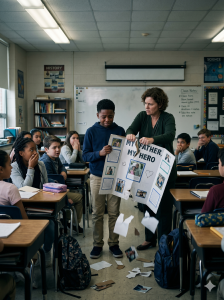
I tried to stay calm and explain I could call him immediately since he was at the Pentagon. She simply dropped the remaining pieces at my feet, accusing me of stolen valor and calling it a federal offense. She embarrassed me in front of 27 classmates, fully leaning on her 15 years of teaching experience.
I knelt down to collect the fragments of my father’s face. My hands had stopped trembling, and I texted my mother that the teacher had called me a liar and destroyed it. She replied instantly that she was on her way.
Mrs. Henderson wouldn’t allow me to sit; she kept me standing at the front as a so-called teachable moment. I tried to defend myself, but she brought up my free lunch status—something meant to remain private. She handed me a pink referral slip, sending me to Principal Graves for academic dishonesty. I lifted my backpack, left the torn poster on the floor, and walked into the hallway wondering when the truth had become something punishable.
Part 2
The walk down the linoleum-tiled hallway to the main office felt like a march to the gallows. I gripped the crumpled pink referral slip in my sweaty hand, while the torn pieces of my father’s face still burned in my pocket. I kept replaying Mrs. Henderson’s sneer, the sound of thick cardstock tearing, and the laughter of my classmates. How did simply telling the truth about my own family turn into a federal crime?
Principal Donald Graves sat behind his massive mahogany desk like a judge on the bench. He was fifty-two, his hair neatly graying at the temples, wearing that practiced, emotionless expression that looked concerned without ever truly caring. Framed behind him were his credentials—a master’s degree, fifteen years in education, and awards for administrative excellence. To me, and kids like me, they were meaningless decorations in a room where complaints went to disappear behind a heavy oak door.
I sat stiffly in the leather chair across from him. The pink referral slip rested between us on the desk like evidence in a case. Principal Graves picked it up and read it slowly, his lips barely moving. When he finished, he exhaled a long, weary sigh—one that said I was just another problem in a long list of problems.
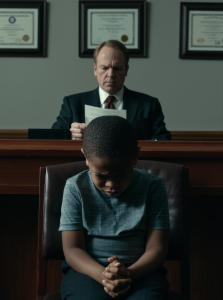
“James,” he began, folding his manicured hands on the polished surface. “This is the third time this semester.”
“Sir, that’s not—” I started, my voice shaking with fear and frustration, but he raised a hand immediately to stop me.
“The third time you’ve been sent to my office,” he continued without pause. “The third time we’ve had this conversation. Academic dishonesty. Disrespect toward a teacher. These are serious matters, James.”
“But I didn’t do anything wrong!” I said, leaning forward. “I was telling the truth about my dad. My dad is exactly who I said he is.”
Graves gave a tight, patronizing smile. “Mrs. Henderson has been teaching fifteen years, James. She has a master’s degree in education. She knows when students are… exaggerating.” He leaned back, the leather chair creaking softly. “And frankly, James, your story… it doesn’t add up.”
My chest tightened until breathing hurt. The office felt smaller. “What doesn’t add up? My dad is a general. I can prove it. I can call him.”
Graves shook his head, looking at me with pity, like I was a child who didn’t understand reality. “Anyone can program a fake number into a phone, James.”
“Then call Fort Bragg!” I snapped, my voice cracking but louder now. “Call the base. Ask for General Robert Washington. They’ll confirm it. Look it up yourself!”
“I am not going to waste military resources on a middle schooler’s fabricated project,” Graves replied, his tone hardening. “Do you understand how inappropriate that would be? Calling a military base to verify a seventh grader’s story?” He leaned forward. “If you just admit it, James… I’m trying to help you. Admit you exaggerated. Everyone does it sometimes. You wanted to impress your classmates. I understand that.”
He paused, letting silence press down before striking again. “But claiming ‘stolen valor’ is serious. Continuing to insist on this story when all evidence suggests otherwise is only making things worse.”
I stared at him, stunned and breaking inside. “What evidence? You haven’t looked at anything! You haven’t called anyone! You just decided I’m lying!”
Graves tapped his finger against the computer screen. “I’m looking at your file right now, James.” He read aloud, turning my life into accusations. “Free lunch program. Subsidized housing. Your mother works as a nurse at Community General. Night shifts. Overtime. Your father is listed as ‘deployed’ with limited contact information.”
He looked up. “These facts don’t align with having a four-star general as a parent.”
Heat rushed to my face—shame and anger colliding. My free lunch status was supposed to be private. “My mom works hard because she wants to!” I said loudly. “My dad sends money, but she’s independent. She loves her job! What does any of that have to do with my dad’s rank?”
Graves shifted uncomfortably. “I’m saying the lifestyle of a four-star general’s family looks… different.”
“Different how?” I asked.
He didn’t answer. He didn’t have to. I saw it in his expression, in the way he avoided my eyes. Different meant wealthier. Different meant whiter. Different meant not me.
“I think we need to call your mother in,” Graves said at last, switching to a colder tone. “And we also need to discuss your placement in advanced classes. Mrs. Henderson has concerns about whether you belong there.”
A heavy dread settled in my stomach. “I have an A-minus!” I said.
“Yes, well,” he replied, clicking his mouse. “Mrs. Henderson suspects some of your work may not be entirely your own.”
Before I could respond, the office door swung open and voices cut through the hallway.
“I need to see my son. Right now,” my mother said sharply.
The secretary responded nervously, “Ma’am, Principal Graves is in a meeting—”
“I don’t care,” my mother snapped. “Get him out here.”
Graves stood, irritated. “Excuse me, James. I need to handle this.”
He stepped into the reception area, leaving the door partly open. My mother stood there in her scrubs, hospital badge clipped to her chest, perfectly still but burning with anger. Behind her stood a silver-haired woman in a dark suit holding a leather portfolio.
“Mrs. Washington, please lower your voice,” Graves said, projecting authority. “We have procedures.”
“Procedures?” my mother laughed sharply. “Like investigating complaints? I filed three this semester alone about Mrs. Henderson’s discrimination. How many did you follow up on?”
Graves hesitated. “I’m sure we addressed—”
“Zero,” she cut in. “I have emails. Dates. Documentation. And no response.”
The woman stepped forward. “I’m Margaret Carter,” she said crisply. “Attorney for Mrs. Washington. These are certified complaints from military families over eighteen months.”
She held up the files. “Six families. Fourteen incidents. Same teacher. All dismissed.”
Graves paled. “Now wait—”
“We are done waiting,” she said. “This is a documented pattern of targeting military children, especially children of color, and administrative failure to act.”
“That’s a serious accusation!” Graves said, stepping back.
“It’s documented fact,” she replied. “October 15th. November 2nd. December 3rd—”
“I don’t have time for this,” Graves interrupted. “We’re in a disciplinary matter—”
My mother’s phone rang. She answered, her posture shifting instantly.
“Yes, Dad. Yes, she did… No, they won’t listen… I know… Yes, he’s sitting right here… Okay… Thank you.”
She ended the call and looked back at Graves, calm now in a way that felt even more intense.
“Go look up Fort Bragg’s chain of command,” she said softly.
“I don’t see why I should—”
“Look up the commanding general,” she said. “I’ll wait.”
Something in her tone made him retreat. He went back into his office and searched.
I watched his face change—confusion, then fear.
“This… says…” he stammered. “General Robert Washington… Deputy Chief of Staff…”
My mother stepped into the doorway. “…at the Pentagon. Four stars. Joint Chiefs meetings.” She looked directly at him. “That is my husband. That is James’s father. That is the man your teacher accused my son of lying about.”
Graves stood slowly, as if his body no longer belonged to him. “Mrs. Washington… if I had known…”
“You should have known,” she said firmly. “You should have checked. Instead of assuming my son was lying because of where we live, what I do, or the color of our skin.”
He couldn’t respond. The weight of what he had done settled in fully.
And then—
Heavy, synchronized footsteps echoed just outside the door.
Part 3
The heavy, synchronized footsteps echoing down the hallway outside Principal Graves’s office didn’t resemble the usual shuffle of students or the hurried pace of teachers between classes. They carried a measured, deliberate authority, reverberating through the linoleum floor and into the soles of my sneakers.
The school secretary appeared in the doorway, her face drained of all color, as if she had seen something impossible. Her hands trembled as she clutched a stack of hall passes she had forgotten she was holding.
“Sir,” she whispered, barely audible over the sudden, oppressive silence. “There are… there are military personnel here.”
Graves, still frozen in front of his computer screen, blinked slowly, his mind struggling to process the situation. “What?” he croaked, disoriented. “Who?”
“Officers, sir,” she stammered, stepping aside from the doorway as though proximity alone might implicate her. “In full dress uniform. They say they need to speak with you immediately regarding a student incident.”
Margaret Carter, my mother’s attorney, let a cold, precise smile form on her lips. It carried no warmth at all. “Ah,” she said evenly. “That would be the formal inquiry. Fort Bragg does not take false accusations against its commanding officers lightly, Principal Graves.”
Graves sank into his leather chair, all his earlier arrogance evaporating in an instant. I sat there, heart pounding violently in my chest, watching the man who was supposed to uphold fairness unravel in real time. He was no longer an authority figure—just someone realizing too late what his assumptions had cost him.
“Where is Mrs. Henderson?” my mother asked, her voice calm but commanding.
“In… in her classroom,” the secretary replied softly.
“Bring her here. Now,” my mother said. Then she turned back to Graves. “You’re going to want her present for this.”
The secretary hurried away. Graves reached for his phone, hands shaking, but he never got the chance to dial.
The office door swung open, and the atmosphere changed instantly. The air itself seemed to tighten.
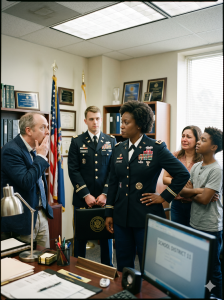
Two figures in immaculate military dress uniforms stepped inside.
I recognized Lieutenant Colonel Morrison immediately—my father’s senior aide, a broad-shouldered man with a chest full of medals and the hardened eyes of someone who had seen war and never softened from it.
But the second figure made everyone in the room rise instinctively.
Major General Patricia Hughes entered.
Two silver stars gleamed on her shoulders. She didn’t just walk into the room—she commanded it. Everything shifted around her presence, as if the space itself reorganized to acknowledge authority.
“Principal Graves,” she said, her voice sharp and unwavering. “I am Major General Patricia Hughes, United States Army. I am here regarding the false allegations made against one of my senior officers and the treatment of his son. We need to talk.”
The office fell into absolute silence. Even the secretary froze mid-step. Even the air seemed to hesitate.
Hughes refused the chair Graves offered. Morrison set a metal briefcase on the counter and opened it with precise clicks that sounded almost explosive in the stillness.
“To be clear about why the United States Army is here,” Hughes began, her gaze locking onto Graves, “a teacher under your supervision accused a twelve-year-old child of a federal offense without evidence, without investigation, and destroyed his property in front of his classmates.”
“General, please—” Graves started weakly.
Morrison raised a tablet, cutting him off. On the screen was a photo of the torn remains of my project, carefully documented.
“This is what was left of James Washington’s assignment,” Morrison said coldly. “Destroyed by Mrs. Patricia Henderson at 2:15 p.m., witnessed by twenty-seven students, and partially recorded.”
He swiped to another image—Mrs. Henderson mid-action, tearing my work apart.
“Do you know who this is?” he asked. “General Robert Washington. Four-star general. Twenty-eight years of service. Bronze Star. Purple Heart. Deputy Chief of Staff at the Pentagon. Advisor to the Joint Chiefs.”
Graves’s breathing became unsteady. “We… we didn’t know—”
“You didn’t verify,” Hughes snapped, her voice cracking like a whip. “You didn’t investigate. You didn’t even make a single phone call. You saw a Black child and decided he was lying.”
Morrison continued reading from a file. “Enlisted at eighteen. Ranger qualified. Airborne qualified. Multiple combat deployments. Pentagon Fellow. Army War College graduate. Promoted to general at forty-two.”
Each detail hit the room like a physical blow.
“This is the man your teacher said did not exist,” Morrison said flatly.
The door clicked open again.
Mrs. Henderson stepped in.
She looked composed at first, clipboard in hand, expecting a routine complaint. But then she saw the uniforms. The stars. My mother’s expression. She stopped mid-step.
“Mrs. Henderson,” General Hughes said, turning toward her fully. “I am Major General Patricia Hughes. General Washington is my subordinate. I have known him for over a decade. He is one of the most respected officers in the United States Army.”
Color drained from Henderson’s face.
“I… I didn’t…” she stammered.
“You didn’t know,” Hughes said coldly, stepping closer. “Because you never bothered to find out. You labeled a child a liar, accused him of a federal crime, and destroyed his work. Based on what?”
“I thought—students exaggerate—” Henderson whispered desperately.
“Based on what?” Hughes pressed again.
The silence that followed answered for her.
Morrison opened another file. “We reviewed eighteen months of complaints involving this school.”
He began listing them.
Six military families.
Fourteen documented incidents.
All involving the same teacher.
All dismissed without investigation.
“October 15th,” he continued. “A student told you her father was deployed. You told her people like him don’t become officers.”
Henderson’s clipboard slipped from her hands and clattered to the floor.
“November 2nd,” Morrison went on. “You accused a military child of cheating because his writing was ‘too advanced for his demographic.’”
His voice hardened.
“December 3rd. You confiscated a child’s unit patch and accused her of pretending to be military.”
The room felt suffocating.
“And today,” Morrison said quietly, “you did this to James Washington.”
Tears spilled down Henderson’s face. “I’m sorry,” she sobbed. “If I had known—if I had known he was really a general’s son—”
My mother stepped forward, her voice sharp and unwavering.
“If you had known what?” she said. “That’s the part you don’t understand.”
She shook her head.
“Every child deserves respect. Not just the ones you deem worthy. Not just the ones you believe. All of them.”
Margaret Carter stepped in, voice precise and final. “This is now a documented civil rights violation. A pattern of discrimination. And it will be treated as such.”
Graves tried one last time. “We can resolve this internally—”
“You will not,” Carter said firmly. “You will conduct a full investigation. You will reopen every complaint you buried. And there will be consequences.”
Before he could respond, the main doors opened again.
The atmosphere shifted instantly.
A man in a dark suit entered first, earpiece visible, scanning the room. Two more followed, moving with disciplined precision. They formed a protective corridor.
And through it walked a man who needed no introduction.
Part 4
Through the corridor formed by the security detail, a man walked in who needed no introduction. General Robert Washington.
Four silver stars shone on each shoulder of his dress uniform under the harsh fluorescent lights. His chest carried rows of decorations—the Bronze Star, Purple Heart, Legion of Merit, Defense Superior Service Medal, and campaign ribbons from four combat deployments. He was tall, broad-shouldered, with close-cropped hair graying at the temples and the steady gaze of someone who had commanded soldiers in war.
But the moment his eyes landed on me—small, shaken, sitting in that chair—the authority in his presence softened instantly.
For illustrative purposes only
“Hey, buddy,” he said gently.
Everything inside me broke at once.
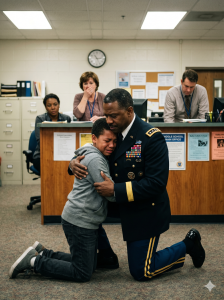
“Dad!” I cried, my voice cracking as I shot out of the chair and ran to him. He caught me without effort, lifting me up and holding me close to his chest like I was still little, still needing protection from the world.
“I know,” he murmured. “I know, son. I’m here now.”
I buried my face into his uniform, my body shaking with sobs. “She tore it up,” I cried. “She said I was lying… she said people like us don’t achieve things like this.”
“I know what she said,” he replied softly, his jaw tightening, but his hands stayed steady on my back. “None of it was true. And none of it is your fault. You did nothing wrong. You told the truth.”
He set me down gently, keeping his hands on my shoulders so I wouldn’t fall apart again. “You stood up for yourself. That’s all I ever want you to do.”
Then he turned toward Mrs. Henderson.
The softness disappeared.
In its place stood a four-star general.
“Ma’am,” he said quietly. “My son looks up to me. He is proud of my service because I taught him to be proud of service. Proud of sacrifice. Proud of doing something bigger than yourself.”
He stepped forward.
Henderson backed away.
“You took that pride and destroyed it in front of his classmates. You called him a liar. You accused him of a federal crime. You humiliated a child because you decided—without evidence—that he couldn’t be telling the truth.”
“General, I didn’t know,” she whispered.
“You didn’t know because you didn’t check,” he said sharply. “You didn’t check because you didn’t think you needed to. You looked at my son, his skin, his background, his mother’s job, and you made a judgment. That isn’t a mistake. That is bias.”
The word landed heavily in the room.
“I’ve served this country for twenty-eight years,” he continued. “I’ve earned every medal you see on this uniform. I’ve buried soldiers. I’ve missed my child’s life to do my duty. And I did it believing this uniform meant something. Equality. Respect. Fairness.”
He pulled out his phone and showed a photo of me as a younger child saluting outside the Pentagon.
“This is my son,” he said. “I told him he could be anything he worked for. And today, you tried to take that from him.”
He lowered the phone and looked at me.
“James,” he said softly, “look at me.”
I did.
“People will doubt you,” he said. “Because of how you look, where you live, or what they assume about you. That’s their failure, not yours. You stand by your truth. You don’t shrink. You keep going.”
Then he turned back to Morrison, who handed me a rolled-up poster.
My father unrolled it.
A clean, official Pentagon image. Four stars. Department of Defense seal. His name and rank printed clearly beneath.
“For your project,” he said. “I expect an A.”
I took it carefully, still shaking.
Then he straightened.
“Now,” he said, turning to Graves and Henderson. “We talk consequences.”
The next morning, Jefferson Middle School felt different.
Everyone already knew.
Messages had spread overnight—parents, students, social media. By the time I walked in with my parents, the hallways were full of staring eyes. This time, I didn’t look down.
Principal Graves’s office door had no nameplate. It had already been removed.
Inside was a new principal.
Dr. Patricia Foster.
She stood immediately when we entered. Firm handshake. Steady voice.
“I want to apologize,” she said. “On behalf of the district. What happened here was unacceptable.”
My mother nodded. “Apologies are not enough. We need change.”
“And you will have it,” Dr. Foster replied, opening a folder. “Mrs. Henderson’s contract has been terminated. Her teaching license is under review. Principal Graves has been placed on leave pending termination. Every dismissed complaint is being reopened.”
She turned to me. “And James, your project is an A-plus.”
My father nodded once. “Good,” he said. “Now what about the students who saw it happen?”
“That’s why you’re here,” Dr. Foster said. “We’d like you to speak to the class.”
Room 204 was silent when we entered.
Ms. Rodriguez stood at the front. The students were already seated. Some avoided my eyes. Some looked ashamed.
My father walked in behind me.
Everyone stood automatically.
“Sit,” he said calmly.
They did.
He stood at the front. Not pacing. Not shouting. Just speaking.
“I’m General Robert Washington,” he began. “And I’m here because something happened in this room that should never happen anywhere.”
He looked around. “How many of you thought James was lying?”
Hands went up slowly.
“Why?”
A boy shifted. “Because… generals are important. And James seemed… normal.”
My father nodded. “What does ‘normal’ mean? That he doesn’t look like what you expect? That he comes from a place you assume people don’t succeed from?”
Silence.
“Some of the best soldiers I ever served with came from neighborhoods like his,” he said. “Including me.”
He told them about his childhood. About being doubted. About being told he didn’t belong.
Then he turned serious.
“When you see something wrong and stay silent, you become part of it.”
Ms. Rodriguez stepped forward. “What happened yesterday was racism. We have to say it clearly, even when it’s uncomfortable.”
My father looked at me. “James, your presentation.”
I stood and gave it again.
This time, nobody interrupted.
Nobody laughed.
When I finished, one student started clapping. Then another. Then the whole room stood.
My father nodded once. Proud.
Six months later, the hallway outside Room 204 had a new name:
The Hall of Heroes.
Photos lined the walls—families of all backgrounds. Nurses, firefighters, soldiers, parents.
My father’s poster was in the center.
Under Dr. Foster’s leadership, disciplinary disparities dropped sharply. The video from that day had gone viral and triggered a district-wide investigation.
My father was promoted.
I stood beside him at the Pentagon ceremony.
When reporters asked what I learned, I said:
“I learned my truth matters. Even when people refuse to believe it.”
But there’s something I still think about.
I got justice because my father was a general.
Not every child has that.
Not every child gets someone powerful enough to force the world to listen.
Some kids are still standing alone in classrooms, being doubted, being dismissed, being ignored.
And the truth is simple:
They shouldn’t need a four-star general for their truth to matter.
They just need someone willing to believe them.
Because somewhere right now, another child is standing at the front of a classroom, hoping someone will say:
“I believe you.”
Will it be you?
