


Phoenix Sky Harbor International Airport in late July felt like a shared endurance test in discomfort. The air conditioning in Terminal 4 strained uselessly against the brutal Arizona sun pouring through the towering floor-to-ceiling windows. I was thirty-two weeks pregnant, my ankles so swollen that my shoes felt like they were cutting into my skin, and my flight back to Washington D.C. had already been delayed for the third time.
I just needed a moment to breathe.
I spotted an empty cluster of seats near Gate B12 and carefully lowered myself into a stiff vinyl chair, releasing a long, unsteady breath. I set my black leather carry-on beside me on the adjacent seat. I understood the unwritten rules of airports, but my doctor had explicitly warned me against repeated bending. Lifting that thirty-pound bag off the ground again wasn’t merely uncomfortable—it felt genuinely unsafe.
I closed my eyes and placed a hand over my rounded stomach, feeling the soft, familiar flutter of my daughter kicking against my ribs.
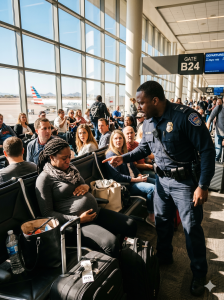
“Excuse me. You need to move the bag.”.
The voice cut through the air—sharp, controlled, and carrying the kind of authority that expected immediate compliance. I opened my eyes. A man in a private airport security uniform stood over me. His badge read MILLER.
“I’m sorry,” I said, keeping my tone calm and steady. “I’m pregnant, and my back is in a lot of pain. I can’t easily bend down to pick it up again.”
His eyes scanned me—my linen dress, my braided hair, my exhausted expression. “Ma’am, this is a seating area for ticketed passengers, not luggage,” he said, raising his voice just enough for nearby travelers to hear. “Move the bag to the floor.”.
I am a Black woman in America. I know this pattern. I’ve spent my life adjusting my tone, softening my presence, making myself smaller just to avoid escalation. But today, my body was stretched beyond its limit. I simply couldn’t comply.
“Officer Miller,” I said, forcing a tired smile. “I physically cannot lift it from the floor right now. Please, just let me rest.”.
He stepped closer, invading my space. “I’m giving you a lawful directive to clear the seating area,” he sn*pped.
“It’s not a lawful directive, sir, it’s a seating policy,” I replied quietly, my heartbeat rising. “Please, step back.”
“You people always think the rules don’t apply to you,” he muttered.
The words landed heavily. You people..
“Excuse me? What did you just say?” I asked.
“I said move the dmn bag!” he brked, his face flushing deep red. He reached out—not for the bag, but toward me.
I raised my hand instinctively to block him, trying to protect both my space and my stomach. Frustrated by my resistance, and visibly angered that I wasn’t immediately complying in front of witnesses, he swung his arm down.
It was a forceful, vilent strke. The loud crck of his hand slmming against my wrist and forearm echoed through the seating area. His momentum carried through, his forearm striking my shoulder. I gasped and curled inward, wrapping both arms protectively around my pregnant belly, terrified of falling onto the hard floor.
A heavy, suffocating silence fell over Gate B12. In broad daylight, inside a crowded American airport, a uniformed security officer had just str*ck a visibly pregnant woman.
Instead of backing down, his reaction was exactly what power clinging to itself often does when exposed: he escalated. “You resisted! You are interfering with airport security!” he shouted, trying to recast me as the aggressor.
I slowly straightened, still protecting my abdomen. With my uninjured hand, I reached into my purse.
“Keep your hands where I can see them!” Miller y*lled.
I pulled out my phone.
He thought I was just another helpless passenger. He didn’t know I wasn’t only a pregnant Black woman trying to get back to Washington D.C.. My name is Sarah Jenkins. I am the Deputy Inspector General for the United States Department of Justice.
I dialed a number that bypassed public systems and connected directly to the Federal Bureau of Investigation’s regional command center in Phoenix.
“I have just been physically ass*ulted by an airport security officer,” I said, my voice unnervingly calm. “I need an immediate federal containment of this terminal.”.
Miller’s expression shifted. The color drained from his face, replaced by a dull, unsettled gray. His confidence vanished instantly.
For the next twenty-two minutes, the terminal seemed frozen in place. Then, at exactly 2:36 PM, everything changed. A surge of federal agents in dark tactical gear and windbreakers moved through the concourse, parting the crowd like water.
I had been quietly compiling files on this security contractor for months. This wasn’t random—I had been testing the system, walking straight into a scenario years in the making. I had used my own vulnerability as part of a controlled operation.
I thought I had succeeded. I had no idea I had just triggered consequences that would reach far beyond that terminal.
Part 2
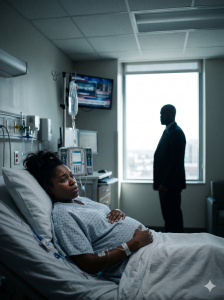
For illustrative purposes only
The hospital room was far too bright—an unforgiving sterile white that made my eyes sting the moment I was wheeled inside. I lay there as the plastic bed shifted faintly beneath me while a technician spread ice-cold ultrasound gel across my stomach.
A rhythmic, frantic wet sound filled the room.
It was my baby’s heartbeat—fast, irregular, like a drumbeat trapped inside the machine, mocking the forced stillness of the recovery space.
I had just spent the last hour trying to explain to a rotating group of panicked nurses why my blood pressure was in a range usually associated with heart attck victims. My wrist was secured in a thick brace, pulsing with a dull, sickening pain where Officer Miller had strck me. But even that wasn’t what scared me most.
What terrified me was the weight pressing on my chest.
Agent David Reyes stood near the window, his broad frame silhouetted against the harsh Arizona sunlight. He faced away from me. He hadn’t spoken since we left the chaos of Terminal 4. He had seen everything—seen me turn my own vulnerable body into bait, seen me deliberately provoke a violent corrupt officer into an assult just to trigger federal intervention.
He knew I had gambled with my unborn child’s safety to win a bureaucratic war.
The silence between us felt thick, suffocating—like damp fabric pressed over my mouth.
The technician finally wiped the gel from my skin with rough paper towels and left without a smile. “You need to rest, Sarah,” she had murmured, though her eyes made it clear she didn’t believe I would.
Rest wasn’t possible.
My phone vibrated nonstop on the bedside table—not calls, but encrypted alerts firing one after another.
The fallout from my airport operation was already turning chaotic. News outlets replayed the viral footage of Miller’s arrest, but the narrative was shifting rapidly.
Edward Henderson, regional manager of Apex Security Group, had spent less than two hours in federal custody before his legal team secured an emergency injunction. They were now arguing that the arrest was unconstitutional, politically motivated, and an abuse of federal power.
Then the call I had been expecting finally came.
The caller ID read: Marcus Vance. Assistant Attorney General. My direct superior. The man who had once mentored me.
I answered immediately, my voice rough.
“Sarah,” he said flatly. No warmth. No familiarity. “What in the h*ll were you thinking?”
I forced myself upright, pain tightening sharply through my abdomen.
“I was thinking Apex has been violating federal law for three years,” I shot back, voice shaking but firm. “We finally had the evidence to shut them down the moment they committed a felony on federal property. Miller committed that felony on me.”
“You provoked him,” Vance sn*pped. “The footage shows escalation. You didn’t observe—you engaged. You used your position to manufacture a confrontation.”
“He put his hands on a pregnant federal officer!” I said, voice breaking. “He would’ve done it to anyone vulnerable. I just made sure it couldn’t be buried.”
“It’s not sticking, Sarah,” Vance said coldly. “The Attorney General is furious. A senator on the oversight committee has already called. They’re calling this a politically driven hit. They’re calling you a rogue agent with a vendetta.”
My stomach dropped.
“Vance, look at the files I sent. The offshore accounts, the contracts, the ab*se reports—everything is there.”
“None of it matters if the lead investigator is suspended for misconduct,” he replied. “And you are. Effective immediately. Hand your credentials to Agent Reyes. Remain at the hospital. No press. No DOJ systems.”
The line disconnected.
It didn’t feel like discipline—it felt like erasure. Ten years of service, gone in a sentence. I had built my entire life inside the Department of Justice, and now the same system was severing me to protect itself.
David finally turned from the window. His expression was heavy, conflicted. “He told you.”
I nodded. “He wants my credentials.”
“I’m not taking them,” he said quietly. “Not yet. But Henderson is already out. They’re wiping servers as we speak. If we don’t recover what was pulled during the raid, it’s gone by morning.”
A cold wave hit me.
If the data disappeared, Miller and Henderson would walk free. Worse, I would become the criminal.
My eyes landed on my black leather bag at the end of the bed.
Inside it sat my encrypted laptop—and inside that, a mirrored copy of Project Chimera. Months of classified investigation into Apex Security’s deeper ties.
It was powerful enough to destroy Henderson.
And illegal enough to destroy me.
My breathing tightened.
“David,” I whispered, throwing off the blanket. “I need the bathroom.”
He understood without looking at me twice. He stepped back. “I’ll be in the hall. I didn’t see anything.”
I grabbed the bag and moved on unsteady legs into the small bathroom, locking the door behind me.
The laptop opened with trembling hands. My password took three tries. I opened the encrypted chat.
Elena Rossi—the investigative reporter.
No hesitation. I dragged the Chimera folder into the message window: offshore transfers, internal emails, abuse documentation, everything.
“It’s all here,” I typed. “Run it now. They’re wiping everything.”
Send.
The upload bar crawled forward. Slow. Relentless.
Ten percent. Thirty. Sixty.
Each second felt like collapse.
At 100%, Elena replied instantly: “Received. Sarah… do you understand what this means for you?”
“Run it,” I typed, then shut the laptop.
I leaned against the bathroom wall, gasping.
A sudden kick hit deep in my abdomen. My baby moved—hard.
Guilt flooded in immediately, sharp and crushing.
I had just crossed a line I could never uncross.
When I returned to the room, it was no longer empty.
David stood frozen near the corner, pale.
Two men in tailored dark suits stood beside my bed. Not agents. Political operators. Controlled. Expensive. Detached.
One stepped forward. I recognized him instantly—Thomas Kade, Chief of Staff to the Attorney General.
“Ms. Jenkins,” he said smoothly. “You’ve been very active.”
“I’m conducting a lawful investigation,” I said, gripping my gown.
“You were,” he corrected softly. “Now you’re a patient with documented instability.”
He lifted a tablet.
Breaking news. The Apex Files were live.
But his expression didn’t show panic.
It showed satisfaction.
“You think you exposed Henderson,” he said quietly. “But he helped start this. He fed you the trail.”
My mind stalled. “What?”
“Apex was a liability,” Kade continued calmly. “A messy one. It needed controlled demolition. Someone self-righteous enough to ignite it publicly.”
My breathing slowed.
“You were the ignition,” he said. “And the assault? Perfect timing. Perfect optics. Perfect justification.”
The room tilted.
I had been guided.
Not resisting a system—but executing its plan.
“And now,” Kade said, stepping closer, “you’ve illegally leaked classified data. That gives us everything we need. We discredit the investigation. We discredit you.”
He leaned in.
“Who will they believe? The Department of Justice—or a pregnant woman they can label unstable?”
My throat tightened.
“You will sign a confession,” he said. “Or we destroy your career, your credibility—and we ensure Child Protective Services is waiting when your child is born.”
David looked away, powerless.
The pressure in the room felt physical now, crushing.
I looked down at my stomach.
Another kick.
Something inside me shifted.
Fear was still there—but beneath it, something colder formed.
“You’re not going to break me,” I said quietly.
Kade’s smile sharpened. “We already have.”
He turned. “Take her.”
As they moved in, pain tore through my abdomen—sudden, violent.
Alarms exploded from the monitor.
My knees gave out.
The room blurred.
And before everything went dark, my eyes caught a tiny red blinking light in the smoke detector.
A camera.
Recording everything.
Even this.
And as darkness swallowed the edges of my vision, one thought stayed fixed, burning through the collapse:
I am not dead yet.
Part 3
The darkness didn’t last long. I woke to the harsh, blinding glare of surgical lights and the panicked shouting of medical staff echoing around me.
My body felt like it had been t*rn apart. The unbearable cramps that had dropped me to my knees had become something far worse in reality. I was in a freezing, sterile operating room, my arms strapped tightly to a steel table. I tried to scream, but the oxygen mask over my face swallowed the sound.
“Her pressure is bottoming out! We have to get the baby out now!” a voice shouted through the chaos.
There was no waiting. There couldn’t be. I felt the horrifying force of an emergency C-section—less like a birth, more like a violent extraction. I was alone, terrified, and in unbearable pain.
And then she arrived.
A cry broke through. Not strong, not full of life like in stories—but a fragile, trembling whimper. Emily. Thirty-two weeks. Forced into the world far too soon, into a reality already trying to destroy her mother. I tried to lift my head, desperate just to touch her, to let her know she wasn’t alone.
But they took her away to the Neonatal Intensive Care Unit (NICU) before I could even see her face. Another loss. Another piece of me torn away.
When I woke again, the surgical lights were gone.
The door clicked shut, and I was alone. But this wasn’t a normal recovery room. It was a containment space. White padded walls, a single shatterproof window facing a sterile courtyard, and the constant, low hum of a security system.
They had taken my phone, my encrypted laptop, even the d*mn pen from my bag. They called it “medical safety.”
I knew better. It was control. Thomas Kade and Marcus Vance had followed through on their threat. I was on a forced psychiatric hold, locked in a secure wing like a prisoner.
A television in the corner, sealed behind plexiglass, was my only connection to the outside world. The news cycle had turned into something brutal and relentless. My face filled every screen.
Sarah Jenkins: Whistleblower or Traitor? Sarah Jenkins: Mentally Unstable Federal Agent Leaks Classified Documents.
My name had become poison. Vance and Kade had executed their strategy flawlessly. My career, my reputation, everything I had built—erased. I had been reduced to a broken, unstable woman who had snapped under pressure.
The truth—Project Chimera, the offshore accounts, Apex’s crimes—was being buried beneath a carefully constructed narrative. I was the story now. Not them. And my story was a lie.
The first days blurred together under forced medication and endless psychiatric evaluations. They asked about my childhood, my stress, my emotions—questions designed not to understand me, but to define me as unstable.
They weren’t seeking truth. They were building a case for insanity.
My lawyer, Mr. Davies, visited when allowed. He always looked exhausted, defeated by a system too large to fight.
“We’re trying, Sarah,” he said quietly. “But the evidence is overwhelming.”
Evidence they created. Carefully constructed lies wrapped in digital manipulation.
But the real pain wasn’t the trial. It was what I couldn’t protect.
Emily.
Days turned into weeks. I was escorted to the NICU under guard. Each visit felt like stepping into a world I couldn’t survive.
She was there—tiny, fragile, surrounded by machines. Her chest rose and fell with a respirator’s rhythm. Tubes, wires, constant alarms.
I sat beside her incubator, hands restrained, whispering through the plastic. Singing lullabies I barely remembered. She was so small, so vulnerable. And I—her mother, once capable of shutting down entire systems—could do nothing.
The guilt was crushing. I had brought her into this. I had gambled with her life, believing I could control forces far beyond me.
The trial continued while I remained confined. Marcus Vance presented the case with cold certainty, showing footage, documents, and psychiatric testimony. The narrative was airtight.
My defense collapsed under the weight of their version of reality.
The verdict came: guilty—not of treason, but of gross negligence and mental incompetence threatening national security.
The sentence was called “lenient.” Five years probation, mandatory therapy, and a permanent gag order preventing contact with anyone tied to Apex, including Elena Rossi.
A few days later, I was released from the psychiatric wing. Hollow. Stripped of everything.
My career was gone. My accounts frozen. Emily was still in intensive care.
I moved into a small, broken apartment and lived in fragments—hours spent waiting for brief NICU visits, days dissolving into silence. Isolation became permanent. Colleagues vanished. Friends disappeared. I became radioactive.
But something small still burned inside me. A stubborn ember. I replayed everything, searching for a flaw in their design.
Then the call came.
Tuesday morning. Grey sky. My phone rang.
Mr. Davies.
His voice was shaking before he even spoke.
“Sarah… I’m so sorry. I have terrible news.”
My chest tightened instantly. “Emily?” I whispered.
“There was an infection,” he said softly. “A sudden complication overnight. The doctors did everything they could. But… she didn’t make it.”
Silence swallowed everything.
The room tilted. My phone slipped from my hand. I sank to the floor.
Emily.
Gone.
The world collapsed inward. My breath disappeared. The last fragile thread holding me together snapped.
They hadn’t just taken my career. They hadn’t just taken my freedom.
They had taken my child.
For three days I didn’t move. Didn’t eat. Didn’t speak. The world blurred into nothing.
On the fourth day, something broke.
The grief didn’t disappear—it transformed.
Coldness replaced it.
Absolute. Empty. Sharp.
I stood, walked to the mirror, and looked at myself. The woman staring back wasn’t Sarah Jenkins anymore. She had died with her daughter.
What remained was something stripped of everything human.
Justice no longer mattered. The system no longer mattered.
Only one thing remained.
Retribution.
They had destroyed everything. Now I would do the same—methodically, completely, without hesitation.
At the funeral, it was small. Private. Devastatingly quiet. My parents, Mr. Davies, two NICU nurses. Federal agents watched from a distance.
A small white casket rested in the ground.
I didn’t cry.
I made a vow instead.
I would not stop. Not breathe. Not rest until Thomas Kade and Marcus Vance were destroyed. No matter the cost.
As the dirt fell onto the white casket, something in me hardened completely.
They thought they had broken me.
They were wrong.
They had only created what came next.
Part 4
The days after Emily’s funeral dissolved into a suffocating blur. I returned to my apartment, which no longer felt like a home but like a sealed cell, every object inside it a sharp reminder of what I had lost. The tiny clothes I had carefully chosen, the books I had imagined reading to her, the empty crib in the corner—they all stood there like accusations. I packed them away in trembling silence, sealing them into cardboard boxes I couldn’t bear to open again.
For weeks, I drifted through life in a hollow state, existing without truly living. My suspension from the DOJ was now official. Thomas Kade, the man behind it all, remained untouched while Project Chimera and its corruption were quietly buried. He had won. And I had lost everything. The anger inside me had hardened, replacing grief with something colder, heavier. I didn’t just want my life back. I wanted his destroyed.
It didn’t begin as a plan. It began as instinct.
I researched Kade obsessively—his routines, his movements, the patterns of his life. I built a profile of a man who believed himself untouchable, protected by power and distance.
One cold, bitter evening, I found myself outside his Georgetown high-rise. The building itself felt like a monument to everything he had stolen. I didn’t know exactly what I would do. I only knew I needed him to see me.
I waited for hours in the freezing air until he finally emerged with a woman in a black dress, laughing as if nothing in the world could reach him. Something inside me snapped.
I stepped forward.
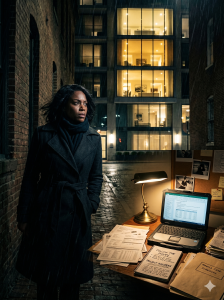
For illustrative purposes only
He stopped when he saw me. The smile faded, replaced with practiced calm.
“Sarah,” he said smoothly. “What a surprise. How are you holding up?”
“How do you think I’m holding up, Thomas?” I replied, my voice shaking with rage I could barely contain. “You destroyed my life. You took my daughter.”
He sighed, as if I were an inconvenience. “Sarah, I understand you’re grieving, but you need to move on. Project Chimera was a necessary evil. It wasn’t personal.”
The words hit like a strke.
“Not personal?” I repeated, louder now. “My daughter ded because of your ‘necessary evil’.”
He turned to the woman beside him, gently guiding her inside. When she was gone, his expression hardened.
He called me unstable. Said I needed help. When I told him I would expose him, he laughed.
“You’re a disgraced investigator,” he said coldly. “No one will believe you.”
“Maybe not,” I said quietly, stepping closer. “But I know the truth. And I won’t stop.”
I walked away, leaving him behind in the dark.
That was the beginning.
I contacted Elena Rossi again, breaking the terms of my probation. At first, she resisted—too cautious, too aware of the risks. But when I told her what happened to Emily, everything changed. She listened.
Elena was relentless in her work. She dug into everything, confirming my claims, uncovering other victims of Project Chimera. But we still needed proof Kade couldn’t erase.
I went back to the original files. That’s when I found it—a hidden name buried deep in the records: Maria Sanchez. A low-level employee everyone had dismissed.
It took weeks to find her. When I finally did, she was hiding in a cheap motel, terrified. But when I showed her a photo of Emily’s tiny white casket, she broke.
She gave me everything—encrypted drives, internal orders, direct links to Kade’s private servers.
That was the key.
Together, Elena and I built the case piece by piece. It was slow, dangerous, exhausting work, but neither of us stopped.
When the story finally broke, it didn’t land—it detonated.
The article exposed Kade’s role in Project Chimera, the manipulation inside the DOJ, and the human cost left behind. Financial records, internal emails, direct orders—everything was there. Undeniable.
The fallout was immediate.
Kade was removed and placed under federal investigation. The Attorney General resigned in disgrace. Congressional hearings began within days. The system that had protected him began to fracture under its own weight.
I watched it unfold from my apartment, feeling no triumph—only a quiet, hollow exhaustion.
Kade was eventually arrested outside his Georgetown residence, the same place where I had once confronted him.
It wasn’t victory.
It was exposure.
And it didn’t bring Emily back.
In the weeks that followed, the silence in my life deepened. The world kept moving, but mine remained suspended in grief.
Then Marcus Vance called.
The charges against me were quietly dropped. No apology. No acknowledgment. Just removal of the legal threat. And then—an offer. My job back.
I didn’t answer right away.
The idea of returning to the DOJ felt like stepping into the ruins of my own life. But it also felt unfinished.
“I’ll think about it,” I finally said.
That evening, I drove to Arlington Cemetery.
I walked until I reached her grave. The small white stone stood quietly against the grass, unchanged.
I knelt down and placed a white rose beside it.
“I did it, Emily,” I whispered. “It wasn’t enough. But I did it.”
I stayed there as the sky shifted from orange to deep violet, then black.
For the first time, I understood something I had resisted for a long time.
Justice hadn’t healed me. Revenge hadn’t either.
But acceptance was something different. Not peace—but continuation.
Eventually, I stood and left.
Back at my apartment, I opened the boxes I had once sealed away. I didn’t break down this time. I simply sorted through them—deciding what to keep, what to give away, what to let go.
At the bottom, I found her photo.
Emily. Small, peaceful, impossibly still.
I placed it in a silver frame and set it on my bedside table.
The next morning, I called Marcus.
“I’ll take the job,” I said. “On my terms. Internal corruption only. I want to make sure what happened to me never happens again.”
He agreed.
When I hung up, something faint shifted inside me—not healing, not happiness. Something smaller.
A beginning.
I looked at Emily’s photo.
“I will never forget you,” I whispered.
And for the first time in a long time, I believed I could keep going.
I was not who I used to be.
I was not whole.
But I was still here.
