

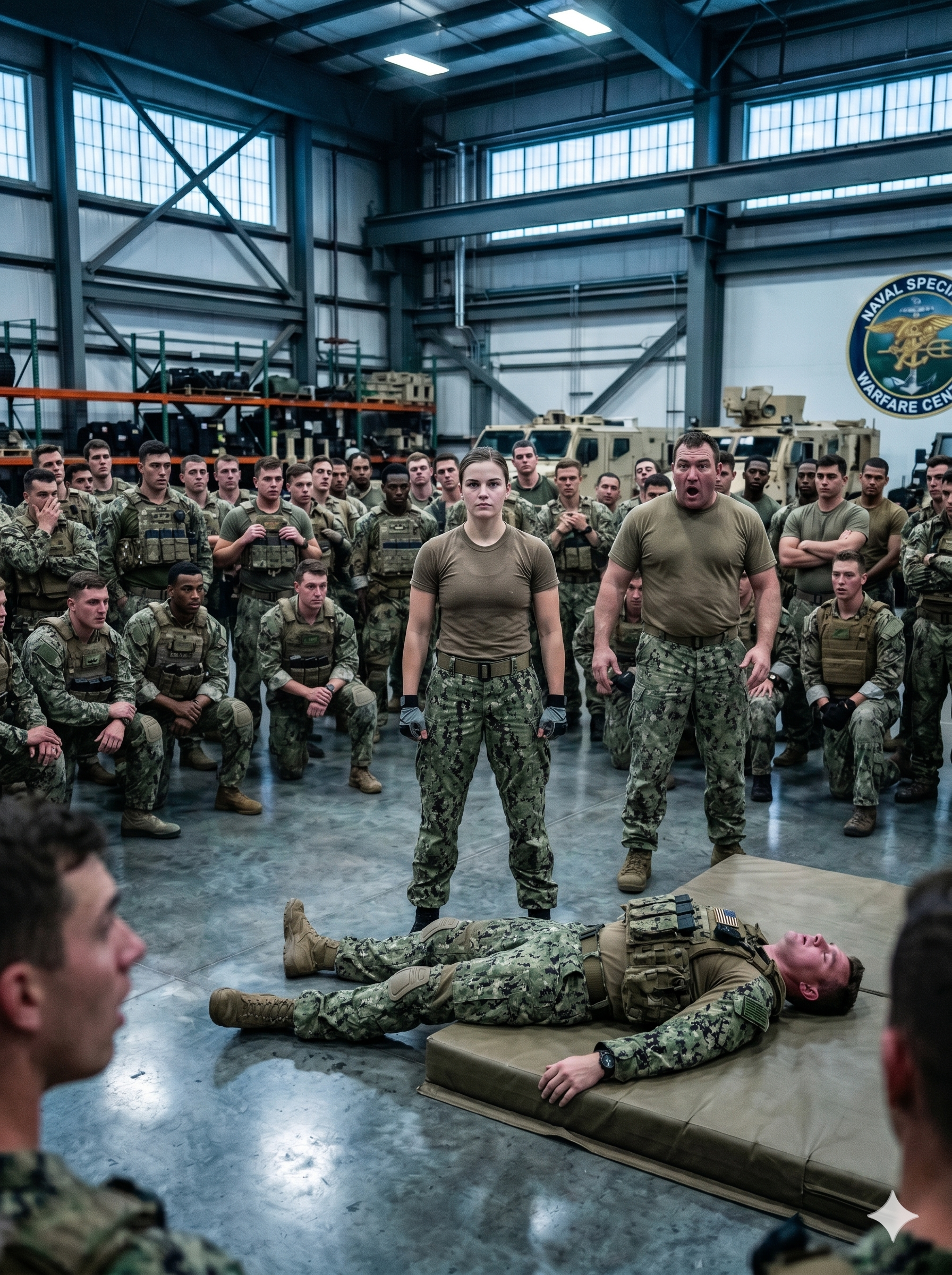
At 05:00 on Naval Base Coronado, the air carried the tang of salt and adrenaline. Inside the combat training facility, 282 SEAL candidates and instructors gathered in a broad circle around a lone mat, boots squeaking across the polished floor as everyone leaned in for one reason: to see if the only woman in the advanced combat pipeline would break.
Her name was Avery Hartman—twenty-four, compact, and composed. Her shoulders stayed loose, her jaw firm, her gaze steady, as if she had already faced the worst possible outcome and chosen not to fear it. She wasn’t loud. She wasn’t there to make a statement. She was there to honor a promise.
Opposite her stood two men who looked like they belonged in every story where the odds were stacked unfairly. Logan “Bulldozer” Rourke, 6’4” and built like a wall, and Cole Keene, a professional MMA fighter on a temporary assignment. They had been matched against Avery for a “controlled” spar—but everyone understood that “controlled” could disappear the moment ego stepped in.
The whistle sounded.
Rourke moved first, charging in and using his size like a battering ram, trying to force her backward with brute force. Avery shifted off-line, not so much retreating as repositioning—her footwork sharp, hips low, shoulders relaxed. Keene circled quickly, feinting, searching for an opening. Avery tracked both men without panic, her eyes moving with steady rhythm: left threat, right threat, escape route.
Then the rules started to slip.
Rourke reached for her neck—an illegal move for the drill. Keene drove in with a knee that should have stopped short. The room reacted like a single breath being drawn in. A few instructors stepped forward, then paused, as if waiting to see how far things would go.
Avery’s expression didn’t shift. She didn’t protest. She didn’t hesitate. She adjusted.
As Rourke reached again, she caught his wrist, turned beneath his arm, and used leverage—not force—to pull him forward into empty space. His own momentum betrayed him. He stumbled, overextended, and Avery’s elbow brushed a nerve point beneath his jaw. His legs dipped, shock flickering across his face.
Keene closed in, assuming she had already used her best move. Avery pivoted lightly on her foot, let his punch slip past her shoulder, and stepped inside his stance. Her hips rotated like a hinge. A compact throw—almost effortless—sent the MMA fighter crashing onto the mat with a sharp slap that echoed across the room.
For illustrative purposes only
The mat fell silent, but the room did not. It wasn’t sound—no one dared to speak—it was pressure, dense and charged, closing in from every side as 282 trained men tried to reconcile what they had just witnessed with what they had expected. Avery Hartman remained at the center, shoulders level, breathing measured, her focus not on the men she had just taken down, but somewhere just beyond them, as if the result had never been the point. A line of sweat ran down her temple, yet her stance held—no celebration, no break in composure, no search for recognition.
Across from her, Rourke pushed himself upright with a low grunt, something shaken flickering in his eyes—not just pride, but disbelief, the kind that lingers because it challenges something deeper than strength. Keene stayed on one knee a moment longer than needed, not injured, but recalculating, replaying each movement she had made, searching for a flaw that would make sense of it. There wasn’t one.
The instructor’s voice cut through again, calm but intentional—the kind of tone that reshapes a moment instead of reacting to it. “You think this was about winning?” he said, stepping forward, eyes sweeping the circle, not just Avery. “It wasn’t.” The men straightened automatically, attention snapping back into place, but their focus kept drifting—back to her, back to the center, back to the moment that had just shifted everything. The instructor stopped in front of Avery, studying her in silence for a long beat, as if weighing something unseen. “You didn’t overpower them,” he went on. “You outlasted their assumptions.” That landed differently. Not as praise—as correction.
Rourke exhaled, wiping his mouth with the back of his hand. “She got angles,” he muttered, not quite meeting anyone’s gaze. Keene gave a small shake of his head. “No,” he said quietly. “She controlled the pace.” That was closer. Around them, the circle shifted again, no longer leaning in to watch her fail, but trying to understand how she hadn’t. Avery spoke at last, her voice low and steady, carrying just far enough to reach those nearest. “You came at me like I had something to prove,” she said. “I didn’t.” There was no sharpness in it. No arrogance. Just clarity. And that clarity cut cleaner than anything that had happened on the mat.
The instructor gave a slight nod, then turned back to the room. “That’s the part you missed,” he said. “You don’t win fights by trying to dominate everything in front of you. You win by controlling what matters.” His gaze returned to Avery. “And she decided what mattered before the whistle even blew.” Silence followed again, but it wasn’t the same as before. It wasn’t waiting for something to give. It was absorbing something that already had. In that moment, Avery wasn’t just the only woman in the room. She wasn’t even the focus. She was the standard—and that realization settled over the room heavier than any impact on the mat.
Avery stepped away from the center without ceremony, not acknowledging the attention that trailed her, not glancing back to see who was watching now. She didn’t need to. The shift had already taken hold. The same men who had leaned forward expecting her to fail now moved slightly aside without thinking—not out of courtesy, but instinct. Respect doesn’t announce itself—it changes behavior. And as she passed them, calm, quiet, unchanged, the room understood something it hadn’t before: she hadn’t just endured the test. She had closed the question completely.
The shift in the room didn’t stop when Avery stepped off the mat—it followed her. You could sense it in the way conversations didn’t resume, in the way boots stayed still instead of shifting, in the hesitation of men who had once been certain of their place in the hierarchy. Respect had entered the space, but it hadn’t settled. It was still moving, still deciding where it belonged. Avery didn’t turn to look for it. She didn’t need validation. But the instructors did. They watched closely—not for reaction, but for transformation. Because in a place like Coronado, the real test wasn’t whether one person could perform under pressure. It was whether the system around them could adjust when something unexpected proved it wrong.
“Back on the mat,” the senior instructor said without warning.
Avery stopped mid-step.
Not startled.
Just aware.
She turned—slow, deliberate—and walked back to the center, not rushed, not resistant, carrying the same controlled presence she had held from the start. Around her, the circle closed in again, but the energy had changed. It was no longer predatory. It was careful. Curious. Measured.
“This isn’t about them anymore,” the instructor said, gesturing briefly toward Rourke and Keene, now standing off to the side in silence. “This is about you.”
A pause.
Then—
“Mask off.”
The room went still.
Not because of the order itself—but because of what it implied.
Avery didn’t move right away.
For the first time since the whistle that morning, something shifted in her stance. Not fear. Not hesitation. Something heavier.
Recognition.
“You heard me,” the instructor said.
Avery lifted her hand slowly.
Her fingers brushed along her jawline—then slid beneath the edge of something no one in the room had realized was there.
A thin, skin-toned layer.
Seamless.
Invisible—until now.
She peeled it away.
For illustrative purposes only
The reaction wasn’t loud—but it was there.
Because the face underneath wasn’t different.
It was… marked.
A faint scar ran from her cheekbone toward her ear. Another cut traced across her collarbone, disappearing beneath the edge of her uniform. Not disfiguring. Not dramatic.
But real.
Earned.
“She doesn’t just train here,” the instructor said quietly, letting the silence stretch. “She’s already been through something none of you have.”
The room drew tight again.
Not with tension.
With understanding.
Avery lowered the mask into her hand.
When she spoke, her voice remained calm—but it was no longer neutral.
“I wasn’t supposed to be here,” she said.
No one spoke.
No one moved.
“Two years ago,” she went on, “I wasn’t in training. I was deployed.”
A subtle shift passed through the instructors at the edge of the room.
Because now—
They understood where this was headed.
“The mission went wrong,” she said plainly.
No embellishment.
No theatrics.
Just truth.
“We were compromised before insertion. The intel was faulty. We walked in blind.”
The room fell completely still.
Because now—
This wasn’t a story.
This was reality.
“There were six of us,” Avery said.
A brief pause.
Then—
“I was the only one who made it back.”
That was the first true shift in the room.
Not sound.
Not movement.
Something deeper.
Because failing in training is one thing.
Surviving that kind of situation—
Is something else entirely.
Rourke looked at her differently now.
Not as an opponent.
Not even as an equal.
But as someone carrying a weight he hadn’t yet earned.
“They pulled me out,” Avery went on. “Said I was finished. Said I’d done enough.”
Her grip tightened slightly around the mask.
“But I didn’t come back to be finished.”
The instructor stepped closer.
“And that’s why you’re here,” he said.
Not a question.
A statement.
Avery gave a single nod.
“That’s not the twist,” the instructor added, turning to the room.
A ripple moved through the candidates.
Because if that wasn’t the twist—
Then what was?
He motioned toward the back of the room.
“Bring him in.”
The double doors opened.
And for the second time that morning—
Everything shifted.
A man stepped inside.
Not in training gear.
Not in uniform.
But carrying quiet authority.
Mid-forties.
Broad-shouldered.
Eyes that had seen enough to stop pretending otherwise.
Avery stilled.
Not obviously.
But enough.
“Lieutenant Hartman,” the man said.
The name landed differently.
Not Avery.
Not trainee.
Lieutenant.
The room shifted sharply.
Because that title—
Didn’t belong to someone being tested.
It belonged to someone being measured for something else entirely.
“You’ve kept them engaged long enough,” he said evenly, stepping forward.
“Now let’s see if they’re ready to understand why you’re really here.”
No one spoke.
No one moved.
Because suddenly—
This wasn’t a training exercise anymore.
It was a reveal.
The instructor turned back to the room, his voice cutting clean through the silence.
“Every one of you thought this was about watching her break,” he said.
A pause.
Then—
“It wasn’t.”
He looked straight at Avery.
Then back at them.
“She’s not here to prove she belongs.”
Another pause.
He let it settle.
Let it sink in.
“She’s here to decide who else does.”
