

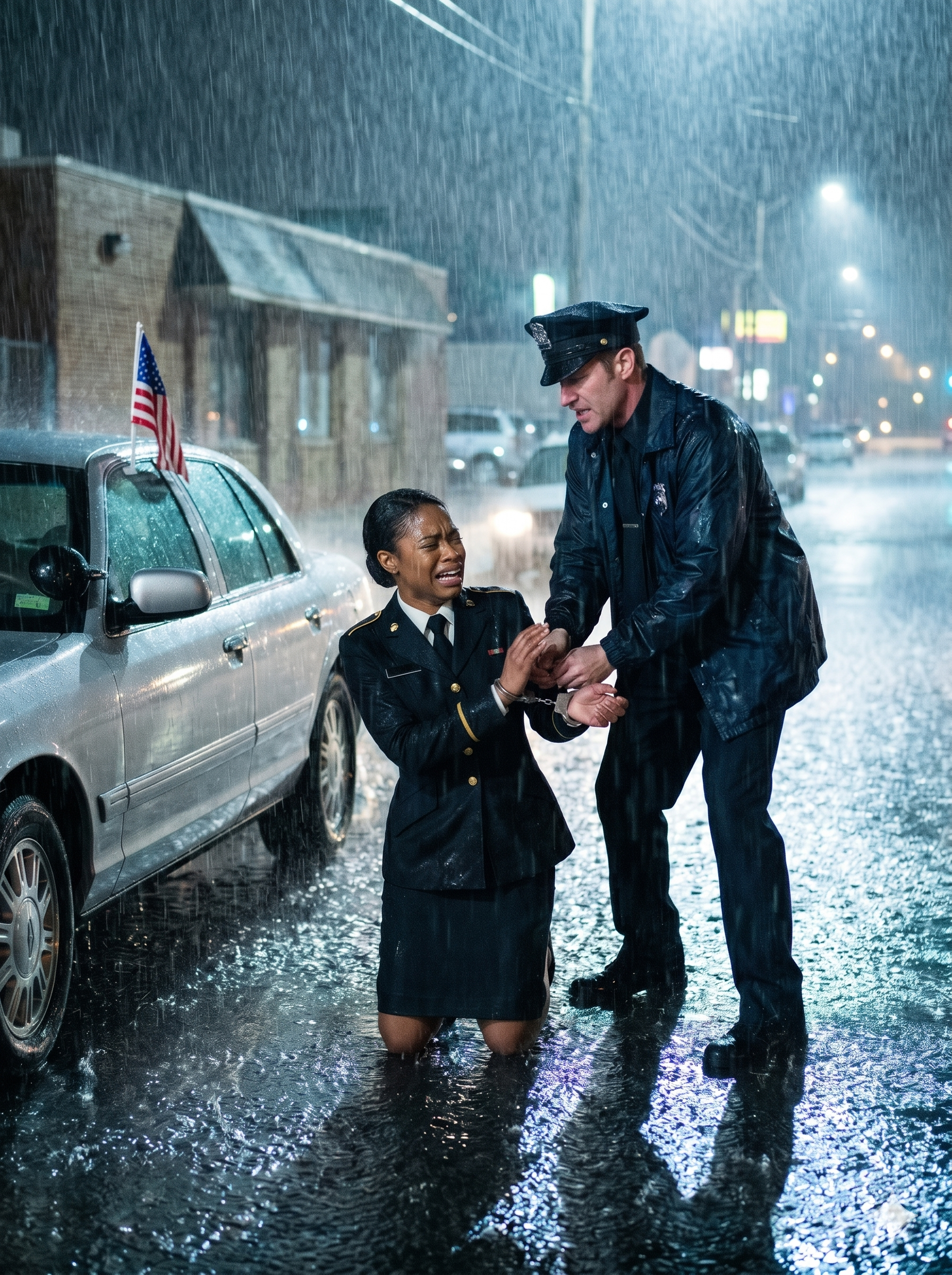
Rain made everything appear uncertain on Interstate 95 that morning. Outside Prince William County, the highway shimmered beneath a gray sheet of water, while passing headlights stretched into smeared, blurred streaks across the asphalt. I am Captain Alina Brooks of the United States Marine Corps. I had just ended a brief leave and was driving north, carrying that quiet sense of peace that comes with returning to base. My uniform was crisply pressed under my dark rain jacket, a representation of the discipline, honor, and duty I had pledged my life to uphold.
Through the relentless rain, I noticed a silver sedan pulled over on the shoulder. Its hazard lights flickered weakly, barely cutting through the heavy storm. A young woman stood beside it, drenched completely through. She was desperately fighting with a jack that kept sinking deeper into the soft, unyielding mud along the highway edge.
I didn’t need to think; I didn’t pause for even a moment. I pulled over about fifty feet ahead, opened my trunk to retrieve heavy work gloves, and ran back through the freezing rain. When I reached her, the young woman looked so relieved I thought she might break into tears right there in the storm.
“Thank God,” she breathed out, her shoulders easing. “I’m Sophie Carter. I think the tire’s gone completely flat, and I don’t know what I’m doing.”
I gave her a steady, calming nod. “I’m Captain Alina Brooks, U.S. Marines. Stay by the guardrail. I’ll handle it.”
Nothing about my actions was dramatic or showy. I simply worked with the controlled efficiency drilled into me, checking the jack’s position, setting the spare tire in place, and repeatedly glancing back to ensure Sophie remained safely away from the speeding traffic. Even in the blinding downpour, with civilian cars rushing past at dangerous speed, I felt centered and composed. Sophie later said she remembered that feeling most clearly—the overwhelming sense that help had finally arrived in human form. I was simply fulfilling my duty as an American citizen, assisting someone in need.
Then the patrol car arrived.
Blue lights suddenly sliced across the wet roadway, turning the roadside into a harsh, jarring wash of color. The feeling of safety vanished instantly. Officer Colin Mercer stepped out. Even before speaking, his posture was openly aggressive; one hand hovered near his holster while the other snapped up toward me.
“Step away from the vehicle!” he shouted over the pounding rain and roaring traffic.
I slowly straightened, keeping my movements measured, calm, and non-threatening. “Officer, I’m assisting with a flat tire,” I explained clearly.
He ignored me entirely. His gaze traveled over my Marine uniform, but instead of easing, his expression tightened with sharp, unfounded suspicion.
“What unit are you with?” he demanded, his voice cutting through the storm.
“United States Marine Corps,” I replied evenly, holding my military composure. “Captain. Logistics command.”
Sophie, sensing the strange and rising tension, looked between us in confusion. “She’s helping me. She didn’t do anything,” she said in my defense.
Mercer spoke directly over her. “Turn around and keep your hands where I can see them.”
I complied without hesitation. I was a Marine Captain; following orders and maintaining composure was instinct. Yet as rain streamed down my face, I understood with a cold clarity that my uniform, my rank, and my intent carried no weight for him. The nightmare had only just begun.
Part 2: The Unthinkable Act and The Erased Truth
For the first few seconds after the shot, the world seemed to lose all form.
The deafening roar of Interstate 95, the relentless drumming of Virginia rain on asphalt, the flashing blue lights of the police cruiser—everything collapsed into a hollow, ringing silence. Time itself seemed to fracture. The impact of the bullet had thrown Captain Alina Brooks backward, but with her hands violently pinned and securely cuffed behind her back, she had no way to brace her fall. She hit the ground hard, her shoulder striking the jagged gravel of the highway shoulder.
Sophie Carter dropped to her knees beside Alina without realizing she had moved. Her mind couldn’t process the reality unfolding in front of her. Moments earlier, this calm, steady Marine had been changing her tire in a storm. Now she was on the ground. Rain hammered the asphalt, turning runoff near the shoulder faintly pink. The water streaming down the incline was no longer just gray—it was carrying away the life of the woman who had stopped to help her.
Alina lay on her side, wrists still cuffed behind her back, her breathing shallow and uneven. Shock had not yet given way fully to pain, but the cold was immediate and brutal. The freezing rain soaked through her pressed Marine uniform, clinging the fabric to her skin. Her eyes, usually sharp and controlled, flickered as she tried to orient herself. She attempted to move, but the metal restraints bit into her wrists. She was completely defenseless, trapped in mud beneath a gray, heavy sky.
Sophie’s hands shook so badly she nearly dropped her phone, but she kept recording, driven by a primal fear that if she stopped, the truth would vanish. Her screen was slick with rain, the lens blurred by droplets, but it still captured everything. Through it, she saw the unthinkable.
“Oh my God, oh my God—” Sophie gasped, her voice breaking through the storm. “She’s bleeding! You shot her!”
The words tore out of her like something burning. She screamed not only at the officer, but into the storm, at passing cars, at anyone who might witness it. But traffic on I-95 kept moving, tires hissing over wet pavement, indifferent to the horror unfolding at the roadside.
Officer Colin Mercer did not rush to help. That detail would later stay with Sophie more than anything else. He did not kneel to apply pressure to the wound. He did not immediately reach for his radio for medical assistance. Instead, he stood over Alina with his weapon still raised, chest heaving, face locked between panic and defensive rage, as though more offended by being challenged than by what had just happened. His grip on his service pistol was rigid. He looked down at the decorated Marine officer bleeding in the mud, and his first instinct was not preservation of life, but preservation of himself.
“She reached!” Mercer shouted, voice cracking with manufactured hysteria. He repeated it into the empty air, performing for an audience that wasn’t there, building a story around what he needed to be true.
“She was handcuffed!” Sophie screamed back, voice straining. “Her hands are behind her back! How could she reach? You handcuffed her!”
Mercer snapped toward her, eyes wide and frantic. The barrel of his weapon twitched. “Stop recording and get back!”
The command landed like a physical удар. Sophie stepped back, boots slipping in mud, but she did not stop filming. She held her phone tight, framing everything: flashing lights, Mercer’s aggressive stance, and Alina on the ground. The recording captured it all—Alina struggling to speak, Mercer finally calling in an “officer-involved shooting with a non-compliant suspect,” the cuffs still locked on her wrists, and traffic slowing as drivers began to understand something was terribly wrong.
On the ground, Alina’s training fought against her failing body. She forced controlled breaths, trying to stabilize her weakening pulse. Pain was spreading now—a burning pressure in her chest—but worse was the spreading numbness in her lower body.
Alina’s voice, when it came, was steady in a way that chilled Sophie. Not panic. Not pleading. A report.
“I can’t feel my legs,” she whispered.
That sentence changed everything. It cut through the storm and hit Sophie like impact. The bullet had not only torn flesh—it had stolen her future.
Paramedics arrived within minutes, sirens echoing over the highway, followed by additional deputies rushing from their cruisers. They arrived expecting a violent suspect situation. Instead, they froze at the sight of a Black female Marine captain lying in the rain, cuffed, critically injured, and bleeding heavily.
The scene was chaos, but the medics moved with focus. One veteran EMT dropped beside Alina, took one look at her uniform, her restrained wrists, and the wound, and swore under his breath while cutting away soaked fabric.
“Get these damn things off her!” another EMT shouted, glaring at deputies.
Mercer paced near his cruiser, repeating the same line: “She made a threatening movement.”
Deputies looked between Mercer and Alina. None of it made sense. A restrained woman could not have made the movement he described. After a long, tense minute, a supervisor ordered the cuffs removed. When they came off, Alina’s arms fell limply, wrists marked deep red.
They loaded her onto a stretcher. Sophie stood by the guardrail, still recording, shaking as the ambulance doors shut. As sirens faded into the distance, she looked down at her phone. The video was saved.
At the hospital, the fight continued under bright surgical lights. Surgeons worked through emergency procedures to keep Alina alive. The damage was severe—the bullet had torn through her upper body and critically injured her spine. Military liaisons arrived, faces tense, pacing as hours passed.
By evening, she was stable but the prognosis was devastating. She was alive, but the captain who had stopped in the rain hours earlier would never walk again.
Meanwhile, Sophie uploaded the video from her small apartment, shaking under a blanket. Her caption was raw: She was just helping me. She is a U.S. Marine. She was in handcuffs. He shot her for nothing. Please share.
It spread rapidly. Local pages shared it first. Then veterans. Then military families. Then national civil rights groups. Millions saw Mercer’s voice, the cuffs, and Sophie’s screams. The internet erupted.
Then the erasure began.
The video started disappearing. Removed for “community standards.” Reuploads deleted. Clips shadow-banned or blocked. Within hours, it was being wiped from major platforms.
By midnight, links went dark. People turned to encrypted messages to share copies. The police statement was vague, calling it an “incident involving an officer discharging a weapon,” with no mention of Alina’s service or restraints.
But prosecutors had already received an unedited copy.
The next shock came from Mercer’s own body camera.
Public pressure forced its release. Then officials claimed it was corrupted by weather. Three days later, federal forensic analysts were brought in.
Their findings were devastating: the file had been deliberately altered.
Thirty-eight seconds were missing, exactly covering the confrontation and shooting.
Someone had accessed the system and deleted the critical segment.
It was not failure. It was cover-up.
What began as one shooting became a federal civil rights case. Alina Brooks was identified publicly as a decorated Marine logistics officer. The case moved beyond county control.
Military attorneys and federal investigators arrived. Mercer’s history was reopened—previous complaints, use-of-force incidents, and internal reviews long dismissed now showed a pattern of escalating violence and ignored warnings.
The national media gathered outside Alina’s hospital. Her mother arrived and stood before cameras, composed despite devastation.
“My daughter served this country in uniform, and this county repaid her with a bullet.”
The statement became the defining headline.
Mercer was placed on leave. His weapon and badge were seized. The prosecutor promised review under national scrutiny. The governor demanded federal briefing.
Veterans, military groups, and civil rights organizations mobilized.
But the most critical discovery was still coming.
Federal investigators dug deeper into Mercer’s digital records. Beyond that night, they found inconsistencies across years—missing dashcam footage, muted interrogations, altered reports.
The pattern was no longer isolated.
The deleted 38 seconds were not an anomaly—they were part of a system.
And as the investigation expanded, it became clear the shooting on the rainy highway was not just about one officer.
It was about everything that had been allowed to happen before it.
And the fight had only just begun.
Part 3: The Command of Justice
For nine agonizing months, my life was no longer measured in deployments, operations, or the miles I once ran, but in millimeters of painful rehabilitation. The trial began exactly nine months after that rainy morning on Interstate 95. But to understand the weight of that federal courtroom, you have to understand the long, grueling purgatory that came before it. I had been a Captain in the United States Marine Corps, a woman who commanded logistics operations across continents. Now my world had been reduced to the narrow, unforgiving limits of a hospital bed and, eventually, a custom-built titanium wheelchair.
The transition was a relentless war of attrition. Endless surgeries attempted to stabilize my shattered spine. Long, disorienting weeks passed in a haze between sedation and sudden, brutal awareness. I still remember the moment the lead neurosurgeon—a kind man with exhausted eyes—sat beside my bed and delivered the sentence that reshaped my entire existence: I would never walk again. The bullet had caused irreversible damage to my spinal cord. The lower half of my body was gone from my internal map, replaced by permanent numbness and occasional, merciless phantom pain.
But as my body settled into its new reality, my mind became something sharper—more focused. I understood early that my survival was not random; it was responsibility. Officer Colin Mercer had tried to erase my life, and when that failed, his department attempted to erase the truth through digital manipulation. They expected silence. They expected me to disappear into statistics. They underestimated what it means to be a United States Marine.
When the morning of the federal trial arrived, the sky over Virginia was clear and painfully blue—a stark contrast to the storm that had changed everything. My mother helped me dress in civilian clothing. I chose a tailored dark blazer and trousers, refusing my dress uniform. I wanted the jury to see an American citizen stripped of her rights, not just a military symbol. But I pinned one thing to my lapel: a polished Marine Corps emblem. A quiet reminder of the oath I had taken—and the one my assaulter had violated.
Outside the courthouse, the atmosphere was electric with chaos. Reporters, cameras, and satellite trucks crowded the steps. But when my transport van arrived, everything shifted.
Along the entire accessible ramp stood my brothers and sisters in arms.
They had come from bases across the country. No chants. No signs. Just silence. They stood at attention in dark suits, forming an unbroken wall of discipline and solidarity as I passed. Their presence said everything that needed to be said: I was one of them, and I would not be erased.
Inside the courtroom, the air felt heavy, sterile, almost suffocating. I rolled into position behind the prosecution table and looked across the aisle.
Officer Colin Mercer no longer looked invincible.
The man who had towered over me in the rain now sat stiffly in a gray suit. He looked older, drained, his face hollowed under fluorescent light. But the arrogance remained—clinging to him like a reflex. He avoided my eyes, staring instead at his notes, as if refusing to acknowledge reality could undo it.
The prosecution opened with surgical precision. The lead federal prosecutor laid out the case not as an error, but as a deliberate deprivation of civil rights under color of law—followed by a calculated cover-up.
Then came the defense.
Their argument was predictable, rehearsed, and hollow. They painted Mercer as a frightened officer in bad conditions. They blamed the rain, the darkness, the unpredictability of roadside stops. And then they delivered their central claim: that I, while restrained with my hands cuffed behind my back, made a sudden threatening movement.
I sat still, expression controlled, while my own restraint was twisted into evidence against me.
But the foundation of their argument was about to collapse.
Sophie Carter was called to the stand.
She looked older now—changed by everything she had witnessed. Her voice trembled, but her words did not. She described the storm, the relief when I stopped to help, and the sudden shift when Mercer arrived.
Then the video was played.
The courtroom screen filled with shaky, rain-blurred footage. There I was—standing calmly in uniform, identifying myself, acting with discipline and restraint. Then Mercer’s escalation. His refusal to verify my identity. The forceful cuffing. My voice, steady even then: “I am complying.”
And then the moment that changed everything.
Mercer raising his weapon.
The shot.
The courtroom reacted as one body—an audible shock rippling through the room. A juror covered her mouth, tears forming instantly. No argument could survive what they had just seen.
The defense never recovered.
Then came the forensic experts.
Federal analysts walked the jury through the digital evidence with calm, devastating clarity. Thirty-eight seconds of body camera footage had been deliberately deleted. Not corrupted. Not lost. Removed.
“This was not accidental,” the lead analyst said. “This was intentional erasure of evidence.”
The implication was undeniable: the truth had been actively edited.
Mercer was not alone in what happened. The system had participated in what came after.
Then came his history.
Prior complaints. Excessive force reports. Racial profiling allegations. Cases dismissed, minimized, or buried. A pattern emerged—clear, consistent, and ignored.
The jury was no longer looking at one man. They were looking at protection built over years.
By the time I was called to testify, the case had stopped being abstract. It was no longer about reports or footage.
It was about my body.
I rolled into the witness box alone. I refused assistance. The room stood as I entered—reporters, attorneys, Marines—rising before the judge even instructed them otherwise. I raised my hand gently. They sat.
I swore in. Then I looked across the room at Mercer.
For the first time since that night, we were face to face.
The prosecutor asked what I remembered.
“I remember the rain,” I said. “I remember trying to help a civilian. I remember identifying myself clearly as a Marine officer.”
A pause.
“I remember being forced to the ground and cuffed.”
My voice remained steady.
“And I remember realizing he had already decided what I was before I ever spoke.”
Silence filled every corner of the courtroom.
Then I described my injuries—not emotionally, but precisely. Surgeries. Spine damage. Paralysis. The moment I was told I would never walk again.
I did not frame it as loss.
I framed it as consequence.
The defense attempted to fracture my testimony.
They failed.
“I am a trained logistics officer,” I said firmly. “I do not make erratic movements. I complied. My hands were cuffed behind my back. The only unlawful action was your client firing a weapon into a restrained American officer.”
The defense attorney sat down shortly after.
When I was asked if I had anything further to say, I paused.
Then I delivered the final truth:
“The bullet that severed my spine came from one officer,” I said. “But the permission for it came from every ignored complaint, every failure to act, and every cover-up that protected him.”
When I finished, I rolled back down the ramp in silence.
Closing arguments came and went like formality. Evidence had already spoken louder than anyone could.
The judge read the charges: attempted murder, civil rights violation under color of law, obstruction of justice, and evidence tampering.
The jury filed out.
The doors closed.
And for the first time since that rainy morning on Interstate 95, everything came down to twelve people deciding whether truth still mattered more than silence.
Part 4: A Legacy Built on Truth
The heavy oak doors of the federal courtroom closed behind the jurors, sealing them inside deliberation. The trial phase was over, and the long, suffocating wait had begun. I rolled out into the sterile corridors of the courthouse. The jury reached a decision in under six hours, yet to me—confined to a body that could no longer feel the ground—those hours stretched into something far more punishing.
My mother sat beside me in the waiting room, her posture rigid, composed in a way that betrayed everything she was holding back. We spoke very little. Words felt fragile in a moment like this, too small to carry the weight of what was coming. Instead, I stared at the polished grain of the table, following its lines as if they could map out the path my life had taken. I thought about how I had survived deployments, combat zones, and years of military logistics without a scratch—only to be brought down on a rain-soaked stretch of Interstate 95 by a man sworn to protect the public. I thought about the thirty-eight seconds of footage he tried to erase, and whether the truth had survived in the minds of those who mattered.
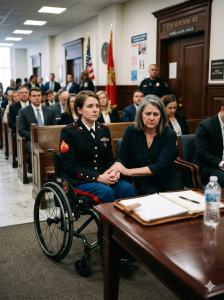
When the knock finally came, sharp and decisive, the air seemed to vanish from the room. The court liaison gave a quiet nod.
It was time.
Back inside the courtroom, everything felt different. The tension of trial had been replaced by an almost unbearable stillness. Reporters froze mid-note. The off-duty Marines behind the prosecution stood unmoving, disciplined and silent. I rolled into position, locked my brakes, and turned toward the defense table.
Officer Colin Mercer was already standing there.
He no longer carried the aura of control he once had. The man who had cuffed me in the rain now looked hollow, stripped down to something smaller and unstable. His hands trembled slightly against the table. But beneath the fatigue and fear, a stubborn refusal to accept reality still lingered in his posture.
The judge called the court to order. The foreperson stood with a single sheet of paper in his hands.
“We have, Your Honor.”
The verdict was read aloud.
Guilty.
The word landed like a strike.
Count after count followed—each one confirmed in the same steady voice.
Guilty.
Guilty.
Guilty.
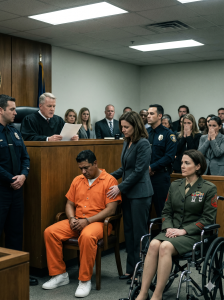
With each repetition, Mercer seemed to collapse further into himself, as if the structure he had built around his actions was finally giving way. When the final count was delivered, a heavy exhale moved through the courtroom. I did not react. Neither did the Marines behind me. There was no celebration in it—only recognition of something deeply broken being formally acknowledged.
The sentence came weeks later.
The courtroom was even more crowded than before. Mercer stood in a federal orange jumpsuit, wrists shackled. The irony of his restraints was not lost on anyone.
The judge did not soften his words.
“You used your authority as a weapon,” he said, voice cold and exact. “You violated your oath, you assaulted a restrained Marine officer, and you attempted to erase the truth that followed.”
He continued, outlining each deliberate act—the force, the shooting, and the digital deletion that followed.
“This court will not tolerate the abuse of power or the destruction of evidence.”
Then the sentence:
Twenty-eight years in federal prison.
The room did not react loudly. There was no applause, no relief. Only a heavy awareness that something had ended, but not been repaired.
As Mercer was led away, chains dragging across the floor, I felt a stillness settle over me. The immediate danger was gone. The person responsible was no longer free.
But it did not feel like completion.
It felt like containment.
The system that allowed him to exist had not been dismantled. Only exposed.
That realization stayed with me.
Months later, in a rehabilitation center filled with quiet repetition and slow progress, I gave a public statement that would spread far beyond those walls. I arrived in a titanium wheelchair, dressed simply, the Marine Corps pin still at my collar. Cameras lined the courtyard.
I did not speak about revenge.
I spoke about structure.
“I do not carry personal hatred,” I said. “What happened to me is not about one man alone.”
I explained what the trial had revealed: a system that normalized suspicion, protected misconduct, and treated erased evidence as a manageable inconvenience rather than a moral collapse.
“This is not about one officer,” I continued. “It is about a machinery that mistakes control for justice, and silence for order.”
My words spread quickly. They became part of a larger national conversation—one that extended beyond my case, beyond the courtroom, and into policy itself.
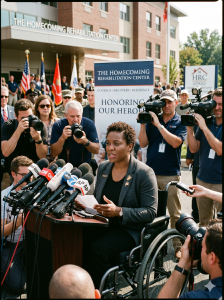
Under mounting pressure from civil rights organizations, veteran coalitions, and public demand, legislative reform began to take shape.
Within a year, Prince William County passed what became known as Alina’s Law: automatic body-camera uploads to independent servers, tamper alerts, mandatory external audits, and federal review triggers for missing or altered footage in use-of-force incidents.
I testified during its creation. Multiple times. Each appearance was deliberate, precise, and grounded in the same reality I had described from the beginning: accountability cannot depend on internal discretion alone.
Other jurisdictions followed. Resistance came from police unions and political groups, but the evidence from my case had already reshaped public expectation. The debate was no longer abstract.
It was documented.
Through all of it, Sophie Carter remained.
She had been the first witness to what happened, and she carried that burden in ways she rarely spoke about. When she visited me at rehab, we did not talk only about policy or courts. We talked about memory.
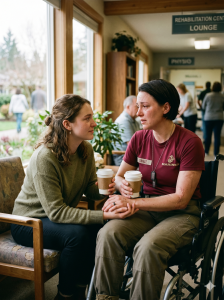
On one of those visits, she admitted she still saw it in her sleep—the rain, the lights, the weapon, my body on the ground.
“I almost stopped recording,” she said quietly. “I was scared.”
I looked at her and answered without hesitation.
“But you didn’t.”
That was the dividing line between silence and truth.
Not courage without fear—but action in spite of it.
Years passed. People still debated whether sentences were enough, whether reform went far enough, whether anything truly changed. And in many ways, they were right to ask.
Because the system did not disappear.
It adapted.
There were still cases. Still failures. Still nights when the weight of what I lost returned with physical force. But something had changed in what could no longer be hidden.
Accountability had gained a record.
I continued to speak—at hearings, at rallies, before legislators who often wished I wouldn’t. Each time, I returned to the same point.
The truth must remain visible.
What happened on Interstate 95 was not just an isolated act. It became documentation of a broader failure—of authority unchecked, evidence manipulated, and lives altered beyond repair.
I had survived deployments, warzones, and injury.
But what I had become afterward was something different.
A witness.
And witness carries responsibility.
I did not walk into rooms anymore.
I rolled into them.
But I ensured the truth arrived with me.
The rain, the handcuffs, the deleted seconds, the verdict—they no longer belonged to a single moment.
They became part of a permanent record.
And that record now stood where silence once tried to exist.
Not because one case ended.
But because it refused to be forgotten.
