

The Afternoon Everyone Misjudged
The lunch crowd at Willow Creek Café in Cedar Falls, Iowa, had been unusually quiet for a Tuesday afternoon.
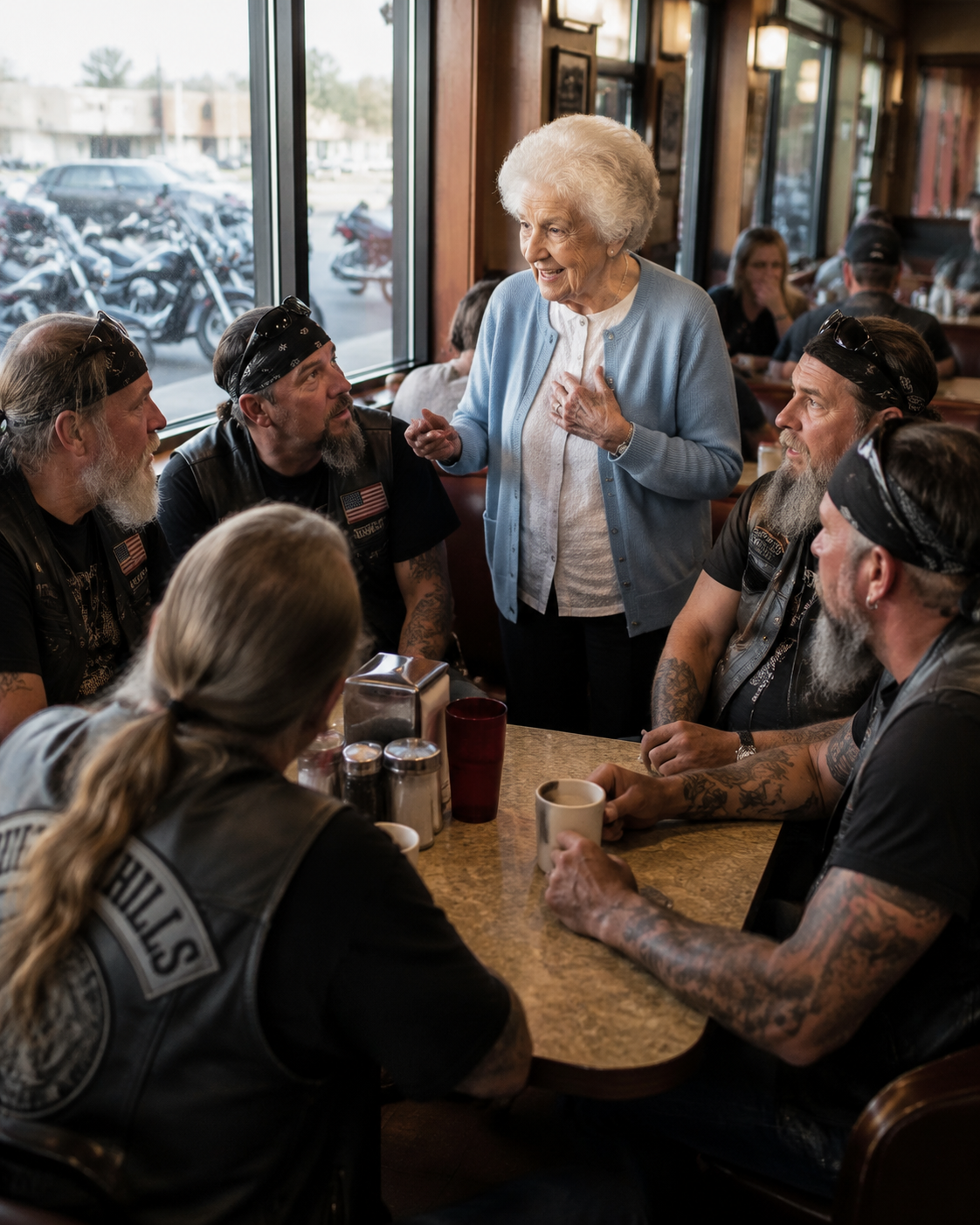
That changed the moment six motorcycles pulled into the parking lot.
The deep growl of their engines carried through the glass windows, drawing several customers’ eyes toward the entrance. Moments later, six large men walked in wearing leather riding vests, heavy boots, and faded jeans.
They looked worn out from the road.
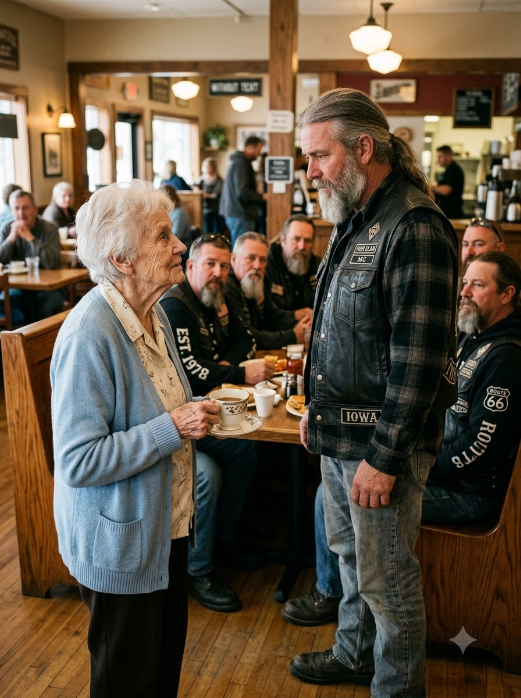
One had a long gray beard. Another had tattoos running down both forearms. The youngest wore his sandy hair tied back behind his neck.
They settled into the largest booth in the back.
Within minutes, the mood in the café shifted.
Voices dropped. A couple near the entrance pulled their chairs a little closer together. One man kept glancing toward the riders, then looking away fast whenever one of them noticed.
Nobody there knew these men.
That made it easy to assume the worst.
But across the room, eighty-eight-year-old Eleanor Whitcomb was watching them for an entirely different reason.
Her hands trembled around her teacup.
She wasn’t afraid of the bikers.
She was wondering whether they might be the only people in the room willing to help her.
Eleanor Had Always Handled Things Herself
Eleanor had called Cedar Falls home for more than fifty years.
She’d taught English at a local middle school for nearly three decades, raised two daughters, nursed her husband through years of failing health, and somehow kept a small garden growing behind her white two-story house through all of it.
Her husband, Arthur, had been gone for six years.
Her daughters lived out of state now.
Claire was in Oregon, and Rebecca lived just outside Boston.
They called often and visited when they could, but Eleanor had always insisted she was perfectly capable of managing on her own.
Most of the time, she was right.
She still drove herself to the grocery store.
She still paid every bill herself.
She still remembered birthdays without writing them down.
And she wasn’t the kind of woman who panicked easily.
Yet that afternoon, she couldn’t stop checking the clock above the counter.
2:17 p.m.
Thirteen minutes left.
At 2:30, her nephew Nolan Pierce was due to arrive.
And Eleanor knew exactly what he’d be bringing with him.
A folder full of papers he was desperate for her to sign.
The Questions Had Started Months Earlier
Nolan hadn’t always been close to Eleanor.
For years, he’d mostly shown up at Thanksgiving or Christmas.
Then, roughly four months earlier, that changed.
Suddenly Nolan became attentive.
He started calling every few days.
He offered to run her grocery errands.
He fixed a loose cabinet door in her kitchen.
He drove her to an eye appointment and insisted on covering lunch afterward.
At first, Eleanor had been moved by it.
Maybe age had finally taught him to value family, she thought.
But then the questions began.
How much was her house worth?
Had Arthur left any investments?
Was her mortgage fully paid off?
Did Claire or Rebecca have access to her bank accounts?
Who was named in her estate documents?
Eleanor noticed every question.
She just never let on that she noticed.
Then, the previous week, Nolan showed up at her house with a stack of papers.
He described them as routine documents that would let him “help” if Eleanor ever felt overwhelmed.
She’d read only three pages before realizing they were anything but routine.
The wording was dense, but Eleanor had spent most of her life teaching people to read carefully.
The meaning came through clearly enough.
Signing those papers would hand Nolan an alarming amount of authority over her property and her finances.
Eleanor had closed the folder.
“I need time to read everything.”
Nolan’s smile had flickered out for half a second.
Then it came back.
“Of course, Aunt Eleanor. I only want to make life easier for you.”
He suggested meeting at Willow Creek Café the following Tuesday.
Eleanor agreed.
But she had no intention of signing a thing.
The Six Men in the Back Booth
The biggest man at the table was named Wade Holloway.
He was fifty-three, broad-shouldered, and carried the kind of quiet that comes from years of listening more than talking.
His friends called him Hawk.
Wade had spent years riding across the country on motorcycles, but he wasn’t the reckless stranger most people in the café assumed him to be.
He owned a small repair shop outside Des Moines.
The man beside him, Curtis, was a retired electrician.
Another rider, Joel, volunteered at an animal rescue.
Two of the others were grandfathers.
They were simply six old friends heading home from a weekend ride through Wisconsin.
Wade had noticed Eleanor watching them almost right away.
At first, he figured she was uneasy about how they looked.
Then he noticed something else.
She wasn’t looking at the motorcycles.
She wasn’t looking at their clothes.
She kept glancing at them, then at the clock, then toward the front door.
Wade leaned toward Curtis.
“Something’s bothering that lady.”
Curtis glanced over.
“Maybe she’s waiting on somebody.”
Wade watched Eleanor’s shaking hands.
“Maybe she’s hoping somebody doesn’t show.”
The Question That Silenced the Café
At 2:20, Eleanor made up her mind.
She set a few dollars beside her teacup, pushed back her chair, and stood.
Molly Keegan, the waitress behind the counter, noticed right away.
“Everything okay, Mrs. Whitcomb?”
Eleanor gave her a small smile.
“I hope so, dear.”
Then she walked toward the bikers.
The café slowly went quiet.
People pretended not to watch, but almost everyone was.
Eleanor stopped beside Wade’s booth.
Up close, he looked even bigger than he had from across the room.
Wade straightened immediately.
“Can I help you, ma’am?”
Eleanor drew a slow breath.
“This is going to sound very strange.”
One of the riders smiled.
“We’ve heard strange before.”
Eleanor looked straight at Wade.
Then she asked:
Part 2 of 3
“Would you pretend to be my son for the next half hour?”
Every nearby conversation stopped.
Wade’s expression shifted at once.
No laughter.
No teasing.
Just concern.
“Are you afraid of somebody?”
Eleanor thought about the question.
“I’m afraid of what somebody wants me to sign.”
That was enough.
Wade slid over in the booth.
“Sit down and tell us.”
What Eleanor Had Discovered
Eleanor laid it all out.
The sudden kindness from Nolan.
The questions about money.
The papers.
The pressure.
The 2:30 meeting.
She told them she’d already called her daughters and had an attorney appointment set for the next morning.
But Nolan didn’t know any of that.
He believed Eleanor was coming to the café alone.
“Why meet him at all?” Joel asked.
Eleanor looked toward the window.
“Because I wanted him to understand that I’m not as alone as he seems to think I am.”
Wade nodded slowly.
That sentence told him nearly everything.
This wasn’t about scaring Nolan.
Eleanor didn’t want a fight.
She wanted presence.
Witnesses.
People beside her.
She wanted Nolan to walk in expecting an elderly woman sitting by herself and find instead that she had backup.
Wade leaned back.
“How many sons do you need?”
Eleanor looked puzzled.
Curtis grinned.
“Because you’re looking at six volunteers.”
For the first time that afternoon, Eleanor laughed.
The Waitress Had Heard Something Too
Molly came by their table with fresh coffee.
She’d been serving Eleanor for almost eight years.
She knew about Arthur.
She knew her daughters’ names.
She knew Eleanor always ordered peach pie in the summer and apple pie once the weather turned.
And she knew Nolan.
Three days earlier, Molly had caught part of a phone call while Eleanor sat alone in the café.
Nolan had called her.
His voice carried loud enough through the phone that Molly picked up a few words while clearing the next table.
She’d heard him tell someone in the background:
“Once everything is signed, I can handle the property myself.”
At the time, Molly hadn’t been sure what he meant.
Now she understood.
She set down the coffee pot.
“Mrs. Whitcomb, there’s something I think you should know.”
When Molly repeated what she’d overheard, Eleanor’s face went very still.
Wade noticed the shift.
Not fear.
Confirmation.
Eleanor had hoped she was misreading her nephew.
Now she knew she wasn’t.
Wade spoke gently.
“You aren’t signing anything today.”
Eleanor nodded.
“No. I’m not.”
Six Strangers Became Her Family
The next ten minutes changed the whole back booth.
Curtis moved his jacket aside so Eleanor could sit comfortably.
Joel ordered her another slice of pie.
A rider named Mason showed her photos of his two grandchildren.
Another told her about missing the right highway outside Madison and adding nearly two hours to their ride.
Soon Eleanor was laughing.
To anyone walking in, the group looked less like strangers and more like family catching up after years apart.
At 2:28, Wade checked the clock.
“Remember, nobody’s here to start trouble. We’re just having coffee with Mom.”
Curtis raised his mug.
“Best-behaved sons in Iowa.”
Eleanor smiled.
“Let’s not make promises we can’t keep.”
Even Wade laughed at that.
Then the front door opened.
Nolan Walked In Carrying the Folder
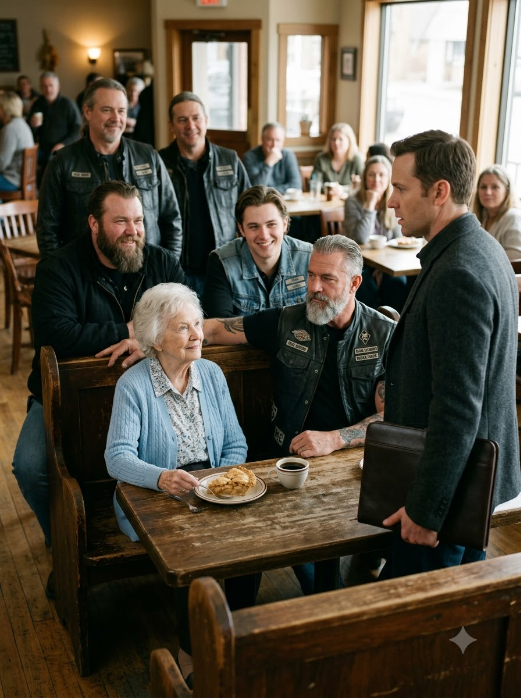
Nolan Pierce walked in wearing a charcoal jacket and a neatly pressed shirt.
A dark leather folder sat tucked under his arm.
He scanned the café until he found Eleanor.
Then he froze.
His confident expression vanished.
Six bikers surrounded his aunt.
Eleanor sat beside the largest one, calmly working on her pie.
Nolan hesitated before walking over.
“Aunt Eleanor?”
She looked up pleasantly.
“Nolan. Right on time.”
His eyes moved from one rider to the next.
“I didn’t know you were meeting other people.”
Eleanor set down her fork.
“These are friends.”
Then she rested her hand lightly on Wade’s arm.
“And this is Wade. He’s looking after me today, like a son would.”
Wade stood and offered his hand.
“Good to meet you, Nolan.”
Nolan had little choice but to shake it.
“Likewise.”
Wade sat back down.
“Eleanor says you brought some paperwork.”
Nolan’s eyes flicked toward his aunt.
“It’s nothing complicated.”
Eleanor arched an eyebrow.
“I found it fairly complicated.”
The Conversation Nolan Hadn’t Prepared For
Nolan set the folder on the table without opening it.
“These documents simply make it easier for me to help you with certain decisions.”
Wade stayed calm.
“Which decisions?”
Nolan looked annoyed.
“It’s a private family matter.”
Curtis took a sip of coffee.
“Seems like Eleanor gets to decide who’s part of the conversation.”
Eleanor looked straight at Nolan.
“That’s right.”
Nolan’s jaw tightened.
“Aunt Eleanor, can we talk alone?”
“No.”
It was the firmest word Eleanor had spoken all afternoon.
Nolan stared at her.
Eleanor went on.
“I read the documents carefully. I’m not signing them.”
“You don’t understand what they’re for.”
“I understand enough.”
Nolan leaned in slightly.
“I’m trying to protect you.”
Eleanor’s expression softened, though not because she believed him.
There was sadness behind her eyes.
“Then you should be relieved to know I’ve arranged professional guidance of my own.”
Nolan stilled.
“What guidance?”
“My attorney reviews everything tomorrow. My daughters already know about the documents.”
For the first time, Nolan looked genuinely thrown.
Wade said nothing.
He didn’t need to.
Neither did the five men beside him.
Their presence alone had shifted the balance of the conversation without a single raised voice.
The Folder Stayed Closed
Nolan glanced around the booth.
Then he looked toward Molly, standing quietly behind the counter, watching.
Other customers had started paying attention too.
The private meeting Nolan had counted on no longer existed.
There were witnesses everywhere.
He picked the folder back up.
“Maybe today isn’t the right time.”
Eleanor nodded.
“I agree.”
Nolan turned to go.
Then Eleanor spoke again.
“Nolan.”
He stopped.
“Please don’t come to my house with documents again unless I’ve asked you to.”
He glanced back at her.
For a few seconds, he looked ready to argue.
Instead, he nodded once and headed for the door.
The bell above it rang.
Then he was gone.
What Happened the Next Morning
Eleanor kept her appointment with attorney Caroline Brooks the following morning.
Caroline went through the documents carefully.
Eleanor’s instincts had been right.
The papers could have given Nolan sweeping authority over important financial and property matters.
Caroline helped Eleanor formally reject the arrangement and tighten several safeguards around her accounts and estate plans.
Eleanor also called both her daughters.
This time, she told them everything.
Claire wanted to fly out to Iowa immediately.
Rebecca wanted Eleanor to move closer to Boston.
But Eleanor wasn’t ready to leave the home where she’d spent most of her adult life.
She did agree to one thing, though.
She would stop trying to handle every hard situation entirely on her own.
That promise mattered more than anyone realized.
One Week Later
The following Tuesday, six motorcycles pulled back into Willow Creek Café.
This time, nobody grew nervous when the riders walked in.
Molly smiled from behind the counter.
A few regulars even waved.
Wade glanced toward Eleanor’s usual table.
It was empty.
Then he heard a familiar voice behind him.
“You’re late.”
He turned around.
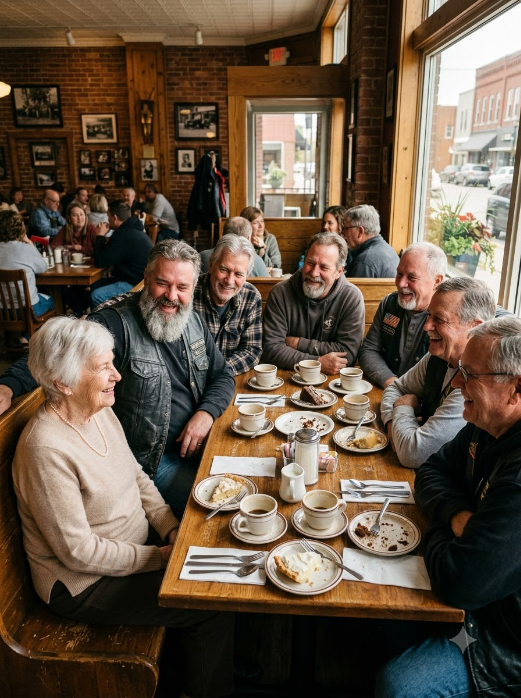
Eleanor was sitting in the big booth, with seven cups already waiting.
Wade laughed.
“You invited us?”
“I did.”
“What’s the occasion?”
Eleanor smiled.
“I wanted lunch with my sons.”
Curtis pressed a hand to his chest dramatically.
“Finally, somebody appreciates us.”
Eleanor laughed.
There were no papers on the table that afternoon.
No trembling hands.
No nervous looks toward the door.
Just coffee, pie, stories from the road, and six men who had once been strangers.
Sometimes family is inherited.
Sometimes it’s chosen.
And sometimes it shows up unexpectedly in a small-town café, wearing leather boots and asking whether you’d like another slice of pie.
Never assume you know someone’s heart just because of the clothes they wear, the vehicle they ride, or the first impression they make — because some of the gentlest people in this world arrive in forms we’ve been taught to misjudge.
Asking for help doesn’t erase a lifetime of independence; sometimes it proves a person is wise enough to recognize when courage means letting trustworthy people stand beside them.
People who genuinely care about us don’t pressure us into big decisions, rush us through papers we don’t understand, or make us feel guilty for asking questions before agreeing to something that will shape our future.
Growing older should never mean giving up the right to make your own choices, seek professional advice, protect what you spent a lifetime building, and decide who gets access to your private affairs.
A person doesn’t always need someone to fight their battles for them; sometimes they just need someone to sit beside them so they remember they still have the strength to speak for themselves.
The most meaningful acts of kindness are often the simplest ones — a chair pulled out, a shared cup of coffee, a stranger willing to listen, or six people quietly refusing to let someone feel alone.
We should pay attention when someone suddenly grows interested in what we own rather than who we are, because real care shows up as concern for a person’s well-being, not curiosity about the value of their belongings.
Family should mean more than shared names and history, because loyalty, respect, patience, and kindness can sometimes forge stronger bonds between strangers than years of blood relation ever do.
There’s real power in calmly setting a boundary and refusing to apologize for it, especially when someone has mistaken kindness, age, loneliness, or politeness for weakness.
Maybe one of life’s greatest lessons is that we should never grow so independent that we forget the value of community, because even the strongest among us deserve people willing to pull out a chair and say, “Sit here — you don’t have to face this alone.”
