

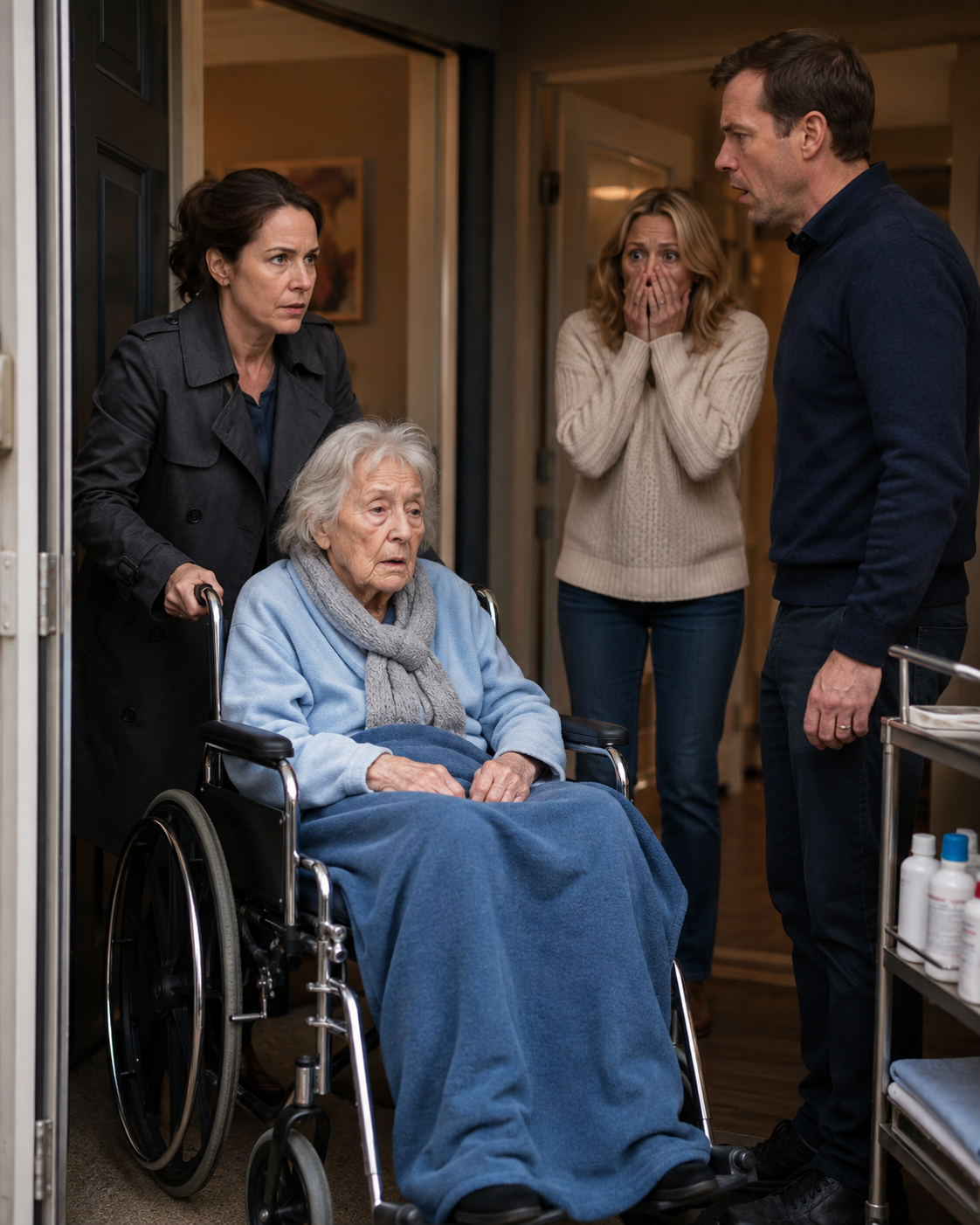
For seven years, I convinced myself marriage was about sacrifice. I convinced myself that love meant enduring, even when enduring hollowed you out bit by bit.
That conviction was why I agreed to bring my husband’s mother into our house after her stroke. Elena had lost most of the movement on her left side. She depended on help for eating, washing, dressing, getting into bed—every basic thing.
In the beginning, Daniel swore we’d share the load.
“We’ll get through this as a team,” he said the night we settled her in.
I took him at his word.
But somehow, “together” turned into just me.
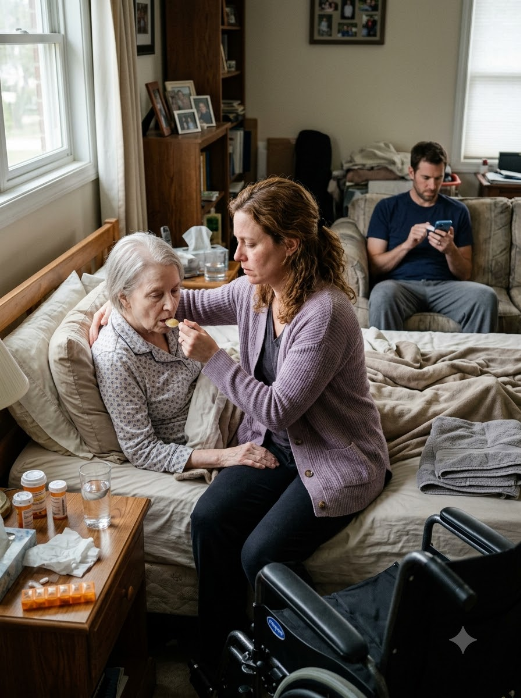
Each day I rose before dawn to lift Elena out of bed. I prepared her meals precisely as her doctor advised, mixed her medication into applesauce when swallowing grew difficult, replaced her bedsheets after rough nights, and figured out how to move her without straining her shoulders.
At night, while I sat by Elena tucking in blankets or massaging lotion into her thin skin, Daniel stayed on the couch, absorbed in his phone.
Every time I asked for his help, he had a ready excuse.
“You’re better at it than I am.”
“She’s more comfortable with you.”
“I’ll only make it worse.”
At first I let those excuses slide because I loved him.
Then I let them slide because I was too worn down to fight.
For illustrative purposes only
Years slipped by like that.
I drifted away from friends. I gave up painting, something I once loved deeply. Some nights I ate dinner cold, alone, at midnight, after Elena had finally drifted off. Some nights I wept quietly in the bathroom so no one would hear.
And still, every morning, I dragged myself up and carried on.
Because somebody had to.
Oddly enough, Elena and I had never been close. She’d never fully warmed to me. She picked apart my cooking, my cleaning, even the way I folded towels.
But sickness reshapes people.
Gradually, her hard edges wore smooth. Some nights, as I settled her into bed, she’d squeeze my hand softly and murmur, “Thank you.”
Daniel never caught those moments.
Maybe because he’d already checked out long before I understood it.
The truth caught up with me on an unremarkable Thursday night.
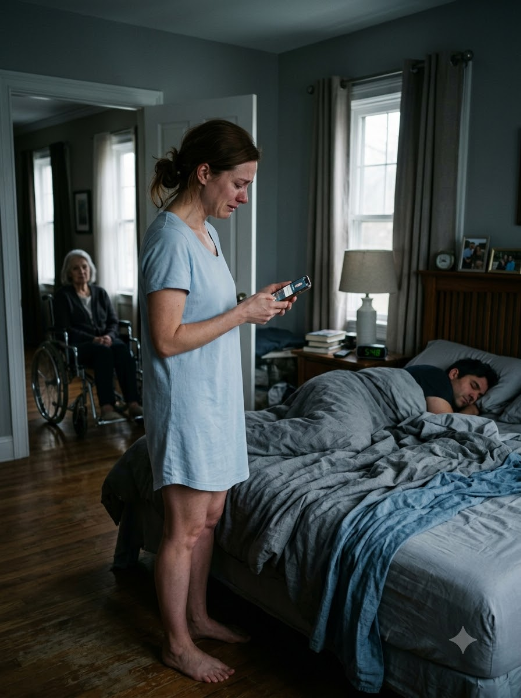
Daniel had drifted off next to me while his phone lit up on the nightstand. I wasn’t looking to snoop—I only picked it up because the screen wouldn’t stop glowing.
That’s when I saw the text.
“This place feels so much better than home. I’m staying here again tonight.”
My chest clenched at once.
Not from shock.
Because somewhere inside, I’d already known.
I stared at the screen for a long moment before setting the phone back down without a sound.
No shouting.
No tears.
No scene.
Only quiet.
The next morning, I handed him his coffee and asked one thing.
“So what are you going to do about your mother?”
He tensed, just for a second.
Then he shrugged.
“We’ll figure something out.”
But he never meant to.
For illustrative purposes only
The next day, Daniel packed a bag and walked out without a word.
No apology.
No conversation.
No accountability.
Just gone.
And somehow, despite it all, I kept caring for Elena.
She kept asking when her son would come by. Every time a car pulled up outside, her face lifted with hope.
“He’s busy,” I’d tell her softly.
I never let her know the truth.
A week later, after another sleepless night helping Elena through muscle spasms, something in me finally gave way—not with noise, but quietly.
Like a cord stretched too far for too long.
That morning, I phoned Daniel.
“I’m bringing your mother to you,” I told him evenly.
Silence.
Then the call cut off.
I looked at my phone and nearly laughed.
For seven years, he’d assumed I’d keep shouldering everything indefinitely.
He genuinely believed I’d never stop.
That afternoon, I methodically packed up Elena’s things. Her medicines. Her medical files. Spare blankets. Skin ointments. Adult diapers. Everything needed to look after her properly.
Then I settled her into the car.
“Where are we going?” she asked with a faint smile.
“To see Daniel,” I said gently. “I think it’s time.”
Her face lit up completely.
That almost undid me.
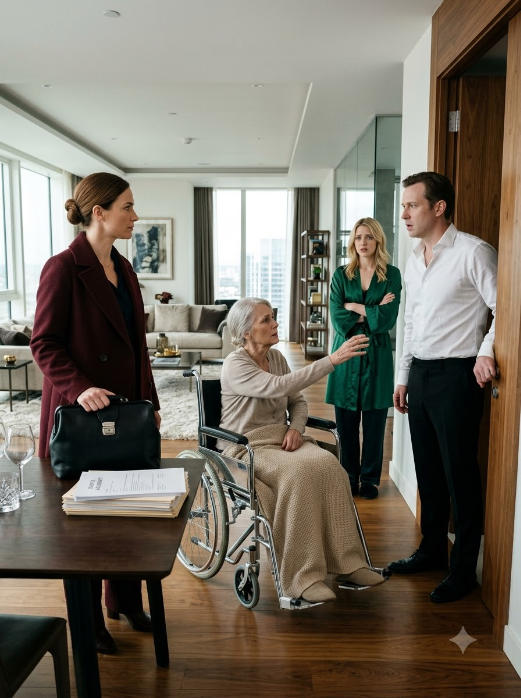
The apartment complex was sleek and pricey, the sort with gleaming floors and fake flowers in the lobby. I wheeled Elena toward the elevator and suddenly noticed something odd.
I wasn’t anxious.
I was finished.
When Daniel opened the door, his face went pale instantly.
Behind him a younger woman stood wrapped in a silk robe, looking at me like she’d seen a ghost.
But neither of them held my gaze for long.
Their eyes fell to the wheelchair.
To Elena.
To what was really happening.
Nobody said anything.
I calmly wheeled Elena into the room and positioned her by the living room window.
The apartment smelled of expensive perfume and brand-new furniture. Everything looked pristine, staged, effortless.
A life free of obligation.
Elena gave her son a faint smile.
“Daniel,” she whispered happily.
He looked cornered.
At last, he spoke.
“What are you doing?”
I placed the medical bag on the table.
“Returning what’s yours,” I told him.
The other woman folded her arms uneasily. “Daniel said she was in professional care.”
For illustrative purposes only
I nearly laughed.
Professional care.
That’s what he called me now.
For seven years I had given up my body, my sleep, my freedom, my entire life for his family.
And somehow he’d reduced me to a hired service he no longer wanted to deal with.
I unzipped the medical bag calmly.
“Her medications are labeled by time and dose,” I explained. “These papers cover emergency instructions. She needs to be repositioned every few hours or she’ll get pressure sores.”
Neither of them moved.
Neither of them spoke.
I looked straight at Daniel.
“She’s your mother,” I said quietly. “I was your wife. I’ve done this by myself for seven years. Now it’s your turn.”
He moved toward me suddenly.
“Wait—don’t do this.”
For the first time in years, I saw real fear on his face.
Not fear of losing me.
Fear of having to take responsibility.
I stepped back before he could reach me.
Then I delivered the last of it.
“I filed for divorce this morning,” I said calmly. “And my lawyer already has copies of the financial records showing you used your mother’s disability payments to help cover this apartment.”
The quiet that followed felt vast.
The woman beside him turned slowly to face Daniel.
“You told me that money was yours,” she whispered.
No one was looking at me anymore.
And for once, that felt like a relief.
I knelt beside Elena and straightened the blanket over her knees.
She reached for my hand, weakly.
“Thank you,” she whispered once more.
My throat tightened.
I pressed a kiss to her forehead, then rose and headed for the door.
Daniel followed me into the hallway.
“You can’t just walk out like this,” he hissed.
I turned to face him, calm.
“No,” I said. “You already did.”
Then I left.
Inside the elevator, the doors slid shut slowly between us.
And for the first time in seven years, I felt something I could barely name anymore.
Relief.
Not vengeance.
Not victory.
Freedom.
Because the truth was, I hadn’t walked away from anyone that day.
I had simply stopped shielding a man who’d walked away from everyone else first.
