


Part One — “I Need the Police”
Across twenty-two years on the force, I had questioned scared witnesses, furious suspects, heartbroken parents, and people so overcome with tears they could hardly speak.
But I had never watched anyone display the kind of fear I saw on four-year-old Nora Bennett’s face.
She walked into our station flanked by her parents, gripping her mother’s sweater as if her life depended on it. Her blond hair was messy from sleep, and shadows ringed her eyes. She seemed to be dragging a burden no small child should have to bear.
Her father, Daniel, addressed the receptionist.
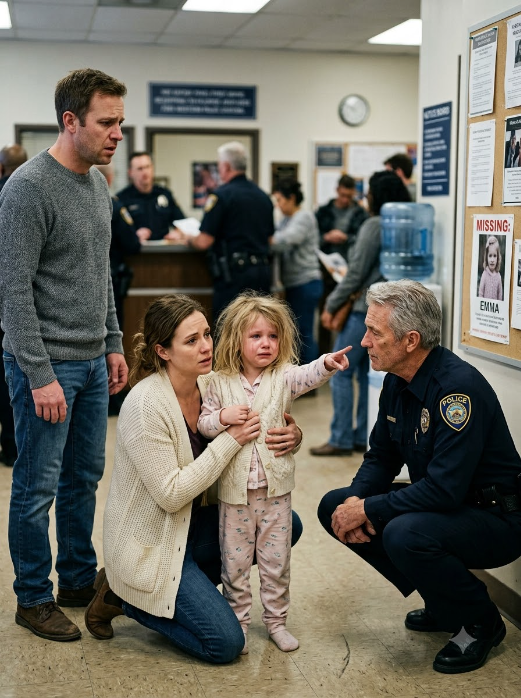
“She keeps saying she has to confess,” he explained, looking embarrassed and exhausted. “For three days, she’s barely eaten. She wakes up screaming. We don’t know what she means.”
I’d been standing by the front desk, going over an update on a missing-child case.
Three-year-old Emma Ruiz had disappeared from the courtyard of the Bennett family’s apartment complex four days before.
Her picture was taped near the station’s entrance — Emma in a pink sweater, smiling and clutching a stuffed rabbit. Officers, volunteers, and search dogs had combed every alley, garage, abandoned building, drainage ditch, and patch of woods for miles around.
No ransom demand had come in.
No witness had come forward.
There was only a grainy traffic-camera shot of a gray van pulling away from the service alley behind the apartment building.
I closed the report and headed toward the family.
Nora’s gaze landed on my uniform. Her eyes grew wide at the sight of my badge.
I dropped down to her level.
“My name is Sergeant Cole,” I said gently. “What’s your name?”
She said nothing at first.
Then she whispered, “Are you really a police officer?”
I tapped my badge.
“I am.”
Her fingers dug into her mother’s sleeve.
“I did something bad.”
Her mother, Maya, crouched next to her. “Sweetheart, you can tell him.”
Nora’s lip began to quiver.
“Are you going to put me in jail?”
The station fell silent.
The receptionist stopped typing. Two officers near the door quieted their voices. Even Daniel looked too stunned to breathe.
I gentled my voice further.
“No one is taking you anywhere. First, you tell me what happened.”
Nora looked down at the floor.
“I showed the man where Emma was hiding.”
Maya’s hand flew to her mouth.
Daniel turned slowly to face his daughter.
“What man, sweetheart?”
Nora lifted a trembling finger and pointed at the missing-child poster.
“He said Emma’s mommy sent him,” she whispered. “He said it was a secret game.”
My pulse quickened, though I kept my expression steady.
I stood and signaled to the receptionist.
“Call Detective Ortiz. Now.”
Then I knelt again.
“Where was Emma hiding?”
“Behind the big washing machines.”
Nora’s account came out in fragments. She and Emma had been playing hide-and-seek in the basement laundry room. Emma had tucked herself behind two industrial washers while Nora counted.
A man in a gray jacket had shown up near the service door.
He’d asked Nora where Emma was hiding.
She had pointed.
He’d handed her a piece of candy and told her she was a good helper.
Then he’d carried Emma out through the service door.
“Why didn’t you tell us?” Maya asked, her face wet with tears.
Nora pressed her hands over her eyes.
“He said police take me away if I tell. He said Daddy go too.”
My stomach dropped.
This child hadn’t been hiding guilt.
She had been carrying a threat far too large for her to understand.
For three days, she believed she was to blame for Emma’s disappearance. She thought that speaking up would land her and her father in jail.
“Nora,” I said, “you did not do anything bad. That man lied to you.”
She peeked out from behind her fingers.
“Really?”
“Really. You were tricked. But telling us now is very brave.”
Detective Lena Ortiz rushed into the lobby, the missing-child file clutched under one arm.
Before she could ask anything, Nora bent down and reached into her sock.
She drew out a small brass key on a yellow tag.
A black lion and the characters B-17 were stamped onto it.
“It fell from his pocket,” she whispered. “I took it.”
She looked up at me, terrified.
“That’s stealing.”
I took the key carefully, holding only the edge of the tag.
“No, Nora,” I said. “I think you may have just helped us find Emma.”
For illustrative purposes only
Part Two — The Man in the Gray Jacket
Detective Ortiz’s eyes locked onto the black-lion symbol.
She flipped the file open so fast that several photos spilled onto the floor.
One picture showed the gray van from the traffic camera. A faded black-lion sticker sat in the corner of its rear window.
Ortiz looked up at me.
“Black Lion Storage,” she said. “Edge of town.”
The missing-child team had already reached out to the company once the logo turned up. The manager said there were hundreds of active renters, and the van’s plate couldn’t be read. Officers were still cross-checking customer records against anyone linked to Emma’s family.
Ortiz crouched down beside Nora.
“Did you know the man who asked about Emma?”
Nora nodded.
“He fixes our lights.”
The color drained from Daniel’s face.
“Greg,” he murmured.
Greg Halpern served as maintenance supervisor at their apartment complex.
He’d worked there almost six years.
He knew every hallway, basement, service door, and security-camera blind spot. He held master keys to the apartments and had access to the maintenance vans.
Worse still, he’d taken part in the search for Emma.
He’d printed the missing-person flyers. He’d gone door to door. He’d stood beside Emma’s mother, Sofia, comforting her while cameras filmed him saying the whole community was praying for Emma’s safe return.
Maya clutched her husband’s arm.
“He was in our apartment this morning,” she whispered.
“Why?” I asked.
“He said someone reported a leaking pipe. But there wasn’t one. He kept staring at Nora. He asked why she was crying.”
A chill settled over me.
Greg had known Nora had seen him.
He’d gone into the apartment to find out whether she’d talked.
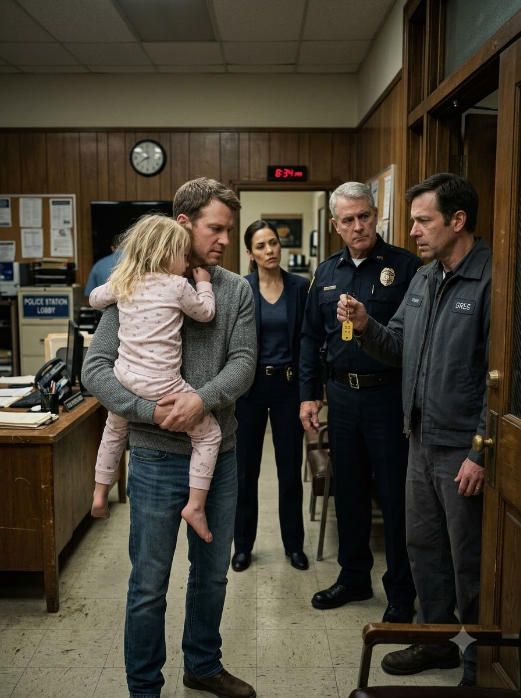
Before I could reach for my radio, the station’s front door swung open.
A man in a gray work jacket stepped in.
I recognized him instantly from the news interview.
Greg Halpern.
He smiled at Daniel and Maya like a concerned neighbor.
“There you are,” he said. “I saw you rush away from the building. I was worried something had happened.”
A choking sound escaped Nora.
She flung herself against her father, hiding her face in his chest.
Then she peered over his shoulder and pointed.
“That’s the man who took Emma.”
The smile fell from Greg’s face.
His eyes flicked from Nora to the yellow tag now in my gloved hand.
For a single second, real fear crossed his features.
Then he spun toward the door.
“Lock every exit,” I ordered.
Officer Reynolds moved to block Greg from the entrance. Two more officers closed in from either side.
Greg threw up his hands.
“This is insane,” he said. “She’s a little kid. She doesn’t know what she saw.”
I studied his eyes.
He wasn’t looking at Nora.
He was looking at the key.
“Why did you follow this family to the police station?” I asked.
“I didn’t follow them. I was concerned.”
“You left work during an active emergency because you were concerned?”
“They’re tenants. It’s my job.”
“Is Black Lion Storage part of your job too?”
Something flickered across his face for half a second.
That told me everything.
Ortiz radioed for units to head to Black Lion Storage immediately. She gave them the unit number and warned that a missing three-year-old might be there.
Greg heard her.
“No,” he said suddenly.
It was the first true thing he’d said.
He lunged toward Ortiz, but Reynolds grabbed his arm and pulled him back.
“Don’t go in there!” Greg shouted. “You don’t understand!”
I moved closer.
“Then explain it.”
He offered nothing.
Ortiz’s radio crackled again.
Units were four minutes out.
Four minutes shouldn’t feel like forever.
That day, it did.
Part Three — Unit B-17
Detective Ortiz headed to the storage facility while I stayed at the station with Nora’s family and the suspect.
Part of me wanted to go with her, but my priority was keeping Greg from warning anyone or destroying evidence.
We confiscated his phone, placed him in an interview room, and started reviewing his recent calls.
He wouldn’t say a word.
Through the glass, I watched him sit motionless. His expression stayed calm, but his foot tapped fast under the table.
In the lobby, Daniel held Nora on his lap. Maya knelt in front of them, both of her daughter’s hands in hers.
“Emma is missing because of me,” Nora cried.
“No,” Maya said firmly. “A bad man told you a lie. This is not your fault.”
“But I showed him.”
“You thought he was helping.”
“He gave me candy.”
“That does not make it your fault.”
Nora glanced toward me, as though she needed a police officer to say the same thing.
I walked over and sat beside her.
“When grown-ups trick children, the grown-up is responsible,” I told her. “Not the child.”
“Even if I pointed?”
“Even then.”
She sat with that for a moment.
“Will Emma be mad at me?”
“I don’t know what Emma will feel,” I answered honestly. “But I know you’re helping us bring her home.”
My radio crackled to life.
“Cole, we’re at Black Lion.”
Ortiz.
I stepped away slightly but kept the volume up so Daniel and Maya could still hear.
The storage facility sat behind an old industrial park near the highway. Unit B-17 was in the last row, farthest from the manager’s office.
The brass key fit the padlock.
Ortiz had the officers announce themselves.
Nothing.
They raised the metal door.
At first glance, the unit looked empty — shelves, paint cans, folded tarps, boxes labeled with the apartment complex’s name.
Then an officer spotted fresh scrapes on the concrete floor.
A tall plywood shelf had clearly been shifted back and forth many times.
They pushed it aside and found a narrow wooden panel hidden behind it.
My hand tightened around the radio.
Ortiz called out Emma’s name.
Several seconds of silence followed.
Then came a faint sound.
A child humming.
One of Emma’s favorite songs, according to her mother.
The officers pried the panel loose.
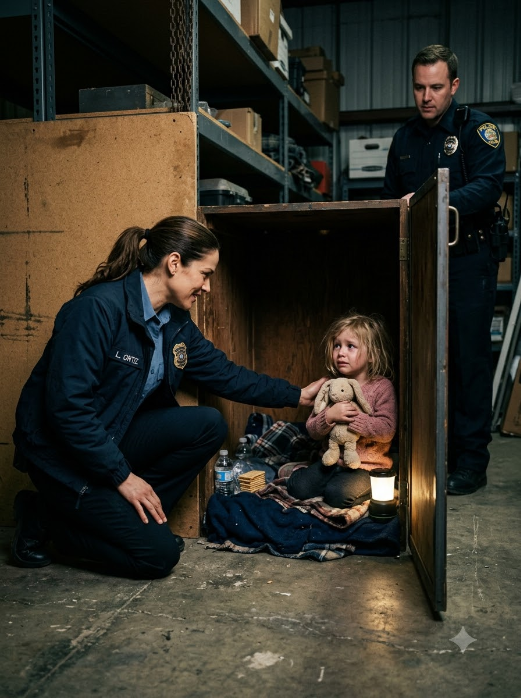
Behind it was a cramped hidden space stocked with blankets, bottled water, crackers, a battery lantern, and Emma’s stuffed rabbit.
And there, tucked in the corner, still in her pink sweater, sat Emma Ruiz.
Frightened and worn out, but alive.
The sound Maya made was half sob, half prayer.
Daniel shut his eyes and hugged Nora so tightly she let out a squeak.
Ortiz’s voice shook over the radio.
“We found her, Cole. She’s alive.”
Every officer in the lobby exhaled a breath we’d all been holding for four days.
The receptionist began to cry. Reynolds turned away, wiping his eyes.
I glanced through the interview-room window.
Greg had heard the radio.
For the first time since walking into the station, his confidence had vanished.
He dropped his head into his hands.
But our work wasn’t over.
Finding Emma mattered most.
Figuring out why Greg had taken her — and making sure he’d never terrify another child again — came next.
For illustrative purposes only
Part Four — The Secret Behind the Search
Emma was taken to the hospital for a checkup.
She was dehydrated and shaken but otherwise unharmed. Greg had supplied food, water, blankets, and a small portable screen for cartoons. He’d repeatedly assured her that her mother was on her way.
None of that excused what he’d done.
But it had kept Emma alive through four long days alone.
Investigators combed through Greg’s apartment, office, vehicle, and storage unit.
The story emerged bit by bit.
Greg had found out that Emma’s grandmother was planning to sell a family property. He assumed the Ruiz family would soon come into a large sum of money.
His plan was to demand payment once the public search began to wind down.
He’d targeted Emma because he understood the building’s cameras, schedules, and exits. He also knew the courtyard children trusted him — they’d watched him fix lights, carry tools, and chat with their parents.
He hadn’t planned for Nora.
He never expected a four-year-old to witness anything.
Once she had, he improvised.
He told her it was a secret game, then threatened her with the thing he knew would scare her most — the idea that her father would be taken from her.
The candy wrapper Nora brought home became additional evidence. Matching candy turned up in Greg’s van and office drawer.
His phone records revealed searches about untraceable ransom messages.
Investigators recovered a draft note from his laptop.
Greg had even used his role in the search to track how close police and volunteers were getting. Each night, he stood beside Emma’s mother offering comfort while quietly checking whether officers were nearing the storage facility.
Showing up at the station had been another misstep.
He’d spotted Daniel’s car leaving the apartment complex and followed it. Realizing the family had gone to police, he panicked, hoping to stop Nora before she gave up the key.
Instead, he’d walked straight into our hands.
Confronted with the evidence, he tried blaming stress, debt, desperation.
I’d heard every excuse imaginable over twenty-two years.
None of them changed the facts.
A grown man had manipulated two little girls, taken one from her family, and threatened the other into silence.
“You made Nora believe she was a criminal,” I told him during the interview.
Greg stared at the table.
“I didn’t think she’d understand.”
“She understood enough to stop eating. She understood enough to wake up screaming.”
“I never planned to hurt them.”
“You already did.”
He finally met my eyes.
For the first time, there was no act left in his expression.
Only the realization that the child he’d written off as too young to matter had brought his entire plan crashing down.
Part Five — When Emma Came Home
The Ruiz family lived two floors below the Bennetts.
The evening Emma returned, hundreds of people gathered outside the apartment building. Candles lined the sidewalk. Handmade signs covered the fence.
WELCOME HOME, EMMA.
OUR LITTLE GIRL IS SAFE.
When the car pulled up, Emma’s mother got out first.
Sofia Ruiz looked as though the past four days had aged her by years. Then the back door opened, and a nurse helped Emma out.
The crowd erupted in cheers.
Emma held her stuffed rabbit in one arm and her mother’s hand in the other.
I stood near the entrance beside Detective Ortiz.
Nora watched from behind the lobby window.
She wanted to see Emma but was too afraid.
“Maybe she hates me,” she whispered.
Maya knelt beside her.
“You told the truth.”
“But I waited.”
“You were scared.”
“I showed the man.”
“You didn’t know.”
Nothing her mother said seemed enough to lift the guilt.
Then Emma spotted Nora through the glass.
She let go of Sofia’s hand.
The crowd went quiet as Emma walked toward the lobby.
Nora ducked behind her father.
Emma stopped a few feet away.
For a moment, neither girl said anything.
Then Emma held out the stuffed rabbit.
“Mr. Bubbles missed you,” she said.
Nora broke into tears.
“I’m sorry I showed him where you were.”
Emma looked puzzled.
“We were playing.”
“He was bad.”
Emma nodded.
“He said Mommy was coming. But she didn’t.”
“I got his key,” Nora said. “The police found you.”
Emma weighed this with the seriousness only a small child can manage.
Then she held out her hand.
“Do you want to play again?”
Nora stared at her.
“Hide-and-seek?”
Emma nodded.
Daniel cleared his throat quickly.
“Maybe a different game.”
For the first time in days, everyone laughed.
The two girls sat together in the lobby, surrounded by their families, coloring pictures while the adults cried, hugged, and thanked every officer nearby.
Nora drew a yellow key.
Next to it, two girls holding hands beneath a wide blue sky.
At the top of the page, with Maya’s help, she wrote:
THE KEY THAT BROUGHT EMMA HOME.
I still keep a copy of that drawing in my desk.
For illustrative purposes only
Part Six — The Weight Children Carry
Many people assume young children move past frightening events quickly.
They don’t.
They may lack the words to describe what happened, but fear finds other outlets.
For weeks, Nora would only take candy from her parents. She flinched at the sight of gray jackets. She checked the locks before bed and kept asking whether police could take children to jail.
Emma had trouble with enclosed spaces. Closing elevator doors made her cry, and she refused to set foot in the basement laundry room.
Both families started seeing a counselor who specialized in helping young children recover from trauma.
Progress came slowly.
The girls began with brief play sessions while their parents stayed close. They learned basic safety rules without being taught to fear every stranger.
They practiced the phrase, “I need to ask my parent.”
They learned that secrets built on fear, threats, or touching weren’t secrets children had to keep.
Above all, Nora came to understand the difference between guilt and responsibility.
Months after Emma’s rescue, Maya brought Nora to the station.
Nora wore a purple dress and carried a paper bag.
“I have something for you,” she announced.
Inside was a plastic police badge covered in glitter.
My name was scrawled across it in uneven letters.
Below it, she’d drawn a black lion with a big red X through it.
“I’m not scared of the lion anymore,” she said.
“That’s good.”
“And I don’t steal.”
“I know.”
She looked up at me, serious.
“But if I find another bad man’s key, I can bring it to you.”
I smiled.
“That would be the right thing to do.”
I handed her a small wooden box. Inside was a new brass key on a yellow tag.
Instead of a black lion, it bore a tiny silver star.
Beneath it were the words:
NORA’S COURAGE KEY
She held it with care.
“What does it open?”
“Nothing,” I said. “It reminds you that telling the truth can open the way home.”
She hugged the box against her chest.
Then, unexpectedly, she threw her arms around my neck.
I’d been given medals and commendations over the course of my career.
None of them meant as much as that hug.
Part Seven — The Trial
Greg Halpern eventually pleaded guilty once prosecutors laid out the evidence against him.
The storage unit, surveillance footage, phone records, draft ransom note, and items found in his van left little room for doubt.
Neither child had to testify in court.
Recorded interviews conducted by trained child specialists were used instead, sparing Nora and Emma from having to face him again.
At sentencing, Sofia described the four nights she’d sat by the phone, too afraid to sleep for fear of missing a call about her daughter.
Daniel talked about hearing Nora cry in her sleep and realizing how terrified she’d been of losing him.
Maya spoke last.
“My daughter believed she had done something unforgivable,” she said. “But the truth is that she did something extraordinarily brave. She brought us the key. She identified the man who threatened her. She helped bring Emma home.”
Greg was sentenced to a long prison term.
Afterward, reporters began calling Nora a hero.
Maya and Daniel were cautious with that word.
They wanted their daughter to feel proud, but not to think she alone had been responsible for saving Emma.
She had simply done what every frightened child should be able to do.
She’d told a trusted adult.
The adults had listened.
The police had believed her.
And a community had acted.
That was the real lesson.
Children should never have to carry danger alone.
Courage isn’t the absence of fear.
Sometimes courage is a four-year-old girl walking into a police station after three sleepless nights, clutching her mother’s sweater and whispering, “I did something bad.”
Sometimes it’s reaching into a sock and handing over a small brass key.
Sometimes it’s finally speaking up after someone has threatened you into silence.
Part Eight — The Day They Stopped Hiding
A year after Emma came home, the apartment complex held a neighborhood safety celebration in the courtyard.
The basement laundry room had been renovated. New cameras now covered the service hallway, and the door could no longer open without leaving an electronic record.
Management brought in a new maintenance team and put strict background checks and access rules in place.
But that afternoon wasn’t about fear.
It was about children laughing again.
Balloons lined the courtyard. Families shared food. Officers brought a patrol car for kids to explore, and Detective Ortiz let them speak into the radio.
Nora and Emma stayed glued to each other.
They ran across the grass in matching yellow bracelets, each with a tiny silver star like the one on Nora’s courage key.
At one point, I found them crouched behind a picnic table.
“What are you two doing?” I asked.
“Playing hide-and-seek,” Emma said.
Daniel looked alarmed.
Nora giggled.
“It’s different now.”
“How?”
“We tell our moms where we’re hiding first.”
Emma nodded proudly.
“And nobody goes near the service door.”
“That sounds like a better game,” I said.
Nora looked up at me.
“Sergeant Cole?”
“Yes?”
“Do police officers ever get scared?”
I could have told her no.
Years earlier, I might have.
But children deserve honest answers.
“All the time,” I said.
Her eyes went wide.
“Then how do you do police things?”
“You decide something else is more important than being scared.”
She considered that for a moment.
“Like finding Emma?”
“Exactly like finding Emma.”
Across the courtyard, Sofia called the girls over for cake.
Emma took Nora’s hand, and they ran off toward their families.
I watched them vanish into the crowd — not because someone had taken them, not because they were hiding out of fear, but because they were surrounded by people who loved them.
Detective Ortiz stepped up beside me.
“You thinking about retirement again?” she asked.
“I was.”
“And now?”
I watched Nora hold her yellow bracelet up to the sunlight. Beside her, Emma laughed, frosting smeared across both their faces.
“Not today,” I said.
For years, I’d believed police work came down to evidence, interviews, arrests, and courtroom wins.
That case taught me it was also about listening.
Especially when the voice was small.
Especially when the story came out in broken sentences.
Especially when a frightened child believed she was the one who’d done something wrong.
Nora had walked into our station asking if we’d put her in jail.
She left knowing the truth.
She hadn’t helped a bad man take Emma.
She’d helped the police bring Emma home.
And the key she once believed marked her as a thief became a symbol of something far greater.
It proved that even the smallest voice can unlock the truth.
It proved that fear loses its grip once it’s finally spoken aloud.
And it proved that heroes don’t always wear uniforms.
Sometimes they wear purple dresses, hide important clues inside their socks, and hold tightly to their mother’s hand while finding the courage to say:
“I need the police.”
