

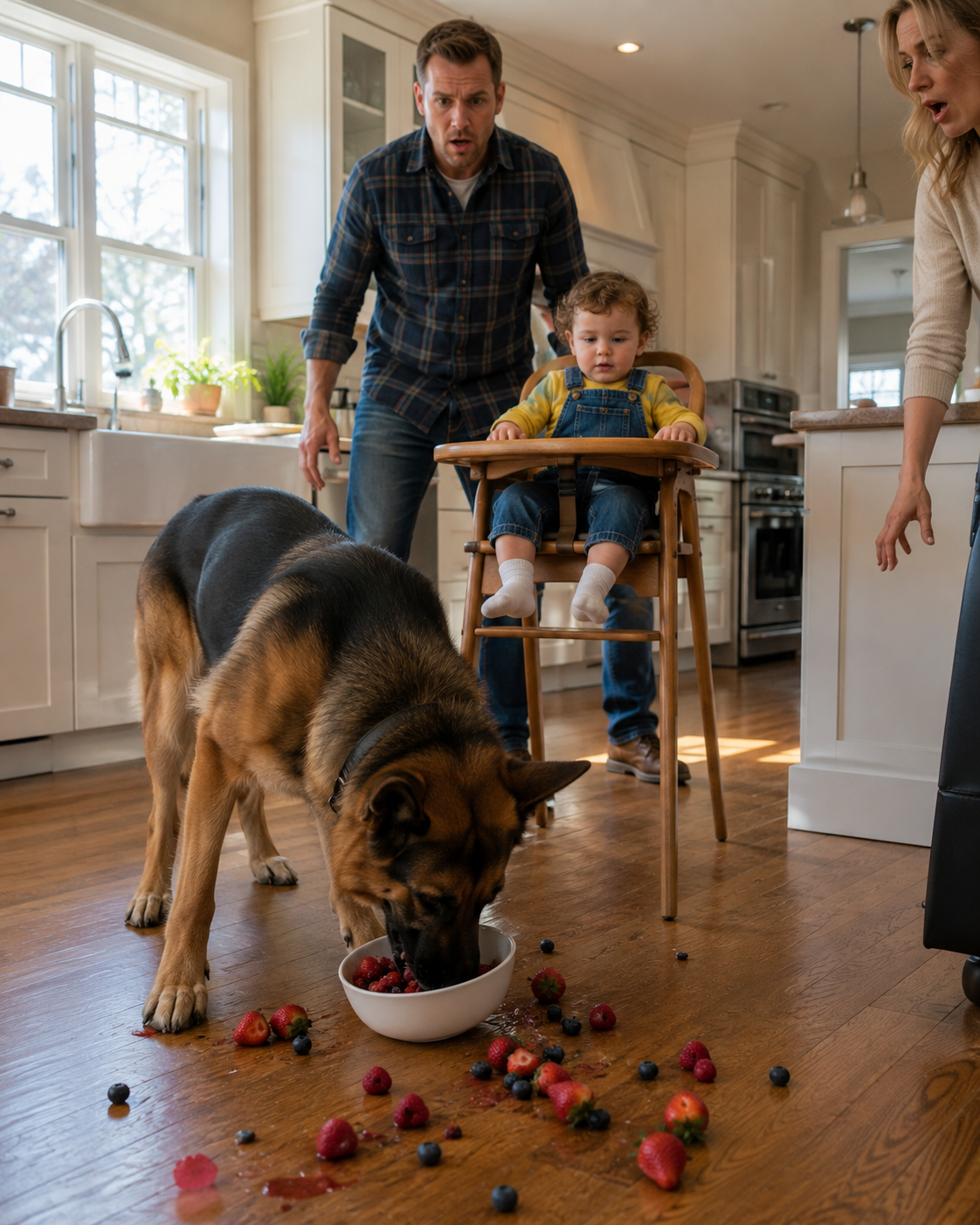
At first, Brandon Hayes assumed it was just a fluke — an odd one, but a fluke nonetheless. The four-year-old German Shepherd had always been gentle around his daughter, Mia; actually, “gentle” didn’t even begin to cover it, since the rescue dog seemed utterly devoted to the little girl. When Mia played in the backyard, Ranger hovered nearby, keeping watch. When she wandered off to another room, he trailed quietly behind her. When she dozed off on the couch, he settled close by like a furry sentinel standing guard. For almost two years, the dog had been mild-mannered, patient, and reliably predictable, which made what happened that Tuesday morning all the more baffling.
Mia sat contentedly in her highchair, feet swinging as she waited for her favorite fruit snack. Rachel Foster, the family’s nanny, walked toward the table carrying a bowl, while Brandon stood nearby pouring his coffee. Nothing seemed out of the ordinary — until Ranger suddenly burst into motion. One moment he was resting peacefully by the kitchen island; the next he was tearing across the room. Before anyone had time to react, the German Shepherd crashed into the highchair tray, sending the bowl toppling over and fruit spilling across the tile. Mia burst into tears, Rachel stumbled backward in shock, and Ranger immediately planted himself between the toddler and the mess on the floor — tense, watchful, and completely locked in, his gaze fixed on the spilled food. “What was that?!” Rachel exclaimed, while Brandon looked on, stunned, because he had never once witnessed Ranger behave this way. The dog wasn’t guarding his resources, wasn’t showing aggression, and certainly wasn’t trying to snatch the food for himself — if anything, he seemed uneasy, almost frightened.
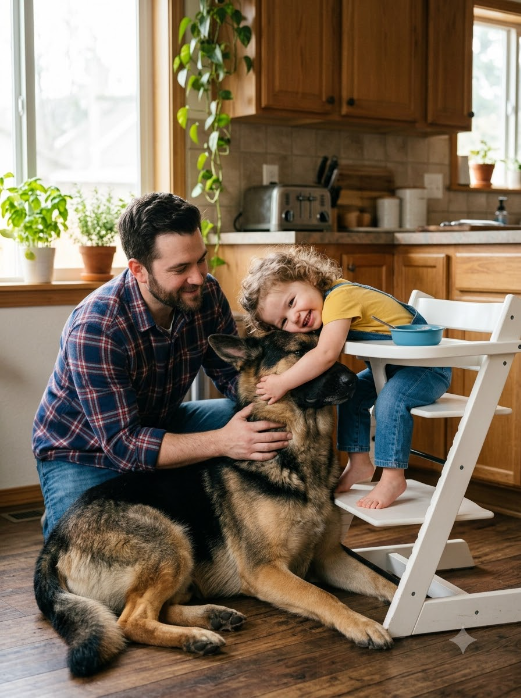
Even so, Brandon let it go, telling himself that dogs sometimes acted strangely; maybe Ranger had caught an unfamiliar scent, or something had spooked him, or it was simply an off moment. But the very next morning, it happened again. Rachel approached Mia with another snack, and before the bowl even reached the tray, Ranger blocked the highchair directly, standing firm and refusing to budge. The day after that, he swatted the spoon right out of Rachel’s hand, and another morning he shoved the tray away before Mia could take a single bite. Every incident unfolded a little differently, yet the pattern never changed: always Mia, always food, always Rachel, and always Ranger fighting desperately to stop snack time from happening.
By the end of the week, Brandon could no longer dismiss it as coincidence. This wasn’t random behavior — the dog was clearly trying to communicate something, though the question remained exactly what. Rachel looked just as puzzled as he felt. “I don’t understand what’s happening,” she admitted one morning after Ranger blocked the highchair yet again, and Brandon didn’t have an answer for her either, not yet anyway. But one small detail kept nagging at him: Ranger never reacted during breakfast when Brandon prepared the food himself. Not once. The dog remained completely calm in those moments. Yet whenever Rachel brought Mia her snacks or meals, that same anxious energy flared up immediately, and the contrast was simply too obvious to ignore any longer.
That realization kept Brandon awake that night. Lying in bed, he replayed every incident in his mind — the overturned bowls, the blocked trays, the urgent barking, the frantic attempts to keep Mia from eating — and slowly it dawned on him that it couldn’t be the food in general, because otherwise Ranger would have reacted every single time. So what exactly made this different? The next morning, Brandon decided to quietly test a theory of his own. He didn’t tell Rachel, and he didn’t tell anyone else. Before snack time, he swapped out Mia’s bowl, setting the original snack aside and preparing a visually identical substitute instead, one that no one would notice had been switched — except, perhaps, Ranger.
Rachel carried the substitute bowl over to Mia while Brandon watched intently from across the room. Ranger lifted his head, fixed his eyes on the bowl, glanced at Mia, then back at the bowl again. A few tense seconds ticked by as Brandon braced himself for the usual reaction — the barking, the charge forward, the blocking, the panic. But instead, nothing came. Ranger simply settled down onto the floor, at ease, content, completely undisturbed, showing zero signs of worry for the first time in weeks. A shiver ran through Brandon, because only one thing had actually changed: the bowl. He turned slowly toward the original snack still sitting untouched on the counter, and his stomach suddenly clenched with a terrible thought — maybe this had never been a behavioral problem at all. Maybe Ranger had been responding to something real all along, something no human could detect.
That afternoon, Brandon quietly saved a sample of the original snack and sent it off for laboratory testing, and then he waited. The days that followed dragged on endlessly. Part of him hoped he’d been wrong; part of him hoped the results would come back completely clean, because if Ranger had been right all along, the implications were nothing short of terrifying. Eventually, the call came. Brandon sat alone as he opened the results, and at first the words simply didn’t register. He read them again, and then once more, and the color slowly drained from his face. The lab had identified substances that had no business being anywhere near that food. His hands began to tremble as every strange morning suddenly clicked into place — every bark, every blocked bowl, every urgent warning. Ranger hadn’t been acting out. He hadn’t been jealous, and he hadn’t been overbearing. He had been trying, all along, to keep Mia from eating something dangerous, long before any human had caught on. Somehow, in some way, the rescue dog had sensed it first. He just knew.
Brandon glanced across the room at Ranger, who lay resting quietly by the window. The German Shepherd met his gaze — calm, steady, completely unshaken, still the exact same loyal dog he had always been. “You knew,” Brandon murmured, and Ranger simply tilted his head, the same way he always did.
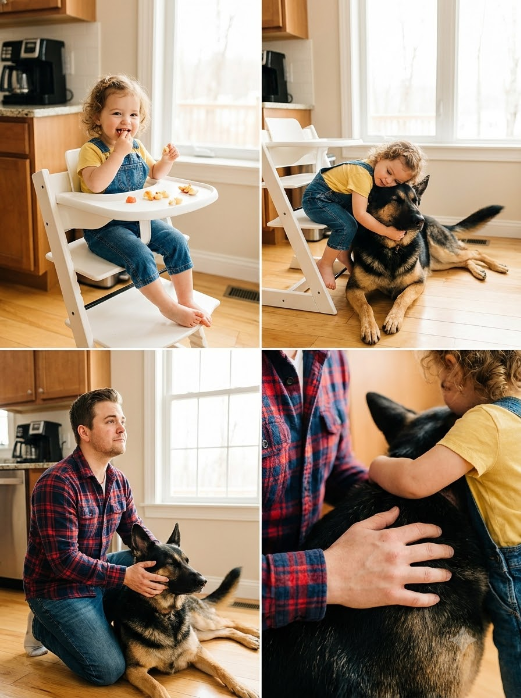
Weeks went by, and life gradually settled back to normal. The worry lifted, the fear eased, and above all, Mia was safe. One sunny morning, light poured through the kitchen windows as the little girl sat cheerfully in her highchair eating her snack, and this time there was no tension at all — no barking, no blocked trays, no urgent alarms. Ranger lay peacefully beside her chair, fully at ease, the watchful anxiety that had gripped him for weeks finally melted away, almost as if he sensed his job was done. Mia giggled and leaned down out of her highchair, wrapping her small arms around the German Shepherd’s neck. Ranger closed his eyes, his tail tapping softly against the floor.
From across the kitchen, Brandon took in the whole moment, a lump forming in his throat. For weeks he had doubted the dog, wondered if something was wrong with him, struggled to make sense of behavior that had seemed impossible to explain. Now, finally, it all made sense — Ranger had simply been doing what he’d always done: watching over Mia. The only thing different this time was that the danger hadn’t been visible. There was no stranger barking orders, no open gate, no obvious threat — just a silent warning hidden inside a bowl of food, and somehow the rescue dog had picked up on it before anyone else could.
Brandon crossed the kitchen and knelt down beside him, gently resting a hand on Ranger’s head. The German Shepherd looked up at him — trusting, loyal, watchful, exactly as he had always been. “You were protecting her,” Brandon said softly, and Ranger’s tail wagged once more. As Mia held him close, Brandon understood something he would carry with him for the rest of his life: sometimes heroes don’t wear badges, sometimes they have no words, and sometimes they can’t even tell you what they sense — but that doesn’t make their warnings any less true. Because sometimes the one keeping danger away from the people you love is already resting quietly right beside you.
