

Part 1: The Baby They Left Behind
The maternity wing at St. Catherine Medical Center was normally wrapped in the gentle, worn-out happiness that comes after new beginnings. Nurses drifted quietly from room to room while parents murmured over bassinets and let happy tears fall into small blankets. But inside Room 412, the mood had grown so cold and heavy that even the nurses lowered their voices.
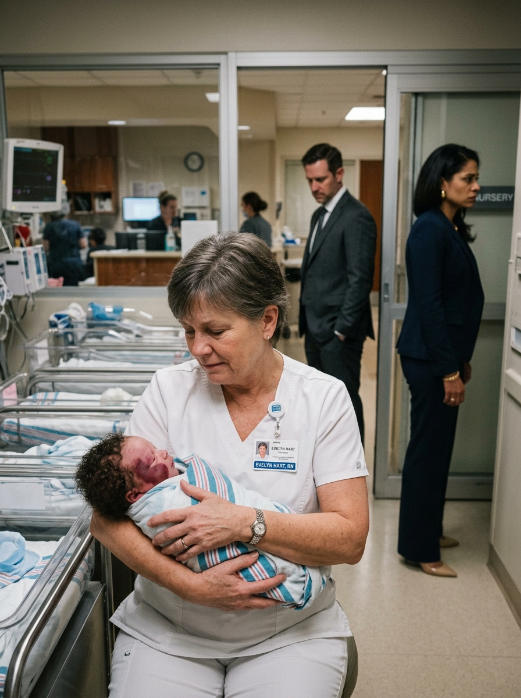
Senior nurse Evelyn Hart stood by the window, holding a newborn baby boy close to her chest. The child was healthy by every measure. A strong heartbeat. Clear lungs. Steady breathing. Thick dark hair already curling near his ears. Yet a deep crimson birthmark spread across the left side of his face, instantly changing how his parents saw him.
Celeste Whitmore looked at the infant with open horror instead of warmth. Her husband, Graham Whitmore, stayed by the doorway, unwilling to move any closer. The Whitmores were well known throughout Connecticut for their luxury cosmetic dermatology empire, a business built entirely on flawless looks, youth, and perfection. Magazines adored them. Charity galas honored them. Their entire public reputation rested on beauty.
And now their newborn son carried something they saw as a flaw.
“No,” Celeste whispered sharply. “No, this cannot be my baby.”
Evelyn looked at her, stunned. “Ma’am, your son is perfectly healthy. He needs warmth and his mother.”
Celeste turned her face away at once. “Take him out of here.”
Graham’s response felt even colder because of how calm it sounded.
“We’ll speak with legal,” he said flatly. “Handle whatever paperwork needs to be handled.”
Evelyn had spent over twenty years in maternity care. She understood panic. Shock. Exhausted parents overcome by fear. But this wasn’t confusion. It was rejection.
Within a few hours, the abandonment paperwork was already quietly underway.
By sunset, the Whitmores had already left the hospital in a black luxury SUV, more concerned with their privacy than with the child they’d left behind.
Long after her shift ended, Evelyn stayed behind alone in the nursery, rocking the baby gently as the evening light dimmed against the windows.
“You are not unwanted,” she whispered softly, brushing her finger against his tiny hand. “Not while I’m here.”
Evelyn had spent years longing to become a mother herself, but life had never opened that door for her. There had been failed relationships, silent doctor’s appointments, and private grief she rarely spoke of to anyone. Yet standing there with the sleeping infant in her arms, something inside her settled with absolute certainty.
She named him Jonah.
Not officially.
Not yet.
But already, in her heart, he belonged to her.
The adoption process turned out to be far harder than Evelyn expected. The system rarely treated children with visible differences kindly, and she knew how easily babies like Jonah could spend years lost in files while shallow adults searched for “perfect” children instead. So she fought harder than anyone expected her to.
She extended his hospital care through every legal channel available while spending nights poring over adoption requirements until the words blurred on the page. Then came the attorneys, interviews, and endless evaluations. Social workers questioned her age, her income, and her choice to adopt alone. Some spoke politely, but their expressions carried quiet doubt, as if love could somehow be measured by salary or square footage.
Evelyn worked double nursing shifts. She sold jewelry she’d inherited from her mother. She gave up vacations, comforts, and nearly every spare dollar she had. A year and a half later, just before Christmas, a judge finally signed the adoption order.
The baby once abandoned in Room 412 officially became Jonah Ellery.
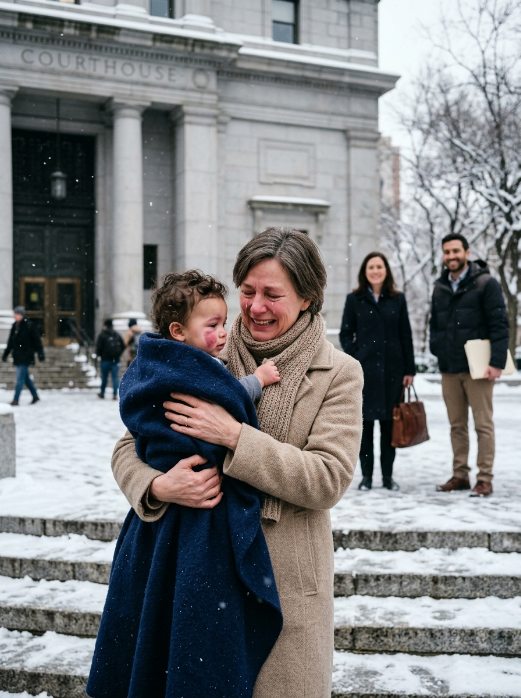
When Evelyn walked out of the courthouse carrying him bundled tightly beneath a navy blanket against the winter air, she cried harder than she had in years while Jonah reached up, catching the edge of her scarf with tiny fingers.
“We did it, sweetheart,” she whispered through tears. “We really did it.”
They moved into a modest duplex in Milford, not far from the shoreline. The house was small but warm. The kitchen floor creaked. The heater rattled every winter. Morning light poured in beautifully through the windows.
It was enough.
More than that, it was peaceful.
Jonah grew into a thoughtful boy with watchful eyes and a quiet, searching mind. By five, he was asking questions adults struggled to answer. By seven, he finished library books faster than Evelyn could check them out. By nine, he was solving science puzzles older students couldn’t crack.
But while the world eventually noticed his intelligence, it noticed his face first.
There were stares in grocery stores. Whispers at school. Cruel children who learned early how to weaponize difference. Some afternoons Jonah came home unusually quiet. Other days he arrived with red eyes and shoulders curled inward, as if he wanted to vanish completely.
One evening at ten years old, he dropped his backpack by the front door and asked softly:
“Mom… if I looked different, would people be nicer to me?”
Evelyn immediately stopped chopping vegetables for dinner and knelt beside him.
“Listen to me carefully,” she said gently. “People can be cruel when they don’t understand something. But your worth has never depended on a stranger’s opinion.”
Jonah’s eyes filled with tears. “But they always see it first.”
Evelyn cupped his cheeks in both hands.
“Then let them see it first,” she whispered. “And let your character become what they remember afterward.”
Part 2: The Truth Hidden Inside Old Papers
As Jonah grew older, the birthmark that once drew stares slowly became just one small part of who he was. What people remembered most after meeting him was his mind. He asked thoughtful questions, listened closely, and carried a quiet empathy unusual for someone so young. At school, teachers noticed how quickly he absorbed information. At home, Evelyn noticed something even more important: despite the cruelty he sometimes faced, Jonah never grew cruel himself.
By twelve, he won first place in a statewide science competition with a project on tissue healing and regenerative medicine. That was where he met Dr. Malcolm Reeves, a retired pediatric surgeon invited to judge the event. Unlike most adults, Dr. Reeves never stared awkwardly at Jonah’s face or softened his voice out of pity. Instead, he pressed him with intense questions about his research.
Jonah answered every one without hesitation.
By the end of the afternoon, Dr. Reeves smiled warmly and said something Jonah never forgot.
“You don’t just memorize science, son. You think like someone who genuinely wants to reduce suffering.”
That single sentence redirected the course of his life.
Over the following years, Dr. Reeves became both mentor and guide. He lent Jonah advanced textbooks, introduced him to physicians, and opened doors Jonah hadn’t known existed. With his encouragement, Jonah gained admission to an elite preparatory academy in Westport. Every morning he made a long commute while wealthy classmates arrived in luxury cars driven by parents who sat on donor boards and private foundations.
Jonah always felt the gap between his world and theirs.
His lunches were homemade.
His clothes simpler.
And while other parents attended networking galas, Evelyn worked exhausting overnight nursing shifts just to keep their small home afloat.
Still, Jonah thrived academically. He studied late into the night, volunteered in science labs, tutored struggling students, and gradually learned how to stand confidently in rooms where wealth tried to define worth.
Then, on a rainy Saturday afternoon when Jonah was sixteen, everything shifted.
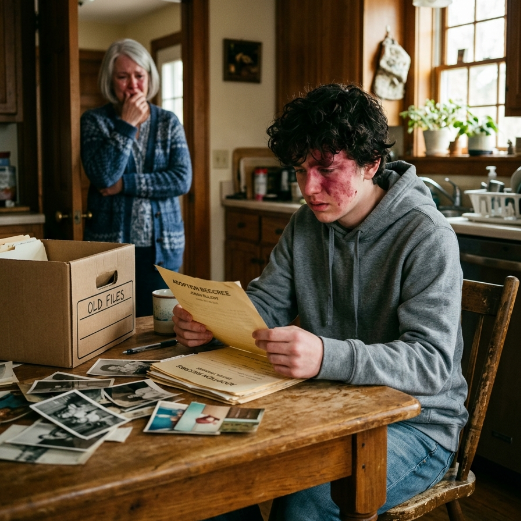
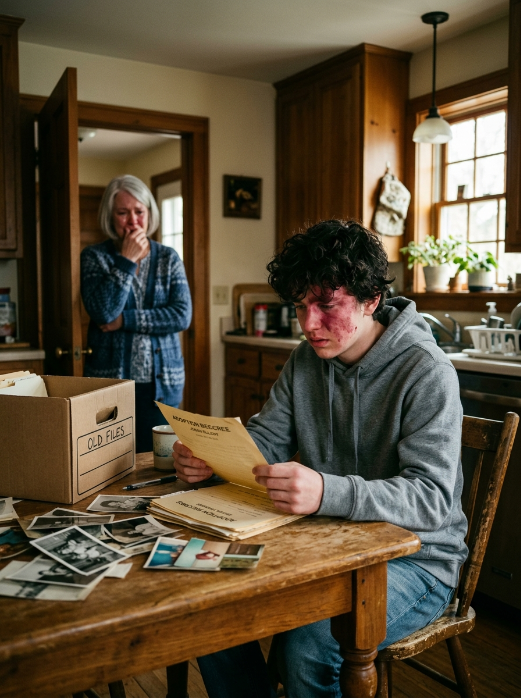
Evelyn asked him to look through the hallway closet for old tax documents while she worked an extra hospital shift. As Jonah reached for the top shelf, a storage box slipped loose and scattered papers across the floor.
At first, he nearly ignored them.
Then he saw his birth date printed on one document.
His hands froze instantly.
Inside the folder were original hospital records, custody transfer forms, and legal adoption papers bearing two names he’d never seen before:
Celeste Whitmore.
Graham Whitmore.
He read the documents once.
Then again.
Then a third time, because some part of him still believed the words might change if he stared long enough.
They didn’t.
Later that night, hands shaking, Jonah searched the names online.
Photographs appeared instantly across the screen. Graham and Celeste Whitmore smiling beneath crystal chandeliers. Posed beside magazine headlines praising their cosmetic empire. Celebrated publicly for restoring beauty, confidence, and appearance.
Jonah sat frozen, staring at the photographs while a painful irony tightened around his chest.
The people who’d built a fortune on appearance had abandoned their own son because of his face.
When Evelyn came home hours later, smelling faintly of antiseptic and cold rain, she found Jonah sitting motionless at the kitchen table with the papers spread before him.
Her face fell instantly.
For several long seconds, neither spoke.
Then Jonah rose, crossed the kitchen quietly, and wrapped his arms around her instead of shouting.
“You knew I’d find out eventually,” he whispered.
Evelyn’s voice shook immediately. “I wanted to tell you when the time felt right. I never wanted you to feel unwanted.”
Jonah pulled back slowly, tears gathering in his eyes.
“I don’t,” he answered honestly. “Not because of them. Because of you.”
That night changed something in him permanently.
Jonah decided he would never waste his life chasing bitterness or revenge. Instead, he would build something so meaningful that no one could ever reduce him to the thing they once rejected.
From then on, his focus grew almost fiercely intense. He slept little, studied constantly, and volunteered wherever he could. By the time college admissions arrived, his academic record had become extraordinary.
Soon after, he entered one of the country’s top pre-medical programs, then medical school itself, earning honors that drew national attention. Reporters gradually became fascinated by the story: a brilliant young man raised modestly by a nurse, overcoming public cruelty and private abandonment to become one of the nation’s most promising medical students.
Eventually, a documentary team asked to feature Jonah in a national human-interest segment. At first he hesitated. So did Evelyn. Neither wanted sympathy or spectacle. But Dr. Reeves gently encouraged him.
“Some frightened kid out there needs this story,” he said.
So Jonah agreed.
The documentary aired on a Sunday evening across the country. It showed Evelyn folding laundry in their tiny kitchen. It showed Dr. Reeves describing Jonah’s compassion and discipline. It showed Jonah walking across campus, calmly discussing dignity, healthcare access, and children who feel invisible because of how they look.
Millions watched.
Including two people sitting silently inside a glass-walled mansion in Darien.
Celeste and Graham Whitmore recognized him at once.
Not because of the birthmark.
Because somewhere beneath the years, they finally saw the son they had abandoned.
By morning, quiet rumors spread quickly through their social circles. Old hospital whispers resurfaced. Questions emerged about the child they’d supposedly never had. The carefully polished Whitmore image slowly began to crack beneath the weight of truth.
Jonah, meanwhile, kept moving forward.
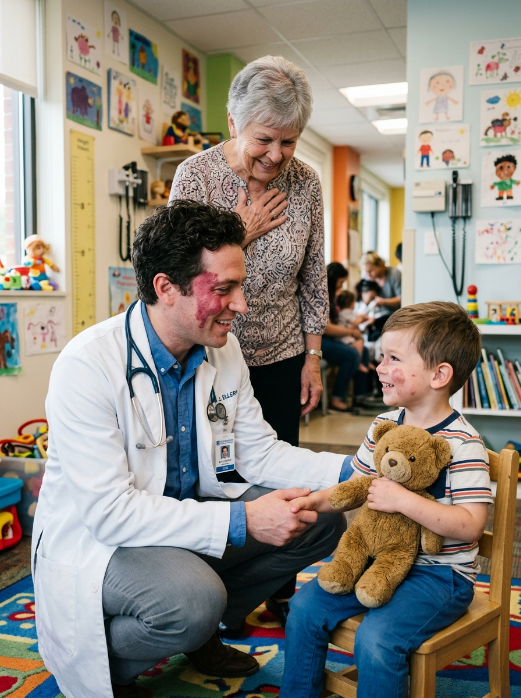
During his third year of medical school, he found his calling in pediatric reconstructive care. Unlike the cosmetic empire his biological parents had built, Jonah focused on children facing pain, difference, fear, and isolation. He understood how cruel the world could be toward anyone visibly different.
He also understood how life-changing a single compassionate voice could be.
Sometimes, before procedures, Jonah knelt beside frightened children and quietly told them:
“You don’t need to hide from me. I understand more than you think.”
And somehow, they believed him right away.
Part 3: The Parents Who Finally Learned What Love Meant
After finishing his medical training, Jonah received prestigious offers from private hospitals in Los Angeles, Chicago, and Boston. The salaries were enormous. The titles carried a status most doctors spend entire careers chasing. But Jonah turned down every one.
Instead, he returned to New Haven and founded the Ellery Center for Pediatric Renewal, a nonprofit clinic dedicated to children with facial differences, visible medical conditions, and families unable to afford specialized treatment. The clinic began modestly, inside a renovated community building filled with donated equipment, mismatched chairs, and overworked staff held together more by purpose than funding.
Evelyn ran daily operations.
Dr. Reeves advised the foundation whenever his health allowed.
And slowly, families began arriving from everywhere.
Within the first year alone, the clinic treated hundreds of children. Word spread quickly among parents about the young doctor with the crimson birthmark who spoke to frightened children like he truly understood them.
Because he did.
Then came the request Jonah had always suspected might arrive someday.
Celeste and Graham Whitmore wanted a meeting.
Several staff members immediately asked whether he intended to refuse. Jonah sat quietly for a long moment before answering.
“No,” he finally said softly. “Let them come.”
They arrived on a gray Thursday afternoon, dressed elegantly but looking far older than the polished photographs that had filled magazines years earlier. The confidence that once made them seem untouchable had given way to something smaller, quieter, and fragile.
Celeste cried first. Graham soon followed.
They spoke of fear, vanity, selfishness, and shame. They admitted abandoning him was unforgivable. Then they offered him everything they still had: their Manhattan cosmetic institute, financial assets, professional connections, public apologies, and full control of the Whitmore empire.
Jonah listened without interrupting once.
When they finally finished, he folded his hands calmly on the desk.
“I cannot give you back the years,” he said quietly. “And nothing you offer erases what happened.”
Celeste lowered her head at once.
Then Jonah continued.
“But I will accept the clinic under one condition.”
Both looked up instantly.
“It will stop serving vanity,” Jonah explained. “It will become a nonprofit extension of my foundation, dedicated entirely to children and families who need care, regardless of money or status.”
Graham swallowed hard. “And what do you want from us?”
Jonah’s answer came without hesitation.
“If your remorse is genuine, prove it through service. No salaries. No control. No privilege. You’ll work there like everyone else.”
Then he glanced toward the office doorway, where Evelyn stood quietly holding a clipboard after overhearing part of the conversation.
“You’ll answer to my mother too.”
At that, Celeste broke down completely.
And, surprisingly, they agreed.
The transformation of the Whitmore Aesthetic Institute into a children’s nonprofit clinic dominated headlines for weeks. Some called it justice. Others called it redemption. Jonah paid none of it much mind. What mattered to him was opening the doors.
And eventually, they did.
What had once been a luxury beauty center became a place filled with coloring books, pediatric exam rooms, counseling offices, and financial assistance programs for struggling families. The early months weren’t graceful. Celeste and Graham had to unlearn decades of ego and image-driven thinking. They scrubbed supply rooms, worked exhausting shifts, handled frightened families, and listened far more than they spoke.
Slowly, something in them began to shift.
Then one afternoon, a four-year-old girl arrived clutching a stuffed rabbit against her chest. A crimson birthmark stretched across the same side of her face Jonah’s once had. The little girl hid behind her aunt, refusing to lift her head.
Celeste knelt carefully in front of her.
The child whispered softly, “Is my face bad?”
Something inside Celeste shattered completely.
She covered her mouth as tears spilled down her cheeks.
“No, sweetheart,” she whispered painfully. “No, it isn’t bad at all.”
That moment marked the true beginning of her transformation.
Over time, the Whitmores donated most of their personal fortune toward expanding pediatric care access. Jonah’s younger biological siblings eventually reached out privately, and slowly built honest relationships with him grounded not in blood alone, but in humility and choice.
Years passed.
The foundation grew from a single clinic to several across the country. Tens of thousands of children received treatment, therapy, mentorship, and emotional support that taught them they deserved dignity regardless of appearance.
Then, fifteen years after founding the organization, Jonah received one of the nation’s highest honors for humanitarian medical service. The ceremony was held in Washington, inside a grand hall filled with doctors, lawmakers, donors, families, and children whose lives his work had changed.
Backstage, Jonah adjusted the cuff of his dark suit while nervously reviewing the speech folded in his pocket. Evelyn sat front row center. Her hair had silvered with age, and time had traced lines across her hands and face. But to Jonah, she still looked exactly like safety.
When his name was announced, applause thundered across the hall.
Jonah accepted the medal, thanked his colleagues, and acknowledged the families who had trusted him with their children. Then he paused and looked toward the front row.
“There’s something I need to say,” he began quietly.
The hall fell completely silent.
“People talk about success like it belongs to the person standing in the spotlight,” he continued. “But success rarely begins there.”
He stepped down from the stage slowly and walked directly toward Evelyn.
“I was given life through biology,” he said, emotion thickening his voice. “But I was raised through sacrifice. I became who I am because one exhausted nurse chose to love a frightened child nobody else wanted.”
Evelyn shook her head immediately through tears.
“Jonah, no,” she whispered emotionally.
He smiled softly and held out his hand.
“Yes, Mom.”
The entire audience rose to its feet as he helped her onto the stage.
Standing beside her, Jonah wrapped one arm around her shoulders before turning back to the crowd.
“Evelyn Ellery didn’t give me her face,” he said. “She gave me my future. She gave me belonging, dignity, courage, and a home. If this foundation has changed lives, it started with her.”
Evelyn covered her face, completely overwhelmed, as applause rolled thunderously across the hall.
In the back rows, Celeste and Graham Whitmore stood crying too, carrying the complicated grief of people who finally understood what love should have looked like all along.
Jonah’s birthmark, once treated as something shameful, eventually became recognized nationwide as a symbol not of rejection, but of compassion transformed into purpose.
Because in the end, the real miracle was never the abandoned child becoming successful.
It was the woman who picked him up first…
and never let go.
