


“One more step and I’ll have you thrown out.”
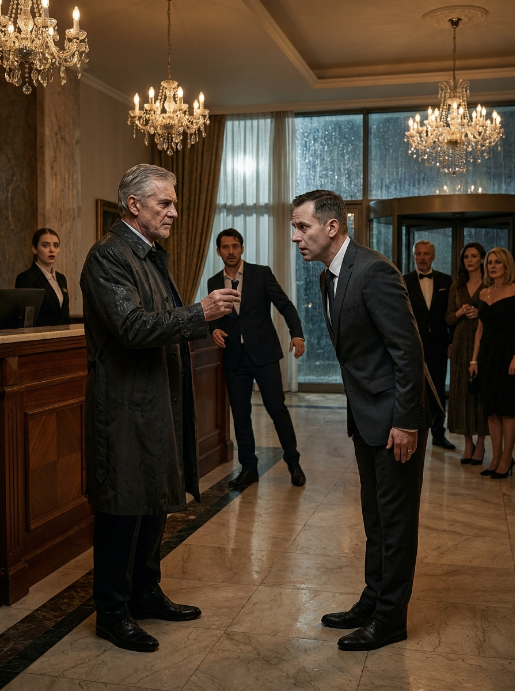
The words sliced through the marble lobby just as the stranger’s soaked shoe left a muddy print on the white floor. Rain hammered the glass of the Margrave Crown Hotel, blurring the city beyond into gold light and dark water. Inside, everything gleamed—crystal chandeliers, polished brass, orchids arranged with mathematical precision. And there, at the center of it all, stood a man who looked like a stain nobody knew how to scrub away.
His coat was ripped at the shoulder. His trousers were drenched to the knee. Water streamed from his hair, pooling in a dark circle on the marble. He carried no bag, no case—nothing to suggest he belonged anywhere near a place where a single night cost more than most people made in a month.
The receptionist behind the onyx desk regarded him the way people regard a bad smell they’re too refined to mention aloud. “Sir,” she said, each syllable honed with contempt, “guests come through the front because they have reservations. You don’t.”
The man didn’t look down at the floor, his sodden clothes, or the dozens of eyes now fixed on him from the lounge and bar. He kept his gaze on her and said, in a voice calm enough to cut through both rain and piano music, “I want to speak to the general manager.”
A laugh slipped out of her before she could catch it.
Near the entrance, a broad-shouldered security guard stepped forward, almost eager, as though this were exactly the kind of scene he enjoyed handling in front of witnesses. A woman dripping in diamonds lowered her champagne glass to whisper to her husband. Two businessmen swiveled in their leather chairs. A bellman by the elevators froze, torn between stepping in and disappearing.
The receptionist clasped her manicured hands together. “The manager doesn’t come down for people looking for shelter.”
“I didn’t ask for shelter,” the man said.
“Then what exactly are you doing here?”
He held her stare. “I’m asking to see the general manager.”
The guard closed the distance. “You need to leave. Now.”
The stranger didn’t flinch, didn’t raise his voice, didn’t reach for an excuse or an apology. That seemed to unsettle them more than pleading ever could have.
“This is a luxury property,” the receptionist said. “We can call you a taxi somewhere more suitable.”
“Call your manager.”
The guard exhaled in disbelief. “You deaf, old man?”
The stranger finally turned to face him. His features were older than his bearing suggested—late fifties, maybe early sixties—with deep grooves around his eyes and mouth that spoke not of exhaustion but of vigilance. “No,” he said. “Are you?”
The businessmen snorted. The guard’s jaw clenched. Embarrassment had entered the lobby, hunting for a place to land.
“That’s it,” the guard said. “Out.”
He reached for the stranger’s arm.
In one smooth motion, the man stepped back—unhurried, not startled, just enough that the guard’s hand closed on empty air. The movement was small, controlled, almost rehearsed. A few people caught it. Most didn’t. The receptionist did, and for the first time something other than irritation crossed her face: not fear exactly, but confusion. That was no clumsy reflex from someone desperate.
“Don’t touch me,” the man said.
The rain beat harder against the glass. Somewhere deeper in the hotel, silverware clattered past a doorway. The pianist kept playing, but the tune had lost its grip on the room.
The receptionist drew herself up. Her name tag read ELISE, her confidence honed by years of polished cruelty dressed up as professionalism.
“You’re causing a scene,” she said. “There are paying guests here.”
The stranger let his eyes travel briefly across the lobby—the velvet chairs, the flower arrangements, the people dressed for private dinners and penthouse meetings—then returned to her.
“No,” he said quietly. “You are.”
The words landed harder than they should have.
Elise’s mouth tightened. “Marco,” she said to the guard, “get him out.”
The guard advanced again, slower this time. “Last warning.”
The stranger held his ground, water still sliding from his sleeves. “Call the manager.”
“Sir,” Elise said, leaning in as if addressing a stubborn child, “let me put this plainly. No one is coming down for you. You’re not a guest. You’re not expected. And this hotel isn’t a public waiting room for—”
She caught herself a beat too late. For what? For men who looked poor? For people who made the place less picturesque?
The unfinished insult lingered anyway.
The woman with the diamonds smiled into her glass.
Marco reached again, gripping the stranger’s sleeve harder this time. This time the man didn’t step back. He let the hand stay a second, then glanced down at it.
“Take your hand off me,” he said.
Something in that steady, quiet voice made Marco let go before he’d even decided to.
That should have settled things. Instead, it shifted them.
The room now sensed an imbalance—not enough to stop watching, not enough to feel guilty, but enough to stir curiosity.
One of the businessmen rose and strolled over with casual entitlement. “Is there a problem here?” he asked, his navy suit immaculate, his expression already rehearsed for a dinner-party retelling.
Elise offered an embarrassed smile. “Nothing serious, sir. We’ve got it handled.”
The stranger glanced at him. “I’m sure she believes that.”
The businessman frowned. “If you need help, there’s a shelter six blocks east.”
The stranger studied him. “And if I wanted a room here?”
A ripple of laughter passed through the onlookers. The businessman smiled theatrically. “Then I’d suggest earning one.”
The stranger nodded once, as if filing the remark away.
Elise, buoyed by the room’s approval, pressed on. “That’s enough. Marco—”
“Call. The manager.”
The words came out clipped this time—not louder, but final.
Something shifted in the lobby. The bellman by the elevator glanced from Elise to Marco to the discreet cameras tucked into the corners. A housekeeper passing with fresh linens slowed her steps, then quickly lowered her eyes when Elise noticed her.
“You know what?” Elise said, her tone gone cold. “Fine. I’ll call duty management so they can hear this themselves. Then you’re leaving.”
She snatched up the phone with an exaggerated sigh, jabbing the internal line harder than necessary. “Lobby,” she said. “We’ve got an intruder refusing to leave.”
She listened, then gave a curt, satisfied nod. “Yes. Right away.”
When she hung up, she looked almost pleased. The guests settled into the particular hush reserved for watching someone else be humiliated. Even the stranger seemed to sense it, because he made no move to fill the silence. He simply stood there in his ruined coat, rainwater collecting beneath him, while every polished person in the room felt a little superior by comparison.
The minutes stretched on.
The guard lingered nearby, shoulders squared.
Elise kept herself busy at the desk, though not busy enough to hide her glances. Once, the stranger caught her staring at the tear in his sleeve, then at his shoes. He said nothing. That silence seemed to unsettle her more than words would have.
Finally, the elevator opened.
A man in a charcoal suit strode out with brisk, irritated steps, tablet in hand. Adrian Vale, the hotel’s general manager, carried himself with the lean, brittle poise of someone trained to repackage stress as command. He didn’t look at the stranger first. He looked at the mess on the floor, then at Elise, then at the guests. He registered the damage to the atmosphere before he registered the person.
“What is this?” he muttered under his breath.
Elise straightened. “Sir, this man pushed his way in and won’t leave. He keeps demanding to see you.”
Vale’s expression made clear he’d already decided how this would end. He approached the stranger with corporate impatience. “Sir, whatever the misunderstanding is, this is private property. I’m going to ask you—”
“I asked to speak to the general manager,” the stranger said.
“You are.”
“Good.”
Vale paused, just long enough to feel his own script thrown off. “Then speak.”
The stranger studied him for a long moment, taking in the expensive suit, the polished shoes, the carefully measured annoyance. “How long have you worked here, Mr. Vale?”
The manager blinked, caught off guard. “Three years.”
“And before that?”
“That’s irrelevant.”
“To you, maybe.”
A few nearby guests traded amused looks. Elise’s face flushed. Vale offered a thin smile meant to close the subject. “This isn’t an interview.”
The stranger reached slowly into the inside pocket of his coat.
Marco lunged forward. “Hands where I can see them.”
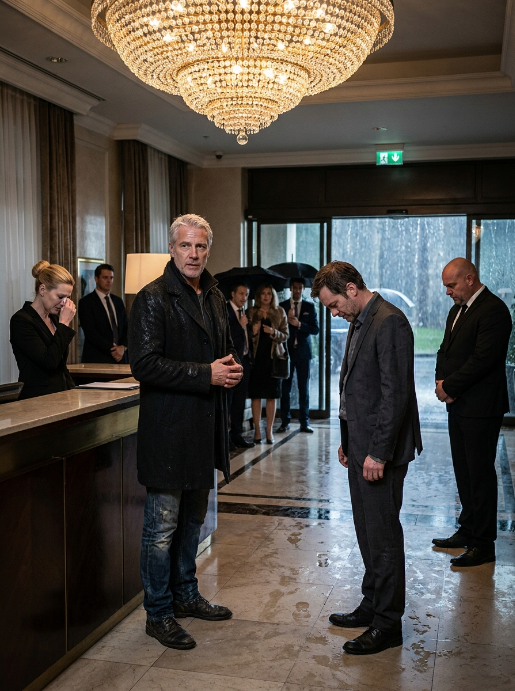
The room jolted. A woman gasped. Chairs scraped softly as people leaned back, suddenly less entertained.
The stranger ignored them and drew out a small object pinched between two fingers.
At a glance it looked unremarkable—a matchbook-sized card of matte black metal, engraved with an emblem that caught the chandelier light in a dull silver flash. No name. No title printed anywhere. Just the symbol.
Vale saw it.
The color drained from his face.
His hand, still gripping the tablet, trembled—just once. But everyone nearby noticed.
For two long seconds, nobody spoke. The rain roared on. Somewhere a glass clinked. Elise’s eyes darted between the object and her manager’s face, trying to make sense of the sudden shift.
Then Vale bowed his head.
Not a polite nod. Not a formal tilt. An actual bow.
“Sir,” he said, his voice tight, almost raw, “I apologize. I didn’t realize.”
The lobby fell completely silent.
Elise stared as though she’d misheard. Marco took half a step back. The businessman in navy slowly turned his head, all certainty stripped from his face.
The stranger slid the metal seal back into his pocket. “No,” he said. “You didn’t.”
Vale swallowed. “Please, come with me to my office.”
“No.”
It wasn’t loud. It didn’t need to be.
The manager lifted his eyes. “Sir?”
“You can speak here.”
“Perhaps somewhere more private would be better.”
“For whom?”
The question cut like a blade. Vale had nothing to offer in return.
The stranger turned slightly, taking in the whole room—the desk, the guard, the guests who had watched his humiliation so comfortably. “Everything that happened, happened here,” he said. “So we’ll finish it here.”
Elise’s voice came out thin. “Mr. Vale… who is he?”
Vale didn’t look at her. “That’s enough.”
But the stranger did look at her. He let the silence stretch until it grew almost unbearable, then said, “I’m one of the founding shareholders of Halcyon Meridian.”
The name struck the room with a delayed weight. Halcyon Meridian was the parent company behind the Margrave Crown and dozens of other properties spread across three continents. It was spoken of in business magazines, cited proudly in training manuals, mythologized at investor conferences. Yet its founding ownership remained famously hidden—layered trusts, quiet acquisitions, old families who never appeared in public.
“I funded the very first property, before there was a brand,” the stranger went on. “Before this lobby, before these chandeliers, before any of you had even heard the phrase guest experience.” His eyes moved to Vale. “And for the past six months, I’ve been visiting our hotels unannounced.”
The businessman in navy stumbled backward so quickly he nearly knocked over a side table.
Elise had gone pale.
Marco’s posture sagged, inch by inch, as though whatever had held him upright had quietly given way.
The stranger’s even tone only made it worse. “I checked room service in Harbor District. Kitchen standards in Bellmere. Staff discretion in East Tower. I was ignored, overcharged, condescended to, and once told to use a service entrance because I ‘didn’t match the clientele.'” His gaze returned to Elise. “Tonight I wanted to find out whether Margrave Crown had learned anything from the memos your corporate office keeps insisting it takes seriously.”
No one breathed.
Rainwater still dripped from his sleeve onto the marble. Standing there that long, it felt unbearable.
Vale cleared his throat. “Sir, on behalf of the entire property—”
“No.” The stranger’s eyes stopped him cold. “Not on behalf of anyone. Speak for yourself.”
Vale’s lips parted, then closed again. Sweat had gathered at his temple.
“I failed,” he admitted finally.
The stranger considered him for a long beat. “You did.”
Elise let out a soft, involuntary sound, half breath, half panic. “Sir, I—I didn’t know. If I had known—”
He turned to her so gently that her words simply collapsed under their own weight.
“That,” he said, “is exactly the problem.”
Her face crumpled in slow motion—not into tears yet, but into the realization that the sentence she’d reached for had condemned her instead of saving her.
Around them, the guests who had watched with amused contempt now avoided every eye. The woman in diamonds suddenly found the floor fascinating. The businessman in navy rubbed at his cuff, as if he could polish away his own words. Even the pianist had stopped playing.
The stranger turned to Marco next. “And you?”
Marco’s throat worked. “Sir, I was following procedure.”
“Show me the procedure that says grab first, think later.”
Marco said nothing.
“Show me the procedure that says a wet coat is a threat.”
Still nothing.
The stranger nodded once. “I didn’t think so.”
He turned back to Vale. “How many training sessions did you sign off on this quarter?”
Vale answered at once, grasping for something solid. “Four.”
“How many did you attend?”
The manager hesitated.
That was answer enough.
A few people near the bar bowed their heads.
The stranger walked—not toward the office, not toward the desk, but slowly across the lobby, forcing every eye to follow him. He stopped beneath the chandelier, where the light caught the frayed edge of his collar and the scuffed leather of his shoes. When he spoke again, he wasn’t addressing only the staff.
“Luxury,” he said, “is the easiest thing in the world to fake. Marble, lighting, imported flowers, uniforms pressed sharp enough to cut. None of it tells me what a place actually is.” He looked around at them. “I learn that the moment someone walks in carrying nothing that impresses you.”
No one moved.
His calm had become more punishing than anger would have been. Anger would have given them something to push against. This left them nowhere to hide.
“I wasn’t loud,” he said. “I wasn’t drunk. I wasn’t threatening anyone. I asked for a manager. That was enough for all of you to decide what I must be.”
Elise’s eyes welled. She didn’t wipe them away.
The stranger’s gaze moved over her, then Marco, then Vale, giving each the same measured silence, laying their actions bare where they could no longer look away.
“If I had truly been poor,” he asked, “would you have treated me this way to the very end?”
The words were quiet. The effect was devastating.
Elise pressed a hand to her mouth.
Marco stared at the floor.
Vale seemed suddenly older, as if the full cost of the moment had finally landed. “No, sir,” he said, though even he could hear how hollow it sounded. Not a promise—a wish for a version of events that hadn’t happened.
The stranger didn’t rescue him from it.
He simply stood there and let the answer hang in the air.
The humiliation deepened precisely because he refused to dress it up. He didn’t accuse. He didn’t raise his voice. He didn’t mention lawsuits, press scandals, board reviews, or market fallout. He simply let their own conduct stay exposed in the most expensive room in the building.
At the edge of the lobby, the young bellman who had frozen earlier suddenly stepped forward. His face was pale, but he spoke anyway.
“Sir,” he said, his voice unsteady, “I should have said something.”
Every head turned.
The stranger studied him. “Why didn’t you?”
The young man swallowed hard. “Because she was in charge,” he said, glancing at Elise before dropping his eyes. “And because I didn’t want to lose my job. But I knew it was wrong.”
It was the first honest sentence anyone in the room had offered.
The stranger gave a slight nod. “What’s your name?”
“Daniel.”
“Thank you for telling the truth, Daniel.”
The small acknowledgment landed harder than any speech could have. Daniel looked as though he might buckle under the weight of relief and shame together.
Vale straightened, grasping for some fragment of managerial authority. “Sir, allow me to arrange a suite immediately. Dry clothes, medical attention if you need it, transportation, anything at all—”
The stranger almost smiled, though not kindly. “Now you’d like to serve me.”
“Please.”
“What changed?”
Vale’s face went blank. He had no answer.
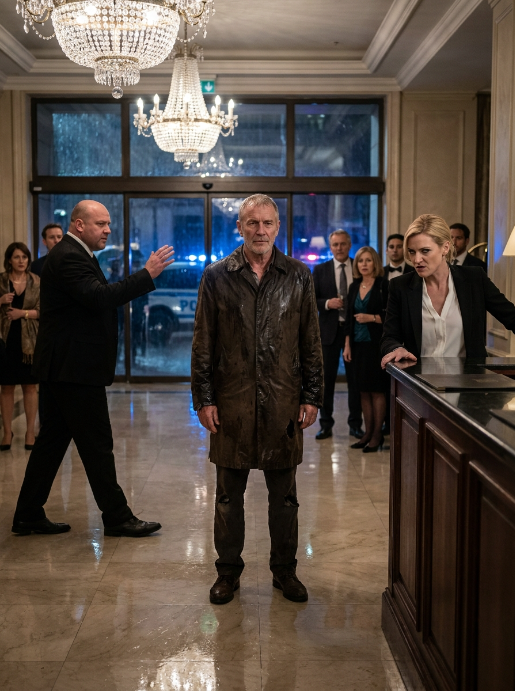
The stranger supplied one for him. “Authority changed.”
That was the real revelation—not who he was, but what everyone else had been all along.
He turned back toward the front doors. Marco stepped aside instinctively before the man even reached him. Elise looked as though she wanted to speak, to plead, to talk herself into being someone better, but found no words she trusted.
At the threshold, the stranger stopped and faced Vale one final time.
“Tomorrow morning,” he said, “corporate human resources and regional operations will have my report. Not just about tonight. About the culture from leadership that made tonight possible. Every camera angle. Every transcript. Every training record. Every guest complaint that got smoothed over instead of addressed.”
Vale shut his eyes briefly. “Understood.”
“I doubt that.”
Then the stranger opened the door, and the storm rushed in—cold, wet, and real.
He walked out into the rain exactly as he’d walked in: in the same torn coat, the same soaked trousers, the same shoes no one had thought worth a second look. But this time nobody saw rags. They saw a verdict.
No one offered to touch him.
No one dared.
The next day, the consequences moved faster than the gossip. Elise was let go before noon. Marco was terminated before his shift even started. Vale was suspended pending formal review, though everyone in the building understood suspension was simply the word used while the paperwork caught up. Mandatory retraining was announced across the property. A new policy went out in language so plain it read almost like an indictment: every person who walks through the door is to be treated as a guest deserving of dignity, regardless of appearance, status, or immediate spending power. No exceptions. No profiling dressed up as discretion.
By evening, copies of the memo had circulated through every corridor, every staff entrance, every break room.
Some said the hotel had changed overnight.
That wasn’t quite true.
What changed overnight was who felt safe showing their true selves.
Three days later, Daniel was promoted to interim front office supervisor. No press release explained why. No one in leadership wanted the story getting out. But inside the building, the memory took hold fast. Staff lowered their voices whenever a soaked coat appeared at the door. Guards kept their hands to themselves. Receptionists looked up before they looked down.
Weeks later, when rain struck the glass facade again, people still glanced toward the entrance with a quiet, involuntary unease.
Because sometimes power doesn’t arrive in a black car or a tailored suit.
Sometimes it walks in, dripping onto polished marble, asks one simple question, and waits for everyone else to reveal who they really are.
And by the time they understood who had truly been standing in front of them, it was already too late.
