


My son-in-law accidentally left his mobile phone sitting on my kitchen table, and a solitary incoming notification resurrected my deceased daughter.
The device vibrated right as I was cleaning up a spill on the stovetop. I nearly paid it no mind. Walking away would have been the honorable path. Yet it vibrated once more, sharp and abrupt, causing my gaze to drop onto the illuminated display before I could check myself.
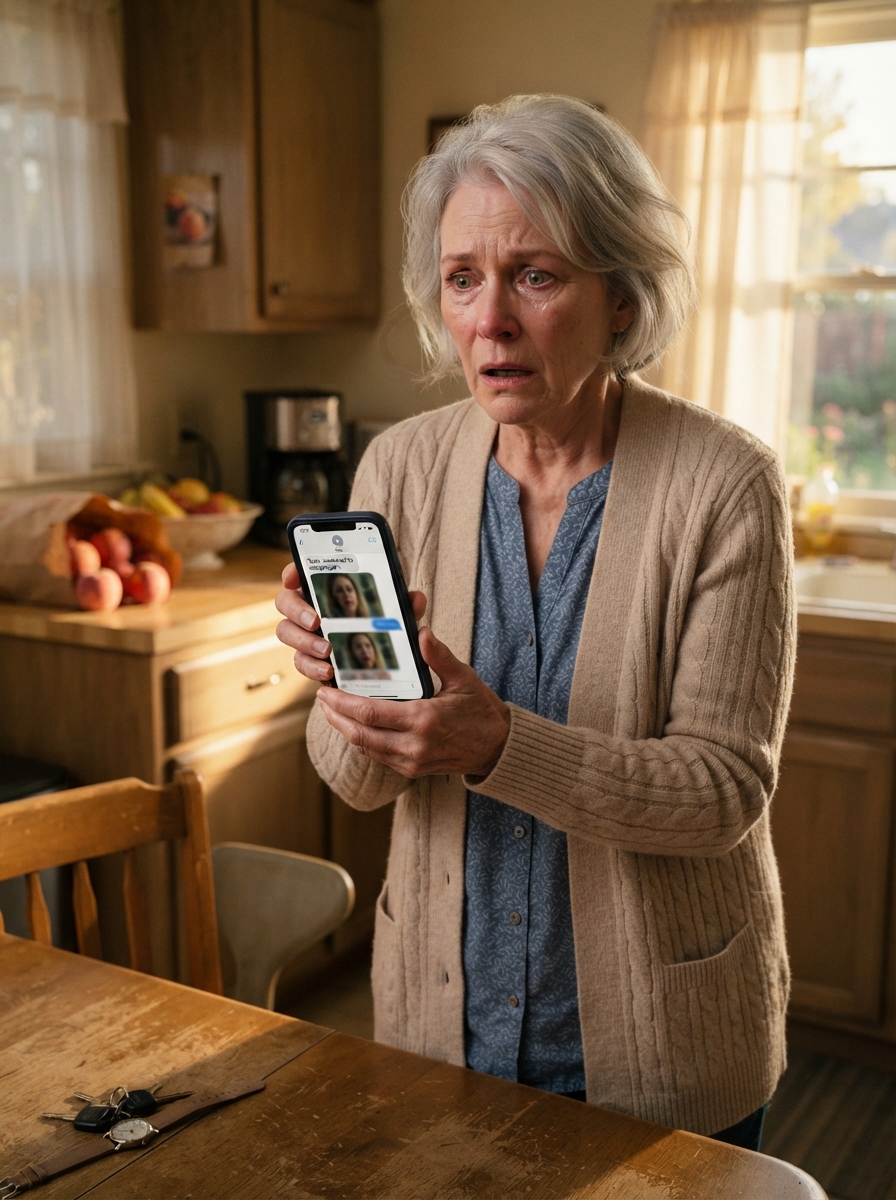
Come now, Janet. Janet tried to escape again.
For a full second, time stood completely still. My hand locked around the kitchen rag. The small light above the stove buzzed softly. The old clock on the wall clicked rhythmically over the basin. From outside, the distant hum of a lawnmower drifted down the block, but within my own chest, everything flatlined. Janet.
That was my daughter’s name. My Janet — the very child I was led to believe had perished five years prior. I locked my eyes onto the glowing glass until they began to sting.
I read the words repeatedly, hoping they might transform into something mundane if I stared long enough. Come now. Janet tried to escape again.
Again. Not a first attempt. Again. My legs buckled beneath me. I dug my fingers into the edge of the wooden table to keep from collapsing, letting the rag tumble from my hand straight into the sink.
An icy wave rushed through my limbs. “No,” I whispered, though it scarcely formed a sound. It felt fragile and frightened, resembling a child speaking in a darkened bedroom.
Miorang — my son-in-law — had departed a mere ten minutes prior. He had arrived displaying one of his gentle smiles, bearing a bag of fresh peaches from the local market. He frequented my place like that, stopping by to check on my well-being, asking if chores needed doing, staying briefly to converse in that serene, reassuring tone that easily won people over.
For five years, I had offered prayers of gratitude that my daughter had wed such a devoted partner before her passing. Now, I stood gazing at his phone while my chest throbbed with a painful, frantic beat.
I glanced out toward the front window. His vehicle was gone, leaving the driveway bare. The neighborhood outside appeared entirely undisturbed. A blue sedan moved down the street. My neighbor, Mrs. Howard, was tending to her garden beds.
Not far away, a dog offered two sharp barks. On the surface, nothing had shifted. In reality, everything had. With trembling fingers, I lifted the device. The notification remained anchored at the top of the screen, like a snake hidden in the grass.
The sender was designated simply as “Mom” — Ryan’s mother, Linda. That realization caused my stomach to churn so violently that I had to press my palm against my abdomen.
Linda had wept right alongside me during Janet’s memorial. Linda had delivered meals to my doorstep. Linda had sat at my very dining table, gripping my hand tightly while uttering, “There are no words big enough for a loss like this.”
I had trusted her completely. I had trusted every single one of them. My breaths turned shallow as my thoughts raced erratically. Perhaps it referred to a different woman named Janet. Perhaps it was some inside joke, a cryptic phrase, or a misunderstanding on my part.
Yet a mother detects an emergency the very moment her daughter’s name is invoked. I bypassed the lock screen. Ryan had maintained the exact same numeric code for a long time. Janet used to mock him for it — she would chuckle and warn him that a thief would easily compromise his security because he made life too easy for people. He would just smile, press a kiss to her brow, and reply, “Nobody cares that much about my boring life.”
My digits shook so severely that I misentered the code on my first try. When the home screen finally appeared, I felt as though I had stepped across a threshold I could never recross.
A massive history of communications between Ryan and Linda unfolded. Many were brief. She’s restless today. Give her half, not a whole one. Curtis, fix the lock. Don’t let her near the stairs. Others carried more detail.
If Evelyn asks again, tell her the storage unit was cleared out months ago. Stop giving details. Too many details make people curious. My breath caught in my throat. Evelyn — they were speaking about me.
Older exchanges stretched back through the months, then drifted back into years. I scrolled endlessly, feeling a detachment from my own hands. Sedatives. Basement. The caretaker moved her. She’s remembering too much.
Tell her the ashes got delayed. Use the back road. I clamped my palm over my mouth to smother a shriek. My legs failed entirely, causing me to drop heavily into a kitchen chair.
The wooden legs screeched against the linoleum, making me startle. Five years. Five long years spent mourning a daughter I thought was gone forever. Five years spent sobbing into a pillow so my grandson wouldn’t awaken during his weekend visits.
Five years gazing at framed photographs, whispering, “I miss you, honey.” And during this entire span, they had been exchanging messages regarding narcotics, deadbolts, and a cellar. I continued tracing the history downward.
Eventually, I uncovered images — poorly lit, blurry, hurried snapshots. They looked as though they had been captured stealthily or in a state of panic. The initial image depicted a cramped, dim space bounded by concrete blocks. A narrow cot was pushed into a corner.
A lamp rested directly on the floorboards, and a plastic tray sat upon a chair. Nothing about the environment suggested a fit habitation for a human being. A tight weight pressed down on my lungs.
I swiped to the subsequent picture. A woman was positioned on the cot, a blanket draped over her frame. Her hair extended far longer than Janet had ever kept it, and her skin lacked color.
Her frame appeared frail — dangerously thin. Her gaze seemed exhausted, unmoored, and terrified. Yet I recognized those features instantly. A mother’s recognition never fails. “Janet,” I breathed, the name fracturing as it left my lips.
I pressed my fingertips to the glass as if trying to stroke her face. My sight grew distorted by rising tears. I blinked them back forcefully to inspect the image again, terrified it might dissolve.
It remained unchanged. The reality was clear. My child was breathing. She was alive, not resting in a cemetery — alive and confined somewhere in the dark. A low, agonizing sound tore from my throat.
It was the noise born when profound mourning and sudden hope collide with such force that the human heart cannot contain both. I folded over myself, clutching the device tightly against my ribs.
I lost all track of the passing minutes — one, five, perhaps more. I only realized that when I finally raised my head, the kitchen remained illuminated and ordinary, and I loathed it for its normalcy.
The shafts of sunlight across the floorboards felt wrong. The spotless dishes felt wrong. Even the basket of peaches Ryan had brought remained on the counter like a cruel mockery.
He had entered my home with a grin, fully aware that my daughter was drawing breath. He had stood precisely where I was standing. He had met my gaze and spun a lie. Instantly, my sorrow shifted into something incandescent.
It was rage. No — something far grander than mere rage. A fierce instinct that ignites when someone harms your child and smiles to your face while doing so.
I straightened my posture and wiped my damp cheeks. Think, I instructed myself. Think. If I contacted the authorities immediately and their response lagged, Ryan and his mother might relocate her.
If I remained passive, Janet would remain a captive. If Ryan returned for his property and discovered I had viewed the text history, the situation would shatter before I secured assistance. I required someone reliable — someone unwavering who would believe my words.
I snatched my own device and dialed my younger brother, Sam. Sam Parker had been the most headstrong individual in our family since boyhood. He repaired engines, split logs, and brooked no deception from anyone.
When Janet vanished, Sam stood alone in maintaining that the narrative lacked coherence. He kept noting that the explanations shifted. He argued that Ryan provided answers with too much ease, and that Linda wept without shedding genuine tears.
Back then, I claimed his own mourning was breeding paranoia. Now, I recognized that my own grief had blinded me. He picked up on the second vibration. “Evie.”
My voice faltered. “Sam.” That single word was all I could manage. His demeanor shifted instantly. “What happened?”
“I need you to come,” I murmured. “Right now. Please.” He asked for no explanation, wasting no time.
“I’m on my way.”
After disconnecting, I engaged the front bolt. Then I immediately disengaged it, realizing a locked entrance might look suspicious if Ryan doubled back. I despised myself for prioritizing appearances while my daughter was held captive underground.
I continued reviewing the message logs as I waited. There were documented financial transfers sent to a man named Curtis Hale, alongside alerts for filling prescriptions. A recurring entry occupied Ryan’s schedule for every Tuesday and Friday evening at 8:30 p.m.
It bore a solitary word. Down. An icy dread settled over me. Then I uncovered a recorded voice note. I paused before pressing play, my thumb hovering over the glass.
A piece of me recognized that once the audio played, it could never be forgotten. I tapped it anyway. Linda’s voice drifted through the space. “She asked about her mother again.”
“I told her Evelyn moved away and never came back. She cried for an hour. Ryan, make sure she takes her pills tonight. I’m sick of these scenes.” I cut the recording off so rapidly the phone nearly slipped from my grasp.
My entire frame was shuddering. She had inquired about me. My daughter had sought her mother, and that woman — that heartless, malicious woman — had informed her that I had abandoned her and departed.
I surged to my feet so quickly the chair tipped backward. The resounding thud caused me to startle, and for a frantic second, I feared Ryan had returned, but it was merely my own terror manifest.
I righted the chair and braced myself against the table, drawing ragged breaths. Another text chain caught my eye, and I opened it. It was a dialogue between Ryan and Curtis. Basement door’s sticking.
Fixed. She scratched me. Use a restraint if you have to. No visible marks, Ryan had replied. A wave of nausea hit me so sharply I hurried to the basin. I managed to suppress the urge to vomit, but barely.
I stood anchored to the counter, staring at my own washed-out reflection in the window pane above the sink. I appeared significantly older than I had hours earlier — not aged by time, but by torment.
By the time Sam’s truck rolled into the driveway, my hands had grown entirely numb. I rushed out the front door, intercepting him before he could set foot on the porch.
The moment he registered my expression, the color vanished from his skin. “Evie, what’s wrong?” I extended Ryan’s phone toward him. He scowled, scanning the initial message, then the next.
His jaw set rigidly. He continued scanning, moving further down the history. When he looked back up at me, a profound horror occupied his eyes. “Where did you get this?”
“He left it here.” Sam inspected the display once more, moving more deliberately. He listened to the voice recording and examined the photo of Janet on the cot. His large, calloused hand gave a slight tremor. Then he murmured, “Good God.”
The tears I had suppressed finally spilled over. “It’s her, Sam. It’s my girl. It’s Janet.” He gripped my shoulders firmly, holding me as if to keep me from breaking apart. “I know,” he responded. For a brief moment, words deserted us.
We simply stood on the porch, anchoring one another while the truth loomed over us like an impending storm. Then Sam drew a deep breath and cast his gaze toward the road.
“We call Ben.” Sheriff Ben Tanner had been a family acquaintance for decades. He and Sam had gone fishing together throughout their youth. He was a measured, quiet man who never spoke without calculation.
In a tight-knit community, a man of that caliber represents the thin line separating justice from catastrophe. “Can we trust him?” I questioned. Sam gave a firm nod. “If we can trust anyone, we can trust Ben.” He placed the call from the porch while I stood close by, clutching Ryan’s device so fiercely my knuckles standard white.
“Ben,” came the swift answer. Sam adopted a low, severe tone I had rarely heard from him. “Ben, I need you at Evelyn’s house right now. No radio call, no deputies yet. Just you.”
The line went silent. A brief pause followed. Then Ben uttered a phrase I couldn’t decipher. Sam countered, “Because if what I’m looking at is real, Janet Parker never died.” The silence on the other end felt interminable.
Eventually, Ben confirmed his arrival. We retreated inside to wait. I prepared a pot of coffee simply to occupy my hands, pouring three mugs despite our shared state of shock.
I kept peering through the front window every few moments. Every passing vehicle caused my pulse to jump; every shifting shadow suggested Ryan’s return. When Ben finally arrived, he left his vehicle down the block and approached on foot.
That action alone demonstrated his grasp of the stakes. He crossed the threshold, evaluated my expression, glanced at Sam, and cut straight to the point. “Show me.”
Sam transferred the phone. Ben scanned the text threads silently, his face hardening like stone under frost. He played Linda’s voice note, examined the photographs twice, and then raised his eyes to meet mine.
“Evelyn,” he uttered deliberately. “I need you to walk me through everything, starting from the second Ryan left this house.” I detailed the entire sequence — every word, every vibration, every message, every snapshot, every agonizing second of rekindled hope.
He remained silent until I concluded, then sat entirely still, rubbing his chin. He then posed the query that chilled my marrow. “Where does Linda have a basement?”
I swallowed with difficulty. “Her old farmhouse out on Willow Creek Road.” Ben shifted his gaze to Sam, and Sam looked at me. In that terrifying, electric flash, before any of us could take action, Ryan’s truck came rolling slowly up my driveway.
The vehicle crept up the gravel so deliberately it carried an implicit threat. For a suspended moment, none of us moved. Sheriff Ben stood near the table, holding Ryan’s device.
My brother Sam kept his position by the window, his frame rigid and jaw locked. I remained anchored near the stovetop, fingers locked around a coffee mug I hadn’t touched.
Suddenly, the house felt claustrophobic and overly exposed. Ryan cut the ignition. The truck door clicked open, then slammed shut. His steps ascended the porch, rhythmic and unhurried, like a man returning for a mundane item.
My pulse thudded so violently I feared it resonated through the walls. Ben reacted first, sliding the mobile device into his coat pocket and stepping out of the direct line of sight from the entrance.
Sam stepped back silently from the glass. I set the mug down before my shaking hands dropped it. The bell rang once, a soft chime that felt sickeningly polite. I looked toward Ben.
“What do I do?” He instructed me in a low, unwavering voice. “Answer the door. Act normal. Don’t mention the phone unless he does.”
Normal. Nothing regarding my existence felt normal anymore.
Regardless, I forced my weak limbs to carry me to the entry and opened it. Ryan stood on the porch, sporting the same amicable grin he had worn fifteen minutes prior.
He was tall, groomed, clean-shaven, dressed in a tidy blue shirt with cuffs turned up. He epitomized the sort of man people instinctively trusted with their children or church keys — a keeper of secrets.
“Hey,” he uttered casually. “I think I left my phone here.” His gaze scanned my features. I caught the exact moment he registered my distress, his grin tightening just a fraction.
“You okay?”
I had spent five years under the impression that this individual cherished my daughter. Now I understood he had assisted in burying her alive in a subterranean cell. Still, I forced a nod.
“Just tired.” He rested his shoulder against the casing, casual as sunshine. “Mind if I come in?” Before an answer could form, Ben stepped into view.
Ryan’s entire countenance shifted instantly. The transformation was swift, but not rapid enough to escape my notice. His eyes expanded, his jaw locked, and then the grin returned — diminished, guarded, and hollow.
“Sheriff,” Ryan stated. “Ryan,” Ben countered. A tense silence followed. Ryan shifted his gaze between Ben, Sam, and myself. His voice maintained its smooth quality, but an underlying tension had crept in.
“Everything alright?” Ben observed him for a protracted moment. “Depends. Why don’t you come on in?” For a split second, I suspected Ryan might flee. I caught the fleeting thought passing over him like a shadow — a rapid evaluation of the lawn, a adjustment of his stance, a dry swallow. Then the smile returned, and he crossed the threshold. He carried the scent of clean soap and cologne.
I detested that. I detested that malice entered my home smelling so pristine. Ryan scanned the kitchen as if attempting to reassert control over the environment. “So, what’s going on?”
Ben withheld his response initially, retrieving the device from his coat and presenting it. Ryan’s gaze locked onto it, and I watched the color recede from his skin — not entirely, but enough to resemble a curtain pulling back. “You left this here,” Ben remarked. Ryan exhaled sharply through his nose. “Right, thanks. I was worried I lost it somewhere.”
Ben maintained his grip on the device. “Read a few things,” Sam interjected, a rough sound catching in his throat, though he added nothing further. Ryan directed his gaze at me, bypassing the sheriff. “You’ve been going through my phone?”
There it lay. No anxiety regarding Janet’s welfare, no shock, not a single inquiry such as “What did you see?” or “Why is the sheriff here?” Only an accusation, an irritation masquerading as injured pride. I crossed my arms to conceal my tremors.
“A message came in,” I stated. Ryan emitted a brief, hollow laugh. “And that gives you the right to go through my private messages?”
“Don’t do that,” Sam commanded. Ryan pivoted. “Do what?”
“Act offended.” Sam barked. “Don’t stand in her house acting wronged.” Ryan’s eyes flared before the polite mask reestablished itself. “Sheriff, with all due respect, whatever this is, I want a lawyer.”
That statement hardened Ben’s expression. “Interesting,” he noted. “I haven’t asked you a single question yet.” The room fell completely quiet. Ryan registered his tactical error the instant the words cleared his lips; I tracked the realization in his eyes. His calculated poise fractured briefly before he forced it back together. “I’m just saying this seems serious.”
“It is serious,” Ben affirmed. “So I’m going to ask you plainly. Who is Janet?” Ryan looked back at me, real terror surfacing for the first time. He clearly desired to lie, but the atmospheric shift in the room rendered simple deceptions useless. Ben watched him like a hawk, Sam looked capable of splintering the table, and I — the mourning mother he had manipulated for five years — met his gaze with absolute coldness.
Ryan moistened his lips. “There’s more than one Janet in the world.” Sam surged forward before I could even register the movement, but Ben extended an arm across his chest just in time.
“Lying snake!” Sam bellowed. “Sam, stop,” Ben ordered. Ryan recoiled, his face washed out. “I didn’t do anything.” My own voice startled me when it cut through the room, low but sharper than any shriek.
“You told me my daughter was dead.” Ryan looked at me, and in that flash, I believe he grasped a crucial truth: I was no longer the broken woman he could appease with gentle words and market fruit. The former Evelyn was gone. “Evelyn,” he murmured cautiously. “You’re upset. I get it. But you don’t know what you think you know.” I took a step toward him. “My daughter asked about me,” I countered. “Your mother told her I moved away and never came back.”
Ryan closed his eyelids for a fraction of a second. That brief lapse was all I needed to see, and it sufficed for Ben as well. The sheriff’s tone dropped to a menacing register. “Ryan, I’m going to ask you once. Is Janet Parker alive?” Ryan opened and closed his mouth repeatedly, but the opportunity to respond vanished.
His truck, still idling in the driveway, suddenly produced two sharp honks. All four of us turned toward the pane. A second vehicle had pulled up to the curb — an old gray sedan.
My blood turned to ice. Linda. Even from a distance, I recognized that rigid posture, the neat silver hair, and the way she sat as if supported by iron rods. She remained behind the wheel, watching the house intently. Ben moved rapidly. “She knows something’s wrong.” Ryan’s voice cracked. “No.”
Ben spun on his heel. “No, what?” But Ryan was already in motion, bolting toward the rear exit. Sam intercepted him around the waist before he could clear three paces, and the two tumbled into the kitchen chairs, sending one crashing against the drywall.
Ryan fought with the desperation of a cornered beast — the neatness, the amiability, and the calm dissolved entirely. He slammed an elbow into Sam’s ribcage, thrashing violently until Ben secured his arm. I retreated against the counter, breathless and horrified, watching the true monster shed its mask. “Let go of me!” Ryan shrieked. “You don’t understand.”
That particular phrase chilled me. He didn’t claim innocence. He didn’t assert her death. He didn’t call me mistaken. He yelled, “You don’t understand.”
Ben and Sam forced him face-down onto the floor, securing his wrists in cuffs. Ryan spat a curse before clamping his jaws shut, realizing he had already compromised his position.
Outside, the door to the sedan clicked open. Sam, breathing heavily, directed, “Ben, watch him.” He then looked toward me. “Stay inside.” But my feet were already carrying me to the front glass.
Linda emerged from the vehicle clad in a cream cardigan and sensible black shoes, looking prepared for a community circle rather than an exposure of malice. She walked with that familiar, detached dignity — chin elevated, face impassive. Only her eyes betrayed the underlying panic. Ben bypassed the threshold and stepped onto the porch before she could ascend. “Linda,” he called out. She paused infinitesimally.
Then her face adjusted into an expression of sweet concern that would have previously deceived me. “Sheriff Tanner? Ryan’s not answering his phone.” Ben barred the entryway. “Why don’t you tell me who Janet is?”
Linda’s composure held. Instead of crumbling, it froze, and that subtle shift revealed everything. Her response emerged too rapidly. “I don’t know what you’re talking about.”
Ben descended a step deliberately. “I think you do.” Linda peered past his frame through the open threshold, locking eyes with me. I will carry that image forever. Five years of shared meals, church embraces, condolence cards, and fabricated tears turned to ash in her gaze. The kindness and sorrow vanished, replaced entirely by cold calculation. She recognized that the secret was out.
Without a word, Linda turned and sprinted toward her car. Ben shouted, Sam roared from within, and Ryan thrashed on the floor, screaming, “Mom! No!” But Linda was already grasping the handle. Ben sprinted down the steps, reaching the vehicle before she could seal herself inside. He seized the door frame and yanked it open, causing her to lose her footing. She resisted with surprising power for a woman of her years.
Her handbag dropped onto the gravel, spilling its contents — cosmetics, papers, loose capsules, and a small ring of keys that caught the sunlight. Keys — Ben spotted them instantly, pinning Linda against the chassis with one arm while snatching the ring with the other. She ceased her struggles the moment he secured them, uttering words that paralyzed me. “You don’t have time for this.”
Ben stared down at her. “What does that mean?”
Linda’s lips thinned into a hard line. She directed her gaze past him, straight at me. “If you’d just kept quiet, none of this would have happened.” I have no recollection of crossing the porch. One moment I was inside; the next, my slippers were grinding into the driveway gravel, my fists clenched so tightly my fingernails bit into my palms.
“You are an evil woman,” I declared, my voice trembling but devoid of weakness. For once, Linda abandoned the pretense, viewing me with absolute disdain. “She ruined everything,” she muttered as Ben secured her wrists behind her back.
“You can explain that at the station,” Ben replied. But I had ceased listening to him; I was tracking the rhythm of my own pulse and the echo of her pronoun. She. Not an abstract memory. She — a living, breathing reality still out there.
Ben secured Linda while Sam hauled Ryan to his feet, positioning him on the porch. Ryan’s complexion had turned a dull gray as he looked toward his mother, the keys, and finally me. The flimsy justification he had manufactured collapsed entirely. “Evelyn,” he rasped. “Please.” I advanced toward him. “Where is my daughter?” He swallowed hard, remaining silent. “Where is she?” Still no reply. Sam gave him a rough shove. “Talk.”
Ryan winced. “Willow Creek.” My breath hitched. Ben’s gaze locked in. “The farmhouse.” Ryan offered a solitary nod. My voice was a mere whisper. “In the basement.”
He closed his eyes, and that confirmation sufficed. Ben turned to Sam. “I need backup, now. Fast and quiet.” He then addressed me. “You’re not coming.”
“Yes I am.”
“No — that’s my daughter.”
His features softened momentarily, though his tone remained ironclad. “And if there’s more danger out there, I’m not walking a mother in blind.”
“I’ve already been blind for five years,” I countered. “Not anymore.” For a second, I anticipated further resistance. Then he evaluated Linda, Ryan, and the key ring, making his choice. “You stay behind me. You do exactly what I say. The second I tell you to stop, you stop.”
“I will.” He gave a single nod. Following that, events proceeded at an urgent pace. Sam assisted Ben in placing Ryan and Linda into separate cruisers. Additional units arrived, commands echoing quietly. Neighbors began peering through their blinds; Mrs. Howard stepped onto her grass, staring openly.
I cared nothing for the neighborhood’s gaze or the exposure of the monsters who had frequented my table. I took the passenger seat in Ben’s vehicle, Sam trailing closely behind us. Willow Creek Farm lay fifteen minutes outside the town limits, past the old agricultural depot and the abandoned station, where the lanes narrowed and the treeline thickened. I had visited the property previously for holiday dinners and summer gatherings. Now, every mile traveled felt like an approach toward an open grave that had waited years for this reckoning.
Silence dominated the vehicle. Ben kept one hand near the transmitter and the other locked onto the wheel. I sat completely rigid, staring down the road, every fiber of my being taut. In the rearview mirror, Sam’s headlights remained an unwavering fixture. My thoughts spun out of control: Was Janet injured? Could she walk? Would she recognize me after the web of lies they had spun? I pressed my fist against my sternum and offered wordless prayers.
As we navigated onto Willow Creek Road, the structure emerged at the terminus of a long dirt path. The white exterior paint was flaking, the porch drooped, and the window panes were dark. From the exterior, it looked peaceful and mundane. That was the most horrific aspect; malice thrives in ordinary spaces, hiding where people are least inclined to investigate. Ben brought the vehicle to a halt near the side door, two additional units parking behind us.
He turned to me a final time. “Stay with Deputy Murphy.” I nodded, my hands cold as ice. The key ring from Linda’s bag rattled softly in Ben’s grip as he stepped out. He analyzed the assortment — one for the primary entry, one for the side, a small brass piece, and a black key wrapped in red tape.
Suddenly, Ryan’s frantic, trembling voice came over the radio from the auxiliary vehicle. “You have to hurry.” Ben seized the mic instantly. “Why?” Static crackled before Ryan’s response landed with immense weight. “Because Curtis gets there at six, and if he finds out she tried to escape again, he’ll move her before you get inside.”
The transmission instantly transformed the atmosphere of the yard, shattering the quiet. Everything sharpened into an urgent, dangerous reality. Deputy Murphy closed the distance to my side while Sam exited his truck with explosive speed. Ben barked out low, commanding directives. “Get around back now. Watch the barn. Watch the road.”
The farmhouse loomed before us, looking as though secrets were embedded in its timber. I recalled previous Sunday meals and birthdays spent here, back when the place seemed hospitable and safe — an old-fashioned home with ivy-covered fences and baked goods on the sills. Now, it stood as a monument to deception. Ben applied a key to the side entrance, and it gave a clean click. He turned back toward me. “Stay here.” I nodded, fully intending to comply.
Yet a chill draft swept through the trees, carrying a faint, muted vibration — a sound so subtle I initially doubted my own senses. A dull impact, followed by another, originating from within the structure. My frame locked up instantly; I recognized that rhythm not with my ears, but with my soul. “Janet,” I breathed. Ben and his personnel vanished down the side corridor, Sam trailing immediately behind them.
I remained near the steps with Deputy Murphy, staring into the dark threshold. The air emanating from the interior smelled stagnant, thick with dust and long-hidden spaces. Then voices echoed from within — rapid and low — followed by the sound of a door swinging wide, shifting boots, a heavy struggle, and a frantic shout: “Sheriff!”
Chaos erupted. Deputy Murphy reacted automatically, raising a hand to restrain me while reaching for his transmitter as another deputy sprinted around the perimeter. The sounds of a physical altercation echoed from inside — the unmistakable noise of a struggle. I should have held my position, I know that. But when a mother hears violence erupting where her child might be confined, logic dissolves. I bypassed Deputy Murphy and bolted through the doorway.
He shouted after me, but I didn’t falter. The interior corridor was narrow, flanked by framed family portraits that turned my stomach — Linda grinning in her Sunday best, Ryan as a boy, scenes designed to present a respectable life. At the far end, an open door revealed a steep staircase descending into darkness. In the cellar, Ben and a deputy occupied the floor, Sam halfway down the steps. Another broad-shouldered individual in work boots and a stained jacket was pinned against the masonry, his arm secured behind his back. Curtis. It had to be Curtis.
He muttered oaths while Ben held him fast. “The keys,” Ben demanded. Curtis spat onto the concrete. “Too late.” I nearly stumbled descending the steps, causing Sam to spin around. “Evie, no —” But I swept right past him.
The basement was significantly colder than the upper floors, characterized by a concrete slab, a single exposed bulb, utility shelves, and a sharp scent of dampness and bleach. Three doors lined the space: one opened into a utility area, another led to the laundry, and a third at the terminus was secured by a heavy padlock. That padlock exposed the absolute truth on its own. Ben retrieved the ring, testing various keys until the black one with red tape engaged the mechanism. The lock gave a heavy click. Nobody drew breath as Ben swung the door wide.
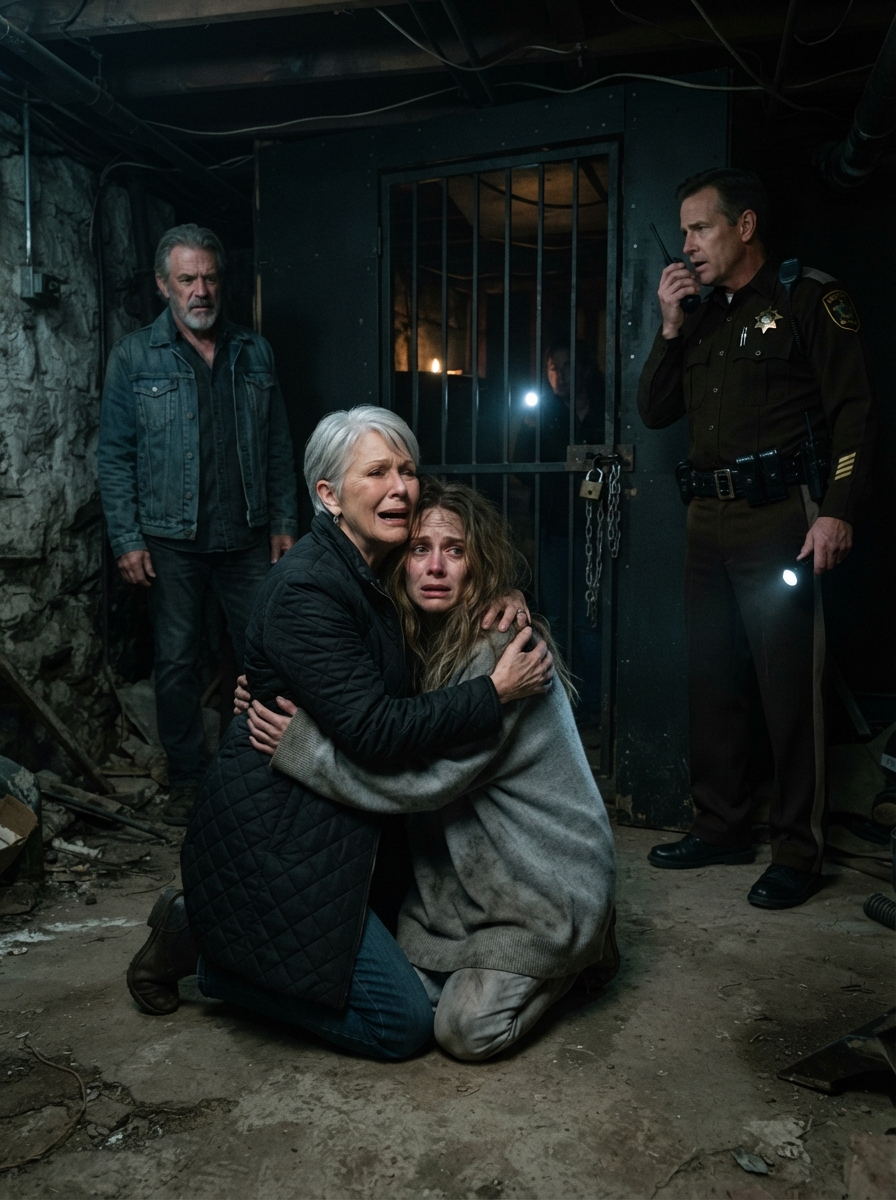
Initially, my mind struggled to comprehend the sight. It was a confined cell with stained, flaking masonry walls. A cot, a lone chair, a small lamp, a tray holding a half-empty glass, and a discarded blanket on the floor. In the corner, shrinking from the sudden influx of light, sat a woman with long, dark hair and terrified eyes. She was emaciated and pale, enveloped in an oversized gray knit sweater. She raised a forearm to block the light, weeping out, “No more, please, no more! I’ll stay quiet, I promise.”
That voice — though weakened, trembling, and altered by years of isolation — was unmistakable. My knees gave way. “Janet.” She froze at the sound, the name breaking something within her. She slowly lowered her guard, her eyes scanning my features as if suspecting an illusion. I advanced a step, then another. “My baby,” I uttered, my vision completely obscured by tears. “Janet, it’s me. It’s Mom.” She stared intently before her lips formed the word. “Mom.”
That solitary word undid me. I crossed the remaining distance instantly, dropping to my knees to envelop her. She possessed scarcely any weight, shivering in my grasp like a bird caught in a winter freeze. Then her arms locked around me, her face burying into my shoulder as she produced the most fractured sound I have ever witnessed. I rocked her on that cold slab, weeping into her hair.
“I’m here,” I chanted repeatedly. “I’m here now. I’m so sorry. I’m so, so sorry.” Behind us, Sam muttered an oath and averted his gaze, and Ben directed a deputy to summon medical transport. Curtis offered hollow protests, claiming, “I was only getting paid to watch her, you don’t know the whole story.” But his words carried no relevance; the only absolute truth was my daughter breathing in my arms. Alive. Alive. Alive.
Janet disengaged slightly, her features displaying hollows and shadows no young woman should ever endure. Yet she remained my child; no amount of time or malice could obscure that reality. She traced my cheek with shaking fingers, validating my presence. “They told me you left,” she whispered. “Said you sold the house and moved away. Said you stopped asking.”
I held her face securely. “Never,” I affirmed. “Not for a single day. They lied to you. They lied to both of us.” Tears coursed down her cheeks. “I tried to write to you.”
I raised my head sharply. “What do you mean?” Janet’s gaze flicked around the space, still frantic. “I wrote letters. Hid them in the laundry room. Once I put one in Curtis’s truck. Last week I tried to get out through the basement door, but Linda heard me.”
From the corridor, Curtis yelled, “I never saw any letters.” Sam turned on him with such volatile anger that two deputies had to intercede. Janet flinched at the commotion, prompting me to tighten my embrace. “It’s okay. He can’t touch you. None of them can ever touch you again.”
Yet I could sense the deep-seated terror residing within her; it was an anxiety that wouldn’t dissipate simply because a lock had been shattered. She had been conditioned by it daily for five years through narcotics, intimidation, and isolation. Ben knelt a short distance away, tempering his tone. “Janet, I need to ask you a few things. Can you tell me if there’s anyone else here?”
She shook her head negatively. “No. Linda sometimes leaves before dark. Curtis brings food. Ryan comes at night.” At the mention of her husband, her expression turned remarkably cold. “He said it was for my own good,” she whispered. I felt my frame stiffen. Ben glanced at me briefly before addressing her again. “Can you tell me why they kept you locked up here?”
Janet focused on her hands. After a lengthy pause, she articulated the explanation slowly, dragging each word through years of enforced silence. “Five years ago I found out Ryan was stealing money from Dad’s company fund. After Dad died, part of that money was supposed to stay protected. Ryan had convinced me to sign some small things because I trusted him.”
“But then I saw bank papers with Linda’s name on them. A lot of money was missing too.” Her lips quivered. “When I told Ryan I was going to the police, he said I was confused. Then he cried, then he begged, then he got angry.” I closed my eyes, remembering how I had once loved that man like a son.
Janet persisted, her gaze fixed downward. “I was driving into town the day they said I died. Ryan called and asked me to stop at Linda’s first so we could talk to a lawyer she knew. I believed him. When I got there, Linda was kind at first. Tea, cake, smiles.” She produced a bitter, joyless sound. “There was something in the tea.”
The environment seemed to tilt. Sam leaned against the masonry, exhaling sharply. “When I woke up, I was down here. Ryan told me I’d been in an accident and hit my head. Said I was confused and dangerous and they were keeping me safe until I got better.”
“When I fought, they gave me pills. When I screamed, they said no one would believe me.” Her voice faltered. “Later I heard them talking. That’s when I found out they’d told everyone I was dead.”
I struggled for breath as the space blurred. Sam looked ready to strike the wall. Ben’s jaw set. “And why not let you go once they’d covered up the money?”
Janet met his gaze with profound exhaustion. “Because I knew the truth. Because I could prove Ryan had forged more documents. Because if I came back, they’d lose everything.” There the motive lay, stripped of artifice: fiscal greed and control. Five years of my maternal agony had been commodified for currency.
Janet reached for my hand. “I stopped taking all the pills months ago. I was just pretending. I wanted to stay clear-headed enough to escape. Linda noticed I was changing, that’s why everything got worse.”
Ben stood up and utilized his transmitter, commanding a thorough sweep of the residence to secure documents and pharmaceutical evidence. He then looked down at Janet. “You did so well. You held on.”
She drew a ragged breath. “I almost didn’t make it.” I pressed a kiss to her brow. “But you did,” I stated. “And now I’m here.” I wish I could state that our ordeal concluded in that moment, but malice rarely yields cleanly. As medical personnel descended and Ben cleared a path for them to evaluate Janet, an officer called down from the upper floor. “Sheriff, you need to see this.”
Ben ascended immediately, Sam following in his wake. I remained by Janet’s side while a paramedic draped a blanket over her frame, posing gentle inquiries. She answered sporadically, her gaze constantly reverting to me to ensure my presence. I remained anchored; I would have stayed until the end of time. Moments later, Ben returned, his facial expression causing my stomach to drop. “What’s wrong?” I inquired.
He looked toward Janet before addressing me. “There’s a locked file box upstairs,” he explained. “Photos, forged signatures, fund documents, copies of the death certificate.” He paused significantly. “What else?” Sam demanded from behind. Ben’s tone dropped. “There’s another name on part of the paperwork. Someone who helped them make the death official.”
The air turned glacial. “Who?” I murmured. Ben met my gaze directly. “Dr. Michael Reeves.”
For a split second, the name failed to register, then it hit with immense force. Our long-term family physician. The individual who had embraced me at the memorial service, who had authorized the legal documentation declaring my daughter deceased. I suddenly grasped the horrifying scope: Ryan and Linda had not executed this scheme in isolation.
A profound stillness filled the cellar. Dr. Michael Reeves. The name lingered like acrid smoke. I felt Janet’s grip tighten around my fingers, her skin icy and breathing shallow. The medical personnel continued their assessment quietly, but the surroundings faded for me. Dr. Reeves had overseen our family’s health for decades, treating Janet’s childhood ailments and offering tokens of encouragement when she was small. He had attended both my husband’s funeral and Janet’s memorial, standing in the aisle to state, “I am deeply sorry for your loss.” Now, Sheriff Ben was revealing his complicity in her living burial.
Nausea forced me to steady myself against the cot. Sam’s voice emerged rough and demanding. “You’d better tell me you’re wrong about this.” Ben looked visibly drained. “I wish I were wrong.”
Janet raised her head slowly, her hollow eyes filled with a steady, painful focus. “He came here twice,” she whispered. Ben stepped closer as we all turned toward her. “Dr. Reeves came here?”
Janet offered a nod. “The first time was early on. I was weak. I’d cried and screamed so much I could barely talk. Ryan told him I was confused from a head injury. So Dr. Reeves came down to the basement and checked my eyes and asked me my name and the date.” Her lips trembled. “I kept begging him to help me. I told him who I was. I told him Ryan was lying. It was hard to even hear myself say it, but I had to. He had to know every part of it.”
“And what did he do?” I inquired softly. Janet met my gaze as tears resurfaced. “He told me to rest.”
The basement seemed to shift. Sam turned away in pure revulsion, covering his face. Janet swallowed hard and persisted. “The second time he brought more pills. Linda said they were to help calm me down. I stopped swallowing them. Eventually I’d hide some under my tongue and spit them out later.”
The paramedic looked up. “Do you know what those pills were called?” Janet shook her head. “No. Some made me sleepy, some made me feel heavy, some made it hard to think.” Ben’s expression darkened further. “We’ll test everything we found upstairs.”
A deep ache rippled through me as I looked at my daughter. She had spent five years fighting to preserve her sanity while those around her constructed a fiction, treating her like a ghost. I brushed a stray lock from her forehead. “You were so brave.”
Her eyes welled. “I was scared the whole time.”
“I know,” I replied. “That’s the truth. Brave people are often terrified. They just keep going anyway.”
The lead paramedic spoke gently. “Sheriff, we need to get her to the hospital soon. She’s dehydrated, underweight, and I’m worried about the long-term effects of the medication.” Ben acquiesced. “Two minutes.” He then turned back to Janet. “Can you tell me when Dr. Reeves last came?”
She furrowed her brow in thought. “Maybe three weeks ago. Maybe four. He didn’t come often. Linda said too many visits would draw attention.” That detail chilled me completely. They had anticipated every variable, exploiting grief through meticulous planning. Malice had been organized into deliberate, clinical steps.
I looked at Ben. “How can a doctor do that? How can a doctor look at a woman begging for help and turn his back?”
Ben responded softly. “Money. Fear. Pride. Sometimes people cross one line and then keep crossing more, because turning back would expose the first terrible thing they did.”
Janet’s voice carried a thin, biting edge. “Ryan said Dr. Reeves signed the papers because he had gambling debts. Linda said desperate men are easy to buy.” I closed my eyes as the final pieces aligned. It was simple greed and subsequent fear that sustained her captivity. Ben stepped away to issue radio commands for the immediate apprehension of Dr. Reeves, demanding strict operational silence to secure financial records and warrants before any potential leaks occurred.
Turning back to us, he stated, “Evelyn, Janet needs to get to the hospital right now.” I nodded, though every instinct demanded I remain wrapped around her. The paramedics assisted Janet to her feet, her frame wavering before I caught her alongside a deputy. Every step required monumental exertion. At the base of the cellar stairs, she paused, gazing upward as if encountering the open air for the first time. “Is it really over?” she whispered.
I held her face between my palms, locking eyes. “This part is over. I promise you.” She gave a marginal nod, though true trust requires time to heal such deep trauma. We navigated into the farmhouse kitchen, where the ambient light forced her to blink. She observed the mundane fixtures — a fruit bowl, a wall calendar, gardening gloves — looking disoriented by how normal cruelty could look on the surface. Near the pantry hung a wedding portrait of Ryan and Janet, flanked by a smiling Linda.
Janet stared at it before uttering in a terrifyingly flat tone, “Take it down.” Sam instantly ripped the frame from the wall, the anchor nail flying free. The glass shattered as he dropped it face-down onto the floorboards, and no one interceded.
Outside, the evening air smelled clean and crisp. Tears tracked down Janet’s face as she took a deep breath. “I forgot what outside smelled like,” she murmured, a statement that nearly broke my resolve entirely.
The ambulance doors stood open, the interior illuminated by a clinical glow. Janet looked at the vehicle with evident hesitation, fearing a loss of autonomy. “I’m coming with you,” I assured her instantly, allowing her posture to ease.
Sam gripped my arm. “I’ll follow behind.”
Ben approached the vehicle. “I’ll be there after I question Ryan and Linda.” I looked at him intently. “Ask them everything.” His expression turned rigid. “That’s exactly what I plan to do.”
They secured Janet inside, and I climbed in beside her as the doors sealed shut. Throughout the transit, I kept a firm grip on her wrist to provide a constant anchor. Janet drifted in and out of awareness while the attendant noted details regarding her health and medication history. At one point, she opened her eyes to murmur, “Mom, if I die now, don’t let them lie again.”
My chest tightened as I leaned close. “You are not going to die,” I stated firmly. “Do you hear me? You survived all of that. You are not leaving me now.” She observed me for a long moment before whispering, “Okay.”
The hospital intake was a blur of bright lights, clipboards, and urgent medical consultations. When they momentarily separated us for evaluations, every minute felt intolerable. Sam arrived shortly after, bearing my forgotten sweater from his truck — a testament to his grounded nature amid chaos. We sat in silence beneath a muted television until Sam spoke, eyes fixed forward. “I want five minutes alone with Ryan.”
Though I shared the sentiment, I shook my head. “No. He doesn’t get to turn this into his excuse.” Sam leaned forward, resting his elbows on his knees. “I should have pushed harder years ago.”
I met his gaze. “You didn’t know something was wrong.”
“I suspected. I didn’t know. I should have made it my business.” I reached over to squeeze his hand. “Listen to me. They lied to all of us. They built this whole thing on trust. That’s not your shame to carry. It’s theirs.”
Ben arrived later, running a hand over his neck, his expression conveying grim developments. “Ryan’s talking a little. Linda’s not.”
“What did he say?” I questioned. Ben exhaled slowly. “He admitted Janet found out about the missing fund money. Admitted they drugged her that first day. Says the plan was only supposed to last a week, maybe two, until they sorted the paperwork and moved the money. But once the death certificate was filed and the insurance money started moving, letting her go became too dangerous.”
Sam muttered, “Monsters.” Ben agreed quietly. “Ryan keeps saying he never meant for it to go this far.”
“That’s what cowards say,” I countered.
“And Dr. Reeves?” I asked.
“Not at his house. Not at the clinic. We’re looking for him.”
“He’s run,” I concluded, the realization hanging heavy between us.
A nurse interrupted to report that Janet was stable. I offered immense gratitude before she informed me that Janet kept inquiring about my presence. “I’m here,” I stated immediately. Following her down the corridor, I found Janet resting against white sheets, her hair brushed and her cracked skin tended to. She appeared weary but significantly less defensive.
She reached out the moment I entered, and I claimed the seat beside her. We sat in a comforting silence until she turned her head. “Mom, is there more?”
My stomach dropped. “What is it, honey?” Her gaze evaluated the doorway before returning to me. “The money wasn’t the only reason.” My posture stiffened. “What do you mean?”
Janet swallowed hard. “A few weeks before they took me, I found papers in Ryan’s office. Not just fund papers — land papers too. Dad’s old lake property. The one he promised would stay in the family.” Her eyes filled. “There was already a buyer lined up, but Ryan and Linda couldn’t sell it while I was alive and refusing to sign.”
I stared at her in disbelief. The lake property was my husband’s legacy — the land where Sam had taught Janet to fish, where our family dog rested beneath the willow tree. Ryan and Linda had been angling to liquidate our history. Janet’s voice trembled. “Ryan wanted that land more than anything. Linda said it was wasted on memories.”
She then tightened her grip. “There’s more,” she whispered. “Last month I heard Linda on the phone. She said if I ever got out, she had one last paper that would ruin everything for you too.” I leaned in closer. “What paper?”
Janet’s expression conveyed pure terror. “A will,” she stated. “A new will, with your name on it.” The air left the room. Janet nodded. “She said if the truth ever came out, they’d make it look like you knew I was alive, and that you kept me hidden to control Dad’s inheritance.”
The depth of their malice left me cold. They had engineered a contingency plan to implicate me, framing the grieving mother to insulate themselves. Right then, Ben appeared at the threshold, his face grim. “Evelyn, we searched Linda’s safe deposit box. We found the forged will.”
The revelation that the document bore my signature froze the room. Janet’s fingers tightened around mine, her face pale against the hospital pillow as the shadow of their deceptions loomed once more. Ben closed the door, Sam trailing behind with an untouched coffee. The sheriff explained the situation plainly.
“We found it in Linda’s safe deposit box, along with backup copies, forged signatures, and letters to open if questions ever came up.” He looked at me directly. “The will makes it look like your husband changed everything before he died and left control of most of the estate in your hands.” He paused. “Then it says you hid Janet because she was unstable and threatening to expose you.”
Janet let out a pained sound as I straightened my spine. “So that was their final plan,” I noted. “If Janet ever resurfaced, they were going to say I was behind all of it.” Ben confirmed it. “That’s how it looks.” Sam shook his head. “They weren’t just thieves. They were building an entire fake world.”
An entire manufactured existence had replaced our reality, casting Ryan as the grieving spouse, Linda as the supportive mother-in-law, and Dr. Reeves as the complicit authority, leaving the truth locked away in the dark. I looked at my daughter. “Listen to me carefully. None of this changes who you are. None of this changes what they did.” Tears spilled down her cheeks. “I know. I just hate that they thought of everything.”
I smoothed her hair. “They thought of everything except this. They never planned on you surviving with a clear mind. They never planned on Ryan leaving his phone on my table. And they never planned on the truth finally getting tired of hiding.”
A marginal smile surfaced on Janet’s lips — the first true glimpse of light since her rescue. Ben pointed to a folder on the table. “Ryan’s started talking more. Once Linda realized we’d found the will, she changed too. Not soft — practical. She knows those papers are enough to bury her.” Sam inquired, “What did they say?”
Ben crossed his arms, presenting the details evenly. “Ryan admitted that he and Linda started stealing from the fund two years before Janet disappeared. He had debts, bad investments, and a taste for other people’s money. Linda had her own financial problems and saw the inheritance as the fix. When Janet discovered the transfers and refused to sign anything else, they panicked.”
Janet kept her gaze on the blanket as Ben continued. “They brought Dr. Reeves in by paying off his gambling debts and promising more. He helped build the false medical story that Janet had died after a supposed accident. The death certificate was fake. There was no body from Janet’s accident because there was no accident. They put together the paperwork just to shut down questions and pushed for a closed-casket memorial.”
The memories of their smooth explanations flooded back — the warnings about the severe accident damage and protecting my final memories. They had systematically weaponized my grief. “And Curtis?” I inquired.
Ben’s face tightened. “He says he knew they had her but told himself it was some kind of family mental health situation. That excuse won’t save him. He took money, changed locks, brought food, and helped keep her there. He knew enough to stop. He didn’t.”
Janet spoke softly. “He used to avoid looking at me.” Ben nodded in agreement. “That tells me he knew exactly how wrong it was.” Silence reclaimed the room, save for the hum of the medical equipment. Outside, the world continued its indifferent pace, a stark contrast to the fracturing of our lives.
Janet broke the silence. “What happens now?” Ben offered an unvarnished response. “Ryan, Linda, Curtis, and Dr. Reeves will all face charges. There’ll be a long process — statements, evidence, financial review, medical review, trial. But the evidence is solid. Very solid.”
Janet looked to me for validation. “People will believe it.” I squeezed her hands tightly. “Yes,” I affirmed. “And even if some small-minded person whispers for a while — let them whisper. The truth doesn’t need every fool’s approval. The truth only needs light.” Her relief manifested in fresh tears.
Later that afternoon, after the room emptied, I sat alone with my daughter as the daylight softened. She observed the window pane for a long stretch before speaking. “I used to picture your kitchen.”
My voice caught. “My kitchen.”
She nodded softly. “When things got bad down there, I’d close my eyes and picture small things. Your yellow curtains. The soup pot with the chipped handle. The sound the back door makes when it sticks in the rain.” Her voice wavered. “I kept thinking that if I could remember ordinary things, maybe I wouldn’t disappear.”
I leaned in to kiss her hands. “You didn’t disappear,” I stated.
“I almost did.”
“No,” I replied gently. “They tried to bury you in silence. That’s different. Silence isn’t the same as disappearing.” She turned her gaze to me. “I was so scared you’d stopped looking for me.” That revelation exposed the deepest psychological wound Linda had inflicted.
I climbed onto the mattress to hold her close, just as I had during her childhood illnesses. “Listen to me very carefully,” I instructed. “There was not one single day — not one — that I stopped loving you. There was not one holiday that didn’t hurt without you. There was not one birthday that I didn’t light a candle inside my heart. They stole years from us, but they will not steal the truth. I was always yours, and you were always mine.” She wept against my frame until the worst of the wave subsided.
That evening, Sam returned with provisions and a simple arrangement of grocery-store flowers. Presenting them to Janet, he remarked, “It was the only thing that didn’t look like it belonged at a funeral.” Janet produced a genuine, albeit weak, laugh. Sam’s relief was palpable. “Good,” he murmured. “That sound deserves to be back in the world.”
The ensuing weeks demanded immense fortitude, yet clarity remained our greatest asset. Janet underwent treatment for severe malnutrition, physical exhaustion, and chemical dependencies stemming from the forced medications. Legal advocates, therapists, and law enforcement processed statements systematically. Ben kept us apprised of the legal developments: Dr. Reeves had been apprehended at a remote motel with a travel bag of currency, Curtis had immediately cooperated against Linda to mitigate his sentence, Ryan had broken down during interrogation, and Linda maintained an absolute, unrepentant silence. The fraudulent documents were disassembled by specialists, revealing a cohesive portrait of their conspiracy.
Upon her release, I escorted Janet directly back to my home. We navigated the familiar neighborhood lanes in Sam’s truck, passing the mundane local scenery that had framed the day the illusion shattered. Pulling into the driveway, Janet observed the structure. “It looks smaller,” she noted quietly.
“That’s because you’ve gotten bigger,” Sam offered from the wheel, eliciting a slight smile.
At the entrance, she paused to touch the frame familiarly. The interior carried the comforting scents of cinnamon and safety. I had restored the yellow curtains above the sink based on her hospital recollection. Upon spotting them, she covered her mouth in shock. “You remembered?”
Naturally, I had. She explored the space deliberately, touching the kitchen chairs and the old soup pot, the emotional weight bringing tears to both our eyes while Sam claimed a sudden irritation in his sight.
Recovery proved non-linear; real healing operates on its own timeline. Mornings occasionally brought disorientation, nights demanded repetitive safety checks, and sudden auditory or visual triggers induced physical panic. Yet the critical difference was that she no longer faced the darkness in isolation. Validation remains a powerful catalyst for transformation. We established a quiet routine of porch breakfasts, yard walks, and shared kitchen tasks as the legal machinery progressed.
One bright Saturday, we revisited the family lake property. The willow tree and weathered bench stood intact against the sunlight. Janet absorbed the environment silently, assessing the legacy they had tried to reduce to fiscal profit. “They thought money mattered more than people?” she asked.
“Yes,” I confirmed.
She met my gaze. “They were wrong.”
“Yes,” I repeated with absolute certainty. “They were wrong.”
We retained ownership of the land; some heritages transcend financial valuation. A month later, at the initial judicial proceeding, Janet stood resolute in a blue sweater. Ryan avoided her gaze entirely, Linda faltered under her direct scrutiny, Dr. Reeves appeared diminished, and Curtis displayed visible remorse, allowing shame to occupy the space previously held by their silence.
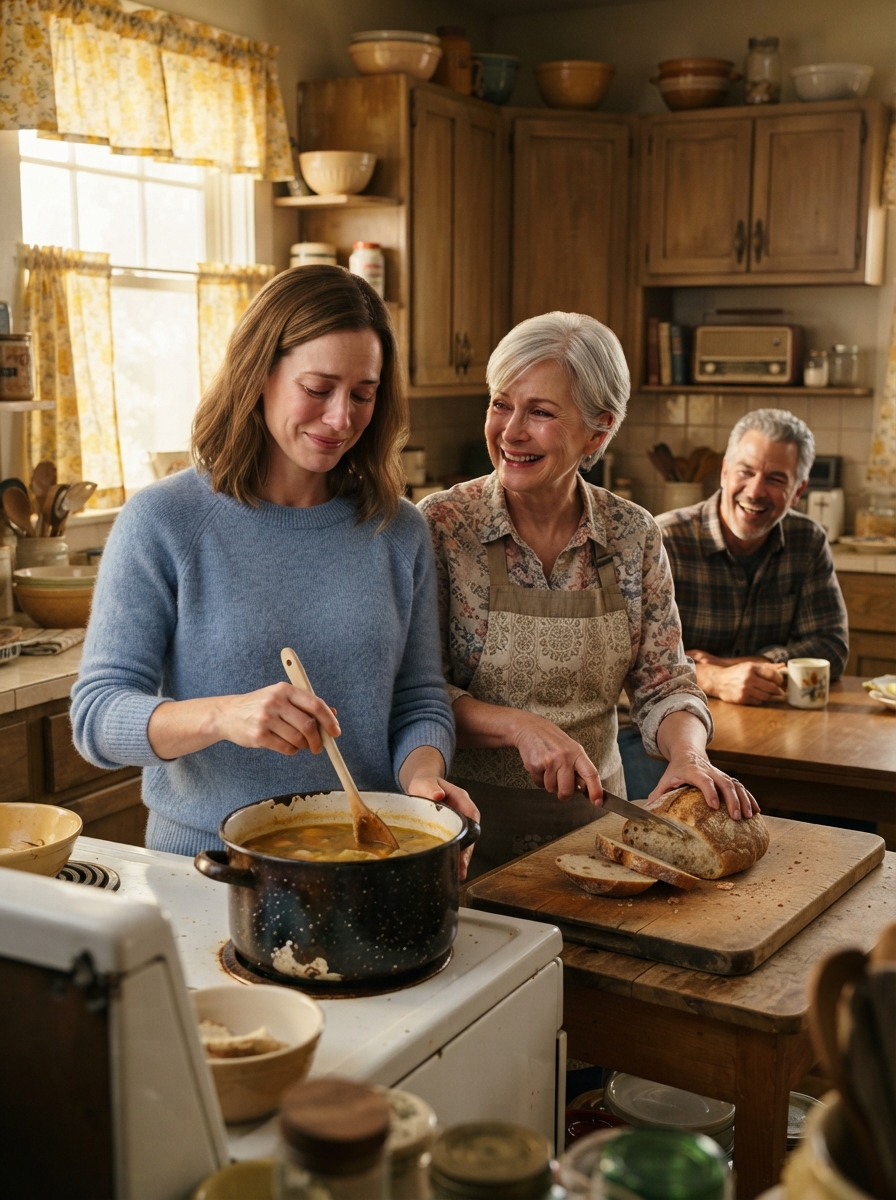
Reporters swarmed the exterior afterward, but Ben insulated us from the spectacle; our priority remained personal peace rather than public theater. That evening, anchored at my kitchen table, Janet tended to the stove while I prepared bread, listening to Sam recount a ridiculous childhood misadventure. Janet’s laughter filled the room entirely.
Standing there with a wooden spoon in hand, a profound warmth filled my chest. It wasn’t a restoration of the old existence — that was permanently altered — but it was an authentic life forged in the light of absolute truth.
Before dinner was served, Janet looked across the table. “Mom, what do we do now?”
I reflected on the cellar, the forged records, the vibrating phone, the stolen timeline, and the journey toward recovery before offering the only honest conclusion available.
“Now we live,” I stated. “And we do it out loud.”
That remains the fundamental lesson of our ordeal: honor your intuition and refuse to let polished presentation invalidate your internal truth. Deception can mimic peace temporarily, but the truth preserves existence. Ultimately, familial bonds are not defined by who laments at a graveside, but by who defends the truth when the consequences are absolute.
Disclaimer: This content may be created by AI for entertainment purposes. Any resemblance to real persons, events, or places is coincidental.
