


“Your Daughter Isn’t Blind”— A Homeless Boy’s Warning Uncovered a Chilling Secret Inside a Billionaire’s Home
“Your daughter isn’t blind… your wife has been lacing her food with something.” The homeless boy’s hushed warning sent a jolt through Marcus Bennett’s entire body. The world seemed to freeze.
The afternoon heat pressed down on Accra, draping the city in stillness. Traffic crawled nearby, street vendors shouted their wares, and children’s laughter drifted from the park as they chased each other around.
But none of it reached Marcus Bennett.
Once one of the most respected names in international finance, Marcus had spent two decades building an empire — negotiating billion-dollar deals, advising world governments, gracing magazine covers across the globe.
None of that meant anything now.
Because the one thing he treasured most was fading from him.
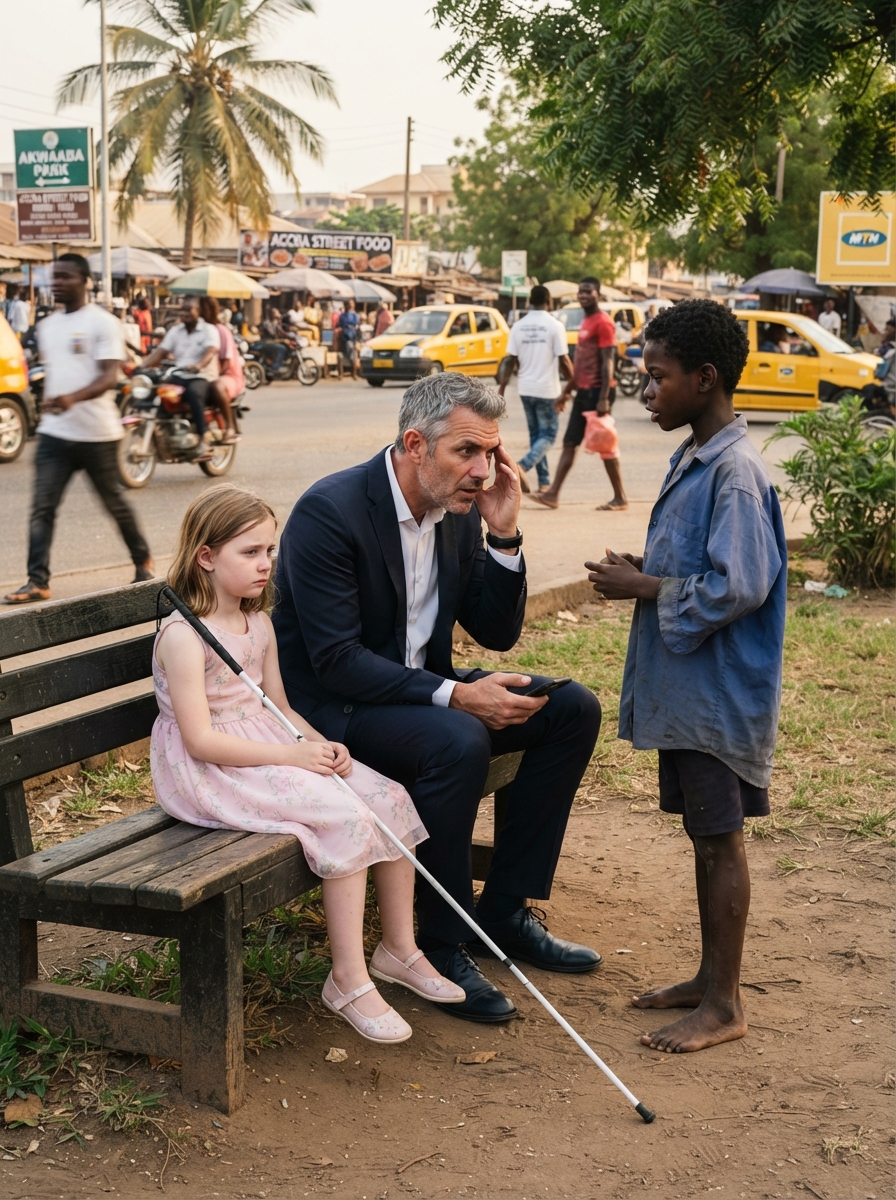
His seven-year-old daughter, Lila, sat beside him on a worn park bench, a white cane resting across her lap.
Just six months earlier, she’d been a lively, curious child — painting pictures, scaling trees, running barefoot through the garden behind their mansion.
Now she could barely walk unassisted.
Every specialist gave the same verdict.
A rare degenerative disease.
Incurable.
Worsening.
Irreversible.
Marcus had flown her to London, Dubai, Paris, New York. He’d poured millions into finding answers.
Nothing had changed.
Every doctor told him the same thing.
Lila was going blind.
“Daddy?”
Her small voice pulled him out of his thoughts.
“Yes, sweetheart?”
“Is it nighttime already?”
Marcus swallowed hard.
It was barely two in the afternoon.
“No, baby,” he said softly. “Just some clouds.”
Lila nodded and gave a faint smile.
Marcus turned away before she could catch the tears building in his eyes.
That’s when he noticed the boy.
Around ten years old.
Skinny.
Dressed in worn clothes several sizes too big.
He stood a few feet off, watching them.
Not begging.
Not asking for a handout.
Just watching.
Marcus exhaled.
Normally he’d have offered something. But today he had nothing left to spare.
“Sorry, kid,” Marcus said. “Not today.”
The boy didn’t budge.
Instead, he took a step closer.
His dark eyes landed on Lila.
Then he spoke, quiet and even.
“Your daughter isn’t sick, sir.”
Marcus frowned. “What?”
“She isn’t losing her sight.”
The boy’s tone stayed calm.
“Someone’s taking it from her.”
Marcus shot to his feet.
“What are you talking about?”
The boy paused.
[For illustrative purposes only]
Then he said the words that changed everything.
“It’s your wife.”
The world seemed to freeze.
Marcus Bennett stared at the boy like he’d spoken in a foreign tongue.
“My wife?” he repeated, voice dropping low, edged with warning.
The boy didn’t flinch. He only glanced at Lila, sitting quietly beside her father, small fingers curled around the white cane.
“She puts something in the girl’s food,” the boy said. “Not every meal. Just enough to weaken her. Just enough to make people believe she’s ill.”
Marcus rose so abruptly that Lila jumped.
“Daddy?”
He forced a breath. “It’s okay, sweetheart.”
He turned back to the boy. “What’s your name?”
“Kofi.”
“And how would you know something like that?”
For the first time, the boy’s composure slipped. He stared down at his worn-out shoes.
“Because I used to sleep behind your house.”
Marcus froze.
Kofi went on. “Near the kitchen window. Your guards never checked over there. I saw her — many times. At night. When the cook wasn’t around.”
Marcus wanted to dismiss every word. Vivian, his wife, was elegant, well-educated, admired. She’d stood at his side through charity galas and doctor’s visits. She’d wept in front of physicians. She’d held Lila’s hand.
But a memory surfaced.
Lila’s illness had started only after Vivian moved back into the mansion.
Marcus and Vivian’s marriage had been rocky for years. They’d quietly separated, then reconciled after Vivian pleaded for another chance — insisting she wanted to be a real mother to Lila.
Not long after, Lila started stumbling.
Then squinting.
Then crying at night because the world was “getting darker.”
Marcus’s stomach turned.
“Why didn’t you say something sooner?” he asked.
Shame filled Kofi’s eyes. “Who would listen to me, sir? I’m just a street kid.”
Marcus looked at his daughter.
Lila tilted her face up toward him. “Daddy, are you mad?”
“No,” Marcus murmured, his hands shaking. “I’m awake.”
That night, Marcus didn’t confront Vivian.
For the first time in his life, he understood real power wasn’t loud. Sometimes it was silence. Patience. Evidence.
He phoned Dr. Elena Rhodes, a trusted pediatric specialist in London who’d never fully agreed with the original diagnosis.
“Marcus,” she said over the line, “bring Lila to me right away. And bring samples of whatever she regularly eats.”
Marcus quietly arranged everything.
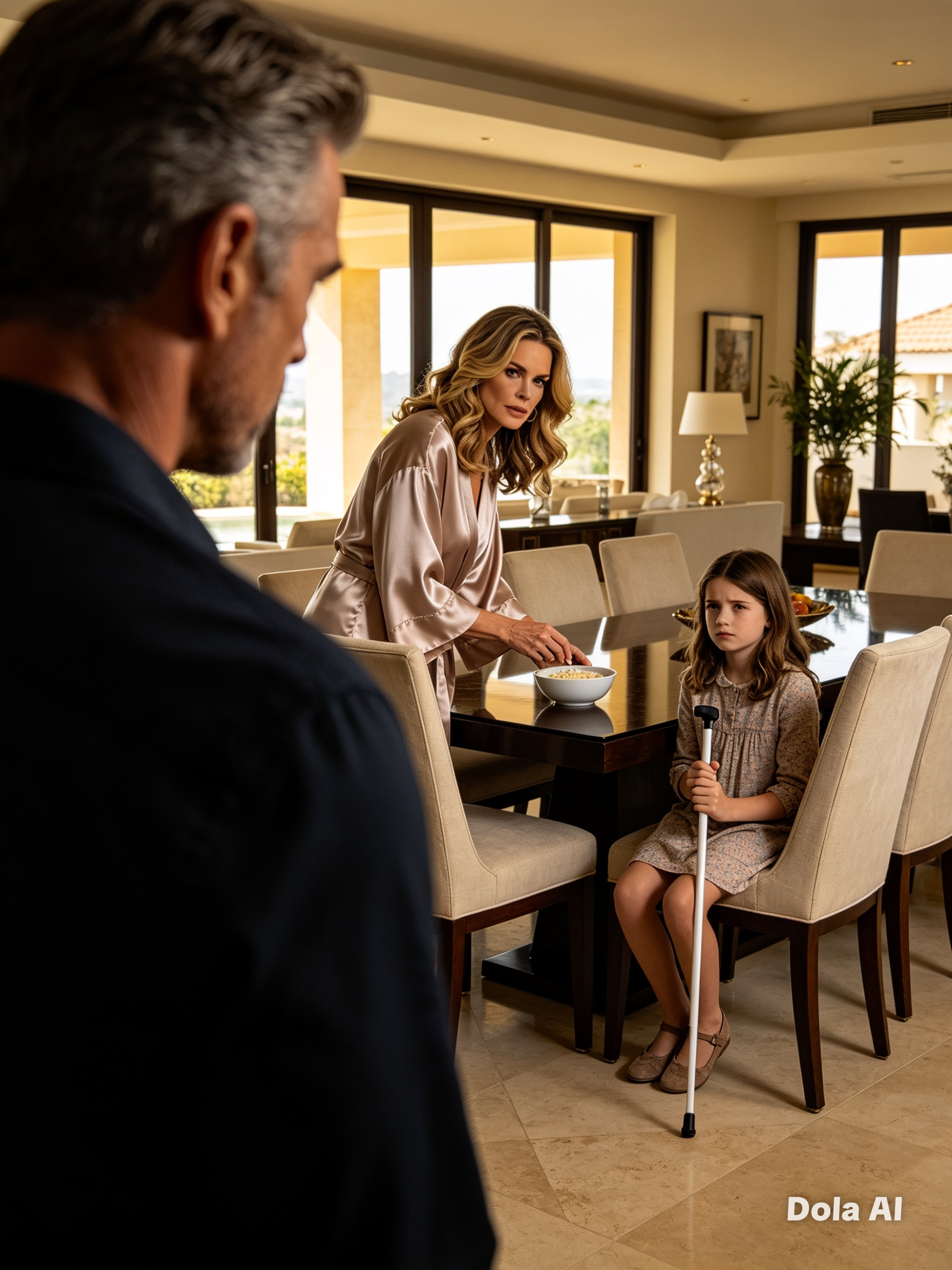
The next morning, Vivian appeared at breakfast in a silk robe, smiling as though nothing were amiss.
“How’s our little angel today?” she asked, setting a bowl of porridge in front of Lila.
Marcus watched her hand closely.
For a brief moment, Vivian’s gaze flicked toward him.
He smiled evenly. “Lila isn’t hungry yet.”
Vivian’s smile stiffened. “She needs to eat.”
“She will,” Marcus said. “Later.”
Once Vivian left the room, Marcus sealed the bowl carefully and handed it to his driver.
By noon, he and Lila were on a private flight to London.
Kofi came along.
When Marcus asked why he wanted to help, the boy’s answer was simple.
“My little sister got sick once,” he said quietly. “Nobody listened until it was too late.”
Marcus said nothing, but his eyes burned.
In London, Dr. Rhodes examined Lila for hours — blood work, scans, vision tests, everything.
When she finally stepped into the room, Marcus was on his feet before she spoke.
“Elena?”
The doctor’s expression was serious, but hope flickered in her eyes.
“Marcus… Lila isn’t blind.”
His knees nearly buckled.
Dr. Rhodes continued. “Her vision has been damaged by repeated exposure to a harmful substance. I can’t yet say how much damage has been done, but I believe much of it could reverse if the exposure stops immediately.”
Lila turned her head. “Daddy?”
Marcus dropped to his knees beside her chair and took her hands.
“You’re going to see again, sweetheart.”
For the first time in months, Lila smiled like a kid again, not a patient.
But Marcus didn’t smile.
Because behind his relief sat something colder.
The truth.
[For illustrative purposes only]
When Marcus returned to Accra, he wasn’t the broken man who’d sat in that park.
He came back as a father.
He brought Dr. Rhodes, legal witnesses, the test results. He brought Kofi too.
Vivian was waiting at the mansion, furious.
“How dare you take my daughter out of the country without telling me?”
Marcus walked into the living room and set the medical report on the table.
“She isn’t your daughter,” he said quietly. “And she was never sick.”
Vivian’s expression shifted.
Only for a second.
But Marcus caught it.
The police arrived minutes later.
They searched the kitchen. Questioned the staff. Found a hidden bottle in a cabinet Vivian believed no one would check. The cook, shaking and in tears, admitted Vivian had often insisted on preparing Lila’s breakfast herself.
Vivian denied everything at first.
Then blamed stress.
Then jealousy.
Then love.
“I only wanted you to need me,” she sobbed. “After your first wife died, you only had eyes for that child. I was invisible in my own home.”
Marcus looked at her with grief, not love.
“You were never invisible,” he said. “You were trusted.”
Vivian was taken into custody.
The mansion felt different afterward. Quieter. Cleaner. As though the walls themselves had been holding their breath.
Lila’s recovery came slowly, but it came.
First she could make out shapes.
Then colors.
One morning, as sunlight poured through the curtains, she gasped.
“Daddy…”
Marcus rushed to her side.
She lifted a trembling finger toward the window.
“The flowers,” she whispered. “They’re yellow.”
Marcus pressed a hand to his mouth, unable to hold back the tears.
Kofi stood near the doorway, fighting a smile.
Lila turned toward him. “Kofi?”
“Yes?”
“I can see your face.”
The boy went still.
Then Lila laughed softly. “You look nicer than your voice.”
For the first time Marcus had ever witnessed, Kofi cried.
Months passed.
Marcus stepped back from the cutthroat world of finance. He still worked, but differently now. He launched a foundation in Accra for abandoned children, medical care, and safe housing. He called it The Clear Light Foundation.
At the opening ceremony, reporters crowded around, expecting remarks about betrayal, justice, scandal.
Instead, Marcus took Lila’s hand.
Then rested his other hand on Kofi’s shoulder.
“For years, I believed power meant money,” he said. “Then my daughter nearly lost her sight, and the one who saved her was a child the world had overlooked.”
The crowd went quiet.
Marcus glanced down at Kofi.
“This boy had no home, no protection, no reason to trust a soul. But he chose courage anyway.”
Kofi bowed his head, overcome.
Marcus went on. “As of today, Kofi is not a homeless boy. He is my son.”
A ripple of emotion moved through the crowd.
Lila threw her arms around Kofi. “I told you, Daddy. He already felt like family.”
Kofi looked up at Marcus, lips trembling.
“Sir…”

Marcus knelt down in front of him.
“No,” he said gently. “Not sir.”
Kofi blinked back tears.
Then, in the smallest voice, he whispered, “Dad?”
Marcus pulled him into an embrace.
And under the bright Accra sun, surrounded by cameras, strangers, doctors, and children waiting for a second chance, Marcus Bennett finally grasped something no boardroom had ever taught him.
Sometimes the truth doesn’t arrive wearing authority.
Sometimes it comes barefoot.
Hungry.
Forgotten.
Standing quietly in a park.
And sometimes, the smallest voice is the one that saves everyone.
