

**Road Rage and Reckoning: When a Father’s Call Changes Everything**
The suburban road stretched long and deceptively quiet that warm afternoon. It was the kind of stretch where drivers accelerate because they believe no one is watching. My son, helmet strapped tight, rode just ahead of me on the shoulder, exactly as I had taught him—head down, eyes forward, staying predictable. Then the engine roared behind us. Loud. Aggressive. Too fast.
A sleek sedan drifted right—too far right—its tires biting the edge of the bike lane. I shouted my son’s name. The car swerved again, deliberate this time, clipping the gravel. His tire skidded. For one terrifying second, I watched him fight for balance, knuckles white on the handlebars. He stayed upright, but barely.

I slammed the brakes of my own vehicle, which I had pulled over moments earlier, and jumped out. The sedan rolled forward another twenty yards before stopping, as if the driver were weighing whether this inconvenience was worth his time. The window descended halfway. A man in his mid-forties, wearing expensive sunglasses, looked out with a smirk already formed.
“You need to teach your kid where he belongs,” he said flatly. “This isn’t a playground.”
My son stood frozen beside his bike. “You almost hit me,” he said, voice cracking before steadying. “You pushed me off the road.”
The driver laughed—amused, not nervous. “I didn’t touch you. Relax.”
I stepped closer. “You forced him off the lane. You accelerated into the shoulder.”
He shrugged. “He shouldn’t be here.”
By then, other cars had slowed. A pickup truck pulled over. Someone raised a phone. The driver leaned farther out. “People like you always think the road owes you something.” His tone carried the casual entitlement of someone who had never been held accountable.
My son swallowed hard. “You didn’t even slow down.”
The man tilted his head. “And you’re still standing, aren’t you?”
My pulse hammered in my neck, but I kept my voice level. I reached for my phone and made one call. That was all it took.
Eight minutes later, the atmosphere shifted. First one black SUV appeared, then another, then several more—gliding in from both directions, engines quiet, movements controlled. No sirens. No shouting. Just presence. The sedan was boxed in neatly. The driver’s smirk evaporated.
“What the hell is this?” he demanded, pushing his door open. A suited man stepped calmly into his path.
“Sir, please stay inside the vehicle for now,” the man said evenly.
The driver forced a laugh. “You can’t do this. This is a public road.”
Another operative approached from behind. “We’re not doing anything illegal. We’re just here to talk.”
My son whispered, “Dad… who are they?”
I placed a hand on his shoulder. “They work with me.”
The driver finally looked at me—really looked. “You set this up? Over a bike?”
“Over my son,” I replied.
He scoffed. “I didn’t hit him.”
One of the team members held up a tablet. “Actually, your vehicle’s front camera footage shows you accelerating toward the shoulder—twice. We’ve already pulled the data.”
The pickup driver raised his phone. “And I recorded the whole thing.”
The man’s jaw tightened. “You’re blowing this out of proportion. Kids get scared. It happens.”
My son spoke up again, voice firmer now. “You told me I didn’t belong on the road.”
The driver hesitated. “I didn’t mean—”
“Yes, you did,” my son cut in. “You laughed.”
Silence settled over the scene. Even the idling engines seemed subdued. I nodded once.
“You’re going to apologize. To him. Not to me.”
The driver blinked. “Excuse me?”
One of the suited men leaned in slightly. “This can end quickly and cleanly if you choose the right words, sir.”
Surrounded by phones, cameras, and unflinching professionals, the driver exhaled sharply. “I’m sorry,” he muttered.
I shook my head. “Mean it.”
He turned toward my son. “I’m sorry. I shouldn’t have done that.”
My son held his gaze. “You scared me. And you didn’t care.”
The man nodded stiffly. “I shouldn’t have scared you.”
But an apology was only the beginning. One team member handed him a card. “Your insurance company has already been notified. The licensing authority will review the footage as well.”
The driver’s face went pale. “You can’t be serious.”
“We already are.”
As my son and I walked back toward our vehicle, I heard the driver ask quietly, “Who are you people?”
No one answered.
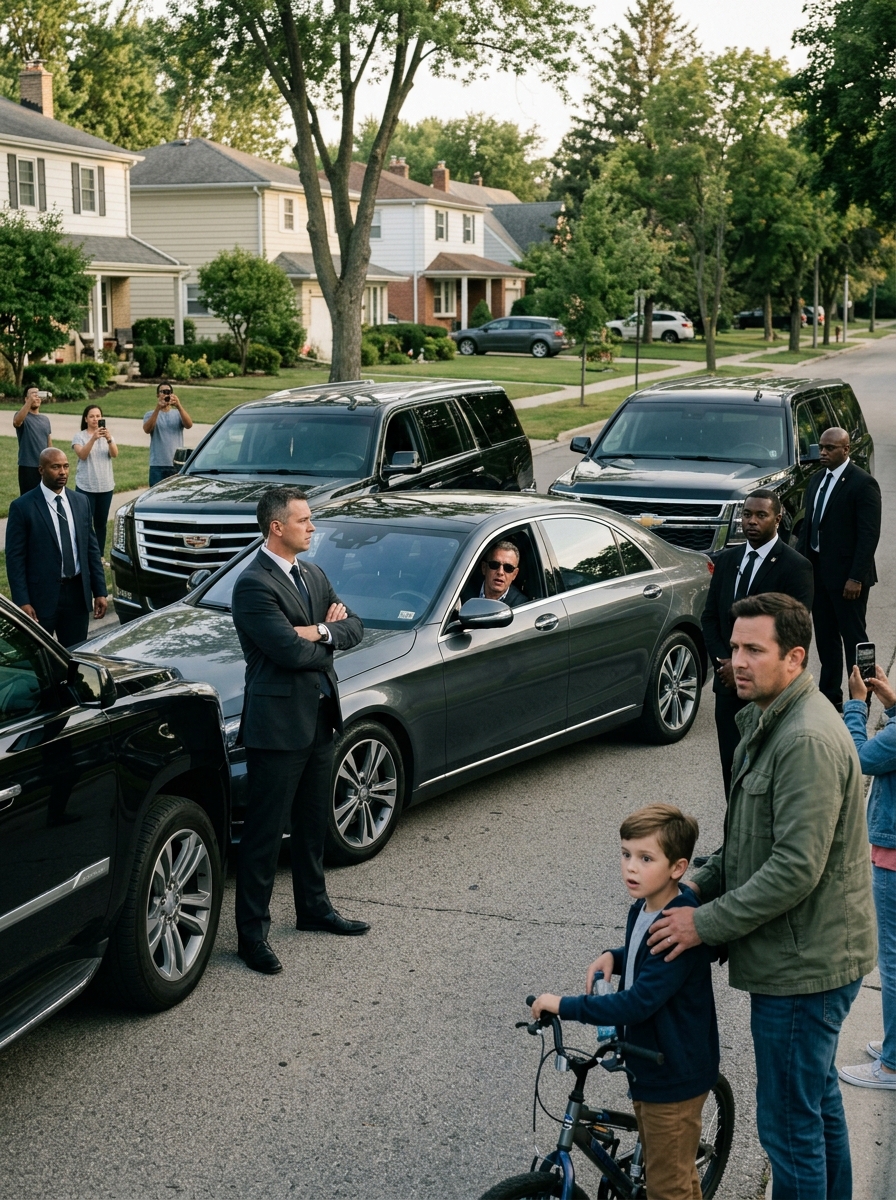
This incident, which occurred on an otherwise ordinary afternoon, reveals deeper fractures in how we share public spaces. Road safety for vulnerable users—cyclists, pedestrians, children—remains a persistent challenge. According to data from transportation safety organizations, thousands of cyclists are injured or killed annually in collisions involving motor vehicles, often due to drivers failing to yield or maintain safe distances. In suburban areas especially, where bike lanes are inconsistent and enforcement sporadic, the power imbalance between cars and bikes is stark.
What unfolded that day was not vigilantism. It was accountability delivered swiftly through preparation, technology, and professional presence. The father in this story—let’s call him a composite of many protective parents who possess both resources and resolve—did not escalate with violence. Instead, he leveraged connections built over years in security and executive protection work. The team that arrived consisted of trained professionals who specialize in risk mitigation, evidence collection, and de-escalation. Their role was documentation and containment, not confrontation.
This raises important questions about power, privilege, and justice. Would an average parent without such resources have received the same outcome? In many cases, the answer is no. Police response times vary, minor traffic incidents often receive low priority, and dashcam or bystander footage, while increasingly common, does not always translate into meaningful consequences. The driver’s initial confidence—“Good luck explaining why your kid’s in traffic”—reflected a common societal attitude: cyclists are interlopers, and any danger they face is their own fault.
Yet the law in most jurisdictions is clear. Vehicles must yield to cyclists in designated lanes and maintain safe passing distances—typically three to four feet depending on the state or country. Deliberately crowding or intimidating a cyclist can constitute reckless driving, assault, or both. The footage in this incident provided irrefutable evidence: acceleration into the shoulder, failure to slow, verbal acknowledgment of intent. Modern vehicles equipped with cameras, combined with widespread smartphone recording, are shifting the balance of proof.
Beyond the immediate confrontation, the story highlights the psychological impact on children. My son, though physically unharmed, carried the memory of fear and dismissal. For days afterward, he processed the event through questions: “Why did he laugh?” “Why didn’t he care?” These moments shape how young people view authority, fairness, and their right to occupy public space. Teaching resilience is important, but so is demonstrating that intimidation has consequences.
The broader cultural issue is entitlement behind the wheel. Speeding through residential or suburban areas, distracted driving, and aggressive maneuvers often stem from a belief that time and convenience trump everyone else’s safety. Campaigns promoting “Share the Road” have existed for decades, yet enforcement remains inconsistent. High-profile cases occasionally spark public outrage, but systemic change is slow.
In this particular case, consequences extended beyond the apology. Insurance notification, license review, and documentation in a private security database serve as deterrents. The driver, likely accustomed to moving through life with minimal friction, faced tangible repercussions. Whether this changes his behavior permanently remains to be seen, but the immediate lesson was clear: actions have witnesses, and some witnesses have influence.
Parents who cycle with children face unique calculations. Every ride involves risk assessment—traffic volume, road conditions, driver awareness. Many choose group rides or dedicated trails, yet part of the appeal of cycling is freedom and normalcy. Teaching children to be predictable, visible, and assertive is essential, but it should not absolve drivers of their greater responsibility. A two-ton vehicle versus a bicycle is not an equal contest.
Reflecting on the event, several principles emerge. First, preparation matters. Having emergency contacts, vehicle cameras, and awareness of one’s rights can transform vulnerability into strength. Second, calm documentation often proves more effective than heated argument. Third, community involvement—bystanders who stop and record—strengthens accountability. The pickup driver’s footage was pivotal.
Yet the story also invites discomfort. The deployment of multiple SUVs and professionals raises questions about proportionality. Was boxing in the vehicle an overreaction? From the father’s perspective, the answer is no—his child’s life was endangered, and a pattern of behavior needed interruption. Others might argue for calling law enforcement exclusively. In practice, both approaches have value. Private response can bridge gaps when public systems are overburdened.
Ultimately, this incident underscores a fundamental truth: respect on the road is not optional. It is a social contract. When that contract is violated—especially when children are involved—society benefits from mechanisms that restore balance. An apology, while necessary, is rarely sufficient on its own. Genuine accountability includes reflection, restitution where appropriate, and behavioral change.
My son continued riding that day. We finished our route together, talking through what happened. He learned that fear can be met with composure, and that standing up for safety is not just the driver’s job—it is everyone’s. As we pedaled home, the suburban road felt a little less intimidating.
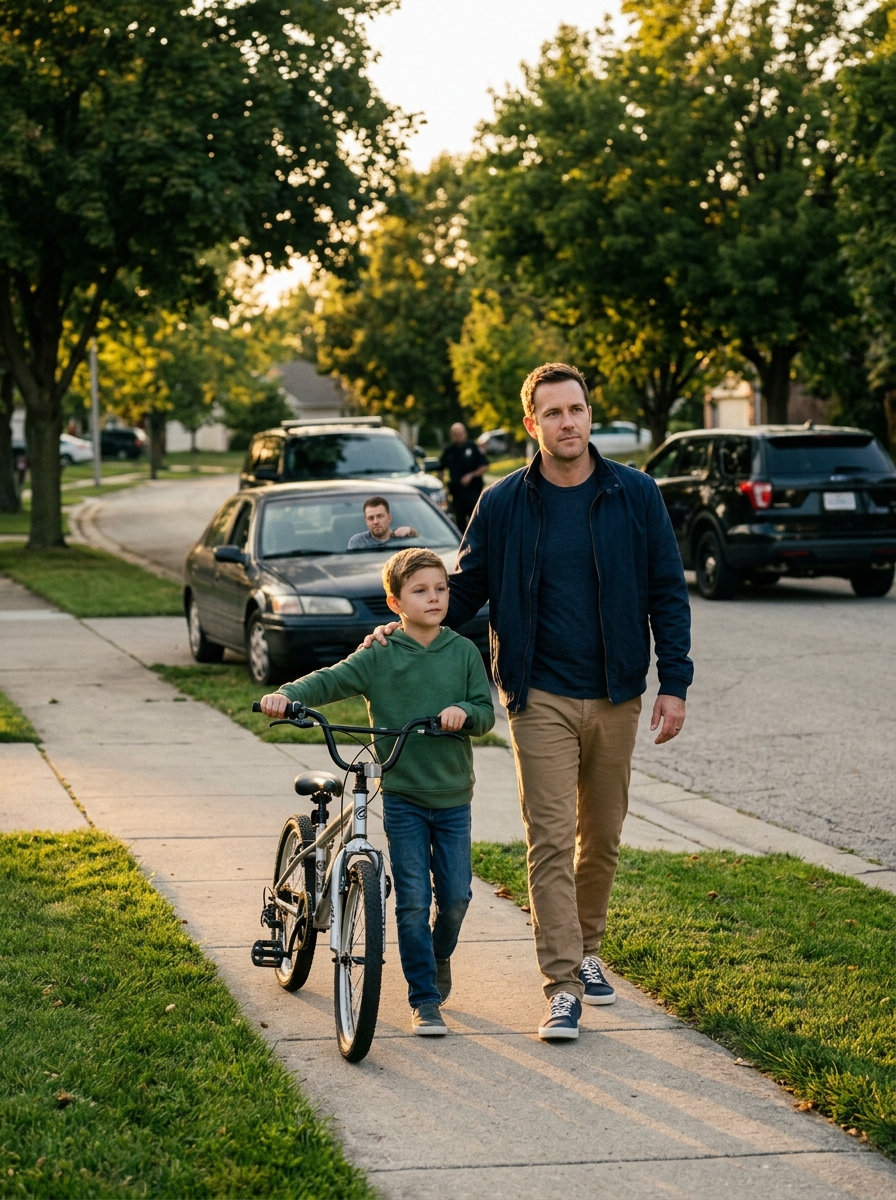
The question lingers for all of us: If you witnessed such an event, would you intervene—by recording, stopping, or simply bearing witness? Or would you keep driving, telling yourself it’s not your concern? In an era of increasing traffic density and divided attention, these small moments of moral choice accumulate into the culture we create.
Respect still matters. For children learning independence. For parents protecting them. For drivers who share the responsibility of two-ton machines. The road belongs to all of us—provided we treat it as a shared space rather than a personal domain.
