


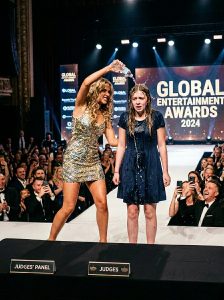
She threw water on me on stage because she thought I was too plain to stand next to her.
That was the part everyone saw.
What they didn’t see was the book in her hand.
For illustrative purposes only
Or the thing I had hidden inside it.
Or the fact that I had spent eight months crafting the words she was now using to build her fame.
The Literary Rising Star Award was supposed to be the happiest night of her life.
Instead, it became the night she discovered what happens when you humiliate the person who knows exactly how your lie was built.
My name is Eliana Brooks.
At Westfield University, nobody knew me unless they needed something written better.
A speech.
An essay.
A recommendation letter draft.
A poem for a girlfriend.
A chapter that wasn’t working.
I was the girl people called “gifted” when they wanted free labor and “weird” when they were done with me.
I didn’t dress like the girls who got noticed.
I wore the same clean, simple clothes over and over because that was what I could afford.
I tied my hair back.
I kept my head down.
I listened more than I talked.
And I wrote.
I wrote because it was the only place nobody could interrupt me.
Then there was Sienna Vale.
Everyone knew Sienna.
She was beautiful in the polished, expensive, practiced way that made people forgive her before she even spoke.
Her father funded part of the arts building.
Her mother sat on charity boards.
Professors smiled too hard when she entered a room.
Other students orbited around her like she was a second campus sun.
Sienna called herself a novelist.
What she really was, at first, was a girl with ambition, image, and absolutely no discipline.
We met in Advanced Fiction Workshop.
Professor Hargrove loved my writing but never quite knew what to do with me socially. I made people uncomfortable because I didn’t play the game.
Sienna did.
On the first day, Hargrove praised one of my pages out loud.
Sienna turned in her chair, looked at me, and smiled.
Not warmly.
Like she had just found a tool.
After class, she stopped me in the hallway.
“That scene was incredible,” she said. “You have such a… raw mind.”
That pause before “raw” told me everything.
She was complimenting me and looking down on me at the same time.
I should have walked away.
I didn’t.
A week later, she asked if I’d look at some chapters she was “developing.”
They were bad.
Pretty sentences. Empty center.
All posture. No pulse.
But I gave notes.
Then I gave more notes.
Then I rewrote a paragraph to show what I meant.
Then a page.
Then a chapter outline.
Then suddenly I was meeting her at coffee shops and “helping shape her voice.”
She would slide her laptop across the table and say things like:
“You just understand pain better than I do.”
Or:
“You make it sound real.”
Or my favorite:
“Don’t be weird about it. Collaboration is normal.”
Collaboration.
That was the word she used when I was doing the work and she was collecting the credit.
At first, I told myself it wasn’t theft.
I told myself I was learning.
I told myself maybe she would acknowledge me when it mattered.
Then one afternoon in the student center, I heard her talking to two girls from the campus lit magazine.
She didn’t know I was behind the vending machine wall.
“I swear,” Sienna laughed, “that ghost girl from workshop is useful, but she’s so tragic-looking. Like if thrift stores wrote poetry.”
The girls laughed.
One asked, “Does she think she’s your co-writer?”
Sienna snorted.
“She’s basically a spellcheck app with bangs.”
I stood there with a granola bar in my hand and felt my face burn.
That should have been the end.
It wasn’t.
Because a month later she came to me crying.
Actual tears.
Mascara perfectly smudged.
She said a publisher’s student imprint had shown interest in her manuscript, but she was “so overwhelmed” and “so scared of failing.”
She said I was the only person she trusted.
She said, “Please, Eliana. You know this book better than anyone.”
That part was true.
Because by then, half the emotional core of that manuscript had come from me.
My images.
My phrasing.
My instincts.
My sleepless nights.
Only I was too naïve to call it what it was.
By the time the book contract came through, I was buried in her draft history, fixing continuity errors, rewriting clunky scenes, making dead chapters breathe.
Every time I hinted about credit, she would go cold.
“Do not embarrass me by making this transactional.”
Or:
“You’re helping because you care about the art.”
Or:
“You know people already doubt women enough. Don’t sabotage another woman out of insecurity.”
That one almost made me laugh.
She weaponized feminism like perfume.
A mist over rot.
Then her book came out.
Ashes Between Roses.
Campus went insane.
Posters.
Interviews.
Panels.
A launch party with white flowers and custom macarons.
I got an email invitation like every other student.
No mention of my help.
No thank-you.
No private note.
Nothing.
I stopped answering her messages after that.
For three weeks, she sent a mix of sweetness and rage.
“Don’t be dramatic.”
“You know I appreciate you.”
“You’re not the author.”
“You never would have made this marketable.”
That last message saved me.
Because I had finally learned to stop feeling hurt long enough to start collecting evidence.
I still had old drafts.
Tracked changes.
Voice memos.
Emails where she literally wrote, “Can you rewrite chapter six so it sounds like you?”
I had meeting dates.
Annotated printouts in my handwriting.
Metadata on documents.
I had enough to prove she hadn’t simply been “inspired.”
I had enough to prove pattern, dependence, deception.
Still, I stayed quiet.
Because public people fear public truth more than private confrontation.
And Sienna loved crowds too much for me to waste this in a closed office.
When Westfield announced she’d be honored at the annual Literary Achievement Gala, I knew that was the night.
Not because I wanted revenge.
Because I wanted a witness.
I wanted all the smiling people who helped build her false halo to watch it crack.
But I also knew accusation alone wasn’t enough.
People forgive the pretty liar when the truth is too complicated.
So I built something simpler.
A trap inside the book.
Months earlier, when she was making me “polish” the final structure, I had inserted a private signature into the chapter openings.
Subtle.
Invisible to anyone not looking.
The first letter of each chapter’s opening sentence formed an acrostic message across the book:
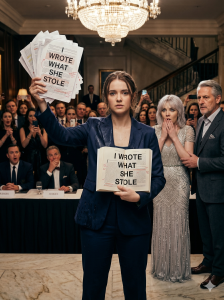
I WROTE WHAT SHE STOLE
It was hidden in plain sight.
Not enough by itself for court, maybe.
But more than enough to stop a room.
More than enough to force attention.
And once attention landed, I had the rest.
So yes, when she threw water on me at that gala, she made my job easier.
The ballroom that night looked like old money pretending to be literature.
Gold chandeliers.
Velvet curtains.
Round tables glowing under candlelight.
Faculty in black suits.
Students desperate to be seen.
Publishers measuring everyone.
I only went because Professor Hargrove personally asked me to attend.
Maybe guilt had finally reached him.
Maybe he suspected more than he admitted.
I wore my only decent dress, navy blue, simple, unremarkable.
Sienna wore silver.
Of course she wore silver.
She wanted to look like a trophy that had learned to walk.
When her name was called, the room erupted.
She floated to the stage, smiling, one hand over her heart, book in the other.
Then she saw me near the front aisle.
Her eyes sharpened.
It was instant.
She did not want me visible in her moment.
She gave the host a sweet smile, took the crystal water glass from the podium, stepped toward me, and said into the microphone:
“It’s honestly adorable when support staff forget where they belong.”
Some people laughed because they thought it was a joke.
Then she threw the water.
Right onto my chest.
My dress clung to me.
My notebook slipped from my arm and landed on the floor.
A hundred faces turned.
A hundred little shocks passed through the room.
And Sienna said, with that cruel soft voice:
“You write in the shadows. Stay there.”
That was the moment from the post.
The moment everyone remembers.
What they remember next is quieter.
I bent down.
Picked up my notebook.
Set it on a nearby chair.
Then I walked toward the stage.
No screaming.
No crying.
No scene.
That scared her more.
The host tried to step in, but I said, “It’s okay. I just want her to do one thing.”
Sienna smiled again, but barely.
“You’re embarrassing yourself.”
I looked at her book.
“No. Read chapter one. First sentence.”
The room went still.
She laughed lightly. “Is this performance art?”
“Read it.”
Professor Hargrove stood up.
“Ms. Vale,” he said, voice tight, “just read the line.”
Now she had no exit that didn’t look guilty.
She opened the book.
Read the first sentence.
I said, “Now chapter two.”
Murmurs started.
She read it.
“Chapter three.”
By chapter four, people were looking at each other.
By chapter six, one of the judges had taken out a pen and was scribbling letters on a program.
By chapter eight, Sienna’s voice had changed.
The judge stood up.
Looked at the letters.
Then looked at me.
Then at Sienna.
“Continue,” he said.
For illustrative purposes only
She didn’t want to.
She had gone pale in a room full of warm light.
Her fingers shook against the pages.
By the final chapter, the message was undeniable.
I WROTE WHAT SHE STOLE
The ballroom exploded.
Actual gasps.
People standing.
Phones up higher now, not to mock me, but to capture her collapse.
Sienna tried to laugh.
“This is insane. It’s a coincidence.”
That’s when I opened my notebook.
Not dramatically.
Just steadily.
Inside were printouts, email headers, draft comparisons, dated notes.
I handed the first packet to the head judge.
The second to Professor Hargrove.
The third to the student newspaper editor who had once ignored my pitch because “stories need a stronger face.”
Then I spoke into the same microphone she had used to humiliate me.
“You called me support staff.”
I held up one marked-up chapter.
“This is your so-called original draft of chapter six.”
Then I held up another.
“This is the version you submitted after asking me to rewrite it because, quote, ‘it needs more soul.’”
The room was silent except for the rustle of paper.
I kept going.
“You told people I helped with proofreading. I rewrote structure, scenes, dialogue, and emotional arc. You asked me to make your characters sound human. You asked me to fix what you could not write.”
Sienna snapped, “You volunteered!”
I turned to her.
“No. I was exploited.”
That landed harder than I expected.
Because everyone in that room understood the word.
Exploited.
A pretty, polished theft.
Professor Hargrove looked sick.
One of the publishers asked to see the email printouts.
Another judge was already flipping through timestamped drafts.
Then came the fatal detail.
A scene in the book about a girl hiding a note inside the hem of a funeral dress.
The judges loved it. Reviewers had called it “achingly original.”
Sienna once bragged in an interview that she wrote it from a “childhood family memory.”
I looked at her on that stage and said, “Tell them where you got the funeral dress image.”
She stared at me.
I answered for her.
“You got it from a story I told you in confidence about my mother. In my apartment. In February. While you were eating takeout and asking me how grief feels in the body.”
A sound moved through the crowd like wind.
Because now this was not vague authorship.
This was identifiable theft.
Private detail.
Human detail.
The kind only one person would know.
Sienna tried one last move.
She cried.
Of course she cried.
Said pressure had gotten to her.
Said collaboration had become blurry.
Said she never meant to hurt anyone.
But lies sound different after evidence.
Within twenty-four hours, the university suspended her literary honor.
Within forty-eight, the student imprint froze distribution pending investigation.
Within a week, the campus paper ran the story with side-by-side drafts.
They didn’t need me to exaggerate.
The truth was enough.
Sienna lost her speaking invitations first.
Then the book deal.
Then the internship a magazine had promised her.
A formal review found “substantial uncredited authorship contributions and misrepresentation.”
That was the clean version.
The dirty version was simpler.
Nobody trusted her anymore.
Her social media apology made things worse.
Too polished.
Too late.
Too centered on her own pain.
She transferred the following semester.
Professor Hargrove called me into his office two weeks later.
He looked older.
Smaller.
“I failed you,” he said.
It did not fix anything.
But for once, somebody named it plainly.
He helped connect me with an attorney from an authors’ rights group.
Because yes, there were legal consequences too.
We reached a settlement after months of documentation.
I cannot tell you every term.
I can tell you this:
My contribution was formally acknowledged.
My material was protected.
Money changed hands.
And the record was corrected.
Rule-based revenge is slow.
But it holds.
That was the part I needed.
Not chaos.
Not screaming.
Not fantasy.
Proof.
Paper.
Consequences.
And then something happened I had not planned for.
People started reading my own work.
Not Sienna’s polished theft.
Mine.
The campus journal published a story under my real name.
Then another.
A small independent press reached out after the scandal and asked if I had a manuscript of my own.
I did.
Of course I did.
Writers like me always do.
We just usually keep it hidden while louder people take the oxygen.
A year later, my debut novel came out.
Not under someone else’s smile.
Under my name.
Eliana Brooks.
On launch night, the room was smaller than Sienna’s had been.
Less glitter.
More truth.
My professor came.
A few students from workshop came.
The student editor came and apologized for not seeing me sooner.
Even my landlord came with grocery-store flowers.
Nobody treated me like an accessory.
Nobody asked me to stand in the shadows.
And when I signed the first copy for a teenage girl in a thrift-store cardigan who said, “You make me feel like quiet girls still have a chance,” I nearly cried.
Because that was the real ending.
Not Sienna falling.
Me standing.
Me being seen.
Me no longer confusing usefulness with friendship.
Me no longer giving talent to people who call exploitation opportunity.
For illustrative purposes only
Some people still ask whether I went too far by exposing her publicly.
Here is my answer:
She chose the public stage.
She chose the humiliation.
She chose to build her crown out of someone else’s words.
All I did was turn on the light.
So I want a clear answer from you, not a polite one:
TEAM ELIANA — expose the thief publicly and protect your dignity. TEAM SIENNA — keep it private, even after the public humiliation.
Pick a side. Share this if you believe quiet people should never be mistaken for weak.
