


The emcee tapped the microphone right as I rose from the floor.
My boss was still smirking.
One of her heels was clean.
My dignity was not.
I could still feel the cold marble against my knees when the ballroom doors swung open and every head turned at once.
That was the exact moment her smile began to fade.
My name is Elena Brooks. I was nineteen, a first-year college student, and the lowest person on the event staff chart that night.
My boss, Vanessa Hale, was the kind of woman people called “impressive” because they were too scared to call her cruel.
She was polished.
Connected.
Always camera-ready.
And absolutely certain that people with less money existed for her convenience.
The charity gala was being held in the grand ballroom of the Sterling Crown Hotel, one of those places where the flowers cost more than my semester books.
Vanessa had spent the whole week treating me like furniture.
“Stand straighter.”
“Speak less.”
“Smile when donors look your way.”
“Don’t embarrass me.”
That last one almost made me laugh.
Because by the time the gala started, she had already embarrassed herself in ways she didn’t understand yet.
The truth is, I was only an intern on paper.
My grandfather, Arthur Brooks, had built Brooks Family Foundation from nothing after my grandmother died in a county hospital that cut corners on care.
He funded scholarships, shelters, and emergency medical grants.
But he hated attention.
He believed anonymous giving showed character.
And he believed people showed their real character when they thought nobody important was watching.
That night, he asked me to attend quietly, observe the partner organizations, and sign the final release for one restricted donation on behalf of our family trust.
Not because I was rich.
Because I was legal counsel-in-training, and the donation required a second family signature under the trust rules my grandfather had set up.
Vanessa never asked why I had private access to the donor packet.
She never asked why the hotel manager greeted me by name when I arrived.
She just saw a young girl in a plain dress and decided I was safe to humiliate.
That is how people like her always make their biggest mistake.
Earlier that evening, I was carrying a folder of pledge confirmations when Vanessa snapped her fingers at me in front of two board members.
“Don’t walk so slowly,” she hissed. “You’re not here for the aesthetic.”
I apologized and kept moving.
Then she noticed the foundation seal peeking out from my folder.
“Why are you carrying donor materials?” she asked.
“Because I was asked to review them.”
She laughed in my face.
“Review them? Sweetheart, you alphabetize place cards.”
The board members chuckled.
I said nothing.
That made her bolder.
Later, during the live auction, she deliberately introduced me to a donor couple as “our little helper.”
Not intern.
Not assistant.
Not by my name.
Just “our little helper.”
Then she added, “She’s learning how high-level people behave.”
The wife looked uncomfortable.
The husband looked away.
I smiled anyway.
Because there’s a strange freedom in letting someone underestimate you completely.
By dessert, Vanessa had been drinking enough champagne to make her meaner, not sloppier.
That’s an important distinction.
Some people get emotional when they drink.
Vanessa got theatrical.
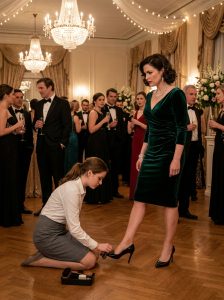
She stepped backward near one of the sponsor tables, let out a sharp gasp, and looked down at the splash on her silver heel.
Then she turned toward me with that fake gracious smile she used when she wanted cruelty to sound professional.
“Elena,” she said loudly, “since you’re so eager to be useful, get down there and wipe this off.”
I thought I had heard her wrong.
The ballroom was full.
Donors.
Executives.
Hotel staff.
A local reporter.
An auction photographer.
This wasn’t a side hallway.
This was center floor.
I kept my voice calm.
“There are towels with the service team. I can bring one.”
Her eyes hardened.
“No,” she said. “You made the mess by bumping the tray carrier.”
I hadn’t.
Everyone near us knew I hadn’t.
The tray carrier knew it too.
But nobody spoke.
That’s the ugliest thing about public humiliation.
It doesn’t just expose the bully.
It exposes every coward in the room.
Vanessa leaned closer and lowered her voice just enough to make it feel personal while still keeping the audience.
“If you want a recommendation from this company, kneel.”
A few people stared at me with pity.
A few stared with curiosity.
One woman near the floral wall slowly lifted her phone.
I could hear the camera shutter from across the room.
Vanessa extended her foot.
“Hurry,” she said. “Important people are watching.”
I looked around the ballroom.
At the crystal lights.
At the silent faces.
At the foundation banner over the stage.
At the sealed donor folder still resting under my hand.
Then I made a decision.
Not because she deserved mercy.
Because I wanted witnesses.
So I took the linen napkin from the service tray beside me.
And I knelt.
The room went dead quiet.
Vanessa exhaled like she had won something.
She tilted her chin and let me wipe the champagne from the side of her heel while people watched.
It lasted maybe five seconds.
It felt like five years.
When I stood back up, she gave a tiny nod like a queen dismissing a servant.
That’s when the emcee stepped forward.
“Ladies and gentlemen,” he said, tapping the microphone, “before we conclude tonight’s program, we have been authorized to reveal the source of the largest anonymous gift in this event’s history.”
Vanessa folded her arms, still glowing from what she had just done.
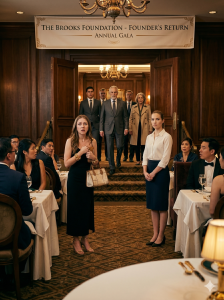
Then the ballroom doors opened.
My grandfather walked in.
Arthur Brooks was seventy-six, silver-haired, sharp-eyed, and impossible to mistake once you knew who he was.
He wasn’t loud.
He didn’t need to be.
Behind him came the hotel’s owner relations director, two members of our foundation board, and the event’s outside compliance attorney.
The crowd shifted instantly.
Whispers spread like fire.
“Oh my God.”
“That’s Arthur Brooks.”
“Why is he here?”
Vanessa’s face changed in stages.
Confidence.
Confusion.
Recognition.
Fear.
My grandfather looked at me first.
His eyes dropped to my hands, then to the faint red marks on my knees, then to Vanessa.
He understood everything without asking a single question.
The emcee swallowed hard and continued, “Tonight’s anonymous donor is the Brooks Family Foundation, in partnership with the Brooks Trust… represented here this evening by Mr. Arthur Brooks and co-signatory Elena Brooks.”
You could feel the air leave the room.
Vanessa turned toward me so fast her earring brushed her cheek.
“Elena… Brooks?” she said.
For the first time all night, her voice sounded small.
I held her stare.
“Yes.”
The hotel director stepped forward with the event contract packet.
That was the legal hammer.
Not luck.
Not drama.
Paperwork.
The gala had been funded under a behavior clause tied to the foundation grant.
My grandfather had insisted on it years earlier after a hospital donor event publicly mistreated service staff.
The clause was simple: any partner executive found engaging in degrading, discriminatory, or abusive conduct toward staff at a foundation-sponsored event could trigger immediate termination of grant disbursement, internal review, and removal from all future partner eligibility.
Vanessa had signed the host compliance acknowledgment herself three days earlier.
She had initialed every page.
Including the conduct page.
Including the recording consent for ballroom security footage.
Including the zero-retaliation clause protecting interns and junior staff.
She had humiliated me in the worst possible place:
Inside the exact venue governed by the exact rules she had agreed to.
The outside attorney asked the hotel security manager to preserve all footage from 8:40 to 9:10 p.m.
Then he requested witness statements.
The woman who had lifted her phone stepped forward first.
So did the tray carrier.
So did one of the board members Vanessa had been trying to impress all night.
Suddenly, everyone found their courage.
That happens too.
Cowards stay quiet when power is rising.
They get very honest when it falls.
Vanessa tried to recover.
“This is a misunderstanding,” she said, laughing too quickly. “I was joking with her. Elena knows that.”
“No,” I said.
Just one word.
But it landed.
Then the tray carrier said, “You threatened her recommendation.”
And the woman with the phone said, “You told her to prove she was there to serve.”
And one of the board members added, “You introduced her as your helper twice. I heard it.”
Vanessa’s husband wasn’t there.
Her protection wasn’t there.
Her image wasn’t there.
Only facts.
My grandfather finally spoke.
His voice was calm, which somehow made it harsher.
“You did not know who my granddaughter was,” he said. “That is clear. What concerns me is what you believed she was worth when you thought she was powerless.”
Nobody moved.
He continued, “That answer disqualifies you from ever touching a single dollar of our foundation again.”
Then he turned to the charity’s executive committee chair, who looked like he wanted the floor to open beneath him.
“Terminate her role in tonight’s event leadership immediately,” my grandfather said. “Suspend pending review. And notify all partner boards that Brooks Foundation is withdrawing support from any program she oversees.”
Vanessa blinked rapidly.
“Please,” she whispered. “We can fix this.”
But it was already past fixing.
The committee chair, who had ignored everything ten minutes earlier, suddenly found a spine.
“Vanessa Hale,” he said, voice shaking, “you are relieved of your responsibilities effective now. Please surrender your credentials.”
A security officer stepped closer.
She stared around the ballroom as if somebody might save her.
Nobody did.
Then came the moment she never imagined.
My grandfather looked at her polished knees, then at mine.
“If you believe public humiliation is an acceptable management tool,” he said evenly, “then public accountability should not offend you.”
Vanessa looked confused.
The chair spoke next.
“Ms. Hale,” he said, “before you leave, you owe Miss Brooks a public apology.”
She opened her mouth.
Closed it.
The room waited.
The same room where she had made me kneel.
Slowly, stiffly, with every eye in the ballroom fixed on her, Vanessa lowered herself to her knees.
Gasps moved through the crowd.
No one was laughing now.
Her gown pooled around her like spilled ink.
She looked up at me and said, “Elena, I am sorry for humiliating you. I abused my authority. I was wrong.”
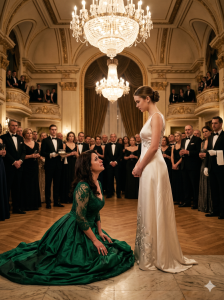
For illustrative purposes only
It wasn’t enough to erase anything.
But it mattered that she had to say it where everyone could hear.
The applause didn’t start right away.
That was the best part.
People weren’t celebrating cruelty.
They were absorbing justice.
Then someone near the back clapped once.
Then another.
Then the room filled with it.
Not for revenge.
For truth.
I wish I could say the story ended there.
It didn’t.
Because rules, when used properly, keep moving after the spotlight fades.
Within forty-eight hours, the security footage had been reviewed by the charity board, the hotel, and two corporate partners Vanessa had been courting.
Her company placed her on leave.
Then terminated her.
The recommendation threats she had used on junior staff triggered a wider HR investigation.
Three former interns came forward.
Two event coordinators submitted emails.
One assistant produced text messages.
Vanessa had built her whole career on the assumption that powerless people stay quiet.
Once one person spoke, the others did too.
She wasn’t charged with a crime.
This wasn’t that kind of story.
It was something colder.
Documented professional ruin.
Her name was quietly dropped from advisory boards.
Consulting offers disappeared.
The nonprofit circuit stopped returning calls.
The hospitality firms she had leaned on for prestige blacklisted her after the footage spread through private executive channels.
That’s what people mean when they say a reputation is everything.
They mean one night can expose what you really are.
A week later, it rained hard over the city.
I was leaving a campus building when I saw her across the street.
Vanessa.
No makeup team.
No ballroom lights.
No perfect posture.
Just a soaked coat, ruined heels, and a face that looked ten years older.
She crossed toward me, rain dripping from her hair.
“Elena, please,” she said. “Talk to your grandfather. I made a mistake. One mistake.”
I almost laughed.
One mistake?
No.
One exposure.
That was different.
“You didn’t make one mistake,” I said. “You built a habit and finally did it in front of the wrong witnesses.”
She started crying.
Real crying this time.
Not elegant.
Not controlled.
She said she was sorry again.
She said she needed work.
She said her life was falling apart.
And for one second, I saw exactly how easy it would be to become cruel back.
That’s the trap.
That’s how bullies reproduce themselves.
So I didn’t humiliate her.
I didn’t raise my voice.
I didn’t film her.
I just said, “You should apologize to every person you thought was too small to matter.”
Then I walked away.
That night changed my life too.
Not because people suddenly respected my last name.
Because I stopped feeling ashamed of taking up space.
I stopped shrinking to make arrogant people comfortable.
I stopped confusing silence with peace.
A month later, I accepted a formal internship with my grandfather’s foundation.
Not because I needed saving.
Because I had earned a seat at the table long before anyone in that ballroom admitted it.
The first policy proposal I helped draft was simple:
Mandatory anti-abuse clauses for all sponsored events.
Protection for interns, servers, assistants, and temporary staff.
Clear reporting lines.
Immediate review of public humiliation or coercion.
In other words, a rule for the people everybody overlooks until it’s too late.
My grandfather framed the napkin from that night.
Not because he enjoyed what happened.
Because he said it represented a decision.
I could have broken down.
Instead, I stayed calm long enough to let the truth walk in through the front door.
So here’s where I stand:
Power does not reveal character.
It tests it.
And anyone who can only feel tall by forcing someone else to kneel was never powerful to begin with.
If you believe Vanessa got exactly what she earned, share this story.
If you believe public humiliation should cost people their title, their access, and their reputation, stand on Elena’s side. 👇
