


He shoved me so hard my chair flipped backward.
My cane skidded across the polished ballroom floor.
And for half a second, all anybody cared about was whether the champagne tower would fall.
Not me.
Not the disabled veteran on the ground.
Not the prosthetic leg the groom had just mocked in front of two hundred wedding guests.
Just the spectacle.
That tells you everything about people like the Carringtons.
I was the poor, damaged old soldier.
He was the polished golden son in a designer military-cut tuxedo, standing under silk banners and fake honor, acting like patriotism was something you could rent by the hour.
The wedding was being held at the Arlington Crown, one of those luxury hotels where every hallway smells like money and everyone speaks in lowered voices like they own the air.
The theme was “American Valor.”
I wish I were kidding.
There were ceremonial sabers on display.
Antique flags behind the sweetheart table.
Custom centerpieces built around miniature helmets and gold stars.
The groom, Preston Carrington, loved the image of service.
Just not actual servicemen who came home broken.
I had been invited by the bride’s father, Martin Hale.
Martin and I served together years ago.
He wasn’t rich back then. Neither was I.
We were just young men trying to stay alive in a place where the sky itself wanted us dead.
Life carried us in different directions.
He built a business.
I built a quieter life.
But every year, without fail, Martin called me on Veterans Day.
When his daughter Elise got engaged, he told me, “You’re family. I want you there.”
He meant it.
The problem was that Preston’s family saw the wedding as a merger, not a marriage.
The Carringtons were deep in defense manufacturing.
Big contracts. Bigger ego.
Their company supplied components, vehicles, communications systems, all dressed up in flag language and sold at elite dinners with men who had never heard a shot fired in anger.
Preston was born into that world.
He had that particular kind of arrogance only inherited money can produce.
The kind that smiles while it humiliates you.
The ceremony had barely ended when it started.
Cocktail hour was in the grand ballroom.
String quartet in the corner.
Servers gliding around with silver trays.
A wall-sized projection of the couple in staged black-and-white portraits.
I had taken a seat near the front because Martin himself had walked me there.
My prosthetic was bothering me that night. The socket had rubbed raw during the drive, and I was moving slower than usual.
I was adjusting my pant leg when Preston spotted me.
He stopped in the middle of greeting guests.
His eyes dropped to my leg.
Then he laughed.
Not nervous laughter.
Cruel laughter.
The kind people use when they think no one important will punish them.
He looked around at his groomsmen and said, “Why is there a broken soldier in my family section?”
A few of them chuckled.
One of the bridesmaids looked down into her drink.
I started to stand, mostly because I’ve never enjoyed being stared at by fools.
But Preston walked straight toward me.
“You can sit in the back,” he said. “This row is for people who actually matter in the photos.”
Martin’s face changed immediately. “Preston, enough.”
But Preston lifted a hand like Martin was a waiter interrupting him.
Then he looked back at me.
At my leg.
At my age.
At the cane.
And he smiled.
“You know what?” he said loudly. “Forget the back. Maybe we should put you near the history display. Make the theme feel more authentic.”
Some people laughed.
That part stayed with me more than the shove.
Not the cruelty.
The permission.
The room gave him permission.
That’s how public humiliation works. It needs an audience more than it needs a villain.
Elise, the bride, whispered, “Preston, stop it.”
He ignored her too.
Then he bent slightly, close enough for me to smell bourbon on his breath, and said, “I don’t want damaged people in my wedding pictures.”
I looked him in the eye.
I said, very calmly, “Son, you have no idea what damage looks like.”
That should have ended it.
But men like Preston hear calmness as weakness.
He grabbed my shoulder.
Hard.
And shoved.
The heel of my good foot caught the leg of a chair, and I went down sideways.
My cane clattered away.
A woman gasped.
Someone laughed nervously.
Three guests immediately raised their phones.
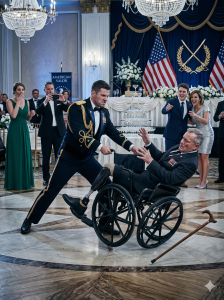
And there I was.
A sixty-two-year-old disabled veteran on the floor of a ballroom built to celebrate fake honor.
Preston straightened his cuffs like he’d merely corrected a seating error.
“Get security,” one of his friends muttered.
I saw Martin surge forward, but two Carrington relatives blocked him with soft voices and fake concern.
“Let’s not create a scene.”
That line always comes after the scene has already been created by the wrong person.
I pushed myself up slowly.
My side hurt.
My leg burned.
The whole room watched like they were waiting to see if I’d cry, yell, or beg.
I did none of those things.
I reached for my cane.
Then for the sealed envelope inside my jacket.
And I stayed quiet.
That bothered Preston more than anger would have.
“You hear me?” he said. “You’re done here.”
Still calm, I said, “Is that official?”
He smirked. “It is in this room.”
There it was.
That family’s disease in one sentence.
They thought the room was the world.
What Preston didn’t know was that Martin hadn’t invited me out of pity.
He invited me because there was history in that room far older than Preston’s tuxedo and far heavier than his ego.
Twenty-seven years earlier, in a combat zone Preston would never be able to find on a map, I dragged a young officer out of a burning vehicle while mortar fire chewed up the road around us.
He was bleeding from the neck and half-conscious.
His driver was dead.
I carried that officer through smoke, dirt, and flying metal, then held pressure on the wound until the medevac arrived.
That officer survived.
He went on to rise higher than any of us expected.
He never forgot my name.
Neither did the government office that still sent me letters on ceremonial paper a few times a year.
Martin knew that.
Preston didn’t.
Because Preston never asked who I was.
He only saw what I had lost.
Not what I had done.
A hotel security manager began moving toward me, uncertain, clearly trying to figure out whether to obey the groom or the older men whispering into earpieces near the entrance.
That was when I noticed them.
Two military aides.
Dark dress uniforms.
Still as statues near the ballroom doors.
I had seen them when I arrived, though I doubted anyone else had.
One of them caught my eye.
Small nod.
Understood.
The call had gone through.
Preston was still talking.
Still performing.
He raised his glass and said, “Tonight is about winners, not charity cases.”
That got a louder reaction.
A few shocked inhales.
A few embarrassed faces.
A few people who suddenly realized maybe they had laughed too early.
Elise stepped back from him as if she had finally seen what she’d agreed to marry.
Martin looked like he wanted to bury the entire room.
And I just stood there, one hand on my cane, one on the envelope, waiting for the trap to close.
Because the truth is this:
Real power rarely shouts.
It schedules consequences.
The ballroom doors opened.
Not dramatically.
Not with some movie-style crash.
They opened with the quiet authority of people who have never once needed permission.
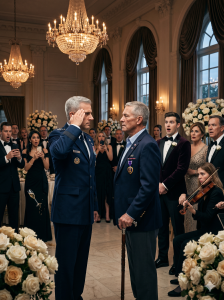
A five-star general stepped inside.
Full dress uniform.
Rows of ribbons.
Silver hair.
Two aides behind him.
And the whole ballroom changed.
Not the mood.
The gravity.
Conversations died mid-word.
Phones lowered.
Even the quartet stopped playing.
The general scanned the room once, saw me, and walked directly across the polished floor while everyone else parted like water.
Then he stopped in front of me.
And saluted.
A real military salute.
Sharp. Formal. Public.
You could hear people suck in breath around the room.
Then the general said, loud enough for every phone in the place to capture it, “Sergeant Daniel Mercer, this nation still stands in your debt.”
Preston’s face emptied.
His mother nearly dropped her clutch.
His father, Richard Carrington, turned gray so fast I thought he might faint where he stood.
The general lowered his hand and continued.
“This man saved my life under enemy fire. Without him, I would not be here. And I understand he has just been insulted, assaulted, and publicly degraded at a wedding financed by a family currently seeking renewed defense contracts with the federal government.”
Nobody moved.
Nobody breathed.
The general turned his head slightly toward Richard Carrington.
“I hope I’ve been misinformed.”
Richard started forward immediately. “General, I assure you, this is all a misunderstanding—”
“No,” I said.
That was the first time I’d raised my voice all night.
I handed the sealed envelope to one of the aides.
Inside were printed photos, witness statements, and a formal complaint Martin’s lawyer had helped prepare before the reception even began.
Why before?
Because Martin had quietly warned me days earlier that Preston had mocked disabled veterans at a rehearsal dinner and bragged that “real heroes don’t come home asking for sympathy.”
Martin hadn’t known if Preston would keep his mouth shut at the wedding.
I hadn’t either.
So I came prepared.
Not for revenge.
For evidence.
The aide removed the documents.
There were screenshots from Preston’s private group chat.
Videos from the ballroom already forwarded by guests.
Hotel security footage timestamps.
Even a contract portfolio showing the Carrington family business was days away from a review for multiple military supply renewals.
The general didn’t need to create punishment.
Preston had built it for himself.
All the general had to do was confirm it.
He looked at the first page.
Then the second.
Then he handed it to the procurement liaison who had entered behind him so quietly almost nobody had noticed.
That man introduced himself, very calmly, as a civilian oversight director attached to defense acquisitions.
Richard Carrington’s mouth opened.
Nothing came out.
The liaison said, “Based on observed conduct, active evidence, and ethical review concerns, all pending Carrington Defense contracts are suspended effective immediately, pending indefinite investigation.”
You could feel the room sway.
Not physically.
Socially.
The bride’s side stared in stunned silence.
The groom’s friends looked like boys who had just realized money could not solve everything.
Richard grabbed Preston by the arm so hard the kid winced.
“You idiot,” he hissed.
Preston looked at me, then at the general, then at his father.
“This is insane,” he said. “Over one old man?”
That was the moment Elise took off her wedding ring.
Technically she’d only been wearing it for an hour.
Still, the sound it made hitting the crystal tray near the cake table was louder than any scream.
“No,” Elise said, voice shaking but clear. “Not over one old man. Over who you are.”
She picked up the front of her dress and walked away from him in front of everyone.
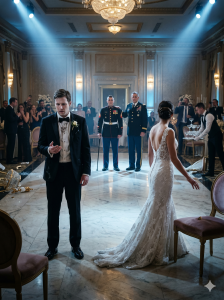
Half her bridesmaids followed without hesitation.
Martin stood beside me, eyes wet, and said softly, “I’m sorry.”
“You didn’t shove me,” I replied.
Meanwhile, the consequences kept unfolding.
Phones were no longer filming me.
They were filming Preston.
His father didn’t try to shield him.
His mother didn’t fake outrage.
Because rich families know when the ledger has turned.
That same week, the suspension of Carrington Defense became public through industry channels.
Not every detail of the wedding incident was released, but enough leaked.
Enough for watchdog groups to circle.
Enough for reporters to dig.
Enough for board members to ask dangerous questions.
Enough for partners to distance themselves.
The company lost not just current orders, but confidence.
And in defense contracting, confidence is oxygen.
Richard Carrington tried to salvage the family name by issuing a statement about “isolated personal misconduct.”
It didn’t work.
The footage from the ballroom surfaced three days later.
There was Preston.
Smiling.
Pointing at my prosthetic.
Shoving me.
Mocking me.
No editing could save him.
No PR team could outtalk the video.
Sponsors backed away.
Board pressure mounted.
Within two weeks, Preston was removed from every formal role in the family business.
Within a month, Richard publicly disowned him from operational leadership.
Privately, I heard it was uglier.
Trust funds frozen.
Residences closed to him.
Friends vanished.
Turns out people who love your yacht don’t usually love your character.
By winter, I was told Preston had been seen outside a downtown bar trying to borrow cash from a former fraternity brother who refused to answer the door.
The boy who once laughed at a prosthetic leg was now walking city blocks in worn shoes because no driver would take his calls.
That part didn’t make me happy.
Not exactly.
Justice isn’t joy.
It’s balance.
What did make me feel something close to peace was what happened after.
Elise annulled the marriage before the floral deposits had even cleared.
Martin asked if I’d join him at a small family dinner a month later.
Just family, he said.
Real family.
No cameras. No fake banners. No rented patriotism.
I went.
Elise was there in a simple sweater, no makeup, no performance.
She sat across from me and said, “I should have seen it sooner.”
“Maybe,” I said.
She looked down.
Then I added, “But seeing it now still counts.”
She cried at that.
Not dramatically.
Quietly.
Like someone mourning the version of life she almost trapped herself inside.
A few months later, she started volunteering with a veterans’ rehabilitation foundation Martin funded quietly for years.
No press.
No gala.
No speeches.
Just work.
As for me, the general invited me to a ceremony in Washington that spring.
A small honor.
Nothing flashy.
During the reception, he stood beside me and said, “The thing I remember most from that day all those years ago wasn’t the fire. It was that you went back for me when nobody would have blamed you for running.”
I smiled and told him the truth.
“Leaving people behind was never my style.”
That includes weddings, apparently.
My leg still hurts when it rains.
I still move slower than I used to.
Crowds still make me tired.
But I no longer confuse being scarred with being diminished.
And I no longer waste anger on men like Preston.
They are raised thinking dignity belongs to the highest bidder.
Life corrects that.
Sometimes in courtrooms.
Sometimes in boardrooms.
And sometimes in a ballroom, under fake flags, when a real soldier refuses to bow.
So here’s where I stand:
If you mock a wounded veteran in public, you don’t just insult one man.
You expose yourself.
If you think wealth gives you the right to humiliate the broken, then maybe you were the weakest person in the room all along.
I didn’t ruin Preston’s life.
He did that the moment he mistook visible scars for worthlessness.
And if you believe public cruelty deserves public consequences, share this story.
If you believe respect should never depend on money, stand with the veteran—not the groom.
