


The heat of the Syrian Desert didn’t merely burn; it suffocated. It pressed against my chest like a solid weight, carrying the taste of sulfur, dried blood, and ground ancient stone.
My sight wavered from sweat and blood trickling down from a shallow cut above my right eyebrow. I blinked it clear, controlling my breathing. In. Out. Two seconds in. Four seconds out.
Through the shimmering haze of the afternoon sun, I tallied the weapons aimed at me. Eleven.
Eleven M4 carbines and AK variants, each held by a man in mismatched tactical gear. They stood in a tight, uneven ring around me in the courtyard of a deserted refinery.
The air reeked of cordite and unwashed bodies. I could hear the faint crunch of boots adjusting on gravel. They were growing impatient.
“End of the line, sweetheart,” a voice rasped.
It came from the man at the center, three paces away. He was enormous, built like a slab of reinforced concrete under Kevlar. A thick, dust-choked beard hid most of his face, but his eyes were visible—pale, lifeless, and flickering with smug amusement.
His nametape read HARRIS. A private military contractor. A mercenary. One of those ghosts who move through gray zones where rules no longer matter.
“Hands away from the vest. Slow,” Harris ordered, his rifle aimed squarely at my center mass. “Don’t make me blow a hole through you before we even have a chance to chat.”
A few of the men let out guttural laughs.
They believed they understood what they were seeing. To them, I was just a stranded American medic. A female soldier separated from a logistics convoy they had hit three miles down the supply route. A leftover. A victim.
They assumed I was scared. They mistook my silence for fear’s paralysis.
They didn’t know about Derek.
My thoughts slipped, briefly, away from the brutal Syrian heat and into a sterile hospital room in San Diego. The scent of bleach. The steady, mechanical beeping of a heart monitor.
I saw again my younger brother’s legs. Legs that would never move again.
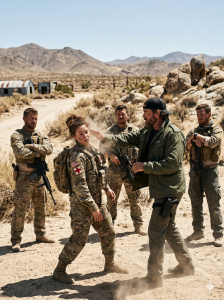
For illustrative purposes only
Derek had been a Marine infantryman. A good kid. A heart big enough to fill a country. Six months earlier, his unit had been pinned in a rocky valley not far from here. They had called for immediate Evac.
The private security firm in the area—Harris’s company—was meant to provide covering fire. Instead, as mortars began to fall, they broke formation and ran. They left Derek’s unit to die in the dirt to preserve their profit margins.
Derek survived, barely. Three of his teammates did not.
When he finally woke in the hospital, staring at nothing, he didn’t cry. He just looked at me—his older sister, the one who raised him after Dad collapsed from a heart attack in his Detroit auto shop.
“They left us, Nora,” Derek had whispered, his voice broken. “They just turned around and drove away.”
I had held his cold hand. I didn’t cry either. I simply made a promise.
“I know,” I had told him. “I’ll fix it.”
For six months, I used every clearance I had, every favor earned across a decade of covert deployments, to track that rogue PMC unit. The military couldn’t touch them; they were buried under contracts, proxies, and bureaucracy.
So I would.
I hadn’t been separated from the convoy today. The convoy was bait. I had walked three miles alone through sniper lanes, making just enough noise to draw them in. I needed them clustered. I needed them all in one place.
“Hey! Deaf bitch, I said hands up!” Harris barked, stepping closer. The rifle barrel hovered less than a foot from my chest.
His breath carried stale tobacco.
I scanned the circle of men in seconds. Two o’clock favored a bad knee. Five o’clock had a jittery trigger finger and sweat-soaked discipline. Nine o’clock stood too close together, their firing lanes likely to interfere.
“Are you praying under there?” Harris mocked, noting my silence. He lowered his rifle slightly, confidence hardening into arrogance. “Nobody is coming for you, medic. Your convoy is burning. You’re completely alone.”
“I’m not praying,” I said.
My voice was low. Steady. It sliced through the heat like steel.
Harris frowned, irritation flashing across his face. Victims weren’t supposed to sound like that. Victims were supposed to beg.
“Then what the hell are you doing?” he spat.
“I was just thinking,” I replied, eyes locked on his. “About a Marine named Derek Vance. And a valley about forty miles south of here.”
The color drained from Harris’s face in an instant. The smirk collapsed into something tight and controlled. He knew the name. He knew the place.
His gaze flicked over my gear—and for the first time, he actually saw it.
Not standard issue. A modified plate carrier. A suppressed Sig Sauer P226 on my thigh. The scars across my knuckles.
Then his attention dropped to my right hand.
I didn’t reach for a weapon. I lifted my hand to my chest instead. My rig was coated in desert mud and dust, concealing its markings.
“Don’t move!” Harris screamed, his voice cracking under sudden panic. He raised his rifle again, but his grip trembled.
The other ten men stiffened, confusion rippling through them. Why was their leader afraid of one unarmed woman?
Slowly, deliberately, I wiped the mud from the center of my chest rig.
The desert sun struck the metal beneath, igniting it in gold light.
An eagle clutching a trident, a flintlock pistol, and an anchor.
The gold insignia of a United States Navy SEAL.
Silence collapsed over the courtyard. Absolute. Heavy. The kind that comes before impact.
I had spent two years in BUD/S, breaking myself in the freezing surf of Coronado, fighting twice as hard as anyone to earn a place in the teams. I had drowned, been revived, fractured, and kept going. I earned the Trident through pain, endurance, and will.
Harris stared at the insignia. His mouth parted, but nothing came out. He understood what it meant.
It meant I wasn’t a stranded medic.
It meant I wasn’t trapped with them.
“You’re not alone,” Harris whispered, his eyes darting across rooftops and broken windows. He expected lasers. He expected drones.
“No,” I said softly, my hand hovering near my sidearm.
“I am alone.”
The truth struck him like a physical impact. The idea of a single operator walking willingly into a camp of eleven armed men.
“You…” Harris stammered, his rifle shaking. “You came here to die?”
A cold, controlled smile touched my lips.
“No, Harris,” I said, the desert wind tugging at my hair. “I came here to kill you.”
Before he could fire, the world detonated.
The “explosion” wasn’t a bomb. It wasn’t a mortar or a drone strike from above. It was the detonation of an M84 stun grenade—a flashbang—going off exactly three feet in front of Harris’s boots.
I had been holding it the entire time, concealed behind the edge of my mud-caked plate carrier, the pin already looped around my pinky finger. When I moved, I didn’t simply move; I disappeared into a white-hot burst of magnesium and ammonium perchlorate.
The world became a screaming wall of white. For the eleven men surrounding me, reality collapsed. Their retinas were burned, their inner ears slammed by 170 decibels of pure disorientation. This was their own Fatal Funnel. A circle meant everyone was exposed to everyone.
I didn’t need sight. I had closed my eyes a fraction before the blast. I already knew the courtyard’s geometry. I had mapped every man like a blueprint before ignition.
One-one-thousand.
I shifted left—not a run, but a low, hunting glide. My hand closed on the Sig Sauer P226 grip. It felt like part of my arm, balanced and cold. The suppressed barrel cleared leather in a whisper.
Two-one-thousand.
The kid at five o’clock—the one with the twitching trigger finger—was stumbling blind, rifle swinging wildly. He screamed, high and broken, the sound of someone realizing too late he was outmatched. I moved into his shadow. Two muffled thuds—thwip-thwip—and the screaming stopped. He never felt the 124-grain hollow points. He simply collapsed into gravel, like a cut puppet.
Three-one-thousand.
The two men at nine o’clock collided as their vision returned in fractured black spots. They tried to spray and pray, but they were too close together. One elbowed the other by accident. In that split-second of confusion, I was already there.
I didn’t use the pistol. I used the knife—a Winkler belt knife, high-carbon steel with a maple handle that fit my grip like it was made for it. A fast horizontal cut across the first man’s femoral artery. A vertical thrust into the second man’s brachial plexus. They dropped without sound, their bodies lost beneath the ringing in the others’ ears.
“Contact! Left! She’s on the left!” Harris’s voice cut through the chaos.
He was sharper than the rest. Former Ranger. Before greed replaced discipline, before contracts mattered more than loyalty. He had recovered faster and was firing blind into the dust cloud, his M4 strobes slicing through haze like nightmare flashes.
But I wasn’t on the left anymore. I had already become part of the steel and dust.
I dropped behind a rusted oil drum, the stench of old petroleum burning my nostrils. Bullets shredded the metal above me, throwing sparks into dry air. I checked my breath. Sixty-five beats per minute.
That was what they never taught in brochures. Not strength. Not firepower. The Quiet Mind. In BUD/S, during Hell Week, when the Pacific tried to freeze your soul and instructors screamed failure into your bones, you learned to shrink existence to six inches. One breath. One movement.
I thought about Detroit.
About winters when the heat failed and Derek and I survived under stacked coats in the living room. I remembered our father’s wrench hitting the garage floor—clank. Clank. Clank.
Now Harris’s men searching for me sounded the same. Predictable. Mechanical.
“Spread out! Finish her!” Harris roared. He was already retreating toward the main refinery building—a skeletal maze of pipes and pressure valves, like a rusted ribcage against the sky.
Smart. He was sacrificing his remaining seven men as cover while he climbed for height. In the courtyard, he was exposed. Inside, he believed he could survive.
I rose into a crouch. Dust was settling, the Syrian sun stretching long distorted shadows across the ground.
The man with the bad knee limped toward the southern gate, eyes wide with animal panic. He had seen what happened. He had seen the Trident. To him, I wasn’t human anymore—I was consequence given form.
I could have ended him easily. But I needed pressure to build. I needed fear to mature.
I let out a short whistle.
He spun. “Where are you?! Show yourself!”
No answer. Only movement through pipe shadows, timed with the wind rattling sheet metal. I was nowhere and everywhere at once.
“Over there!” another shouted, firing at a flicker near the cooling towers.
They all turned. They all fired. Expensive ammunition chewed rust and empty air.
While they hunted the ghost, I was behind the man with the bad knee. I didn’t kill him. I grabbed his rifle barrel, forced it upward, and drove my palm into his throat. He dropped, choking, airway crushed. I took his radio.
I pressed transmit.
“Harris,” I said, voice cold against the heat. “Seven left. You’re running out of friends.”
Static hissed. Then Harris, tight and strained. “You think you’re some kind of reaper? You’re just one girl. My boys will find you, and when they do, I’m going to make sure you stay awake for what comes next.”
“You already made that mistake with Derek,” I replied, eyes tracking the catwalks. “You thought he was just another grunt. You thought his life was worth less than your exit bonus. You were wrong about him. And you’re very, very wrong about me.”
I crushed the radio against concrete and moved.
The refinery was a maze of shadow and rust. Massive tanks rose like silent sentinels, scarred by sand and time. I climbed Tank Four’s ladder, silent and fluid. From the top, the courtyard opened beneath me like a map.
Five men left. They moved in a tight V, overcorrecting constantly, checking behind them every few seconds, muzzles dipping and rising.
I pulled a black cylinder from my pouch—a thermal distraction device—and threw it across the courtyard. It ignited, blooming a heat signature that would flood their optics like a flare.
“THERMAL! TWELVE O’CLOCK!” one screamed.
They opened fire on nothing, muzzle flashes revealing their positions.
I didn’t take the Sig. I drew a collapsible carbon-fiber bow carried across three continents. I fitted a broadhead.
Thrum.
One dropped—arrow through the neck, silent.
Thrum.
Another fell clutching his chest.
The last three broke instantly. Training vanished. Discipline dissolved. They sprinted for the refinery doors, screaming for Harris to open up.
“Open the door! Harris! She’s picking us off!”
The steel door stayed shut. Harris didn’t move. Professional instinct. Opening it meant letting death inside. He was sacrificing them for minutes of survival.
I stood atop the tank, wind tearing through my hair. Below, the three survivors hammered the door, pleading turning to rage.
I didn’t end them. Not yet. I wanted them to understand the betrayal. To realize the man they trusted had already abandoned them.
“He’s not coming for you,” I called down. “Just like he didn’t come for the Marines in the valley. How does it feel to be on the other side of the contract?”
One man looked up, face twisted with hatred, raising his rifle at the tank.
I didn’t flinch. I was already moving, sliding down the fast rope I had rigged earlier.
I landed like a cat, impact absorbed through my knees. Before he could acquire me, I was inside his space. I swept his legs, drove my elbow into his temple, and felt the structure give way.
The other two tried to run, but they were trapped between the sealed door and the woman with the Trident.
It was over in seconds—a storm of precision and controlled violence. When the dust finally settled, the courtyard fell silent again. The only sounds left were the faint ticking of cooling metal and the distant, lonely cry of the desert wind.
Ten men down. One remaining.
I moved toward the heavy steel door. I could hear Harris on the other side—dragging crates, trying to barricade the entrance. His breathing was heavy, the sound of a man who knew the tide was closing over him.
I reached into my vest and withdrew a compact block of C4.
“Harris,” I said, my voice steady, almost casual. “I told Derek I’d fix it. I’m a woman of my word.”
I pressed the detonator.
The door didn’t open—it vanished.
The blast ripped the breath out of the structure. Dust, rust, and fragments surged into the refinery’s dark interior. I stepped through the smoke, night-vision optics sliding down over my eyes. The world shifted into an eerie electric green.
Heat signatures appeared immediately. I saw Harris’s boot trail as he fled deeper into the pipe maze.
He was moving toward the pressure control room—the highest point in the facility. He intended to trap me in the stairwell, to create a choke point.
I smiled. He was still thinking like a soldier. Still thinking in territory.
He didn’t understand this wasn’t a battle.
It was an execution.
I crossed the threshold, boots crunching on shattered glass. I didn’t hurry. Time was irrelevant. Back in Detroit, my father used to say the most dangerous thing in the world wasn’t a man with a gun—it was someone with nothing left to lose and a long memory.
I saw Derek’s face when the doctors told him he would never walk again. I saw him trying to smile for me anyway, at twenty-one years old.
“I’m coming for you, Harris,” I whispered into the dark.
The hunt had only begun.
Inside, the refinery became a cathedral of rust and fading echoes. As I moved through the jagged opening where the door had been, the heat shifted. Outside was dry and searing. Inside was stagnant—thick with stale air, decaying insulation, and the metallic breath of abandoned machinery.
I lowered my GPNVG-18s. The panoramic night vision turned the darkness into a haunted green expanse. Every pipe, drip, and crack stood out in sharp relief.
I wasn’t just tracking Harris. I was reading the building.
Dust patterns on the floor told a clear story—heavy, rushed footprints leading toward the central stairwell. He was running, but still disciplined. Even in panic, he was searching for elevation, for a choke point where numbers might matter more than skill.
I didn’t follow them. That was the first rule: never take the route they design for you.
I looked up. Above me, a web of support beams stretched across the ceiling. I launched a magnetized grappling hook upward. It caught with a dull metallic thunk. I tested it once, then climbed.
As I rose, my mind drifted back to Detroit.
I could almost smell motor oil and burnt coffee in my father’s shop. “Nora,” he used to say, hands wiped on a rag darker than fabric. “A machine is just choices. Understand the choices, you understand the machine. Don’t smash it—find the bolt that holds it together.”
I was in the rafters now, moving like a shadow given form. Below, metal clanged once. Then again.
“I know you’re in here!” Harris’s voice boomed through the intercom, distorted and crackling, filling the refinery like something inhuman. “I know who sent you, Nora. You think you’re the first ‘Angel of Vengeance’ to come for a payout? You think your brother was special?”
My grip tightened on cold steel.
“Derek Vance was a loser,” Harris continued, his voice echoing through hollow tanks. “Just a kid playing soldier. We didn’t abandon him—we withdrew. That’s business, sweetheart. Your brother was government property. A line item. Why risk a million-dollar team for a twenty-thousand-dollar grunt?”
His logic landed like ice in my chest—the logic of privatized war, where loyalty is accounting and death is overhead.
“You’re not a hero, Nora!” Harris shouted, voice cracking now. “You’re just a murderer! You killed ten men doing their jobs! How are you any different from me?”
I didn’t respond. I was already moving again, bypassing the stairs entirely. A ventilation shaft led toward the control level. I unscrewed the grate, the sound drowned out by his echoing voice.
I crawled through the narrow metal tunnel. It was tight, reeking of rust and old soot. It reminded me of BUD/S—the Pipe, where darkness and pressure teach you that confinement isn’t an enemy, it’s discipline.
After what felt like miles, I reached another grate. Below: the boiler room.
And Harris.
He hadn’t reached the control room yet. He was setting a trap.
Through the slats, I watched him kneeling by steam pipes, rigging an M18A1 Claymore. He oriented it carefully toward the stairwell entrance. Sweat dripped through his beard. His hands were fast, but his eyes kept flicking back—fear leaking through professionalism.
He thought I was coming from behind him. Through the stairs.
I reached for my suppressed Sig Sauer. One shot would end it cleanly. Mission complete. Derek avenged.
Then I saw the laptop.
It sat glowing beside him. Files uploading. A satellite link active.
I froze.
This wasn’t just a hit team. It was a pipeline. Data, coordinates, stolen caches—everything they had looted from the sector was being transmitted out.
Harris wasn’t just a mercenary. He was a broker.
If I killed him now, the system would lock. The uplink would die. The truth would disappear into encrypted silence.
I needed him alive. At least long enough to break it.
I pulled back from the grate, thoughts sharpening into something colder than anger. The Quiet Mind returned—but transformed. This wasn’t only about Derek anymore. It was containment.
I dropped from the vent into shadow behind him, landing near a massive furnace.
“Harris,” I whispered.
Not through speakers. Direct. Human.
He spun instantly, rifle snapping up, nearly triggering his own Claymore.
“Where are you?!” he shouted.
“I’m right here,” I said, stepping into the edge of his light, hands raised. The Trident visible on my chest.
He froze.
For a moment, disbelief overtook him.
“You… you stupid bitch,” Harris breathed, a strained laugh breaking through. “You walked right into it. That pin doesn’t make you invincible. It just makes you a trophy.”
He advanced, rifle steady on my head.
Ten feet.
Eight feet.
“I want the laptop, Harris,” I said evenly. “And I want the name of the man on the other end of that earpiece.”
Harris halted, his gaze flicking between the computer and me. His expression twisted into something raw and vicious.
“You want the truth? Here’s the truth, SEAL,” he spat. “Your brother died for nothing. He died so that men like me could get rich. And now, you’re going to die for the exact same reason.”
His finger tightened on the trigger.
In that instant, I didn’t reach for my weapon. I reached for what he had failed to anticipate.
Earlier, from the rafters, I had spotted a pressure bypass valve above the boiler. Old, corroded, vibrating under the strain of failing systems.
Five minutes ago, I had placed a timed incendiary charge on it.
Now.
The valve didn’t leak. It ruptured.
A torrent of superheated, pressurized steam erupted downward between us—a blinding white wall of heat and screaming force.
Harris howled as three-hundred-degree vapor seared his exposed skin. He fired blindly, rounds slicing through steam and striking only iron.
I didn’t hesitate. I drove through the vapor, lungs burning, and collided with him like a freight train.
We slammed into concrete. His rifle skittered into darkness. I moved to control him, but Harris was massive. With a brutal heave, he threw me off, a fist catching my ribs. Something cracked.
I rolled away, gasping, but he was already on me again. No firearm now—only a serrated combat knife, its edge jagged with old violence.
“I’m going to carve that Trident right off your chest!” he roared, lunging.
We clashed in the boiler room’s shifting steam, the air hissing like serpents. He had strength; I had speed. He fought for survival. I fought for something far more dangerous.
I deflected his strike, the blade grazing my arm. I answered with a palm strike that snapped his head back. He staggered into a heated pipe without reaction—adrenaline drowning pain.
He swung again in a wide, desperate arc. I slipped inside it and drove a knee into his solar plexus. Air exploded from his lungs.
I seized his knife wrist and twisted with a motion drilled into me a thousand times in Coronado mud. The joint gave with a pop. The blade dropped.
I didn’t stop. Elbows followed—short, brutal, precise. Bone cracked under impact. Nose shattered. Cheek gave way. I wanted him broken. I wanted him to feel every abandoned Marine behind him.
At last, Harris collapsed against the boiler, ruined and bleeding, breath turning wet and ragged.
I stood over him, chest rising hard, blood from my brow dripping onto my vest. I retrieved the laptop and earpiece.
“The transfer is stalled, Harris,” I said, watching the screen. “You need a biometric override. Your thumb.”
Harris looked up through blood and grinned faintly. “Go… to hell.”
“I’ve been there,” I said, drawing my Winkler knife. “It’s cold. It’s wet. And there’s no way out.”
I seized his hand. He struggled weakly, but it wasn’t enough.
“This is for Derek,” I whispered.
I didn’t kill him then. I pressed his thumb to the scanner. The laptop chimed: Access Granted.
Files began transferring—names, accounts, weapons cache coordinates spanning three continents. The Black Ledger of a corrupt private army.
I glanced at the earpiece. The line was still live.
“He’s not coming,” I said into it. “And neither are you. I have the ledger. I have your names. And I’m a Navy SEAL. You can run, but you’ll only die tired.”
I crushed the earpiece beneath my boot.
Harris stared up, fear finally overtaking defiance. He understood I wouldn’t be handing him over to any court he could buy.
“You can’t…” he rasped. “You’re a soldier. You have… rules.”
I looked at the golden Trident on my chest. Honor. Courage. Commitment. A shield for the innocent.
And sometimes, a blade for what rots beneath them.
“The rules changed in that valley, Harris,” I said.
My eyes shifted to the Claymore he had placed earlier—still armed, still wired across the doorway.
I hauled him up by his collar and dragged him toward it. His body hung heavy, drenched in failure. I propped him at the threshold, inches from the tripwire.
“You wanted a welcome mat,” I said, stepping back into shadow. “Use it.”
“Nora! No! Please!” Harris begged, voice breaking. “I’ll give you everything! The money! The contacts! Just let me go!”
I said nothing. I looked at him once—long, final—at the man who had destroyed my brother’s life.
Then I turned away.
“Wait! NORA!”
I didn’t look back. I was already on the ladder when the explosion tore through the refinery.
The blast hit like a final punctuation mark. The building groaned, then began to fail. Fire raced through old pipes. Pressure built. The structure began to collapse in slow, violent sequence.
I reached the roof as the first level gave way.
The Syrian sun was bleeding into the horizon, desert painted gold and crimson. Far off, dust trails marked incoming forces—the real military finally arriving to control the aftermath.
I sat at the roof’s edge, watching the refinery burn. I pulled out a worn photograph: Derek and me, standing outside the Detroit shop, both of us covered in grease, smiling like nothing in the world could touch us.
“It’s fixed, Derek,” I whispered.
Something inside me finally loosened. Not peace—never peace—but completion.
I stood, adjusted my gear, and began walking toward the horizon. Navy SEAL. Sister. Moving forward.
My phone vibrated.
A secure message. No sender.
The Ledger is only the beginning, Nora. They know you have it. They’re coming.
I looked back at the burning structure, then out into the desert.
A cold smile formed.
“Good,” I murmured. “I’m counting on it.”
The refinery burned behind me like a dying animal—fire coughing smoke into a darkening sky. Shockwaves rolled through the sand in steady pulses, like something refusing to accept death.
I didn’t look back. Looking back belonged to people with homes to return to. I had only the horizon and the encrypted drive in my pocket.
At the perimeter fence, I cut through chain-link and barbed wire. Every movement sent pain flaring through my ribs. The fracture wasn’t minor—it was sharp, absolute. Each breath scraped like broken glass.
I reached Route Bronze just as daylight collapsed into night. The desert cooled fast, turning from furnace to knife-edge cold. Shadows stretched long and thin across the sand.
My GPS marked the extraction point four miles north-northwest—a JSOC black site strip. If I reached it, 160th SOAR would take me out. Extraction, debrief, silence.
But the message kept echoing: They know you have it. They’re coming.
“They” wasn’t Harris. He was expendable muscle. “They” were the architects—men in clean suits turning wars into spreadsheets of blood.
I heard them before I saw them.
A deep, rhythmic diesel throb—too heavy for a technical, too controlled for a Humvee. Oshkosh M-ATVs.
I dropped into a dry wadi, pressing into sand, slowing everything. Be the rock. Be the absence.
The convoy rolled past—searchlights slicing the dusk. Three vehicles. No flags. No markings.
Painted in matte black that seemed to swallow remaining light.
Not rescue.
Eraser team. Sent to ensure the refinery became an accident—and I became another casualty of war.
I stayed in the wadi for ten minutes after their engine noise faded. I needed a plan. The road was compromised. The extraction point was almost certainly a trap. If I went there, I’d be walking straight into a kill zone.
I unfolded my map and studied the terrain. To the east lay the Devil’s Throat—a narrow canyon system leading toward an abandoned Soviet listening post. It was dangerous, unstable shale and steep drops. But it was the only route vehicles couldn’t follow.
I rose, my body protesting with a surge of nausea. I ignored it. Pain is only a signal. You can obey it, or you can turn it down.
I turned it down.
The climb into the Devil’s Throat felt like a slow descent into something worse than hell. Every hold was a risk. The rock crumbled under my fingers. I climbed by starlight, my night-vision goggles off to conserve power.
My mind kept drifting back to Derek.
I remembered the day he said he wanted to enlist. We were on the porch of our Detroit house, air thick with rain and charcoal smoke from a neighbor’s grill.
“I want to do what you do, Nora,” he said, eyes bright with dangerous optimism. “I want to be part of something bigger. I want to make a difference.”
I looked at him—my little brother, the kid I taught to tie his shoes, to ride a bike—and felt dread settle in my chest. I knew what “bigger” cost. I knew what “difference” meant.
“Don’t,” I said. “Stay here. Go to college. Take over the shop. The world doesn’t need more heroes, Derek. It needs more good men.”
He laughed, that uneven grin that made everyone trust him. “Too late, sis. I already saw the recruiter. I ship out for Parris Island in three weeks.”
I failed him there. I should have stopped him. Broken his leg if I had to.
Instead, I stood on the tarmac and watched him board the transport. I let him believe in it.
A loose stone gave way beneath my boot. I slipped, sliding ten feet down the incline before my fingers caught a jagged edge. Skin tore open, blood slicking my grip. I hung over a hundred-foot drop, breathing hard.
“Not today,” I hissed. “Not today.”
I hauled myself up, muscles burning in a white-hot wave, and collapsed onto the ridge.
My watch read 0200 hours.
Across the canyon, a green flicker moved—an IR designator sweeping the rocks just feet away.
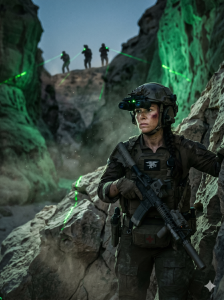
They were here. On foot now. Hunters.
I rolled onto my stomach and brought up my Sig Sauer. No rifle. No support. Just a sidearm and a bow. Outgunned. Outnumbered. Damaged.
But in my element.
In the Teams, they say: you sweat in peace so you don’t bleed in war. There’s another truth: when you have nothing left, you become the monster.
I became the monster.
Night vision came on. The world turned green. Three heat signatures moved along the opposite ridge in disciplined formation—Bounding Overwatch. Professional. Controlled.
I pulled a small C4 charge from my pack, along with magnesium shavings and a flare.
I didn’t need them all dead. I needed distraction.
I rigged a dead-man tripwire across the narrowest path, then vanished into shadow.
Five minutes passed. Then ten.
The first hunter appeared—high-end gear, GPNVG setup, suppressed rifle. He moved like water.
He stepped over the line without seeing it.
Click.
The blast was small, but the magnesium ignited instantly. A white flash swallowed the canyon. His NVGs were instantly useless. He screamed, blinded.
I didn’t hesitate.
I loosed an arrow. Thrum. It punched through the gap between helmet and vest. He collapsed.
The second opened fire, suppressed rounds snapping off rock. I dove behind cover as stone exploded around me.
“She’s at the ridge! Focus fire!” he shouted.
I didn’t respond. I shifted left, staying low, disappearing into terrain.
The third moved to flank. Fast. Boots scraping shale.
I dropped the bow and drew my Winkler knife.
He rounded the rock, rifle up.
I was inside his guard before he could fire. The blade drove upward beneath his ribcage, aiming for the heart.
He gasped, stunned. For a moment, I saw him clearly—young, human, someone’s brother.
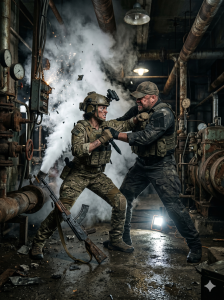
For illustrative purposes only
I held him as he fell, lowering him quietly to the ground.
One remained. The leader.
I could hear his breathing. He had stopped firing. Waiting. Listening. He had been the designator.
“Nora!” he called.
Familiar.
I froze. That voice didn’t belong here.
“Show yourself, Miller,” I said coldly.
A figure stepped out from behind rock. Helmet off.
Commander Sarah Miller. My former instructor. The woman who gave me my Trident.
“You were always the best, Nora,” Miller said, rifle low. “I told them you’d make it. I told them you wouldn’t break.”
“You?” I whispered. The betrayal hit deeper than pain. “You’re working for the people who left those Marines to die?”
Miller exhaled heavily. “It’s not that simple. The world has changed. We’re not soldiers of nations anymore. We’re stabilizers of systems. That Black Ledger… it doesn’t just name criminals. It names senators, generals. If it goes public, it won’t bring justice. It will bring collapse.”
“Then let it burn,” I said. “If it’s built on kids like Derek, it deserves to fall.”
Miller shook her head. “I can’t let that happen. Give me the drive, Nora. Walk away. I’ll say you died in the blast. You can disappear. Go back to Detroit. Be a ghost.”
“I already am a ghost,” I said, stepping into starlight. “I died with Derek. This is just finishing it.”
Miller raised her rifle. “I’m sorry.”
“Me too.”
I didn’t reach for my weapon. I reached for the detonator in my left hand.
“What—?” she began.
I had rigged more than the trail. The listening post behind us sat on unstable limestone.
I pressed the button.
The ridge groaned.
A massive section collapsed into darkness. Miller tried to leap, but the ground disappeared. Her scream vanished into falling rock.
I lunged for a ledge, fingers catching dirt. I hung there as dust rolled through the canyon.
Then silence.
Three days later. San Diego.
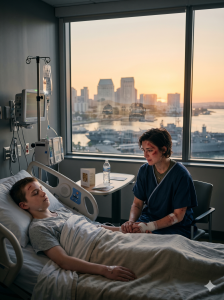
The hospital corridor was quiet at 3:00 AM. Only vending machine hum and soft footsteps broke the stillness.
I walked in with a sling on my arm, bruises across my face. No gear. No weapon. Just exhaustion in a hoodie.
Room 402.
Derek was awake, staring at the city lights.
He turned as I entered. Took in my injuries. Didn’t ask questions.
“You look like hell, Nora,” he whispered, smiling faintly.
I sat beside him and took his hand. Warm. Alive.
“I found them, Derek,” I said. “All of them.”
He studied me. “Is it over?”
I thought of the drive. Already sent to a journalist who couldn’t be bought. By morning, the names would spread worldwide. The system would crack.
I thought of Harris. Miller. The desert.
“Yeah,” I said. “It’s over.”
I leaned against him. For the first time in six months, the desert was gone.
“I was home.”
Morning light rose over the Pacific, filling the room in gold.
I closed my eyes.
And I slept.
