

Chapter 1: The Invisible Man
The city’s morning air always carried a blend of roasted coffee and exhaust fumes, a scent I had grown used to over forty years of public service. I sat on my porch, the wooden boards creaking beneath my weight, holding a letter that had arrived the previous day. It was from Maya, my granddaughter. She had been accepted into the nursing program at State, but the financial aid office was delaying her paperwork.

“Don’t worry, honey,” I’d told her over the phone. “I’ll handle the tuition. Just focus on your anatomy finals.”
I was never a man of show or attention. I wore the same waxed canvas jacket I had bought in the nineties and a pair of jeans that had clearly seen better days. To everyone else, I looked like just another retiree slowly drifting toward the end of the line—a man whose relevance had faded along with his hairline. But as I placed the tuition bill into my breast pocket, I felt the familiar weight of something else already there. A leather case. A fragment of history. A burden of responsibility most people in this city didn’t even know existed.
The drive to First National Bank was quiet. I watched the city through the windshield of my ten-year-old Ford, noticing what others ignored. Patrol cars lingered on the corners of lower-income districts. Subtle tension showed in pedestrians’ shoulders. I knew exactly why that tension existed. I was the one who had spent the last eighteen months reviewing “Use of Force” reports no one else was allowed to see.
When I entered the bank, the air-conditioning struck me like a solid wall. It was a cathedral of glass and marble, designed to make anyone without enough digits in their account feel insignificant. I took my place in line behind a young man in a sharp navy suit who was loudly discussing his investments over a Bluetooth headset.
I waited my turn. Waiting didn’t bother me. Patience is something you learn when you spend half your life on a federal bench.
“Next,” a voice called out.
I stepped forward. The teller was a young woman, maybe twenty-four, with perfectly manicured nails and an expression that made my presence feel like an inconvenience. Her name tag read Tiffany. She didn’t look up for the first ten seconds.
“How can I help you?” she asked, her tone flat and rehearsed.
“I’d like to make a wire transfer for a tuition payment,” I said, sliding the paperwork and my ID across the counter.
She picked up my driver’s license with two fingers, as though it were contaminated. She studied the photo—taken eight years ago, when my beard carried more color—then looked at me. Her gaze moved over my worn jacket and calloused hands.
A small crease formed between her eyebrows. “This ID… the photo doesn’t look much like you, Mr. Cole.”
“Time has a way of doing that,” I said with a faint, tired smile. “But the signature matches, and the account has been active since before you were born.”
She didn’t return the smile. Instead, she leaned closer to her screen, typing rapidly. The silence between us stretched—not from delay, but from suspicion forming. I felt that familiar prickle at the back of my neck—the sense that something was about to turn.
“Is there a problem, Tiffany?” I asked softly.
“I need to verify the authenticity of these documents,” she said, raising her voice just enough for the man in the navy suit to glance back. “And this account… it has a high-security flag. I’ve never seen a flag like this for an individual account.”
“That’s because it’s a protected account,” I replied calmly. “If you call your branch manager, Mr. Henderson, he can clear this in ten seconds. We’ve known each other for years.”
“Mr. Henderson is in a meeting,” she snapped. She didn’t call him. Instead, she reached beneath the counter.
A faint click followed.
I exhaled. I knew that sound. It wasn’t a manager request. It was a silent alarm for suspicious activity.
“You really don’t want to do this, Tiffany,” I said—not as a threat, but as a warning.
“Stay right there, sir,” she said, her voice now trembling slightly, driven by a misplaced sense of urgency. “Don’t move your hands.”
I stayed still. I watched the entrance. I knew the response time for this precinct. Three minutes. The lobby’s tension thickened. Conversations stopped. The security guard shifted near the door.
Something was wrong—not just an ID issue, but the way she looked at me. There was a strange eagerness. She wanted me to be guilty. She wanted the moment.
The sirens arrived fast, stopping abruptly outside. Two cruisers blocked the ramps.
“Here we go,” I whispered.
The doors flew open. Two officers entered—Officer Miller and Officer Vance. I recognized them instantly from the files I had reviewed at home. Miller was younger, aggressive, with complaints on record. Vance was older, long past concern for procedure.
They didn’t walk in. They marched. They didn’t ask questions. They assumed.
“That’s him!” Tiffany shouted, pointing through the glass. “He’s trying to move a massive amount of money with a fake ID and a flagged account!”
Miller reached me first. No questions. He grabbed my shoulder and slammed me into the marble counter.
“Hands behind your back, Pop! Now!” Miller barked.
“Officer, if you’ll just look at the paperwork—”
“Shut your mouth!” Vance snapped, stepping in close. “We don’t need a lecture from a grifter. You think you can walk into a bank and rob it with a smile and a dusty coat?”
The lobby went silent. Everyone watched the old man being restrained. Cold steel pressed against my wrists. I saw Tiffany’s satisfaction.
But they didn’t know.
They didn’t know the “flag” on my account connected directly to the Department of Justice. They didn’t know I had spent six months documenting Miller and Vance’s excessive force.
And they didn’t know everything was about to change in less than a minute.
“I’m going to ask you one more time,” I said quietly, my voice shifting into something that had once silenced entire courtrooms. “Call your supervisor. Tell him Jasper Cole is here.”
Miller laughed harshly. “The only person I’m calling is the processing sergeant at the county jail. Move!”
As they dragged me toward the exit, I realized this wasn’t a mistake. It was exactly why I had been sent here. The corruption ran deeper than I expected.
“Wait,” I said, planting my heels.
“What now?” Vance growled.
“I have something in my pocket you need to see. And if you don’t look at it right now, you won’t have a job by sundown.”
They exchanged amused looks. They thought I was bluffing. Just another old man talking.
They were wrong.
Chapter 2: The Table Turns
The pressure of Miller’s hand on my shoulder felt heavy, like the weight of a system that had forgotten its purpose. Dust motes drifted through the sunlight pouring in from the tall bank windows, a quiet contrast to the chaos unfolding on the marble floor.
“I said, don’t move,” Vance hissed, tightening his grip. “You’ve got a lot of nerve making threats while you’re in cuffs, old man.”
“It’s not a threat, Officer Vance,” I said calmly. “It’s a courtesy. I’m giving you a chance to save what’s left of your pension. Now let go of my arm and let me reach my interior pocket. Slowly.”
Miller laughed briefly and looked toward Tiffany, who watched with wide, expectant eyes. She clearly thought she was about to see a weapon—something to confirm her suspicions.
“Let him,” Vance said after a pause. His eyes were sharper than Miller’s. He saw something the younger officer missed: I wasn’t afraid. “But you move wrong, Pop, and you’re going down hard.”
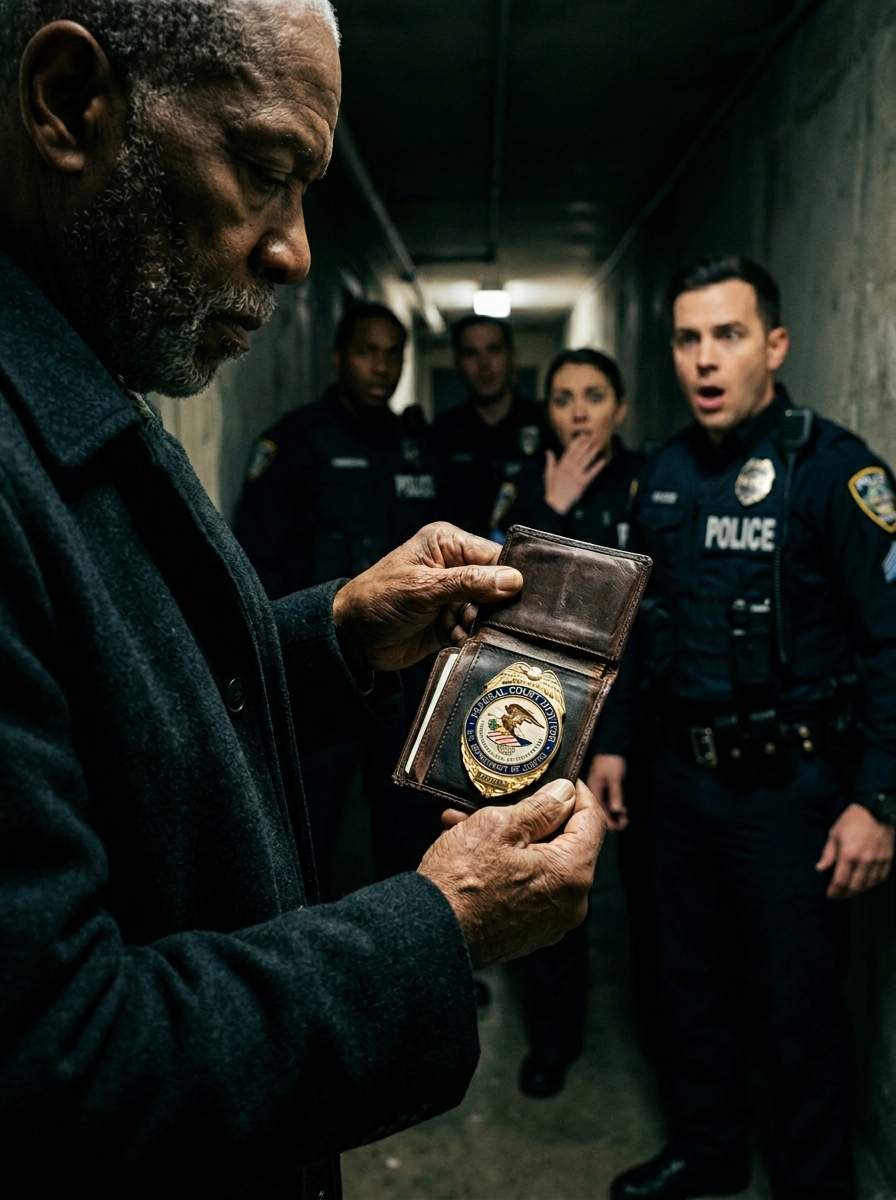
I moved deliberately, slowly, reaching past the tuition papers, past my old checkbook, into the interior pocket of my jacket. I pulled out a small mahogany leather wallet and held it flat on my palm.
With my thumb, I opened it.
The silver badge didn’t just reflect light—it seemed to command it. It wasn’t a standard shield. It was a heavy federal emblem, topped with an eagle, and beneath it sat a gold-embossed card reading: OFFICE OF THE FEDERAL COURT MONITOR – U.S. DISTRICT COURT.
The silence that followed was complete.
Miller’s grip vanished instantly. He stepped back as if burned. Vance froze, eyes locked on the badge, then on my face, then back again.
“Federal… Court Monitor?” Vance whispered.
They knew what it meant. In this city, it was a warning sign. A federal oversight decree had placed the department under review. And I was the man assigned to monitor everything—force reports, disciplinary records, budgets. The man who could recommend dismantling the entire system.
I stood taller. The “invisible man” persona disappeared. I didn’t raise my voice. I didn’t need to.
“Officer Miller. Officer Vance,” I said evenly. “You are in violation of multiple protocols regarding unlawful detention and failure to establish probable cause. You also escalated to physical restraint without proper identification or questioning.”
“Sir… Judge Cole… we didn’t… the teller said…” Miller stammered.
I ignored him and turned to Tiffany. Her confidence had vanished. She looked pale, frozen.
“Tiffany, correct?” I asked.
She couldn’t respond.
“I asked you to call Mr. Henderson,” I continued. “Since you failed to do so, I will handle it.”
I picked up the phone and dialed the manager’s line.
“Arthur? It’s Jasper Cole,” I said. “I’m in your lobby. I’ve been detained by your staff and two officers over a false assumption. I need you here immediately. And bring the keys to the front door.”
I hung up.
The lobby froze. The navy-suited man had stopped breathing into his headset. The security guard stared at the ceiling.
Then the doors burst open. Arthur Henderson rushed out.
“Jasper! Good heavens—what is happening?” he exclaimed.
“Your staff called the police on me for a tuition transfer,” I said calmly. “And your officers decided suspicion was enough to override rights.”
“Release him immediately!” Henderson ordered.
The officers stepped back.
“Tiffany, my office. Now,” Henderson snapped.
She ran off in tears.
“Lock the doors,” I said.
Henderson hesitated.
“Now,” I repeated.
The locks clicked.
I turned to Miller and Vance. “Sit down. Write everything that happened. Chronologically. You will be reviewed against the footage.”
Miller swallowed hard. “We can do that at the precinct—”
“You’ll do it here,” I said.
I sat down, calm and steady. I still had tuition to take care of. But first, I was going to make sure they understood exactly where they had gone wrong.
The authority in the room had completely inverted. The hunters had become the hunted, and they understood it. They sat at the small round table with their heads lowered, pens moving in frantic strokes across paper. Every so often, Miller glanced up at me, his eyes widened by the realization that he had chosen the wrong target on the wrong day.
Yet as I observed them, a different feeling began to settle in my chest. It wasn’t satisfaction. It was something heavier, more unsettling. I noticed Vance leaning in to whisper to Miller, both of them repeatedly checking the front door.
Their fear wasn’t limited to their careers. It was directed at something else entirely. Something they hoped I wouldn’t uncover in that security footage.
It became clear to me then that this wasn’t simply a misunderstanding over identification. I had walked into something far darker, and the earlier sense that something was off had only been the beginning.
“The doors are locked, Jasper,” Henderson said as he returned, his hand visibly unsteady.
“Good,” I replied, leaning back slightly. “Now the real work begins.”
I studied the officers. They were no longer writing. Instead, they stared at each other with raw, uncontrolled panic.
“Officer Vance,” I called out. “Why did you truly come here today? I checked the dispatch logs on my way in. There was no ‘suspicious person’ call sent to your unit.”
Vance’s pen snapped in his grip. The silence returned, even heavier than before.
Something was deeply, unmistakably wrong.
Chapter 3: The Ghost in the Machine
The air inside the bank’s executive office was stale, carrying the scent of old carpet and electronics. I sat in Arthur Henderson’s oversized leather chair, watching the security monitors. On the screen, the lobby looked like a contained aquarium. Miller and Vance remained at the round table, two blue figures against white marble. From here, they looked reduced. Diminished.
“Jasper, I’ve got the footage up,” Arthur said, his voice tense. He leaned over the keyboard, his luxury watch tapping faintly against the desk. “Where should I begin?”
“Ten minutes before I entered the building,” I said. “And Arthur, pull the exterior cameras. The parking lot. Focus on the northwest corner near the service entrance.”
Arthur frowned. “The service entrance? The alert came from the main desk.”
“I know where it came from, Arthur. Show me the lot.”
The display shifted, revealing a wider, grainier view of the rear parking area. The sky was gray and heavy, draining color from everything. I studied the timestamp: 10:14 AM.
At 10:16 AM, a black SUV with tinted windows entered and parked far from the entrance. Two men stepped out. Not uniformed, but unmistakably law enforcement in posture alone—alert, scanning, controlled.
Two minutes later, Miller and Vance’s cruiser arrived. It did not park at the front. It pulled directly beside the SUV.
“Wait,” Arthur whispered. “That’s not standard procedure.”
On the screen, Vance exited the cruiser and exchanged a thick envelope with one of the men from the SUV. The exchange was quick, practiced. Then Vance checked his phone, signaled to Miller, and drove the cruiser toward the front entrance.
“They weren’t dispatched,” I said quietly, the realization landing with force. “They were already here. That was a handoff in your parking lot. When Tiffany triggered the silent alarm, it didn’t summon them. It gave them cover already in motion.”
“A handoff? For what?”
“That’s what I intend to find out.”
I rose from the chair, joints protesting. I felt every one of my seventy years in that moment. I wasn’t merely observing anymore. I was inside an active violation. My footsteps echoed sharply as I returned to the lobby.
Miller and Vance looked up as I approached. Their reports were finished. Miller looked exhausted, drenched in stress. Vance carried a colder, more contained tension.
“Reports on the table,” I said firmly. “Phones. Face down.”
“Now hold on, Judge,” Vance said, standing. “We’ve cooperated. But you’re not law enforcement. You don’t have authority to seize property without a warrant.”
“You’re correct,” I replied, stepping closer. “I don’t have that authority for routine matters. But as Court Monitor under a federal Consent Decree, I can secure any equipment used during potential violations of civil rights protocols. And you unlawfully detained a federal official without probable cause. That puts us well beyond routine.”
I leaned closer, lowering my voice so only he could hear. “I saw the SUV, Vance. I saw the envelope.”
Color drained from his face. His hand twitched instinctively toward his belt.
“Don’t,” I said calmly. “Cameras are active. Arthur is already speaking with the FBI field office. If you touch that weapon, it won’t be obstruction charges. It’ll be attempted murder of a federal officer.”
His hand froze. He looked at Miller, who appeared close to breaking entirely. Slowly, both men placed their encrypted phones on the table.
“Sit,” I said.
I picked up Vance’s phone. Locked, as expected. But that wasn’t what mattered yet. A small sticker marked the back: a blue thin-line flag with the number 744 written in marker.
My expression tightened.
744 wasn’t an identifier. It was a file reference from my own office. A case tied to three hundred thousand dollars missing from a drug operation three months earlier—dismissed after “lost” body camera footage.
I looked at the men across from me. Officers entrusted with protecting this city. And I felt something sharp and unforgiving settle in my chest.
“Arthur!” I called.
Henderson leaned out. “Yes?”
“Call the County Sheriff. Not city police. Tell them I have two officers detained for felony obstruction and suspected racketeering. And send a transport unit.”
“You can’t do this!” Miller snapped. “You’re just a lawyer with a title!”
“I’m not arresting you,” I said evenly, returning to my seat and opening my badge case again. “I’m holding you for the people who will.”
I glanced at Tiffany, still trembling in the corner.
“Tiffany.”
“Y-yes, sir?”
“Coffee. Black. No sugar.”
She hurried away without hesitation.
Outside, a crowd had gathered, pressing against the glass, recording everything. Two officers sat broken in plain view while a single man controlled the room.
Then I noticed him.
A man in a dark suit, standing near a lamppost. Not filming. Not reacting. Just watching.
The same man from the SUV.
The unease returned—sharper, colder. Miller and Vance were not the source of this. They were simply the surface.
I looked down at the phone.
It vibrated.
A message appeared:
“Is the old man dead yet?”
Ice spread through my chest.
This was not a misunderstanding. It was planned. The “arrest” had been staged as cover—an execution disguised as escalation.
The only reason I was still breathing was because I had revealed my identity before the trigger point was reached.
I looked at Vance. He wasn’t watching me anymore. He was staring at the doors, face drained of color, hands trembling.
“They’re not coming for backup, are they?” I asked quietly.
He didn’t respond.
“Arthur!” I shouted. “Away from the windows! Everyone move to the vault—now!”
A second later, the front glass exploded inward.
Chapter 4: The Price of Justice
The first shot hit like a cracking whip, followed instantly by the collapse of the entire front window wall. Glass exploded inward in a violent cascade, scattering across the marble floor like shattered ice.
“Down! Get away from the windows!” I roared, my voice returning with the force it once carried in courtrooms.
I didn’t wait for compliance. I seized Arthur Henderson by the collar and dragged him behind the thick wood of the teller counter. Tiffany was already there, curled tightly on the floor, hands clamped over her ears.
Miller and Vance had gone completely still. It’s a strange sight—men who wear badges and carry firearms frozen by the same violence they usually project outward. Vance was staring at the jagged opening in the glass where, only seconds earlier, a man had been standing. He understood that bullet had been meant for the back of my head—but also as a warning aimed at him.
“Vance! Miller!” I shouted, crawling through the scattered debris. “They aren’t here to rescue you! You’re loose ends! If I die, you die right beside me so they can spin it as a ‘tragic shootout’ where everyone was killed. Do you understand me?”
Vance looked at me, his eyes wide and unfocused with fear. “They… they said they just wanted the phone back. They said they’d handle you.”
“They’re handling it, alright,” I snapped. I reached out and ripped Miller’s service weapon from his shaking grip. He didn’t resist. I checked the chamber—one round loaded. I hadn’t fired a weapon since my JAG days, but that kind of instinct never disappears. “Now move to the vault. Arthur, does the vault have an internal secondary lock?”
“Yes,” Arthur gasped, face drained of color. “The emergency lockdown. But we still need to get through the gate.”
Another shot cracked through the air, striking a marble column and exploding it into dust. Through the broken entrance, I saw the man in the suit—the same one from the SUV. He wasn’t rushing. He was walking calmly, methodically, like this was routine. A suppressed submachine gun rested beneath his light raincoat.
“Move! Now!”
We ran. I shoved Tiffany and Arthur toward the heavy steel gate protecting the vault. Miller crawled after us, panicked and sobbing. Vance, however, suddenly steadied himself. He raised his weapon, hands shaking but controlled.
“I’ll cover the rear,” Vance whispered, voice breaking. “Judge… I didn’t know it would be this. I swear, I didn’t know.”
“Stay alive and tell it to the grand jury, Vance,” I said.
We slipped behind the gate just as the attacker stepped through the shattered entrance. The alarm had fully activated now, screaming through the bank in sharp, relentless waves. The gunman ignored the cameras, ignored the terrified civilians hiding under desks—his focus was locked on the vault.
He raised his weapon.
“Arthur, the code! Close it!”
Arthur’s hands were shaking too badly to type. I pushed him aside and entered the keypad myself. Standard electronic lock system.
“Code, Arthur. Now.”
“4-9-2-2,” he choked.
I keyed it in. The vault mechanism began to grind, slow and heavy, like a giant waking up. Six inches of steel started inching shut.
The gunman opened fire. Bullets hammered the outer gate. Vance returned fire—three shots, rushed and inaccurate. Enough to force the shooter briefly behind cover.
“The door is too slow!” Vance shouted.
He was right. The gunman realized it too. He stood again, aiming directly at the narrowing gap.
I turned toward the teller station. Beside the terminal was the emergency CO2 suppression trigger for the server room behind the vault.
“Close your eyes!” I shouted.
I leaned out and fired once. The shot shattered the red glass canister.
It detonated in a violent burst of freezing white gas, swallowing the lobby in seconds. Visibility vanished. The gunman fired blindly into the cloud, rounds slamming into the back wall.
I pulled Vance inside just as the vault sealed shut with a heavy metallic click.
Silence followed.
Only the muffled alarm remained, distant and hollow. Five of us stood inside a sealed steel room filled with safe deposit boxes and shaking breath.
Arthur collapsed against the wall. Miller curled into himself on the floor. Tiffany stared at me without blinking.
The weapon was still in my hand. I looked at Vance. He sat heavily, head lowered.
“The phone,” I said quietly. “What’s on it that’s worth killing a federal monitor for?”
Vance looked up slowly. The tough exterior was gone entirely. “It’s not just money. It’s names. Half the city council… the District Attorney… they’re all tied in. The SUV guy? He’s not just muscle. He’s ex-State Trooper. He cleans things up.”
I felt the phone in my pocket vibrate again.
“They won’t stop,” Miller whispered. “They’ll wait us out. Or find a way in.”
“No,” I said. I turned to Arthur. “This vault has a federal audit line, correct?”
Arthur nodded weakly and pointed to a desk phone.
I picked it up and dialed a number I had not used in years—the direct line to the U.S. Attorney General’s office.
“This is Judge Jasper Cole,” I said when it connected. “Authentication code: Whiskey-Six-Niner-Bravo. I’m under attack at First National Bank. I have evidence of a coordinated racketeering conspiracy and an active assassination attempt. I need a Tier 1 response. And send a transport for detainees.”
The next two hours blurred into chaos. Distant blasts echoed through the building. The helicopter thump of a Blackhawk vibrated through the ceiling.
When the vault finally reopened, it wasn’t the attacker outside.
It was FBI tactical agents.
“Judge Cole? Sir, are you injured?”
I stood, adjusting my worn jacket. Exhausted, but steady.
“I’m fine. Take these two into federal custody. No local units.”
As they led Miller and Vance away in cuffs, Vance paused briefly in front of me. He said nothing—just a small, resigned nod.
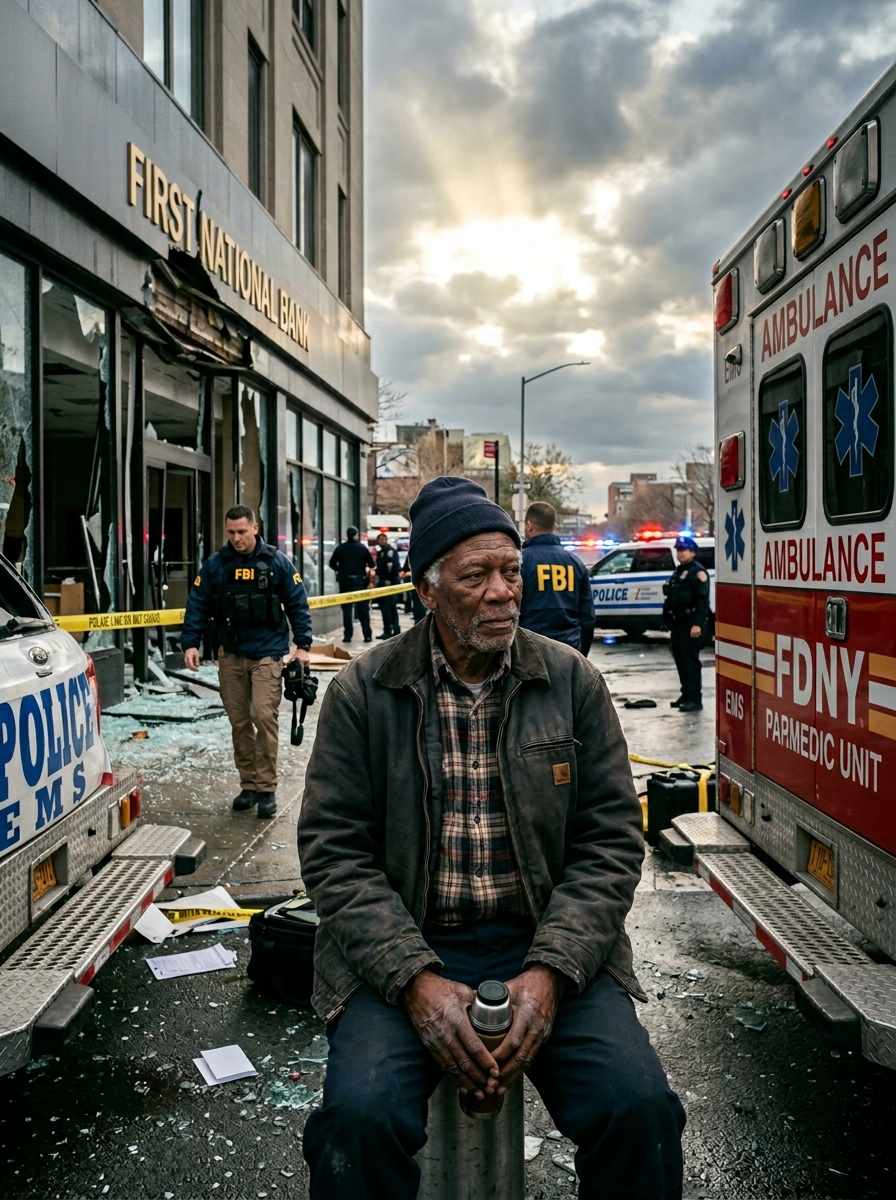
The lobby was destroyed. Glass everywhere. The SUV was gone. The evidence on the phone would be enough to burn the entire network down.
I walked to the teller counter. Tiffany looked up at me, trembling.
“Mr. Cole… I’m sorry,” she whispered. “I just thought—”
“You thought I didn’t matter,” I said softly. “People make that mistake all the time. Just remember: the man in the old coat usually has the longest story.”
I turned to Arthur, who was sitting with a medic.
“The tuition transfer,” I said. “Is it done?”
He blinked in disbelief. “After all this… you still want that sent?”
“My granddaughter has an anatomy final,” I said, holding out the crumpled bill. “Justice can wait. Her education can’t.”
Arthur took it carefully. “I’ll handle it personally. No fees.”
“I’d expect nothing less,” I said.
I stepped outside. The sun was breaking through the clouds. Sirens still echoed through the streets, but the city was already shifting toward something larger.
I sat on the bumper of an ambulance and called Maya.
“Hey, Grandpa!” she said brightly. “Did everything go okay at the bank?”
I looked at the broken glass, the agents moving through the scene, the badge resting in my hand.
“Yeah,” I said quietly. “It took a while, but it’s handled. Just focus on your studies. I’ll be there for graduation.”
I ended the call and watched the black SUV being hauled away.
An old man in a faded jacket sat on the curb of a city that had tried to bury him—and failed.
And as I felt the weight of the badge in my pocket, I understood something simple.
Justice isn’t always quiet. Sometimes it waits in silence, then refuses to move.
I closed my eyes and breathed in the cold air.
Justice had been done.
And the tuition was paid.
THE END
